Posted: July 4th, 2013 | Author: Nicholas Minns | Filed under: Performance | Tags: Arietta, Aurélie Cayla, Beethoven, David Morrow, Dirk Haubrich, Jiří Kylián, Katrin Brännström, Kees Tjebbes, Lukas Timulak, Massimo Murru, Mats Ek, Rachel Shipp, Sadler's Wells, Sylvie Guillem, William Forsythe | Comments Off on Sylvie Guillem: 6,000 Miles Away at Sadler’s Wells
Sylvie Guillem: 6000 Miles Away at Sadler’s Wells, May 21

Sylvie Guillem in Mats Ek’s Bye (photo: Lesley Leslie-Spinks)
The evening of dance Sylvie Guillem was putting together in March 2011 might have been called simply ‘Sylvie Guillem and Friends’ if her rehearsals with William Forsythe in London had not coincided with the devastating tsunami that hit Japan. Calling the new program 6000 Miles Away was Guillem’s way of keeping in mind those who were suffering the effects of that environmental disaster (she raised £80,000 for the Red Cross Tsunami appeal at the original 2011 performances at Sadler’s Wells), but the title also neatly ties in with a charity Guillem supports, Sea Shepherd, among whose projects is the protection of whale habitats from the illegal practices of the Japanese whaling fleet. This in turn seems at least 6,000 miles from the playful, ecstatic image of Guillem on the publicity material under the names of three iconic choreographers, Jiří Kylián, William Forsythe and Mats Ek. Welcome to the world of Sylvie Guillem. She serves on the Media and Arts Advisory Board of Sea Shepherd and Sadler’s Wells this time round devoted an evening to fundraise for the charity, presenting a short filmed message from founding skipper Paul Watson, who could have been, yes, 6,000 miles away.
The attraction of the evening is indisputably Guillem herself, but she does not dance in all three works. It seems she commissioned Forsythe and Ek to make works for this program but the duet from Kylián’s 27’52” — in which Guillem does not dance — dates from 2002 and has no direct relation to her. Alistair Spalding’s welcome note in the program simply links the three works by stating that they showcase the work of ‘three creators who have held a special place in Sylvie’s career’ but Sarah Crompton in her article on the making of 6000 Miles Away makes no mention of Kylián at all. This suggests either that plans to commission Kylián to create a work for Guillem came to nothing, or that the duet from 27’52” — danced here by Aurélie Cayla and Lukas Timulak — was an afterthought.
As the curtain rises, Cayla and Timulak are on stage, she in a red top (later removed) and black pants standing in a spotlight and he lying in black pants and stripped to the waist at the edge of the floor. Lit beautifully by Kees Tjebbes, the stage is a clean canvas on which Kylián highlights with quiet precision the beauty of the articulated, semi-naked bodies in movement, something we can expect from him even when he is not at his most inspired. The problem is not with the choreography, nor with the dancing, nor with the score by Dirk Haubrich: the duet just doesn’t fit on the program; without Guillem’s creative involvement, it has an energy and identity at odds with the other two works, and deprives the evening of any unity.
Rearray is a duet of minimal form danced in and out of intermittent lighting conditions (Forsythe’s concept, Rachel Shipp’s realisation) that have an overly dominant role. There are so many blackouts, exits and entrances that the only way we recognize the end is when the dancers don’t come on again. When the lighting gets overly complex, one senses Rearray is a work that uses Guillem to show off Forsythe, but there are other luminous passages when Forsythe is clearly showing off Guillem. Dressed in t-shirt and jeans she performs what appears to be a series of relaxed, impromptu dances but has the ability to create starkly precise and beautiful shapes that seem to imprint themselves in the air. Her partner on this occasion, Massimo Murru, doesn’t have quite the same alchemy, which in a piece where partnering in the old sense is less in demand than an equality of presence keeps the equation one-sided. Forsythe gives him an arresting solo, however, in which his hands appear to be tied behind him, like a puppet unable to escape his own serfdom. David Morrow’s music is not an easy listen, but Forsythe evidently relishes its intricacy and in a lighter moment shares its humour: the fourth section begins as both dancers, facing upstage, simply bend their knees to the rhythm of Morrow’s score, creating a simple, articulated pattern that is both rich and quirky. Forsythe’s mastery of the stage remains undimmed, and it is a real joy to see Guillem responding to his direction even in a work that spends far too much time concealing her.
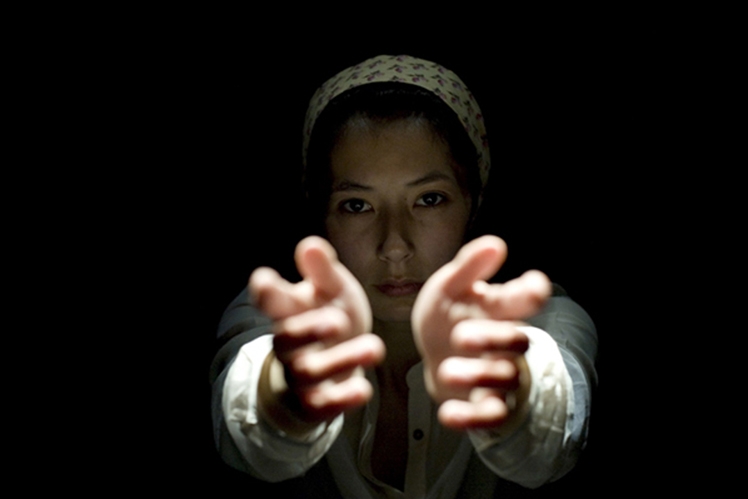
After the strong taste of Forsythe, Ek’s constant stream of ludic ideas in Bye is as refreshing as a sorbet. Ek, one feels, has put his choreography at the service of the artist, and Guillem returns his devotion in full. Katrin Brännström’s set is like a room with a small door in the back through which we see a black and white projection (thanks to Elias Benxon) of Guillem’s giant, cyclopic eye; the image of her face moves across the doorway/screen to reveal her other eye, then she walks away until she reaches stage size. Returning to peer through the glass, her real hands now appear over the doorframe as extensions of her filmed image. She is pigtailed, dressed in a yellow skirt, a green pullover and bobby socks (costumes by the ever-ingenious Brännström), a long-legged gamine playing games to her heart’s content. Erik Berglund’s lighting picks out both her line and the architectural elements beautifully, and enhances the playful colours of her costume. Ek uses the Arietta movement of Beethoven’s final piano sonata, op 111, shaping the rhythmic content and painting delightfully irreverent images that Guillem plays with her entire body as if on an instrument. Ek seems to derive his vocabulary from an array of sources including classical dance, yoga, everyday gestures and the sculptural forms of Henry Moore. As the sonata becomes more rhythmic and playful, so does Guillem, taking off her cardigan, shoes and socks, improvising as if in her own room like a clown or Raggedy Ann doll with her leg thrown nonchalantly up to her forehead. A man appears at the door looking in and glancing impatiently at his watch. How long will Guillem be? He goes away. She yawns, rolls over, and stands on her head. A virtual labrador comes to the door and sits down patiently, but eventually he, too, moves on. Guillem remains oblivious of time, bouncing to the luscious chords of the sonata with joyful abandon. Ek narrows our focus for a moment to the projected outlines of a bed on which Guillem lies. We concentrate on her hand gestures against the black and her form is like a goddess eating grapes, the pose from the poster. She stands on her head again, watched by a growing number of children at the door but finally puts on her socks and shoes. In the cadenza she dances a little madness before stepping outside and looking back wistfully at the interior world of her colourful imagination that she must regretfully leave to face the black and white reality outside.
Posted: June 27th, 2013 | Author: Nicholas Minns | Filed under: Performance | Tags: Afterlight (Part One), Daisy Phillips, Daniel Proietto, Faun, James O'Hara, Lucy Carter, Made at Sadler's Wells, Mark Wallinger, Mark-Anthony Turnage, Michael Hulls, Nitin Sawhney, Russell Maliphant, Sadler's Sampled, Sidi Larbi Cherkaoui, Thomasin Gulgeç, UNDANCE, Wayne McGregor | Comments Off on Made at Sadler’s Wells
Made at Sadler’s Wells, Sadler’s Sampled Festival, Sadler’s Wells, June 22
The Sadler’s Sampled festival is a welcome initiative by Sadler’s Wells to popularize dance that brings the concept of the BBC Proms to the theatre and adds a raft of programmed events in and around the foyer that ‘will provide a way in for audiences who many not be familiar with dance of any kind.’ There are four separate programs of dance over the two-week festival (ending July 7) beginning with Made at Sadler’s Wells that highlights three works the theatre has produced since 2005.
Russell Maliphant’s Afterlight (Part One) is all about the play between the dynamism of form in the choreography and the deconstruction of mass in the lighting and it takes a dancer who has the plasticity and precision to carve lines and shapes in space. I had the pleasure of seeing Daniel Proietto dance Afterlight (Part One) in 2010 and it was an extraordinary performance (his photograph appears in the program although Thomasin Gulgeç is on stage). For Made at Sadler’s Wells it is essentially the same work but it doesn’t quite match the unequivocal memory of something breathtakingly beautiful.
Afterlight premiered in October 2009 as part of the Spirit of Diaghilev program at Sadler’s Wells. Proietto brought to life the spirit of Nijinsky (which you can sense in the pages of Lincoln Kirstein’s superb collection of photographs, Nijinsky Dancing): introspective, sensitive, exotic. It was Maliphant’s inspired idea to marry the movement with music of similar qualities — the first four of Erik Satie’s Gnossiennes — and with Michael Hulls’ alchemy of light: choreography, music and lighting that compose a deeply satisfying unity.
Gulgeç appears with his back to us in carmine tunic and skullcap, spiraling his arms around his turning torso as if he is pressed against the glass that Hulls’ tube of light suggests. Gulgeç has the muscular ability to draw out the unctuous quality of the movement, but without quite the poetic, otherworldly element that I remember in Proietto’s performance. At the end of the second movement, he flings off his jacket in an uncharacteristically prosaic gesture and is now all in white for the third movement, which has a tone of pain or ecstasy whose ambivalence Gulgeç matches. Maliphant builds up the range of movement, exploring the air for the first time while keeping the spiraling, cutting, fluid turns that scythe through space so beautifully. The dappled lighting shrinks in the fourth movement while the dance continues to grow in elevation and expanse at the outer reaches of the solo piano, but the lighting gradually hauls Gulgeç back in to the jar until he disappears altogether.
Sidi Larbi Cherkaoui’s Faun continues in the spirit of Nijinsky, delving into and reinventing his 1912 ballet, L’après-midi d’un faune. Cherkaoui’s choreography lays aside Egyptian fresco for free form, but he keeps the lithe, muscled and animal quality that James O’Hara embodies beautifully in his opening solo. The way he first appears, tightly rolled up under Adam Carré’s lighting, gives the impression he is still coiled around another’s body. To Debussy’s evocative score he unfurls, as if waking up on a lazy morning, shaking out the orgy of the previous night and imagining the next. Nittin Sawhney seamlessly interweaves his own score into that of Debussy to introduce the new object of the faun’s desire, Daisy Phillips. Where O’Hara is sinuous, Phillips is so flexible that her articulation verges on contortion; her facility undermines the feral sense of muscle and tendons and has the odd effect of leaving the partnership emotionless: muscular articulation, it would appear, is part of the language of dance and conveys emotional sense. However, the sheer invention of the interlocking choreography is not lost, nor is the sense of mysticism overlaid with the erotic in both choreography and music. Sometimes it is difficult to tell whose leg is whose in the intricate embraces and there are animal images of a mother cradling her young and a playfulness between the couple that is a pleasure to watch. At the end, Carré focuses a very bright spot on O’Hara as he reaches down to pick up Phillips from their feral sporting, but she recedes between his legs while he remains standing, suddenly imbued with moral sense, unsure what they had just experienced.
The link to Nijinsky in the first two works abruptly disappears in the third. Wayne McGregor’s UNDANCE, as its capital letters shrilly proclaim, is an elaborate conceit: some Muybridge-inspired exercises performed between Mark Wallinger’s two side boards with large painted letters ‘UN’ equals UNDANCE. Ha. Despite the conceit (though I did at first wonder what the political overtones could be), the opening is visually promising — a feature of McGregor’s collaborative works and of Lucy Carter’s lighting — but the promise fails to deliver and the end deceives: the restlessness of the audience as the performance progresses is palpable. Wallinger’s set design, including the UN boards, consists of a screen at the back of the stage on which the dancers are projected deliberately out of synch with the choreography on stage, either a step or two ahead or a step or two behind. As a statement in itself it is visually arresting, but in the context of UNDANCE, it simply multiplies what is essentially uninteresting. I don’t think Mark Anthony Turnage’s music helps the attention span, either. We are told that his score was inspired by a text written by Wallinger, which was in turn inspired by American sculptor Richard Serra’s Compilation of Verbs and the work of photographer Eadweard J. Muybridge. McGregor picked up on the Muybridge but his choreography is inconsequential in the company of his two mutually inspired artistic collaborators who appear to be doing their own thing in their own time.
Posted: June 18th, 2013 | Author: Nicholas Minns | Filed under: Performance | Tags: Dan Canham, Ian Morgan, Laura Dannequin, Malcolm Rippeth, Neil Paris, Ours Was The Fen Country, Spring Loaded, Still House, The Place, Tilly Webber | Comments Off on Still House / Dan Canham: Ours Was The Fen Country
Still House / Dan Canham: Ours Was the Fen Country, The Place, June 7

Ours Was The Fen Country. Photo © Still House
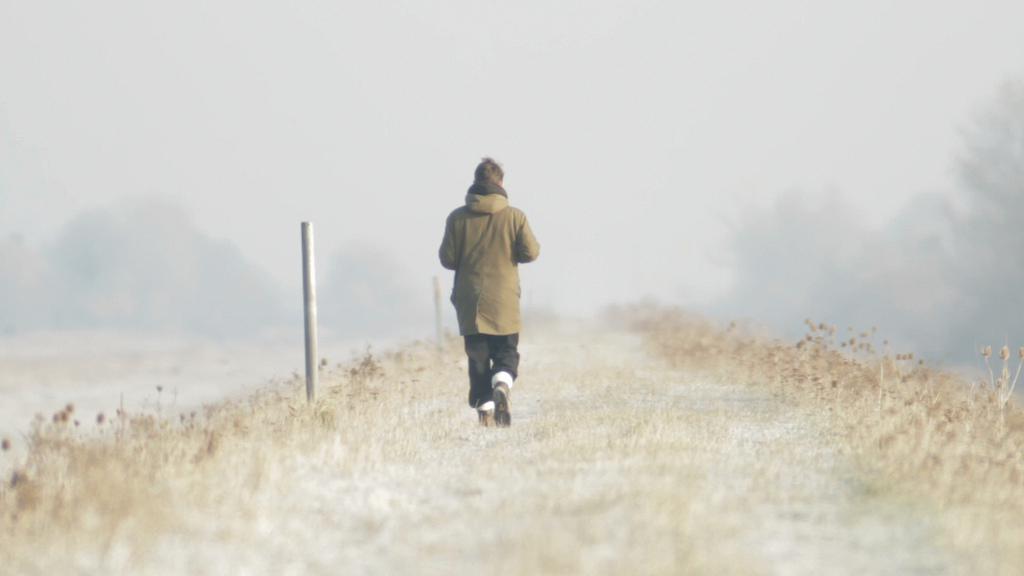
‘The relationship between human beings and the earth is very complex, but it is not something remote from our daily lives. Rather, the people/earth relationship is involved in everything we do, and it affects every aspect of our experience….’ So wrote Tsunesaburo Makiguchi in his 1903 treatise A Geography of Human Life, and Dan Canham would agree. He takes the relationship between the flat land of the Fens and the people who have lived there for generations, farming, fishing, trapping and surviving the windswept, desolate, sinking countryside as the starting point for his choreographic exploration, Ours Was The Fen Country. The Fens are where Canham grew up, so the piece is both a revisiting of familiar geography and an autobiographical ode to the landscape and culture that formed him, distilling the people and places into an essence with which we can feel an emotional connection with an indelible sense of respect and humility.
Canham has already explored the notion of place as common denominator between dance and geography in his idiosyncratic history of a derelict theatre in Limerick, 30 Cecil Street, in which a building is a proxy for the town; in Ours Was The Fen Country, it is the Holme Fen Post that is a proxy for the entire countryside. The original cast-iron column, represented on stage by a wooden post, was sunk into the fen in 1852 till its top was flush with the peat surface. It now rises some four metres above ground level, a metaphor for a disappearing way of life.
Canham shares this project with three other performers, all attuned to its physical and spiritual nature: Neil Paris, Tilly Webber and Ian Morgan. Canham and assistant director, Laura Dannequin, conducted the interviews that form the raw material of the work over a period of two years, cycling or taking trains to seek out the colourful characters who people Ours Was The Fen Country and who reveal as much about themselves as the land on which they live: an indication of the trust they invested in their two interviewers, a trust that will be returned later this month when Canham and company perform Ours Was The Fen Country in some of the communities where these people live (see www.stillhouse.co.uk for dates). There’s the man who makes and lays willow traps for eels, the cattle farmer concerned about the viability of his farm, the stress counselor who gives her son the heebie-jeebies, the stableman who has shaken hands with seven members of the Royal Family, and the daughter who feels she is seeing the end of the traditional way of life. Canham holds up a mirror to their lives, like a painter who sees and develops the identifying characteristics of his subject on canvas, but he also honours them.
The recorded conversations are disembodied voices, but Canham pulls the disembodiment out of the ether and on to the stage by the way the performers inhabit the characters. We hear the words on different layers: the original interview, the same words spoken by one of the performers or lip synced; sections of conversation may alternate all three techniques, and at other times they will overlap to provide different emotional reactions. Canham, who has done the brilliant work of editing the interviews, has mined the conversations for their nuggets of wisdom and insight, and sets them in a textual framework like gemstones on a ring. At the beginning it is Webber who personifies a woman who wonders why anyone would want to learn more about the Fens, then Paris speaks about the village he lives in, Canham about Sutton Market and Morgan about the closeness of the rural communities. This is the neutral documentary style, the vanilla flavor, on top of which Canham layers additional techniques as the work progresses. There are projections of the countryside overlaid with verbal descriptions (‘flat’ is a word that comes up frequently) and a little history of the transformation of the marshland into agricultural land, and even into political land: Paris reminds us this is Cromwell country, with a portrait of the independent, cussed and awkward parliamentarian on the screen looking remarkably similar to Paris (without the warts).
Each performer is synchronized with the other three — and with the recordings — through individual iPods with earphones. For those who have seen 30 Cecil Street, the setup will be familiar, with a computer and speakers on a table at the side (updated technology from the reel-to-reel machine), timber to demarcate the performing space, chairs to sit on and some 4×4 fence posts to build a frame for the makeshift projection screen: all redolent of a summer fair on the green, a small-scale countryside laid out before us under Malcolm Rippeth’s lighting and beautifully costumed by Dannequin. But it is in the dance that I feel Canham has taken the documentary to new levels of power and poetry. There are no steps that could be characterized as ballet or modern, contemporary, hip hop or jazz; the movement finds its form from the sometimes percussive and sometimes lyrical rhythms of the recorded speech, from the hesitancies of expression as much as from the sly humour. It is dancing to the voice as an instrument, incorporating body-at-the-pub gestures and personality ticks extrapolated into rhythmic steps and forms. There is a sense that the steps emerge only when needed as an additional layer of emphasis or colour, and always echo in their groundedness the ties to the earth. When Webber’s character speaks, she looks and thinks with her, head back, arched back, tensed shoulders and turned-in feet, her stress evident before she starts to move. All the men look at her until they stand up swaying as if the world is turning too fast. Canham is aware of the fissures in this rural way of life (his title is in the past for good reason) and places himself both inside it and outside, inhabitant and commentator. The four characters look at each other, exchanging positions, keeping eye contact. Two fall to the ground then get up, before they all lurch backwards, balanced on the edge, on the brink. Canham begins a simple gesture of slowly creaking back on his chair, until all four performers seem to be riding in place. Moving off their chairs, advancing slowly, they keep the rhythm while Webber articulates her arms and head so expressively within their minimalist range. The music takes on a unifying role as its rhythms urge the characters to find new ways of moving forward together. Keeping their focus on each other, they circle the stage, their steps getting bigger, anchored in the music, now turning, now jumping in place, an optimistic, joyous expression of ‘yes’ in the obdurate shadow of the Holme Fen Post.
Posted: June 10th, 2013 | Author: Nicholas Minns | Filed under: Performance | Tags: Aaron Vickers, Amstatten, Guy Hoare, In Cycle, James Cousins, James Wilton, Lee Curran, Lisa Welham, Louise Tanoto, Robert Clark, Spring Loaded, There We Have Been | Comments Off on Spring Loaded: Triple Bill
Spring Loaded: Triple Bill, The Place, June 5
Robert Clark, Amstatten

Louise Tanoto in Amstatten. Photo: Ludovic des Cognets
The spill of light from the exit lamps dimly illumines Louise Tanoto’s preparations before the start of the performance (wouldn’t it be wonderful if a performance could start in a true blackout), which takes some of the magic away. This is a finely tuned, concentrated performance that should appear out of the dark with the immediacy and vividness of a dream. Nevertheless, Tanoto soon puts back the magic when Guy Hoare’s lighting works it’s own magic with hers. Magic is not something one associates with imprisonment, but Robert Clark has chosen to take the brutality out of the prison and replace it with heart, imagination and stoicism, suggesting that our interior state of life is enough to transform a place or situation. Even if it is clear the stage at The Place is not a prison, still the sense of poetry and freedom in Tanoto’s sensitive performance has the ability to remove any barrier that may fetter our spirit.
A chair stands in the shadows beside a cell of light in which Tanoto lies prone, toes tensed against the floor, a bag over her head. To the eerie sound of a repeated organ phrase and a ticking clock her hand scuttles out from under her, reaching away blindly to the perimeter of the rectangle. Having done the rounds she gets up and bumps into the chair on which she sinks her head in a gesture of silent prayer or exhaustion. The bag on her head looks like it has ears but she slowly removes it, crumples it absent-mindedly and takes another tour round her cell. Three steps long, one step wide, she reacts to the sense of constriction by backing out of the light as if someone is sucking her life through a hole in the back wall. A masked figure in black stands ominously in the shadows like an executioner, then disappears. A recollection, a presentiment? The foreshortening of movements, the contortions of her body to keep within the confines of her cell are powerful reminders of physical repression, contrasted with an inner life that is both comic and surreal. As she sits bent forward on her chair, two fingers poke through her long hair, two imaginary eyes peering at us. Now all her fingers comb through her hair and end in fists, becoming defensive gestures, violent gestures that with a sinuous struggle end with hands held firmly behind her back. As we contemplate her next move, she faces us, turns her hands over, wrists uppermost, brushes back her hair, looking at us dispassionately. Hoares’s lighting alternates her outer form with her inner form, making her in turn both opaque and translucent. The music now takes over – Katyna Ranieri singing Riz Ortolani’s Oh My Love — providing a sentimental short cut to memories of better times and dreams of a bright new day. As the volume of music increases, Tanoto turns like a record, or a dervish, arms extended to her side, faster and faster. She has an ecstatic smile on her face as she spins out of control and gropes for the chair. Back to the ticking clock in her solitary cell. Tears.
James Wilton, In Cycles
In Cycles is a solo James Wilton created on a female dancer. It is evidently fungible as he writhes through it effortlessly, twisting and turning his well-developed torso into dynamic shapes and lyrical forms that defy gravity with a playfulness that is breathtaking. The title of the work derives from the idea of reincarnation and while certain of Wilton’s phrases repeat like a musical refrain, there is little else in the work to suggest the cyclical nature of life. If the idea has made its mark on his sensibility, its choreographic development has been hijacked by Wilton’s particular form of movement: for such a spiritual subject, the impression is unremittingly physical. I had a similar reaction to Wilton’s earlier work, Cave, that was inspired by the philosophy of Plato and Jean-Paul Sartre, perceptions of reality and the desire to uncover the truth: more the dialectical territory of Robert Pirsig’s The Art of Motorcycle Maintenance than dance material. It is as if Wilton’s intellectual questioning wanders far beyond the capacity of his choreographic body to respond, or that his choreographic body is in a comfortable groove and he is dressing it up in different intellectual clothes. Either way, the clothes don’t fit. Perhaps I am making too much of a program note, but it is Wilton’s note, not mine and I assume his note is a way of giving himself a direction. He did seem, however, to be attracted to, and to have unconsciously given expression to his choice of music, a couple of songs by Einstürzende Neubauten that have a dark, secular fascination that roots one to the ground. Wilton’s introverted gaze and moments of existential angst seemed clearly attuned to the band’s sound while his rhythmic tapping with his foot or the heel of his hand engaged with the unctuous beat of the songs. Wilton has no lack of physical ability and his mind is evidently searching. Perhaps he simply needs to breathe in some fresh air to discover the true form of his intellectual and spiritual yearnings.
James Cousins, There We Have Been

Aaron Vickers and Lisa Welham in There We Have Been Photo: David Foulkes
Lisa Welham’s torso is illuminated (thanks to Lee Curran) high in the air but her source of elevation is for the moment invisible. She brushes her hair back as if sitting at her boudoir, bends forward, arches to the side and all the way round to the front again, then languidly reaches up with her arms for the full effect of being artificially high. She drops down through the ozone layer to a crouching position, just off the ground, in the miraculous embrace of Aaron Vickers. For the next sixteen minutes Welham never touches the ground, like a circus artist on a human trapeze, circling Vickers, climbing him, straddling him, and cantilevering her body from his iron grip. Vickers is undemonstrative, allowing Welham to do all of this without once complaining; he seems in his quiet way to revel in it. Some of the partnering is stunning, but it is not always pretty; there are some awkward angles and manoeuvres (otherwise described as ‘a daringly intimate glimpse into a secluded world of fragile dependency’), but this is inevitable given what Vickers has to do to keep Welham airborne. To suggest There We Have Been ‘takes its inspiration from the troubled relationships portrayed in Murakami’s bestselling novel, Norwegian Wood’ (this is my day for program notes) may be true but it is irrelevant: the entire focus of the piece — what Roland Barthes might call the ‘punctum’ — is that Vickers keep Welham off the ground. Any emotional involvement is swallowed up by this overriding physical objective. How do you end such an exercise? Cousins cheats. Vickers brings Welham down from the final lift in the dark, where a third person lifts her up again and Curran’s lighting picks her out as in the beginning sequence. Relieved, Vickers walks by himself into a circle of light.
Posted: June 5th, 2013 | Author: Nicholas Minns | Filed under: Performance | Tags: Anna Pearce, Chantal Guevara, Cloud Dance Sundays, John Ross, Laura Erwin, Lauren Bridle, Man Down, Pull Through Flick, Rachel Burn, Tom Jackson Greaves, Vanity Fowl | Comments Off on Cloud Dance Sundays
Cloud Dance Sundays, Lion & Unicorn, Kentish Town, May 19
Bravo to Chantal Guevara for getting Cloud Dance Sundays (www.cloud-dance-sundays.com) underway, aiming to provide ‘monthly evenings of good contemporary dance in the comfort of a cosy pub – a great way to end the week, with time for a drink or two downstairs before heading home.’ On this first outing:
Rachel Burn, Pull Through, Flick.

Anna Pearce and Lauren Bridle in Pull Through, Flick. Photo: Chantal Guevara
One can almost feel cold flagstones underfoot in the tiny Giant Olive theatre in Kentish Town’s Lion & Unicorn as a sweeping trio of pre-Raphaelite women enters with the somberness of a procession of nuns. Rachel Burn’s Pull Through, Flick builds up images of darkness, pain, and penitence as the women shed and share veils in communal bereavement. Hildegard von Bingen’s O Pastor Animarium sets the tone as the shape of Lauren Bridle, shrouded in a veil, moves in a grey ecclesiastical light, shuffling from one foot to the other as if loosening her roots. Laura Erwin takes the pose of a classical orator with one hand on stomach and the other at her throat, unable to breathe, unable to speak, a blur of pain as Bridle and Anna Pearce coil around each other and around the stage in mutual support. The tone of Pull Through, Flick is predominantly mournful and the score between the glorious von Bingen bookends does not relieve the gloom, but somewhere in the middle Bridle slips into a stormy, spiral solo that releases a sense of light as if she holds some ineffable secret. Her beautiful lines and circles last momentarily but when she rejoins Pearce and Erwin on their knees and the night of penitence, cleansing and submission descends again, the knowledge of that solo pulls me through. Not a flick exactly, and I’m not sure about the hope, but there was a moment of light.
John Ross, Man Down.

John Ross in Man Down. Photo: Chantal Guevara
As John Ross kneels in a pool of light, the voice of Matthew Lackford reads the opening paragraph of a letter from the platoon commander of a soldier killed in Afghanistan to the soldier’s mother. Ross replays the soldier’s last moments in a series of abstract gestures — kneeling, crawling, urging, now standing, crumpling, turning — that he imbues with a maturity (gained perhaps through his research) that transforms these gestures into a commanding presence, a commanding officer: signaling, enjoying the danger, throwing himself out of harm’s way, then getting up and seeing it coming. Hit, he crumples, hands to ears, muffling the sounds of gunfire and perhaps hearing the urgent shouts of “Where, where, where?” but unable to respond. We are inside his head, aware of his mortality. Ross stands up looking back at where the fallen soldier lay. He is now the platoon commander, bravado gone, standing at ease with his troops, 19-year old boys any of whom could become, like their former colleague, a dead man. He looks away, tries to take it all in and throws up; he looks for memories, for friends, but finds only a nightmare of loss, throwing up again and violently throwing himself to the ground. Ross shows the reaction to the violent death of a comrade is more violent than the experience of death itself. Defeated by the loss, the violence, the brutality, the commander’s eyes — and Ross’s — seem to have seen what ours have not. He stands, takes off his top and turns his back, on which is written across his shoulder blade Bang! and a small hole just behind the heart: expressing the inexpressible. The performance is not only remarkable for its maturity and in avoiding any cloying sentimentality, but for the sound collage in which Ross has seamlessly layered a grungy, churned up track from Nine Inch Nails with his own thoughtful instrumentation and battleground sounds. A gem.
Tom Jackson Greaves, Vanity Fowl

Tom Jackson Greaves in Vanity Fowl. Photo: Chantal Guevara
‘Vanity Fowl follows an ordinary man, full of the usual insecurities that affect us all. A man who craves love, friendship and the need to belong…’ So begins the program note, with a title that could have come straight from early Matthew Bourne. In fact Tom Jackson Greaves has danced with New Adventures and Vanity Fowl was the runner up in the New Adventures Choreography Award last year, but although there is certainly something of Bourne in Vanity Fowl, Greaves has a sincerity and a self-deprecating sense of humour that sets him apart. His style does not wander far from his own physical capabilities, and its idiosyncrasy may prove to be limiting when he creates on other bodies, but here he is on his own territory creating on himself an imaginary rite of passage in three movements, which he labels Commonplace, Grace, and Disgrace. These designations are misleading: the trajectory is from gauche and stammering to rousingly articulate and back to self doubt and despair.
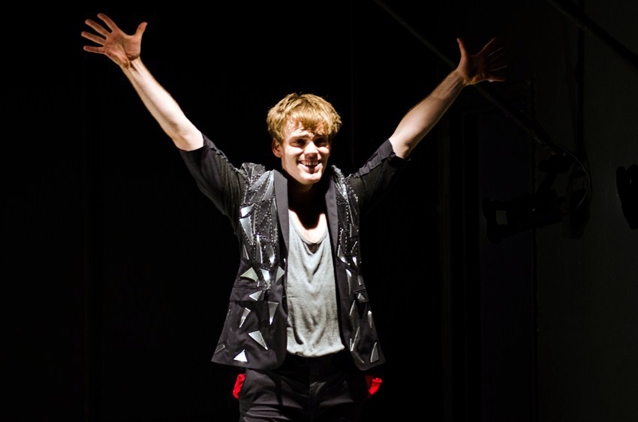
The context is set in a filmed introduction, a chic bar peopled with the stylish and the beautiful, where Greaves appears underdressed and out of character with everyone dancing around him. He catches the eye of an impossibly vain man who comes up to shake his hand and ridicule his appearance. This is the point at which Greaves comes on stage to prolong the handshake so we see only his reactions to the unseen man’s overarching snobbery and withering assessment. Greaves’ timing and squirming responses are very funny as he is skewered to the dance floor. The middle, transformative section begins with a Cinderella moment in his flat when he takes from his cupboard and puts on a handsome mirror jacket (courtesy of Theo Clinkard). His inhibitions fall away and he returns to the chic bar to dance his dreams. This is Greaves giving his all, and he does it effectively until the mirrored jacket falls apart, like the clock striking midnight. Self-doubt assails him once again as he props up his smiling face in his framed hands, removes his jacket and curls up on what is left of it in the dying light: not so much disgrace as sincerity about the superficial.
Posted: June 1st, 2013 | Author: Nicholas Minns | Filed under: Performance | Tags: Anusha Subramanyam, Ash Mukherjee, Asian Arts Agency, Breathe, Erhebung, Jeff Lowe, Kamala Devam, Mayuri Boonham, Pavilion Dance, Power Games, Seeta Patel, Shane Shambhu, South Asian Dance Summit, Subathra Subramaniam, Under My Skin | Comments Off on South Asian Dance Summit
South Asian Dance Summit, Pavilion Dance, May 17-18

The Art of Defining Me photo: Peter Schiazza
The purpose of the 24-hour South Asian Dance Summit presented by Pavilion Dance South West and Asian Arts Agency was to demystify South Asian dance for presenters and producers by allowing them to get up close and personal with the traditional form and contemporary developments. What the summit achieved was to take South Asian dance out of its cultural, indigenous box and to put it on display as a communicative art. Paradoxically, it was seeing Seeta Patel interpreting Marvin Khoo’s Bharatanatyam solo, Dancing My Siva — with all its cultural associations — that put the entire summit in perspective. Here was a classical dance form with its unmistakable sophistication in gesture and rhythm that has been developing for hundreds of years; the way Patel danced it communicated effortlessly a beauty and an excitement that was timeless. At the same time the performance contextualised the efforts by other summit choreographers to derive a contemporary form.
Of the full-length works, Subathra Subramaniam’s Under My Skin takes gesture from another kind of theatre (that of the operating room) as its inspiration in her challenge to ‘the traditional boundaries between clinical practice and dance’. Where Subramanian dips in to the Bharatnatyam form becomes a point of self-identification, a vestige of a glorious past that has nevertheless embraced the present. In his latest work, Power Games, Shane Shambhu adopts the gestures of the trading floor in his comic-strip style story of the rise and fall of a market trader and in Erhebung, Mayuri Boonham marries the sculptural form of the body with a rigid sculptural framework by Jeff Lowe, resulting in a meditative play of movement against stillness, of ripe fruit on a tree.
The summit also presented ChoreoLAB2, a series of shorter works that are still in development. Subramaniam takes her inspiration for a solo from observations of mental illness; in Breathe, Ash Mukherjee crashes deliriously into the traditional form to see what remains; Anusha Subramanyam retains the humanity of the narrative form to depict the humanity of Aung San Suu Kyi and finally Seeta Patel and Kamala Devam play devil’s advocate in a short film called The Art of Defining Me. It raises impertinent yet pertinent questions for audiences and presenters alike, for while it thumbs its nose at cultural claustrophobia and narrow mindedness (as does Seeta Patel’s series of vignettes, What is Indian Enough?), its light-hearted approach effectively transforms our perceptions.
The summit organisers were keen to provide ample opportunities for dialogue between artists and presenters and to cross-reference the dance with other practices. In the lobby of Subramaniam’s Under My Skin were a bespoke tailor, Joshua Byrne, and the surgeon Professor Roger Kneebone (Subramaniam’s collaborator on the project), both of whom demonstrated their respective forms of hand gesture. What the summit showed is thus a broad, interrelated universe of creative expression showing not only the origins but also the new directions of the traditional form. We should not be impatient; we do not have the time to see the development of these forms over the next hundred years, but both past and future exist in the present moment, and that is where the summit unequivocally placed us.
Posted: May 21st, 2013 | Author: Nicholas Minns | Filed under: Performance | Tags: Anne Plamondon, Daniel Mayo, Elon Höglund, Emmanuelle LêPhan, Gravity of Centre, Jasper Gahunia, Rubberbandance, Victor Quijada, Yan Lee Chan | Comments Off on Rubberbandance: Gravity of Center
Rubberbandance: Gravity of Center, Purcell Room, May 3

photo: Jocelyn Michel
In his essay on the relationship between language and style, Writing Degree Zero, Roland Barthes makes the case that literary style, having its origin in the ‘biology and biography’ of the writer, is a profound transmutation of these two elements through the medium of language that can carry man ‘to the threshold of power and magic.’ What strikes me in this notion is that style, be it literary or choreographic, is not a category, nor is it a conscious application of rules; its value is in its transformative force. Without such a force, style is as arbitrary as the words or steps or gestures that happen to comprise it. In dance, as in other performing arts, style is multiplied by the number of creative inputs and in the case of collaboration between dance, music, lighting and set design, the confluence of styles has the potential to drill down to our very core.
Victor Quijada’s work is an interesting study of language and style. His ‘biography and biology’ bridges forms of street dance learned in the ciphers of Los Angeles and contemporary forms of classical ballet in the companies of Twyla Tharp, Elliott Feld and Montreal’s Les Grands Ballets Canadiens. One can see these dual origins in his steps, but he transforms them with his dark, passionate persona into a style that can equally delve into the sub-currents of his life or strike a vein of laughter and light, as it did in his recent work for Scottish Dance Theatre, Second Coming.
Gravity of Center is an altogether darker work — it has some of the bleakness of Cormac McCarthy’s The Road — that deals with the dynamics within a tight-knit group of five itinerant souls on the edge of survival: the tensions, jealousies, frustrations, violence, rejection and redemption. The style Quijada has created to express this is not simply illustrating a story; it is the story.
The narrative is contained within a small sphere of activity, perhaps an evening’s sortie; certainly most of it takes place in what appears to be night. A group that feels its way hesitantly across the stage is an image Quijada used in the opening of Second Coming, though there the narrative breaks up into fragments, whereas Gravity of Center keeps the action in a tight grip; it is almost claustrophobic, to which is added the seemingly inevitable smoke to make it all thicker still. Each of the five performers incorporates a single universal virtue or vice like characters in a contemporary morality play. Quijada is the patriarchal leader of the group; Elon Höglund is a grudging, brooding brother; Daniel Mayo is a gentler, more virtuous soul who is keen to prove himself, and Emmanuelle LêPhan is a free spirit, attractive and attracted, who is the cause of most of the tensions between the alpha males. Anne Plamondon is cast in the role of mother, healer and compassionate one whose patient efforts and wisdom keep the group alive. It is the interplay of these five characters that makes up the psychological drama in Gravity of Center.
Quijada likes to play with theatrical conventions. At the beginning it is the audience that is bathed in a blue light while the stage remains dark (lighting design and technical direction by Yan Lee Chan). Even the exit lights in the Purcell Room seem dimmed. The only indication of something happening on stage is the sound of squeaking shoes on the rubber floor to Jasper Gahunia’s desolate soundscape that seems to grow out of the Russian steppes and evolves into an eclectic sampling of musical forms from Stravinsky to Chopin to Piazzola. When the lights allow us a first glimpse of the figures rising from the floor, they look like a band of giant marauders but it is not long before the band splinters into micro conflicts. Quijada’s dancers take risks; although we know they are not going to walk off the stage and hurt themselves, they come perilously close to disabusing us of our certainty. It means split-second timing, and it keeps our attention (and the dancers’ attention) on the edge. It is a quality that infuses everything Quijada does and it heightens the sense of animality in Gravity of Center: the prowling, pushing, elbowing, and kicking out at the air; the cartwheeling backwards over each other, the scorpion kicks and the writhing around each other like serpents; the bullying, cajoling, and the constant searching for dominance and survival. At one point, as the dynamics of the group get out of hand once again, a voice behind me whispers, ”God, this is not going well.” Plamondon’s lyrical qualities are the antidote, the balm to the wounded souls, the compassion to the blind outbursts of rage. If there is any narrative within this volatile scenario, it is that Mayo’s character, the runt of the group, is ready to prove himself. Plamondon senses he is better off alone (or he comes to the same conclusion), and with her blessing and a little pushing, he disappears over the edge of the stage for a period of time only to be ‘found’ later by Plamondon’s maternal, sensory instincts. The core of the work is a series of tactical exits and menacing entrances, solos, duets, trios (notably between Höglund, LêPhan and Quijada), quartets and unison quintets focusing on the constantly looping dynamics of the group. Quijada’s challenge here is to find a conclusion. There are a couple of blackouts and an edging toward a point of no arrival, but in a sense these are five characters in search of an ending; it arrives by the theatrical convention of the lights going down (for the third time) rather than by any sense of finality. In fact there is a very real sense that the action continues through the night and into the following morning.
As such, Gravity of Center constitutes less a narrative than an essay. Second Coming coalesced into a spark; this one bubbles in the background, waiting to draw those gestures and signs and symbols into a coherence that has a life of its own rather than describing how it is going to get there. It is a style in search of its true form.
Posted: May 3rd, 2013 | Author: Nicholas Minns | Filed under: Performance | Tags: Alexandre Jolicoeur, Compagnie Flak, Erik Satie, Erin Poole, Fleck Theatre, Gnossiennes, Gymnopédies, Harbourfront, José Navas, Lauren Semeschuk, Marc Parent, S, Sarah Fregeau, Villanelle, Waldean Nelson | Comments Off on José Navas/Compagnie Flak: Villanelle/S
José Navas/Compagnie Flak: Villanelle/S, Fleck Theatre, Harbourfront, Toronto, April 19

photo: Michael Slobodian
José Navas’ S and the short solo Villanelle that precedes it form a choreographic progression from a single, partially clothed, luminous figure performing the equivalent of a temple dance to a grouping of denuded, ethereal beings emerging from the darkness into light. It is a meditation — like the music of Erik Satie that inspires it — on light and beauty in which Navas harnesses a classical sensibility to a sensuous quality of movement and form.
It is a naked work: the dancers slough off their diaphanous clothing (designed by Navas himself) as the work progresses, keeping just their skin-coloured trunks to maintain a continuous sculptural body surface. But it is also a naked work in the same way the piano music of Satie is naked: without any embellishment. It requires a subtle style of dancing and despite the many opportunities for individual dancers to shine, the abstract quality of the work depends on anonymity of character, like figures in a classical frieze. Much depends on the qualities of the dancers: beauty, a fine, supple line, a lack of ego, and the ability to keep a phrase of movement alive without end. Some of the dancers are new to the company, and one can sense they are trying to assimilate Navas’ choreography; they still have to unlearn elements of their past training to dance this convincingly. In watching Lauren Semeschuk, however, I feel the qualities required by Navas are eloquently embodied.
Villanelle is danced to the music of Vivaldi, Cum dederit delictis suis somnum from the Nisi Dominus. It is spiritual music, heightened by the (unattributed) counter tenor voice to an emanation of pure, imagined divinity. The choreographic language belongs as much to eastern mysticism as to western classical style as Alex Jolicoeur emerges from the dark in a circle of light clothed in diaphanous leggings with his chest bare, sitting on his heels on demi pointe, legs turned out. He rises up keeping his head downinitially, raising his arms until his body is fully stretched upwards in a moment of quiet control and serenity. As the music begins, he descends once again into the opening position only to rise again with the lighting levels to a summit of abandon that reminds me of a photograph of Nijinsky in Scheherezade. Jolicoeur, who is substituting for the absent Navas, tries hard at times to hold on to the movement where I feel he should instead be letting go. It stems perhaps from a misunderstanding of the difference between the muscles needed to maintain a structural core and those needed to move. In the middle section of his solo he foregoes stillness to expand his spatial reach and classical technique — where he is more comfortable — until he returns once again to the opening pose, looking now at the audience as his mirror.
Although Villanelle is a solo in itself, it forms a prelude to S (S for Satie and S for silence) whose structure is like a theme and variations with the difference that it never returns to the theme in its finale but moves into new territory altogether. The theme is unity, sensuality, animality emerging from the earth and into the light. Seven dancers, fully clothed in similar diaphanous material to Jolicoeur, stand one behind the other, extending their arms and legs like a multi-limbed devotional statue of Shiva. They move across the stage changing places, all in silence, from slow movement to circular, helix shapes, to a point of stillness. Then they start again, carving out the air to stop in open positions, seated or standing. Jolicoeur joins in a section of unison phrases during which Satie’s music — sections of Gnossiennes and Gymnopédies played slowly, almost plaintively in an unattributed recording — begins like a body slipping noiselessly into the water. The quality of the movement makes it appear the dancers are performing somewhere inside the music. And yet there are also moments when a heavier quality weighs down the choreography; it wants to float, like Satie’s notes, and at its most sublime succeeds, yet gravity reasserts its hold — sometimes too much — on these souls about to leave. Anything that doesn’t flow like water, like an errant sound (a hand slapping hold of a partner’s thigh) or a moment of tension, breaks the spell. Even a tentative approach jars. This is, I think, the issue in Waldean Nelson’s first solo. He is followed by Lauren Semeschuk, now stripped to the waist, who dances an unequivocally feminine solo in which she gently pushes and pulls the space around her with a freedom of expression that is as luminous as her skin. She ends with her back to us as Sarah Fregeau and Erin Poole enter to form a trio that begins in silence and recalls phrases from Villanelle.
Navas writes in the program that ‘When you listen carefully to the Gymnopédies and the Gnossiennes, you realise that Satie is developing the same theme with all kinds of variations. It’s simple, clear, and totally abstract, but it’s also poetic and very touching. His manner of creating is echoed in my way of composing choreography from a key phrase that generates all the others.’ Solos intermingle with a flowing arrangement of duets, trios and sextets until the choreography begins to coalesce in a more solid sculptural form, beginning with Fregeau’s standing beautifully in an open fourth position, the dancers placing a hand on another’s shoulder, and walking on their heels like the nymphs in Nijinsky’s Faune. Other solos continue to play within the music and the silence — some more successfully than others, though Nelson finds his fluid form here — but we are moving inevitably towards the realization of the final octet.
To the third of the Trois Gymnopédies, the dancers, now all stripped to their trunks, gather closely together like Rodin figures, slipping around and in between each other in slow motion. Marc Parent’s lighting picks out beautifully all the skin colours and shades and shapes. There is a long rectangle of light like a road; only one person is on it at first, while the others are in the shadows, growing up from the ground, caught in the process of emergence or disappearance. The line spreads out until the dancers each have the space to begin their slow walk forward, eyes closed, letting the music guide them. It is a section of being, not doing, a spiritual, almost blind journey into the unknown. The dancers continue until the dying light finally engulfs them in dark as the last chord reverberates through the theatre.
With his ability to find common ground between the classical and the sensuous, between light and dark, weight and weightlessness, Navas is currently choreographing Giselle for Ballet BC. He has also been asked to create a work for The National Ballet of Canada that will première in November on a program of new works by Robert Binet and James Kudelka.
Thanks to Mimi Beck and DanceWorks for producing this program and for making it possible for me to reserve a ticket. Before I left London, I reserved a seat on the train from Montreal to Toronto, but there was no way I could reserve a seat at Harbourfront’s Fleck Theatre. Strange, but seeing the performance was worth any amount of frustration.
Posted: April 22nd, 2013 | Author: Nicholas Minns | Filed under: Performance | Tags: Aleksandra Jakovic, Chapter One, Connor Quill, Cornelia Voglmayr, Jasmin Vardimon, Joe Garbett, JV2, Lawrence James, Mafalda Deville, Maria Doulgeri, Noriko Nishidate, Silence, The Books, Tim Casson, Tomorrow | Comments Off on JV2: Tomorrow
JV2: Tomorrow, The Place, April 5

photo: David Gerrard
JV2 consists of ten dancers from Europe and Asia who are studying for the Jasmin Vardimon Company Professional Development Certificate. Part of the course includes a series of seven performances that premiered at the Gulbenkian in Canterbury on March 19 and ends at the Brewery Arts Centre in Kendal on April 27. ‘Our aim,’ writes Vardimon, ‘is to train and develop well-rounded stage artists in a variety of performance disciplines and at the same time enable them to develop their own creativity. By blurring the definitions between art forms and encouraging collaboration they will be able to create and present work in a new and engaging light.’
Vardimon chose these dancers at an open audition, and they have been working alongside the professional company as part of their course. Seeing them on stage, it seems that any one of them could move seamlessly into the main company, which makes the course rather like a 25-week audition for which the students pay college-level fees. It is an inspired business model (unique in England), an inspired pedagogical model, but as a model for an evening of dance it proves less alluring.
JV2 is in part ‘an ideal opportunity for participants to deepen their knowledge of Vardimon’s methodology’ and there is no better way than to perform her works. Vardimon has designed this triple bill specifically for this tour, creating one of her own — a collage of extracts from previous works called paradoxically Tomorrow — and commissioning two others: Mafalda Deville’s Silence and Tim Casson’s Chapter One. Both choreographers have danced in the main company and Casson is the course leader for the JV2 Certificate, while Deville is the director of the company’s Education Project. One would expect a strong stylistic influence on their work from Vardimon, but Silence and Chapter One bear such a close resemblance to each other and to Tomorrow as to take their creative exploration to a level somewhere between plagiarism and sycophancy. While this may be stimulating and beneficial to the students, the effect of the triple bill over the course of the evening is one of predictable surprise.
On the positive side, Vardimon’s work is always witty, visually stimulating and musically eclectic and her dancers never give less than their all. On the distaff side, the wit, visual stimulus and musical eclecticism can be formulaic, like an overused refrain. All three works have a similar juxtaposition of unison movement and solos, narrative diversions, textual humour, surreal imagery, the use of voice, the overuse of the tucked-up fourth position and an overtly punishing tic of dancers having to hurl themselves to the floor (a dancer’s career is fragile enough as it is).
Deville’s Silence opens with a white sheet entering as a rectangle and turning into a sofa stuffed with dancers. The story of a first date on a dance floor (former ballroom dancer Lawrence James is a powerful and engaging presence) morphs into a crowd of hysterical fans at a Marilyn Manson concert giving us the full range of their voices (Noriko Nishidate’s hysterics indicate a performer with boundless resources). Tchaikovsky’s Only the Lonely Heart changes the mood to a mourning procession at the head of which Nishidate is pulled around the stage on the white sheet like a figurehead or an angel of mercy. In the background a couple is struggling in their embrace: a rag doll girl who can’t stand up and a violent partner who picks her up and lets her fall through his arms repeatedly. Silence is billed as an exploration of loss and longing, but it is loss and longing seen through the prism of Vardimon’s methodology; it is carefully crafted, has all the Vardimon attributes, but it lacks a unique voice.
At the very beginning of his work, Casson reminds us wryly of a dominant aspect of the Vardimon style when Joe Garbett flies prostrate from the wings on to the stage in his boxing gloves and shiny shorts as if ejected forcefully from the ring. Casson explores the music of the American folktronica duo, The Books, bringing out its quirky theatrical imagery in the wittily titled Chapter One. There’s a girl with a talking flower in a pot, a couple in clear plastic raincoats, Aleksandra Jakovic with her pet goat, Maria Doulgeri with a squid in a plastic bag and Connor Quill in a raccoon hat. In between The Books’ songs, Casson explores gestural correlation with both the speech of an incoherent drunk and with upper class conversational interjections. Casson’s strength is in his attention to detail, creating an intricate work — perhaps the most original of the evening — though it tends to default to the Vardimon style when it comes to broad phrases of movement and ensemble work. Although all ten dancers share equally in the details of gesture and voice Casson calls for, Cornelia Voglmayr is the one who is most herself in this work.
Vardimon’s Tomorrow is made up of the past; it is the art of making a retrospective look like an entirely new work. While three of the original works (Park, Justitia and 7734) were conceived with an integral vision — the fourth, Yesterday, is itself a collage of past works — their fragmentation and reconstitution into a new work raises the question of what we are seeing: without the integral vision, what is left is a visual and aural stimulus. It is as if we are seeing the building blocks of Vardimon’s creative process, the very methodology that is at the heart of the Certificate course. Interestingly, even though both Deville and Casson have created integral works, the form they use is heavily influenced by this building block concept, which in turn is facilitated by the eclectic choice of music: Tomorrow allows room for John Fahey, Sparklehorse, Brian Eno, Deathprod, Wagner, Mozart and Spiderbait. Deville’s Silence has a more restrained menu of Einstürzende Neubauten, Marilyn Manson, and Tchaikovsky.
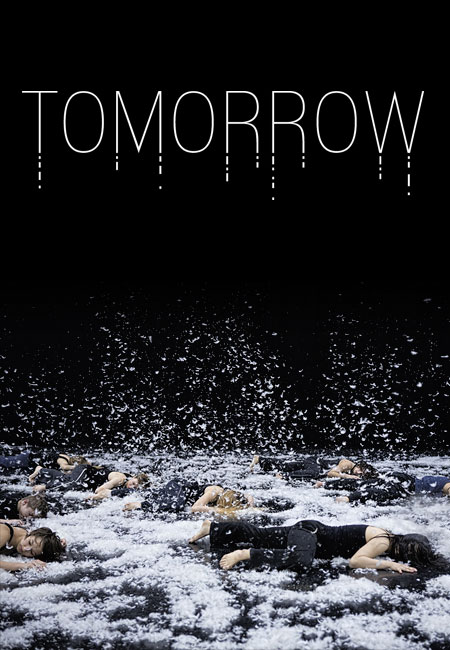
The predominating image in Tomorrow is the vision of a moulting angel (Vogelmayr) in white with an armful of feathers. A flush of other angels swish crabwise like a blizzard back and forth across the stage, accenting their steps with their breathing. Vogelmayr gets caught up in their movement as she advances, losing feathers to the stampede despite her efforts to protect them: a sacrifice of purity and innocence to the passing of troubled times. This is where the redemptive music from Wagner’s Tannhauser swells the heartstrings along with Sparklehorse’s It’s a wonderful life and the Kyrie from Mozart’s Requiem. The feathers become the leitmotif, but Vardimon’s unison patterns and crashing fourth position dominate the choreography like an army on the rampage. It’s an unequal competition and the feathers remain scattered on the stage at the end, the ephemeral remnants of something alive and pure.
Posted: April 5th, 2013 | Author: Nicholas Minns | Filed under: Performance | Tags: Jon Beney, LOL (Lots of Love), Luca Silvestrini, Parsifal James Hurst, Pavilion Dance, Protein, The Quay School, Valentina Golfieri, xoxo | Comments Off on Protein: xoxo
Protein: xoxo, Pavilion Dance, March 22

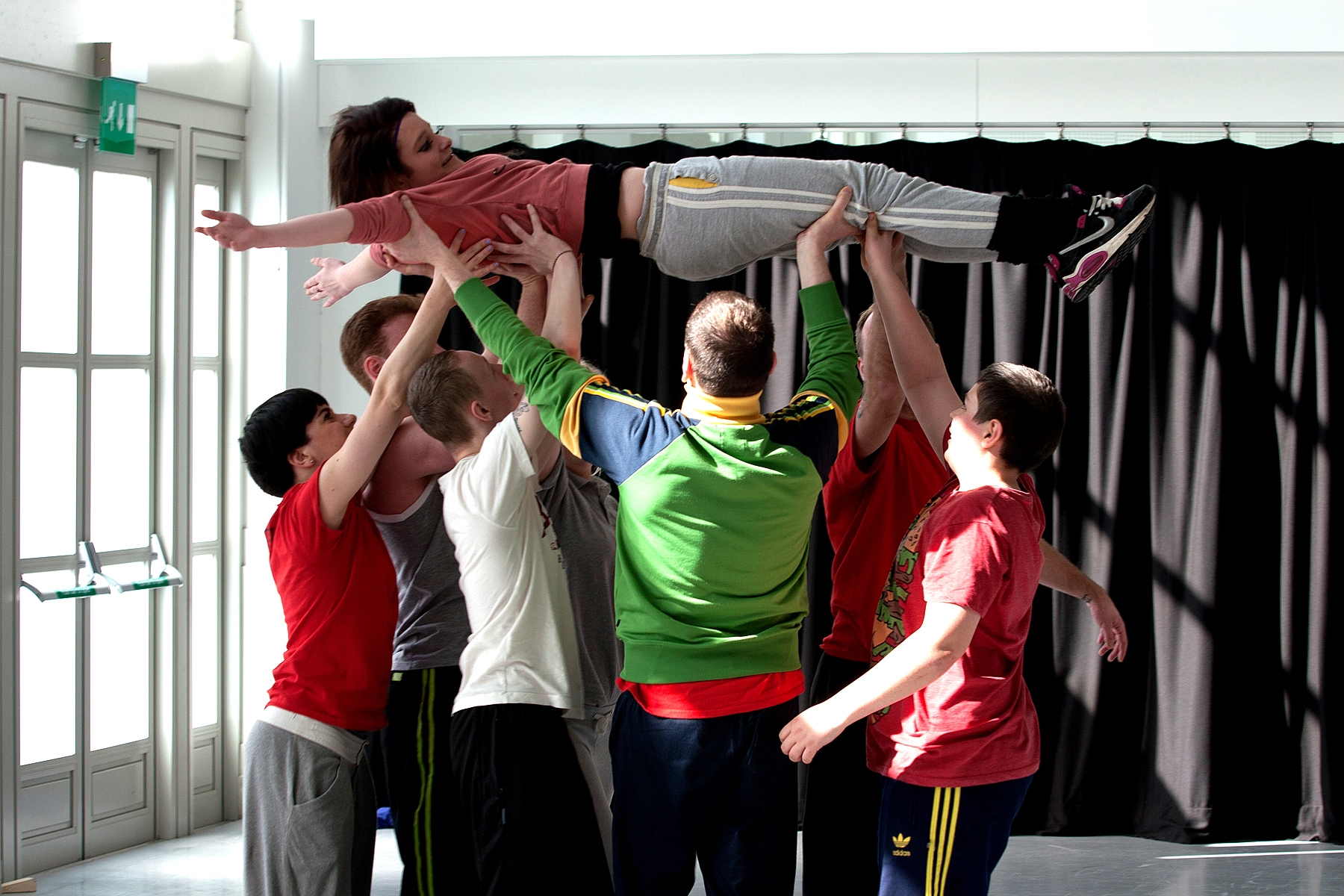
Sarah aloft in xoxo rehearsal
XOXO is the written equivalent of kisses and hugs but there isn’t much time for the relationship to develop: Luca Silvestrini and his three dancers from Protein have just three weeks to create a work with specially picked students from The Quay School in Poole and Hamworthy. It is part of Protein’s Real Life Real Dance participatory program, supported by The Monument Trust, Pavilion Dance South West, wave arts education agency and The Quay School. The students, Jamie, Rhys, Jordan, Holly and Sarah are the second group this year, after a partnership between Protein and artsdepot in London in January.
Silvestrini has derived xoxo from LOL (Lots of Love), his company’s very successful work about love and communications in the online social media age. He adapts parts of it to the students, but keeps the thread of LOL going with his own dancers, Valentina Golfieri, Jon Beney and Parsifal James Hurst (PJ).
I arrive for the second week of rehearsals. The first week apparently went really well but week two begins slightly differently. The Quay School supports young people who are at risk of exclusion from mainstream schools. Some disruptive behavior manifests in the studio, so that at any one time there is a charge of both creativity and negativity among the students; when the latter cancels out the former, the two accompanying teachers take time out to encourage the students back in to the studio. This takes its toll, as one person’s outburst affects everyone else, and in the meantime choreography has to be learned. The atmosphere can be fragile on both sides, but the goal of performance remains, which is why the project is so important. Silvestrini and his dancers manage to keep the project on track with pep talks, encouragement, and vast amounts of patience and respect.
The second day I attend, the atmosphere has improved dramatically; the studio is full of energy and drive, although one of the students wasn’t able to come in on that day due to illness. One of the Protein dancers takes his place and new sections are learned. As well as choreography, the students are asked to talk about their online experiences, to offer their brand of chatter to be recorded and used in the performance. By the end of the day a lot has been accomplished and all seems well.
I return the following week to see the show, but am sad to learn that one of the students who had shown so much promise couldn’t be involved with the performance at the last minute. She cannot be replaced at short notice so Silvestrini adapts the piece again. I can’t imagine too many choreographers who can deal with this kind of instability and uncertainty, but he does, brilliantly, as do his dancers and the remaining students.
The theatre is full of family, friends and school staff. There is lots of chatter and laughter. PJ wanders on to the stage from the audience with a tangle of red and yellow computer cables over his shoulder. There is a loud short-circuit, a flash of light and all goes black. Out of the darkness each student appears on a screen at the back of the stage; they are each at a keyboard looking into the camera so it looks as if we are watching them from the screen. Rhys, Sarah, Jamie and Jordan gather in a group at the front of the stage as we hear Valentina’s voice reading their online messages, chats and status updates. They then watch PJ and Valentina’s keyboard duet from LOL. It is movement that communicates immediately, and with the score of computer and keyboard sounds (it’s clearly not a Mac), it’s witty and accessible. Online dating goes livid with Valentina having a fit in computer time when Jon intervenes between the two. Gradually the students shed their nerves and take their places with the company members in movement and text. There is a sofa at the back where Jamie takes a rest. A couple of teachers appear on the screen with anecdotes from a day in the life at school. Rhys and Sarah dance a duet, PJ runs fast around the stage with Valentina and Jon to form two teams with the students on either side of the stage. Jumping over each other (with PJ’s extraordinary elevation he could jump easily over two people at a time), the performers circle Jamie in the centre, while Jordan takes a moment to smile at his Mum. PJ brings more cables into the centre on which Jordan rests. His mother, who we see talking on screen, says she’s still on his friends list while Jordan mimes gaming on stage. Xoxo is all about communicating in the internet age, but is also about social values: the students agree they don’t want a friend that judges a book by its cover.
Very soon it is all over. Cheers and applause from a proud and appreciative audience. Jamie whistles his relief. PJ and Jon bring the sofa to the front of the stage on which the students relax as if they own it. Valentina brings flowers for each, and Luca a present. Sarah and Rhys look so confident: trust and confidence are the rewards of this project. Jordan has learned teamwork and more capabilities. Jamie puts what he has learned into one word: skillage.
At the backstage reception afterwards the sense of pride, achievement and relief is palpable. Sarah and Rhys want to continue dance classes. But more than that: in an age of online chatter, non-verbal dance has found a way to bring out the characters and personalities of these students. It has not always been easy, but Silvestrini and his dancers have showed what is possible with patience, persistence and the right kind of moves. xoxo