Pam Tanowitz, Caroline Shaw and Sarah Crowner, Pastoral, Barbican Theatre, October 1
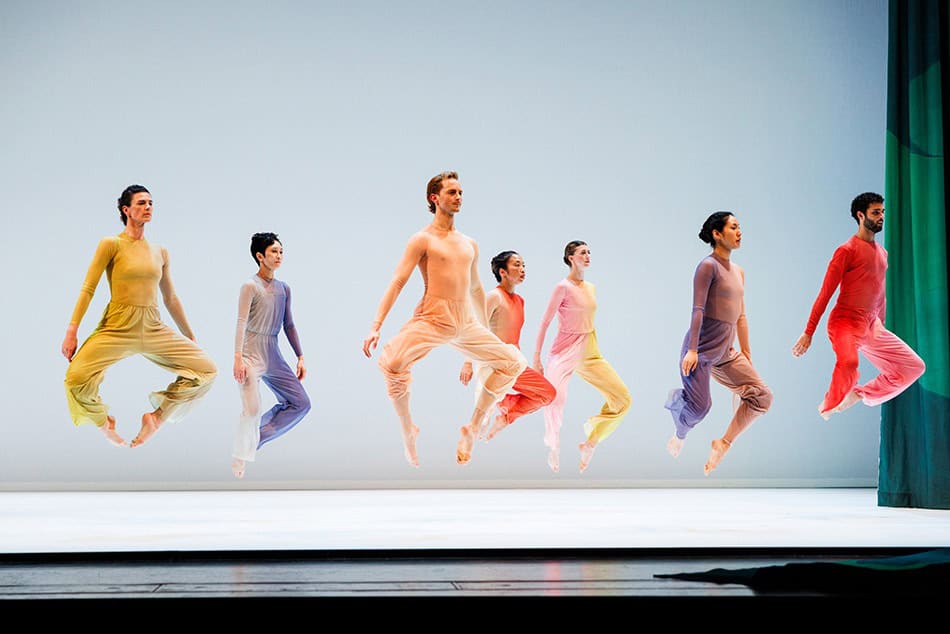
The Pam Tanowitz dancers in Pastoral. Photo: Maria Baranova
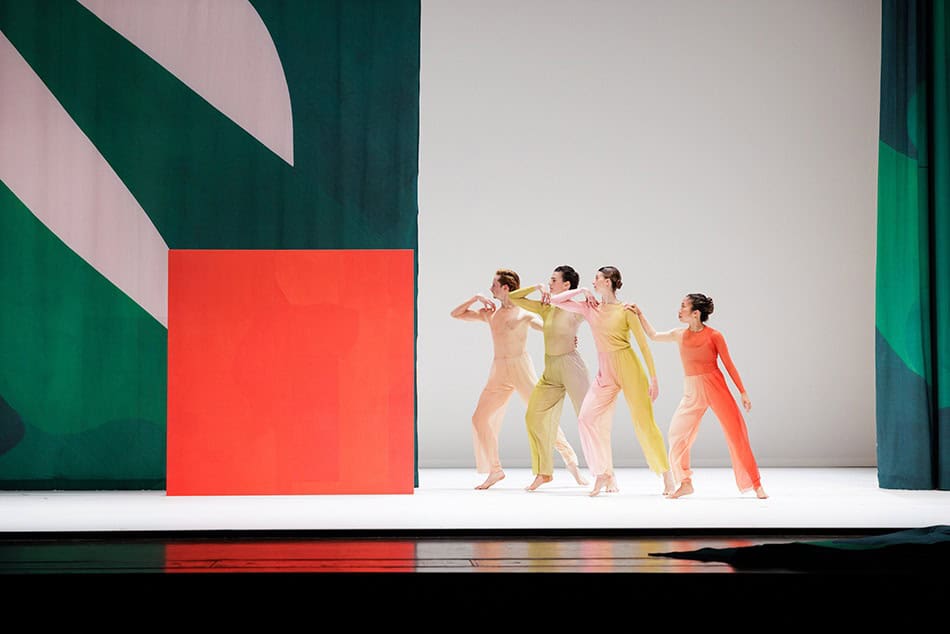
Billed as the UK première and the third co-commission between the Barbican and Pam Tanowitz Dance, Pastoral is, at its creative heart, a co-creation between choreographer Pam Tanowitz, composer Caroline Shaw and visual artist Sarah Crowner. Davison Scandrett’s beautifully lit stage transforms The Barbican Theatre into a gallery space in which seven dancers in Reid Bartelme’s diaphanous pastel colours negotiate Crowner’s pastoral screens, curtains and a swathe of green cloth with hushed precision to Shaw’s luminous, playful score. The collaboration is so intimately conceived that there’s a sense of seeing and hearing figures at an exhibition who are themselves the subject of the exhibition. When the dancers move around and between Crowner’s canvases, those canvases take on a dynamic life of their own, and Shaw’s score, a dialogue conceived between Beethoven and three musicians who are seated in front of the stage — Dana Jessen on bassoon, Bill Kalinkos on Clarinet/ Bass Clarinet and Andrew Nogal on Oboe/English Horn — forms a contemporary pastoral that in turn affects the choreography. Alongside the musicians, Shaw presents Beethoven’s most familiar phrases from his sixth symphony in diverse recordings and interpolates the sound of cicadas, the hum of traffic, or the clatter of someone washing dishes. It’s like hearing snatches of the symphony on the kitchen radio or while driving in an open convertible. Throughout Pastoral new life is constantly pulsing in an out of each collaborative art; Tanowitz’s choreography takes on sometimes the flatness of the picture plane and at others the sinuous play of Shaw’s score. That is the nature of a true collaboration.
A scene from Pam Tanowitz’s Pastoral. Photo: Maria Baranova
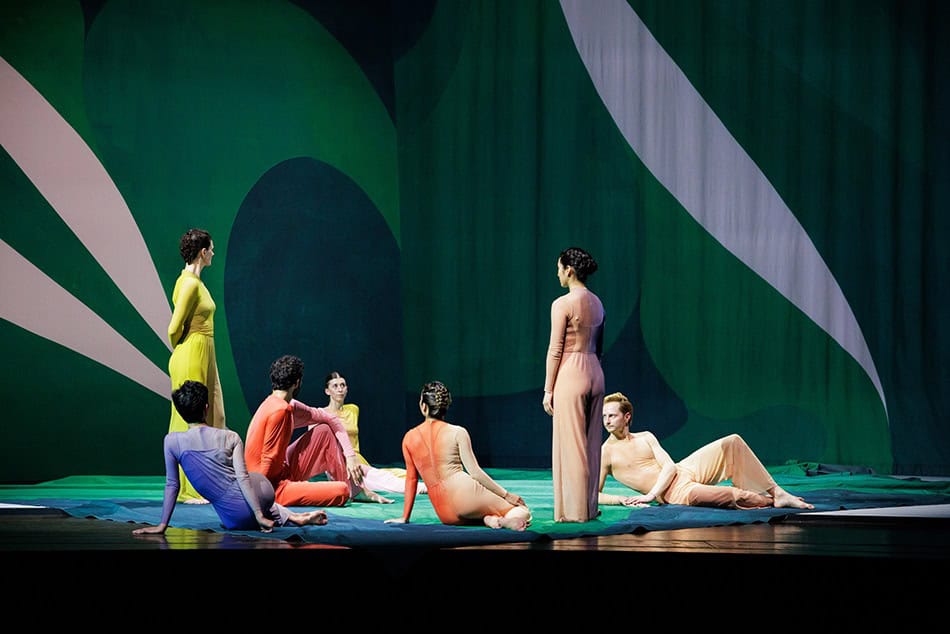
The choreography is nevertheless the most alive of the collaborative elements in that it is always in real time. Crowner’s canvases are already in place and can be moved mechanically or by the dancers, and while the musicians are also playing live, they are interacting with a recorded score integrated into Justin Ellington’s sound design. But the dancers have to deliver their movements in the moment on the stage. Marc Croussillat, Christine Flores, Lindsey Jones, Maile Okamura, Caitlin Scranton, Stephanie Terasaki and Anson Zwingelberg display a variety of techniques, with classical training in varying degrees and the influence of Merce Cunningham very much in the mix. As figures in the exhibition, they carry equal weight over the course of Pastoral, as complementary and unified as colours on a canvas, but clearly Tanowitz choreographs on the strengths and talents of each dancer. She does not hold back from choreographing deceptively simple steps that require great strength and balance, but any virtuosity appears without a note of drama; it comes across as almost nonchalant or as part of a game. It’s not too much to describe Tanowitz’s choreography as sampled in similar fashion to Shaw’s score: there are references not only to other ballets — Nijinsky’s L’Après-midi d’un Faune and Paquita — but to painting, where one grouping seated on the swathe of green cloth suggests Manet’s Le Dejeuner sur l’herbe. Like Shaw’s sound interpolations, Tanowitz’s visual allusions meld effortlessly into the movement.
The Pam Tanowitz dancers in a scene from Pastoral. Photo: Maria Baranova
For the most part the dancers’ facial features are neutral, dispassionate, their gaze throughout Pastoral staying within the stage frame, engaging with the space created by Crowner’s sets rather than directly with the other dancers or the audience. This creates the impression not of a story that we can read so much as a series of aleatory rituals or games whose rules are known uniquely to the participants. Only occasionally does one of the dancers take a stance directed at the audience, inviting us into their secret. Scranton draws our attention with her statuesque stare, and Croussillat at one point looks as if he’s trying — with the same success as Nijinsky’s faun — to catch the attention of one of the women, but generally the intentions behind the dancers’ dynamic shapes taking inspiration from Crowner’s designs and Shaw’s score remain inscrutable.
With our attention moving freely between the three art forms, there is nevertheless an emotional reading of the whole. Watching from the outside you can’t help feeling deeply involved in the work, like spending a concentrated time in front of a painting. Pastoral is a work that quietly demands further viewing so as to reveal itself over time. Whereas it is possible in this age of mechanical (and digital) reproduction to see Crowner’s art and to hear Shaw’s score, we are less likely to see Pastoral in its full collaborative setting. That is a shame. Having transformed the Barbican Theatre stage into a gallery, seeing it on screen would not be so much different from seeing it in the theatre.
Sylvie Guillem: 6000 Miles Away at Sadler’s Wells, May 21
Sylvie Guillem in Mats Ek’s Bye (photo: Lesley Leslie-Spinks)
The evening of dance Sylvie Guillem was putting together in March 2011 might have been called simply ‘Sylvie Guillem and Friends’ if her rehearsals with William Forsythe in London had not coincided with the devastating tsunami that hit Japan. Calling the new program 6000 Miles Away was Guillem’s way of keeping in mind those who were suffering the effects of that environmental disaster (she raised £80,000 for the Red Cross Tsunami appeal at the original 2011 performances at Sadler’s Wells), but the title also neatly ties in with a charity Guillem supports, Sea Shepherd, among whose projects is the protection of whale habitats from the illegal practices of the Japanese whaling fleet. This in turn seems at least 6,000 miles from the playful, ecstatic image of Guillem on the publicity material under the names of three iconic choreographers, Jiří Kylián, William Forsythe and Mats Ek. Welcome to the world of Sylvie Guillem. She serves on the Media and Arts Advisory Board of Sea Shepherd and Sadler’s Wells this time round devoted an evening to fundraise for the charity, presenting a short filmed message from founding skipper Paul Watson, who could have been, yes, 6,000 miles away.
The attraction of the evening is indisputably Guillem herself, but she does not dance in all three works. It seems she commissioned Forsythe and Ek to make works for this program but the duet from Kylián’s 27’52” — in which Guillem does not dance — dates from 2002 and has no direct relation to her. Alistair Spalding’s welcome note in the program simply links the three works by stating that they showcase the work of ‘three creators who have held a special place in Sylvie’s career’ but Sarah Crompton in her article on the making of 6000 Miles Away makes no mention of Kylián at all. This suggests either that plans to commission Kylián to create a work for Guillem came to nothing, or that the duet from 27’52” — danced here by Aurélie Cayla and Lukas Timulak — was an afterthought.
As the curtain rises, Cayla and Timulak are on stage, she in a red top (later removed) and black pants standing in a spotlight and he lying in black pants and stripped to the waist at the edge of the floor. Lit beautifully by Kees Tjebbes, the stage is a clean canvas on which Kylián highlights with quiet precision the beauty of the articulated, semi-naked bodies in movement, something we can expect from him even when he is not at his most inspired. The problem is not with the choreography, nor with the dancing, nor with the score by Dirk Haubrich: the duet just doesn’t fit on the program; without Guillem’s creative involvement, it has an energy and identity at odds with the other two works, and deprives the evening of any unity.
Rearray is a duet of minimal form danced in and out of intermittent lighting conditions (Forsythe’s concept, Rachel Shipp’s realisation) that have an overly dominant role. There are so many blackouts, exits and entrances that the only way we recognize the end is when the dancers don’t come on again. When the lighting gets overly complex, one senses Rearray is a work that uses Guillem to show off Forsythe, but there are other luminous passages when Forsythe is clearly showing off Guillem. Dressed in t-shirt and jeans she performs what appears to be a series of relaxed, impromptu dances but has the ability to create starkly precise and beautiful shapes that seem to imprint themselves in the air. Her partner on this occasion, Massimo Murru, doesn’t have quite the same alchemy, which in a piece where partnering in the old sense is less in demand than an equality of presence keeps the equation one-sided. Forsythe gives him an arresting solo, however, in which his hands appear to be tied behind him, like a puppet unable to escape his own serfdom. David Morrow’s music is not an easy listen, but Forsythe evidently relishes its intricacy and in a lighter moment shares its humour: the fourth section begins as both dancers, facing upstage, simply bend their knees to the rhythm of Morrow’s score, creating a simple, articulated pattern that is both rich and quirky. Forsythe’s mastery of the stage remains undimmed, and it is a real joy to see Guillem responding to his direction even in a work that spends far too much time concealing her.
After the strong taste of Forsythe, Ek’s constant stream of ludic ideas in Bye is as refreshing as a sorbet. Ek, one feels, has put his choreography at the service of the artist, and Guillem returns his devotion in full. Katrin Brännström’s set is like a room with a small door in the back through which we see a black and white projection (thanks to Elias Benxon) of Guillem’s giant, cyclopic eye; the image of her face moves across the doorway/screen to reveal her other eye, then she walks away until she reaches stage size. Returning to peer through the glass, her real hands now appear over the doorframe as extensions of her filmed image. She is pigtailed, dressed in a yellow skirt, a green pullover and bobby socks (costumes by the ever-ingenious Brännström), a long-legged gamine playing games to her heart’s content. Erik Berglund’s lighting picks out both her line and the architectural elements beautifully, and enhances the playful colours of her costume. Ek uses the Arietta movement of Beethoven’s final piano sonata, op 111, shaping the rhythmic content and painting delightfully irreverent images that Guillem plays with her entire body as if on an instrument. Ek seems to derive his vocabulary from an array of sources including classical dance, yoga, everyday gestures and the sculptural forms of Henry Moore. As the sonata becomes more rhythmic and playful, so does Guillem, taking off her cardigan, shoes and socks, improvising as if in her own room like a clown or Raggedy Ann doll with her leg thrown nonchalantly up to her forehead. A man appears at the door looking in and glancing impatiently at his watch. How long will Guillem be? He goes away. She yawns, rolls over, and stands on her head. A virtual labrador comes to the door and sits down patiently, but eventually he, too, moves on. Guillem remains oblivious of time, bouncing to the luscious chords of the sonata with joyful abandon. Ek narrows our focus for a moment to the projected outlines of a bed on which Guillem lies. We concentrate on her hand gestures against the black and her form is like a goddess eating grapes, the pose from the poster. She stands on her head again, watched by a growing number of children at the door but finally puts on her socks and shoes. In the cadenza she dances a little madness before stepping outside and looking back wistfully at the interior world of her colourful imagination that she must regretfully leave to face the black and white reality outside.