Posted: October 6th, 2015 | Author: Nicholas Minns | Filed under: Performance | Tags: Alessandra Ferri, Christopher Akerlind, David Zinn, Francesca Annis, Herman Cornejo, Martha Clarke, Sarah Rothenberg | Comments Off on Alessandra Ferri in Martha Clarke’s Chéri
Martha Clarke and Signature Theatre, Chéri, Linbury Studio Theatre, September 30

Herman Cornejo and Alessandra Ferri in Martha Clarke’s Chéri © Signature Theatre (photo: Joan Marcus, 2015)
The combination of Martha Clarke and Alessandra Ferri seems irresistible. I remember vividly a piece by Clarke called Nocturne, a poignant portrait of an ageing ballerina. With its unerring sense of the absurd Nocturne was painted with strokes of beauty and compassion and a wicked sense of humour. What might she create with Ferri in the adaptation of Chéri, a novel by Colette describing the love between a young man (Chéri) and an older woman (Léa)? In Nocturne Clarke seemed to have taken to heart Colette’s advice to writers: ‘No narration, for heaven’s sake! Just brush strokes and splashes of colour…’ and in the opening section of Chéri she does just that: Ferri relishing the taste of strawberries at the breakfast table while her tousled partner, Herman Cornejo, gets out of the rumpled bed; the playful exchanges over a pearl necklace; the passionate airborne embraces, the petty jealousies, the smiles and the tenderness. But as Chéri develops Clarke appears to repudiate Colette’s advice in favour of narrative elements that serve to attach the dance to the story in overly literal ways.
Firstly, the set by David Zinn — a comfortably sparse, fin-de-siècle Parisian apartment — dominates the stage in its theatrical detail and reduces the dancing area to the spaces between furniture. There is a grand piano in one corner at which Sarah Rothenberg plays (mostly) French repertoire by Colette’s contemporaries with studious attention. She is on stage but she is not in the apartment; Léa and Chéri do not hear her playing — the music serves, like Zinn’s set, as an anchor to a specific time and place — but it provides a structure to which they dance. It is not Colette’s structure, however. For that, Clarke asked Tina Howe to adapt Colette’s novels and to shape a text to be spoken by Léa’s friend and Chéri’s mother, Charlotte (the actress Francesca Annis). Charlotte is thus both a nominal character in the work and a one-woman chorus. Like Rothenberg, she doesn’t seem to be in the apartment but slips invisibly into the room like a spiteful ghost to poison the surroundings with her prattle and hasten the story to its end. Her interventions are directed to and for the benefit of the audience; Chéri and Léa overhear her but remain mute. For the purposes of unity, I wonder if Charlotte’s role could have been divided into a program note and a third dancer and if the grand piano could have been replaced — with no disrespect to Rothenberg’s playing — by a gramophone.
Taken on its own level, the dancing is beautiful. Ferri may be older than Cornejo but when they dance we see two young lovers. The initial vocabulary of intimate partnering sings of romance, sex and their complexities — the two can’t keep out of each other’s arms and legs — even if in subsequent scenes the partnering does not evolve sufficiently to give a sense of development in the relationship. It is in two solos that Clarke allows her characters to express their inner feelings more completely. She translates Léa’s despair following Chéri’s arranged marriage into movements close to the floor, leaving behind as much as possible the trappings of classical ballet to reveal Ferri’s embodied experience. Nevertheless, when Ferri dances there is something of the consummate artist in her that expresses her fragile state in a body that is too confident of its ability. Cornejo’s solo is more substantial; it comes in the final scene of the work, an adaptation of Colette’s La Fin de Chéri, which portrays the unstable, frenetic mind of the young man burdened by his experiences of the First World War and aware that his relationship with Léa is over. Cornejo is very much the romantic antihero here and like Ferri his effortless technique makes him appear much stronger than his state of mind might otherwise indicate.
I read Colette at school and remember the excitement of imagining forbidden, sensual relationships at a time when they seemed so out of reach. Without advocating complete realism on the dance stage, it is rather disappointing to see Colette’s vision turned into a scrupulously censored version where Cornejo and Ferri make love in their underwear and sleep and wake in their costumes. Clarke is fully aware of this; for one brief moment she has Cornejo pull down his underwear to present his bare backside as he falls on top of Ferri in bed. It is another gesture meant only for the audience, a naughty peak in a peep show that at best titillates and at worst passes for sensuality. Colette might well be giggling in her grave.
One more ambush awaits Clarke. In Colette’s story, one of the causes of Chéri’s existential crisis is that Léa, his once beautiful courtesan, has grown plump. It is left to Charlotte to announce it to us (with unconcealed pleasure) but there is an immediate suspension of belief. We do not see Léa again on stage; we cannot. She appears to Chéri instead in a mirror as a romantic vision. Chéri’s downward spiral is thus based on an implausible abstraction and his end is reduced to little more than a dramatic artifice.
Chéri has too many contradictions to make it work as dance theatre, but in one important regard it is invaluable: it has allowed Ferri the confidence to emerge from retirement. She is at a remarkable stage in her career when the instrument of her body is working beautifully in its maturity as she searches for ways to express it. Chéri has given this great dramatic dancer a chance to find her feet once again.
Posted: September 24th, 2015 | Author: Nicholas Minns | Filed under: Performance | Tags: Amanda Forsythe, Conor Murphy, English Baroque Soloists, Hofesh Schechter, John Fulljames, Juan Diego Flórez, Lee Curran, Lucy Crowe, Monteverdi Choir, Sir John Eliot Gardiner, The Royal Opera | Comments Off on The Royal Opera, Hofesh Schechter, Orphée et Eurydice
Orphée et Eurydice, The Royal Opera, Royal Opera House, September 17

Dancers from Hofesh Schechter Company as Furies in Orphée et Eurydice (photo: Tristram Kenton)
Hofesh Shechter’s directorial role in the Royal Opera’s production of Gluck’s Orphée et Eurydice is part of a month-long season of Schechter works under the modest moniker Hofest. The titles of choreographic works on the Hofest bill — Degeneration, Political Mother and Barbarians — seem worlds away from Orphée et Eurydice; what links them is Schechter’s ability to summon up tortured, angst-ridden furies, who in Gluck’s opera inhabit the second act underworld. But this leaves two acts in which his dancers are called on, along with the Monteverdi Choir, to be shepherds and nymphs lamenting with Orphée over the death of his wife, Eurydice, or celebrating the victory of love over death in Act 3. Neither pastoral lamentation nor joyous celebration are particularly Schechtian subjects. In the opening of Act 1 his dancers are on their best behaviour, however, sharing simple gestures of grief with the choir in harmony with Orphée’s first aria. There is a magical moment where the fluid bowing of the violinists above merges with the fluid gestures of the mourners below. As the first act develops, however, the dancers default to the familiar Schechtian mode of movement — Shechter has imported his own company and members of his junior company to fulfill his choreographic role — that distances them from the chorus to the point of creating two distinct artistic entities. From here the dance and the opera part ways; in the dance of the blessed spirits there is a sense of calm but the earthiness of the steps drags down the ethereal charm of the music, and when Eurydice appears in Elysium, her ‘cheerful home’, the dancers manage at best to look sullenly depressed with their heads down and shoulders hunched over. This unsettling imbalance is lost on the two directors of the opera, one of whom is the Associate Director of the The Royal Opera, John Fulljames and the other is Schechter himself.
He has not only imported his dancers but also his lighting designer, Lee Curran. After the pencil spot on Juan Diego Flórez as Orphée flashes three times in the dark like an errant cue after the curtain rises, the first impression of the set in full light is visually stunning; the orchestra floats above the middle of the stage as if on the private deck on a sumptuous liner and the three trombonists stand on a separate, spacious plane above them. Below the orchestra, among the columns of the hydraulic stage, wander the chorus and dancers. Curran is at his best in creating a dramatic sweep of light in productions in which movement is central. He gives this production a feel of calm suspension, but it is in his treatment of individual singers that he falters. Amanda Forsythe as Amour looking like a cabaret singer in a golden suit too often merges into the soft golden tones of the orchestra around her and the lone figure of Flórez on the forestage in Act 3 sings in shadow (he may simply have wandered too far forward on the extended apron) while the vast, empty upper planes of the stage above the orchestra are bathed in light. It is an odd inversion of focus that detracts from Flórez’ superb singing.
Conor Murphy’s stage concept promises much on first view but is shot through with inconsistencies. It also places the production’s design at the service of the dance over the central role of the orchestra. Not only is the conductor placed in the middle of the stage where he cannot see his soloists or chorus for most of the time (nor they him), but any sense of cosmological order — where the floating orchestra might indicate the upper world and the sunken orchestra the underworld — is subverted for logistical reasons. When Orphée arrives in the underworld to meet Eurydice the orchestra is appropriately below the level of the stage, but it has to rise to let Orphée cross through the musicians from the back to the front of the stage to sing. At the end of Act 2 the orchestra is still level with the stage, but at the beginning of Act 3, which follows on scenically where Act 2 finishes, the orchestra has been buried in a bunker. What happened in the intermission?
There is no record in the program as to what John Eliot Gardiner thinks of his placement on the stage or of the merciless rising and lowering of his orchestra in this production. Fulljames insists he and Schechter ‘have understood John Eliot’s thoughts about the structure of the music and borne those in mind as the production has evolved.’ This eloquently suggests the production was designed with the orchestra, the chorus and their conductor but not necessarily to their advantage.
The inconsistencies of the production values, however, are nothing compared to the effect of Schechter’s choreography in the extended dancing scenes of Act 3. The divide between opera and dance is at its nadir; all hell lets loose as if the furies have been set free as well. In its overwrought self-indulgence the celebratory atmosphere is pulled down to the stamping, grunting level of the underworld from which not even the elegant forces of Gluck’s music can pull it back. I left the auditorium with a sinking feeling that all the efforts of Orphée and his victory of love and music over death had been in vain.
Posted: September 18th, 2015 | Author: Nicholas Minns | Filed under: Performance | Tags: Busola Peters, Chester Hayes, Darkstar, Grace Jabbari, Gwilym Gold, Hales Gallery, Holly Blakey, Luke Crook, Naomi Weijand, Some Greater Class, Ted Rogers | Comments Off on Holly Blakey: Some Greater Class
Holly Blakey, Some Greater Class, Hales Gallery, August 21

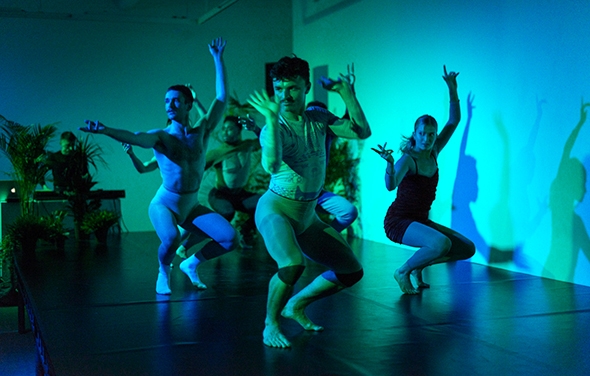
Holly Blakey’s Some Greater Class at Hales Gallery (photo © Hales Gallery London)
The convergence of art gallery and dance performance is an interesting one, especially when the dance is presented as an exhibit. At the invitation of Hales Gallery, choreographer and director Holly Blakey brings her experience of performance art and music videos to the gallery space in the form of Some Greater Class. Dance in this kind of setting is not new but Blakey’s presence here goes beyond the performance itself. One of the preoccupations of Some Greater Class focuses on the relationship between High Art and pop culture, or rather on the perceived value systems and expectations of the two. By transposing on to a formal gallery setting a popular commercial dance form based on the pop music video and with DJs Gwilym Gold and Darkstar on hand to provide the music, Blakey invites our attention to shift from subjective association to objective appreciation.
Against a wall of Hales Gallery the narrow temporary stage with potted plants at either end acts as a frame for the dance, more like the frame of a painting than a theatrical proscenium. Blakey’s dance is contained mostly within the frame using the columns of the gallery as additional props. She nevertheless plays with this formal display, having one of the dancers step off the stage at one point to continue his dance among the galleried throng and occasionally sitting her dancers on the front of the stage, observing members of the audience observing them. The fourth wall is thus perforated but not entirely removed; the onlooker, by close proximity to the action, also participates. The audience is seated close to the stage as at a fashion show and the six dancers (Luke Crook, Chester Hayes, Grace Jabbari, Naomi Weijand, Busola Peters and Ted Rogers) take their places at the beginning like models on a catwalk. The costumes by Blakey and Hannah Hopkins are a layered patchwork of skin-coloured trappings over bare skin or body tights, a commercially sensual image that hides as much as it purports to reveal.
Blakey’s mediation between pop culture and High Art is a provocative blurring of the edges of both art form and perception but it comes with its own artistic risk. Some Greater Class does not simply place a pop music video in a highbrow establishment to test perceptions; Blakey has distilled elements of commercial dance into an expressive choreographic form that points to but does not mimic the original. It is as if she has gone some way to bridging the perceived gap in values before presenting her thesis. But on reflection it is the interplay of ideas that comes across more compellingly than the performance. Some Greater Class delivers a quality of movement that is intimate bordering on narcissistic with a heady mixture of gestures from bodybuilding, martial arts, yoga as well as stylized sexual play. At the end the six characters take stock of their exertions with a blank stare that speaks of euphoria or exhaustion or both; Some Greater Class functions according to its own hedonistic rules and fades out, presumably to start again at the next opportunity. In bringing the characters and the movement (and the DJs) to a gallery, Blakey succeeds in framing Some Greater Class as an artifact but does not translate it fully to the stage; it thus sits ambivalently between the two. It reminds me of the ubiquitous selfie: a camera (and a universe) turned on itself in which the viewer and the viewed are one and the same. It is a picture with significance for the participants and for those related to them but it lacks the detachment that marks a work of art.
Posted: August 14th, 2015 | Author: Nicholas Minns | Filed under: Performance | Tags: Casson & Friends, Justine Reeve, Katie Green, PDSW, Purple HR, Robert Guy, Tim Casson | Comments Off on Casson & Friends, Selling Secrets Part 3: Office
Casson & Friends, Selling Secrets Part 3: Office, Purple HR, Bournemouth, August 7

Robert Guy in a previous manifestation of Selling Secrets (photo: Ian Abbott and Casson & Friends)
The idea behind Tim Casson & Friends’ Selling Secrets is simple: gather information from a group of people and translate that information into a dance. It is the basis for Casson’s pop-up performances, The Dance WE Made and he did a variation of it for his Wild Card evening at the Lilian Baylis Studio. He added themes to the idea in two series of Selling Secrets — Part 1 in a hotel and Part 2 in a pub in Bournemouth — through commissions by Pavilion Dance South West. So successful were they that PDSW has commissioned a sequel, Selling Secrets Part 3: Office, hosted at Purple HR, a small office squeezed into what was once a neat, manila-coloured seaside town villa. It is possibly the first world premiere of a dance theatre work to be performed in an office.
For Office, Casson & Friends — the incomparable trio of Justine Reeve, Robert Guy and Katie Green — collected insights (and the odd choreographic suggestion) about office culture from fourteen people and the entire process, from the first interview to the first performance took five days. Notwithstanding, there is a maturity and cohesion about Office that takes the themed pop-up form to a new level. In short it’s a winner and opens up a host of possibilities for future performances: its portable nature and susceptibility to local stories means it could be coming to an office near you.
The framework of Office is a guided tour of the building for as many people as can sit around the boardroom table. Purple HR is a real company, but Casson & Friends’s surrogate, Mauve, is a tiny creative enterprise that designs, manufactures, hand folds and distributes birthday cards. Once inside we find out we are there not because we booked tickets but because we had won the first round of Mauve’s design competition.
Guy greets us at the front door and ushers us in to the boardroom where he preps us for the tour. What he doesn’t tell us in words he parlays into a gestural dance that snakes and twists, darts and smiles around the truth with a comic improvisation that has us all giggling helplessly. Before the tour he has us look at the desultory examples of cards on the shelves with a view to competing in the final round of designing a new birthday card. The card stock, colours and stickers on the table look as if they are lifted from the local kindergarten. We only have five minutes to complete the task (so Guy can see how we work under pressure) and the winning design, he tells us, will be accepted into the company’s catalogue.
This much is artifice, but the rest — the personality traits of the owner and her employees, their interactions and the events we witness on the office tour — are a synthesis of the real stories and anecdotes Casson & Friends collected. We have to pinch ourselves to remind us of this because reality is (far) stranger than fiction. If reality wasn’t so bizarre (and hilarious) it would be easy to see Selling Secrets as a slick parody or an easy satire of office life. Reeve, Guy and Green are gifted translators bursting with conviction but the material they are translating is nothing short of surreal which gives the performance a double edge of trenchant wit and underlying veracity.
Selling Secrets constantly crosses the line between an interactive presentation of the office environment and a performance of the anecdotal material, seamlessly flowing from one to the other and back again. Guy is telling us how dedicated and upbeat the team is just as a brooding Green mopes in with her lunch box. Reeve, the manager, comes in to demonstrate her control by making sure Guy is following the correct procedure, which he already has.
After the five-minute design task is officially closed, Guy invites us to see how the office he shares with Green handles the company’s distribution and logistics. We shuffle down the corridor and bunch into the office to see how skilled Green is at putting callers on hold — especially Guy’s mother — and then dancing to the hold music. Before any work is accomplished she and Guy encourage each other to take an early lunch at their desks. Reeve appears like a vengeful ghost outside the window spying on their activities. Amid all the office culture is a moment of pathos. It is Green’s birthday and nobody has remembered (perhaps it is this anecdote that suggested the nature of the company). She invites us outside with her birthday cake and a single candle; she lights it and asks us, in a tone reminiscent of Eeyore, to sing Happy Birthday. Through the window we see Guy’s chagrin as he rushes into rearguard action.
The anecdotes Casson & Friends have collected seem to run along two themes: the insidious control culture of authority and the many surreptitious ways of surviving it. On our final stop in her office Reeve gives a Chaplinesque performance of masterful bloviation that illustrates the link between the two.
Guy rescues us by ushering us back into the boardroom where he has hastily assembled party hats (which we put on), crackers (with which we arm ourselves) and lurid cupcakes (which remain on the plate). Green walks in to enjoy the surprise of seeing streamers and hearing Happy Birthday once again, with gusto.
And the winner of the design competition? My card was chosen. Reeve hired me and fired me within the space of five minutes. It was a narrow escape.
Posted: August 10th, 2015 | Author: Nicholas Minns | Filed under: Performance | Tags: Caitlin, Chapter, Deborah Light, Dylan Thomas, Eddie Ladd, Gwyn Emberton, Neil Davies, Sion Orgon, Thighpaulsandra | Comments Off on Light, Ladd & Emberton: Caitlin
Light, Ladd & Emberton: Caitlin, Chapter Arts Centre, Cardiff, August 5

Eddie Ladd wrapped around Gwyn Emberton in Light, Ladd & Emberton’s Caitlin (photo: Warren Orchard)
“My husband was a very famous poet and I was going to be a very famous dancer,” says Caitlin wistfully at the beginning of her eponymous show as she revisits the ambitions and disappointments of her life with Dylan Thomas. It was a famously unfaithful, fractious yet inseparable relationship recorded in Caitlin’s Leftover Life to Kill and in numerous biographies of Dylan. In their recreation of the relationship, however, the team of Deborah Light (director), Eddie Ladd (Caitlin) and Gwyn Emberton (Dylan) decided not to follow the well-trodden textual paths but instead built a high energy, highly physical language to convey the passions of these two lives to the point of overflowing. It is not a pretty work of artistic-romance-turned-alcoholic-upheaval but a brutally subjective reconstruction that makes use of the dispassionate, mass-produced folding chair as an extension of the body to express the rage, subservience, servitude, consummation and consumption that infused, confused and ultimately broke apart these two lives for ever.
The folding chair is in itself emotionally neutral but something happened during rehearsals for Caitlin to make the folding chair a central metaphor for the entire story. Upturned and backwards, it becomes a low highchair on which Emberton turns quietly reading Agatha Christie and stuffing sweets; it is used on different occasions as a straightjacket, a noose, a yoke, even Dylan’s penitential cross. Folded, stacked and loaded on Ladd’s back or balancing on her head it is her intractable burden; laid on her supine figure it becomes a self-imposed grave and tombstone on which Emberton lays his manuscript in hommage. It is a token bed, a dais for Dylan’s recitals and unfolded and precariously stacked, a fêted throne from which he topples and crashes. The chairs are also thrown, scattered, refolded and stacked like pieces of a desperate game in tune with the narrative tide.
As we arrive in the studio at Chapter, however, the red or grey chairs form a harmonious circle in the centre, a stasis. We occupy only the twenty grey chairs; on some of the red ones are assorted plastic cups, sweets/pills and a rumpled manuscript. The circle takes its inspiration from the form of an Alcoholics Anonymous meeting with which Caitlin became familiar some 20 years after Dylan’s death in 1953. “My name is Caitlin and I’m an alcoholic,” says Ladd at the end, but the end is a lifetime away from the beginning.
Emberton is sitting in the circle as we enter to take our seats. He is dressed casually, inconspicuously, and looks as if he is waiting, like us, for the performance to begin. Ladd walks in with an almost imperceptible flounce in a red tartan skirt and an embroidered velvet top the colour of blood (costumes by the subtly imaginative Neil Davies) and sits on her hands to deliver her matter-of-fact opening line. She engages her audience directly, looking around at us as if we are all complicit in her situation, knowing we know what she knows but determined to refresh her side of it with grim familiarity. Emberton is immediately drawn to her as if he is seeing her for the first time and runs to plant his face in her lap. This is the connection that sets their fate; he will return to this place as often as he needs absolution, forgiveness, reassurance, sex. ‘It was going to be a truce between his brain and my body’ she says as she wraps herself around his head like a scarf, his mouth filled with her thighs. They collapse, not for the last time, under the weight of each other’s passion.
This is Caitlin’s story, her circle of chairs and we are her guests; Dylan is merely the argument, the flashback, the colour and flame in her story. Emberton’s focus is fixed on Ladd; his eyes are dead to all but her. She is the one who engages us directly with her eyes and irony: “He wrote three poems that year; I gave birth to our third child,” she bristles, her motherly activities contrasting with the famous husband standing on a chair silently intoning his immortal words. “We were supposed to be equal”, she adds, withdrawing a chair rudely from the circle while Emberton pushes his to the centre. The harmony of the chairs is broken and the domestic tension breaks with it as they both bounce off the walls in inebriated, screaming abandon and crawl on all fours with the empty plastic cups held tightly in their teeth. The soundscore of Thighpaulsandra manipulated by Sion Orgon punctuate the action with unnerving accuracy.
After more drinking and pills and vomiting the chairs go flying; ours are the only ones left in the circle. “That year he went to America for the first time” Ladd informs us, rocking a chair like a cradle, while Emberton spins dizzyingly outside the circle. In between building his throne of chairs on the other side of the Atlantic (from the wreckage of chairs in the family circle) he returns to Caitlin to be ‘tickled by the rub of love’ which inevitably turns into a brutal battle, reconciliation, head rubbing and departure on yet another North American tour. At four chairs high Dylan’s throne finally topples and Emberton crashes to the ground; Ladd in a circle that has suddenly lost its tension falls to the floor in shock.
The difference between Dylan and Caitlin is that Dylan was able to transform his desires into words that gained him immortality while Caitlin remained unfulfilled outside her family circle. All she knows is that without her Dylan would not have succeeded. Resigned to this and proud, she thanks us for listening. What she cannot see is that Light, Ladd & Emberton have made her a gift of her chosen art in providing her with a rich body of language she was unable to develop during her life with Dylan.
Caitlin was commissioned by National Library of Wales and funded by Arts Council Wales. It is supported by Volcano, Chapter, Aberystwyth Arts Centre and Borough Theatre Abergavenny. It will be at the Edinburgh Fringe from August 21-30 at DanceBase.
Posted: August 6th, 2015 | Author: Nicholas Minns | Filed under: Performance | Tags: Christiana Ioannou, Cockpit Theatre, Eirini Apostolatou, Euripides, Phaedra | Comments Off on Eirini Apostolatou: Phaedra
Eirini Apostolatou, Phaedra, Cockpit Theatre, August 4

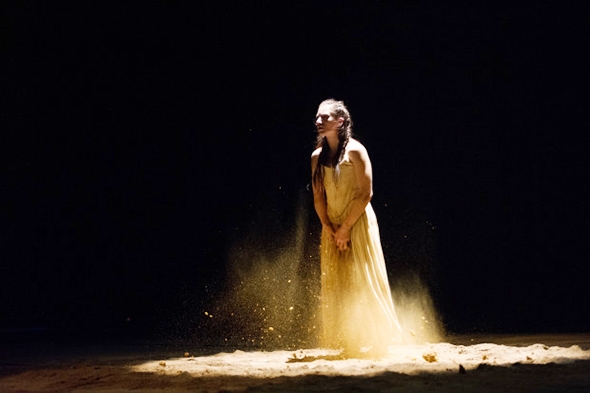
Eirini Apostolatou in Phaedra
Sand is impossible to hold together. Mould it to whatever shape you wish and it will soon crumble; scoop it up in your hands and it will gradually slip through your fingers. Eirini Apostolatu’s performance of Phaedra is built on sand that along with the bone dry, sun-dried branches becomes an extension of her self. Even her costume of a boned bodice over a flowing muslin dress is sand coloured. She is mired in sand, burdened down with it on her entrance and even when she leaves the stage the sand sticks to her feet. Sand is a glorious metaphor for her shifting state of mind, a state that is in the process of falling apart, collapsing, about to reduce into its tiniest components.
The stage at the Cockpit Theatre is small, surrounded on three sides by seating and covered in patches of thick dry sand. In the course of her 20-minutes solo Apostolatou becomes the very sand in which she moves, rising, falling, rolling and slithering with the quality of dry water. Sand muffles sound, too, so Apostolatou’s movements are eerily silent; the only sound comes from the pre-recorded sound of waves (a metaphor of washing or cleansing) mixed with narrated extracts from the ancient Greek play, Hippolitus, by Euripides.
This is where the creative elements begin to come unstuck. Whereas the physical qualities of Apostolatou’s performance are very real (her ability to throw herself into the air, land like a rag doll and resolve the movement seamlessly to the upright again is worth the price of the ticket), the context is almost apocryphal: there is very little in what Apostolatou does to link her inescapably to the story of Phaedra or the story of Phaedra to her. What we see is a woman whose physical contortions — her gestures and postures of despair and regret — reflect an anguished state of mind but they exist as if in a vacuum. There is no history, except what is written in the program notes: we meet Apostolatou at some point on her journey as she staggers in bent under the weight of her burden but we do not know where she has come from. When she leaves the stage she is calmer and more upright than at the beginning as if she has exorcised her demons in the dance and come to terms with her fate but we don’t know where she is going. The performance is thus more like an abstraction of grief and despair rather than a narrative portrayal of an epic character. Perhaps this is what the program notes mean by calling the work a deconstruction of the story of Phaedra (the program notes are not otherwise particularly coherent) but then the work could be titled simply Grief and the context of Euripides would slide through Apostolatou’s fingers as quickly as the sand.
This instability between concept and performance may indicate a divergence between Apostolatou, who is credited with choreography and Christiana Ioannou who conceived and directed the work. Whatever the reason, there is a sense of temporal inertia in the work; it seems to have no beginning or end (the end is so attenuated as to delay any audience reaction because we are unsure it has happened). Another element that reinforces this weak sense of time passing is that despite changes in physical dynamic, Apostolatou’s features barely register the changes. I don’t feel her mind is going on the same journey as her body and it leaves a dramatic gap in expression between the physical and the emotional; real time passes but psychological time barely moves. It is a shame as Apostolatou clearly has the capacity and the intensity but she needs direction that will channel these qualities inside a well-conceived framework.
Posted: August 2nd, 2015 | Author: Nicholas Minns | Filed under: Performance | Tags: Angela Carter, Arbonauts, Carl Robertshaw, Dimitri Launder, Dominique Vannod, Hamish Tjoeng, Helen Galliano, Lee Berwick, Marty Langthorne, Megan Saunders, Rachel Alexander, Rachel Taylor, Silvia Almeida, The Desire Machine | Comments Off on Arbonauts, The Desire Machine
Arbonauts, The Desire Machine, Brunel Tunnel Shaft, Rotherhithe, July 25

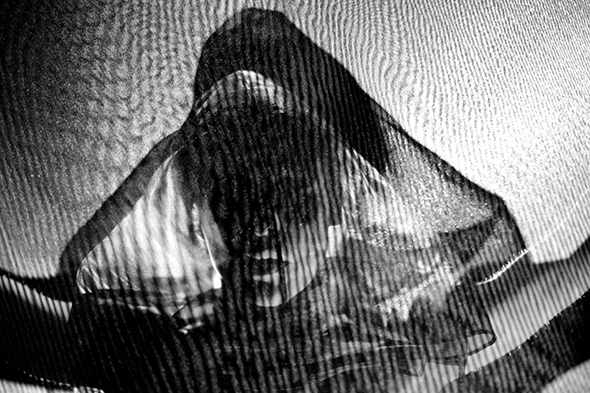
A spectral image from The Desire Machine (photo: Ludovic Des Cognets)
You enter the venue over a brick stile, down two footholds into a very low horizontal shaft, descend a couple of stories by metal staircase into the heart of a circular shaft where a sub-frequency sound throbs in your ears. It is a venue like no other. In the centre of the space an imposing tubular structure (designed by Carl Robertshaw) rises with ropes ascending to an invisible apex and a round stage floor at its base. We stand around it like bystanders wondering what has just fallen to earth. After the lights go down (to a real blackout), it is at the apex of the structure that we see a suspended figure (Megan Saunders) bathed in light, turning and somersaulting slowly, weightlessly. We are craning our necks to watch and I hope it’s not going to continue for too long. The suffused light reveals a structure that is sturdy and at this proximity it looms large. If there is one venue where haze may have been effective it is this one, but the feeling of claustrophobia may already be at the limit. The lighting by Marty Langthorne is subtle enough not to give much away but haze might have eroded the outlines of the structure even more to suggest a platform that is suspended in the air in which the performers are in turn suspended. For now the legacy of Brunel’s industrial machinery hovers over us. Only towards the end of The Desire Machine does the use of strobe lighting effectively remove the structure as well as the outlines of the performers and the vision of bodies in four-dimensional space is stunning.
For now the figure suspended in Lee Berwick’s low frequency sound seems like a metaphor for suspending our own conceptions of what The Desire Machine might be. We are all swimming and neither Dimitri Launder nor Helen Galliano, the creative directors of Arbonauts, are going to offer us a hand. They are taking us on a sensory journey where there are no dots to match up, no rational thoughts to guide us and no text that we can piece together into a narrative. We are floating on our own senses.
The light fades on Saunders and from the darkness the figure of Rachel Alexander in a translucent white wedding dress (the ‘bride’) emerges into the light turning like a mechanical doll on a music box in the centre of the floor. As she turns she looks at the audience through pale eyes from a pale face, her arms bending at the elbow only, a minimal semaphoric communication, the heartbeat of a cold spectral being. Even her speech is mechanical; she mouths snippets of text and the words are reproduced through the speakers. The text is the only clue to the inspiration behind The Desire Machine. As a creative process, Launder and Galliano start with text before working on images; the movement then emerges from the images and finally they research a venue in which the whole artistic edifice can be installed. Perhaps because the final product has a life of its own they are not forthcoming about the source, but having seen The Desire Machine twice, I want to fill this conceptual stage. The snippets of text lead me to Angela Carter and her surreal novel, The Desire Machines of Doctor Hoffman. I’ll come back to Carter later as there is a lot more sensual information to glean from the performance first.
A woman in a latex top and black shiny jodpur pants (Dominique Vannod) rises on to the platform and circles in the opposite direction to the bride and then a third siren (Silvia Almeida) joins, all three looking at us intensely from the inside of their circling desire machine. What exactly is the relationship between us? I have the impression of watching a hologram, an unattainable image or mirage of a peep show playground of desire but the pedestrian (however carefully they step), mechanical pace falls short of the illusion (Launder and Galliano write of harnessing the idea of an 18th century zoetrope, which is closer to the cylindrical nature of the structure).
The costumes by Rachel Taylor have ‘erotic’ sewn all over them but they have a prosaic quality that reminds me too much of the artifice. It is a quality that undermines The Desire Machine: to arouse desire — or the illusion of desire — in the audience (I am assuming this is the idea) desire has to be manifest in the performance. The signifier (in Barthes’ term) is there but the signified does not fully register. Like the soundscape, where pockets of intensity give way to pockets where it is relatively calm, the visual and physical language can be powerful — notably in the muzzled, muscled, mantis-like Vannod preying on the heads of two colleagues — but it is not consistent throughout. Hamish Toeng suspended on the ropes is more tautly expressive than his supine interpretation of perpetual motion that has lost so much of the erotic as to fall short of calisthenics.
The result of this imbalance between idea and performance is more esoteric than erotic, which points away from desire in a direction that is too vague to interpret; the destination is clearly marked but the signpost is not facing the right way.
The Desire Machine is nevertheless an ambitious project that attempts what Angela Carter created in her novel, a meeting of ideas and images bordering on the surreal that underline and undermine societal attitudes towards desire. The language of both the novel and the performance resists classification, and even if the resonance of the written word speaks to my imagination more powerfully, the promise of The Desire Machine, pushed further in its imagery, is intoxicating.
Posted: July 31st, 2015 | Author: Nicholas Minns | Filed under: Performance | Tags: Brian Ellsbury, Daniel Whiley, Danilo Moroni, Ellen Williams, Faith Prendergast, Karl Fagerlund Brekke, Morfydd Owen, Sally Marie, Sweetshop Revolution | Comments Off on Sweetshop Revolution: I loved you & I loved you
Sweetshop Revolution, I loved you & I loved you, The Place, July 30

Faith Prendergast, Daniel Whiley and Karl Fagerlund Brekke in I loved you & I loved you (photo: ©Danilo Moroni)
I had already fallen in love with the title, the story of Welsh composer Morfydd Owen and the publicity image by Danilo Moroni of Faith Prendergast, Karl Fargerlund Brekke and Daniel Whiley that heralded the new work by Sally Marie but having had the opportunity last night to see its work-in-progress form as part of Fringe at The Place, I can say I loved you & I loved you goes beyond my expectations. Let me count the ways.
The way Prendergast anticipates the first note of music with a subtle turn of her head after which she inhabits the music and the music inhabits her as if she is the composer (which she is). The way she moves and the way her eyes make her movement an entire story with the emotional breadth of a tragic life. I loved you & I loved you is a dark work about a beautiful and gifted composer who at 26 died mysteriously on a kitchen table at the hands of her husband, Ernest Jones, but Prendergast brings out the simple joy and beauty embedded in the music (played by Brian Ellsbury) that keeps the light from dying.
The way Daniel Whiley (as Ernest Jones) matches Prendergast in sensitivity. Whiley has a powerful physique matched by an intelligence and humility that remind me of Paul White. Like Prendergast he illustrates his story through his eyes and head while his body shapes the emotions. Initially he shares Prendergast cheerfully enough with his rival for her affections, Fargerlund-Brekke, but gradually reveals a streak of menace. His solo of bare-chested, breathy exertions shows a contorted, analytical soul who is soon consumed by the sexual theories (as a psychoanalyst Jones was a close associate of Freud) that he demonstrates in a self-absorbed, rhythmical anal dance.
The way Fagerlund Brekke (as Elliot Crawshay-Williams, ‘the man she longed to love’) plays a half-hearted game of tennis with Whiley in the garden as he smiles his way through his coy, self-deprecatory story that he delivers with more conviction than his serve and pisses off his opponent no end. He is a gentle romantic unaware of his rival’s morbid preoccupation with theories of control. His role in the work’s story is cursory at this point, but in the three weeks before Edinburgh Marie promises to bring it to the significance it holds in the title.
The way soprano Ellen Williams colours the music and the way Ellsbury plays Owen’s works on the upright piano (he is the first pianist to record Owen’s solo piano works). And the way Owen herself phrases her music with both strength and gentleness.
And finally the way Marie has entered into this story with her entire creative being and has not only drawn the elements together in a poignant dance theatre production but has filled it with a love of and admiration for her subject. That’s why the photograph, the title, the story and the performance have a creative unity that doesn’t lie. This is a gem.
I loved you & I loved you is co-produced with Coreo Cymru and Chapter in association with Galeri, Caernarfon and National Theatre Wales and supported by both Arts Council England and Wales
Posted: July 28th, 2015 | Author: Nicholas Minns | Filed under: Performance | Tags: Anuradha Chaturvedi, Avid for Ovid, Bikram Ghosh, Burton Taylor Studio, Ffin Dance, GOlive, Jeremy Thurlow, Marie-Louise Crawley, Meena Selva Anand, Oxford, Sue Lewis, Susan Kempster, Susie Crow | Comments Off on GOlive in Oxford
GOlive, Burton Taylor studio, Oxford Playhouse, July 18

Susan Kempster in My Own Private Movie (photo: Maurizio Malangone)
Critic turned critic-entrepreneur Donald Hutera is creating and curating opportunities for dancers to perform who might otherwise have few occasions to show their work. Oxford is a first for GOlive and there is a further outing at the Chesil Theatre in Winchester on July 24. The venues are small — the original GOlive venue at the Lion & Unicorn Theatre in Kentish Town holds 60 people and the Burton-Taylor studio seats 50 — but their intimacy works well for the small-scale works Hutera is presenting. One of the advantages of this proximity is the value given to the subtleties of communication; there are elements of this evening’s program that provide a master class in the art of integrating the head and eyes in the moving body, a vital aspect that is all too often overlooked in dance training.
When Anuradha Chaturvedi performs her solo, Quicksilver, to a score by Jeremy Thurlow, her dancing is not only attuned rhythmically to the music but has a refreshing clarity of expression because her eyes, head and hands are in constant communication with the rest of her body. She gives the impression of being centred and focused from within and there is a direct line of communication from inside to the audience. I am reminded of something Henri Cartier-Bresson said about a photographic image: it is formed of a line between they eye, the heart, and the head. In a photographic image that line stops at the plane of the image; in dance it is carried through the entire body. In the duet Chaturvedi dances with Meena Selva Anand, Silent Melody, to music by Bikram Ghosh, the same elements are present but there is an added complexity — and beauty — in that the two dancers are communicating with each other at the same time they are communicating with us. It is mesmerizing.
Marie-Louise Crawley performs as part of Avid for Ovid, an umbrella title for a new ensemble of Oxford area dance and music artists who bring ideas and methods from Roman pantomime to the telling of ancient myths. When she wears a neutral mask for her solo, Myrrha, she makes her body express what the face cannot but her head with its smooth, china-white exterior is also expressive because it is precisely tuned with the rest of the body. Crawley spent six years performing with Ariane Mnouchkine in her Théâtre du Soleil so she knows the rigour of and the responsibility for working with the mask. It is fascinating to see how the very lack of innate expression in the mask — its animal-like emotionless state — contrasts with the body’s emotional turmoil. Through Crawley’s articulate arms and expressive plastic shapes we can feel her inner workings of fear and despair in the telling of her incestuous story. Her hands on her womb become a leitmotif of birth and of the unrelenting hand of fate.
Susie Crow, a stalwart of the Oxford dance scene, is also instrumental in Avid for Ovid; her personification of Tisiphone is an instructive contrast to Crawley because while she has no mask she finds a stillness in her face as if it is one. Crow, who danced with the Royal Ballet, has a naturally classical line and she constructs her solo on the spiral that is as present in the classical fifth position as it is all the way up the body into the head and shoulders. Crow mastered this form some time ago and relishes in the freedom it gives her to move. Tisiphone is a fury in classical legend and although Crow herself hardly fits the description, her movement conjures up Tisiphone’s fiery character in the forceful sweep of her choreography. Malcolm Atkins’ lovely score for both pieces colours the dramatic elements in a way that informs the movement without dictating to it. Unfortunately I missed the third Avid for Ovid segment by Segolene Tarte, who performed Lyacaon the night before.
The strength of Sue Lewis’s female trio, Fascination, is in the physical drive of Catrin Lewis, Effie McGuire and Natasha Wade but is undermined by its weakness in communication. Perhaps Fascination suffers from its juxtaposition to the four previous works because it is immediately apparent that the movement of the dancers’ eyes and heads is focused inwards (if anywhere), which places the audience in a similar relation to a viewer in an art gallery. Interestingly, Fascination is based on the recurring pattern of three women in Picasso’s paintings but the spatial tension that keeps his women on the canvas does not hold the choreography together on the stage. The elements Lewis has taken from these paintings and woven into her choreography express a purely physical realm — even Adrian Corker’s music seems to flow by on another plane — that has lost something in translation.
The evening begins with Susan Kempster’s My Own Private Movie, a conceptual work about personal communication in a wired environment saturated with iPods, iPhones and social media. At the start of the performance, Kempster hands each member of the audience a mini iPod with a pre-recorded track of music, text and, for some, instructions. She apologizes in advance that some of the iPods may not work, in which case there is nothing to be done but listen to the performance in silence. Ironically Kempster’s own iPod malfunctions at the moment she signals all of us to turn on the device, which seems to feed into the theme perfectly. Those members of the audience who receive instructions descend to the stage, change places, turn and wait, listening for the next instruction. Their vacant expression is indicative of inner process, and Kempster’s idea is to show us the contrast between that inner process and being fully in the external reality. Because she is the only one without an iPod, her role is rather more poetic than it might have been as she stops to listen for signs of life, for a sense of community with her wired cast; she is the only one who is free to act. It shows in the eyes and head.
Posted: July 22nd, 2015 | Author: Nicholas Minns | Filed under: Performance | Tags: Danilo Caruso, Domenico Angarano, Faith Prendergast, Family Portrait, Greenwich Dance, Karl Fagerlund Brekke, Karolina Kraczkowska, Leila McMillan, Martha Passakopoulou, Monsur Ali, Paolo Fiorentini, Typhaine Delaup | Comments Off on Leila McMillan, Family Portrait
Leila McMillan, Family Portrait, The Borough Hall, Greenwich Dance, June 12

Family Portait (photo: Manuel Vasquez)
“What moves me is the actor who can move me, if only for an instant. True theatre is a balance between truth and poetry. “ Ariane Mnouchkine
If, like me, you hadn’t heard of the contemporary dance technique of Flying Low and Passing Through, you can look online for founder David Zambrano to get a full account of what he teaches. Briefly, he discovered over the course of rehabilitation for his injured feet how to use the floor to develop the dynamics of the rest of his body. Once he had regained the strength in his feet, Zambrano developed his technique that his friends jokingly referred to as Flying Low. Passing Through is a further development of his technique through improvisation. Choreographer Leila McMillan teaches the technique and has based her new work on its principles, though Family Portrait is perhaps less a demonstration of the technique as it is a framework for the improvisational play of one-upmanship that McMillan and the cast have developed.
It is hard to imagine a more heterogeneous family than this one: Faith Prendergast, Karl Fagerlund Brekke, Karolina Kraczkowska, Monsur Ali, Martha Passakopoulou, Typhaine Delaup and Danilo Caruso. McMillan clearly relishes the diversity of the performers, not only of their characters but of their physical attributes — most noticeably the disparity in sizes between Brekke and Prendergast. What unites them is a wicked sense of humour that Paolo Fiorentini has brought out in his costumes topped with a selection of rakish hats that make these children chic and colourful on top of their natural exuberance. The set by I. Carlos is enclosed on three sides by banks of seating in The Borough Hall at Greenwich Dance, a stage emptied of furniture except for guitarist Domenico Angarano’s seat and musical equipment in one corner. Ben Pacey and Emerald Faerie light the stage to the intimate scale of the family with a selection of floor lamps and hanging chandeliers created by Faerie herself.
Silence descends on the room, a long silence in the dark broken by the creaking hinges of a metal door and the sound of scampering feet. The siblings emerge from the shadows in a tight group with what seems like trepidation but each is already wondering how best to upstage the others. This is no collection of shrinking violets; the stage is their frame and they make a point of presenting their best face to each of the three sides of the auditorium as if posing for a photographer. Each successive pose becomes a little more complicated, elongated and manipulated as the improvisation develops according to the machinations of each character. Delaup soon emerges as a provocateur, always smiling even while she is obstructing someone from the frame or throwing herself into it. Kraczkowska is the eccentric, duly unconcerned with all that is going on around her but managing to take centre stage whenever possible. There is something of the clown in her that permeates the flying low and passing through, giving it a character that is all her own.
Angarano’s guitar accompaniment enters into the sense of fun, plucking notes and playing riffs on the behaviour of the family, colouring it as well as taking it on a journey. In a sense he wills the dancers to continue without directing them.
The opening section is quite slow and subtle as the performers attune to each other’s movement tics and traits but the improvisation soon starts to open up as Prendergast and Passakopoulou drag Delaup out the frame and the subsequent groupings become more hilarious and bizarre: Brekke is upturned, the hats are passed around, Kraczkowska removes Prendergast by her overalls as if she is a carrier bag and there are headlocks and tripping over each other in the clambering for position. The Japanese have a saying that the nail that sticks up is always beaten down, and Brekke seems to suffer from the truth of this as he is cuddled, straddled and bent over to the height of his siblings. He subsequently uses his height to disguise himself as a lampstand until Kraczkowska tries to lift him into the light socket. Passakopoulou presents the lining of her jacket as a bullfighter’s cape, Kraczowska delivers a breathtaking improvisation in the middle of the bustle and then everyone is running. Angarano gets swept to his feet and enters into the rhythmic swirl as the children fly around the room. The hustling and scurrying reaches a climax when Brekke throws himself to the ground in what appears to be a series of fits. The mood changes to one of inward contemplation and the more extrovert siblings begin to tire. Ali and Caruso, like late developers, start to emerge into the light but nothing, it seems, will tire Kraczkowska’s imagination and drive; she makes wings of Passakopoulou’s shirt, picks up Prendergast again and tries to plug her into one of the lamps and finally puts on all the hats, framing herself between two lampstands as the others withdraw to watch the remnants of their family portrait. The lamps dim, Angarano resolves the music beautifully and all is quiet again.
For those who missed it in performance, there is a showing of Family Portrait on film on July 31
On December 3 Leila McMillan is curating a Wild Card evening at the Lilian Baylis