Posted: March 11th, 2016 | Author: Nicholas Minns | Filed under: Festival, Performance | Tags: Antonia Jiménez, Flamenco Festival, Inma Rivero, Ismael El Bola, José Maria Velázquez-Gaztélu, Marco Flores, Mercedes Cortés, Miguel Lavi, Olga Pericet, Paso a Dos, Sadler's Wells, Victor ‘El Tomate’ | Comments Off on Marco Flores & Olga Pericet, Flamenco Festival London
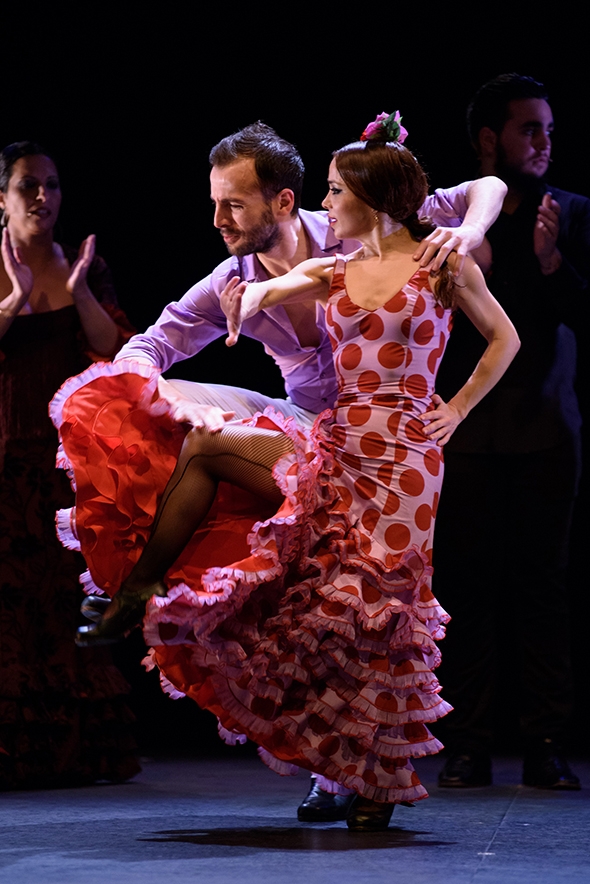
Marco Flores & Olga Pericet, Paso a Dos, Flamenco Festival London, Sadler’s Wells, February 27

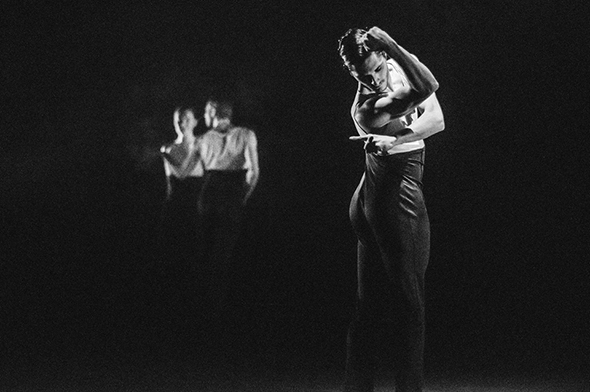
Marco Flores and Olga Pericet in Paso a Dos (photo: Paco Villalta)
Marco Flores & Olga Pericet’s Paso a Dos is part of London’s Flamenco Festival, a mighty river of Spanish culture merging with the mineral springs of Sadler’s Wells. Now in its 13th edition, the festival is a two-week immersion in what Alistair Spalding calls ‘the best flamenco dance and music performed today.’
The origins of flamenco lie deep within the history of Spain. Its four elements are voice (cante), dance (baile), guitar (toque), and hand clapping, foot beating and shouts of encouragement (jaleo) all connected through what is called duende (soul). Although dance is just one element of flamenco it is the most readily recognisable: the arched back and arms, sharp, steely lines, shapely costumes, florid gestures of the wrists and hands are all signifiers of its long tradition. What we see tonight is flamenco in a contemporary theatrical setting in which tradition and commercial development are combined.
What is apparent in Paso a Dos is an interesting contrast: while the musical element still evokes the rough depths of emotion, of pain and suffering from which flamenco arose, the dance is refined and polished. When the singers in Paso a Dos draw up such rich and visceral sounds from their depths it is as if they are coming from another time and place, sometimes uncomfortably so. There is nothing uncomfortable about the dance, however, which is rich in its smoothness and litheness without any visible reminders of the suffering in its musical accompaniment.
This is immediately apparent in the opening section where the six musicians are seated next to each other. When Ismael El Bola begins to sing his voice gives form to a contorted dance of its own; his facial and corporal gestures seem to come directly from the passion of the song. When Flores and Pericet enter they strut through the music in a line of elegant stretch that winds up like a spring ready to release. And release it does, in flashes of mercurial posture and riveting beaten foot rhythms while the arms sing like a melody. The two forms together suggest that the voice is the rough earth from which the elegant flower of the dance emerges in its beauty and sensuality. These levels of expression are what make flamenco so complete.
And yet there is something in Paso a Dos that is less than compelling as a theatrical performance. Interestingly, it ‘originated from an idea by poet and flamencologist José Maria Velázquez-Gaztélu’ as an illustrated conference on the art of duo dancing in which the poet’s words alternated with Pericet’s and Flores’ dance. The two dancers subsequently ‘developed Paso a Dos, turning it into a dance show.’ So the idea of the dance developing out of the music is here turned on its head and the integrated experience in which all the elements of flamenco arise from the same source is reduced to the piecing together of elements under a single idea: the show. The bland entrances of the dancers are the unfortunate vestige of the lecture demonstration.
There is no lack of virtuosity, however. Pericet and Flores can hammer out the fastest beats and turns, and their partnering is a passionate display of precise attention. When Flores places his hand on Pericet’s waist or shoulder, he is not simply holding her but communicating with her through his fingers that continue a dance of their own. Pericet’s solo simmers with suppressed energy until she lets fly with her feet and swirls her long dress like an ornate and very lively fishtail. She expresses a range of emotions in her dances, while Flores, ardent as he is, tends to maintain a similar register throughout. The same cannot be said of the musicians: the two guitarists (Antonia Jiménez and Victor ‘El Tomate’) strum and pick their way through Spain with melancholy beauty and fire, while the four singers (El Bola, Miguel Lavi, Mercedes Cortés and Inma Rivero) each wrench from their bodies the most exciting vocal shades and rhythms; Rivero seems to exorcise her words with her fists. Each song, each instrumental solo or duet is rich in expressive power.
So while all four elements of flamenco are present in Paso a Dos, each performed by artists at the height of their powers, it is the form of the show itself that disappoints; its overall effect falls short of being any more than the sum of its parts.
Posted: March 4th, 2016 | Author: Nicholas Minns | Filed under: Interview | Tags: Alistair Spalding, Andy Hamer, Claire McCue, Evelyn Glennie, For Now I Am, Jamie Wardrop, Kitty Lunn, Marc Brew, Ruth Mills | Comments Off on An interview with Marc Brew
An interview with Marc Brew

Marc Brew (photo: Andy Ross)
How does a dancer in the formative stages of his performing career deal with an accident that leaves him paralysed from the chest down? Marc Brew had trained at Victorian College of the Arts Secondary School in Melbourne, then at the Australian Ballet School where he performed as an extra in Australian Ballet productions. His first professional engagement at the age of 18 was with P.A.C.T. Ballet in South Africa but it was there that he was involved in a car accident in which three of his friends were killed. Waking up in hospital with a white sheet over his body he learned that his spinal chord injury at C6/C7 meant he would never again have the use of his legs. “At first I was in denial. I thought, just get me back to Australia and into the gym again and I will be fine,” he laughs. Initially he was not able to move his hands but a lot of muscle strength came back to his shoulders and arms. Rehabilitation proved to be a whole identity shift. “I had to reassess what a dancer was. For me a dancer had to be on his legs, turned out in the hips. I had to stop looking in the mirror.” Brew had a lot of friends who wanted to get him back into a studio. In class one day a couple of dancers in New York came across a young woman who rolled into the studio in her wheelchair. “They jumped on her,” laughs Brew, “and told her all about me.” This was Kitty Lunn, whose career had been similarly interrupted after breaking her back in a fall. As she later wrote, “What I learned was that the dancer inside me didn’t know or care that I was using a wheelchair, she just wanted to keep dancing.” This was the kind of encouragement Brew needed and he travelled to New York to work with her and the company she founded, Infinity Dance. “I had to find a way to translate and adapt my former technique to my present body,” he recalls. “A year after the accident I was still thinking what my legs and feet would be doing.” However, the chair work, floor work and contact improvisation he worked on led him down the path of contemporary dance. Since then Brew has been dancing, choreographing, teaching and speaking around the world.
Brew had always been encouraged to choreograph since his school days. Within two years of his accident he was back in a studio creating and teaching and he hasn’t stopped. “I feel I have come full circle in regard to my practice. Before my accident I set work from my own body but after it my work was more task based. Now I am going back to generating my own material. I teach it to dancers and see what they do with it; then I direct it to bring it all together…My disability has helped inform the way I work…It was strange to work recently with Scottish Ballet. Instead of giving directions for the legs, I would give them upper body directions and let them sort out what they would have to do with their feet… All my ballet training is still there. It’s in my arms. Line, placement and shapes are still there. I just have to find new ways of exploring movement.”
In 2008 Brew created Remember When, the first work of a planned trilogy and at Sadler’s Wells in March he will present the second part, For Now, I Am. Introducing the personal pronoun into the latter title suggests a change in his attitude towards his disability. “I have reached a point of acceptance, which for me means being whole. I love my body as it is now. This is the first time in 18 years that I am showing my body, allowing people to explore it as if it were being examined on the hospital table. I am giving permission to everyone to explore.” Brew started the creative process wanting to explore the notion of being broken. He analysed his body by looking once again in the mirror, coming to terms with being both broken and becoming whole. Through Jamie Wardrop’s video projections, Andy Hamer’s lighting design and Claire McCue’s musical score he uses the analogy of water as an element of ritual cleansing. He also uses X-rays and scans to map his accident, finding a new freedom in working through those painful memories. “With rehearsal director Ruth Mills, I am able to talk about it now. I feel I am moving through it, like a chrysalis being born…Acquiring a disability is different from being born with a disability. Before the accident I was Marc and I still am. I am comfortable with having a disability; I claim ownership over it… Disability creates different possibilities. I hope other people see it in the same way. That’s what I find difficult, how other people view disability…It’s great that Sadler’s Wells is supporting my work and finding ways of communicating the human condition to the audience.”
What about the third part of the trilogy? Brew smiles. “I have some ideas. Maybe the last performance will be my funeral.” More laughs. “You’ve got to have a sense of humour.”
For Now, I Am is at Lilian Baylis Studio at Sadler’s Wells on Thursday 10 and Friday 11 March before embarking on a national tour. The evening is a dual presentation of movement and words, illuminating distinctive artistic practice, entitled Dance & Dialogue. On Thursday 10 March, renowned percussionist Dame Evelyn Glennie and Marc Brew compare creating, performing, and collaborating in their respective art forms. On Friday 11 March, Alistair Spalding, Sadler’s Wells’ Artistic Director and Chief Executive, will be in conversation with Marc Brew on creating dance that reflects life experience.
Posted: March 3rd, 2016 | Author: Nicholas Minns | Filed under: Performance | Tags: Anne-Gaëlle Thiriot, Bruno Humberto, Geneviève Giron, Greenwich Dance, Marc Stevenson, Ottillie Parfitt, Philippe Lenzini, Quests, Tara D'Arquian, Typhaine Delaup, Yann Seabra | Comments Off on Tara D’Arquian, Quests
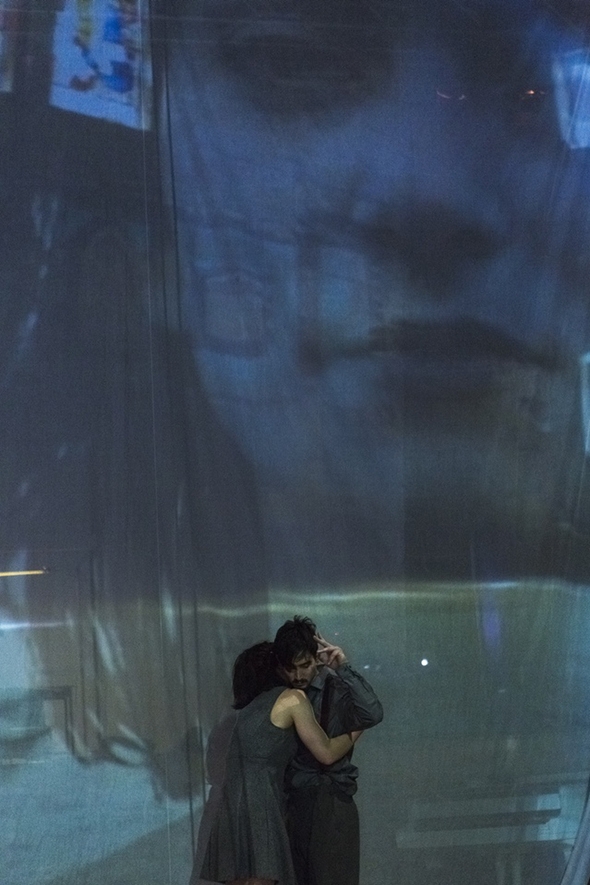
Tara D’Arquian, Quests, Borough Hall, Greenwich Dance, February 18

Anne-Gaëlle Thiriot and Marc Stevenson in Tara D’Arquian’s Quests (photo: Alicia Clarke)
One can’t help but admire the scale of Tara D’Arquian’s Quests, not only its physical embrace (taking over most of The Borough Hall at Greenwich Dance) and its musical scope (thanks to Bruno Humberto and Philippe Lenzini), but its philosophical sweep. The second part of a trilogy which began with In Situ and is yet to be completed, Quests ‘explores the conflict of identity in contemporary society’ though D’Arquian immediately qualifies this by adding, ‘The conflict…opposes humans’ longing to define themselves to the indefinable character of the self.’ It’s a philosophical argument that borrows from Nietzche’s Three Metamorphoses as a filter through which to approach the issue of identity, but if it structures the thinking behind Quests, it is the ambition and imagination of D’Arquian’s dance theatre that clothes it.
The narrative is a ‘fictitious story of a stage director slowly falling into madness after the loss of his wife whilst creating the first piece of the In Situ trilogy.’ This reference to the previous work is where Quests begins in Greenwich Dance’s Minor Hall that Yann Seabra has refurbished as a rose-coloured lounge of an ocean liner. When the audience wanders in to take a seat the performers are already in place, fixed in time, caught in mid-movement at their tables or sitting in their chairs. A bar serves drinks, the noise of chatter and laughter rises around these transfixed characters and a curious little boy walks over to each one to see if they are real. It’s an intriguing start. The playwright (Humberto) and his wife (Typhaine Delaup) are seated at a table on a raised dais in the centre of the room looking into each other’s eyes. The stage is set up for a cabaret show and musicians (Lenzini on guitar, D’Arquian on bass) start to assemble. From their static poses Anne-Gaëlle Thiriot and Marc Stevenson come to life and slowly make their way to the stage. The band starts up and Thiriot delivers a ballad in a rich French voice while dropping flowers distractedly from a bowl. Delaup suddenly jumps up from the table and rushes from the room. Quests has begun in real time. Three veiled beauties waft into the room like muses to inspire Humberto while Ottillie Parfitt as his producer arrives dripping with disdain and drops an envelope of money on the table to get the writer out of his depression and into finishing the new work.
Quests is, like Francois Truffaut’s film Day for Night, a play about the making of a play. In this promenade format, D’Arquian pulls apart the story to put it back together again, sets us loose to explore aspects of the narrative and gives us enigmatic clues along the way that only deepen the mystery. We shuffle through Stevenson’s room, a suicidal bathroom, a noxious vision of Eden in the lobby where Humberto chases his spirited wife out of the theatre into a taxi and back, on through a passage with a pram spattered in blood, a room where one of the muses plays piano and bodies lie under a dinner table of dirty dishes, up the stairs with walls pasted with notes and envelopes, and finally into the main hall where the two aspects of the story collide in symbolism of epic proportions.
Paradoxically the means by which D’Arquian achieves all this are flimsy; it is theatre-by-the-seat-of-your-pants in which the richness of its soaring imagination is in conflict with the naivety of its materials. The struggle of this latter part of Quests is how to make our imagination surmount the means. The contrast in scale between the performers — extended to a cast of almost 30 — and the giant muslin tent that covers most of the Hall is redolent of a religious ceremony and the plainsong chant (and Geneviève Giron’s bright white light) raises the ritual theatre to a contemplative level. But the dispersed action in this large space lacks sufficient tension to keep our focus from wandering to the manipulation of the fabric. There are episodes that overcome this, as when two performers desperately try to communicate while their handlers at opposite corners let them out slowly towards each other on the end of ropes. When Humberto raises his voice, the ropes are let go and the two fall into an embrace. Or when Humberto is playing the white piano like a crazed genius and the three muses interrupt him; while two drag him away a third seamlessly takes over playing his score. But it is the setting of the final duet with Stevenson and Thiriot that gets close to bringing all the elements together and to suggesting the scale D’Arquian has in mind. Using the muslin as a screen for projecting images of In Situ, placing the extended chorus singing a ritual chant behind the (now seated) audience, summoning the author and the producer to resolve the story (the play is a huge success but Humberto is leaving to start a band), and introducing a funeral procession with a coffin outlined in rope, the choreography is a catalyst of resolution in its contrast of sinuous and angular, torso and extremities, and distance and contact. All that remains is a grand anthem of a song while an electric fan in the background sends those mountains of script floating into the air.
Posted: March 2nd, 2016 | Author: Ian Abbott | Filed under: Performance | Tags: Azzurra Ardovini, Barnaby Booth, Carlos Pons Guerra, DeNada Dance Theatre, Ham and Passion, Marivi Da Silva, Phil Sanger | Comments Off on DeNada Dance Theatre, Ham and Passion
DeNada Dance Theatre, Ham and Passion, mac, Birmingham, February 25

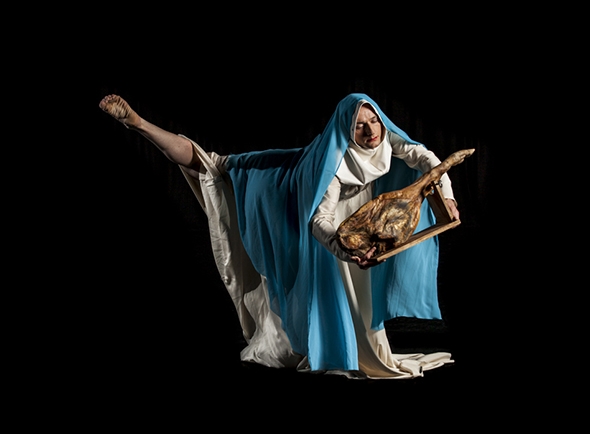
Phil Sanger as the Virgin Mary in Ham and Passion (photo: Joe ‘Boneshaker’ Armitage)
I saw ham.
I saw passion.
I saw Ham and Passion.
Cooking is like painting or writing a song. Just as there are only so many colours or notes, there are only so many flavours — it’s how you combine them that sets you apart. It’s an expression of the land where you are and the culture of that place. – Wolfgang Puck
Carlos Pons Guerra has created theatrical tapas, interweaving three courses with the same ingredients of power, identity and gender whilst managing to concoct distinct and contrasting choreography with a jus of Spain poured over the top. The etymology of ‘ham’ is an overacting inferior performer derived from the late 19th century and linked to the old minstrel song The Hamfat Man from 1863. Amateurs and actors on a low income were forced to employ cheaper substances like ham rind or pig grease to apply their make-up rather than the professionals’ use of sophisticated oils.
As an adventure in extravagant kitsch, Ham and Passion allows us to wallow and question our preconceptions of gender and sexuality by ramping up the absurdity quotient over the course of the evening. From the tender cries of the downtown pearl, Anna La Passionara, to the wanton urges of the Virgin Mary, Pons Guerra firmly directs our gaze on this world, and there’s very little ham fat on show.
Great dancers are not great because of their technique, they are great because of their [ham and] passion. – Martha Graham
Passionara is a three-legged duet between a drag artiste and the titular motionless ham; playing out as a back stage pre-show mini-drama, Phil Sanger prepares to grace the stage, transforming into a bedazzling mirrorball with a dress and knife that winks, flashes and absorbs the light. Sanger is exceptional in finding the maudlin physical nuances amongst the swell of sentimental Spanish songs; combined with a heavily stylised lighting design from Barnaby Booth, we’re presented with the possibilities of how much (or how little) a performer chooses to reveal himself.
Young Man! (inspired by Jean Cocteau’s libretto for Roland Petit’s ballet Le Jeune Homme et la mort) exhibits an enticing duel between Azzurra Ardovini and Marivi Da Silva in the sexual frenzy of post-Franco Spain. The kitchen table and food again provide the scenic anchor as Ardovini and Da Silva oscillate roles between matador and bull, man and woman, full body munching, and ham masturbation while a surrealist stereo soundtrack audibly pans around the stage created an aurally nauseous experience before they march us towards a heroin injecting crescendo.
To say that gender is performative is a little different because for something to be performative means that it produces a series of effects. We act and walk and speak and talk in ways that consolidate an impression of being a man or being a woman.– Judith Butler
It is in the trio (quartet if you count the ham) of O Maria where we reach ‘Peak Ham’ as Catholicism’s very own Virgin Mary (played to sublime comic effect by Sanger) reveals her chastity belt is a little looser than history has lead us to believe. In a heady dessert of fleshy temptation and wild, abandoned hair whipped together by a dominatrix, Da Silva and Ardovini are the perfect physical foil to the simpering Virgin Mary. Gender has been tossed out of the window and what remains is power, temptation and the residue of a fixed identity. O Maria is the newest work in the evening and with the Virgin Mary Pons Guerra has created a character with a wealth of narrative possibilities to develop and explore in the future.
With an interval between each of the three courses my viewing rhythm was disturbed and so was unable to truly sink into Pons Guerra’s Spanish ham opera. Despite the finely crafted environment and extensive programme notes, I felt there was little ambiguity on display and no room for me to manoeuvre emotionally. I wanted my brain to do more; to fill a gap, discover a missing connection — but this fully-formed world asked very little of me. DeNada Dance Theatre’s Ham and Passion coalesces around the kitchen table and the presence of food in a riotous portrait of Spanish life. Pons Guerra has brought a fine set of ingredients for his guests but must be careful of potential choreographic gavage.
Posted: February 28th, 2016 | Author: Nicholas Minns | Filed under: Performance | Tags: 59 Productions, After the Rain, Amélie Gautreau, Christopher Wheeldon, Edward Watson, Ezio Bosso, Federico Bonelli, John Singer Sargent, Martin Pakledinaz, Mathew Ball, Natalia Osipova, Strapless, The Royal Ballet, Within the Golden Hour | Comments Off on The Royal Ballet, Wheeldon’s Triple Bill
The Royal Ballet, Christopher Wheeldon triple bill, February 16

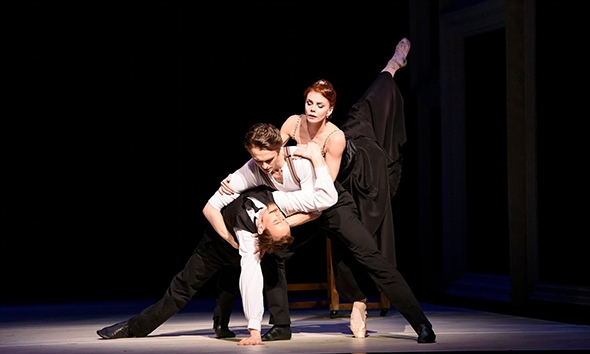
Edward Watson, Matthew Ball and Natalia Osipova in Strapless (photo: Bill Cooper)
When the UK Critics’ Circle National Dance Awards recently voted Wayne McGregor’s Woolf Works the best classical choreography for 2015 I felt ballet had died and been relegated to purgatory. Fortunately Christopher Wheeldon has come along to rescue it with a triple bill for The Royal Ballet that includes the première of Strapless and two earlier works; over the course of the evening Wheeldon builds a salutary image of what the classical language can still say in both traditional steps and contemporary invention, in its musical phrasing as well as in something that has been in danger of extinction in recent years: danced characters, those that emerge convincingly through their dancing.
Strapless is the one commission of the evening but this is the first time After The Rain, created for New York City Ballet in 2005 and Within The Golden Hour for San Francisco Ballet in 2008 enter the Royal Ballet repertoire.
After The Rain is in two movements, both of which are set to music by Arvo Pärt. The first is an interwoven trio of duets and the second, to Pärt’s exquisite Spiegel im Spiegel, is a duet by one of the couples from the first movement. It’s a bit like an A-side which takes on a life of its own — it is often performed by itself — as if there were two distinct choreographic processes in Wheeldon’s mind at the time of creation. The opening movement of After The Rain finds a later echo in Within The Golden Hour; the musical play, the choreographic idiom and the spatial groupings are of the same family. The duet, however, is more ethereal, requiring a flow of two harmonious bodies in a series of seamless shapes that allow an audience to imagine their own dialogue; in this it is reminiscent of Norbert Vezak’s Belong. But in this performance Marianela Nuñez and Thiago Soares seem to add their own commentary to what should be free and dreamlike; it comes across instead as tense and curiously earthbound.
Strapless continues a worrying scenic trend in recent one-act narrative ballets for being opulently overweight. Since dancers are still the same size, the result is a miscalibration of scale, the scenic elements (five changes in 45 minutes) vying with the dancers for attention. Strapless is all about frames — in both society and art — in front of which we see the beau monde of Paris milling around in a state of heightened excitement until one beauty, Amélie Gautreau (Natalia Osipova), is finally enticed on to canvas by painter John Singer Sargent (Edward Watson) — his Portrait of Madame X — with unexpected, tragic consequences for the sitter.
While the drama depends for its climax on the slipping of a strap on an evening dress (the anticipation is intense), the core of the choreography is the tangle of intrigue in the lives of a quartet of principal characters: Singer Sargent is keen to paint society beauty Gautreau but needs the help of her lover (and his sitter) Dr. Samuel Pozzi to convince her to sit for him. Once she accepts, however, Sargent depends on the image of his lover, Albert de Belleroche, to inspire the pose. Sex is clearly the preoccupation from beginning to end but its depiction in the scene between Gautreau and Pozzi (Federico Bonelli) shocks in its clichéd artificiality. By contrast, Wheeldon treats Sargent’s lover (Matthew Ball) with an understated charm and elegance that exudes sensuality without giving him very much to do. The real sex is in the way Gautreau relates to her own image that she hopes will be framed in immortality. This is where Osipova’s characterization, through Wheeldon’s use of her formidable technique and artistry, brings to light Gautreau’s overweening ambition and irrepressible sensuality. The problem is that the role is too circumscribed; Osipova has the capacity to embody a much larger palette in a story that extends far beyond the picture frame.
I saw Within the Golden Hour when San Francisco Ballet performed it in their program C at Sadler’s Wells in 2012 and it didn’t appeal, perhaps due to a last-minute cast substitution. But this evening the performance is qualitatively different; the galvanizing effect on the audience of each successive movement is palpable. Wheeldon’s choice of short compositions by Ezio Bosso for each section (except for the sixth, to the andante from a Vivaldi violin concerto) allows him to weave a complex but playful choreographic line with only the subtlest musical support. Revisiting the opening motifs of After the Rain, three principal couples weave their patterns and shapes with four supporting ones over the seven sections, building up a vocabulary through the accumulation, reproduction and development of basic motifs. There is from the beginning a sense of mastery in the use of space; the large stage of the opera house comes alive with the asymmetric groups and interactions and with lighting and backdrop projections (by 59 Productions) linking to the autumnal colours of the costumes (to the designs of the late Martin Pakledinaz), Within the Golden Hour ensures the unity of its elements. The dancers look good because they are comfortable in the technique both they and Wheeldon understand. The Royal Ballet, as its title suggests, is devoted to the preservation and development of the highest level of classical technique, which is what Sir Frederick Ashton and Sir Kenneth MacMillan upheld. Wheeldon looks remarkably like their natural heir.
Posted: February 24th, 2016 | Author: Nicholas Minns | Filed under: Performance | Tags: Anya, Ben Park, Bethany Edwards, Charlotte McLean, Conor Kerrigan, Daniel de Luca, Edward Hookham, Elena Zubeldia Perez, Eleonora Ramsby Herrera, Evelyn Hart, Fin Walker, Frances Morris, Kyle Olson, London Contemporary Dance School, Me You & Us, Nicole Bowden, Ori Flomin, Tom Roden | Comments Off on LCDS Undergraduate Show 2016
London Contemporary Dance School, Undergraduate Show, The Place, February 3

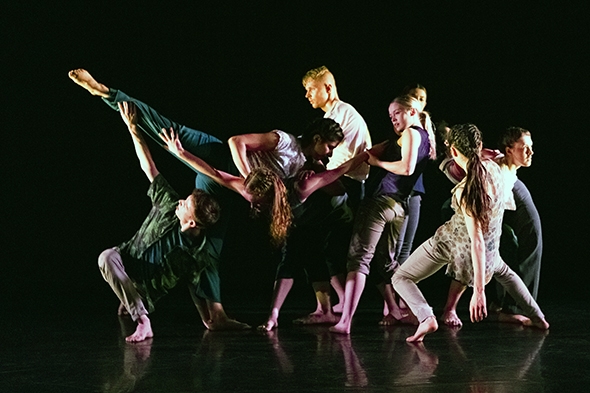
LCDS undergraduates in Ori Flomin’s Things Happen Just (photo: Alicia Clarke)
Undergraduate shows shift the way dance is usually presented. Choreographers come to set work on students and the school in effect becomes a temporary, and quite unique company. Tonight there are three commissioned works for ensembles but the opening pieces are choreographic miniatures by the students on the BA1 Composition course and the BA2 Music & Choreography course respectively.
As soon as Edward Hookham and Conor Kerrigan begin their It’s Nice, Isn’t It? you feel in safe hands. And Hookham’s hands are large, an extension of long arms that he weaves in articulated patterns around his tall frame. It’s Nice, Isn’t It? is a structured improvisation in which Kerrigan wrily comments on Hookham’s improvisation then Hookham on Kerrigan’s. The two are quite different; Hookham has a languid lyricism while Kerrigan is more compact and forceful (‘aggressive’, suggests Hookham). Kerrigan’s desire to interfere with his friend’s improvisation ‘just to see what will happen’ seems in character. He bumps into him, destabilizes him; Hookham stays low, undeterred, and continues his soliloquy in a smaller space. Both performers come across as relaxed and in tune with each other, performing their material with natural ease. A pleasure to watch.
Not to be outdone by the men, Evelyn Hart and Charlotte McLean munch into cake? what cake? with relish for both the Sarabande from J.S. Bach’s cello suite No. 1 in G and for their gestural play. They seem to find in the curves of their short unctuous phrases the curves in the music, and even the playful nibbling routine seems embodied in the score. Designed as ‘an exercise in being in conversation with the music’, it is only three minutes long but its irreverent humour and pluck reverberate long afterwards.
In another exercise, Let in Fall, Daniel de Luca and Bethany Edwards choose to juxtapose their movement to the music of Arvo Pärt’s Für Alina. The juxtaposition nevertheless retains a relationship with the score, a kind of love-hate relationship that juxtaposes less than it aggravates. It’s as if neither de Luca nor Edwards quite know what to do with the music, which sails on notwithstanding.
For Me, You & Us, choreographer Fin Walker reworks the third duet from her 5 2 10 (5 duets, 2 solos and 10 instruments) which she created with composer Ben Park when their company was resident at ROH2. Explaining how 2 became 14, Walker writes, ‘I have taken the concept, ideas, structure and intention and adapted it for this piece.’ The original seven dances were based on the seven chakras, and the third, located in the solar plexus, is the seat of taking action (or not). As Walker writes, ‘At times we are unable to step forward into life, other times we follow an unconscious “doing, doing, doing”.’ It is this contrast on which the choreography focuses. Initially dancers in a line alternate between gestures of still self-reflection and wave-form action but then the fire takes over and the line explodes into wild movement in which someone screams an angry Fuck You! and from which quartets and quintets detach in complex patterns marked with vocal instructions and contrasted stillness. It is not long before the fire burns out and the asymmetric groups reform in the calmness of the orderly opening line. But even if this final poise, reflected in Park’s music, is intended to convey a spiritual resolution, it is the reverberating influence of patterns and energy in Me, You & Us that overwhelm it.
Tom Roden’s Anya speaks and dances for itself. The story of Anya’s life is told from the historical perspective of an older woman through the eyes of her youth in the person of Eleonora Ramsby Herrera. Roden clearly admires Anya’s strength and social conscience (she could be someone he knew well) and invests the work with an appropriate warmth and energy that the entire cast soaks up, in particular Elena Zubeldia Perez who plays Anya’s little sister with a delightful sense of pathos and comic timing. Roden is the dance side of New Art Club, so there is both a choreographic line and a smile that run through the work. Each biographical story is magnified and coloured with songs, text and dance enhanced by Nicole Bowden’s warm-coloured costumes. Roden reveals a company that is unique, varied in size and shape but working together as a regular (as opposed to idealised) social group. Unfortunately such companies don’t exist, but perhaps they should.
The final work is a challenge in its abstraction, its rhythms and its complexity. Even the title, Things Happen Just, is enigmatic, like the earlier Let in Fall. Choreographer Ori Flomin cites the American artist Frank Stella as his inspiration, in particular his ‘layering colours, texture and shapes in a chaotic yet organized way.’ This is exactly how Things Happen Just comes across. If the costumes by Frances Morris provide the colour on which Kyle Olson layers the musical texture, Flomin does the rest. Choreographic meaning is abstracted and form is eviscerated in favour of high voltage dancing and dynamic juxtapositions. Storms evolve out of stillness and gravity is overcome with a thrust that has been lacking all evening. Emma Farnell-Watson stands out but the entire cast manages to create a sense of beauty at the heart of Flomin’s chaos.
Posted: February 23rd, 2016 | Author: Nicholas Minns | Filed under: Performance | Tags: Alice Barbero, Joy Griffiths, Maddy Morgan, Rhiannon Faith, Rich Mix, Scary Shit | Comments Off on Rhiannon Faith, Scary Shit
Rhiannon Faith, Scary Shit, Venue 2, Rich Mix, February 20

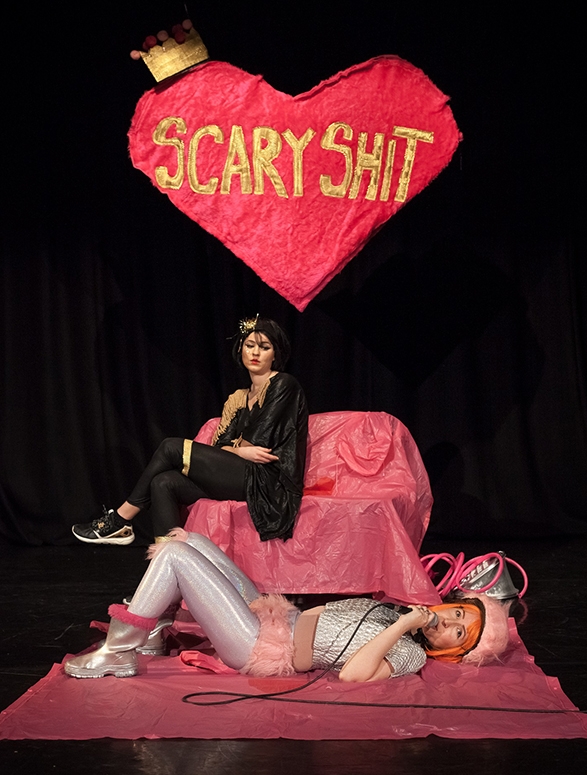
Rhiannon Faith and Maddy Morgan in Scary Shit (photo: Tina Remiz)
Admittedly you might not invite your young children to a show called Scary Shit, but at first glance the brightly-coloured poster of Maddy Morgan and Rhiannon Faith cavorting on soft fuzzy cubes in an AstroTurf green field might indicate a fun romp for young audiences until you notice the tampon falling from the sky on a parachute and a recommended age limit of 16+ right under the venue and date. On the other hand, as a 16+ theatregoer you might not even consider attending Scary Shit just because the image appears to be aimed at young audiences. It’s a marketing conundrum, for while the image reveals the means by which Morgan and Faith arrive at their goal, it doesn’t prepare you for the goal itself. But that is the nature of Scary Shit: the comic naivety of Alice Barbero’s colours, costumes and props is a deliberate antidote to the maturity of the content about the shared phobias and insecurities of the two women. By the end you are wondering how they drew you so unsparingly into their innermost thoughts while play-acting with a pink telephone, a pink plastic poncho, a water pistol, and red inflatable boxing gloves. You go in the ‘Silly’ door and come out profoundly moved.
The context of Scary Shit is Faith and Morgan’s introduction to cognitive behavioural therapy (CBT) through the psychologist Joy Griffiths ‘in order to learn more about themselves and maybe, just maybe, find a future free of fear.’ The focus at first is on Faith; she sits on a (pink) throne, her coronet emblem hanging on the (pink) Scary Shit heart above her head. She is holding an oxygen mask to her mouth as Morgan duly pumps air into it from a (pink) foot pump. Morgan has the mien of the put-upon, hard-pressed, underpaid, under-appreciated drudge of a royal hypochondriac, but Faith is too preoccupied by her phobias to entertain delusions of grandeur. She and Morgan recite some of the A-list phobias from Arachibutyrophobia (fear of peanut butter sticking to the roof of your mouth) to Necrophobia (fear of dead people) but Faith’s real phobia is talking on the telephone with unknown people as a result of a traumatic telephone dumping. She relives the guided revisualization Griffiths (who happens to be Faith’s mother-in-law) suggested as therapy, starting with an introduction to CBT in a fight-or-flight sequence with Morgan that resembles an in-flight demonstration. Movements were suggested (so I learned later) by viewing body language filmed during the therapy sessions.
Morgan at this point begins to differentiate her phobia from Faith’s by marking out her own small square of red tape and standing in it; she has not intimated what her phobia is but she demonstrates innocently enough some of her father’s sailor’s knots. While continuing to act as Faith’s sidekick — helping her to illustrate a dry hump during Faith’s story of losing her virginity — we sense a frustration building up inside her as she tells her own story and dances her darkness behind a suspended balloon covered with tangled knots that bears an uncanny resemblance to a brain or a womb. As Faith’s self-confidence and her smutty-mouth returns, she takes on the topic of fertility but her attention (and ours) is drawn to Morgan’s predicament. Faith plays Puccini’s aria, O Mio Babbino Caro from Gianni Schicchi to calm her down but Morgan steps into her ring wearing the inflatable boxing gloves. At a loss, Faith tries everything from cock jokes to a funny dance get her to talk and after a while she does, reciting a bruisingly personal poem with the refrain, Baby Box Blood Bath, about her periods in which no blood is running. Griffiths’ calming voice returns, Morgan pops the knotted balloon, she and Faith wrap up the bloody remains in the pink poncho like garbage to be thrown out and do breathing exercises on the creaky throne. The audience is absolutely silent.
Like the therapy that underlies it, the superficial appearance of Scary Shit may be an unpalatable or unattractive prospect, but after seeing the performance you may well feel restored, patched up and grateful for the experiences of these two generous, unwitting clowns. Or you may prefer to keep everything knotted up inside like Morgan until it pops. Like all good theatre, Scary Shit offers a cathartic lift for the head and heart.
Scary Shit will be at The Pleasance on Friday 26 and Saturday 27 February at 7:30
Posted: February 22nd, 2016 | Author: Ian Abbott | Filed under: Performance | Tags: Adrienne Hart, Ana Rajcevic, Annapaola Leso, Carys Staton, Casper Clausen, Empathy, Gyda Valtysdottir, Ian Abbott, Mads Brauer, Neon Dance, Numen, Shahzad Ismaily, The Lemon Tree | Comments Off on Neon Dance, Empathy
Neon Dance, Empathy, The Lemon Tree, Aberdeen, February 13

Neon Dance in Empathy (screen shot from filmmaker Tom Schumann)
“The story is a machine for empathy. In contrast to logic or reason, a story is about emotion that gets staged over a sequence of dramatic moments, so you empathize with the characters without really thinking about it too much.” – Ira Glass
Empathy is a work that I have already danced with a little. I invited the artistic director of Neon Dance, Adrienne Hart, and dancer Annapaola Leso to Bournemouth in 2014 for two research residencies, saw snatches of a duet at Tony Adigun’s The Factory during Dance Umbrella in late 2015 and viewed the video series released in the run-up to the première of Empathy in 2016. This ensured a proximity to the ideas and flavours prior to stepping into the theatre and this exposure influenced my receipt of the work and not necessarily in a way I was expecting. Being closer to Empathy I felt partially blunted, encountered less discovery on the evening and it made me question whether I want my pre-information appetite dry, whetted or drowned.
Hart and her creative co-conspirators in sound (composers Mads Brauer, Casper Clausen, Shahzad Ismaily and Gyda Valtysdottir) and design (Numen and Ana Rajcevic) have deftly woven a seamless environment that sits equally between the choreographic, sonic and scenographic. Letting the performance grow over two years has imbued it with a depth and rigour that is missing in many works that are constrained by a 3-to-4 week rehearsal process. With five human performers and an insentient laser feeding our eyes, Empathy executes Hart’s aim of asking us to think about this state of being through an elaborate, dense and stimulating world. With a tight choreographic palette of amorphous floor-dwelling bodies, melting into each other and the floor, I found it hard to like and yet easy to admire – but the work is still resonating.
“Technology is making gestures precise and brutal, and with them men.”– Theodor Adorno
Hierarchies are consistently present: human vs. human and human vs. laser; the invisibility of power is enhanced through the (wo)man/machine battles. The behaviour of the laser oscillated between playfulness and brutality; ambushing movement and suffocating extensions whilst framing the dancers with an incisive clarity. I couldn’t help but project emotional narratives on these duets and at those moments I’m looking at the empathy spectrum and deciding who should I side with? The lasers acted as a metronome, carving the stage, dictating the pace and in its more flighty moments slowing down my perception of the dancers.
There were resonances for me on the tender spectrum; when Annapaola stepped slowly towards the laser wall and waited with the tips of her hairs brushing the edge of the light as her breath settled suggesting a possibility to move through and beyond. There was emotional dissonance too; Carys Staton (a glacial technician) during her glitching laser tunnel duet failed to connect as it narrowed, slowly constricting her space — I felt nothing. This spectrum of emotional attachment to and between the performers was a large part of the success of the work; however, there were two late arrivals into this cast who weren’t present throughout the making period and were (re)presenting movement that had been generated and embodied by other bodies and this lack of investment was telling.
“Empathy is the faculty to resonate with the feelings of others. When we meet someone who is joyful, we smile. When we witness someone in pain, we suffer in resonance with his or her suffering.” – Matthieu Ricard
Rajcevic’s costume pieces enhanced the notion of empathy; mouth pieces and masks disguised areas of the body that are usually used to convey emotion challenging the dancers to present alternatively through their bodies. The arm extensions worn by Annapaola affected her movement quality, masked the hands and helped attune her to her surroundings and other bodies in her orbit.
Hart is playing the long game and her extended practice and approach to collaboration, inquiry and audience ensures Empathy remains with you long after you’ve left the theatre. She’s an architect, commentator and conductor of an orchestra of empathy, with human instruments revelling in her excavations.
Posted: February 18th, 2016 | Author: Nicholas Minns | Filed under: Performance | Tags: Antaraal, Anuradha Chaturvedi, Betty Toogood Sayers, Bridget Lappin, Charlie Stock, Drishti Dance, Gulshan Bharati, James Finnemore, Kieran Page, Laura Obiols, Léa Tirabasso, Malcolm Atkins, Meena Anand, Michael James Gilbert, Mohan Rana, Nuria Sobrino, Resolution! 2016, Rosie Terry, Shoninki, Shyam Patel, The Art of Exposure | Comments Off on Resolution! 2016, Drishti Dance, Bridget Lappin, Laura Obiols
Resolution! 2016, Drishti Dance, Bridget Lappin, Laura Obiols

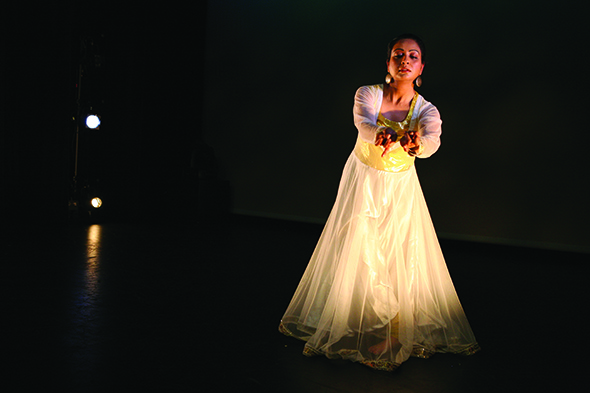
Anuradha Chaturvedi of Drishti Dance (photo: Sarah Jex)
This evening of Resolution! begins with an exposition of Kathak by Drishti Dance, a trio of choreographer Anuradha Chaturvedi and dancers Meena Anand and Shyam Patel. Antaraal is a work that weaves choreography with music and verse in which all three elements span two cultures: Chaturvedi is based in Reading but brings her knowledge and mastery of Kathak from Lucknow in India; the score is shared between Oxford-based Malcolm Atkins and Lucknow-based Ustad Gulshan Bharati, while the verse is from Mohan Rana, a Hindi poet living in Bath. Antaraal is thus a meditation on the diaspora life, rooted in tradition while adapting to a new cultural context, a place where ‘movement is caught between two worlds, one dead and the other yet to be born.’ To my Western eye, however, the elements of gesture, rhythm and costume in Antaraal speak of an unequivocal, and very much living, Indian experience, so it is difficult to know what is ‘dead’ and what is ‘yet to be born.’ Perhaps in placing Kathak in the service of both Eastern and Western musical rhythms Chaturvedi is suggesting a journey between the two, somewhere between departure and arrival. But what my memory retains are the floating, sinuous gestures of the three dancers, their poise, the clarity of their facial expressions and the rhythmical hand and footwork responding both intimately and animatedly to the music.
There we have stopped, while the world stands still,
and the endless days that were following us, too have stopped.
There we stand, meeting after a long time,
in a conversation that catches an unfinished past.
Having moved far, been lived, told, and retold
our story is now hand in hand with emptiness,
and we’re left
pondering an elusive end.
- Mohan Rana (translation: Mohan Rana & Georgina Tate)
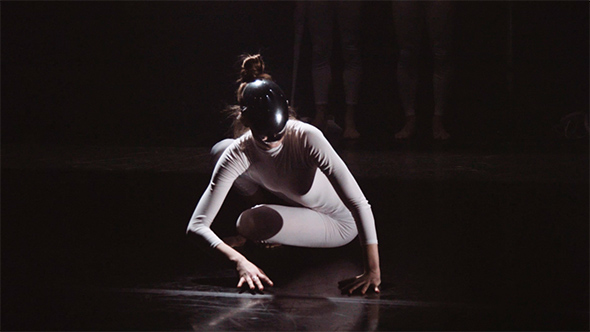
Dressed in layers of black against a black backdrop on a black floor seems a paradoxical way of establishing the art of exposure but Bridget Lappin relishes the challenge, bringing her bright gaze to the darkness around her in The Art of Exposure. There is no credit for lighting but the timeless beginning — a very gradual sensitizing of our eyes to Lappin’s still, shadowy, spectral form — and her mysterious disappearance at the end are beautifully staged. Camouflage is central to the work, and Lappin refers in her program note to a 17th-century Ninja manual on the art of concealment, Shoninki, but she spends the entire performance shedding her camouflage just enough to establish it, teasing us with her ability to materialize out of the dark and leave an indelible image. She does this by taking on the disguise of first a ninja, then, by replacing her warrior mask with a touch of lipstick, a woman and finally (as in Young Galaxy’s track) ‘just a body’ — what she describes as ‘deceptions in an act of self-preservation against her environment.’ Her movements are at once assured and mysteriously quiet, clear and off-balance, her gestures fast and complex. In the half-light the outlines of her body are erased so all we see of her is bare hands and face, or, in the final stage, her bare back inside the v-shaped opening of her unitard. It is the art of exposure by stealth and suggestion and it is remarkably persuasive.
The final work, Laura Obiols’ Hourglass, is ‘a journey with Lilly to explore growing up in a society full of expectations and fear of taking risks, where time seems to be chasing you.’ Obiols pulls together elements of biography like a magician conjuring rabbits out of a hat: the talking shoes and boots setting up the family story at the beginning (set design by Michelle Bristow), Lilly’s transformation from young girl to a young woman and the appearance of characters one after the other from behind a sofa. We first see Lilly in the person of Betty Toogood Sayers sitting long-legged on the floor writing in a diary while her father, James Finnemore, is (so we learn from the voiceover) going through a bad phase. Lilly is unaware of his anxt-ridden, gravity-laden solo and runs to be picked up on his shoulders. By sleight of hand she grows into Léa Tirabasso but then things start to get fuzzy. Michael James Gilbert is someone she picks up (or he picks her up) at a club but it is not clear for whom he is performing. Rosie Terry makes an appearance as a friend and then Kieran Page dressed like Terry replaces her from behind the sofa to offer Lilly his hand. The three men in Lilly’s life bear an uncanny resemblance to each other, which is confusing; they are distinguished more by their respective dance genres than by their characters. Only Tirabasso remains her growing or shrinking self, and there is a tantalizing moment after the four adult characters manipulate her like a spinning compass when I thought for sure she would dance a trembling apotheosis but she is interrupted and never gets to express herself in maturity.
It is an analogy for Hourglass itself; with the exception of the two underused musicians — Nuria Sobrino on piano and Charlie Stock on viola — the talents of her cast and the input of her production team appear to have turned Obiols in different directions: beside some lovely symbolism and imagination there are elements of over-literal storytelling and patchwork dance: building blocks but not yet architecture.
Posted: February 17th, 2016 | Author: Ian Abbott | Filed under: Performance | Tags: Alon Cohen, Anton Lachky, Audrey Rogero, Dreamers, Fleur Darkin, Francesco Ferrari, Gai Behar, Jori Kerreman, Josh Wild, Matthew Robinson, Ori Lichtik, Process Day, Rebecca Hytting, Sharon Eyal | Comments Off on Scottish Dance Theatre, Dreamers & Process Day
Scottish Dance Theatre, Dreamers & Process Day, Dundee Rep, February 12

Scottish Dance Theatre in Sharon Eyal and Gai Behar’s Process Day (photo: Brian Hartley)
“Dreams have only one owner at a time. That’s why dreamers are lonely.” – Erma Bombeck
Anton Lachky’s Dreamers woke up last February in a Scottish Dance Theatre double bill with Jo Strømgren’s Winter, Again. Upon first viewing I struggled to see the fit as the pair were too similar — both showcasing lightness, comedy and a hyper-real quality. So I’ve come back to Dreamers to see how it has settled into the bodies of the dancers, into the company and how it sits with a new bedfellow, Sharon Eyal and Gai Behar’s Process Day.
Dreamers defines itself as “making sense from nonsense and exploring links between reality and surrealism” and over the course of 35 minutes it delivers its intention well. A police line-up forms the opening image where all nine performers face front and Aya Steigman erupts from the line, fizzes with skittish urgency and delivers a hiphop-laced solo that is startling in its ferocity. This is the opening minute and I wonder whether my eyes can contain or maintain the pace. The invisible energy passed between each of the solo performers is dialled down the further away from the original source we go until everyone has had a chance or two to show us their best moves.
Nothing lingers for too long and at the same time we’re not asked as an audience to invest much either; we see two or three playful examples of what the world might look like if the choreographic power is given over to Audrey Rogero and Francesco Ferrari. The strongest visual memory from my first Dreamers was the face-melting elasticity of Rogero and 12 months on, the malleability, facial contortions and impossibly extended neck stand out again as she out-Doyles Mrs Doyle. Slapstick, physical buffoonery and bodily control are re-employed again and again with Rogero manipulating the remainder of the company at her whim; spinning, flicking, and boot-camping them. As she discovers her power and ability to transform she gifts us one of the most infectious cackles heard on stage.
“Nearly all men can stand adversity, but if you want to test a man’s character, give him power.” – Abraham Lincoln
When Ferrari emerges from the pack to take control, he’s barking orders ferociously in an unknown language and basking in the power of controlling the others — apart from when Amy Hollinshead marches out of the line like a rebellious tin soldier, frustrating Ferrari even more.
The lightness and humour shines alongside the musical choices of Bach, Verdi, Chopin and Haydn. Dreamers is a white, crisp, and frothy demonstration of personality, wild abandon and fine dancing.
“A man must dream a long time in order to act with grandeur, and dreaming is nursed in darkness.” – Jean Genet
As night follows day, dark will follow light and Process Day now follows Dreamers.
Are we in Dundee or have we been transported to a Weimar Republic cabaret, a dark world filled with luscious, crepuscular creatures, a place where gender is dissolved and eyes linger on the smallest of details? Eyal and Behar, alongside Ori Lichtik (musician), Rebecca Hytting (assistant and co-costume designer) and Alon Cohen (lighting) create an unsettling environment that either repulses or embraces the eyes that rest on the stage.
Clad in black from foot to ribs and a neutral scrim from the chest upwards, the dancers exist in a quarter light giving the impression of a floating set of torsos and amplified arms which frame and isolate each other like a vogue ball. From the nine performers, Josh Wild (apprentice dancer from London Contemporary Dance School) is a choreographic leech, creeping onto other performers, intruding and creating a series of unwanted duets before blending back into the dark. The dancers seem almost extra human and there’s a striking motif of Matthew Robinson’s controlled head-butting of Jori Kerreman’s stomach – it fits perfectly in this world and is one of the many lingering frescoes which sit amongst the larger-scale ensemble moments.
“So the darkness shall be the light, and the stillness the dancing.” – T. S. Eliot
Cohen’s lighting design aligns well with the choreographic intention; despite the lights being so dim I am noticing the slightest of movements: twitches, ankle rotations and shoulder snaps were pulling my eyes all over the stage as a thin film of haze weighs heavily on the stage.
Classical strings, abrasive bass and relentless synths offer a sonic realm that promotes difficulty. Choreographic difficulty is also on show as not all the dancers are comfortable with this hard, sinewy performance style. Eyal and Behar are a brave choice from Artistic Director Fleur Darkin as they’re asking the dancers a completely different set of choreographic questions from those of Damien Jalet’s Yama, Darkin’s own Miann or Strømgren’s Winter, Again.
“Androgyny is not trying to manage the relationship between the opposites; it is simply flowing between them.” – June Singer
I am sucked into the world of Process Day by the scenographic control that Eyal, Behar and their collaborators have over me. It is satisfying to spend 40 minutes with them in their world of heavy and dark; but if the company does with Process Day what they did with Yama — extending it from an original half bill to a full-length work — now that would be a 30th birthday present worth unwrapping.
(Dreamers and Process Day are on Scottish Dance Theatre’s double bill tonight and tomorrow at Traverse Theatre in Edinburgh)