Posted: July 10th, 2017 | Author: Nicholas Minns | Filed under: Performance | Tags: Anna Meredith, Images Ballet Company, Jennifer Jackson, Liz Aggiss, London Studio Centre, Matthew Hart, Morgann Runacre-Temple | Comments Off on Images Ballet Company 2017 at Lilian Baylis Studio
Images Ballet Company, Lilian Baylis Studio, June 13

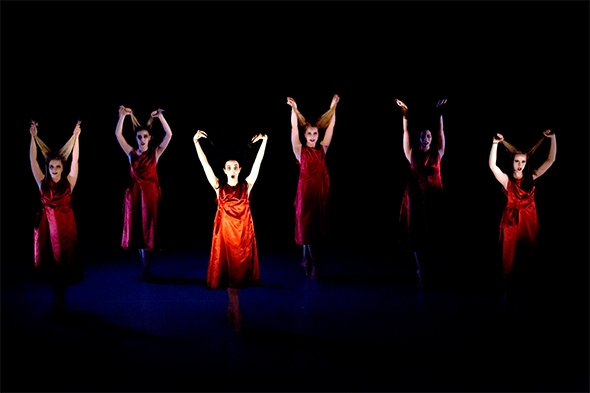
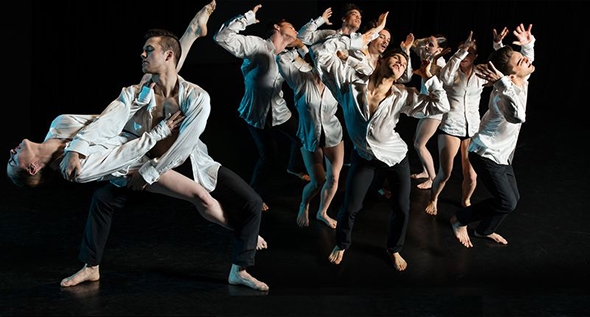
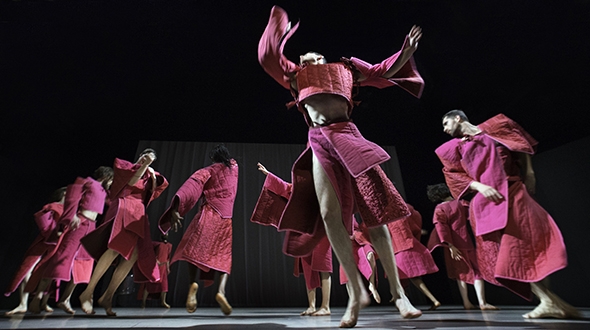
(l to r) Briony Andrew, Courtney Reading, Eleonora Falovo, Maria Bruguet, Gwainn van der Bijl, and Jessica Harding in Liz Aggiss’s Scenes of Death and Disaster (photo: Billy Nichols)
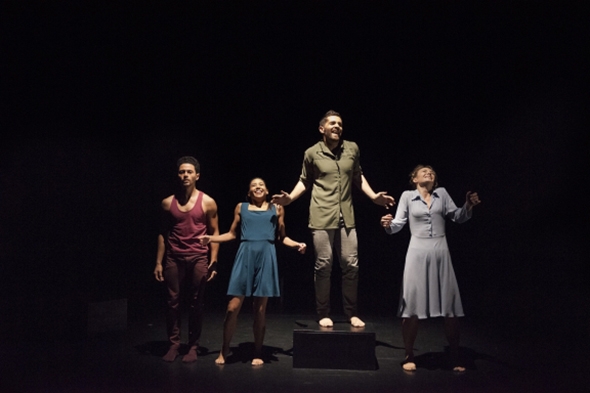
Images Ballet Company is a showcase for the dancers who choose to specialize in classical ballet in their final year of professional training at London Studio Centre. The program at Lilian Baylis Studio tests this training in a broad spectrum of dance performance that challenges the students’ versatility and stretches their expressive abilities. While Artistic Director Jennifer Jackson’s own work of the evening, Distant Beauties, is the one work to merge classical technique with a classical image, Matthew Hart’s Concerto for Joyce and Dennis uses pointe work in a contemporary setting, and Morgann Runacre-Temple’s Handsfree uses classical articulation and elongation in an abstract work. Only Liz Aggiss, who comes from the august tradition of German Ausdruckstänz, makes the technique utterly subservient in her Scenes of Death and Destruction to a rich expressive approach to dance that just happens, in its irreverent approach to classical ballet structures, to deconstruct them with evident relish.
It might be said that this year-end showcase reflects the current prospects for students of classical ballet in this country and elsewhere, as Jackson is well aware (just consider Scottish Ballet’s recent program of works by Angelin Preljocaj and Crystal Pite). Her decision to include such a variety of styles will serve her dancers well as their comfort levels are tested from work to work. Shaun Reidman, the one male in the group, does not look entirely at home in Distant Beauties, but in Scenes of Death and Disaster he comes into his own as the figure of Death replete with black cloak and scythe. Eleonora Falovo carries the narrative in Concerto for Joyce and Dennis so convincingly as Joyce that she looks out through her eyes. This kind of transformation is at the heart of performance and Falovo’s natural ability to unite her technical ability with a high level of expressivity is a gift for dance narrative in whatever form it might take.
Jackson’s Distant Beauties is loosely based on the pas de six from the Petipa/Tchaikovsky ballet, Sleeping Beauty with which she would have been familiar in her days as a soloist with the Royal Ballet. Rather than getting her dancers to execute Petipa’s choreography, Jackson models the steps on the capacities of her dancers and ascribes contemporary values to the six Fairies of integrity, independence, humility, talent, resilience and confidence. By choosing Tom Armstrong to adapt Tchaikovsky’s score for a viola and flute (played live on stage by Rosie Bowker and Henrietta Hill), she has created a sparse aural environment which the dancers have the chance to fill with their ensemble work and solos. Classical technique is notoriously difficult to execute well, and not all the dancers do justice to the steps but they maintain the spirit behind them. Maria S. Catalayud managed both in her variation with a confidence that is a pleasure to see.
One of the characteristics that gives unity to the evening is the way Bowker and Hill play through the pauses between works, transitioning from one musical style to another as they wander like minstrels on stage. It allows the huge social gap between the Russian Imperial court and a care home to be bridged effortlessly along with the sterling efforts of the crew to transform the stage.
The central character of Concerto for Joyce and Dennis is modeled on Hart’s own grandmother whose physical condition has rendered her housebound and subject to a carer (Reidman) who doubles as her late husband. The cast enters into this poignant portrayal of memory and friendship with conviction, though the ideas in this narrative work carry a weight well beyond the scope of this performance; it is full of short scenes and episodes that strike me as the seed of a musical in which a larger, more diverse cast could more realistically portray the disparity in ages and physical (dis)abilities.
Handsfree, to the eponymous body-percussion score by Anna Meredith, is a response both to the music and to the sculpture of Dorothea Tanning. Set in rectangles of light that Runacre-Temple seems to relish, Handsfree is a complex rhythmical exercise in which the four dancers (Falovo, Catalayud, Courtney Reading, and Jessica Harding) engage with the music and with each other in close partnership where they seem to listen to the music in each other’s bodies. The exhilaration from the dancing and from the score itself is palpable, though the work seems more weighted towards Meredith than Tanning, missing a sufficiently visual component to satisfy the eye.
The title of Scenes of Death and Disaster accurately describes the progression of Aggiss’s work, from Reidman’s slow, cold, majestic entrance as the figure of death to the seven women with disheveled hair complaining about male choreographers of classical ballets who portray women as weak with a propensity for untimely deaths. Musically it progresses from its music box introduction through sampling of the ballet classics of Giselle, Swan Lake and Romeo and Juliet to earthy gypsy tunes and Highland bagpipes. Its irreverence for the classical canon belies the rigorous construction of the work and the expressivity required of the dancers to make it work. And work it does, with ferocious wit and satire both in what it says and the way the entire cast says it. That Jackson has the pragmatism and insight to program this broad scope of work is testament to her stewardship of the company.
Posted: July 7th, 2017 | Author: Ian Abbott | Filed under: Festival | Tags: Avant Garde Dance, Deaf Men Dancing, Etta Ermini, Far From The Norm, Greenwich Fair | Comments Off on Ian Abbott at Greenwich Fair
Greenwich Fair, Greenwich + Docklands International Festival, June 24 and 25

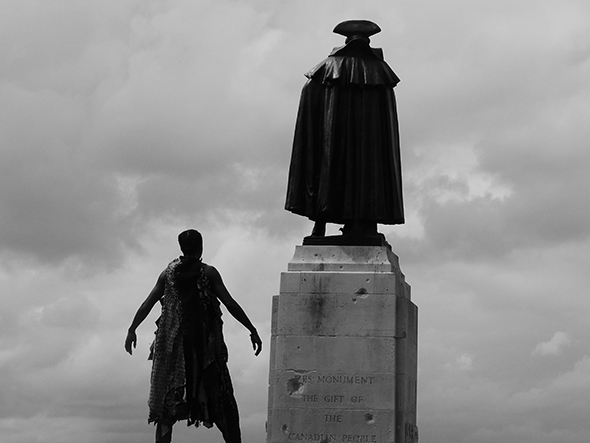
Far From The Norm’s Da Native in front of the statue of General Wolfe (photo: Ian Abbott)
Greenwich Fair is the opening weekend blitz of Greenwich+Docklands International Festival (a 15-day celebration of street arts) featuring circus, theatre, games, live art and a suite of new dance works. GDIF has ‘a particular focus on the commissioning and development of outdoor work led by deaf and disabled artists and artists from diverse backgrounds’ and there was new small-scale outdoor work on show from Deaf Men Dancing, Far From The Norm and Avant Garde Dance.
Etta Ermini’s Culinary Duel sees two male dancers in chefs’ whites goofing around in tune with the fading relevance of TV cookery shows. In an under-rehearsed work where legs and limbs collide in contact and lift work, movements are not fully executed and lines are certainly not clean. However, none of this mattered to the 300+ audience who attended the Sunday afternoon because the underused star of the show was a remote controlled cooker which trundled around bumping into the chefs, approaching the audience and flapping its oven door like a hungry mouth. In amongst the frenzied whisking and flinging of Angel Delight there is a hunger for light entertainment, an amusing photo to post on social media and something to hold your attention for 20 minutes; by these standards Culinary Duel delivers in spades. Younger audiences were in raptures, screaming in delight at seeing a domestic appliance transformed into a living, dancing machine that succeeded in upstaging the humans.
On a similarly unpalatable menu, the premiere of Avant Garde Dance’s new outdoor work Table Manners, commissioned by Without Walls, describes itself as ‘a choreographic feast exploring human relationships through our cultural connections with food and dining, with a thought-provoking social subtext.’ The reality is somewhat different: an undercooked and disjointed collection of scenes that reheat tired food clichés that have little cultural relevance today. At 40 minutes, Table Manners sags dramatically between scenes as the three dancers tinker with fiddly adjustments needed to switch and extend the table surfaces, drawing our focus away from any choreography. Sasha Shadid proves particularly irksome as an over-officious, fake-dacting waiter, while Duwane Taylor and Julie Minaai are presented as 2D characters and struggle to exhibit any technique or musicality, with any subtlety being left in the pantry. Tony Adigun has choreographed a number of excellent outdoor works for Avant Garde (Taxi, Romeo & Juliet, Silver Tree) which have delivered greater complexity, signature choreography and an attention to musicality; with a severe edit there is potential in Table Manners but the audible sighs around me left my choreographic stomach rumbling.
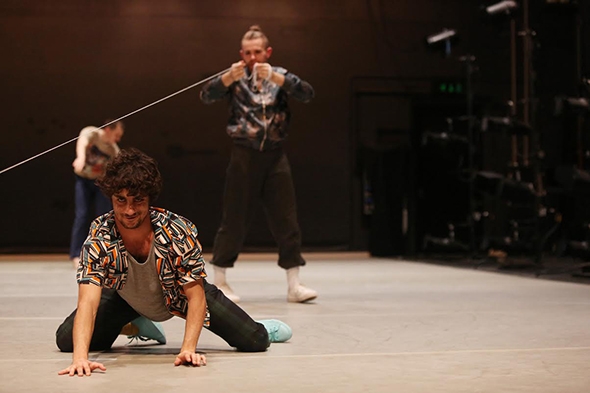
Corazón a Corazón, performed by Deaf Men Dancing and Leo Hedman, was commissioned by GDIF, Without Walls, Brighton Festival and Ageas Salisbury International Arts Festival. It is a 25-minute work inspired by Manuel Puig’s Kiss of the Spider Woman and was conceived, choreographed and directed by Mark Smith. Charlie Hembrow and Shane Pearson are Puig’s prisoners who form an intimate bond in their cell whilst suffering the brutality of Hedman’s baton-wielding guard. With a tango-inspired soundtrack and simple contemporary partner work, two beds provide the main set pieces, upended to represent bars, flipped in displays of dominance and skittled as Hembrow and Pearson seek solace under Hedman’s watchful eye. After seeing Smith’s previous work, Let Us Tell You A Story, his theatricality and overtly dramatic performance style is at home in the outdoor environment and his subtle integration of BSL rewards a close reading. However, an inexplicable and wild narrative shift 10 minutes out sees Hedman’s guard scampering up into the crows nest scaffold structure and transform the show into a burlesque-inspired rope aerial act lasting the remainder of the show. Hedman displays fine skill and technique but this shoehorned metamorphosis attempts to bring two entirely different worlds together with little subtlety or consideration for an audience.
The majority of work programmed for outdoor/street arts festivals is work that isn’t emotionally or politically resonant and chooses not to deal with alternative forms; this signalling that programmers believe audiences want the primary colour splat of Britain’s-Got-Talent-lite spectacles and don’t want to engage with complexity is misplaced. With the recent large-scale outpouring of support for alternative narratives and our ability to deal with complexity that have emerged in the wake of the London and Manchester terror attacks and the Grenfell Tower fire signifies we are able to talk, debate and dialogue about things of scale.
It is refreshing to see Botis Seva’s Far From The Norm’s Da Native, a work that actively refuses to locate itself and embraces multiple narrative readings, set against a geodesic dome decorated with three-sided patterned textiles that echo the cultural significance attached to weaving and cloth that exists in different non-Western cultures. Set in the shadow of Greenwich Park’s statue of Major-General James Wolfe (the 18th century British army officer posthumously dubbed ‘The Conqueror of Quebec’ for capturing Quebec City from the French), the territorial and colonial frame in which Da Native operates offers extra resonance; with nomads arriving from east/west and finding respite in the dome Da Native offers a series of tight choreographic rituals that look at community, home and departure. With a consistency of intense physical detonation and attack, Far From The Norm delivers a water-tight performance balancing moments of stillness atop the dome with searing choreographic ensemble work; images of drenched cloths being pulled from the dancers’ mouths like a magician’s mouth coil conjure up arid landscapes and dusty travels and leave an indelible mark on the audience. With a slight tweaking by shifting and extending the visual focus of the work to three sides (not just front on), Da Native has a great chance of being a work that offers alternative perspectives while rejecting the simplistic narrative of other outdoor festival works.
Greenwich Fair was 97% free (A View from the Bridge being the exception) and accessible to people who encountered the 40+ works around the Old Royal Naval College, Cutty Sark Gardens and Greenwich Park; however by spreading out to the park there was a dissipation of energy and a dispersal of audience over the opening weekend. In previous iterations I’ve attended the densely packed programme focused on a tight geographical location which builds an energy, buzz and ferocity of people – shows programmed back to back so that as soon as one finishes, an audience swarms from one to another and is swept along in the rhythm and waves of performance. Greenwich Fair sits amongst the larger GDIF which has multiple themed programs including Dancing City, finales and mass street events, but if the opening weekend is meant to build momentum for what follows and if the commentary and discussions on the quality of programmed work amongst the dozens of Xtrax delegates are anything to go by, then the omens are not good.
Posted: July 2nd, 2017 | Author: Nicholas Minns | Filed under: Festival | Tags: Ana Laguna, Charlotta Öfverholm, Company of Elders, Dominique Mercy, Elixir, Knowbody II, Liz Aggiss, Mats Ek, Pascal Merighi, Shobana Jeyasingh, Thusnelda Mercy, Wendy Houstoun, Yvan Auzely | Comments Off on Knowbody II, Elixir Festival 2017
Knowbody II, Elixir Festival, Sadler’s Wells, June 24

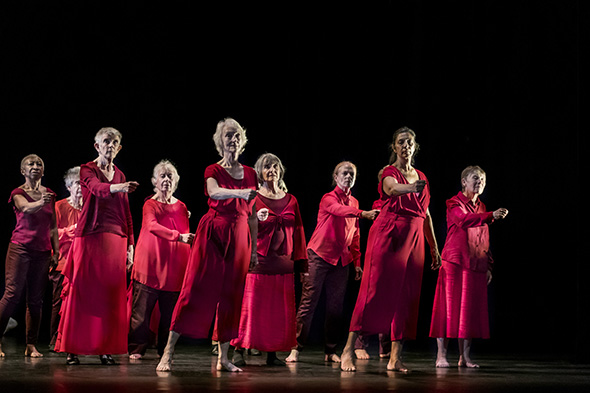
Company of Elders in Shobana Jeyasingh’s Here (photo: Johan Persson)
Something interesting has happened to the bipartite formula for Sadler’s Wells’ Elixir dance festival celebrating lifelong creativity. Three year’s ago, the main stage performance Knowbody was clearly the headliner of the festival while the Extracts, based predominantly on community dance, were the supporting acts. This year the quality of Knowbody II has declined while the first evening of Extracts has shown a marked advance in mature amateur dance to a middle ground between community dance and the main stage. One of the reasons is that the current programming of Elixir has not reflected what has been happening in mature dance in the intervening three years, both in this country and in Europe. Despite Sadler’s Wells membership of the large-scale, EU funded co-operation project, Dance On, Pass On, Dream On (DOPODO), that nine dance institutions from eight countries have developed to address ageism in the dance sector and in society, this year’s Elixir has the same format, some of the same performers, and the same division between professional and amateur companies as before. While the inclusion of Berlin’s Dance On Ensemble (a professional company for the over-40s) and some amateur performances from Holland, Germany and Denmark in the Extracts are welcome, it is a shame that Charlotta Öfverholm’s company Jus de la Vie, a signatory of the DOPODO agreement, could not be included on the main stage event this year. Öfverholm’s presence alone would have countered the tiresome absurdity of Annie-B Parson’s The Road Awaits Us and the misplaced, if respectful inclusion of Robert Cohan’s Forest Revisited. And if Elixir is addressing ageism in dance, why are such artists as Wendy Houstoun and Liz Aggiss, who are battling on the same front, missing from the lineup for the second time? But there is a much larger question that Sadler’s Wells’ own flagship Company of Elders raises that remains to be resolved.
There is a fundamental but vitally important distinction between presenting age on stage and celebrating age on stage. To watch Ana Laguna and Yvan Auzely on the main stage in Mats Ek’s Axe is to celebrate the unique contribution of the mature performer, and the same is true of the performance by Holland Dance of Jérôme Meyer and Isabelle Chaffaud’s My tasteful life in the first program of Extracts. It is not the difference between amateur and professional that counts but the degree to which performers can project their maturity in all its richness and complexity. This doesn’t happen, however, in Shobana Jeyasingh’s Here, choreographed for Company of Elders as part of Knowbody II; it opens promisingly with a wash of crimson costumes in glorious light but descends quickly to a composition of seated dancers waving arms, and such is the design of the chairs and the way the dancers are seated that a comparison with wheelchairs is unavoidable. This is a display of age dressed in glorious costumes and lights where the individuality of the dancers is replaced, in formal terms, by the identity of the group. If someone of Jeyasingh’s creativity cannot make a work on Company of Elders that celebrates their age, there is a problem. Perhaps the makeup of the company means she has had to create on the abilities of the weaker members to the detriment of the expressivity of the stronger ones, but no work of value can ensue from this compromise and the notion of a flagship company for mature dance sinks with it. For all the advantages Company of Elders receives as the Sadler’s Wells resident performance group for the over-60s — working with renowned choreographers, a highly visible platform, touring and high production values — its qualities are no more developed than its counterparts in Brighton, Ipswich, East London and Greenwich (all of whom were presented next door in Extracts). It would seem the opportunities laid at Company of Elders’ feet are being exploited rather than fully realised. Auditions may be one way forward and a re-selection of current members according to ability. And if Sadler’s Wells wants Company of Elders to share the main stage with professional dancers, shouldn’t they, too, be paid?
Another feature of this edition of Elixir that compromises its value is the presence of so many young dancers on the main stage program. Pascal Merighi, who choreographed a solo for Dominique Mercy at the last Elixir has for this one created a duet for Mercy and his daughter, Thusnelda. Why? In Forest Revisited, some of the dancers who once performed Robert Cohan’s Forest (Kenneth Tharp, Anne Donnelly, Linda Gibbs, and Christopher Bannerman, joined by a younger Paul Liburd) are seen teaching it to a new generation. Is Elixir becoming an intergenerational festival? Artistic director Alastair Spalding describes Elixir as ‘an evening featuring choreography created and danced by older artists’ while his programmers seem to be doing something else. What Extracts has confirmed, however, is that works for mature dancers are gaining in quality and interest; hopefully we won’t have to wait another three years for the next edition of Elixir festival to see mature dancers in a new category of work that is currently coming of age.
Posted: June 21st, 2017 | Author: Nicholas Minns | Filed under: Performance | Tags: Édouard Levé, Irene Russolillo, Lisi Estaras, Spartaco Cortesi, The Speech | Comments Off on Irene Russolillo / Lisi Estaras, The Speech
Irene Russolillo / Lisi Estaras, The Speech, Italian Cultural Institute, June 16

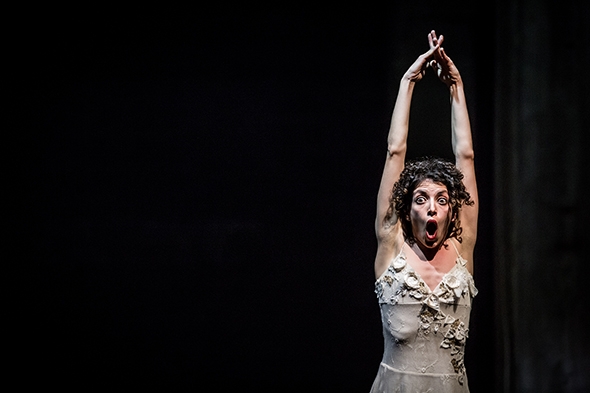
Irene Russolillo in The Speech (photo: Ilaria Costanzo)
It’s the time of year when the nineteenth-century architectural legacy of London looks its best and Belgrave Square, where the Italian Cultural Institute is housed, is no exception. Inside, the evening light filters into the piano nobile where the walls are hung with photographs of some of Rome’s architectural heritage whose influence can be seen in the classical facades outside, while through the grand windows you can almost feel the shade of the plane trees in the Gardens across the street. In the interior grandeur of these architectural traces, standing in a corner as we take our seats, is the figure of Irene Russolillo dressed simply and elegantly in a white summer dress emerging delicately from another consciousness as if our sudden arrival has disturbed her. She inches her way apologetically to the centre of the floor transforming the space by her presence while she silently, slowly forms words with tentative gestures and casts her expressive eyes over the assembled guests. The human scale of the room removes any sense of theatrical perspective so we find ourselves attending a reception at the point at which the beautiful hostess is about to address us with gracious words of welcome. In this setting, The Speech, which Russolillo created with Lisi Estaras, is a slow-motion, thirty-minute recall of all that happens inside her head and body between the intention to speak and its actualization.
In this time Russolillo takes us on a journey through inner realms that are inaccessible but for her eloquent physical articulation of gesture and voice, from sensual disintegration to the turbulence of a body losing control, from nervous apprehension to delirious abandon. There are suggestions of an invisible puppeteer manipulating a doll that has lost some but not all of its strings, or of a patient in a mental asylum, hunched, turned in and dazed. Her voice is at times as fragile as her body, catching in her throat or refusing to enunciate, and at others emerging with such power and clarity that her open mouth, wild hair and dark eyes extrapolate it into surreal territory. But however fragmented or fractured these inner realms may be, Russolillo summons them with a strength that belies their fragility. She improvises much of this within a structure and rhythm that fuse the portrayal of inner realms into a unified portrait as vivid and as poignant as a ripped and mended photograph.
There are two principal threads in The Speech, one textual and the other aural; the text is an adaptation of Édouard Levé’s book, Autoportrait, which has been described as ‘a series of declarative sentences…all ostensibly about Levé himself…lacking any discernable order…contained within one book-length paragraph.’ Here is a basis for the fractured nature of The Speech. Similarly, in Spartaco Cortesi’s sound processing, a song threads its way through the work, at first with barely audible notes. It fades away and returns again in another form; Russolillo sings the words and translates them in both English and Italian (with a voluble bias towards the latter) but by the time it manifests towards the end of the work in a version with a full-blown reverberating beat, it is her exuberant dancing that fills the room like a music video on steroids.
In a work like The Speech, it is very difficult to sense where it is going to end, for the beginning and end are outside the work’s frame. What is clear is that our hostess never quite arrives at the point of articulating her words, for the journey she has taken leads us only to the moment before she starts. What she has revealed, however, is that the realm of performance is as eloquent and mysterious as an internal process, and that through an artist of her calibre a nineteenth-century room can be transformed into a precarious but nevertheless rapturous human landscape, like those Roman ruins looking out across time from their mute frames.
The Speech was presented at the Italian Cultural Institute by TripSpace Projects
Posted: June 19th, 2017 | Author: Nicholas Minns | Filed under: Performance | Tags: Cas Public, Émilie Boyer-Beaulieu, Hélène Blackburn, Martin Tétreault, Symphonie Dramatique | Comments Off on Cas Public, Symphonie Dramatique
Cas Public, Symphonie Dramatique, Salisbury Playhouse, May 30

Cas Public in Symphonie Dramatique (photo: Damien Siqueiros)
Hélène Blackburn, who founded her dance company Cas Public in Montréal in 1989, talks of creating work as a dialogue between her and her dancers, mixing what she has in mind with what they can do; she describes it as an act of writing dance with crossed hands. This notion of choreographic dexterity and of testing the limits of her dancers is fully realised in her 2014 work, Symphonie Dramatique, presented at this year’s Ageas Salisbury International Arts Festival as part of its Québec showcase, but it is Blackburn’s stagecraft and her visual sense that dominate it. She has stripped back the narrative from Shakespeare’s Romeo and Juliet to concentrate on its emotional core as evinced by just three characters in whom the playwright’s themes of seduction, desire and unbridled passion are so redolent they represent the entire cast: the star-cross’d lovers themselves and Tybalt. It is thus a choreographic reworking of the play as a tempest of emotions that revel blindly in and constantly reject the possibility of tragic consequences. There is no moral tale in Blackburn’s conception, however; she creates no authorial distance between the raging passions and the societal notion of tragedy but rather enters into the passions with the same relentless energy as the characters themselves and leaves the audience to arrive at its own conclusions.
Having a cast of three interpreted by eight dancers allows Blackburn to fragment and recreate aspects of their emotional makeup in the same way the early cubist artists fragmented the picture-space to build up the subject independently in geometric forms. By removing a dramatis personae and plot, Blackburn has re-created a work that corresponds to the subject of Shakespeare’s play in a new, dynamic form with its own independent life. Her fast, intricate choreography worked out on the bodies of the dancers under the intense lighting of Émilie Boyer-Beaulieu builds up energetic physical fragments into a convincing picture of emotional turmoil that ends not with literal stage deaths but with the crashing to the ground of an enormous glass chandelier that for the entire work has hung over the stage like fate itself.
Threading through the work, and indeed another aspect of its cubist structure, is the music by Martin Tétreault, a brilliant sampling of orchestral scores on the theme of Romeo and Juliet by Gounod, Tchaikovsky, Berlioz and, predominantly, Prokofiev. Tétreault’s mastery of the sampling form, like Blackburn’s choreography, removes narrative associations that leave the raw emotional qualities of the music to be re-interpreted by the movements of the dancers. To Prokofiev’s Public Merrymaking music, for example, the dancers begin an agitated unison phrase relating to internal processes of conflict that brings out an emotional instability in the music that is revelatory. Tétreault’s score is thus ideally matched to Blackburn’s choreography and the dramatic unity they create — perhaps closer to the visceral force of music than to the emotional/intellectual force of theatre — is thrilling.
One of Blackburn’s stated aims is to open up her work to a broad spectrum of the public without having to label it for adult or young audiences; she searches for ways to portray such controversial themes as sex and death that a younger audience can readily grasp without playing down to them. After all, as she has said, we can all be Romeo, Juliet or Tybalt and in Symphonie Dramatique’s multiplicity of these characters we can recognize elements of our own emotional landscape without the shading of romance or heroism. In quicksilver duets love is fragmented into sensuality and passion but also into frustration and insecurity; emotions change rapidly as one couple is replaced with another in stark circles of light. Death, in the form of Tybalt’s body being repeatedly and brutally dropped like a heavy sack on the floor, is as raw as a paroxysm of rage. Quick changes of focus, whiplash partnering and fast footwork — on pointe for the girls — give the choreography a visual dynamism that belongs as much to the cinema as to the stage, while the manic energy of the dancers grounds the work in the sweat and toil of the body. It is this physicality of emotions urged on by the muscular score that brings the work alive and gives it an urgent, contemporary relevance.
Posted: June 15th, 2017 | Author: Nicholas Minns | Filed under: Performance | Tags: Elsa Petit, Feminism, Georges Maikel Pires Monteiro, Hannah Buckley, James Finnemore, Joss Carter, Lauren Reyhani, Léa Tirabasso, Rosie Terry Toogood, S/HE, Simon Palmer, TOYS | Comments Off on Hannah Buckley and Léa Tirabasso: Double Bill
Hannah Buckley and Léa Tirabasso, Double Bill, The Place, June 3

Simon Palmer, Hannah Buckley and the Universe (photo: Amy Buckley / Emanuele Pecorari)
S/HE is a duet that reflects on the questions, ‘do men need feminism?’ and ‘does feminism need men?’. As a dancer and thus already on the fringes of what chauvinistic patriarchy might consider ‘male’, Simon Palmer may feel the first question is redundant and for Hannah Buckley, a witty and passionate advocate of dissolving such social imperatives as having children (see her Woman With Eggs), the second question is rhetorical. Neither question, however, addresses the more personal one of the common ground between the two sexes, which is what S/HE reveals and negotiates choreographically in terms of implicitly heterosexual relations. As the work begins, the common ground is the stage area covered in cards printed with a picture of the starry universe — about as vast a context as one could imagine. Palmer and Buckley in latex unisex overalls (courtesy of Lauren Reyhani) crawl around with eyes closed, feeling for the cards and constructing with them small houses with precarious balance. In the course of their blind activity they knock over as many card houses as they build. This is Buckley’s sense of humour sharpening our concentration as she makes her opening statement: we may be sharing common ground but all our efforts will collapse if we remain blind to the way in which we share. Thereafter Buckley uses a raft of texts, either spoken or recorded (the latter more audible), that set out the arguments for her position: from Gloria Steinem to Iris Marion Young, and from standup comedian Bill Burr to scripts by Buckley and Palmer. I find texts are more accessible in written form as they are not always compatible — especially in this kind of volume — with the spatial or physical appreciation of associated movement. I find myself dividing my attention from one to the other like adversaries in a game, but what Buckley and Palmer appear to illustrate in their performance together is the fragile reality of the stated principles of feminist theory. Neither Buckley nor Palmer seem particularly happy with the result, especially in a duet of intertwined, upended forms, when Palmer appears to suffocate Buckley between his legs. It is only when Buckley dances alone that she allows herself the detached pleasure of being SHE, when the dry wit and serious intent of the work break into a smile. Buckley states in the program note that ‘rather than providing answers, S/HE wants to give audiences space to imagine new possibilities for co-existing.’ There is no doubt about the sincerity of the work, but there is a mournful quality, a sadness in the performance that mitigates the potential of the proposal; the choreographic interaction does not appear to share the intellectual inspiration.
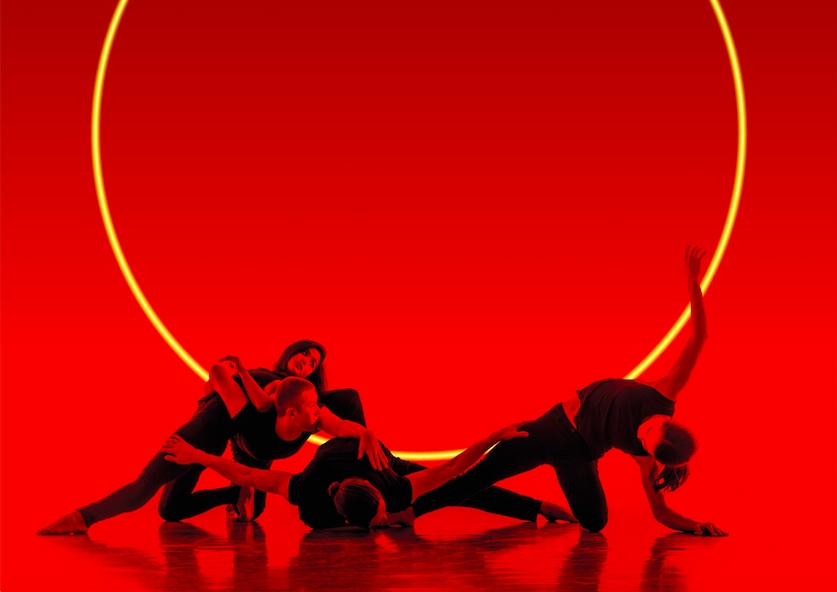
Léa Tirabasso’s TOYS (yes, both works this evening are in capitals) is more philosophical than it appears. In a dance work that treats the subject of hedonism, the moral underpinning is less visible than the celebration of the body, and with a cast as outrageously physical as Joss Carter, James Finnemore, Elsa Petit, Georges Maikel Pires Monteiro and Rosie Terry Toogood, the balance is predestined to excess. Tirabasso nevertheless reins it all in with a simple expedient in the form of a prologue and an epilogue that remind us of the moral implications of the work. At the very beginning we see Toogood in a circle of light, very much alone with her thoughts, and at the end, after all the choreographic debauchery, she returns to that ‘circle of public solitude’ to ponder her predicament. It is an eloquent image of the quote from Blaise Pascal’s Pensées that Tirabasso prints in the program: “However full of sadness a man may be, he is happy for the time, if you can prevail upon him to enter into some amusement.”
Even if the context of TOYS is contemporary, its spirit predates the influence of feminism by three centuries or so, and is thus a far cry — but a good programming distance — from S/HE. Both works return to a point of personal responsibility. Buckley and Palmer get to grips intellectually with gender equality even if the physical imagery channels a sense of personal isolation, while Tirabasso lets everything go in her exploration of hedonistic human relations to arrive at a point of personal awakening. As a statement of intent about human relations that proposes an egalitarian way forward, S/HE is the intellectual heavyweight while TOYS presents an exuberantly macho physical universe with a philosophical twist. For an evening of dance that sets out to ponder the human condition, it doesn’t get much richer than this.
Posted: June 8th, 2017 | Author: Nicholas Minns | Filed under: Preview | Tags: 8 Minutes, Alexander Whitley, Daniel Wohl, David Ledger, Hannah Ekholm, Hugh Mortimer, Julia Sanz Fernandez, Leon Poulton, Luke Crook, Rutherford Appleton Laboratory, Sadler's Wells, Tal Rosner, Tia Hockey, Victoria Roberts | Comments Off on A preview of Alexander Whitley’s new work, 8 Minutes
Alexander Whitley, 8 Minutes, Studio Wayne McGregor, May 25, 26

Dancers rehearsing Alexander Whitley’s 8 Minutes (photo: Johan Persson)
Eight minutes is the time it takes for light to reach the Earth from the Sun.
On the white floor in the white space the figures and gestures of the seven dancers (Luke Crook, Hannah Ekholm, Tia Hockey, David Ledger, Leon Poulton, Victoria Roberts and Julia Sanz Fernandez) are as clear as atoms under a microscope moving with the detached precision and fluidity of dynamic particles. We are in the larger of the two studios in the Wayne McGregor Studio complex in the former Olympics media centre under the surprisingly composed gaze of choreographer Alexander Whitley. He wants to run for the first time his new work, 8 Minutes, but the closer he gets to starting the more the dancers are wondering ‘what comes next’ and the more Whitely realizes there are transitional details he hasn’t fully worked through with them. It is that moment in the choreographic process when the creator will see the first complete view of what until now has been rehearsed only in sections. It’s nerve-wracking for both the dancers and the choreographer and being a late Friday afternoon brains are tired if not fried.
There is a good deal of expectation sitting on Whitley’s new work as it is his first full-scale main-stage work for co-commissioner Sadler’s Wells. It was Alastair Spalding who brokered the idea between Whitley and the Rutherford Appleton Laboratory (RAL) to create a work based on solar science. Whitley has always been interested in and inspired by science and RAL has always been interested in finding artistic means to disseminate the knowledge that comes out of their research (the complete 8 Minutes project includes workshops in schools with a scientist and two dancers). This is the first time RAL has approached dance as a medium. Hugh Mortimer, the scientist who has been overseeing the project, sees himself and Whitley as interested in the same ideas about the world but differing in their approach; scientists seek an understanding of the universe as objectively as possible, while artists approach it more subjectively. And as Whitley points out, he shares the scientist’s interest in movement but on a vastly different scale.
Whitley is not choreographing to illustrate the science directly, but in talking with Mortimer he has narrowed down notions such as magnetic fields to translate into choreographic form. Some concepts were eliminated as untranslatable, but others led to interesting movement ideas that embody what Whitley describes as ‘relative complexity’. As he explains, “A lot of the material came from thinking about the physics and applying it to the body; how the body can get anywhere near the speed of light or thinking about scales unimaginably large within the body, or working with the minute atomic scale of things. It was about taking these principles and framing questions. It really has thrown up a quite different vocabulary of movement.”
For 8 Minutes, Whitley has collaborated with electro-acoustic musical innovator Daniel Wohl whose task is to imagine sound from the sun’s soundless environment, and visual artist Tal Rosner who has the advantage of access to RAL’s library of extraordinary solar images. It will be another week before Rosner’s contribution is added to the choreographic mix, but Whitley has relied on the composition of each section of Whol’s score for shaping the work.
Back in the studio, it’s a question of making form out of flow, adjusting the complex spatial patterns with the dancers in sections that have some predictable names like ‘a new day’, ‘sun’s rays’, ‘sun bathing’, ‘chasing the sun’ and some less predictable like ‘spring lambs’. It is choreographic imagery that helps dancers and choreographer keep track of sections that will be connected in the run-through. As one would expect from a dancer and choreographer who is naturally musical, Whitley knows his score intimately and he cues the dancers to sounds that take careful and repeated hearing (“This is easier on headphones”, he quips at one point). He accompanies his verbal corrections with kinesthetic ones, demonstrating a mastery of the phrases he wants his dancers to embody. In short, he is in control of his work and the dancers respond tirelessly with their own ability to refine and connect the phrases.
Watching the full run-through is to see a mature choreographic entity emerge that places human activity and solar science on the same plane, that imagines the effects of time and space on our daily lives. The solar science is the same but its influence on the movement of the dancers shows a transformation in Whitley’s vocabulary which in turn is influenced by, and influences our hearing of the score. The two work together beautifully. In the next few days Whitley will be seeing the lighting, visuals and costumes added to the mix for the first time. Uppermost in his mind as he watches the emergence of his work in all its complexity will be the kind of fragile ecological balance our planet requires for its continuing existence.
8 Minutes, a Sadler’s Wells commission, co-commissioned by DanceEast and Trinity Laban Conservatoire of Music and Dance,
will première at Sadler’s Wells on June 27 and 28 at 7:30
Sadler’s Wells Box Office: 020 7863 8000 www.sadlerswells.com
Twitter: @awdc_
Posted: June 8th, 2017 | Author: Nicholas Minns | Filed under: Performance | Tags: &, Becky Horne, Bryn Aled, Charles Linehan, Christian Duarte, Jonathan Owen Clark, Kintsugi, Marcus Alessandrini, Michael Mannion, Nothing But Time, Oded Ronen, Sean Murray, Transitions Dance Company, Trinity Laban | Comments Off on Transitions Dance Company, Triple Bill 2017
Transitions Dance Company, Triple Bill, Laban Theatre, June 1

Giannis Economides and Bryn Aled in Christian Duarte’s & (photo: James Keates)
It would be hard to imagine an evening of dance in which there was less transition from one work to the next. If Charles Linehan’s Nothing But Time raised high the bar for minimal movement in Transitions Dance Company’s Triple Bill, Oded Ronen’s Kintsugi added to it only a superficial psychological layer and Cristian Duarte’s & framed it in conceptual conceits. Linehan shows how minimal movement can be interesting; his spatial awareness and the intent in starting a movement are worth experiencing. Not all the dancers are comfortable in beginning movement from stillness but when it works you know something significant has happened; Becky Horne shows how it can be done at the very beginning of the work as she peels off from Sean Murray. There is also an idea in Nothing But Time that lends itself to choreographic treatment; it evolved out of Linehan’s research combining choreography and drone technology. In a film he showed at the Brighton Festival last year it was the long shadows of moving figures seen from the air at sunset that formed the choreographic material. Here, Michael Mannion’s searchlight stands in for the sun and Jonathan Owen Clark’s electro-acoustic score places us in the heart of the drone, its engine in our ears, looking down on the mundane motions of silent figures far below. There is thus a dynamic tension between Clark’s stormy, elemental score and the stark simplicity of Linehan’s movement that holds the work together. Linehan presents the dancers in a neutral unmannered way, their motion and gestures removed by distance from their implicit thoughts and relationships.
We might expect to find the dancers in Ronen’s Kintsugi inhabiting a different universe from Linehan’s, but the layers of psychological gesturing Ronen uses to suggest ‘a broken, lonely and fragmented world’ are little more than psychological dressing. Ronen uses the metaphor of Kintsugi — the Japanese art of repairing broken pottery — to suggest a parallel art of healing social wounds, but his choreography digresses too often into accumulative patterns and endless solos to keep the subject alive. Woven into all this action is the shaping of a line of yellow confetti — ‘leaking’ like stuffing from the pockets of the dancers — into a crack on the stage that is erased by one of the dancers in the final moments. To conclude the work with this facile reference to Kintsugi is to diminish the metaphor.
If, as the program note states, Duarte’s & ‘invites the dancers to (re)visit and plunder their own physical and conceptual memory banks’, can we be sure they have accepted the invitation? And if they have, what does Duarte’s work reveal about their years of training? Not very much. But judging by the self-conscious flirtation with minimal movement, the involvement with absurdist props and the derisory breaking down of the third wall, the dancers have been duped into adopting Duarte’s physical and conceptual memory banks as their own. There are moments when dancers like Bryn Aled and Marcus Alessandrini do re-visit their own physical memory bank, pulling off some bravura steps that light up the stage, but they are sparks in what is otherwise a rather damp confection of conceptual clichés.
I realised at the beginning of & that once the dancers had appeared in Linehan’s work, they did not seem to change in any physical or psychological way in subsequent works; they simply reappeared in different costumes. At this level of postgraduate performance it would have done the dancers a service to provide a more varied program in which they would be challenged by contrasting choreographic voices to bring out their own intrinsic qualities. Audiences might have benefited too.
Posted: May 28th, 2017 | Author: Nicholas Minns | Filed under: Performance | Tags: Francis Bacon, Guy Hoare, James Keane, Juhani Pallasmaa, Leah Marojević, The Eyes of the Skin, Theo Clinkard, This Bright Field | Comments Off on Theo Clinkard’s This Bright Field
Theo Clinkard, This Bright Field, Brighton Dome, May 25

The dancers in Rike Zollner’s costumes in Theo Clinkard’s This Bright Field (photo: Pari Naderi)
Field: a place where a subject of scientific study or artistic representation can be observed in its natural location or context.
Theo Clinkard’s This Bright Field, which received its world première at the Brighton Festival, is an abstract work that, like Francis Bacon’s use of colour, eschews representation for the affect of sensation. In Clinkard’s case, the sensation derives from his field of choreography that comprises the presence of the (superb) dancers, movement, colour, light and sound. What he set out to address in this work is ‘existing notions about the kind of contemporary dance that is usually created for larger theatres’ and he derived part of his inspiration from Finnish architect Juhani Pallasmaa’s book, The Eyes of the Skin. Whereas sight may be our most important sense, Pallasmaa argues that ‘problems arise from the isolation of the eye outside its natural interaction with other sense modalities…which increasingly reduce and restrict our experience of the world into the sphere of vision.’ Adapting this notion to the stage, Clinkard has in effect unified his own choreographic field to develop a theatre of the senses from the inside out, which in turn addresses notions of theatrical design.
To illustrate both of these achievements, This Bright Field is divided into two performances (called simply Part 1 and Part 2) in two different places that retain their own individuality and integrity yet form a whole. In the first, Clinkard has created his own physical context; audiences have timed entry through the stage door at the Brighton Dome to a small square space with dark, moveable panels. Cushions have been placed for the audience around the four sides with standing room behind. All the dancers are present in this miniature environment and we see them in the foreground or through the spaces between the panels which the dancers move often, so there is only a brief sense of a view being blocked; it will soon open up to a fresh glimpse, another dancer or dancers like life-size figures in a doll’s house performing phrases of idiosyncratic dance. The sound of birdsong and voices is muted to the scale of the environment so that even if the lighting is subdued the sense of intimacy with the expression of each performer is deeply felt. Although we don’t actually taste or smell the dancers, our close proximity to them engages all our senses in a synesthetic equation that makes this 20-minute Part 1 all-embracing and fulfilling. It is when we move, after a short break, into the Concert Hall of the Brighton Dome for Part 2 that Clinkard’s notions of intimacy are challenged by the cavernous space with its appalling sight lines. The further back you sit in the auditorium, the more the choreography is limited to the sensory vehicle of the eye as if the brain is relating to what it sees through a telescope. Nevertheless, with the help of light, sound and colour and with the memory of Part 1 still fresh in our minds, all is not lost.
Guy Hoare’s lighting is doing far more than illuminating the stage; his grand scheme is to reduce the visual distance of the theatre by building a wall of light at the back of the performance area that sets a scale to the movements of the dancers and, in the first section, exaggerates them in silhouette. In the second movement, Hoare lights the naked figure of Leah Marojević as delicately as the sound we can hear of rustling foil blankets on the stage. One sensation juxtaposed with another alters our perception; Marojević rises and falls with the weightlessness of the foil as she tries to break free of gravity. When the other dancers enter Hoare sculpts their naked bodies in light so their forms are almost tangible. The final section is all crimson, a passionate wash of colour that sets off the interlocking panels of Rike Zollner’s striking costumes as the dancers gather weight and dynamics.
Sound designer James Keane was inspired by other notions in Pallasmaa’s book. The first he cites is that ‘sound often provides the temporal continuum in which visual impressions are embedded’; Keane’s rumbling white noise in the opening section has the quality of space, holding in its thick embrace the movements of the dancers in silhouette. While appreciating this sensory element for its ability to scale down the size of the auditorium to the stage action, the sheer volume of sound seems to overcompensate, though when it dissipates into the sampling of strings and into song the aural relief is palpable; the rustlings of those foil blankets around the figure of Marojević could not have been quite so magical without the storm that preceded it.
What Clinkard and his creative team have accomplished is more significant than might first appear. Bacon’s paintings are limited by little more than our imagination and Pallasmaa’s architecture can define its own internal and, to a lesser extent, its external environments. But choreography is very much dependent on and limited by the architectural environment in which it is produced. It would be a circle completed if a dance performance inspired by Pallasmaa’s architectural writing might in turn inspire an architecture in which to experience dance; This Bright Field might well be a litmus test for such exploration. It so happens that Sadler’s Wells has plans to build a dance theatre on the former Olympics site and it would be fitting if Clinkard’s experience of creating This Bright Field might lead him to consulting on its design and implementation.
This Bright Field was co-commissioned by Brighton Festival, Dance4, Greenwich Dance and Trinity Laban Partnership, The Lowry and Tramway. It will be performed in the autumn at Tramway, The Lowry and Laban as part of a commissioners’ tour.
Posted: May 26th, 2017 | Author: Nicholas Minns | Filed under: Performance | Tags: Alexander Balanescu, Dane Hurst, Didy Veldman, Estela Merlos, Hannah Kidd, Madeleine Jonsson, Mathieu Geffré, The Happiness Project, Umanoove | Comments Off on Didy Veldman’s Umanoove, The Happiness Project
Didy Veldman’s Umanoove, The Happiness Project, The Place, May 6, 2017

Dane Hurst, Estela Merlos, Mathieu Geffré and Hannah Kidd in The Happiness Project (photo: Chris Nash)
Happiness is an elusive state and like the Mona Lisa’s smile remains enigmatic under scrutiny. There have been a couple of dance projects at The Place created around the concept of happiness: Robert Clark’s Promises of Happiness and now The Happiness Project by Didy Veldman, her first independent work for her own company, Umanoove. As their respective titles suggest, neither Clark nor Veldman set out to put their finger directly on happiness, but instead gather together some of its more familiar signifiers as a point of departure to explore it and disseminate their findings.
There are many such explorations in The Happiness Project, but the principal vehicle of Veldman’s work is the dancing itself. Veldman, a Rambert Company alumna, rejoices in the sheer pleasure of dancing, and the dancers with whom she created the work — Dane Hurst, Estela Merlos, Mathieu Geffré and Hannah Kidd — respond in equal measure (Kidd, however, was unable to perform the work and was replaced at short notice by Madeleine Jonsson). The movement is loose-limbed and generous, it jumps and turns with joyous intensity and is at times ecstatic.
In turn the dancing is inspired by the music, in which The Happiness Project is blessed with the presence on stage of composer and violinist, Alexander Balanescu. Balanescu takes on the central role of agent provocateur, a wandering musician who incites movement and laughter in his comrades. He is passionate in his playing, and his gestures are in themselves a form of dance linked directly to the music. Sometimes he plays solo and sometimes accompanied by a recorded ensemble, but he is always animated and his musical presence is pivotal to all that happens.
The inclusion in The Happiness Project of these two exalted expressions of music and dance are more than enough to fulfill the project’s promise; witnessing the dionysian nature expressed so fully in both musician and dancers is intoxicating. But for Veldman there is an additional rationale for the work: sorting out her approach to happiness by illustrating what it might be and rejecting what it is not. For a spectator this is less uplifting than it is interesting, for to follow Veldman’s illustrations is to learn as much about her thought processes as about happiness itself.
Her illustrations are in turn amusing, poignant and clichéd. They range from an individual desire to find love and inclusion to the pursuit of eternal youth, from the commercial association of happiness and fashion to sexual gratification, and from winning a pub quiz to enjoying Sunday mornings. With four dancers Veldman can vary reactions to a given stimulus, most notably in the episode on fashion. Hurst pulls out a piece of clothing from a box, announces its brand name and passes it to Jonsson who admires the design but passes it to Merlos who is generally unimpressed and passes it to Geffré who goes into fetishist rapture. The brands keep coming until Geffré comes too, Faun-like, on his pile of clothing. (Veldman is fond of quoting, and this is not the only dance reference; in a duet with Geffré and Jonsson there is a particularly egregious one from Pina Bausch’s Café Müller, which Geffré himself used in his duet, What Songs May Do). Veldman also questions notions of happiness through its antithesis: Hurst is a figure who at times stands back from the enjoyment of his peers like a cloud on a sunny day or dances up a storm to wreck what he sees the others enjoying. Geffré, in one of the more surreal episodes, carries desire to masochistic extremes.
Laughter is often synonymous with happiness though more as signifier than the state itself. In the same way, Veldman indicates happiness through an early performative display of slow-motion laughter (reminiscent, as one audience member pointed out, of Bill Viola), and Balanescu later conducts the quartet of dancers as a laughing chorus. In both cases the dancers appear to be happy but we cannot be sure. In a section where they each perform their response to the question, Are you happy?, a sense of equivocation infuses their words and gestures and when they display on a large piece of plastic sheeting what makes them happy, the scope of happiness is reduced to written indications. There is thus a dual nature in The Happiness Project: the more Veldman explores happiness, the further away she seems to get, and yet the vehicle of her exploration — the dance and the music — are singing its praises all along. In the question and answer session following the show, audience questions were uniquely about aspects of the performance rather than about happiness. I’m not sure if that is a mark of success or failure.