Posted: November 19th, 2013 | Author: Nicholas Minns | Filed under: Performance | Tags: Angela Woodhouse, Between, Caroline Broadhead, David McCormick, Martina Conti, Stine Nilsen | Comments Off on Angela Woodhouse: Between
Angela Woodhouse, Between, Studio Theatre, Central Saint Martins, November 7

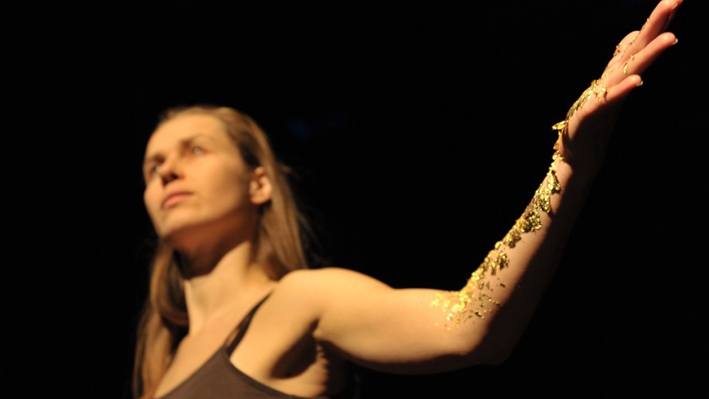
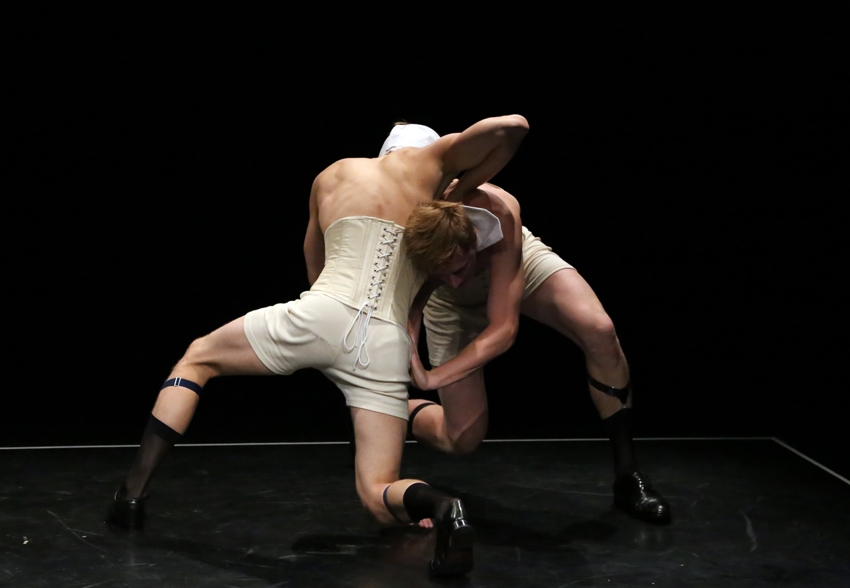
Stine Nilsen in Between (photo: Hugo Glendinning)
There are two kinds of perception in Angela Woodhouse’s Between: that of events at our own human scale and that of an intimate aural, visual and sensual kind. These broadly reflect the respective artistic disciplines of the two collaborators; Woodhouse in dance and Caroline Broadhead in textiles and jewellery. The challenge of creating a work based on these different ways of seeing is the space in which it is performed: theatre is designed to enlarge the small into something heroic whereas a gallery space is conceived around our relationship with what is small and can be observed up close. Between, which has been performed in both kinds of environment, requires elements of each but I suspect the Studio Theatre — a rather cavernous black box with black hangings that have been drawn in to reduce its scale — is not entirely comfortable in its intimacy.
Lying on the floor as we enter the dimmed space is a body under a coat; our small group gathers round, not knowing quite what to expect. Darkness descends and a small light picks out a pair of feet traveling upright under the coat into invisibility and silence. From the same direction comes the sound of a rustling material that manifests under an intense halogen beam as an animated coat isolated against the blackness, a magical image that attunes our senses to a disembodied human scale. Between is a series of such sensory adventures creating an intimate relationship between the three dancers (Stine Nilsen, David McCormick and Martina Conti) and the standing or ambulatory audience that is both observer and participant. The role of the dancers with their pared-down gestures and calm, controlled movement slows down time and increases our powers of perception, leaving us somewhere in between theatrical experience and the intimacy of our own space, between the known and the unknown, light and dark, comfort and discomfort, clarity and obfuscation.
Nilsen in a diaphanous black gown moves silently into an arena of light. Conti sidles up to her, puts her arm in Nilsen’s sleeve, then the other, slipping the garment deftly off Nilsen’s shoulders onto her self; we are voyeurs in an intimate act. The two women take turns removing and replacing the gown, accelerating the seamless transference like a dynamic sculpture. Nilsen takes a hand to her necklace and pulls it hard. It breaks and the pearls scuttle on the floor. Our aural concentration kicks in with the sudden stillness of the moment. McCormick gives Conti a similar necklace but holds on to it as they pull away from each other, stretching it to the limits of its elasticity; the sense of expectation in the space is palpable. Conti finally reclaims the necklace as she approaches McCormick with a smile and puts it on the floor while McCormick moves towards a square of light projected on to someone’s pocket. He puts his hand in the beam of light to reveal a filigree pattern of gold leaf on the inside of his hand like a decoration or a mark, shining and glinting as he turns his hand slowly, following the light’s moving path until it is extinguished.
Conti and Nilsen embrace without quite touching, like a form within a form. They select a member of the audience to include within their enfolding arms and choose my daughter. It is an arbitrary choice, but the confluence of time and place in this encounter is profoundly moving for me, highlighting one of the key elements in the work: pinpointing a privileged relationship between the lives of the performers and the lives of those attending.
McCormick stands among us with his arms raised, walking forward with space as his partner and returning to repeat the same meditation three times, without conclusion. Conti approaches a man to touch hands. McCormick circles Conti in slow motion, drawing her into a gentle, spiraling dance, chest to chest, arms to head, like two docile stags with locked horns. Conti circles away but moves back to McCormick whose hand is behind him like an angel’s wing. She pushes on his outstretched arm as if on a turnstile, but it is he who spins off. Nilsen leaves, leaving Conti in place withdrawing her arm from one sleeve of her sweater, then the other, her fingers slowly disappearing in the light. It appears she is turning her sweater back to front but then she takes out her slip from underneath, offers it to the woman in front of her and leaves. Nilsen returns to reveal a pattern of gold on her forearm. She takes the arm of a young woman and by gently rubbing their two arms together attempts to transfer the gold as a ritual gift. After Nilsen leaves, the young woman shakes her arm as if waking from a dream.
Posted: November 11th, 2013 | Author: Nicholas Minns | Filed under: Performance | Tags: Aideen Malone, Allen Fisher, Archana Ballal, Bharatanatyam, Carl Pattrick, Chris Fogg, Gemma Bass-Williams, Roger Kneebone, Subathra Subramaniam, Under My Skin | Comments Off on Sadhana Dance: Under My Skin
Sadhana Dance, Under My Skin, The Place, October 18

Archana Ballal, Gemma Bass-Williams and Carl Pattrick in Under My Skin (photo: Marc Pepperall)
What we wish for sometimes manifests in ways that are as unpredictable as they are inexorable. Choreographer Subathra Subramaniam wanted first to be a doctor but found her expression in the classical Indian dance tradition of Bharatanatyam. Her latest work, Under My Skin, returns to her first love, which gives the title a certain ambiguity: it refers not only to what happens to a patient undergoing surgery but also to an emotional attachment that is hard to shake off, as in the Cole Porter song, I’ve Got You Under My Skin. Subramaniam’s involvement is both: undoubtedly passionate in transforming surgery into choreographic form, she also demonstrates a vicarious curiosity in the operating theatre through a program of simulations, craft demonstrations and haptics that precedes the performance.
Enter Dr. Roger Kneebone, professor of surgical education at Imperial College London, whose mission to disseminate a greater understanding of surgical procedures dovetailed seamlessly with Subramaniam’s research into Under My Skin and gives it a rich context. There is evidently no pain in Subramaniam’s work, nor the emotion of dealing with the balance of life and death — something that even the surgical simulations bring affectingly to the surface. Her skill is in extracting the beauty of the movement from the operating theatre and in interpreting the essential trust that is a perquisite for any surgical procedure. In doing so, she not only expands the boundaries of Bharatanatyam but provides Professor Kneebone with an expressive medium to further his own research.
Through the surgical simulations (staged at The Place as part of the Bloomsbury Festival) we begin to understand the critical importance of close and accurate communication within a team of specialists providing an acute level of care for a patient undergoing surgery. This will involve the surgeon, at least one assistant surgeon, a scrub nurse, an anaesthetist, and an OTP (operating theatre practitioner). Sometimes the team will meet each other for the first time around the operating table, but they must work meticulously and intimately on matters of vital importance to the patient. In the course of her research for Under My Skin, Subramaniam witnessed this teamwork as an observer, and although there are only three dancers in her work, their relationship to one another is as tightly choreographed as that of the operating theatre team.
As in other works of Subramaniam there is text, here a poem about the nature of blood by Allen Fisher, whom Professor Kneebone commissioned. Its clinically precise language takes on a sense of mystery in the recording of Chris Fogg’s sonorous voice emanating from the dark. The reading of the opening lines is superimposed on a single red light like a drop of blood under a microscope to the sound of baffles, plungers and artificial breathing apparatus, the beginning of a parallel collaboration between lighting designer Aideen Malone and sound artists Kathy Hinde and Matthew Olden.
Malone also observed the operating theatre environment (and as a consequence has been asked to propose improvements to the lighting system). Her three rectangular corridors of light form distinct environments for the three medical personnel (Gemma Bass-Williams, Archana Ballal and Carl Pattrick) in blue surgical scrubs (assimilated by Kate Rigby) who adjust imaginary controls and instruments with minute accuracy and concentration: three routines that develop freely and beautifully into extended dance movement. Ballal is clearly at home with the flow of Bharatanatyam that underlies the choreography — especially in her solo to the violin of Preetha Narayanan — and adapts the gestures of the operating theatre as if putting on a pair of latex gloves. Bass-Williams and Pattrick, while clearly immersed in the style, work towards the flow of Bharatanatyam from the task-based material. What unites the three dancers is the clarity and precision of their gestures.
As the trio merges into the central corridor of light, Malone expands it into one large theatre in which the trio breathes with the breath of an imaginary patient preparing for an operation. Taking the weight of, supporting and balancing each other’s body are all metaphors for the mutual dependency of the team.
Bass-Williams and Pattrick abstract the meticulous washing of hands and the precise order of gowning into a ritual dance. Malone’s lighting moves like a film from one scene to another; in the light at one moment is Ballal in a dynamic dance while in the semi-darkness the surgeons continue their preparation, a solo of life superimposed on a duet of support. The dance vocabulary immerses itself increasingly in the current of Bharatanatyam; Bass-Williams and Pattrick join Ballal in a trio of rhythmic turning steps accented with the deep plié and completed by the rich arm and hand mudras.
The focus is narrowed to a circle of yellow light in which we see — as if we are in the team — just the hands the colour of latex taking and placing instruments, sharing actions, cutting, stitching, checking, swabbing, and cleaning in a silent, concentrated rhythm. Subramaniam once again transforms these gestures away from the operating theatre into the performing theatre, adapting the ability of Bharatanatyam to tell stories through gesture and dance. One aspect that is less developed here is the traditional use of the face as an expressive instrument, especially the eyes. The dancers look at each other, but their eyes are not always eloquent.
An acceleration in the music returns us to Bharatanatyam’s rapid, rhythmic footwork; the influence of Indian classical dance is strongest here and the dancers are stripped down to their essential natures. This is the pleasure of movement where flow is everything; it feels like a coda of growing complexity and technical achievement, but Subramaniam returns us once again to the routine operating theatre where poetry is supplanted by the sounds of the machines, the broad wash of light by a circle of yellow light and dancing by a silent concentration on gestures of intimacy and healing. Pattrick finishes his task and leaves. Bass-Williams and Ballal stay on to accompany the patient’s recovery, then Bass-Williams hands over to Ballal whose head is bathed in the opening blood-red circle of light. She withdraws her head as Fogg’s voice intones the final lines, ending neatly with, “This is blood clotting that will help to save your life.”
Posted: October 23rd, 2013 | Author: Nicholas Minns | Filed under: Performance | Tags: Bellyflop, Dan Watson, Dance Umbrella, Flora Wellesley-Wesley, Jacket Dance, Matthew Winston, Ridiculous Dancing | Comments Off on Dan Watson’s Jacket Dance
Dan Watson’s Jacket Dance, Founders’ Studio, The Place, October 12

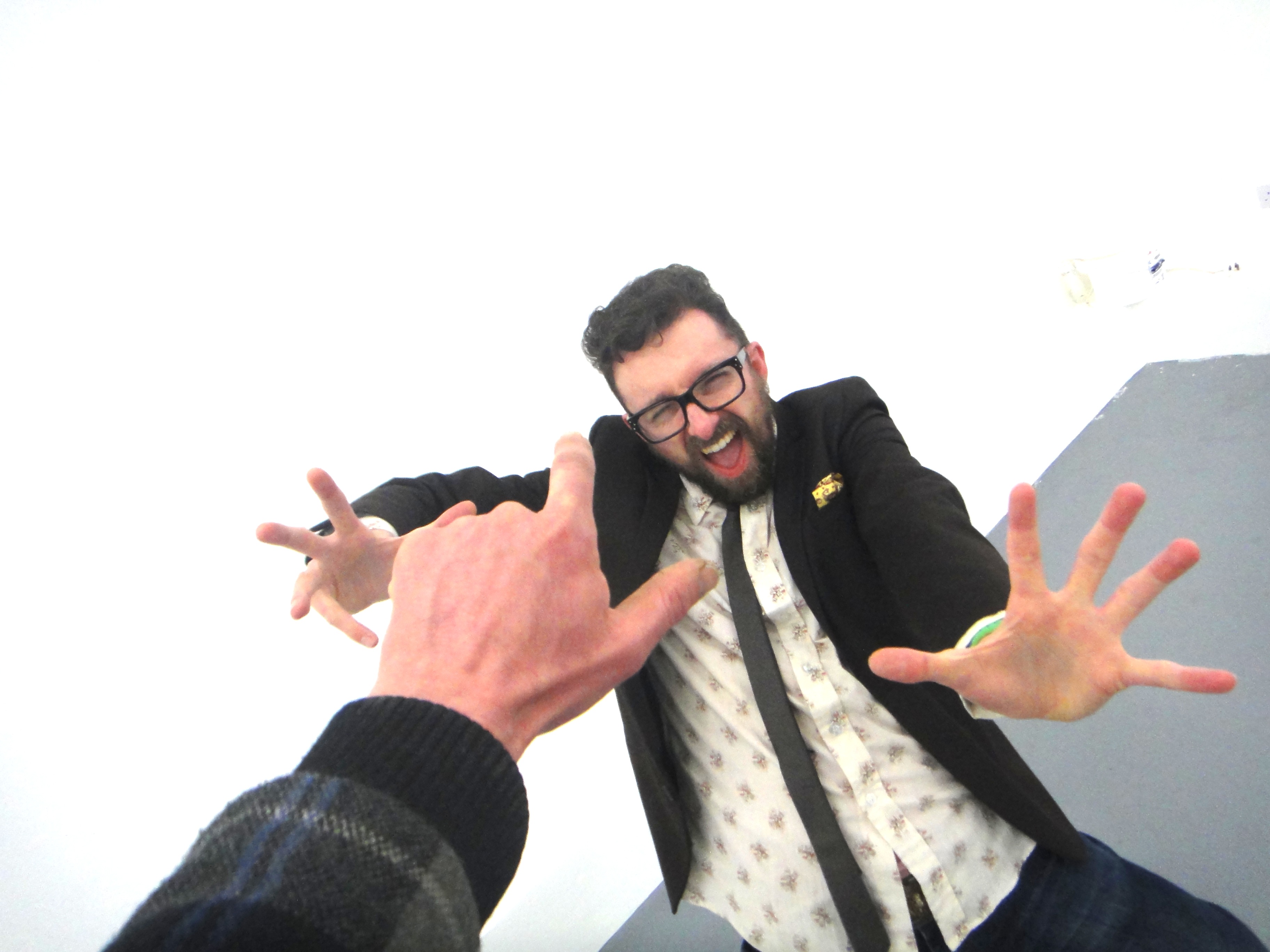
Dan Watson in a jacket (photo: Brian Archer)
This year there was a big heart beating at Dance Umbrella, epitomized not only in such works at Gunilla Heilborn’s This Is Not A Love Story and Robyn Orlin’s Beauty Remained For Just A Moment Then Returned Gently To Her Starting Position, but in a rather special Fringe element curated by Bellyflop Magazine. This is Heart with a capital H, accompanied by a printed program (only £5) in which the collaborative artist-led team produced a delightfully informative and refreshing approach to dance. What caught my attention was Flora Wellesley-Wesley’s article on Ridiculous Dancing, a name that summoned up a David and Goliath challenge to the neuroscientific-banks-of-research approach to choreography prevalent in some of our more serious (and well-funded) dance establishments; Ridiculous Dancing, it seems to promise, takes the ‘&’ out of R&D.
As an advocate of Ridiculous Dancing and the choreographer of Jacket Dance, Dan Watson explains to Wellesley-Wesley, ‘I genuinely enjoy watching people who feel compelled to express themselves in the moment: these spontaneous little personal dances that have nothing to do with rightness or composition and everything to do with humanity and physicalising internal states, whether that be a reaction to music or the moment itself….You can see the person more than the movement. The movement is a vehicle to see the humanity.’
There is an intimate scale in Watson’s approach, so it is appropriate that Jacket Dance is performed in the Founders’ Studio, a large living room with the audience packed in at one end and a floor-to-ceiling muslin backdrop at the other — what traveling players might once have set up in the village square. Watson and fellow dancer Matthew Winston are warming up as we enter. The signal to start is the donning of their jackets that hang on either side of the room.
Jacket Dance comprises a handful of scenes in a single fifteen-minute act, a ludic exploration of impulsive dance that favours exultation over technique. As Watson further explains: ‘Jacket Dance is a lot to do with joy: kids dancing to their favourite music, drunk old men dancing for each others’ enjoyment, comedians — both alternative and more traditional — provoking laughter in their audiences.’
Watson starts to riff on a shuffle and Winston picks it up and adds to it. They alternate, playing off each other like a Vaudeville team before establishing a single rhythm that one of them then muddles up. Part two develops individual sequences quite independently of each other, short dance phrases with interlinking shuffles and silly walks until Watson limps away with the choreographic equivalent of a throwaway line. Watson and Winston each wear their character like a mask: Winston’s is over-concentrated effort, while Watson’s is more abandoned though there is an underlying sense of fun in both. They watch each other and surreptitiously copy each other but for the most part they sense the space between them with the eyes of the body.
The next section explores contact in the context of Ridiculous Dancing: Winston and Watson fall against each other, embrace, and shake down. Watson picks Winston up, loses interest and drops him. The dropping and the getting up are treated as movement not story, so there are no recriminations. They judder together, jump like beans, and riff on silly walks until Watson knocks Winston down. Punch and Judy? No matter, they are up and shaking again until they both fall as flailing angels in the snow. A brief musical interlude follows, in which the two men alternate, one playing itsy-bitsy spider on his fingers while the other sings. The songs have an unselfconscious rawness — not to mention breathlessness — about them that goes hand in hand with the movement. In the coda the gloves come off in a dance of one-upmanship that adds the element of extreme to Ridiculous Dancing in some knee-crashing landings until both men are ready to drop, which they do, tracing angels in the snow again. Winding down further, they walk round the room to face each other as at the beginning. The only way to stop is to take off their jackets. Naturally.
Posted: October 21st, 2013 | Author: Nicholas Minns | Filed under: Performance | Tags: Amy Cutler, Army of Me, Brian Cox, Brychan Tudor, Drew Hawkins, Filipe Sousa, Gwyn Emberton, Joanna Young, John Collingswood, Karol Cysewski, Kirsty Arnold, Neil Davies, Sion Orgon, Wonders of the Universe | Comments Off on Joanna Young and Karol Cysewski
Army of Me by Joanna Young and Wonders of the Universe by Karol Cysewski, Borough Theatre, Abergavenny, September 18

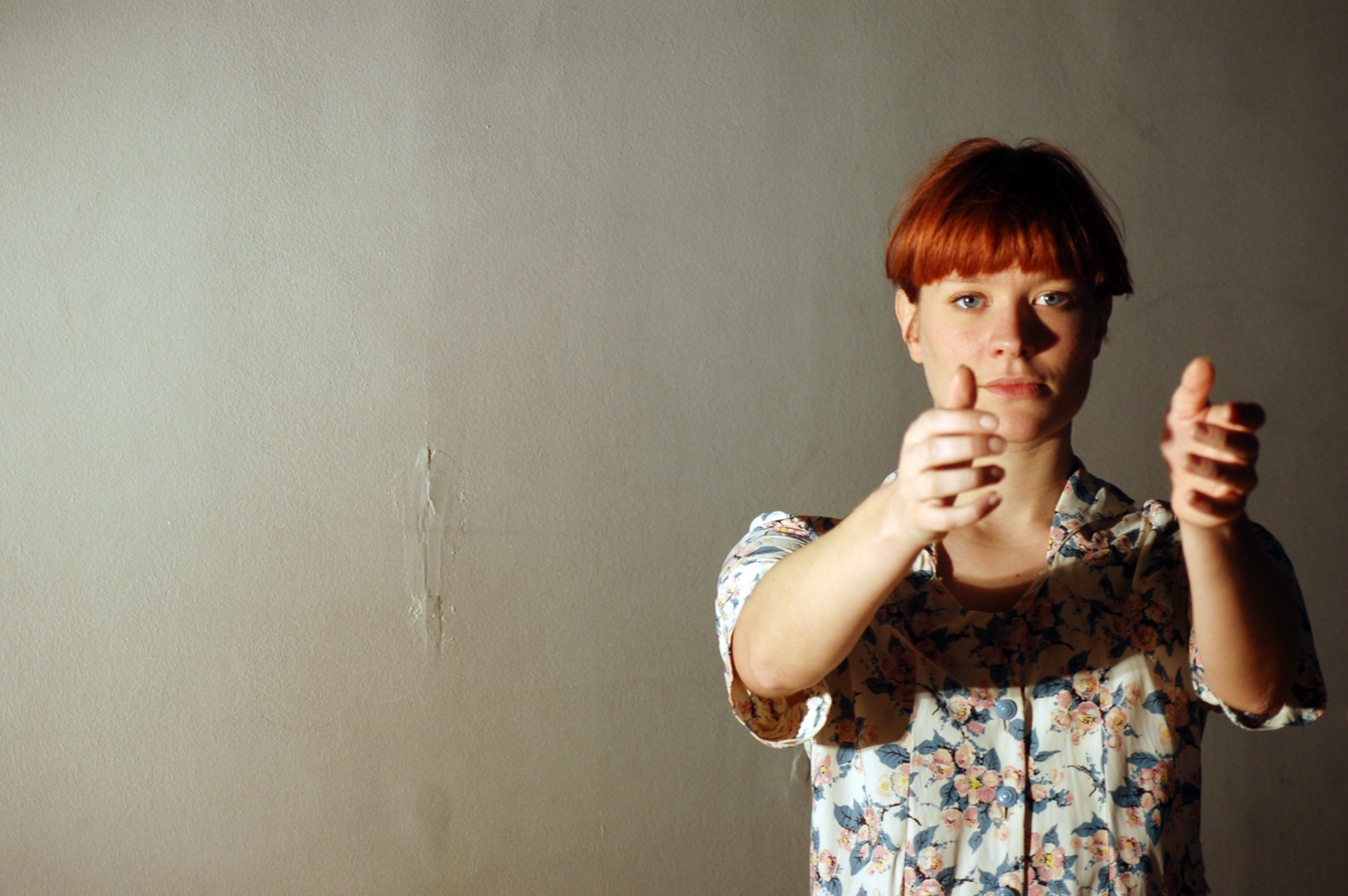
Kirsty Arnold in Joanna Young’s Army of Me (photo Iain Payne)
The power of theatre is not only in the images we see in front of us but in what memories they inspire; the two are inextricably linked. The image of Kirsty Arnold standing barefoot in her printed cotton dress in the corner of the stage, slightly in the shadows as if not quite daring to come out, is just the beginning of a delicate journey — ‘distorted echoes in a world made of small pieces’— that choreographer Joanna Young weaves, that Arnold traces, that John Collingswood illumines and that Filipe Sousa’s sensitive soundscape evokes. It is the stuff of memory made manifest in all its clarity of detail. Through the phenomenon of recall, Young places us in the life of a young woman at a moment of intense significance, a shift in maturity perhaps, or a pique of rebellion.
The space in which Arnold stands so pensively is itself the suggestion of a room, in which she stands at a window looking up at the birds flying overhead, thinking perhaps of her future. Collingswood’s lighting projects three shadows of her on the back wall, one progressively taller than the next, like a chart of imagined growth. She crosses her arms in silence then places her hands on her hips looking up. A winsome young girl with red hair, beautifully self-contained and playful, she kneels, shaking her head, then lies stretched out on the floor. Getting up, she shakes her head again, with an arm gesture of dismissal. She is anticipating what we can now hear, the sound of feet crunching up a gravel path, up wooden steps, approaching or walking around. Sousa’s score includes recordings of footsteps by Brychan Tudor, one of Young’s inspirations along with Amy Cutler’s visual art. Arnold moves out of the light into silhouette, but Collingswood finds her, defines her in a wash of light. It is as if we are watching her as she plays in her own room; she pauses, then slides playfully to the side, skipping across the floor, independent, on the verge of experience, arms raised defiantly, running, turning like a dervish, not wishing to surrender her freedom; there’s that dismissive gesture again. Her figure moves into silhouette then back to the light, a little helpless, brushing away the distractions, faster and faster, in her journey of awakening. The steps are getting louder, closer. She runs across the room, suspended in time like the tolling church bells we hear. Her toes play, she kneels, bends forward, prays, but with a sense of an impending closure. In the darkening room she contemplates her hands until they disappear.

Gwyn Emberton, Karol Cysewski and Drew Hawkins in Wonders of the Universe (photo John Collingswood)
Karol Cysewski’s Wonders of the Universe is another kettle of (prehistoric) fish, an exploratory look at the origins of the universe through the agency not of NASA but of three comic crustacea in jackets and jeans (cleverly designed by Neil Davies) whose sexual proclivities at this stage of creation are openly acknowledged. John Collingswood lights and clouds the murky depths of the universe and ocean in which the three performers (Cysewski, Gwyn Emberton and Drew Hawkins) take evolution for a spin with a suitably elemental sound score by Sian Orgon. Cysewski is clearly having fun, but he is careful to moderate the cartoon-like characterization by harnessing the awe and excitement of Brian Cox’s commentary from his series Wonders of the Universe (the starting point of the work). Cox’s theories lend context to the choreography and at the same time Cysewski’s choreographic treatment reduces those vast theories to a more manageable size. The mouthpiece of Cox’s voice is Cysewski’s midriff, manipulated into blind lips by his fellow anthropods and through these lips pass some of the great evolutionary theories of our time which the trio then plays out: the Big Bang as a writhing form that is suddenly zapped and Emberton demonstrates the survival of the fittest by knocking his fellows on the head, a favour they return as they dance in solo or pairs: gametes and zygotes in a primeval mating ritual with attendant cluckings and horn-like siren calls.
In this grand scheme of evolutionary fervour there is suddenly an amoebic fart, an infinitesimal bang with a bad smell. The trio looks at each other accusingly. Cox is silent on the subject but Orgon is clearly having a ball with a techno riff on farts, snores and whistles.
Our evolutionary trio rushes forward from the oceans across the growling African plains to the point at which they stand on the Borough Theatre stage this evening — thousands of generations later — illustrating their miraculous journey. The midriff oracle speaks again; we hear the wonderment in Cox’s voice as he describes the stars evolving and dying, time unfolding and how nothing lasts forever. It’s a ‘majestic story’ and a lot to ponder, but the cheers and applause at the end signal an engagement by the audience not only in the science but in the dance. It’s a heady mixture.
Posted: October 18th, 2013 | Author: Nicholas Minns | Filed under: Performance | Tags: Andrius Stakele, Aura Dance Theatre, Birute Letukaite, Deborah Light, Gotaute Kalmataviciute, Marius Pinigis, Mary Anning, Neil Davies, Solveiga Vasiliauskaite, The Curio Cabinet | Comments Off on Aura Dance Theatre
Aura Dance Theatre’s double bill of Birute Letukaite’s Am I The One Who I Am? and Deborah Light’s The Curio Cabinet, Chapter, Cardiff, October 15

Andrius Stakele and Marius Pinigis in The Curio Cabinet (photo Noel Dacey)
How refreshing to see a new company that hails from off the beaten cultural track. Such is Aura Dance Theatre from Kaunas in Lithuania that presented a double bill at Chapter in Cardiff with a recent work by their director Birute Letukaite (Am I The One Who I Am?) and new choreography by Deborah Light (The Curio Cabinet).
The title of Letukaite’s piece is a little convoluted, which may be a translation problem or an indication of the complexity in dealing with the theme of identity. Certainly there is a lot going from the very beginning of the performance as we enter the theatre. On the way down to my seat, I pass a line of four women in costume and makeup draped against the wall and sit in the front row next to a tall young man in makeup wearing a skirt and jacket, and wonder if I will be part of the performance. He gestures to the seat as if to say it’s ok and I trust him. On stage a woman lies in the steely blue light looking as if she is having contractions. Another woman sits facing the back apparently naked in an office chair next to a textile clock (I thought of the painting by Dali I had just seen — The Persistence of Memory — that features his melting watches). Four moulded-textile anatomical forms (by Almyra Bartkeviciute-Weigel) hang lifeless on a rail at the back as if waiting for a body to fill them. Imprinted on each is an office chair in lurid, silky blue.
The woman with contractions (Gotaute Kalmataviciute) sits up and marks the space around her with precise, repetitive, bird-like gestures of the head and arms with breathtaking sensuality. The young man next to me (Andrius Stakele) gets up to join her and is immediately sniffed by the bird-like head and hands before he introduces himself in a solo of large gestures that blur the lines around him with a bull’s force to Kalmataviciute’s avian curiosity. In the posture and gestures of a second man (Marius Pinigis), there is a suggestion of Nijinsky’s introverted prankster Tyl Eulenspiegel, gestures of illness or instability delivered with uninhibited force. Letukaite has nurtured the identity of these three characters convincingly, enhancing their natural stage presence and ability to make beautiful shapes. Delve under the surface of identity and you come quickly to the sexuality and eroticism of gender and these are explored as well in the repeated interlocking and piling of bodies, but there is an equality of sexual expression between men and women, even if Kalmataviciute’s mastery of space makes her identity dominant.
The other seven dancers are used less forcefully, more to illustrate a point than to express their inner selves. In a secondary theme of identity in the workplace, a woman concentrates on repeating a series of mechanical gestures and there is a comic reference to our reliance on mobile technology to promote and enhance our identities. These clichés are underlined and explored further in an accompanying film, though the medium’s ability to draw our attention tends to eclipse the action on the stage. We are left with a woman dancing to a repetitive beat who nevertheless reveals a tenacious spirit of individuality and the quiet woman in the office chair who has been wheeled around by a trio of acolytes is finally revealed to be pregnant: the regeneration of life, a new identity in a complex world.
Identity of course goes far deeper than the shadow of an occupation, of the clothes we wear or of any other external cause. Perhaps the three main characters come across so well because their identity is allowed to develop from the inside in its genuinely anarchic, sometimes anti-social way. As soon as identity is processed, it loses its richness. The success of Am I The One Who I Am? is divided along this fault line.
Identity also infuses Deborah Light’s The Curio Cabinet, though in terms not so much of individual expression as of the gender issue. Light, one of whose ‘guilty pleasures’ (her term) is reading historical novels, drew her inspiration for The Curio Cabinet from the story of Mary Anning, whose name is little known outside the world of palaeontology to which she devoted her life in the first half of the nineteenth century. Her significant contribution to the science of fossils — then called curios — was acknowledged in her time though not officially recognised by the male-dominated scientific circles in which she would have moved had her gender not been a barrier. In The Curio Cabinet there is not a curio in sight, no delicate pick in Anning’s hand, for this is no historical tale. The one indication of Anning’s fieldwork is the ruggedness of her outfit: a bodice, corduroy pants, woollen socks and hiking boots.
Light takes us straight onto the un-level playing field, marked out by a white taped square within which Anning’s two male counterparts (Andrius Stakele and Marius Pinigis) search, strut and squabble. They are conceived as a homoerotic Tweedledum and Tweedledee and costumed with unsparing satire by Neil Davies in old school black shoes and socks with suspenders, woollen underwear, boned corsets and an exaggeratedly high Etonian collar. Anning (Solveiga Vasiliauskaite) with her flaming red hair moves for the most part outside the white taped square, keeping her nose to the ground, but her feminine alter ego (the beautiful Gotaute Kalmataviciute) dressed in a black lace body suit finds a way in that sends the two males into a tailspin. Light is uncompromising in championing Anning as a model for the female cause, but she never lets her sharp wit upset the tone of the story: at one point she repeats a motif where her characters chip away at the rock; Anning and the men make the percussive sound with their feet but the über-female uses her hand, sensing precisely where the hidden curios lie in this game of opening up opportunities.
The imagery is both striking and beautiful, with an erotic charge that drives the action. Anning is left on the sidelines after the heat of battle, as she was in her professional life, but Light has chipped away at the fossil of male chauvinism to reveal her rightful identity. Perhaps Anning herself has the last word: like the curios she so painstakingly released from the rock, the identity of the choreographer is inherent in the choreography. Keep chipping.
This performance is the result of the first stage of a collaboration between Deborah Light and Aura Dance Theatre supported by Chapter and Wales Arts International. A full version of the work will be developed and performed by Aura Dance Theatre in Kaunas in November.
Deborah Light’s HIDE can be seen at the Traverse, Edinburgh on January 31 as part of the 2014 British Dance Edition.
Posted: October 3rd, 2013 | Author: Nicholas Minns | Filed under: Performance | Tags: Emmanuel Grivet, Transparence blanc | Comments Off on Emmanuel Grivet: Transparence blanc
Emmanuel Grivet, Transparence blanc, Chapter, Cardiff, September 26

Emmanuel Grivet
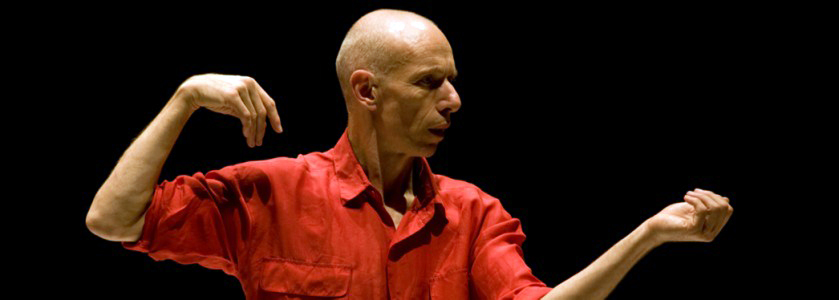
Emmanuel Grivet rehearses his improvised solo, Transparence blanc, before an audience of delegates at the Dance Roads Open Process at Chapter in Cardiff. I had seen it a few nights before when Grivet, who had been hired as the mentor for the five choreographers in this project, had time for his own work after the day’s rehearsals were over. I was on that occasion the only observer; tonight’s sharing is a more formal setting and I want to test my initial reaction. I had been watching Grivet’s morning classes and knew I was in the presence of a gifted teacher of movement but his performance strips away the pedagogic elements and concentrates on his singular use of the body in space. His body is itself an expressive instrument, gaunt and gently angular with a shaven head and a pair of sympathetic eyes that give as much as they take in: a wise abbot, perhaps, who is quite comfortable in the presence of laity. He tells us before he starts that we have to imagine a water clock on the stage that he upends to begin the performance and that dictates the duration of the work. There is also, under normal performance conditions, a white floor with a black surround, a white backdrop and he is dressed in white. But this is an impromptu rehearsal, and none of those conditions exist.
Thus he begins, in silence, blurring lines between mime and dance as he partners the floor and the space around him with a clarity of intention that never falters. He tells us later that his inspiration for Transparence blanc came from his observation of babies (he has two children), in particular their unconditioned response to stimuli. Grivet’s gestures and sudden postural changes of direction and tempi are similarly unreadable as a message or narrative, but keep our attention fixed on the strength and freshness with which they are delivered. The power of this language is heightened paradoxically by its lack of emotional delivery and direct eye contact; he is aware of us without seeing us. But the real mystery of the work is how the continuous flow of gestures and body loci, moving effortlessly around a centre, form a cohesive, consistent whole. The improvisation takes the form of a soliloquy in which the entire body speaks with the physical equivalent of punctuation, inflection, and all the histrionic qualities of a masterful speaker. Grivet also employs his voice in an imagined language that sounds like a mix between Danish and Austrian and even though we cannot understand his meaning, there is never any doubt that there is a meaning because all the parts of his body accentuate the intention.
Grivet learned to articulate his body following an accident that injured his spine, putting an end to his sporting aspirations. Remedial body work led to a desire to express himself through the body and he turned to dance. He now heads his own company, compagnie emmanuel Grivet, in Tournefeuille, on the outskirts of Toulouse, where he continues to develop danced improvisation in which the freedom to move is sustained by a freedom to react. I was going to say ‘freedom to think’ but Grivet’s dance is essentially non-rational; it seems to derive from a depth of feeling and timelessness that connects with us on an atavistic level, sharing uncomplicated sensations like turning, jumping, crawling and walking in any number of variations without any pre-conceived idea of how they should be performed nor in what order. Improvisation is, after all, the free navigation between points in space. Grivet keeps the rhythm very much alive, shaping his space sometimes like a brief sketch and at others like a long, painterly line, recalling the famous French actor, Jean-Louis Barrault, when he described his mime as the ‘body writing a silent sentence in space’. Grivet creates an environment in silence and with music, but the music is more a balm to our senses than a stimulus for the improvisation. He makes visible what is invisible. I have never seen a dance form that is so free, nor, for one so overtly unemotional, so profoundly moving.
Posted: September 19th, 2013 | Author: Nicholas Minns | Filed under: Performance | Tags: Airen Koopmans, Annie Loc, Dog Kennel Hill Project, Eleanor Sikorski, Heni Hale, Jordan Lennie, Joseph Mercier, Leila McMillan, Panic Lab, Rachel Lopez de la Nieta, Tess Letham, The Place, Touch Wood, Valentina Golfieri, William Collins | Comments Off on Touch Wood 1 at The Place
Touch Wood, The Place, September 3
Three women relax, stretch and gaze out at the audience as we come into the studio. On stage there is a wooden platform with two tiny, coloured beach chairs on it and a long wire hanging above it with a light fitting at one end but no bulb. This is Touch Wood, in which ‘four choreographers straight out of the studio seek out the audiences’ reaction as they try out fragments of their latest work.’ Or as the director of theatre and artist development, Eddie Nixon, points out in his introduction, ‘What unites all these works is that nothing is yet finished.’
Dog Kennel Hill has been working on Etudes in Tension and Cries, which Rachel Lopez de la Nieta introduces. It is the outcome of five days of work ‘appropriating scenes of high drama and conflict to see how we find ourselves in relation to them.’ ‘Appropriating’ is the operative word here; despite the gravity of the material the result is ambivalent, coming across as almost parodic. The melodramatic title could be a clue. There are four tableaux in which aggressor and victim change roles. In the first Lopez de la Nieta is a parade ground sergeant barking at a choreographer (Heni Hale) who is gently punching out a movement motif and answering back in army parlance about the duality of mind and body. The second frames a face-off between Lopez de la Nieta as a domineering director and Hale as her terrified, speechless assistant. The director wants her to talk about the work. Lopez de la Nieta’s languorous gyrations betray her pleasure at inflicting discomfort, while Hale is petrified and withers under the scrutiny. Finally, she stammers, ‘I think we should show it to some people and get some feedback.’ In the third tableau, Hale is the bullying aggressor pushing Lopez de la Nieta to her physical limits in a comic book treatment of boot camp with American accents, and the fourth portrays a sexual aggressor (a gyrating Hale this time) whose victim places a length of rope on her own lap, tapes her own mouth and puts her hands behind her chair. Neither Lopez de la Nieta nor Hale hold back in their performance but the treatment of violence remains enigmatic. Annie Loc is on stage to manage the lights — Guy Hoare’s lightprint is in the work already — but has no role in the action.
I had misread the title of William Collins’ work, Untied States, as United States, thinking he was an American in London. As soon as he begins to talk in a broad Scottish accent, I realize my mistake. In his introduction, Collins compares a dance in which the act disappears as soon as it is performed to the written word that can be left and picked up again at any time. I don’t remember what else he said, but his performance remains indelibly imprinted on my memory. Collins shares Untied States with Airen Koopmans and Eleanor Sikorski, but his quirky, angular choreographic style is so idiosyncratic that they wear it rather than inhabit it. As soon as Collins takes the stage, not unlike an Egon Schiele drawing in motion, it is clear he is totally committed to what he is doing; it’s in the eyes which are as engaged as the rest of his body. Collins is someone (he explains later) who can read a book in no particular order, and his choreography borrows from this propensity, though remaining (and this is what dance has over the written word) rivetingly in the moment. When we see emerge from his gestures the image of a long-haired girl throwing her hair around (he has no hair), and fanning herself before taking a refreshing shower, we are not sure if it’s the end of the story or the beginning, but he has fixed it in our minds with his wry sense of humour and inimitable mime, giving meaning to what has gone before. While he is rinsing his hair, Nixon calls ‘time out’ and the work steps out of its frame. In a revealing session of questions and answers with the choreographer afterwards (part of the Touch Wood format), Collins speaks about the beginning of Virginia Woolf’s The Waves in which she describes in minute detail all the elements of a sunrise before the reader can put all the micro elements together to see the bigger picture. Collins seems to have pulled off a similar accomplishment in his choreography.
Valentina Golfieri walks on clutching her Mac, sets up a screen on the side, beams some images on to it and introduces her work, Strange and Unproductive Thinking to David Lynch’s track of the same name. Golfieri says she is not working towards making a product as much as she wants to create a means to an end. The images on the screen are a record of her influences. Standing centre stage, without moving her feet, her arms pull her neck and back down to her feet, again and again, faster, like peeling off a jumper or taking off layers to see what is left. What is left? Golfieri is not sure; her dark and lively eyes wear an expression of uncertainty as the unpeeling gets out of control. She pulls it back from chaos and her face relaxes; she is enjoying the process, circling her body now with raised arm gestures, until a sense of worry and despair returns. As the music stops she is left holding her head. In the silence she repeats a phrase ‘What if I speak now’ quietly, somewhere between a prayer and an incantation. Golfieri’s bold process reminds me of Paul Taylor’s early choreographic experiments in which he deliberately used everyday gestures (walking, queuing, standing) in an effort to rid himself of the influences of his past on any present or future choreography. To some it was strange and unproductive, but it gave him a platform (and the confidence) on which to build. Golfieri’s process is also one of divestment but we shall have to wait to see if it is the stimulus she wants.
Joseph Mercier lugs on his Mac connected to a keyboard. Tess Letham rolls on a suitcase and Leila McMillan and Jordan Lennie drag on large crash pad. Mercier and his Panic Lab colleagues introduce the concept of Toxic as a comic strip: how we might be superheroes, using a movement vocabulary of characterization with little bits of a story. Letham takes her suitcase with her to the microphone to set the story’s context; she has just the right intonation and delivery. The show begins with city sounds; Joseph is a man reading the Daily Mail (with the headline Pupils packed in like sardines) waiting for a bus with two others. Letham herself is, we are to imagine, dressed in a yellow leather biker suit, ‘like Uma Thurman in Kill Bill.’ Mercier picks a fight with her in which the other two join, but Letham makes quick work of his attack and defends herself convincingly in slow motion combat circling the stage, beating them all. She is the only one left standing. ‘It was not my intention to do that in front of you’ she demurs heroically into the microphone.
In the second clip, Lennie is locked up in jail. Mercier the interrogator asks him his name. ‘T-Cell’. We hear the sound of a whip (thanks to sound designer Dinah Mullen). What’s your real name? asks Mercier, trying hard to look menacing. Whip. What do you know about the one they call Canary? McMillan walks down the stage provocatively, arms rising, looking at each of us, a femme fatale. Letham provokes her by saying, ‘I’m the Iron Lady, the world’s most powerful.’ McMillan tells us that the girl wearing the yellow suit is a whole world of trouble. They strut around each other. McMillan zaps her with her fingers: round one to the femme fatale. Mercier moves the crash pad to meet Letham’s next knockout. Meanwhile Lennie wakes up and tangles with her but McMillan steps in to destroy them both while Mercier looks on wide-eyed.
He warns us that the next scene is a little violent. He and Lennie are walking around in another slow motion fight scene, punctuated by violent contact blows or lifts that send Lennie flying while the two girls look on. Letham concludes in a bubble of speech that she knows exactly what she needs to do. They all do. To be continued.
Posted: September 2nd, 2013 | Author: Nicholas Minns | Filed under: Performance | Tags: Carlos Acosta, Eric Underwood, James Potter, Leanne Benjamin, Marianela Nuñez, Meaghan Grace HInkis, Melissa Hamilton, Nehemiah Kish, Ricardo Cervera, Robert Clark, Sir Frederick Ashton, Sir Kenneth MacMillan, Yuhui Choe | Comments Off on Carlos Acosta: Classical Selection
Carlos Acosta, Classical Selection, London Coliseum, July 30
There is something about the dancers Carlos Acosta has gathered to celebrate his 40th birthday that reminds me of a band of players that puts on performances for the sheer joy of performing. Although Acosta is clearly the central figure there is a thoughtful egalitarianism in the various performances, an abandonment of star status for the delight of working collectively. In an interview with David Jays, Acosta says that ‘In my programmes, people are not just dancers — they are people who dance.’ It is an apt distinction, for what comes across in Classical Selection is the human element, the drama, the filtering out of any conceit to lay bare the person dancing.
Pianist Robert Clark is alone on stage in a pool of light, playing a Tchaikovsky nocturne. A second light picks out an empty chair in which Acosta, dressed in military attire, soon relaxes as if to start a rehearsal of Sir Kenneth MacMillan’s Winter Dreams. He massages his foot, takes off his leggings, stuffs them in a bag, and puts on an overcoat. Any pretense of rehearsal evaporates as Marianela Nuñez arrives. Acosta throws off his coat (so soon after putting it on) and rushes to her. What follows is a duet of leave-taking between Masha and her lover Vershinin based on Chekhov’s Three Sisters. It is rich MacMillan territory in miniature, and the contrast between the exquisite Nuñez and Acosta’s bravado — she speaks in lines and beauty, he in clarity of force — keeps the drama alive in a passionate complexity of lifts and embraces that dissipate with his abrupt departure and her collapsing on the discarded coat.
In creating the programme for Classical Selection, Acosta wanted to ‘revisit some of the choreographers who have shaped and inspired me as a dancer down the years and to showcase some of the dancing talents with whom I have had the privilege to work’. Melissa Hamilton dancing Mikhail Fokine’s The Dying Swan is clearly in the latter category, the first of three works in which she dances. Last year Susan Pritchard and Anya Sainsbury produced a book on Anna Pavlova (for whom Fokine created the solo) to mark the centenary of her moving to Ivy House. The old photographs show Pavlova at the height of her artistry but with a balletic line that appears less refined than that of today’s Royal Ballet. Melissa Hamilton has a precision in her wrists and arms that is swan-like but a high arabesque that belongs elsewhere. Unlike the musical interpretation (by Robert Clark on piano and James Potter on cello), Hamilton does not differentiate (as in a swan) the beauty and fragility of the upper body from the working of the legs, so we are drawn to her lines rather than to her heart: she is a swan, but she is not dying.
Sir Frederick Ashton’s choreography is so deceptively simple perhaps because his language is so articulate and clear; his steps dance the dancers. In Rhapsody, to Rachmaninoff’s Rhapsody on a Theme of Paganini, Ricardo Cervera and Yuhei Choe are all freshness and light, and Choe is quite fearless as she launches herself into Cervera’s arms. Rhapsody is like a sketch in pencil with watercolour highlights in which the costumes amplify the movement to perfection.
As the lights come up on Scheherezade, a story ballet from Diaghilev’s 1910 Paris season, it looks as if two oriental sleeping bags are on stage, a vestige of the exotic design of Leon Bakst’s original sets. The role of Zobeida was originally made for Ida Rubinstein, a beauty of her time whose power was in her mime rather than her dance. Nuñez is a beauty of our time, but she is also an exquisite dancer; she brings almost too much to the role. Acosta has all the animal quality and the overcharged energy of the passionate slave bolting into the harem for a brief, forbidden moment, with his large hands, like a Rodin sculpture, exaggerating his thrall. The extract is all expectation and suggestion: Nuñez is languorously supple and seductive, succumbing inevitably to the passion of Acosta who, after a final, brief climax, is spent. Unlike the murderous ending of Fokine’s full-length ballet, this is a ‘petite mort’.
In another kind of bedroom, an opulent four-poster dwarfs the set of MacMillan’s Manon. Nehemiah Kish as Des Grieux is writing at a desk while Leanne Benjamin as his lover makes her sensual way from the sheets to his side, snatching his feather quill and, forgetting it is not a Parker fountain pen, tossing it away with a great deal of force for very little effect. Kish gets up not, it would seem, from any internal motivation but because the choreography dictates. She wants to play but he does not. She has the looks, the sinuous passion; he keeps well within his balletic shell. Their kiss at the end is, finally, believable, but the extract never really gets going, as it takes two and Kish’s motors are not turning over at Benjamin’s rate. He appears stilted: technically able, but without the emotional spark.
A musical interlude allows the orchestra, under Paul Murphy, to let rip on one of Dvorak’s Slavonic Dances, directing the audience eastward from France to Russia.
Agrippina Vaganova’s choreography, Diana and Acteon, is a demonstration of the classical training for which Vaganova as a teacher is so renowned. And Acosta and Nuñez thrive on it. Nuñez already displays a lovely opening ballon before there is an audible ‘Aaaah!’ from the audience as Acosta flies in. Nuñez and Acosta are very calm together even though the choreography, on a bow-and-arrow theme, is highly charged and virtuosic. Nuñez’s split arabesque penchés are probably not in the original Vaganova conception but do not appear out of place as her entire performance is transposed to a consistently higher plane of performance. Acosta’s solo is beautiful, contained and centred, even if he has to put himself back on to his pirouette. Nuñez is ravishing in her solo with a breathtaking series of opening penchés. They are not all particularly feminine steps, but she brings together her strength and poise to create beautiful shapes. Acosta and Nuñez evidently inspire each other, and the coda is thrilling. There is a lovely moment when he partners her in pirouettes then takes away his hands to leave her to continue turning as if he were never there. This story of Diana and Actaeon has a happy ending: by the time this duet is finished, Diana’s desire for vengeance has metamorphosed into physical union. This is what we have come to see, classical ballet danced by two artists who are at the peak of their art.
The second half of the evening is more choreographed than the first, an almost continuous flow of works with the briefest of pauses and no bows. It is a more satisfactory format. In MacMillan’s Mayerling, Acosta pushes his interpretation of Crown Prince Rudolph to the edges of sanity. A three-panel screen at the back of the stage, a table and two chairs suggest Nicholas Georgiadis’s design for the hunting lodge where Rudolf and Mary Vetsera (Benjamin in great form) meet for their suicide pact. Cervera, as Rudolph’s driver Bratfisch, is delightfully at ease as he tries in vain to entertain the couple. Perhaps he senses something is not right and jokes away the quiet before the storm. MacMillan is at his most psychologically inventive, having the nervy Crown Prince move his own legs with his hands like someone controlled by an outside force. He craves the drugs that are evidently on the table. Vetsera has left the room to change and reappears in a light diaphanous gown as Rudolph reaches for the morphine. She circles her chair, he circles his and they meet to dance a tormented, passionate duet that gets rougher until he collapses on her. He draws himself up to the table with difficulty to get his fix. She climbs under his legs and reaches up his thighs. It’s heady stuff, and he is now out of control, throwing her around until he collapses on the floor, exhausted. They take each others’ hands. Rudolph then takes the pistol, goes with Vetsera behind the screen and shoots her. Staggering out, he raises the pistol, looks at it, and pulls the trigger just as Cervera returns. The applause seems out of place, a reminder of another tragedy: it was during a revival of Mayerling in October 1992 that MacMillan died of a heart attack backstage at The Royal Opera House.
Kish is the soldier in Gloria (I can’t help remembering the image of Julian Hosking in the role), and Hamilton the sylph, his ideal image. It is a complex relationship, with Kish manipulating her body with care (his partnering is superb) yet at one point he holds her like a gun. It is Macmillan at his most spare, a poem of movement in memory of his father who suffered in the trenches in World War 1. Hamilton is gorgeous here, her line matching the purity of voice in Francis Poulenc’s Gloria in G sung by the Pegasus Choir, and Kish is the perfect counterbalance.
Another ballet of leave-taking, MacMillan’s Requiem is his ode to John Cranko, friend and fellow choreographer for whose Stuttgart company MacMillan created Song of the Earth. The music is Gabriel Fauré’s Requiem, with the Pegasus Choir once more in the pit. Chris Davey’s lighting creates an autumnal pattern of leaves in which Benjamin appears in angel mode, moving Acosta back from the abyss of his mourning; his body is finely attuned to the voice as he lies listening close to the ground. Requiem is a quiet, fundamental piece that has elements of stillness, as in Romeo and Juliet, that serve to focus the power of the music. There is something universal here as Acosta seems to search for a sign of outer presence, but it’s already in him. His poignant final shape as he lies down, with his feet raised sideways, is reminiscent of Song of the Earth. MacMillan was evidently inspired by the voice; Benjamin in the Pie Jesu is beautifully wedded to the soprano voice of Moira Johnston, showing the purity and sensitivity of the female form, requiring balance, poise and line. She has them all: a joy to watch.
For the Rubies section of George Balanchine’s Jewels, Cervera is joined by Meaghan Grace Hinkis. Though Cervera has danced this before with the Royal Ballet, it is a version that does not exercise the wit of the music and Balanchine’s playful, devoted response, with the result that the dancing and the music are separated like misaligned colours in a print. Unfortunately for Hinkis, for whom this is the only appearance, neither ruby sparkles particularly brightly.
With Apollo, in which Balanchine ‘laid the foundations of what was to become neo-classicism,’ we see the clarity and elegance of pure form and Acosta and Nuñez bathe in its light. In this central pas de deux, Apollo plays with Terpsichore with breathtaking sensitivity.
It is heartening to see a work of Christopher Wheeldon on the bill. Tryst is a quiet duet that carves space beautifully, as Hamilton does in a simple transition from flexed foot to a pointed one. Her tryst is with Eric Underwood who has the luxuriance and grace to complement Hamilton in shapes that collapse, melt and reform like James MacMillan’s music. Underwood and Hamilton work well together. Left gazing into space on a trumpet passage, they roll together to a kneeling position like two perfectly attuned individuals finding each other.
The evening ends with Acosta drawing on his Cuban roots in a sensuous and powerful work by fellow countryman and Rambert dancer, Miguel Altunaga, called appropriately Memoria, to music by Mexican electronica artist Murcof. Acosta appears at first in a conical light as if in a jar, his torso and arms dancing while his heart directs. Altunaga brings out all of Acosta’s abilities here: power, passion, and technical bravado in all directions, showing us a dancer who is more completely himself than at any other point in the evening. There is also a sense that Acosta is doing this for us, giving back with a generosity of spirit that lifts the audience with him.
In a symmetrical end to the evening, Robert Clark returns to play – this time Sweet Dreams from Tchaikovsky’s Album for the Young – while Acosta sits back in his chair, puts on some warmer clothes, relaxes, perhaps dreams of his life at 40 in ‘the circle of public solitude’. He puts his bag over his shoulder and walks offstage.
Three years ago I happened to meet Acosta on the tube as I was passing through Covent Garden station. We spoke for all of two stops; I just had time to tell him I hadn’t yet seen him dance. He responded with a self-deprecating, warm smile that I had better see him soon as he was becoming a dinosaur.
Some dinosaur. Happy Birthday.
Posted: August 9th, 2013 | Author: Nicholas Minns | Filed under: Performance | Tags: B-Hybrid Dance, Brian Gillespie, Foundations, Isadora Duncan, Johnny Autin, Julia Pond, Nina von der Werth, Taksim Square | Comments Off on Cloud Dance Sundays 2
Cloud Dance Sundays 2, Lion & Unicorn, July 14
As the opening work of this second iteration of Cloud Dance Sundays, B-Hybrid Dance reprises Foundations, which I had seen at the Cloud Dance Festival two weeks before. The shortcoming I noted then is just as stark here: a static reading of the lyrics that leaves the music for the most part stranded. The brief solos of Eloise Sheldon and Jumar Aben show that choreographer Brian Gillespie is not insensitive to the musical inspiration, but such a literal interpretation of the lyrics ‘I climbed a tree to see the world’ as a dancer climbing the backs of her colleagues or of ‘I held on as tightly as you held on to me’ as the line of dancers linking arms over shoulders limits Gillespie to a one-dimensional response to the musical line.
Julia Pond is only four generations removed from the first teachers Isadora Duncan formed at her school; before dancing three works to the music of Schubert and Chopin, Pond gives a short introduction to Duncan’s legacy. It must be difficult to give life to the work of a dancer who was active at the beginning of the last century, but there is a freshness and freedom in Pond’s interpretation. The rhythm of each dance is in the feet while the beauty is in the upper body and Pond must have a powerful pair of lungs to keep her breathing so controlled and calm throughout the exertion. If the beautiful photograph by Arnold Genthe of an ecstatic Duncan with her head and arms raised is any indication, all that is missing in Pond’s performance is the abandon and longing that I imagine arose as much from Duncan’s lifestyle as from her dance style. There is a similar reserve in Pond’s own choreography, Take/Give, in which she sports enticingly with yards of flowing white cloth. Despite the voluptuous nature of the imagery and of the voice of Leonard Cohen (Take This Waltz), our connection to Pond keeps its distance on the edge of emotion. Perhaps Duncan’s art was so radical in its time that we still expect to be seduced by it, but like the value of money 100 years ago, it takes a lot more now to match it.
There is very little historical about Nina von der Werth, a recent graduate of London Contemporary Dance School, who is clearly influenced by reality television and conceptual dance. Francesco appears on screen to introduce the work that is based on his recent heartache. His commentary on losing his partner, to whom he refers as ‘my little yellow fairy’, takes on the nature of the performance and he is so plaintive and over the top (to a piano accompaniment of Someone Like You) that the audience is not sure whether to laugh or to get out their hankies. The real Francesco appears on stage and Tori, who plays his late love interest, appears in a flurry of yellow feathers to a live recording of (yes) Coldplay’s Yellow. This is already the climax of the work and there is not very much else to say though the duet continues to wild applause (from Coldplay’s performance) and some rather clunky partnering on stage until the departing Tori looks back at Francesco’s despair with calculated pleasure and runs off. Perhaps it should be Francesco who sweeps up the feathers instead of the stagehand. Either way, the feathers do not cooperate with the broom and have to be picked up one by one.
A wooden stool is placed on stage and Johnny Autin steps up to turn slowly, like a revolving mug shot, to a hypnotic violin track (Cajon by Daniel Waples and Flavio Lopez). There is a certain defiance in his strong rounded features. Taksim Square is a work in progress that refers to and is inspired by ‘the recent Turkish protests against Prime Minister Erdogan’s government and the violent clashes with the riot police in Ankara and Istanbul.’ Autin passes his hand across his face, then examines his hand in detail. From these small gestures, he builds up an intense physical portrait of repression that courses through his entire body. At one point he takes off his t-shirt to create a brutish, faceless choreography of the muscles of his back. His mime is clear and his articulation is imbued by a violence that is never far below the surface. Another musical track (the dance inside by Ceccal) accompanies his lightning gestures — a ferocious, internal struggle for sanity — in a square of light like a cell. His arms rise again in a fist, then an open hand, trembling; he suddenly and violently slaps his face, looking ready to explode; his eyes trust no one Once out of his square, facing unseen opponents, his entire body is shaking, answering gesture for gesture with a full-out body language. At the extremes of physical endurance, he nevertheless expresses a calm that reflects his unbowed, unrepentant core to the end. A remarkable performance.
Posted: July 18th, 2013 | Author: Nicholas Minns | Filed under: Performance | Tags: 'Moments, B-Hybrid Dance, Brian Gillespie, Ceyda Tanc, Chantal Guevara, Charlie Cooper Ford, Cloud Dance Festival, Ella Mesma, Eloise Sheldon, EvoL, Gone To Get Milk, Helen Aschauer, Ieva Kuniskis, John Ross, Joseph Toonga, Jumar Aben, Man Down, Melanie Lopez, Mikkel Svak, Nic Holdridge, Oliver Freeston, Past', Peter Humphrey, Raymond Chai, Unbroken Silence, Volta | Comments Off on Cloud Dance Festival: Lacuna
Cloud Dance Festival: Lacuna, Bernie Grant Centre, July 7

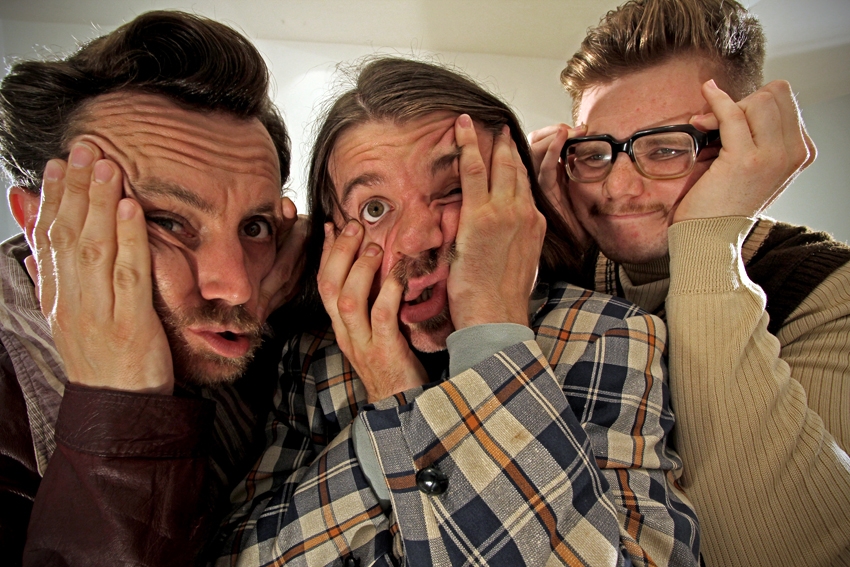
Ieva Kuniskis, Charlie Cooper Ford and Helen Aschauer in Gone To Get Milk (photo: D. Matvejevas)
That Chantal Guevara managed to pull this festival together in such a short time is a testament to her untiring entrepreneurship. A lacuna is a gap, but rather than being a gap, Cloud Dance Festival: Lacuna is filling one, making a generous opportunity for lesser known choreographers to show their work to the public: nineteen different works by seventeen choreographers over three days. There was no particular theme, no recognizable curatorial intervention: after a three-year hiatus, re-creating the opportunity was itself the catalyst for a strong roster of artists. Bernie Grant Centre was Guevara’s partner in this project and it proved well suited to the festival. Hopefully both will return in mid November for a joint venture, so watch the CDF space.
I was only able to see the last day — one of the hotter days of the year and the day Andy Murray finally won Wimbledon — but clearly Guevara has touched a vibrant nerve in contemporary dance presenting. The quality is uneven but rarely uninteresting. Ieva Kuniskis’s Gone to Get Milk has a strong theatrical value, a sense of humour, and a sense of the absurd. It starts with Helen Aschauer stumbling down from the stalls with an armful of oranges and spilling them on the stage. Because the lighting is still low, she bumps into a figure (Kuniskis) seated at a table before ricocheting off into the wings to pee (the sound of which is amplified into the auditorium, thanks to Peter Humphrey). She returns with a light bulb for the socket suspended above the table and reaches up to screw it in. The reaching morphs into images snatched in poetic concentration from an oppressive daily routine: hanging from an overhead hand rail, washing a floor and painting it, putting a restraining hand over her mouth and pulling out the side wall of her cheek with her finger. Charlie Cooper Ford enters with a milk pail, takes a chair and picks up an orange. Aschauer keeps an eye on him while she takes down her hair. Ford has a neat, small chopping action that suggests food preparation. He drops the orange and measures the room like the servant in Mozart’s Le Nozze di Figaro. Kuniskis, who has been sitting quietly in the shadows, begins to stir while Ford has a conversation with himself and draws his frame into a Charlie Chaplin figure, pulling on his forelock and stuffing an orange under his chin, ready to waltz. Kuniskis in her peasant dress pulls up her socks (a repeated gesture with both women) and sets up a circular hand and torso movement until the bell rings and she seems to be anticipating hara kiri when Aschauer puts a hand on her wrist to stop her. Ford lightens up the atmosphere by initiating Pass the Orange…. and so it goes on until it reaches the end, which is back at the beginning. The lighting by Mikkel Svak is lovely and the eclectic music provides an aural framework while the visual one is less cohesive. The dreamlike, floating figures of Chagall come to mind: Gone to Get Milk has a multitude of colourful images that almost, but not quite, coalesce in the three dimensions of the theatre. A painting, which is still, can nevertheless move in our imagination; a piece of dance theatre that moves can yet remain relatively still. It is an interesting paradox.
I had seen Joseph Toonga’s work Picture Perfect? early in 2011 at East London Dance when he won that year’s Blueprint Bursary. I had thought then that he was not at ease in his style, which set out to cross the boundaries between hip hop and contemporary. Whatever he has been doing in the intervening two years, Toonga has bridged that gap: Moments, Past has a language of its own that is both mature and confident. He has also assembled an impressive group of dancers, all from London Contemporary Dance School.
When dance works, it doesn’t really matter what the program note says. Moments, Past has fine shapes, dynamic groupings, and a pervasive enthusiasm even if it is not a particularly extrovert work. Choreographed for five dancers to Jocelyn Pook’s Bleeding Soles, the material is divided into a number of solos, duos, trios and ensembles linked stylistically by willowy backbends, lunges, and slides along the floor. Toonga himself is quick, and expressive and Kenny Wing Tao Ho complements him with his explosive precision. Ishaan de Banya, Daniel Baker and Poh Hian Chia complete the lively quintet in what is a refreshingly mature work in a youthful form. Later in the program Toonga presents a short duet, Ours, for Wing Tao Ho and Lucia Txokarro, that is popping meets contemporary dance (a favourite theme Toonga’s) in the guise of boy meets girl. It is in the nature of a relationship to change us as we share, borrow and adapt each others’ thoughts and ideas, which is what the two dancers do in choreographic phrases. Only towards the end do they touch, but soon after it comes all too suddenly to an end.
The challenge for B-Hybrid’s Brian Gillespie is in using music that already has such a strong identity: Cinematic Orchestra’s To Build a Home with Patrick Watson’s hauntingly honeyed voice. Structuring the dance as a series of tableaux illustrating the lyrics (the work is called Foundations) sets apart what we see on stage from what we hear. Although Eloise Sheldon finds the sinuous, ethereal quality of the music in her first solo, and Jumar Aben gets close in his, Foundations loses sight of the music and thus fails to complement it.
The idea of Ceyda Tanc’s Volta is potent: a walking prison dance for six women. ‘In Turkish prisons, to turn your back on your fellow inmate during a walking exercise is a sign of great disrespect. How do we convey this disrespect in everyday life, and how do people react to it?’ There is certainly a lot of walking, and the women keep a hawk-like eye on each other but Tanc has either abstracted the choreography to the point where the meaning is obscured or fallen prey to using dance forms that do not belong in this setting. There is an effective section of grounded, folk-inspired phrases but then the three subsequent duets were seemingly unrelated. I was not sure either if all the dancers were convinced of what they were doing. In a section where all six women are moving in unison, their look is fierce but the look does not come out of the body; it appears superficial. In the end, there seems to be too much walking, and not enough energy coursing through the body to make the walking tell the story Tanc set out to express.
When I first saw John Ross’s Man Down, it was on the tiny Lion & Unicorn stage. It came across as a tight interior landscape, and the space exaggerated the claustrophobic tension within the minds of the two protagonists. On a bigger stage the clarity of the gestures is the same, but the larger space has a tendency to thin down the intensity. However, it is the kind of work that rewards in the re-seeing, for there are so many details — like the officer who stabs himself with the pen that wrote the letter — that make up this passionate panegyric to a fallen solider. Ross performed a preview of another work, Woolfpack the previous evening, which I unfortunately missed.
Ballet slippers in this contemporary environment grab attention, and not necessarily for the right reason. Classical form is already embodied in the dancer’s body; there is no need to flag it with a plethora of classical clichés like bourrées, jetés, arabesques, and promenades. Raymond Chai’s Unbroken Silence may be about strong attraction and rejection, but the classical quotations feel out of place and tend to emasculate the emotion. Both Melanie Lopez and Oliver Freeston are trained in classical dance and if Chai were to choreograph on them without recourse to a single ballet cliché, the classical form would still be visible — especially with Nic Holdridge’s lovely lighting — and he would be free to concentrate on the emotional expression at the heart of the work.
Ella Mesma’s EvoL begins with its most powerful image in which she stands in a small square of light as if rooted to the spot or tied to an imaginary pole in a contradictory pose on the slippery side of yes. Her hand slides up her chest to form a fist under her chin, or traces her body curves up to her neck. ‘Yes!’ she screams, again and again, writhing beyond a point of control, her hand at her throat, ecstatic, while her other hand travels up from the stomach to take displace it. EvoL (LovE spelled backwards) is a solo on the serious theme of grey rape, ‘referring to the myth that sexual assault can sometimes be an accident.’ From that opening image, it is clear that Mesma has the form and the passion to tackle the theme, but as soon as she leaves that small square of light the concentration of energy dissipates with dance moves that meander further away from that initial statement. Nothing quite comes up to that level of communication until at the end, lying in the light, in pain, she says, ‘Yes’, then ‘No, no, no, yes… I said no.’ All the uncertainty and brutality can be found in the beginning and the end. The middle is the grey area.