Posted: December 2nd, 2016 | Author: Nicholas Minns | Filed under: Performance | Tags: Beckoning, Blaire Ko, Cheng Tsung-lung, Chung Cheng-da, Cloud Gate 2, Huang Yi, Iannis Xenakis, Lee Chien-chang, Lin Bin-hao, Lin Hwai-min, Michael Gordon, Quiet Quartet, Sadler's Wells, Shaar, Shen Po-hung, The Wall, Weather One, Wicked Fish | Comments Off on Cloud Gate 2, Triple Bill
Cloud Gate 2, Triple Bill, Sadler’s Wells, November 21

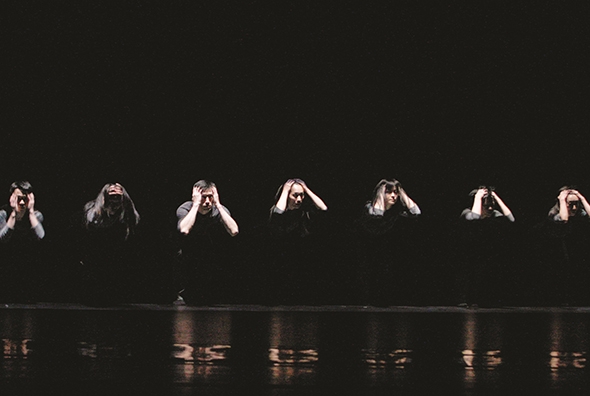
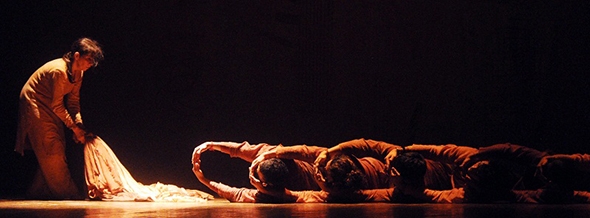
Cloud Gate 2 in Wicked Fish (photo: Liu Chen-hsiang)
Part of Sadler’s Wells’ Out of Asia 2 platform showcasing dance in Asia, the appearance of Taiwan’s Cloud Gate 2 poses an enigma. Not to be confused with Cloud Gate Dance Theatre, an internationally renowned company in its own right and synonymous with its founder, Lin Hwai-min, Cloud Gate 2, founded by Lin in 1999, might well be seen as the junior company. Yet despite its parentage and the similarity in training for the dancers — a mix of ballet, contemporary, Tai chi and martial arts — Cloud Gate 2 evidently has a different destiny. For now the separation of the two companies is predicated on the younger one developing promising Taiwanese choreographers under the guidance of artistic director, Cheng Tsung-lung, and on laying the grassroots foundations of dance in Taiwan as broadly as possible in local communities, towns and cities. Appearing in London for the first time may not appear to fulfil that national function but Cloud Gate 2, by virtue of the quality of its dancers and its choreography, has the stature of an international company, as is evident from its performance at Sadler’s Wells on Monday.
The company’s international aspect is reflected in all three works on the program, but while Huang Yi’s Wicked Fish and Cheng’s The Wall touch on themes of human contact and isolation that are universal, Cheng’s more recent Beckoning is imbued with a more parochial element of native religious beliefs and ceremonies that turn our view inwards towards Taiwanese traditions.
Yi’s Wicked Fish begins with a buzzing, frenetic wave of dancers flitting in and out of darkness; Lee Chien-chang’s choreographic lighting dapples the dancers’ faces, arms and feet like sunlight on the surface of a shaded stream. It is not hard to see fish swimming just under the surface, yet there is also a continuous exchange of energy at play between pairs of dancers as well as between the group and the individual, an abstract microcosm of society in movement. It is as if the stage is the visible part of a much broader, continuous flow across it while Iannis Xenakis’ complex score, Shaar, sets up the changing and often turbulent currents. Both the lighting and the black and white setting of Wicked Fish shows off the dancers beautifully in their strength, their flow of movement, and the clarity of their lines.
In The Wall, Cheng sublimates his childhood memories of hawking his family’s brand of slippers on the streets into a spatial arrangement of walking figures that convey the notion of the individual facing social and psychological walls and barriers. It’s deeply personal, delving into Cheng’s sense of isolation at the time of its creation in 2009, and created with a masterful hand, maintaining a dynamic tension of tidal movements throughout. The groupings follow closely the orchestration of Michael Gordon’s Weather One so that Lee’s intense lighting seems to illuminate both the dancers and the music.
The third work of the evening, Cheng’s Beckoning, stands out for its bright costumes by Lin Bin-hao and in its wash of light by Shen Po-hung. But it also differentiates itself from the previous works by its subject matter. Cheng spent a lot of his childhood with his mother attending religious ceremonies; as he wrote in a written interview, “On the birthdays of the deities, religious parades like carnivals would be held, usually with an amazing line-up of people. Gigantic puppets, representing various gods in the heavens or in the underworld, would swing and walk along streets. In the old days when the plague struck, people believed it was caused by ghosts and bad spirits. When that happened, the street-dancing rituals of Ba Jia Jiang, the “Eight Infernal Generals,” would be responsible for casting out the evils.” There are no puppets here, however, but lots of swing; Cheng has subsumed the festivities into bright colours and an exquisite gestural language. The meditative opening solo by Chan Hing-chung represents, perhaps, the matured Cheng as subject; it has no overt choreographic religious connotations but as Beckoning progresses it becomes more objective, approaching Ba Jia Jiang through the external eye of tradition. This is heightened by composers Chung Cheng-da and Quiet Quartet’s use of traditional instrumentation (arranged by Blaire Ko) that incorporates bells and street sounds. Cheng insists, however, that the dance itself is not about religion. “I recall a story in Joseph Campbell’s The Power of Myth where a western sociologist asked a Shinto priest: “I don’t get your ideology. I don’t get your theology.” The Shinto priest gave deep thought and answered politely: “We do not have ideology. We do not have theology. We dance.”
And they do.
Posted: November 18th, 2016 | Author: Ian Abbott | Filed under: Performance | Tags: Dance Umbrella, i ride in colour and soft focus no longer anywhere, Jackie Shemesh, Jamila Johnson-Small, Rich Mix | Comments Off on Jamila Johnson-Small, i ride in colour and soft focus, no longer anywhere
Jamila Johnson-Small, i ride in colour and soft focus, no longer anywhere, Rich Mix, October 9

Jamila Johnson-Small in i ride in colour and soft focus, no longer anywhere (photo: Foteini Christofilopoulou)
“We need limitations and temptations to open our inner selves, dispel our ignorance, tear off disguises, throw down old idols, and destroy false standards.” – Helen Keller
What happens when an edge is invited to the centre?
Jamila Johnson-Small premiered her new solo work i ride in colour and soft focus, no longer anywhere at this year’s Dance Umbrella. Prior to the festival she was the subject of an in-depth portrait by Lyndsey Winship where Johnson-Small said: “I guess I still have my fantasies about not selling out.” Having encountered some of her other collaborative performance guises (Project O and immigrants and animals) I was curious to see the distillation of a solo voice and how it would manifest.
There’s a tension when an edge meets a centre. Nearly a month after I left Johnson-Small’s performance at Rich Mix I’m still carrying it, unable to shift it; there’s something inside this work that will not settle. It’s a work of resistance. One thing that tingles is the still image of Johnson-Small’s back as she is lying on the floor, head nestled in her arms, facing the same way as the projected images we’re watching. Her choice to stay on the stage, to be still and not remove herself from our gaze stays with me. This is her domain and we are guests who are fleetingly present and then disappear; she will remain. The projected film is full of deconstructed limbs twitching, rotating and removed from the baby-pink hooded torso of the architect of our experience. The edge and centre are in play again.
“The need for change bulldozed a road down the centre of my mind.” – Maya Angelou
The lighting design by Jackie Shemesh tightly frames Johnson-Small for the first 25 minutes, isolating her body and framing legs and torso with hands bobbing amongst the shards of sidelight. Existing in a one-metre radius of space Johnson-Small is a groove finder and beat rider with a muted knee bounce despite encouragement from the score emanating from the towering sound system like a stage left shadow. With an 8-foot space rock fixed and glinting stage right the scenography and performance slowly suffocate the space.
What do you do when you meet a wall? How do you navigate it? This is what I’ve been wrestling with and I’m left in a void of emotion; I’m unsure which way my response faces. A resistance and tension were present and there’s the smell of a bristling Beckett character who is here yet not here, who acknowledges us but doesn’t necessarily want us to be here. However, something keeps whirring. i ride in colour and soft focus, no longer anywhere is hard to define. It’s not full of virtuosic or pre-supposed ideas of beautiful dancing; it’s numbed, reflecting different emotional states and different ways of being in this world.
“The reinvention of daily life means marching off the edge of our maps.” – Bob Black
Although it may feel like a stand-off with neither of us yielding attention, I think what I’ve encountered is an archive of the self. How does Johnson-Small not let her edge be pulled to the centre but still accept the offer and associated profile that comes with a premiere at Dance Umbrella? How do I let i ride in colour and soft focus, no longer anywhere enter my own archive? It’s currently resisting the established classification, so maybe I need to build a new space for it — closer to the edge.
Posted: November 17th, 2016 | Author: Nicholas Minns | Filed under: Performance | Tags: Blue Elephant, Gracefool Collective, Kate Cox, Northern School of Contemporary Dance, Rachel Fullegar, Rebecca Holmberg, Sofia Edstrand | Comments Off on Gracefool Collective, This Really Is Too Much
Gracefool Collective, This Really Is Too Much, Blue Elephant, November 11

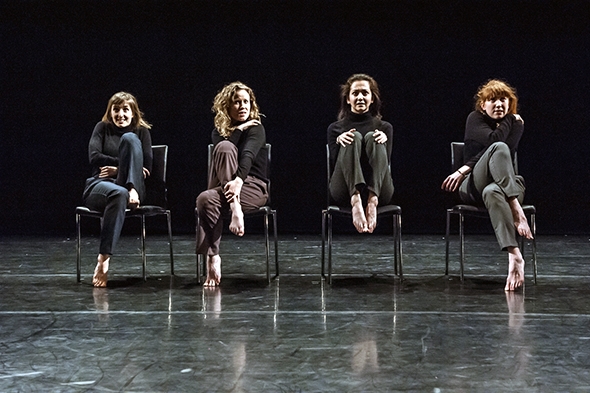
Kate Cox, Sofia Edstrand, Rachel Fullegar and Rebecca Holmberg of Gracefool Collective in This Really Is Too Much (photo: Lidia Crisafulli)
It’s interesting to look at the four women of Gracefool Collective — Kate Cox, Sofia Edstrand, Rachel Fullegar and Rebecca Holmberg — as they sit facing us in matching black outfits at the beginning of their collectively created This Really Is Too Much: four faces, four pairs of eyes each with a different focus and inflection expressing a range of moods from amusement to dead serious. They recite in tight unison the phrase ‘I’m telling you something…(long pause)…something important…I have the answer…’ Reminiscent of Victor Borge’s vocal punctuation, they vocalise their gestures within their text: ‘I am the answer (exhale-gain-their-trust)’ or ‘Look (point), you’ve never had it so good.’ It’s a carefully crafted opening gambit in a game the four women play knowingly with the audience. By the end of the performance the synchronous opening has given way to a colourful disarray on a floor littered with the detritus of what the program note calls ‘the downright absurd realities of what it means to be a 3-dimensional, high definition, water-drinking, salad-eating, moisturizing WO-man in modern society.’
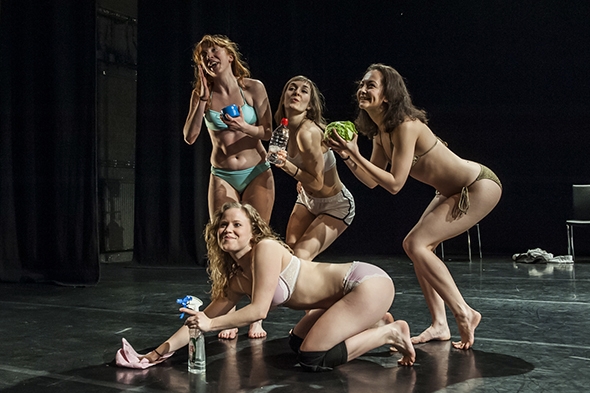
The Collective performed a shorter pilot version of This Really Is Too Much at Resolution earlier this year; the desire to expand it into a full evening work has led to this first performance at Blue Elephant Theatre. The work as it now stands contrasts some tightly choreographed sequences (like the opening) with more flaccid sections that suggest the hyperbole and capital letters of the program note may have been an agent of expansion. There is a sense that having chosen to focus their intelligence and humour on resisting stereotypical boxes, the four women scupper their desire to emerge as individuals with their mirth in demonstrating the stereotypes. Do they need to undress repeatedly to their underwear — apart from Fullegar as the beauty queen — to prove a point, or are they merely reinforcing a stereotype for the purpose of laughs?

Gracefool Collective undressed in This Really Is Too Much (photo: Lidia Crisafulli)
It is not for nothing that the Collective has ‘fool’ in its name:
…let those that play your clowns speak no more than is set down for them; for there be of them that will themselves laugh, to set on some quantity of barren spectators to laugh too, though in the meantime some necessary question of the play be then to be considered. That’s villainous, and shows a most pitiful ambition in the fool that uses it. (Hamlet, Act 3, Scene 2)
William Shakespeare’s early fools provided laughter as a distraction for the crowds but later his fools took on the more powerful role of speaking truth to power through their wit. The seeds of the latter can be seen in This Really Is Too Much but the former strategy dominates.
Fullegar is cast as an intelligent beauty queen, the only one to express a coherent point of view on government, economics, politics and the state of women, but each time she makes a statement she either qualifies it with a self-deprecatory joke (‘We can combine radical feminism…and Downton Abbey’) or is overwhelmed by her raucous mates. Statements are thus given weight and then the weight is taken away.
Exceptions occur not in the text but in physical form: Fullegar’s dogged running round and round the stage in bikini and oversized heels is gutsy physical satire and the destabilization by two viciously smiling cronies of the chair Holmberg stands on as she tries to talk is a disturbingly dark image. Less dramatic but equally effective is the ironic way Edstrand expresses her gratitude while reclining on the shoulders and back of Cox and Holmberg. These moments show how close Gracefool Collective is to defining a physical language to deal with the subject of their work without having to resort to gags.
The mix between the four women, who met at the Northern School of Contemporary Dance, is evident; their personalities hold well together though they have talents that remain unexplored. For four graduates of a prestigious dance school, there is little to suggest their training (though in the trailer for Resolution both Holmberg and Cox had well-defined gestural portraits) and Holmberg is a musician who could well provide a welcome ingredient to the Collective’s brand of theatre. Choosing, as they have done here, a track list as sophisticated and diverse as Steely Dan (Only A Fool Would Say That), Moondog, Barry White, Handel, Lars Hollmer, Cissy & Whitney Houston and Vivaldi does not serve the home-grown identity of the Collective as their own musical input (or silence) might. Nevertheless it is the infectious enthusiasm of the four women that drives This Really Is Too Much and that gives it cohesion despite the sense of manic dissipation with which the work comes to an end.
Posted: November 11th, 2016 | Author: Ian Abbott | Filed under: Performance | Tags: Garden of Orgonon, Impermanence Dance Theatre, Jan Jelinek, Pam Tait, SEXBOX, Ugly Duck, Ursula Bogner, Wilhelm Reich | Comments Off on Impermanence Dance Theatre, SEXBOX
Impermanence Dance Theatre, SEXBOX (The Garden of Orgonon), October 15, Ugly Duck, London

Members of Impermanence Dance Theatre in SEXBOX (photo: Jeremy Reider)
“Pleasure cannot be shared; like pain, it can only be experienced or inflicted, and when we give pleasure to our lovers or bestow charity upon the needy, we do so, not to gratify the object of our benevolence, but only ourselves.” – Aldous Huxley
Bristol-based Impermanence Dance Theatre is a controlling mistress; in their dungeon loft your eyes are softly spanked for 60 minutes with a series of carefully crafted and choreographed episodes of pleasure. Played in the round at the top of Ugly Duck, SEXBOX is a feast of punctuated movements and sticky visual images from seven dancers with exceptional musicality.
SEXBOX is inspired by the pioneering but little-known German electronic musician, Ursula Bogner and her fascination with the writings of Wilhelm Reich, a controversial feminist psychoanalyst for whom a healthy discharge of sexual energy was the crux of humanity’s salvation. (There is rumour a-plenty about the existence of Bogner and whether or not she is the construction of veteran electronic music producer Jan Jelinek; it is at the edges of bliss and untruth that SEXBOX exists.)
“We live in a community of people not so that we can suppress and dominate each other or make each other miserable but so that we can better and more reliably satisfy all life’s healthy needs.” – Wilhelm Reich
The seven dancers met at the Rambert School 10 years ago and are now exploring new models of non-hierarchical collaboration; with SEXBOX they achieve an impressive visual cohesion and choreographic consistency. The costumes and characters could have stepped out of Reich’s Orgone Accumulator with their 60s sci-fi futurism from the palette of costume designer Pam Tait: unitards, reflective white plastic, and silver cheek-heightening makeup are tailored for ease of movement and for the accentuation of the body. Each of the fragments of pleasure (this would make an interesting response work to Pop-Up-Duets by Janis Claxton Dance) features duets, trios or the entire company and their pacing is exquisite; when interest almost begins to wane or is in danger of repetition, extra bodies are injected into the scene to shift focus, add texture and intelligently puncture (sometimes for just a few seconds) our visual rhythm.
With lingering hands and crotches itching to play with each other, six pairs of gnashing teeth hungry for the sex box of the carcass of another, and all manner of exposed and freshly-squeezed cheeks on display, there’s a controlled depravity across the dozen-plus episodes without a full-on BDSM experience. I left not sullied by SEXBOX but in state of visual buzz having witnessed seven accomplished performers in complete control of their material and their audience.
“Sex without love is as hollow and ridiculous as love without sex.” – Hunter S. Thompson
The memory of pleasure and the pleasure of memory is something I’ve been wrestling with; part of the reason for the delay in publishing is my endeavour to see how SEXBOX fits into my own internal reward memory system. I have memories of mirth and appreciation on the night yet it is difficult to re-create those same feelings on the page. Did it stimulate the eye? Yes. The images were sharp, transitions were electric and the lip-syncing film recreation was a hoot. Did it stimulate the heart? I don’t think so but I don’t think that was its intention. What SEXBOX has done is reinforce my belief in Impermanence as a company that creates work that is impressive, controlled and quite unique in the dance/theatre ecology of the UK. Wilhelm Reich was once denounced as the orchestrator of a cult of sex and anarchy; with SEXBOX, Impermanence takes on that mantle and becomes a throbbing cult of pleasure, anarchy and dance.
Posted: November 9th, 2016 | Author: Nicholas Minns | Filed under: Performance | Tags: Aditi Mangaldas, Akram Khan, Dance Umbrella, Fabiana Piccioli, Farooq Chaudhry, Inter-rupted, Kimie Nakano, Manish Kansara, Pema Chödrön | Comments Off on Aditi Mangaldas Dance Company, Inter-rupted
Aditi Mangaldas Dance Company, Inter-rupted, Barbican, October 22

Aditi Mangaldas Dance Company in Inter-rupted (photo: NCPA)
“When we look at the body in finer and finer detail, can we find what we’re protecting? If we visualise searching right down amid the very marrow for the thingness of our body, can we find it? Attachment to one’s physical form is based on the body being a reliable, continuous entity. But can we pinpoint what we’re clinging to when we probe its depths?” – Pema Chödrön.
The quote from Tibetan Buddhist nun, Pema Chödrön, is printed in the program for Aditi Mangaldas Dance Company’s Inter-rupted, part of this year’s Dance Umbrella. It is a text about attachment, the subject Mangaldas explores choreographically in 75 minutes of uninterrupted choreography. She and her six dancers appear and disappear, gather and disperse, disintegrate and reform, interlock and unlock, yet all these contrasts form a series of scenes without borders, one merging into the next, each with a symbolism of its own that is carried in the movement. While Mangaldas set out to counter the temporal nature of life by resisting the notion of attachment, in the course of making the work she had to face the very nature of attachment she had set out to explore. Woven into the cloth of the work is thus the solitary thread of its imperfection. Mangaldas herself embodies this dynamic contradiction as she brings us into the fragile moment, ‘like any we might strive to hold on to…even if all is transient, all is flowing, and all is Inter-rupted.’ Her dancers — Karan Gangani, Minhaz, Aamrapali Bhandari, Anjana Singh, Sunny Shishodiya and Manoj Kumar — move like a chorus that flows with and around her with virtuosic, fire-cracker footwork, vertiginous turning and a wonderfully lyrical use of gesture and voice. In addition to a recorded sound score by Sajid Akbar, the company is joined on stage by three gifted musicians — Mohit Gangani on tabla and padhant, Ashish Gangani on pakhawaj and padhant, and Faraz Ahmed on vocals — who punctuate the choreographic flow with, respectively, virtuosic rhythms and plaintive song.
In some ways Inter-rupted is familiar territory; it is a journey of ‘exploring the past (of kathak) with a modern mind’ that Akram Khan has been forging in this country for the last 16 years. Khan, however, was born in England and has been working with an international cast of performers in a country that welcomes cross-cultural fertilisation as an expression of its identity; Mangaldas and her dancers have had to challenge the established norms of kathak from within its own cultural context. As she wrote in response to a question I asked her, this process ‘does raise debates in India but that makes the entire conversation alive and relevant. There is a growing appreciation of looking at our classical traditions in contemporary contexts and a huge appreciative viewership that encourages change. So the environment is quite vibrant with debate and interesting new directions.’ Inter-rupted thus resists tradition while remaining very much within it, a very different proposition to that of Khan; Mangaldas’s work looks refreshingly like the real thing.
What makes the aesthetic of Inter-rupted familiar, perhaps, is that the production team includes some of Khan’s key figures he had introduced to Mangaldas nearly seven years ago, since when they have been working together on various productions: Farooq Chaudhry is listed as dramaturg, Fabiana Piccioli as lighting designer and Kimie Nakano designed the costumes. The confluence of Piccioli and set designer Manish Kansara — a sculptor based in Delhi — is visually stunning: an airy, three-sided space in shades of ochre that acts, depending on the lighting, as much like a large interior room as it does an undefined exterior space. The very opening shows a solitary man short of breath shaking uncontrollably in his room as he stares out at the audience, his body disintegrating until he recedes into the dark. Out of the dark we see the figure of Mangaldas slithering diagonally backwards through a shadowy, open space dragging a cloth that unwinds into a broad stream of material before she gathers it in slowly and purposefully as six figures enter the space that becomes a room once again.
Nakano’s evident understanding of, and sensibility to kathak rhythms allow her costumes to breathe and flow with the movement while maintaining an ascetic, spiritual quality in which the work is painted.
But while Mangaldas’s collaborators give Inter-rupted its aesthetic cohesion, it is the richness of the material — Pema Chödrön’s ‘thingness’ — and its interpretation that make this body-and-mind struggle to face its true nature a cause for celebration.
This review was commissioned by Pulse Asian Dance and Music and appears here with the very kind permission of its editors.
Posted: November 8th, 2016 | Author: Nicholas Minns | Filed under: Performance | Tags: Aref Durvesh, Ashwin Srinivasan, Dystopian Dream, Honji Wang, Ian Burdge, J'Danah, Nitin Sawhney, Royal Albert Hall, Sadler's Wells, Sébastien Ramirez, Tina Grace | Comments Off on Nitin Sawhney with Wang Ramirez
Nitin Sawhney with Wang Ramirez, Royal Albert Hall, November 2

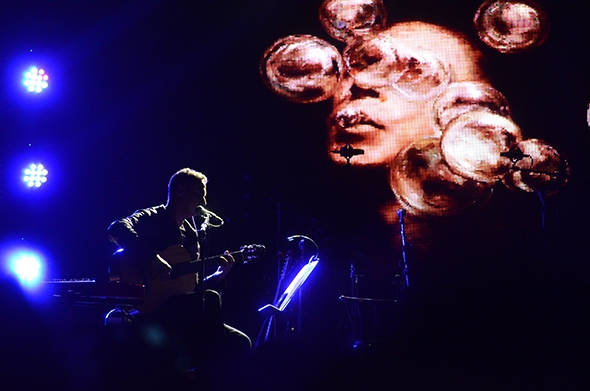
Nitin Sawhney at Royal Albert Hall (photo: Morah Geist)
Being an Associate Artist at Sadler’s Wells means Nitin Sawhney has privileged access to dance; he is, after all, known to dance enthusiasts for his collaborations with Akram Khan and Sidi Larbi Cherkaoui. This evening, Royal Albert Hall and Sadler’s Wells have got together for the first time to co-produce a dance element by inviting the duo Wang Ramirez — Honji Wang and Sébastien Ramirez — to perform with Sawnhey and his guests. It’s a revelation not only on a musical level but choreographically.
In front of a series of vertical panels on which is projected the artwork from his 2015 Dystopian Dream, Sawhney plays a number of tracks from the album and from his wide-ranging catalogue. His music is based on an elaborate layering of sounds and textures led by Sawnhey himself on guitar or piano. Occasionally a single instrument or voice from the ensemble will rise above the orchestration to sing its own song, as with tabla player Aref Durvesh, flautist and vocalist Ashwin Srinivasan, and cellist Ian Burdge. Despite their individual quality, other instrumentalists fare less well on the balance of sounds in the cavernous Albert Hall. Sawhney’s use of the voice as an integral part of his instrumentation leads to some fine performances, particularly from J’Danah and Tina Grace whose voices have what Roland Barthes called ‘le grain de la voix’, or a rich textural quality that carries the sound.
Wang and Ramirez dance two consecutive pieces in each half of the program. Sound quality is not something that concerns them yet in their first track, Time Trap, they perform like two additional instruments in the band, so totally inside the music that we see it as they dance. Like an inspired riff on the music, it’s infectious; if Fred Astaire and Ginger Rogers had had the disciplinary makeup of Ramirez and Wang — gymnastics, b-boying and martial arts, to name a few — this is how they might have moved. In addition to the rhythmic speed and precision — there are as many articulations in their bodies as there are notes in the music — there is a clarity of line and a mercurial virtuosity in the duo’s performance that takes the breath away. For the second piece, Silence, with Eva Stone on vocals, the balance of dance to music is less effective; the choreographic language is similar but it stands outside the framework of the song. I find myself watching the dance while the music continues in the background. In the second half, in which Sawhney introduces his Latin side, Wang and Ramirez dance to Redshift with lead vocals by J’Danah and to a recorded track, Dimensions. In both the fluid complicity with the music is back. The body is once again both instrument and musician, silently creating images like a skillful mime while building its vocabulary by effortlessly adopting and playing with such kathak idioms as the rippling arms. This is the alchemy of artistic collaboration, a process of contributing to and being transformed by the other. As artists working both inside and outside their cultural identities, Wang and Ramirez have built their reputation on this kind of sensitivity just as Sawhney has done in his fusion of musical influences. The three have a lot in common and it shows.
In a written interview I conducted with Wang and Ramirez, Wang remembers first hearing Sawhney’s Homelands when she was 16. ‘I loved that sound, but for me he was an artist who was far away from where I was…’ Before going on stage in the second half, she would have heard the same track with Srinivasan and Grace on lead vocals. Whatever distance there might have been has evidently shrunk to a proximity we can all enjoy.
Posted: October 6th, 2016 | Author: Nicholas Minns | Filed under: Performance | Tags: Arthur Pita, Jackie Shemesh, James O'Hara, Jason Kittelberger, Luis F. Carvalho, Michael Hulls, Natalia Osipova, Qutb, Run Mary Run, Russell Maliphant, Sadler's Wells, Sergei Polunin, Sidi Larbi Cherkaoui, Silent Echo | Comments Off on Natalia Osipova, Three Commissions
Natalia Osipova, Three commissions, Sadler’s Wells, October 1

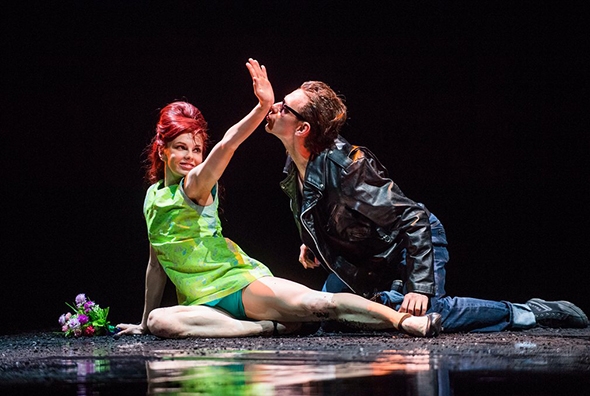
Natalia Osipova and Sergei Polunin in Arthur Pita’s Run Mary Run (photo: Tristram Kenton)
Natalia Osipova is a dancer I could happily watch in any performance. Brought up in the Russian classical tradition, a supreme technician and dramatic presence, she is at home in the classical repertoire but itching to broaden her scope as an artist. Without retracting that opening statement, this evening of contemporary work for Osipova at Sadler’s Wells falls somewhere short of my anticipation. The issue is who commissioned this triple bill — first seen here in June — and why. Sadler’s Wells’ chief executive and artistic director, Alistair Spalding, suggests in the program’s welcome note that Sadler’s Wells commissioned the works, which happen to include two by Sadler’s Wells associate artists: Sidi Larbi Cherkaoui and Russell Maliphant. In Sarah Crompton’s overview of the evening in the same program she makes it appear that Osipova commissioned the works. But if she did, why so early in her drive to broaden her horizons would she commission new works from choreographers she has already worked with (Sidi Larbi Cherkaoui and Arthur Pita) so recently? And is Russell Maliphant’s choreographic process likely to expand Osipova’s artistic range? I don’t think so. No, it is unlikely Osipova commissioned these works but has instead lent her name and talent — along with those of her partner Sergei Polunin — to the evening in return for the creation of three works brokered for her by Sadler’s Wells. It’s a compromise in which neither party comes off particularly well artistically; Osipova is not challenged enough because the works fall short of providing her with a vehicle for her scope. Cherkaoui’s Qutb thinks about it in philosophical terms but delivers a trio in which Osipova’s desire for flight is constantly grounded and smothered by the overpowering physique of Jason Kittelberger and in which the only (rather uninteresting) solo is given to James O’Hara. Qutb is Arabic for ‘axis’ but the axis of the work is Kittelberger not Osipova. Some commission.
Maliphant’s Silent Echo without the lighting would be like watching Osipova and Polunin consummately messing around in the studio. Maliphant’s choreography is so totally dependent on the lighting of Michael Hulls (a dependence that has become derivative) that any artistic development for the dancers is merely subordinate to the Maliphant/Hulls formula; the greatest hurdle for them is to dance on the edges of darkness.
Pita’s Run Mary Run is the only work in which Osipova and Polunin have roles to explore; Pita puts them centre stage in a musical narrative of love, sex, drugs and death to the songs of the 60’s girl group, The Shangri-Las. Known for their ‘splatter platters’ with lyrics about failed teenage relationships, Pita invests Run Mary Run with a theme of love from beyond the grave that he can’t resist associating — in the opening scene of two arms intertwining as they emerge from a grave — with Giselle. But Osipova’s persona is closer to Amy Winehouse (whose album Back to Black was inspired by The Shangri-Las and whose life Pita cites as the major influence for the work), and Polunin in his jeans, white tee shirt, black leather jacket and dark glasses is more like bad-boy Marlon Brando than a remorseful duke. While Pita’s narrative mirrors the destructive relationships in Winehouse’s life, the romantic elements of raunchy duets, flirtatious advances and feral solos feed off the partnership of the two dancers. Pita is pulling out of them elements of their own lives and putting the audience in the privileged position of voyeurs; we are living their emotions in the moment. This gives the work its edge and inevitable attraction. The colourful lightness of Run Mary Run — thanks to costumes and sets by Luis F. Carvalho and lighting by Jackie Shemesh — thus reveals a genuine heart that saves the work from its dark parody. But such is the nature of the heart that Run Mary Run may only succeed with these two protagonists.
Pita’s work is a step in the right direction for Osipova, as is the idea of her performing works outside her comfort zone. But if she really wants to find works that allow her more than an opportunity to dance a different vocabulary, she needs to find choreographers able and sensitive enough to fulfill her full potential by creating enduring works that are irrevocably stamped with her technical ability and personality.
Posted: October 4th, 2016 | Author: Ian Abbott | Filed under: Performance | Tags: Alva Noe, Chris Copland, Claire Cunningham, Jess Curtis, Luke Pell, The Way You Look (At Me) Tonight | Comments Off on Claire Cunningham and Jess Curtis, The Way You Look (At Me) Tonight
Claire Cunningham and Jess Curtis, The Way You Look (At Me) Tonight, Tramway, September 16

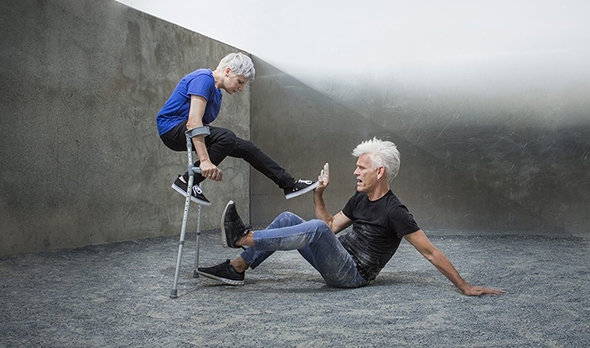
Claire Cunningham and Jess Curtis in The Way You Look (At Me) Tonight (photo: Sven Hagolani)
“You will walk differently alone, dear, through a thicker atmosphere, forcing your way through the shadows of chairs, through the dripping smoke of the funnels. You will feel your own reflection sliding along the eyes of those who look at you. You are no longer insulated; but I suppose you must touch life in order to spring from it.” – F Scott Fitzgerald
It was Jess Curtis who introduced Claire Cunningham to contact improvisation and in The Way You Look (At Me) Tonight we see their invisible histories fizzing across 90 minutes of physical trust and emotional exchange as they build and share with the audience a rare magic that is not only a choreography of bodies, crutches and people but a symphony of intimacy, tenderness and generosity.
Cunningham and Curtis offer a directors’ note: ‘The Way You Look (At Me) Tonight is a social sculpture — a sensory journey for two performers and audience. Dancing, singing, telling stories…and asking important questions about our habits and practices of perceiving each other and the world.’ We are welcomed with a quality of eye contact by both performers and invited to sit either on one of the chairs or cushions on the stage (‘where we may come into physical contact with the performers’) or in the seating bank. I choose a small cushion, centre stage, from where I can see the entire journey unfold.
Cunningham and Curtis walk and weave in and out of the bodies on stage demonstrating an ease and familiarity with each other whilst sharing encounters of how people have looked at them in the past. Cunningham cites Bill Shannon’s (aka Crutch Master) theory of peripheral fluctuation where, as a disabled person in public, you feel people staring at you in the periphery of your vision but when you turn to meet their gaze their eyes vanish and they won’t look you in the eye. Curtis shares: “In my position of white, male, 6-foot-plus privilege I would confidently meet the gaze of women in the street who would often avert their eyes. However, after I had an accident and used crutches for a few weeks those gazes would now be met and maybe even with an exchange of ‘hi’. Was I less of a sexual predator? Less of a man when I was using crutches?”
“Looking from afar — from present to past, from exile to homeland, from island back to mainland, mountain-top to lowland — results not in vision’s diffusion but in its sharpening; not in memory’s dispersal but in it’s plenishment.” Robert Macfarlane
In the theatre sometimes we watch, sometimes we witness and sometimes we participate. In asking us to look at them and listen to their lived experiences of being looked at, Cunningham and Curtis are also asking us to reflect and consider our own eyes and the power they hold. What assumptions do we make about how people look? These verbal exchanges are peppered throughout the performance with screened appearances by the philosopher, Alva Nöe, who extrapolates on philosophy, love, Socrates and accessibility in remarkable depth without using inaccessible language. There are words — and plenty of them — constantly nourishing the ears yet it is the physical exchanges between the performers that are delivered with searing depth.
Tenderness abounds and we see moments of genuine exchange as Fred and Ginger’s Dancing Cheek to Cheek fires up to signal the start of a glacial floor-based duet: two bodies lying down upside down, eyes closed, their cheeks kissing and heads nestling in each other’s collar bone. Using the cheek as the point of connection, Curtis and Cunningham slowly, delicately revolve, shifting weight, balance and power; what could have been an indulgent studio-based exercise lands with emotional power. The structure of the evening is deftly woven as scenes melt in and out, inviting different scales, a shift of focus and ample opportunity for reflection. These shifts of mood create a balance that is enhanced by both Luke Pell’s dramaturgy and Chris Copland’s lighting design that ensure a sensitivity and meshing with not only with the artistic intention but how the audience receives the work.
Cunningham also delivers a parkour/contact hybrid on and over the body of Curtis, eating up the floor at speed and negotiating the human nodes around the stage. As Curtis is flat backed on all fours, Claire plants her crutches and skids over him; her four points of contact with the floor (two legs and two crutches) enable her ultimate control. Coming towards me at speed she places her crutches either side of my crossed legs, lifts herself and gently places her foot on my knee. She is airborne – no bodily contact with the floor; our eyes meet for a second before she reverses out of it.
“It isn’t that to have an honorable relationship with you, I have to understand everything, or tell you everything at once, or that I can know, beforehand, everything I need to tell you. It means that most of the time I am eager, longing for the possibility of telling you. That these possibilities may seem frightening, but not destructive, to me. That I feel strong enough to hear your tentative and groping words. That we both know we are trying, all the time, to extend the possibilities of truth between us. The possibility of life between us.” Adrienne Rich
Cunningham and Curtis share so much about looking, yet I see something else in the peripheries of The Way You Look (At Me) Tonight; I see the real human cost of judging, staring and objectifying: loneliness and a vacuum of love that slowly breaks your heart. With Cunningham perched silent atop a 12-foot ladder with Curtis gazing at her from below, a series of pre-recorded statements emerge in her voice: “This body has never…carried a television…run on the beach… been in love.” In a moment towards the end Cunningham extends her crutches one last time and launches herself so she and Curtis are equal; no longer cheek to cheek, they are now face to face and here they stay for three or four minutes as she balances with magnetic eyes and bears her weight on her arms. From my position less than 5 feet from this intimate encounter I see all of her face, the flickers of her mouth, the subtle adjustments of her body; but the emotional epicentre is in her eyes.
Posted: September 27th, 2016 | Author: Ian Abbott | Filed under: Performance | Tags: Habibat Ajayi, Shanelle Clemenson, Sheila Attah, The Head Wrap Diaries, Uchenna Dance, Vicki Igbokwe | Comments Off on Uchenna Dance, The Head Wrap Diaries
Uchenna Dance, The Head Wrap Diaries, The Place, September 19

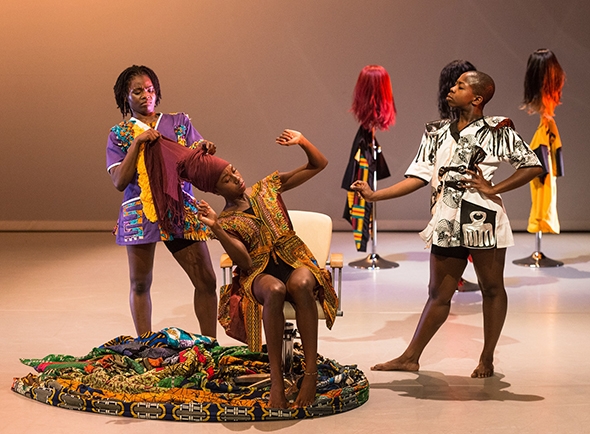
Habibat Ajayi, Shelia Attah & Shanelle Clemenson in Uchenna Dance’s The Head Wrap Diaries (photo © Foteini Christofilopoulou)
“I want to talk about natural black hair, and how it’s not just hair. I mean, I’m interested in hair in sort of a very aesthetic way, just the beauty of hair, but also in a political way: what it says, what it means.” – Chimamanda Ngozi Adichie
In a lingering opening the three Uchenna Dance (UD) performers, Shanelle Clemenson, Sheila Attah and Habibat Ajayi, emerge slowly on their knees into a silvery light with foreheads kissing the floor. They each tie around their heads part of a 10m x 3m patchwork of patterned and printed material and as their undulating backs glacially retreat stage left they use their heads to unfurl a giant head wrap. The relative stillness of the image draws the audience towards the bodies and the head wrap as sombre echoes of history, women and colour are united by hair. With over a dozen self-contained chapters exploring female beauty, empowerment and relationships across generations, The Head Wrap Diaries is sprinkled with humour, lightness and empathy. Clemenson, Attah and Ajayi adopt multiple personalities that melt choreographically between the vocabularies of waacking, house, contemporary and African people’s dance set by UD’s artistic director, Vicki Igbokwe. (If you want to know more about the motivation and some of the insights for The Head Wrap Diaries see my companion piece which I wrote as the work was being created).
“If I were really asked to define myself, I wouldn’t start with race; I wouldn’t start with blackness; I wouldn’t start with gender; I wouldn’t start with feminism. I would start with stripping down to what fundamentally informs my life, which is that I’m a seeker on the path. I think of feminism, and I think of anti-racist struggles as part of it. But where I stand spiritually is, steadfastly, on a path about love.” – Bell Hooks
The tone and pacing across the evening is well crafted as the chapters shift between solo characters, fierce dancing and clear movement direction. Attah’s detailed portrait of Auntie Florence in her hairdresser’s chair, (wo)manspreading, hutching up the hem of her dress and delivering a perm monologue in a booming Nigerian voice with oodles of inflexions and pitches, has the crowd in howls of laughter. From a single arm and face raised high echoing, “We give thanks, we give thanks” to “How old am I? How old are you?” the front row of the audience almost erupts.
Clemenson’s wide eyed death stare and swift head shake as she commands a reluctant Ajayi to sit between her legs and prepare for the mother of all hair brushings is a parody born of experience. Ajayi’s quivering legs, splayed toes and tensed fingertips create memory triggers and bodily reactions in the audience. I’m surrounded by the voices of mothers who share with their neighbours: “Too true, too true,” and “Perhaps I shouldn’t do that to my daughter.” These stories, communities and histories are culturally rooted across decades, continents and politics; it is testament to Igbokwe’s authentic and humorous portrayal of black, female experience that the crowd responds with such vocal relish.
Scenographically there are two fixed hairdressing chairs, three wig stands and a large screen positioned upstage on which a number of black female hairstyles and portraits are projected. The screen feels unnecessary, not only because the images are often partially bleached out by the lighting but the screen content can draw attention away from the dancers. This material might sit better as an accompaniment to the pre- and post-show foyer installation that includes head wraps for sale, newly commissioned art work, organic tea, photography and dolls, all of which aided the understanding and engagement of the work, framed the performance and ensured the audience had a hands-on (and heads-on) experience.
Apart from the two hairdressing chairs there are seven others placed stage left; at the beginning of the performance two audience members are invited to sit on the chairs to have an alternative perspective of the performance. When Attah, in the role of a travelling saleswoman, demonstrates step by step the art of putting on the head wrap, Clemenson and Ajayi follow her instructions but the two unsuspecting audience members need a lot of encouragement to try; after calls from the audience to “tuck, tuck,” they too are crowned. This is one of the few hands-on moments of interaction between the cast and audience; it is an element that has the potential to grow, to bring more people on stage and to create the melee and buzz of a hairdressing salon: an ideal opportunity for UD to work with an extended cast.
“Challenging power structures from the inside, working the cracks within the system, however, requires learning to speak multiple languages of power convincingly.” – Patricia Hill Collins
The Head Wrap Diaries is a hair piece but it is also a dance piece and when the choreographed sections arrive they land with ferocity. Attah, Ajayi and Clemenson’s head-snapping faux self-importance, all fill the stage with swag. Together they cat walk, strut, waack and are constantly up on their toes with lean calves giving elasticity to their steps. This strut bouncing embellishes their characters, accentuates their rhythm and pays homage to the Queen of the New Jack Swing, Janet Jackson.
With only two English venues on the tour, the increasingly conservative and monochromatic choices by UK dance venues is a real concern. Here is a work that is engaging, authentic, culturally rooted and beautifully danced with an intelligent installation and (head)wrap-around programme. With a society crying out for cultural understanding, it is no longer acceptable for programmers to think they already have their one ‘black/disabled/trans’ artist for the season and can’t programme another. Never mind Arts Council England’s Creative Case for Diversity, The Head Wrap Diaries is great dance for all.
Posted: August 31st, 2016 | Author: Ian Abbott | Filed under: Festival, Performance | Tags: Adrienne O'Leary, Carlos J Martinez, Christina Liddell, James Southward, Janis Claxton, National Museum of Scotland, Popup Duets | Comments Off on Ian Abbott at Edinburgh Fringe: Janis Claxton Dance, Pop Up Duets
Janis Claxton Dance, Pop Up Duets (fragments of love), National Museum of Scotland, August 17

James Southward & Christina Liddell in one of Janis Claxton’s Popup Duets (photo: Ian Abbott)
“Age does not protect you from love. But love, to some extent, protects you from age.” – Anais Nin
With Pop Up Duets Janis Claxton has made photographic dance catnip; four lithe, athletic bodies, dripping with clean and dramatic lines, set against the backdrop of the National Museum of Scotland. Choreographically it’s a canny decision and demonstrates a genuine understanding of how audiences engage with work in public space. They will often stay with a work for four to six minutes, invest a little of themselves, take a photo and carry on with their day. But Pop Up Duets has been all over social media and the company has also been interviewed by BBC Loop to create a short video that racked up over 32,000 views — by far the biggest audience for contemporary dance at the Fringe.
With a company of exceptional dancers (Adrienne O’Leary, James Southward, Christina Liddell and Carlos J Martinez), nine duets lasting four to five minutes each are performed within the gallery spaces; the choreography and musicality are akin to rain droplets on the window of a speeding train: a swooshing arrival as they land, bodies slowly unfurling, leaving a water tail as they make their horizontal journey across the floor and then ramping up again as they gather momentum to join with other miniature streams as they run against the wind. There’s oodles of fevered contact, silky bodily meshing and recognisable tropes of physical intimacy delivering a choreographic vocabulary that is recognisable and accessible for all who encounter it.
“I did not want to be a tree, a flower or a wave. In a dancer’s body, we as audience must see ourselves, not the imitated behavior of everyday actions, not the phenomenon of nature, not exotic creatures from another planet, but something of the miracle that is a human being.” – Martha Graham.
As the duets popped up around the museum an accidental audience would gather temporarily for a duet or two but when I attended the majority of the crowd were ready for a performance and stayed for the entire 45 minutes; they naturally formed a ring, hugged the safety of the edge and framed a circular stage area for the dancers to perform in. The space was never crossed or intruded upon once a performance began, demonstrating an understanding and familiarity with performance in public places. The audience was guided from the site of one duet to another by the introduction of the next piece of music issuing from two smartly designed vintage suitcases that acted as portable speakers. As the crowds gathered again the dancers emerged from within the crowd. The main gallery in National Museum of Scotland is like a three-tier ivory budgie cage with natural light beaming down from the roof; it was levels one and two that offered a birds-eye view and it was here that those a little less familiar with performance encountered the work from a safe distance with the ability to capture the results on their smart phone.
“That hunger of the flesh, that longing for ease, that terror of incarceration, that insistence on tribal honour being obeyed: all of that exists, and it exists everywhere.” – Ben Kingsley
However, as I stayed with Pop Up Duets, my interest began to wane. Because the individual fragments exist in isolation and don’t talk to each other, there is a similarity in pacing and a lack of visible development in the wider narrative, and although the setting is majestic the context of the venue (a museum of inanimate history placed on plinths or stuck behind glass) offers little in terms of framing. Love and intimacy are rarely treated well choreographically in contemporary dance; convincing the audience that two people are longing to be together is difficult (and not all the dancers in the company manage it) but James Southward absolutely nails it — his body amplifies the feeling that exists in his hungry eyes as he falls into the orbit of all those he dances with — he’s absolutely magnetic and melts in and out of the eyes of all who watch him.
Presenting accessible contemporary dance in public has a fruitful history across the UK with the likes of Casson and Friends, Protein Dance and Tilted actively embracing the richness that comes from this level of engagement. There is a lot to love in Pop Up Duets, including Kathryn Joseph on the soundtrack, the technical facility of the dancers and blending of museum/dance audiences together, but I didn’t fall in love with all of it; we brushed cheeks, flirted together and enjoyed a little fringe holiday romance.