Ian Abbott: Nott A Fierce Umbrella, A Tale Of Three Festivals, October 2019
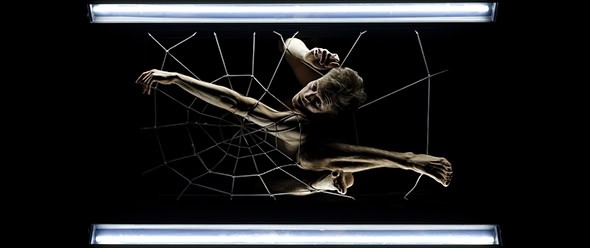
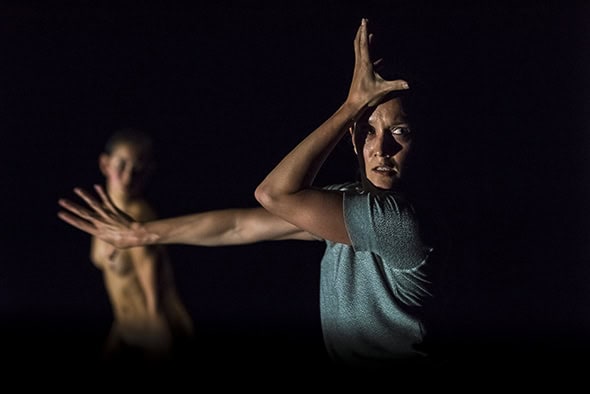
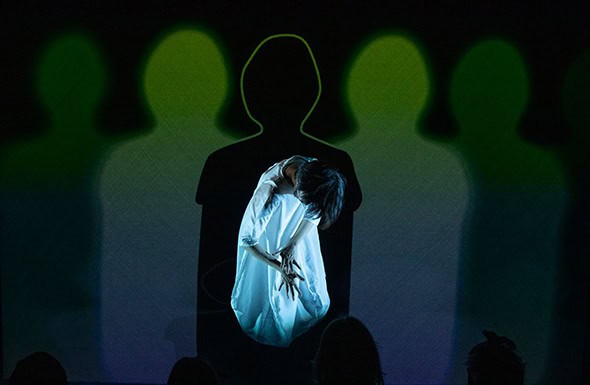
Philippe Chosson and Mickaël Henrotay-Delaunay in Hocus Pocus (photo: Philippe Pache)
The choreographic density of October and November is the result of a number of UK dance festivals vying for the eyes and attentions of audiences and artists; over a period of six weeks there’s Dance Umbrella, Nottdance, Fierce, Dance International Glasgow, Shout, LEAP and Cardiff Dance Festival. I spent some time in three of the English ones — Dance Umbrella, Nott Dance and Fierce — to look at their programmes and the sense of community around them.
There are some macro questions around who festivals are for, and what difference they make to the form and to their community. Are festivals moments of cultural change? Do they mark a shifting of taste and aesthetic? Are they miniature economic impact machines? Gentrification tools? Festivals that are simply made up of dance performances? A chance for artistic directors to display their air miles and intellectual baubles? Not all festivals are perhaps clear in what/who/why they are. I’m interested in festivals as a site of repetition as people return to the same city, see the same people, enter the same venues year after year but see different works by different artists. I recognise this is a partial view — in as much as the time I spent at each event was limited — but remembering previous editions of each festival I thought it would be worth looking at the three as a whole. With the shift of focus of the UK Dance Showcase (the new incarnation of British Dance Edition) to actively not invite international promoters to the event in May 2019 and focus purely on UK promoters, Dance Umbrella and Nottdance have worked together to create the October Collection, a project that invited a number of international promoters to spend five days traversing the festivals in Nottingham and London offering exposure to a selected group of artists pitching and presenting work. It is worth noting that of the ten works I saw at the festivals none were created by disabled artists.
Nottdance is a biennial festival in Nottingham that is curated by the team at Dance4. They ‘position the voice of artists at the heart of the development of the festival’. For the 2019 edition they published a three page curational statement on the vision for the festival, co-curated by Dance4’s artistic director/CEO Paul Russ and Matthias Sperling, and announced an ambition that Sperling select his successor for the 2021 edition. I spent Saturday October 12 in Nottingham attending five events — three performances and two discussions; all performance works were from artists based in Canada and/or France and the discussions were led by dance artists based in England.
Extended Hermeneutics by Jennifer Lacey ‘uses the sprawling meta-expanse of Bauhaus Imaginista as a divining system where individual readings are offered to those who desire them’. It is nestled in a corner of Nottingham Contemporary where Lacey and I sit facing each other at a small table. This 30-minute 1-to-1 encounter authored by Lacey leans towards a choreographic divination using the Bauhaus exhibition as a frame and set of tools to interpret the problem you have brought to her. Lacey is hyper attentive, responding to visual gestures and titbits of information derived from the verbal and non-verbal signals that leak from my body; after I choose from four decks of cards, she offers an approach to help me find an answer. Lacey is engaging in an American psychotherapist way; she holds eye contact, keeps the beats in between the conversation natural to a point of believeability. It’s an attempt at seduction, looking into the mirror she is presenting and asking me to find my own answer. It feels akin to an intellectual seaside/end-of-the-pier tarot entertainment and ends with a two-minute 55 second, mainly floor-based solo that Lacey performs for me before our time is up. When I’m taking the time to process the information she’s offering in relation to the history of 1970s Leeds Polytechnic Bauhaus practice or geometric costumes I don’t really pay attention because there is little time for me or the thoughts it conjures up in the moment; it is a broadcast that at that moment doesn’t feel personal at all. A seduction takes time and although the encounter could have been useful, it depends on how much weight you give to fortune tellers and tarot practices — they are all a mirror through which we attempt to see ourselves more clearly.
Beside by Maribé – sors de ce corps at Lakeside Arts Centre is choreographed by Marie Béland who begins with a two-minute introduction that explains that everything the performers say is what they hear on the radio on their headphones in that moment and, parallel to this, their movement score is derived and harvested from the gestures and choreographic body patterns on talk shows, political broadcasts and current affairs TV shows. We get the set up instantly; a performer delivers the words they hear (on this occasion at 5pm on a Saturday afternoon in Nottingham) over the course of 60 minutes, including the recent upturn of form at Notts County Football Club, a programme on Blockchain and Libra (Facebook’s new cryptocurrency) and the Irish backstop, all matched with pre-existing gestures. What is created is an ever evolving, live choreographic meme which reflects some of our broadcast media, music, songs and political broadcasts.
What Béland has created is a frame that could enable this work to last forever; the work will always be relevant because it derives its currency from the radio content broadcast on that day in that city, and it will always connect and reflect the energies and priorities of that day. It could scale up from the three dancers to 13 or 103, depending on the size of the stage or the complexity of the audio narratives. It is funny, because life is funny when it is removed from its original frame. Hearing the absurdity of in-depth analysis of a football game coming from an alien mouth set to artificial gestures emphasises the assumptions of language (word and body) each community uses. The agility of thought and how each performer combines it with straight-faced and physical control demonstrates that Rachel Harris, Sylvain Lafortune, and Bernard Martin are skilled performers, but we see little of their dancing ability; it is more a controlled suite of bodily movement.
How does the relationship of our geographical context to the work we see affect how we see it? The Nott Dance closing performance at Backlit Gallery is the same as Fierce’s Sunday lunchtime performance at Birmingham Museum and Art Gallery a week later: Make Banana Cry by Andrew Tay and Stephen Thomson. It’s the difference between a festival closer at 9pm on a Saturday night and a Sunday luncher at 12.30pm; energies, attentions and expectations of experience are entirely different. Described in Nottingham as ‘a continuous barrage of identity politics, a durational parade which contemplates the problematics of universal “Western” pop culture while drawing on the artistic background of each of the invited artists’, it becomes in Birmingham a work that ‘confronts western perceptions of the ‘Asian Fantasy’ in a durational parade drawing on the background of the diverse cast of Canadian artists.’
Set in a catwalk fashion seat configuration with a U-shaped runway on which the performers walk up and down, we see a slow, iterative introduction of each ‘model’ who is over-clothed with up to a dozen layers of items, props and accessories, some of which we would recognise as clothes, some not (tablecloths, giant fans, suitcases). Over the course of 70 minutes, garments and items are removed and embellished leading to a sense of a live GIF parade; each model demands attention for 5 seconds — in one case by swatting their naked butt cheek with a fly swatter — whilst the next comes along with a plunger that is being repurposed as a rocket launcher. The continual attempt of each act to outdo and one-up the next is predictable and is accompanied by a playlist of Asian stereotype music like Mr Roboto by Styx, We Are Siamese by Peggy Lee (from 1955’s Lady & The Tramp) or excerpts from the Miss Saigon soundtrack.
The noon encounter with Make Banana Cry sees a community, audience and staff feeling the effects of Fierce Party the night before with at least forty empty chairs, compared to the neatly organised, manicured, sold-out presentation in Nottingham. Although the prop and costume game is stronger in Birmingham (insert electrical fans, fire extinguishers and 3 phase extension leads) the cool, air-conditioned colonialism of BMAG drags it down. When you see a work again so quickly, you notice differences that were missed before because so much of our audience attention is taken with that immediate first impression. This time I pay attention to prop usage, gait and micro performativity, all of which had a depth of attention and detail that you don’t get from a single viewing. Make Banana Cry is a barrage of bodies, props, and music that raises a wry smile as it attempts to question Asian stereotypes and to examine the transmission of cultural identity, but the form of presentation and the predictability that ensues (and its finale of nakedness) dampens the impact and makes it appear quite facile when in fact there are layers, signs and Easter eggs to discover in multiple viewings.
Fierce is the Birmingham biennial which frames itself as Performance Parties Politics Pop. With his written introduction in the programme, artistic director Aaron Wright goes some way to answering my initial questions about what a festival is and who it’s for. ‘With a world in crisis what use is an arts festival, really? What can art achieve in the context of creeping fascism, mass anxiety and the ever-looming threat of the extinction of the human race? Will the performances get an anti-austerity government into Downing Street? Seems unlikely. Will they convince BP to move their focus to renewable energy? No. Will they bring about the demise of neo liberalism and the White supremacist patriarchy? Not any time soon.’ Instead Wright thinks the festival programme ‘can be boiled down to four elements that feel more vital than ever; communion, empathy, resistance and joy.’
Following on from Make Banana Cry I spend the rest of Sunday October 20at Fierce encountering another set of performances by non UK-based artists, including Bain Brisé by Yann Marussich, Private: wear a mask when you talk to me by Alexandra Bachzetsis and iFeel2 by Melk Prod./Marco Berrettini; these three artists, all hailing from Switzerland, are supported by Pro Helvetia.
Bain Brisé self describes as ‘A bath is filled with broken glass. A man’s forearm is visible on the surface of the sharp and crystalline magma. The man is stuck inside his bath of glass shards and cannot get out without getting injured…It is impossible for the audience to truly grasp that he is steeped inside some 600kg of solid matter, and that time is ticking by.’ Over the course of 50 minutes in Midlands Arts Centre’s Second Floor Gallery, we see a forearm delicately choreograph itself to slowly evict hundreds of shards of glass that splinter and smash as they hit the floor, scattering glass over the legs of the front row of a hushed audience. It is an act of choreographic removal, a slow unveiling of Marussich’s naked body which is encased in a cast iron roll-top bath filled to the brim with glass. With a live percussion and tense electronic score from Julie Semoroz and a sense of classic 80s Performance Art Top Trumps, there seems to be genuine peril that Marussich’s body could a) be cut to ribbons and b) suffocate under the weight of over half a ton of glass. There is both tension and boredom in play as the accompanying glass drops sting the ears alongside the predictability of outcome as his body finally emerges and leaves the gallery. From a choreographic point of view, the control and stillness of an almost Kerplunk choice of which glass to remove to minimise bloodletting is incredibly watchable and draws the focus into an area of about 70cm x 70cm. As part of his head, second arm and torso emerge, he attempts to pull/lift himself up in the bath to an almost sitting position and the sound of glass shifting underneath his legs and bum is an absolute eyelid twitcher. With the bath’s opacity obscuring the detail of how his tendons are being nibbled by glass, the imagination just runs wild.
Private: Wear a mask when you talk to me, also at Midlands Arts Centre, self describes as ‘a timeless hymn to transitions. A notation of its inner development, but also a mourning sketch for possibilities that were once open but can no longer be realized. In the end, this dance is not about normative gender performativity, but rather about the somatic energy that allows us to introduce moments of what Jacques Derrida called “improvisatory anarchy” in order to interrupt history and trigger cultural change and political transformation.’ Private… is a 50-minute solo conceived, choreographed and performed by Bachzetsis that is the perfect embodiment of Fierce’s 4 P’s. With a presentation, demolition and (re)presentation of gendered movement from Michael Jackson’s choreography to Beat It, to mutated westernised yoga positions as well as football and porn poses, Bachzetsis stares straight down our lens and with inverted alacrity bathes in her own power, including presenting herself in a black latex dress and demanding an audience member to spray shine her to reflective mirrordom. There is silence, space and buckets of technical dance ability in the work — when Bachzetsis wants it on display. Private…is a #findom, #subdom and #choreodom; after all, we are only here to see Bachzetsis.
The festival closer at DanceXchange is iFeel2, a 70-minute work for three performers which self describes as ‘a young woman and a middle-aged man, half naked in a tropical dream world boasting floating plants. They are being watched. An erotic female voice sings strange associations with nature. The elegant trance they trace out is done so according to a minimalist and repetitive structure based on the residue of social dances, which are then mirrored.’ iFeel2 is the embodiment of middle-aged white male confidence and entitlement; as Berrettini and Marie-Caroline Hominal, mirrored in only black trousers and black shoes, deliver a simple, repetitive, six step Tina Turner grape vine to each other whilst holding eye contact, Berrettini constantly crosses the invisible line (without touching) and invades the space, pigeon-heading and gesturing in the pursuit of desire. I cannot help but see Berrettini’s facial resemblance to Harvey Weinstein and this consistent invasion and act of violence on an unflinching Hominal is uncomfortable. iFeel2 is a work that was created in 2012, before the #MeToo campaign and Eirini Kartsaki wrote about the work in 2015 in an article entitled Circular Paths of Pleasurewhich offers an eloquent analysis of the work and its proximity to desire, repetition and philosophy. However, even with all my favourite components in play — repetitive choreographic structures, unusual scenography and lighting design (by Victor Roy) and an alternative pop soundtrack from Summer Music (a pop band formed by Berrettini and performer Samuel Pajand) — it is a work that in its conception and original creation time was an ode to catharsis, desire and unfulfillment, but in 2019 reads as invasion, violence and trauma. The world has shifted but the work has not.
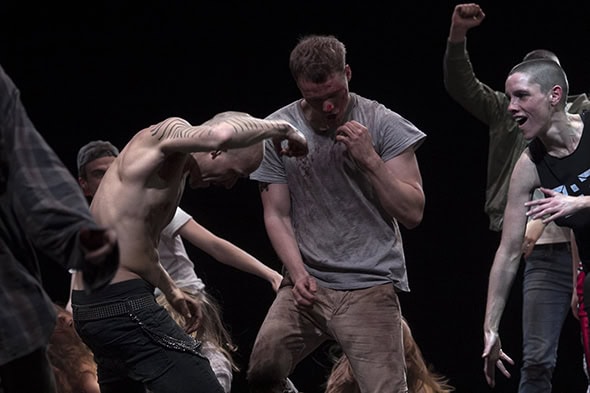
Moving away from the Midlands, I had three trips to London’s Dance Umbrella to see four works; the three-week programme doesn’t offer the same possibilities of seeing a density of work in a single day. The first was the festival opener CROWD by Gisèle Vienne on the main stage at Sadler’s Wells. CROWD is the ultimate commitment to a concept as Vienne takes a single idea and has the courage to not sway or bend from it. On the soil- and litter-encrusted stage we have 15 White bodies engaged in a glacial movement score that looks like the morning after a loose and faux hedonistic night of drink, drugs and carnal encounters at a Glastonbury type festival; bodies emote, flirt, abuse, attack and re-evaluate each other across 85 minutes to an EDM and trance soundtrack compiled by Peter Rehberg. If this were a political and knowing portrait of the ‘festival community’ where rich, White millennials go for a weekend and pay to get high then Vienne has absolutely nailed it. However, CROWD is described as ‘dissecting the vast spectrum of our fantasies, emotions, and dark sides, in addition to our inherent need for violence and our sensuality. Flying in the face of the different artistic disciplines, the journey Vienne takes us on renders the onstage experience a cathartic one.’ What is it with White, European, middle-aged choreographers and their desire for White catharsis? As a festival opener and a lens to see the rest of the festival through it, CROWD is one that reeks of privilege, Whiteness and a concept that is radically dated. The slow-motion aftermath/energy of party/disco/club has been conceptually rinsed by GCSE dance students for the past 25 years and Vienne adds nothing to the dialogue. We see the anatomically perfect dancers dressed dubiously (working class holiday, anyone?) and present exaggerated limb emphasis and facial gurns with the odd break-out for 30-60 seconds as a solo takes place in real time. With the soundtrack playing in real time (and not slowed down), there is a jarring to our auditory and visual food which doesn’t resolve; it is merely presented without comment. No one really likes to watch other people have a good time, especially when you’re asking contemporary and classically-trained dancers to punctuate and dime stop movements to attempt an emphasis they don’t have the ability to execute. Put this concept in the body of Hip Hop dancers and at least you’ll have bodies that can execute what is being asked of them.
Moving across London to Southbank Centre’s Queen Elizabeth Hall, Hard to be Soft – A Belfast Prayer by Oona Dohetry is the second work from the Belfast-based choreographer and performer, which follows on from the incredible solo Hope Hunt and The Ascension into Lazarus in both the chronology of when it was made but also in the thematic sensibility of a portrait of a city and its people. All life is here. Some life is here. How can you stage a portrait of some parts of a city (Belfast), some of its history and some of its inhabitants? At a sliver under 50 minutes, Hard to be Soft…presents a work in four parts, bookended by solo’s from Doherty with an addition of a dozen young female dancers from the Croydon Sugar Army (Doherty draws a community cast from each tour location to perform this section) alongside a duet from John Scott and Sam Finnegan. It also sees Doherty shift from the small-scale intimacy of the type of theatres to which Hope Hunt toured to the larger and more physically distancing stages of QEH. Scott and Finnegan embark on a topless, fleshy, meaty sumo embrace which is all arms clutching and chest sweating that is the distillation of Doherty’s choreographic signature, tender violence. The Sugar Army with ponytails a-bouncin’ offer V formations, commercial routines to David Holmes score and are the choreographic embodiment of teeth sucking. What made Hope Hunt so electric was the performance and power of Doherty, not her choreographic work on other bodies; this is where Hard to be Soft is lacking. How can Doherty paint herself onto other bodies? That level of ferocity doesn’t translate and so everything around her is viewed as inferior and I’m left thinking about the long shadow cast by Hope Hunt and whether Doherty will be able to escape it. It is also worth noting that this is the first work I am seeing at the three festivals that is presented by a UK-based artist.
There’s something about festivals as agents of gentrification and culture washers when they present the commodified trauma of others for the price of a ticket. Are Dance Umbrella and the other festivals really opening a dialogue and offering an insight into things that are unfamiliar to us like the tension and violence set deep amongst the people and architecture of Belfast that Doherty speaks of or are they perpetuating and cementing the evidence from the Warwick Commission report that arts audiences make up 8% of the population who are the richest, most educated and least diverse.
One of the successes of Dance Umbrella is the multi-venue orbital tour of European work for families and young people that has enabled work by Dadodans, Erik Kaiel and now Philippe Saire’s Hocus Pocus to tour to five or six venues across London (I saw it at The Place). Hocus Pocus ‘is based on the power of images, their magic and the sensations they provoke, and it is delicious; it’s a duet that nibbles at the edges of illusion and performance. Parts of Philippe Chosson and Mickaël Henrotay-Delaunay appear and disappear between two strip lights as they emerge and are absorbed back into the darkness. Playing with perspective, birds eye view, and vanishing points, it’s like they’re walking on alternate planes; sometimes we view them from above, sometimes they swing around, sometimes they present isolated limbs on rotation which plays havoc with the eyes as it takes a while to understand how the Jenga body parts are working together. At 50 minutes, the scenography, design and prop-making skill (Stage Device Realisation fromLéo Piccirelli and Props and Accessories byJulie Chapallaz and Hervé Jabveneau) mixed with the physical skills of the two performers leave us jawdropped at how the things are happening.
REDD by Boy Blue (who’ve removed the word Entertainment from their name and descriptors in the programme) was the closing show from the Dance Umbrella Takeover of Fairfield Hall — two days of dance, performance, live music, participation and free events in Croydon which included a new commission from The Urban Playground Team and the premiere of Here and Now by Mythili Prakash — and my final show of DU19. Instead of a programme synopsis, Boy Blue offers 143 Words On Grief by R. Moulden as a contextual explainer in the programme.
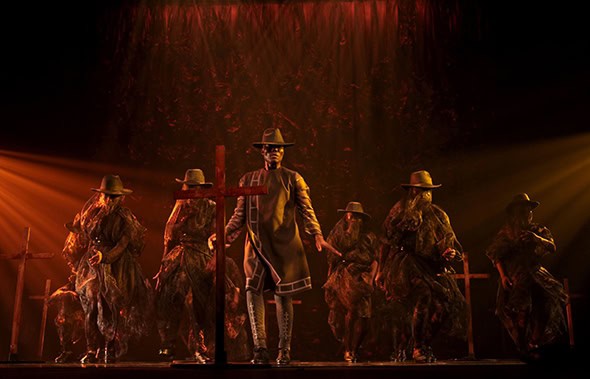
At 75 minutes without interval, this is a solo for choreographer and co-artistic director Kenrick ‘H20’ Sandy, MBE, supported by a chorus of eight dancers who act as his physical echoes, partial tormentors and skulk about in the shadows of grief. As the first dance show on the newly refurbished Fairfield Halls stage, REDD had an anticipation as it is the follow-up to their internationally acclaimed Blak White Gray. Silences and the mis-expectations of grief trigger different emotions in all those who encounter it, so how are we to comment on the sincerity or portrayal of the grief of another?
As someone who has recently lost a parent, there’s little in REDD that speaks to me on an emotional plane; there are no dramaturgical invitations, no communion of power, and an empathy void; I am left to bear witness and engage if I want. With this lack of generosity, my focus and reflections switch to looking at it as a work of Hip Hop theatre in an attempt to find other things in it but I’m left weary by yet another commodification of trauma.
Sandy, who is on stage throughout, wades, dives, stills and re-enacts some of Moulden’s words — ‘slinks in like a beaten dog and makes its home at your feet…with cracked voice and lolling tongue…reaching into your mouth’ — whilst the shadows of grief make visual noise in the periphery. With a new score from composer and Boy Blue co-artistic director Michael ‘Mikey J’ Asante and a lighting design from Charlie Morgan Jones there is little subtlety and craft in how the lighting, score and choreography come together. Each of the component parts (louder music and a flash flicker of light) often emphasise a particular choreographic move on Sandy all at the same time like three anguish anvils being rammed down your throat.
In previous Boy Blue works, Sandy is usually choreographically en pointe, he pops harder, isolates more cleanly and punctuates more sharply. However in REDD he is the weakest performer. He looked laboured getting in and out of the floor (with his hands on his thigh to help him up), he is out of breath in the final joint choreographic sequences and his performance presence is considerably duller than previous iterations; in the final duet he is unintentionally upstaged by the execution and presence of Emma Houston with whom he dances. It’s like seeing Superman bleed. REDD isn’t ready to be on stage, it doesn’t feel like it is sure what it wants to be (a solo or group work) and consequently what its strongest cast should be.
There are dozens of very average contemporary dance performances happening in theatres every week; that’s because there are hundreds of artists making work across the UK and not everything can be incredible or abysmal; 90% of work sits in this middle ground. However, when a Hip Hop theatre company (who are considerably rarer and we’re talking in the low dozens of artists) makes an average work multiplied by the reputation, financial security and profile of Boy Blue, it feels shocking, but it shouldn’t. Not everything that everybody does will always be the best. We should be able to talk about and write about very average Hip Hop Theatre like we do contemporary dance; as a form, Hip Hop theatre needs honesty in the debate and honesty in the community about work that will enable it to grow and flourish.
One of the strands of Nottdance (alongside performance, studio sharings, etc.) is a discourse strand and during Dr Gillie Kleiman’s session she speaks about her own practice in relationship to Community Dance and cites the idea of ‘Measuring The Distance’ taken from the theatre scholar Shannon Jackson. If we were to measure our practice/distance from a fixed centre (e.g. dance as centre, theatre as centre, visual art as centre) how far or close are we from it? What does this do to centre(s) and who determines what the centre (or perception of centre) is? Do Nottdance, Fierce and Dance Umbrella represent a centre of dance? How might artists and audiences measure their distance from these festivals and what is the proximity and size of their community? Later in the day there’s a panel, Artist. Curator. Leader, conceived by Joe Moran (as part of a larger piece of research he is undertaking) who invited Alexandrina Hemsley and Heidi Rustgaard to be part of it. One of the interesting things that comes up when the discussion opens is that Paul Hughes (who presented at Nottdance earlier in the festival) had asked Paul Russ if Dance4 would do an end-of-the-week sharing on Friday afternoon so that artists could see what Dance4 as an organisation had been working on that week. It is the reverse of when artists, in exchange for using a studio in their building, nine times out of ten give a presentation of ‘work’ to internal staff at the end of the week who then offer their ‘feedback’ on how to make it better. Can you imagine if Dance Umbrella, Fierce, Dance4 and dance development organisations and theatres were to give Friday afternoon sharings to rooms of artists and audiences who would be able to offer an assessment and critique of how they’re doing and how might they do better? Such events could alter the power imbalance that exists between artist and organisations, change centres, and equalise relationships across the entire ecology.
Dance Umbrella 2019: Oona Doherty at Southbank Centre and The Yard Theatre.
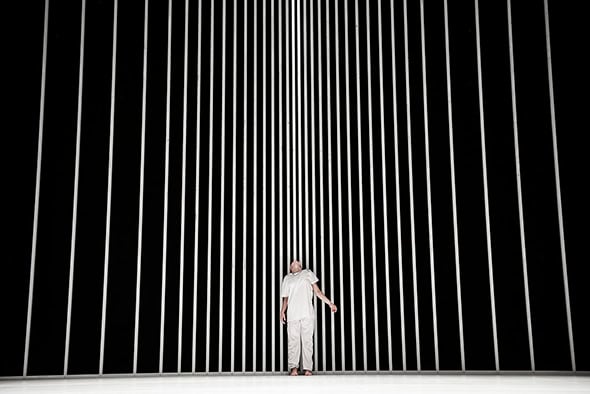
Oona Doherty in Hard to Be Soft (photo: Luca Truffarelli)
In a welcome programming decision, Dance Umbrella includes two works by Belfast-based choreographer, Oona Doherty. One is Hope Hunt and The Ascension Into Lazarus at The Yard Theatre in Hackney Wick and the other is Hard to Be Soft at Southbank Centre. Doherty created Hope Hunt first, in 2016, but the two works are like cousins; the family resemblance is clear while the gene pool is shared. What binds them together is the common canvas on which they are created: life in Belfast. Doherty has lived in the Northern Irish city for the past 20 years and knows it intimately; she also has a proclivity for researching the rougher side of life. There’s a rawness to her work that has no truck with artifice; she’s not interested in translating her experiences into choreography but in embodying them on stage. At the same time her performance effortlessly channels the elements of violence and anger into a paradoxical sense of freedom; her gravitational pull to the floor is equalled by her quicksilver ability to rise from it.
Hope Hunt and The Ascension Into Lazarus is concentrated Doherty, serving as both inspiration and reference for Hard to Be Soft. The biblical figure of Lazarus, whom Jesus miraculously raised from the dead, serves for Doherty as an enduring metaphor to champion the disaffected male youth of Belfast she portrays. By juxtaposing the soundtrack of recorded confrontational conversations from the Belfast streets with seventeenth century choral church music — Allegri’s sublime Miserere — Doherty’s body is constantly charged with contrasting impulses; her gestures are imbued with the hurled aggression and frustration of the conversations, while they equally aspire, or ascend, to some finer, ineffable state reflected in the music. The pleasure of seeing the performance is how Doherty invokes these two inputs, sometimes separately and sometimes together but always playing between them like separate monodies that she combines into a harmonious line. She achieves this because she is a rare combination of accomplished dancer and mimic; her expressive facial features and gestures engage in the conversations we are hearing with candid clarity and make us laugh at the accuracy of her observation, and then her fluid dance body will overlay a response to the music to suggest a spiritual context. As a performer she is nowhere other than on the streets of Belfast and she draws us to them, and to their stories, with an immediacy as if we were there too.
Hard to Be Soft broadens her canvas while maintaining the same metaphor; she describes it as ‘a physical prayer celebrating all that we have and an invocation for what we are missing.’ Doherty divides her performance into four episodes — ‘a cinematic sci-fi stations of the cross’, as she has called it — in which she performs the first and last episodes as solos, but has choreographed the middle two respectively on a group of sassy young women — The Sugar Army — and two bare-chested men — John Scott and Sam Finnegan — whose meaty presence is both a bid to bring the physicality of Belfast directly to the stage and a welcome provocation to dance conventions. Her two solos anchor the work in the singular imagery of Hope Hunt, providing both a prologue (Lazarus and the Bird of Paradise) and an epilogue (Helium) to the central sections. The Sugar Army is a bevy of teenage girls recruited from each city with whom Doherty has spent a couple of weeks discussing identity in relation to mediatised attitudes towards beauty. To a soundscape beat by David Holmes, the Sugar Army inhabits the prêt-à-porter choreography with their youthful personalities and attitudes that don’t, however, quite match the delightful cynicism of a Belfast woman who describes ‘dressing up the politics of conflict with glamour’. In the third section, Meat Kaleidoscope, the presence of Scott and Finnegan correlates the power dynamic between a father and son with an expletive-strewn recording of a growling argument that echoes broader political tensions. The size and weight of the men, like two equally matched wrestlers, create their own form of physical dialogue that poignantly embraces antagonism and understanding in equal measure.
Given the physical and aural iconography of both works and the overt reference to Lazarus in each, it is hard not to acknowledge the religious signification of Doherty’s work that underpins the potential of the human body to unite earthly and spiritual opposites. Ciarran Bagnall’s set for Hard to Be Soft is made up of vertical steel columns that refer ambiguously to prison bars or cathedral architecture, while her lighting generates the upward aspiration towards the divine. Yet despite the religious allusion, there is no overt moralizing; Doherty’s earthy, streetwise persona consistently deflects it. The power of her work is in juxtaposing hard-hitting political imagery with a state of radiant belief. A line from the Helium section straddles the possibilities between the two: ‘What if Jesus came back? What if he was bricking your car on the Saintfield road?’
Dance Umbrella 2019: Lucy Guerin’s Split at The Place, October 12
Ashley McLellan and Lilian Steiner in Split (photo: Gregory Lorenzutti)
Lucy Guerin’s Split, performed by dancers Lilian Steiner and Ashley McLellan at The Place as part of Dance Umbrella, is an enquiry into duality that is structured on a grid laid down in white tape with a corresponding division of time. For the opening section, the dancers move within a spacious rectangle to a pulsing, driving score by Scanner for a prescribed period. When the time is up — and while the musical engine idles patiently — the dancers stop to rest, towel down and then divide the rectangle into two equal spaces with more white tape. They perform the next section in just one of the two rectangles for half the amount of time. With Paul Lim’s lighting providing an additional delineation to each section, the dancers continue in a diminishing geometric space/time structure until they have only a tiny square in which to stand and a final brief moment in which to resolve the entire choreographic puzzle. There is a strict logic to the pattern of partitions — resembling that of a Fibonacci series without the guiding Golden spiral — that appears to sublimate the agency of the dancers. Despite Guerin’s choreographic depiction of a ‘diminishing world’ that ‘induces competition, negotiation, harmony and aggression’, there is little overt emotional intent from the dancers beyond the gestural language itself.
In the first section, Steiner and McLellan perform an ever-expanding sequence of movements in unison, remaining in the same relation to each other without ever touching. The gestural expression extends out from the torso to the bodies’ extremities — especially the hands and fingers — as much as to the patterns on the floor. This harmonious relationship within an ample space can be seen as the ground of human identity, while the sheer volubility and intricacy of actions and reactions, of skipping, jumping, reclining and swirling in all directions — a tour de force for the dancers — shows the rich complexity of such ground. Within this apparent unity, Guerin introduces a singular contrast by choosing to clothe only one of her dancers. As she writes in the program, ‘Having one naked and the other clothed created a split in identity that intensified the piece. For me it gives seriousness and normality to the female body, which is such a site of commodification, exploitation, shame and shock.’ On the other hand, as John Berger wrote about the fine art tradition of the nude in Ways of Seeing, ‘She is not naked as she is. She is naked as the spectator sees her.’ While Guerin’s choice may provide an apt choreographic duality, in the context of the theatre she cannot preclude a spectator reaction that recognizes in Steiner’s naked body the very attributes she rightly deplores and allows their formal presentation to distract from the work’s rigorous construction. It is telling that the authority of Steiner’s body appears less assured than McLellan’s, suggesting she may not have come to terms with the reflection of her nakedness in the spectator’s gaze; she wears her nakedness like a costume but is not yet reconciled to revealing herself forcefully through it.
Given that Steiner remains as she is throughout Split, the polarity of naked and clothed becomes the guiding metaphor for other recognizable dualities Guerin develops — human/animal, coloniser/colonised, predator/prey, and master/slave — in subsequent sections that see an increasing inclination towards argument and examination, one memorably olfactory. Because McLellan is dressed, she comes across as the more dominant of the two women in images of aggression, while Steiner is inevitably seen as vulnerable. In their process of negotiation this works well, but when they swap antagonistic roles the duality is less convincing. Guerin’s structure and dramaturgy are most persuasive in showing that pressure from ever-diminishing space and time leads to ever-darker shades of behaviour. As Split develops, we see the individual increasingly at cross-purposes with herself — even if there are moments of respite and harmony — until Steiner’s enactment of disembowelling McLellan and eating her entrails suggests a profound existential crisis.
It is hard to read the final gesture in terms of all that has gone before. Reduced to a tiny space, there is only room for the two women to stand tightly together, with McLellan behind Steiner. As McLellan tips backwards the lights are quickly extinguished, leaving her fate suspended in space. As a powerful dramatic gesture — reminiscent of Tosca’s launch from the battlements in Puccini’s opera — it is beautifully timed and executed, but it leaves the issue of duality curiously unresolved.
Gisèle Vienne, CROWD, Dance Umbrella at Sadler’s Wells, October 8
A scene from Gisèle Vienne’s CROWD (photo: Estelle Hanania)
Gisèle Vienne’s CROWD, presented at Sadler’s Wells as the opening event of this year’s Dance Umbrella season, sets not so much a tone for the festival as a standard of engagement. Requiring full attention to its myriad details, it in turn rewards with an afterimage that lasts well beyond the performance.
The setting, like a visual counterpart of Gérard Manset’s ‘un grand terrain de nulle part’, is an earth-strewn stage that suggests an exterior space on which the evidence of messy human occupation ranges from plastic bottles to abandoned clothing; whatever has happened has already finished — or has it? Approaching this ambiguous scene through the high decibel beat of Peter Rehberg playlist of 90’s club music, there is an evident disconnect between the deafening heat of a dance floor and the detritus from the aftermath of an outdoor rock concert, a demonstration or a climactic disaster, while Patrick Riou’s lighting picks out details like a torch searching through the debris for some lost possession. The sound cuts off any aural distractions, so our eyes focus at first on an empty space mired in a past event yet charged with the prospect of something about to happen. Vienne seems to be playing with our expectations by setting up anticipation and then gently diffusing it; when the first hooded figure makes her way across the stage, she is moving so slowly it takes a while to recognize her human agency before our eyes start to make out the details of colour, shape and topography. A second figure enters the stage with the same mystery, ending in a familiar gesture of lighting a cigarette; the smoke becomes not just a recognizable effect but part of CROWD’s visual dialogue. Riou’s lighting adds to the quality of the dialogue by enhancing the depth and volume of the stage and generating through the arrival of the crowd living tableaux that veer from the pictorial to the virtual. Vienne builds up layers of action, behaviour and narrative through a judicious mix of choreography, dramaturgy, colour and light so that the images breathe with the varied dynamics of individual and group behaviour.
There are 15 narratives woven into CROWD that might each take up to 5 minutes to enact in real time, but Vienne calibrates the actions and interactions of each performer using the cinematic devices of slow motion, splicing and freeze frame to expand each 5-minute narrative into a collective performance that lasts 90 minutes. It is as if she focuses an aleatory light on what makes each person move rather than on the movements they make and in doing so builds up a finely detailed composite image of a crowd. The gathering of young people like displaced survivors in what could be construed as a post-industrial environment inevitably lends itself to a poetic comparison with the uncanny proximity and overlap of Extinction Rebellion protests in London. CROWD sees a very human drama unfolding between the individual and the group, and we are caught in the micronarrative of each performer’s struggle for recognition, comfort and intimacy.
Vienne’s manipulation of time also makes CROWD a work about choreographic seeing. How much time do we spend looking at a painting or a photograph in a gallery? Do we not tend to rush past images, searching for immediate gratification? Choreographic narrative and imagery can rush forward like a conveyor belt of emotional returns — sometimes very successfully — but here Vienne draws us into her frame and makes us linger to savour the image she puts before us. In deconstructing the choreographic image, she thus gears what we see to the way we see it.
The time it takes Vienne and her team — writer Dennis Cooper and assistants Anja Röttgerkamp and Nuria Guiu Sagarra — to achieve this experiment in duration is pure theatrical time. The only elements that happen in real time are the mimed conversations between performers — in contradistinction to their slow-motion gestures — and the trajectory of water spilled or ejected from plastic bottles that are evidence of the inevitable pull of gravity. We are reminded of time’s cyclical nature at the end as the performers chart their individual paths away from the gathering into the darkness; against the flow, almost imperceptibly, the first figure can be seen re-entering the stage before the lights dim. As we reach for our scarves we find ourselves back at the beginning; having witnessed this microcosmic crowd of preoccupations on the stage, we prepare to go out into the city night with our own.
Presented by Dance Umbrella in partnership with Sadler’s Wells Gisèle Vienne is supported by the Institut français as part of FranceDance UK
Interview with Dance Umbrella’s Artistic Director, Emma Gladstone, September 12
Emma Gladstone (photo: Hugo Glendinning)
NM I read there’s a through-line to the 2019 Dance Umbrella festival focusing on ‘the emotional, intellectual and sensual power of the body’. I wonder if this focus is the result of the works you have chosen or if it is a pre-selected theme for this year?
EG I suppose I do like works that have structural concepts within them. Lucy Guerin’s Split is an example; it’s a pure dance piece but there’s a very clear structure of space and time in it that I think is not only a fabulous invention but also a guide to our watching. I feel there is more intellectual power and association and suggestion and connection in dance than people sometimes think. That’s why we do all the debates and talks during the festival; I think choreographers are such intelligent beings and so wide in their thinking and their invention that when they do find a way of working, or a particular discovery, it’s quite different from theatre.
Lucy Guerin’s Split (photo: Gregory Lorenzutti)
NM Do you think dance has a place in intellectual and political discourse?
EG Yes, but I always think dance is not a good art form for facts, so you are always working more subtly and that includes the power of suggestion and connection for audiences while they are watching. There’s always going to be politics because of the body. But there are also many other things that can be revealed within the frame…
NM Do you think they are revealed during the performance or in discussing and thinking about it afterwards?
EG Well, if you take Jérôme Bel’s Gala, for example, it’s a hugely political work because of the journey on which it takes us, how it addresses our prejudices or assumptions and I love that evolution of our headspace while we’re watching. There’s also a big thing about difference, when international artists bring different worlds or different perceptions. In Gregory Maqoma’s CION for this year’s festival, you will hear an African choir singing Ravel’s Bolero and it makes you appreciate difference, hearing one of those rather hackneyed bits of music that are ‘owned’ in the western canon, how they can be used and treated and still be effective and moving and powerful from another world. To me difference is always part of the politics: looking at difference, understanding difference, not being afraid of difference. I think it’s something the art form as a whole can do very well. There’s something much more interesting for me about works that are full of politics through suggestion rather than flag waving.
Gregory Maqoma’s CION (photo: John Hogg)
NM Do you find this kind of content is more marked in works from outside the UK?
EG Oona Doherty is an interesting case for the questions of class and place she brings and reveals in her work (Hard To Be Soft at Southbank Centre and Hope Hunt and The Ascension Into Lazarus at The Yard Theatre). I think as an artform dance can also exist for its strength and beauty like music. There’s a wonderful American artist, Theaster Gates, who said in response to a question about the validity of art in a context of deprivations within society, “Beauty is a basic service”. I think there is a total validity in work that is for the human spirit alone. I don’t wish to negate that, but there is also the potential for insipid or empty works in the same way. I do search for complexity that includes intellectual ideas in the choreography, but there are so many different ways these can be realised.
NM What percentage of works that you see contain the ingredients you are looking for and find their way into your Dance Umbrella program?
EG I probably see about 180 works a year and there are usually 10 or 11 in a festival. But that 10 or 11 can include five or six commissions and then I don’t know what’s coming! These are artists I believe in who we’re keen to support and they’ll bring their work whatever it is, and we take that leap with them. For example, one of the works at the Linbury Theatre this year is Jacobsson and Caley’s reimagining of a Merce Cunningham piece, ForFour Walls, and there are a couple of works in Freddie Opoku-Adaie’s Mixed Bill in his Out Of The System at Bernie Grant Arts Centre that are commissions. There are also two of the Four by FourCommissions, one chosen by Akram Khan — a new work by Mythili Prakash, Here and Now, at Croydon’s Fairfield Takeover — and the other by Anne-Teresa de Keersmaeker — Georgia Vardarou’s Why Should It Be More Desirable For Green Fire Balls To Exist Than Not? at the Lilian Baylis Theatre. I think it is part of our job to support artists and trust in them. That’s part of the fun. You’re asking people to take that leap with you and you get to see something at the start of a journey. I love those works that make me leave the theatre in a different place from where I went in; that’s what I want an audience to feel.
Mythili Prakash (photo: Jonathan Potter)
NM How do you see Dance Umbrella supporting the dance ecology in London?
EG One of the big decisions I made when I became artistic director was to bring over artists who are not already represented here. I felt liberated by the fact that most people don’t know most of the names most of the time, so it’s our reputation that we have to build through the quality of the work we present. Hopefully that means people will trust us and come to see fascinating artists because they appear under a banner whose quality audiences have come to value. Another decision was to stretch the diversity of choreographic expression as wide as possible, as with Charlotte Spencer’s Is This A Wasteland? in 2017 and Annie-B Parson’s 17c last year.
Another thing we are doing this year in Croydon and at the Opera House is working with our partners to put a mixture of work in a single frame; this is where I feel most responsible in terms of curating, figuring out what sits next to what, how will the audience see it after seeing something else. I’m excited by Amala Dianor’s work, Somewhere in the middle of infinity, at the Linbury, because he is in such an interesting place and the diverse training and styles of his three dancers contrasts with what Merce Cunningham is doing with his solid, single technique at the other end of the bill (Sounddance performed by CCN-Ballet de Lorraine). That’s why I like the title of the program, The Future Bursts In, that is taken from a 1964 Observer review of Cunningham’s first London performances. We have to look at works differently now; there are no longer those kinds of monolithic techniques.
Amala Dianor’s Somewhere in the middle of infinity (photo: Valérie Frossard)
NM How do you sift through the works you see to arrive at a Dance Umbrella program?
EG Apart from working on the diverse elements of age, culture, gender, and the geography of the city, I often invite those pieces I am not sure I liked at first, but which remain with me; they become milestones in my art journey of life. This is why I enjoy programming a festival rather than a venue; it’s the difference between the responsibility of programming year-round to develop a dance scene, with the growth over time of individual artists, and then the idea of a two-and-a-half week festival that’s about the new, the international. It’s a quite different focus, and it’s fun to play within that framework.
NM The geographical reach of the festival seems to have increased this year.
EG Yes, this is the most we have ever attempted. We have added the Royal Opera House — though it’s not a first for Dance Umbrella — because of the mix of audiences and the strength of the technique of the dancers in the program. And, of course, there’s four different locations in Croydon’s Fairfield Takeover. We are also developing our partnerships with festivals around the UK and internationally though we only tour within London; Philippe Saire’s Hocus Pocus is going to six venues around the city. I love that. This year the festival will embrace a total of 23 locations. It’s a bit mad!
NM In terms of the future?
EG This is my sixth year and I have no plans to be programming this festival years into the future. It’s a huge job, because it’s personal — art is personal; there’s no other way to do it. I love the job, and I love the team I am working with, but the scene is constantly changing and new, younger voices need to be heard. You can only reinvent your own wheel so many times.
Dance Umbrella runs from 8 – 27 October. Here’s the full program.
Ian Abbott at the 2019 Edinburgh Festival Fringe – Part 2
Chisato Minamimura in Scored In Silence (photo: Mark Pickthall)
As part of the British Council Edinburgh Showcase at Emerald Theatre (Greenside at Nicolson Square), Chisato Minamimura’s Scored in Silence is a ‘solo digital artwork that unpacks the untold tales of deaf hibakusha — survivors of the A-Bombs that fell in Hiroshima and Nagasaki in 1945 — and their experiences at the time and thereafter’. Having visited the Nagasaki Atomic Bomb Museum (NABM) last year, I spent some time thinking about how Japanese museums present information. In the city there are six numbers representing the total deaths from the initial impact of the “Fat Man” alongside the thermal blast winds that killed many more, for many decades after. NABM presented warped metal water towers, items of clothing, radiation shadows, melted rosary beads and much more from that day — August 9, 1945 — with a level of emotional neutrality that was massively affecting; there was no bombast, no histrionics, just a presentation of what happened.
Framed by this history, Minamimura appears as a floating spectral presence behind the Holo-gauze screen, inhabiting the past and giving voice to the trauma and history of ‘people like her’ — those who have been silenced. Through her use of BSL (and British Pathé-like voiceover provided by Peter Abraham), Minamimura echoes this mode of presentation with an accomplished sign mime performance (supported by Tetzuya Izaki), aided by a suite of simple white-line animations of life in 1940s Hiroshima by Dave Packer, slithers of video from two hibakusha (Katsumi Takebu and Tomoe Kurogawa) who recount the impact and effects of the A-bomb in Hiroshima, and the pioneering inclusion of Woojer straps for the audience — immersive haptic belts (mainly used for gaming) worn around the waist with a big bass vibrating speaker that emphasise certain parts of Danny Bright’s score.
Throughout this 55-minute work, Minamimura’s ability to conjure deft emotional landscape is without peer; she is our sign mime medium holding these stories, passing them on to audiences and leaving us to reflect on the emotional enormity and human consequence of those fateful days in Hiroshima and Nagasaki.
The Beautiful Game by Next Door Dance is ‘a laugh-out-loud look at Britain’s undying obsession with football, celebrating everything from weird match day rituals to ridiculous armchair punditry’ and has been selling out at the newly minted ZOO Playground; after a significant shift in the mainstream visibility and awareness of women’s football following this summer’s World Cup in France, The Beautiful Game — created by Jennifer Manderson in collaboration with Hayley Corah, Emily Thurston, Georgina Saunders and Laura Savage — is the perfect show at the perfect time to reinforce female-led football narratives and to continue the quest for gender equality in football.
Premiered in 2016, The Beautiful Game is a wholesome, 55-minute, whistlestop sketchbook of all the physical quirks, behaviours and customs associated with association football. From the faux semaphore of the ref’s assistants’ flags and stanning Beckham and Lineker to the mimetic accuracy of in-seat fans sit standing as their team ALMOST scores a goal. Next Door Dance has choreographically dissected and reassembled football into a theatrical work that is accessible and super family-friendly — although I would love to see an updated scene referencing VAR. It is heartening to see it tour to village halls, community centres and social clubs as the work has a disarming charm and Next Door Dance FC will continue to gather more fans over the coming months.
Working On My Night Moves by Julia Croft and Nishan Madhan — presented by Zanetti Productions — at the Old Lab (Summerhall) ‘breaks the rules, the patriarchy and the time/space continuum. It’s a search for multiple feminist futurisms, a gesture to the impossible and an ode to the search for utopia.’ It is presented as a live artwork but has an original choreographic sensibility, a clear movement score and enough things that look like dance (with Sarah Fister-Sproull as Movement Advisor) to warrant further inspection.
Let us assume that the theatre is a patriarchal space; French feminist philosopher, Hélène Cixous, asks “How…can women go to the theatre without lending complicity to the sadism directed against [them], or being asked to assume, in the patriarchal family structure that the theatre reproduces ad infinitum, the position of victim?” Croft and Madhan take the bodies of their audience and herd them on stage behind a star cloth for the opening seven minutes in the first rebalancing of power. As the cloth is ripped from the rig, we are ushered into the seating bank which has piles of stacked chairs, ladders and lights which are taking up room in the positions that we thought were ours.
Working On My Night Moves deals with the usurping of power and the anatomies of belonging; Croft and Madhan depatriarchalise the space and we look not at their bodies but at what their bodies achieve in the transformation of spaces and futures. With a consistent suite of retina burners they go about their business, exploding scenographic conventions by dangling seats (on a safety chain) above the audience, tailoring suits made of tinfoil, dropping parcans from the lighting rig dangling just above the floor and invoking some sort of poetic fever dream of Judy Garland’s Dorothy from TheWizard of Oz.
There is something delicious in their idea and execution; each night under the cover of darkness (to the tune of Bob Seger’s Night Moves and Carly Simon’s Nobody Does It Better) Croft and Madhan could enter every theatre space in the country, reconstruct it and shift the perceptions of those who enter it. Their strategies for a new feminist futurism are like the durational dance live-action version of Cornelia Parker’s Cold Dark Matter but with a better soundtrack.
Ian Abbott at the 2019 Edinburgh Festival Fringe, Part 1
Reetta Honkakoski’s The Desk (photo: Noomi Ljungdell)
Snipping at the fringes of the Fringe this year have been some discussions about price, privilege and the voices that are not present. On one side are those who directly benefit from Edinburgh Fringe espousing the historical foundation and ideology on which it was built; they treat it like a cult, swearing unswerving devotion to it and proudly wearing their badge of service reflecting the years they have put into their community. On the other side are those who see the reality of the Fringe as a paid marketplace, a neoliberal capitalist playground that has long since lost the values on which it was founded. One of the works on From Start To Finnish, the showcase of work from Finland at the Old Lab (Summerhall), speaks to some of these macro discussions. It is Reetta Honkakoski’s The Desk that ‘mines her personal lived experience of a cult in this meticulous ensemble piece about the seductive power of discipline, hierarchy and mind control.’
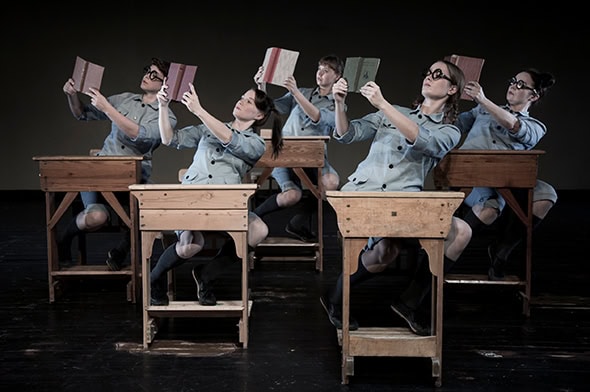
With five ‘students’ and one whistle-happy ‘leader’ we see 60 minutes of tightly choreographed, softly punctuated and highly repetitive wheely-desk manipulation with students jostling for prime position right under the nose of their glorious leader. The duration of the scenes is always almost too long, but Honkakoski pulls it back before we lose interest and in some ways it has a predictability these structures like the army, enforced education, and cults often manifest: the erasure of the self, physical automation and the absence of constructive thinking. They just do. However, the final 10 minutes deliver two scenes that lift The Desk to another level. There is a well-worn trope of the puppet/master/invisible strings that has been done to death; however in this context it works conceptually. The detail, weight and anatomical cause and effect of the pulling activated parts of the body in each of the five dancers is delivered with such finesse and believability this section alone is a fringe highlight. It is followed by an absolute skewering of a lot of the former (and current) communist statues that are built in victorious poses, questing forward into battle or displaying benevolence to the poor; echoing the pulling down of statues by the people, we see the leader in rigor mortis slowly decaying, ready to timber, be caught and repositioned by the students. The Desk is like an absurd, fascist epilogue to The Prime of Miss Jean Brodie with an immaculate execution.
111 by Joel Brown and Eve Mutso — part of the Made in Scotland showcase at Emerald Theatre (Greenside at Nicolson Square) — is named after the number of vertebrae Brown (Candoco Dance Company) and Mutso (former Principal at Scottish Ballet) share ‘as his spine has fused, meaning he has only 11, and she moves like she has a 100.’ As our genial host Brown welcomes us, he offers some context about how the two met in 2015 on a project initiated by Karen Andersen of Indepen-dance and choreographed by Marc Brew (who gets a name check for his witticism of “getting his strap on” as he secures himself in his wheelchair).
Brown and Mutso have developed an unsettling intimacy; during their floor sections and on the exoskeleton cube of ballet scaffold barres (which creates a miniature Krypton Factor), we see them meet, mirror, linger, brush, carry and display their physical prowess on stage but are left after 55 minutes without a defined relationship. There’s a lack of coherence to the work or of a sole choreographic voice with something to say; this may have something to do with the number of ‘outside eyes’ in the creation of the work — Tim Nunn, David Street, Risto Oja and Susan Hay. The work feels less like a piece of theatre than a display of what Brown and Mutso can do (they are both excellent dancers) alone and together on a stage, but this isn’t enough. Having worked with the aerial coach Mark Gibson, the 20 or so minutes they are engaged in hanging, climbing, and conquering heights with the cube, there seems to be the potential for an interesting outdoor work, where technical virtuosity and feats of strength are familiar and welcome. 111 feels like it wants to get out.
Back for its sixth year, the Taiwan Season features the return of Chang Dance Theatre with the first iteration of their new work Bout at the Old Lab (Summerhall) and an Edinburgh debut, Monster, by Dua Shin Te Production at Dance Base.
Bout claims to be ‘inspired by observations of live boxing shows on TV, investigating how spatial configuration and role setting evolve nuanced conversations between moving bodies.’ This sounds way more academic than is necessary; the reality is it’s much closer to a sometimes playful, sometimes sombre physical portrait of the brothers Chang and how their relation, friendship and conflictships manifest in distances between them over the years. There are some inventive moments of how their bodies come together and echo each other; an opening scene sees one body pacing the edge of the stage and is eventually joined in step and in time (with little more than a bead of sweat between them) by a second and a third and we’re now watching a multi/single being with six arms and six legs with perfect gait and rhythm. Another scene is where one brother is the other’s 3D shadow; as one strolls across the stage inhabiting verticality, the other is at home in his horizontality glide-sliding and mirroring him detail by detail. However, choreographer Chien-Hao Chang burns through scenes and ideas at a rate of knots meaning that not every scene is successful and the ones that are are quickly discarded and not extended to their dénouement. At 40 minutes Bout hasn’t quite settled into its final shape and would benefit from some judicious editing; it needs to not leave the audience feeling like we’re fighting to like them as we know they have buckets of charm after the success of Bon 4 Bon.
Monster is an Entirely. Different. Kettle. Of. Fish. Choreographed, and performed by Yen-Cheng Liu (who also created the sound design), the programme note states, ‘Everyone alone carries a different monster in his/her own mind, a monster gradually bred, grown and shaped by various influences in life. If the master of one’s mind is the soul that dwells in the body, it must be a complicated compound, expandable, shrinkable and distortable at different stages of life. A distinct monster.’
Reminiscent of Antony Gormley’s 2007 work Blind Light at the Hayward Gallery (aka Fog in a Box), the audience enters a white-out. We see no monster. We have a 3-metre visibility range as the studio is suffocated with dry ice; as our eyes begin to settle on the scenographic detail — somewhat like The Generation Game — we’re presented with a white, stationary masked figure holding an elongated and home-made version of a boom mic. Along with Liu, a number of noiseless technicians move a rotary telephone, a spherical object wrapped in white paper, a small white wireless, a white 3m x 0.5m LED scrolling screen, two white prison-like loudhailer speakers on extendable stands and a pair of floodlights into a line from stage left to stage right. Enter dry ice smoke blast part 2. As the LED screen delivers philosophical platitudes on time, self and chasing unknown futures, some of the things are moved, delicious silhouettes are created, Liu gets nude and crawls off stage in an act of self-loathing. Slowly the things are moved, re-presented, dismantled and taken down.
It is the perfect fringe companion to Ultimate Dancer’s For Now We Through The Mirror, Darkly as it offers us a mirror to what we are and what preconceptions we bring to the studio. In effect, Liu has created an alternative, 35-minute performance art version of Frankenstein that places us with him in this simple/complex/indulgent/terrifying/laughable space.
Shaun Parker & Company, Little Big Man, Ramallah Contemporary Dance Festival, April 5
Shaun Parker & Company with Ivo Dimchev in Little Big Man (photo: Prudence Upton)
What you see first in Shaun Parker’s Little Big Man at the Municipality Theatre in Ramallah City Hall is a fresh-faced, platinum blonde boy in baggy shorts and a maroon velvet jacket buttoned across his bare chest sitting casually with his legs dangling over the edge of the stage playing a small keyboard while humming and singing in a rich falsetto voice. The singer is in full control of his material and can improvise his words to include an invitation to latecomers to fill in the front rows; this is the inimitable singer/songwriter Ivo Dimchev. Finishing the song, he begins a new rhythmic introduction that the audience immediately accompanies with a hand beat. Dimchev stops, looks at the audience with a mixture of sternness and cheek and pulls one hand across his throat. The audience laughs and Dimchev resumes in silence. From that moment on he holds the entire audience within his grasp and the audience willingly accedes.
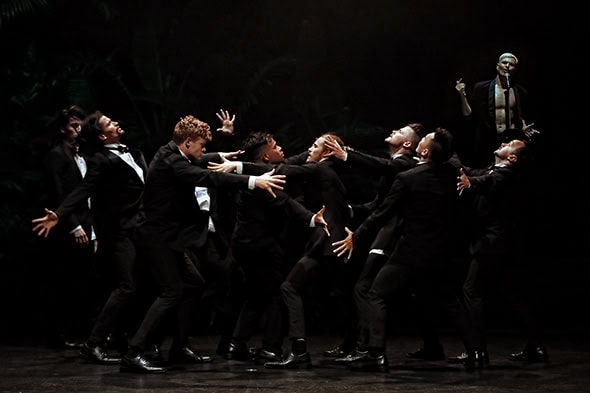
Parker, the artistic director and choreographer of Shaun Parker & Company, changed the name of his work from King to Little Big Man for the company’s tour of the Middle East where it was felt judicious to avoid any disrespect or misunderstanding in the Kingdom of Jordan. Little Big Man (as it shall be known here) references the Y chromosome that is present only in the male of the species and determines the sex of offspring. The all-male cast — Josh Mu, Toby Derrick, Libby Montilla, Imanuel Dabo, Joel Fenton, Samuel Beazley, Harrison Hall, Robert Tinning, Damian Meredith and Alex Warren — finds itself inexorably trapped inside its masculinity as if Parker has put his men on a glass plate under a microscope and is allowing us to watch the biological process unfold. Crystalline choreographic patterns and intricate timing suggest the workings of sentient organisms but the presence of ten men in dinner jackets performing under an ornate chandelier against Penny Hunstead’s lush backdrop of potted palm trees transports the organic to the social and, with the emergence of male aggression, from the social to the political; Little Big Man is a gently satirical but resolute reminder of the inherent violence in masculinity and by extension in our current system of patriarchy.
Parker is not the first choreographer to dissect male aggression, but in collaborating with Dimchev as composer and performer he presents an alternative running dialogue to masculinity that undermines it with the sensuality and beauty of androgyny. Dimchev is the catalyst for change; although he is on stage throughout the performance and remains aloof from the macho machinations around him, his presence weaves a spell on the ten men that by the end reduces them — and the audience — to emotional putty. Dimchev’s alchemy aside, Parker is careful not to caricature maleness too narrowly; the cast is sophisticated, charming, debonair and athletically accomplished, qualities we can easily admire. They lift, ride and leapfrog each other with childlike innocence, can scrum down with gentlemanly vigour and they explore homoerotic relations with candour. Parker strips them down to reveal their naked traits, and in the case of Derrick, his naked form as a focus of quintessential gender (for this tour full nudity has been scaled back to partial nudity). It is at this point that a spark of jealousy turns survival of the fittest into a self-fulfilling contest in which the biggest of the group picks on the smallest and smothers him. Violence erupts in the bonded cocks with head-butting and aggressive combat, all meticulously crafted, while Dimchev accompanies their antics with a beatific smile and lines like, ‘We’re living together’ and ‘Why do I love you?’ After a brief interlude in which the men disappear through the undergrowth where we can see them playing ritually, they return with more composure, collaboration and cooperation in an intricate choreographic layering of strength and softness until re-emerging traits of sadistic boot-camp behaviour result in a revolt, leaving two bodies on the stage. As the remaining men retreat around the ‘guardian angel’ of Dimchev, the victim gets up and lays his head on the body of his assailant: aggression turns to vulnerability in a monument to ambiguity.
Like any work of integrity, Little Big Man raises as many questions as it answers; it has taken Parker five years, working with sporadic grants, to achieve this level of integration between genetic and psychological material and a dance theatre form that alternately thrills and soothes; it indicates a rare form of inspired collaboration.
Claire Cunningham, Thank You Very Much, Ukrainian Cultural Centre, July 20
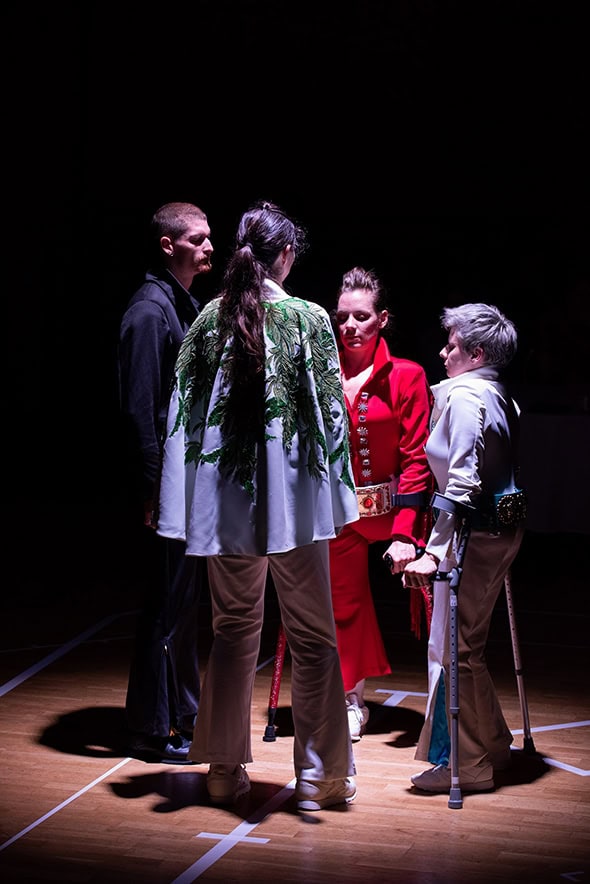
Dan Daw, Vicky Malin, Tanja Erhart and Claire Cunningham in Thank You Very Much (photo: Hugo Glendinning)
“The image is one thing and the human being is another. It’s very hard to live up to an image.” – Elvis Presley
The Ukrainian Cultural Centre, tucked away in the residential side streets of Cheetham Hill and a tram ride from the slick glossy centre of Manchester International Festival, is the venue for a new work from Claire Cunningham, Thank You Very Much, commissioned by MIF; the social club cum bar cum community centre is the perfect location to explore impersonation, identity and acceptance through the lens of Elvis tribute artists.
The idea of using a tribute artist as a vehicle to pose questions on the authenticity of self already has a delightful irony, but to extend the idea to embrace questions on disabled and non-disabled bodies in a society that requires an almost mythic quest for the perfect normative body is a touch of genius. The four-performer ensemble (Daniel Daw, Tanja Erhart, Vicky Malin and Claire Cunningham) pull back their personal curtains on the glittering world of the professional tribute artist; they share intimate solo moments and delightful interactions with the audience alongside the experiences and authentic movement tips from the tribute acts like Black Elvis and Elvis Desley they spent time with during the creation process.
Presley made the jump from local Mississippi heart-throb to national icon after his TV appearance on The Milton Berle Show on June 5, 1956; the intense pelvis shaking and broken choreographic lines alongside his appropriation of gospel/rhythm-and-blues/country sounds beamed a new and exotic culture into small screen America. Just as Elvis danced passionately with his microphone stand bent towards him, Cunningham introduces the evening in a gentle Glaswegian burr with an exquisite triped solo of weighted microphone stand and crutches; delicate balances mixed with 45-degree crutch leans while she serenades us with a flawless Elvis opener.
Thank You Very Much is a love letter to those that exist on the edges. Cunningham is using the considerable privilege of an MIF frame to show what is possible when you invest in disabled artists by bringing to the fore an exquisite team. Dan ‘Hounddog’ Daw belongs on the catwalk, from blending the heel-to-toe walking assessments for motor control to strutting the stage wearing little more than a gold spangled jacket and tight boxers. Tanja ‘Wooden’ Erhart is totally compelling, drawing our eyes through the quality of movement and charismatic presence. Shanti Creed (costume designer) is a rhinestone monster and had an absolute ball with the jump suits, capes and belts, but it was the attention to detail in Erhart’s red diamante crutches and deep red satin kneepads that was most satisfying, even if they only made a couple of appearances.
BSL interpreter Amy Cheskin was also on stage with all four performers; she is an electric stage presence in her own right adding value for those who are BSL users and those who aren’t. As an interpreter she has an incredible transparency in how quickly she is able to communicate; there’s no latency in the signs. Whether we’re hearing from Black Elvis on voiceover or Hounddog Daw conducting a live/fake interview on stage with an unsuspecting audience member she quietly appears next to the performer and delivers an embodied BSL that matches the emotive tone and delivery of the performers; we even learn the sign for Elvis which looks like you’re pulling a quiff with your right hand. There are enough nods to and affection for the King, tribute artists and the Porthcawl Elvis Festival that ensures the work isn’t taking from or using the culture for cheap laughs; there is care in buckets on how the performers are with each other and how they interact with the audience. Cunningham is an artist with a rich enough vein of works (Guide Gods, Give Me A Reason to Live and The Way You Look (At Me) Tonight) that could spawn their own tribute artists; I would love to see “Care Clunningham” mining the best bits of these existing works into a new evening.
“To be yourself in a world that is constantly trying to make you something else is the greatest accomplishment.” – Ralph Waldo Emerson
Elixir Extracts Festival, Lilian Baylis Theatre, June 14-16
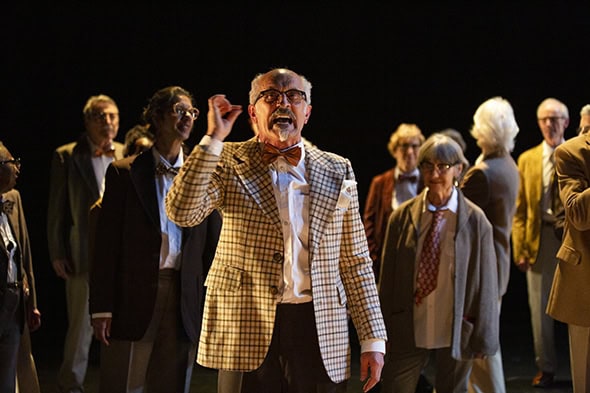
Company of Elders in Alesandra Seutin’s Dare I Speak (photo: Ellie Kurttz)
Billed five years ago as a lifelong celebration of creativity, Elixir Festival focused on mature dancers, both professional and amateur, to counter the notion of ageism in a predominantly youthful dance culture. The format consisted of a mainstage mixed bill with professional and ex-professional dancers like Mats Ek, Ana Laguna, Dominic Mercy, as well as members of the original London Contemporary Dance Company, while the smaller Lilian Baylis theatre hosted two days of performances by amateur groups. The mix was inspiring if uneven — professionals who have danced for over 40 years at the summit of their field have a mastery of dance language that amateurs, however dedicated, rarely can. Two years later the next incarnation of Elixir followed the original format but the balance had changed; the mainstage show failed to duplicate the excellence of the first iteration while some of the ‘extracts’ next door were markedly more interesting choreographically and expressively. Despite Sadler’s Wells being a signatory to a European co-operation project that addresses ageism in dance (Dance On, Pass On, Dream On, or DOPODO), this year’s Elixir Extracts Festival — even the name suggests something is missing — retreats so far from its original idea that the distinction between professional and amateur has disappeared altogether and ageism in the dance profession has dropped off the radar; Elixir has become a yellow pages of over-sixties community dance in the UK.
The quality of works on the program tends to suffer not so much from any low ability among the dancers but of choreography that fails to challenge their age. The one exception on Saturday was Dance Six-O’s performance of Liz Agiss’s Head In My Bag which, in Agiss’s inimitable language, ‘dumps age centre stage and kicks preconceptions into the long grass.’ Because Agiss is herself a performer of a certain age (though she has not been invited to previous Elixir festivals) she knows how to lift performance to a level that goes well beyond the demonstration of community and health benefits; she has an artistic vision that has no truck with the limitations of age. Her performers, with handbags on their heads, become a radical army of spirited individuals calling for the overturn of institutional myopia.
Sunday’s program kicks back with a little more force, particularly from the Merseyside Dance Initiative’s Men! Dancing! performing Shoulder to Shoulder choreographed by MDI’s Jennifer Hale, and the PC*DC’s infectious finale, Your Invisible Balls Please. In the former, six men distil tension, aggression and resistance into a convincing choreographic form of mutual support, while the latter is a riotous refusal to go quietly led by the irrepressible Donald Hutera. It’s an apt message on which to close Elixir Extracts: in opting for the social value of older amateur dance over the artistic significance of mature dance, Sadler’s Wells is not so much challenging ageism in dance as avoiding the issue altogether.
In contrast to the two programs of extracts that are limited to around ten minutes each, Sadler’s Wells’ own flagship elderly amateur group, Company of Elders, celebrates 30 years of activity with a full-length evening of dance. With ages ranging from 60 to 90, the company can hardly be accused of ageism, but while its longevity supports the argument for older amateur dance, the range of its members’ abilities requires an approach to choreography that resolves the inherent limitations of its repertoire.
Alesandra Seutin’s Dare I Speak bypasses this opportunity by proposing the final speech and subsequent disappearance of the Congo’s first prime minister, Patrice Lumumba, as subject. In wrapping the company in a narrative that is beyond the embodied experience of its performers, Seutin turns gestures of menace and violence into expressions of half-hearted complicity. The context of African dances emphasizes the ability of Monica Tuck but while this is a benefit for the audience it does little to carry the momentous events Seutin proposes; it’s a fine subject on the wrong company.
Clara Andermatt’s Natural 2019 approaches the company from within. It’s a reconstruction of a work Andermatt created on Company of Elders in 2005; fourteen years later seven members are still involved. It is ‘natural’ in the way it presents each person and transforms their experiences into dance theatre but while its confessional nature suits the company, the disparate abilities of its members limit the development of its choreographic form. If the artistic potential of the company is to develop in line with its flagship, repertoire status, ageism may prove to have a time limit.