Resolution 2026 : Westpfel Co., Ming Chin Hsieh, Wild Guess at The Place, January 14
Resolution is a festival of new choreography and on Wednesday it proved the perfect antidote to a damp evening in London. Behind the well-stocked bar at The Place is a warm, crowded theatre space where young choreographers can take risks in front of an audience that expects them. It’s a place where anything can happen, and this evening anything did.
Yo-Yo Ma once answered the question, ‘What is music to you?’ He replied very simply, ‘Music is energy; we are energy. Music is part of us.’ Watching Resolution on Wednesday leaves no doubt that dance, too, is palpable energy, but the three performances played with energy and passed on that energy to the audience in three very different ways.
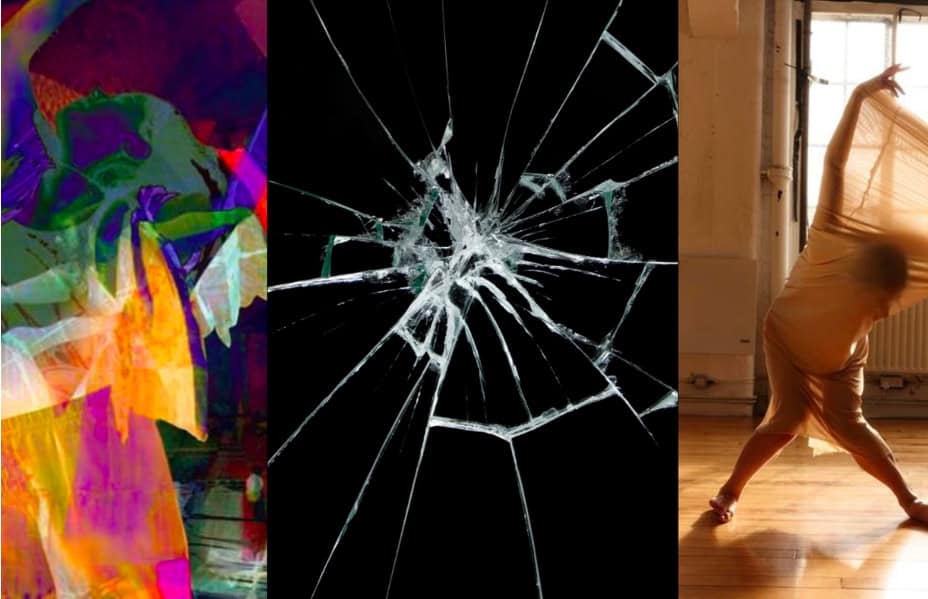
Megan Westpfel’s Fracture immediately assails our bodies with a rush of raw energy wrapped in stylish costumes under rock concert lighting by David Street and fed by Jack Manley’s immersive, pulsing electronic score. In just 3 days of rehearsal, Westpfel drilled her six dancers — Sammy Consamti, Eden Law Gleen, Hannah Arbury, Deavion Brown, Emma Houston and Chris Vasileiadi — with an eye to detail that is so polished they shine with almost mechanical precision. That may be part of the scenario; the drilled precision and evening dress with ghoulish masks makes way for a more laid-back, laid bare aesthetic that underlies what Westpfel describes as a process that ‘delves into the process of embodying who you truly are before the world told you who to be.’ Fracture is a protest that is choreographically more convincing in its angry preamble than it is in its resolution but there is a cohesion to the work and a blast in its production values that belies its fast-track birth. The intense energy it produced was returned in full in the audience reaction.
The Resolution format of clearing the auditorium in between each work serves here as a necessary breathing space between Fracture and Ming Chin Hsieh’s Born, Never Asked. Hsieh’s solo has a soft yet powerful internal energy that is beguiling in its conception and performance, choreographed as a ‘tender exploration of what love requires, seen through the fragile bond between mother and daughter.’ Hsieh is already sitting on stage as we return to our seats, wearing a white mask and gathering up five identical masks in front of her inside one other, her expressive body shuddering and relaxing in turn as she appears to be communicating with a departed spirit. This is the choreographic premise that informs Born, Never Asked, from a mimed birth to a final veiled negotiation with her past that, as the title suggests, is never fully resolved. As well as the masks, Hsieh uses materials — her stretch fabric dress and a tulle veil — to suggest and diffuse her states of mind that range from affection to pain, from light to darkness. She combines a fluid dance style with a high degree of mime artistry that communicates a temporal and spatial distance between herself and her mother while keeping our imagination flowing with hers.
Returning from another intermission, the setup for Attention Economy by the performance collective Wild Guess gives the impression of an aleatory event with three performers and a sampling machine. Formally, it’s a ‘collaboration between poet and playwright Harry Walker, movement artist Margot Conde Arenas, and sound artist Robbie Hall’ but essentially what Wild Guess is proposing is ‘a cerebral collision of seemingly dissonant forms and ideas, a fitting representation of a liquid modernity.’ Hall lays down a track and manipulates it. He holds up a board on which is written ‘COLLAPSE’. Walker reads a poem from his notebook as he walks around the stage in his hooded anorak, but his words are inaudible. Arenas shines a flashlight on herself as she follows Walker round the stage while Hall holds up the second board, ‘CHANGE RELATIONS’. There are more boards, more messages punctuating Arenas’ somatic landscape and Walker’s intermittently audible lines of poetry that seem designed to avoid their mark. I pick out ‘thought without rhyme or reason’ and wonder if that is an appropriate epitaph for ‘liquid modernity’. Attention Economy is a brave new work, but the cerebral collision turns into a bit of a damp squib; by the time the trio of disparate characters finishes propped against each other in a gesture of yogic improbability even the energy in the theatre has seeped away.
Ian Abbott at the 2019 Edinburgh Festival Fringe, Part 1
Reetta Honkakoski’s The Desk (photo: Noomi Ljungdell)
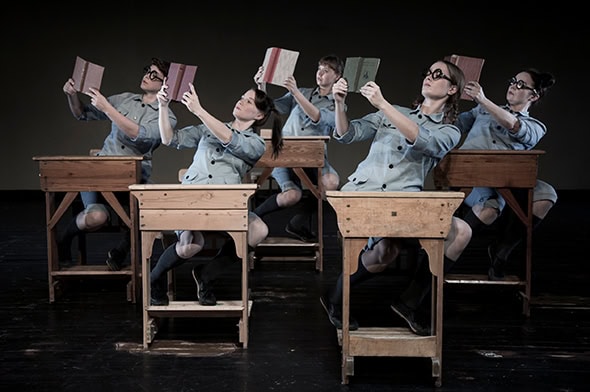
Snipping at the fringes of the Fringe this year have been some discussions about price, privilege and the voices that are not present. On one side are those who directly benefit from Edinburgh Fringe espousing the historical foundation and ideology on which it was built; they treat it like a cult, swearing unswerving devotion to it and proudly wearing their badge of service reflecting the years they have put into their community. On the other side are those who see the reality of the Fringe as a paid marketplace, a neoliberal capitalist playground that has long since lost the values on which it was founded. One of the works on From Start To Finnish, the showcase of work from Finland at the Old Lab (Summerhall), speaks to some of these macro discussions. It is Reetta Honkakoski’s The Desk that ‘mines her personal lived experience of a cult in this meticulous ensemble piece about the seductive power of discipline, hierarchy and mind control.’
With five ‘students’ and one whistle-happy ‘leader’ we see 60 minutes of tightly choreographed, softly punctuated and highly repetitive wheely-desk manipulation with students jostling for prime position right under the nose of their glorious leader. The duration of the scenes is always almost too long, but Honkakoski pulls it back before we lose interest and in some ways it has a predictability these structures like the army, enforced education, and cults often manifest: the erasure of the self, physical automation and the absence of constructive thinking. They just do. However, the final 10 minutes deliver two scenes that lift The Desk to another level. There is a well-worn trope of the puppet/master/invisible strings that has been done to death; however in this context it works conceptually. The detail, weight and anatomical cause and effect of the pulling activated parts of the body in each of the five dancers is delivered with such finesse and believability this section alone is a fringe highlight. It is followed by an absolute skewering of a lot of the former (and current) communist statues that are built in victorious poses, questing forward into battle or displaying benevolence to the poor; echoing the pulling down of statues by the people, we see the leader in rigor mortis slowly decaying, ready to timber, be caught and repositioned by the students. The Desk is like an absurd, fascist epilogue to The Prime of Miss Jean Brodie with an immaculate execution.
111 by Joel Brown and Eve Mutso — part of the Made in Scotland showcase at Emerald Theatre (Greenside at Nicolson Square) — is named after the number of vertebrae Brown (Candoco Dance Company) and Mutso (former Principal at Scottish Ballet) share ‘as his spine has fused, meaning he has only 11, and she moves like she has a 100.’ As our genial host Brown welcomes us, he offers some context about how the two met in 2015 on a project initiated by Karen Andersen of Indepen-dance and choreographed by Marc Brew (who gets a name check for his witticism of “getting his strap on” as he secures himself in his wheelchair).
Brown and Mutso have developed an unsettling intimacy; during their floor sections and on the exoskeleton cube of ballet scaffold barres (which creates a miniature Krypton Factor), we see them meet, mirror, linger, brush, carry and display their physical prowess on stage but are left after 55 minutes without a defined relationship. There’s a lack of coherence to the work or of a sole choreographic voice with something to say; this may have something to do with the number of ‘outside eyes’ in the creation of the work — Tim Nunn, David Street, Risto Oja and Susan Hay. The work feels less like a piece of theatre than a display of what Brown and Mutso can do (they are both excellent dancers) alone and together on a stage, but this isn’t enough. Having worked with the aerial coach Mark Gibson, the 20 or so minutes they are engaged in hanging, climbing, and conquering heights with the cube, there seems to be the potential for an interesting outdoor work, where technical virtuosity and feats of strength are familiar and welcome. 111 feels like it wants to get out.
Back for its sixth year, the Taiwan Season features the return of Chang Dance Theatre with the first iteration of their new work Bout at the Old Lab (Summerhall) and an Edinburgh debut, Monster, by Dua Shin Te Production at Dance Base.
Bout claims to be ‘inspired by observations of live boxing shows on TV, investigating how spatial configuration and role setting evolve nuanced conversations between moving bodies.’ This sounds way more academic than is necessary; the reality is it’s much closer to a sometimes playful, sometimes sombre physical portrait of the brothers Chang and how their relation, friendship and conflictships manifest in distances between them over the years. There are some inventive moments of how their bodies come together and echo each other; an opening scene sees one body pacing the edge of the stage and is eventually joined in step and in time (with little more than a bead of sweat between them) by a second and a third and we’re now watching a multi/single being with six arms and six legs with perfect gait and rhythm. Another scene is where one brother is the other’s 3D shadow; as one strolls across the stage inhabiting verticality, the other is at home in his horizontality glide-sliding and mirroring him detail by detail. However, choreographer Chien-Hao Chang burns through scenes and ideas at a rate of knots meaning that not every scene is successful and the ones that are are quickly discarded and not extended to their dénouement. At 40 minutes Bout hasn’t quite settled into its final shape and would benefit from some judicious editing; it needs to not leave the audience feeling like we’re fighting to like them as we know they have buckets of charm after the success of Bon 4 Bon.
Monster is an Entirely. Different. Kettle. Of. Fish. Choreographed, and performed by Yen-Cheng Liu (who also created the sound design), the programme note states, ‘Everyone alone carries a different monster in his/her own mind, a monster gradually bred, grown and shaped by various influences in life. If the master of one’s mind is the soul that dwells in the body, it must be a complicated compound, expandable, shrinkable and distortable at different stages of life. A distinct monster.’
Reminiscent of Antony Gormley’s 2007 work Blind Light at the Hayward Gallery (aka Fog in a Box), the audience enters a white-out. We see no monster. We have a 3-metre visibility range as the studio is suffocated with dry ice; as our eyes begin to settle on the scenographic detail — somewhat like The Generation Game — we’re presented with a white, stationary masked figure holding an elongated and home-made version of a boom mic. Along with Liu, a number of noiseless technicians move a rotary telephone, a spherical object wrapped in white paper, a small white wireless, a white 3m x 0.5m LED scrolling screen, two white prison-like loudhailer speakers on extendable stands and a pair of floodlights into a line from stage left to stage right. Enter dry ice smoke blast part 2. As the LED screen delivers philosophical platitudes on time, self and chasing unknown futures, some of the things are moved, delicious silhouettes are created, Liu gets nude and crawls off stage in an act of self-loathing. Slowly the things are moved, re-presented, dismantled and taken down.
It is the perfect fringe companion to Ultimate Dancer’s For Now We Through The Mirror, Darkly as it offers us a mirror to what we are and what preconceptions we bring to the studio. In effect, Liu has created an alternative, 35-minute performance art version of Frankenstein that places us with him in this simple/complex/indulgent/terrifying/laughable space.