Here lies a reflection of some moments, performances and work that have settled in my 2019 memory bank. It was a year when we had the UK Dance Showcase — which I will come back to later — and when so many artists created work in response to institutional power and epistemic violence.
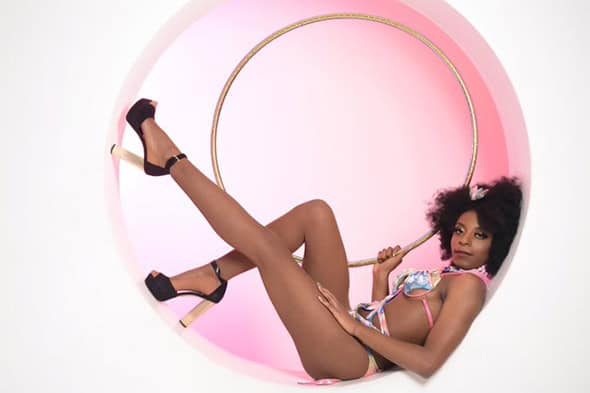
Wendy Houstoun’s Hell Hath No Fury at Wainsgate Chapel, Hebden Bridge (part of Wainsgate Dances in June) took us to her Sunday school pulpit of philosophy and rage whilst delivering us from evil in a ferociously hilarious 45 minutes of wordplay and image making. Aided by the servitude and deferential bell ringing of Charlie Morrissey, Houstoun was our High Priestess, our sermon giver offering hope, hula hoop skipping, and water to those in need; as she commanded the audience to sit, stand and listen in our pews to ripostes against the 2019 political landscape she was swift and rapier-like. With Hell Hath No Fury Houstoun has demonstrated (and built upon from her previous works 50 Acts and A Pact With Pointlessness) her gift for rhythm, distillation and an ability to hold attention; she captures a mood of how some people are feeling and lampoons it. Wainsgate Chapel as a site of performance and Houstoun as prophet is an immaculate combination; in the age of fracturing communities and the slow death of theatre buildings I imagine a world where Hell Hath No Fury is a 2020 version of a mystery play travelling to chapels, churches and cathedrals across the country, a liturgical drama serving to shame our morally unanchored institutions of power.
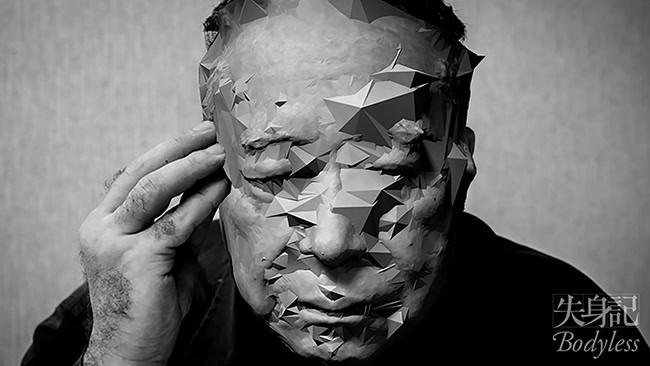
Bodyless, directed by Hsin-Chien Huang, is a single-person 31-minute VR experience I saw at the Phi Centre in Montreal (part of an exhibition of VR work from Laurie Anderson, Marina Abramovic, Paul McCarthy and Olafur Eliasson) in November. Bodyless is based on Huang’s memory and set during Taiwan’s martial law and colonial period of the 1970s. The repression and control of people through old (and new) technologies blended with pervasive digital surveillance to ensure this has a relevance now; what Bodyless achieves that no other VR art work I’ve encountered so far has done, is the technological holy trinity of embodied encounter, emotional narrative investment and graphical fidelity. As we move round a dark and oppressive system, we encounter multiple timeless episodes/scenes where we find bodies in differing states of control; polygon-twitching bodies in cells with rewilding plants growing through the bars, faded newspaper portraits of people who have been deliberately missing-ed or dozens of limp and floating bodies in a hospital or boarding school with limbs defying gravity. The intimacy of VR as a single-person experience heightens emotions as you glide, ooze, sink or float through landscapes; the fact that you have a level of agency, an ability to move, look at and focus where you want embodies this act of witnessing bodyless-ness in action. We see how people are erased from a society, and the emotional distancing that VR and screen-based work usually causes is dissolved by Hsin-Chien Huang in this fantastical response to the memory of trauma.
From the macro power portraits of Hell Hath No Fury and Bodyless to a micro power portrait of Black male mental health, Elephant In The Room by Lanre Malaolu at Camden People’s Theatre in April is proof that Malaolu (supported by dramaturg Season Butler) has created a work of total theatre. We meet man, a multi-charactered everyman in control of his external body, but this control does not extend to his internal mind. Malaolu has a Hip Hop dance technique and execution that sparkles in its clarity; his physicality is accompanied by a command of language and a dexterity in verbal delivery that would cast long shadows at the RSC. He is wav(er)ing and popping; the use of these Hip Hop dance vocabularies is a fine foil for the wider debate around mental health: scrambled muscles that erupt and contract, dispersing clotted brain fog and bringing forth windows of clarity only to close again. Stability and control are bywords for mental health, and if you’re experiencing low level depression GPs recommend activities and inhabiting the types of spaces that Malaolu offers up in multiple scenes: football (exercise), Nando’s (food), barbers (community) and gym (self-worth). From a frozen barber, moving only his eyes and wrist with an imaginary shaver to a magnetic slapping of limbs and his back onto and into the floor and wall to an almost motionless slouch in a chair talking about too chewy chicken…Malaolu has the smarts and this work could and should have an international life like Inua Ellams’ The Barbershop Chronicles. What Malaolu achieves is a transference of a heavy feeling and an internal spiralling which are sometimes impossible to give shape to; the 70-minute work whistles by and it is the monstrosity of his attack, physical commitment (which bordered on the painful), multiplicity of voices and choice of stillnesses and excesses of movement that made this a highly satisfying evening that has the ability to stimulate further discussions in this terrain.
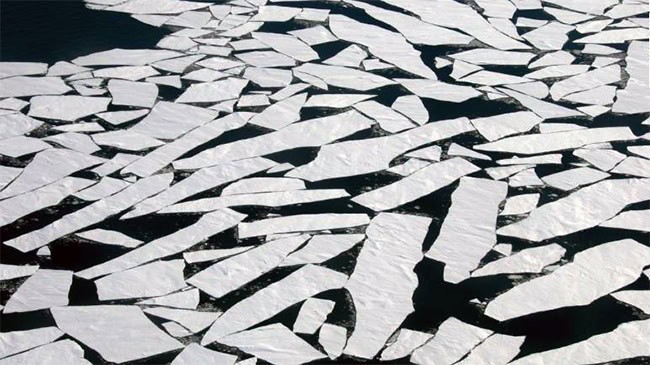
Cardiff Dance Festival hosted Montreal-based Daina Ashbee in residence during the festival in November and over the course of her stay in Wales Ashbee spent some time researching a new work, J’ai pleuré avec les chiens, which will be ready in 2020 as well as remounting and recasting her 2016 work When the ice melts, will we drink the water? We saw around 50 minutes of When the ice melts…performed by Lorena Ceraso in Chapter Arts Centre Studio. With Ceraso on the floor, back flatted and knees triangled, we understand early that her pelvis lies at the root of the work and at the centre of this bodily discourse on survival and endurance. Time is experienced slowly and there is a sparse choreographic landscape but one that is littered with violence, perceptions of the female body and sexuality. Slow quarter-turn rotations at 3, 6, 9 and 12 o’clock see Ceraso address all sides of the audience with her ascended and descended pelvis, flickering edges and glacial eyes, but as she presents each suite of movements four times we witness multiple angles, new and unseen details that were previously hidden from view. When the ice melts…was named the best dance piece of the year at Montreal’s 2016 Prix de la danse awards and in the intervening years it has only gathered relevance with the attention drawn towards violence against women from the #MeToo movement; what it does is build an atmosphere that is so charged and so unpleasant that silence blankets the audience — we barely breathe as we pay attention to every sound and movement emitted from Ceraso’s body. The feelings of anxiety created by the work echo the pressure and internal questioning of should/will/how do we speak of violence against women when we are unsure of what it is we need to say or do in response to it.
Violence towards women was consistently visible in a lot of the works I saw by female choreographer’s in 2019; another example (and a rare one because it is made for outdoor settings) was the 30-minute Scalped by Initiative.DKF. Created by Damilola DK Fashola and Wofai, with movement direction and writing by Fashola, Scalped was part of the opening night of Greenwich+Docklands International Festival in Woolwich in June. ‘For black women one of the most common shared experiences is a passive but ever-present scrutiny. From what you wear to the way you walk, and most especially hair. Whether permed, braided, or in locs, black hair is political.’ Scalped is a work that demands your attention, holds it and then brings you in, which is credit to the company in the context of outdoor presentation when there are dozens of other distractions to compete for your eyes. Patience James, Audrey Lobe, Bubsy Spence, DK and Bimpe Pacheco climb, frame, pose and move around their scaffold set and wheeled boxes telling stories of discrimination, can-I-touch-your-hair violence and desire for freedom. The choreography is big, the performances are huge and the company is rightfully taking up space and presenting politically and narratively strong work in public spaces; Scalped is relentless in its power and energy and forces audiences to at least think about the discrimination consistently faced by Black women in British society. Representation and visibility is crucial and Scalped is one of the very few outdoor works made and performed by Black artists in the UK; Fashola has written and directed a new work Fragments of a Complicated Mind which runs at Theatre 503 in London from January 21 to February 1, and this interrogation of race, religion, sex and cultural expectations is sure to see her star shine even brighter.
Creative responses to institutional power do not always have to be heavy or filled with activist sensibilities; they can achieve just as much from a position that sparks joy, refreshes perspectives and brings people together socially. The Box of Delights by 2Faced Dance Company is a fine example of that (full disclosure: I work with 2Faced Dance Company as Executive Director and had a small performance role in the work). Running for seven nights from December 17-23 as part of their 20th Anniversary programme, what co-directors Tamsin Fitzgerald and Tim Evans have created with The Box of Delights is something that I’ve not seen before from a company in the UK; with the first act of 50 minutes taking place outdoors at night at over 20 locations and performance interventions throughout the historic centre of Hereford, they guided an audience of 80 towards The Green Dragon Hotel for a second act which contained a meat or vegan three-course meal prepared by executive chef Simon Bolsover and the continuation of the narrative taking place over 1hour 45 minutes. The seamless shift of the narrative and audience experience from outdoor to indoor, altering perceptions of place alongside the inclusion of food, is an innovative model for presenting work and place-making which suits audiences, performers and companies alike.
The aforementioned works are some of the great ones I saw across the year, but it wasn’t all as good as this. The first outing of Impermanence Dance Theatre’s dance adaptation of Bertolt Brecht’s Baal at Bristol Old Vic in April was both under and over baked at the same time; their portrayal of excess felt muted and duller in comparison to their previous successive portraits of excess in SEXBOX and Da-Da Darling. Rosie Kay Dance Company premiered the scaled-up version of 5 Soldiers…10 Soldiers (complete with 10 dancers) on the main stage at Birmingham Hippodrome in May which saw a dull 30-minute prequel tacked on to the previously successful 60-minute 5 Soldiers. The first half was meant to show the time getting in the army, but emotionally, physically and tonally it mirrored the second half leaving me questioning its purpose. The work clearly resonated with people who had a personal connection to, and involvement with, the army, but as a work at this scale, when the company hasn’t presented in this size auditorium, why would we expect it to be good immediately? Maybe after three or four shows when they understand that the intimacy, nuance and detail that made 5 Soldiers so good needs to shift considerably for grander and less subtle inferences. However, the work I had most trouble with this year was Confessions of a Cockney Temple Dancer by Shane Shambhu at Gloucester Guildhall, part of Strike A Light’s festival in March. In a year when there have been so many works of dance, performance and theatre exploring the effects of immigration/race/displacement/othering like Demi Nandra’s Life is No Laughing Matter, Akeim Toussaint Buck’s Windows of Displacement, Claire Cunningham’s Thank You Very Much or Rachael Young’s Out, Shambhu’s Confessions is a lite and frothy idiot’s guide to bharatanatyam made for White people. Peppered with anecdotes about his relationship to Indian dance and performing his arangetrum, it asks little of you and there’s little empathy, emotional investment or calls to action. Shambhu is a likeable mimic, scatting between citizenship issues and the physicalities of his family members, and while the work is well constructed it plays into the self-exoticisation that so many contemporary bharatanatyam creators attempt to repel. There are short bursts of 10-15 seconds of classical movement, which are not the cleanest and he is sometimes out of breath when coming out of a movement sequence straight into speech. There’s a nice reveal towards the end, an emotional hit that shows a duality: that this is part of him and that he wants to reject it but is unable to because it has partially formed him and how he is in the world.
…and back to the UK Dance Showcase, phase two of the Surf The Wave project conceived by Deryck Newland before he left PDSW in February 2017. The UK Dance Showcase was curated by 11 people and of those there were no women on the committee who weren’t white, there was nobody who worked in an organisation north of Salford, there were no people with a disability, no female artists and no producers. Surf The Wave is ‘the major project led by PDSW, on behalf of the National Dance Network (NDN)’ but it is telling how the other 26 members of NDN have been very public in distancing themselves from the project and choose/chose not to publicly or privately acknowledge the reality, successes or failures of Surf The Wave.
Artists and producers are always in the position of least power, least resources and least privilege in their relationships with institutions, and what has been heartening in 2019 is see how they have spoken up, back to, and in solidarity with others while forging new alliances en route. The relevance of the majority of cultural institutions and how they behave in society and with their community demonstrate at best a wilful ostriching ignorance of how society is shifting and at worst a consistent and harmful contribution that perpetuates outmoded thinking, broken systems and systemic bias.
With the total funds raised at more than £1million — on top of the other public subsidy added to the total from the time spent by salaried organisations across the UK — the narrative presented back to NDN and to other funders has been that some of the artists who attended the event have achieved some positive outcomes, built tours and new relationships. While this is brilliant for those artists who presented/pitched work that appealed to small-scale, non-dance specialist arts centres across England, the active choice not to invite international programmers rendered the entire narrative as a sweet set of Tory Leadership/Brexit analogies (taking back control of our borders/exports), and conservative leadership breadcrumbs (Jeremy Hunt’s I’m an Artist as Entrepreneur) that beggars belief. What has not been reported is the anger, frustration, bitterness and experiences of unprofessionalism in the way artists who were ‘selected’ were engaged in the lead-up to the event. Delaying the timeline of announcing selected artists (ensuring artists missed funding windows to apply for support to enable their presence at the event), offering fees to present the work, reneging on that offer and then offering a lower one to the same artists or selecting work that is not in a touring window and expecting artists to absorb the costs of remounting it, were some of the examples (there were many more) of how artists were treated. While it is acknowledged that those who programme work congratulated the PDSW team on a well-organised showcase event, the structural debris of damaged and fractured relationships has mirrored our political situation. Those holding power are ever more desperate to preserve old models and thinking, whilst those in receipt of the email vacuum of silence are left to wonder how to engage in the future.
I wrote a whole other piece (unpublished) about my experience at one of the Artist as Entrepreneur events but it follows a similar vein. Artists and producers are often encouraged by organisations and institutions of power to acknowledge their failures and mistakes in the creation and presentation of work — a growing focus and thematic consideration of a number of dance works including Epic Failure by Cultured Mongrel and The Unwanted by Shaper Caper. These and other works in development offer a personal, interesting and critical perspective on human fallibility, but until our organisations and institutions of power begin to acknowledge their own failure, or offer a public narrative about things which went well or not so well, then things will never change, and the power imbalance shall remain.
Dance Umbrella 2019: Out of the System – Mixed Bill at Bernie Grant Arts Centre, October 22
Jonzi-D in Aeroplane Man (photo: Chris Nash)
Out of the System is a guest-programmed section of Dance Umbrella; for the past three years it has been curated with characteristic flair by Freddie Opoku-Addaie who described it in 2017 as ‘the presence of diverse dance cultures within vocational and non-vocational structures outside the regular framework of dance presentation’. Two years later Out of the System has worked its way into the system with the Big Pink Vogue Ball at Shoreditch Town Hall and a mixed bill at, and presented in partnership with, Bernie Grant Arts Centre. With five artists over four works, the mixed bill consists of small-scale works with large-scale themes of identity and racial politics that Opoku-Addaie characterises in public transport terms (influenced by his commute on a No. 26 Routemaster bus between Waterloo Station and Hackney Wick) as telling ‘complex journeys that are routed in the shared struggle, continuous stop/start but dealt with a crafted overview of human fortitude.’
Theo TJ Lowe (THÉO INART) has worked with Hofesh Schechter and Akram Khan, among others, and this shows in his compelling presence on stage in his solo, Fragility in Man – Part 1. He makes his entrance through the doors of the theatre on to the stage that resembles a bare waiting room with three chairs; ill at ease, he takes a seat like a patient waiting to be examined or, more ominously, a suspect about to be interrogated. There is something simmering or explosive in his succession of halting gestures and periods of stillness that respond to human commands, the barking of dogs or the cocking of a gun. The trauma of past violence extends out from behind his eyes to land somewhere on a vertical plane between us, like a two-way mirror; he shines a light on the audience but sees only his own reflection. Even behind a superhero mask he cannot hide his vulnerability because he is turned inside out; when he exits through the same doors he entered, he leaves behind him the fragile landscape of his being.
Like Lowe, Becky Namgauds turns herself into an exhibit, Exhibit F, tracing figures back and forth across the stage with her swirling, naked torso and long hair like a brush gradually filling in the paper with lines and colour. She is not so much building up a figure — the space is not like paper and releases the image as soon as it has passed — so much as laying down her emotional ground in repetitive patterns. What is exhibited and what is not is the constant issue in Exhibit F in which costume, movement and Michael Mannion’s lighting are fluid factors. Namgaud’s work, according to the program, deals with ‘recurring themes of feminism, femicide and the environment.’ There is no object in Exhibit F; it is its own constantly transforming subject.
Breaking the solo format, Ffion Campbell-Davies enters at the start of Beyond Words, vocalising high on the shoulders of Tyrone Isaac-Stuart while he blows a cool saxophone below. Beyond Words questions the framework of a colonial approach to black dance through ‘a journey between two people communicating matters of the heart’. Beginning as a procession, it disintegrates to the sound of machinery into images of physical oppression and struggle that lead to questions of self-worth and respect. Campbell-Davies and Isaac-Stuart confront a broad canvas of history and social significance, from ancestry and tribal affinity to the idea of home, with a sense of residual frustration. At the end, perched once again on Isaac-Stuart’s shoulders, Campbell-Davies asks the audience, ‘Who are you standing on?’ It’s a question, ironically, that Opoku-Addaie’s curation over the last three years has set out to answer.
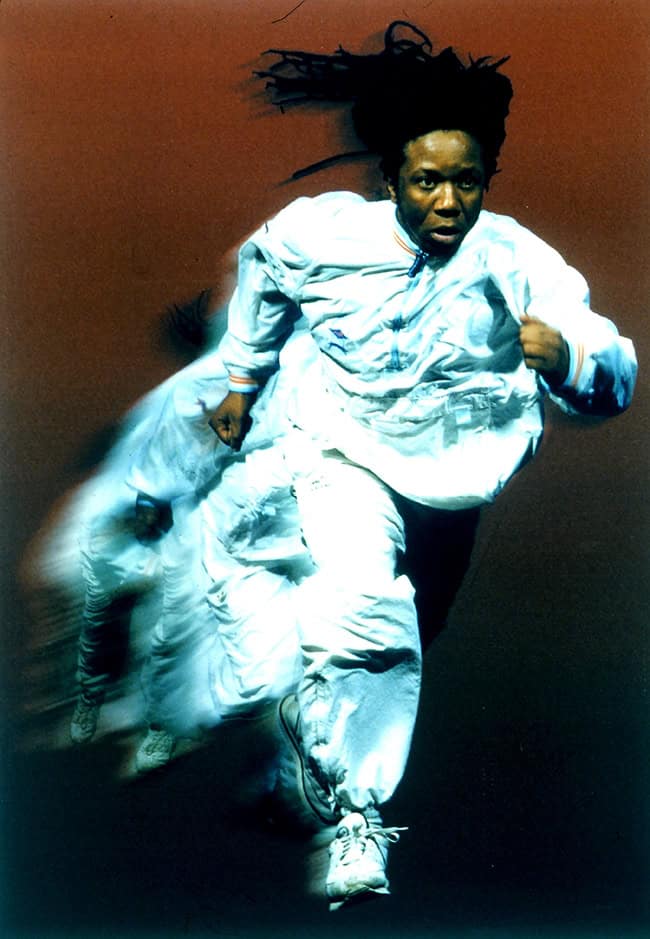
Jonzi-D’s Aeroplane Man, created in 1999 ‘but sadly still resonating today’, is founded on a similar frustration but ends in a more measured affirmation. His finely-honed parable of identity and cultural politics pulls no punches and makes its point in keen satire and brilliant mimicry. Born and bred in the East End of London, he is both pilot and passenger traveling in his Adidas trainers to search for his ‘own country’ at the unceremonious urging of one of his white colleagues. His air miles take him from Grenada (‘my mother’s land, not my motherland’), to Jamaica, the Bronx and Zululand, but wherever he lands he finds he is not quite genuine enough. With the running refrain of ‘Call up Mr. Aeroplane Man, Yeah Man, Yeah Man’, he returns to London to discover ‘this brown frame has found his name.’
Helen Cox, Bodies in Space, Bloomsbury Festival, Goodenough College, October 13
Natasha Arcoleo, Jordan Ajadi and Andrew Oliver in Bodies in Space (photo: Liz Gorman)
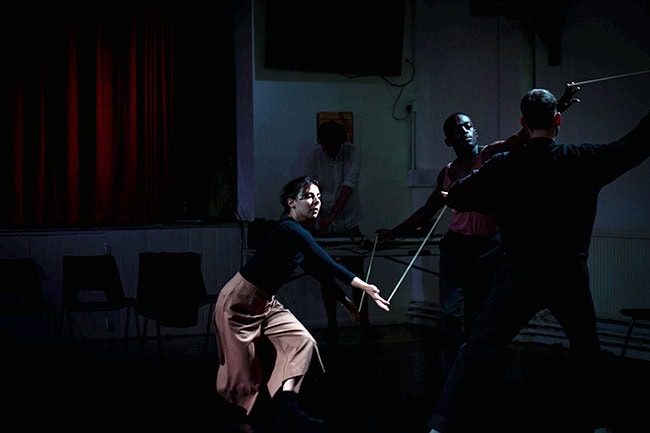
Dancers are often urged to ‘explore space’ in class, but choreographer Helen Cox has taken this encouragement far outside the walls of a studio in her new work, Bodies in Space, at the Bloomsbury Festival. Teaming up with composer Dougie Brown, she has choreographed a trio to the sounds of the stars. Actually, as Professor Fabio Iocco clarified in a post-show talk, we can’t hear the stars because there are no molecules in space through which sound can vibrate, but there are recordings of light emitted from stars far beyond our solar system captured by NASA’s Kepler space telescope. What Brown has done is to take two available sources of this data, mapped their topographical qualities and then processed the results with reverb and granular synthesis to produce what to the layman’s ears is the sound of the stars. It’s not quite as catchy as Pink Floyd’s Interstellar Overdrive, but all the more affecting for being close to the real thing. Adding movement to this sonic sense of mystery, three dancers — Natasha Arcoleo, Jordan Ajadi and Andrew Oliver — move with planetary suspension through a subtly darkened space in a hall of London House (part of Goodenough College in Bloomsbury), displaying in equal measure both a resistance to, and a celebration of gravity. Having seen Cox dance previously, this is the way she moves, but while Bodies in Space is the first time she has remained on the outside of a creation, the transposition clearly has not affected her choreographic intuition.
The audience is seated on four sides of the open floor, delineating the physical perimeter of the hall but not limiting the kind of spatial universe the dancers imagine as they ease slowly around and in between each other maintaining contact through slender wooden batons stretched between their index fingers with just enough pressure to keep them in place. It’s like linking stars with lines to make a classical astrological figure, but the stars are constantly moving; a dancer may drop a baton but the elastic geometry of the trio is simply suspended until the baton is retrieved and replaced.
It’s the first of a series of choreographic ideas Cox created during an intense two-week period in the studio, in which she plays with the central axis of body movement that arises from stillness and silence. Against Brown’s otherworldly soundscape there is a stealth in the dancers’ articulation, a feline quality that is a mark of muscular control and articulation. Exploring this further in a series of duets, trios and inter-related solos, Cox is clearly inspired by the subject and its intimate relationship to dance; her imagery weaves celestial figures with choreographic form. Arcoleo’s solo starts with swirling circular patterns within the body that expand out into the curvature of the trunk and limbs, while Ajadi seems to flow through the ether, measuring space with his hands in a fluid articulation that knows no boundaries. After a trio in which the dancers move in orbits around each other, Oliver’s solo conjures up the smooth working of an exploratory space arm extending from the fulcrum of his shoulder. They are all visual ideas that have a natural coherence, and in combination with Brown’s soundscape and the sombre lighting of the hall, Bodies in Space gives a corresponding impression of suspended time.
With such a short period of gestation — all too frequent in the socio-political context where space and time equal money — it is such a pleasure to see the distance travelled from Cox’s initial movement ideas in a studio to the outer reaches of the universe and back to this Bloomsbury Festival venue in the heart of London.
MuzArts Triple Bill of Edward Clug, Sidi Larbi Cherkaoui and Wayne McGregor, The London Coliseum, December 7
Edward Watson and Olga Smirnova in McGregor + Mugler (photo: Sasha Gusov)
The second London program from MuzArts is a triple bill comprising the choreographic work of Edward Clug, Sidi Larbi Cherkaoui and Wayne McGregor. In terms of dancers it’s a mix and match program with principals of the Bolshoi and Mariinsky working alongside first soloist Katja Khaniukova from English National Ballet, principal Edward Watson of the Royal Ballet and five dancers from SNG Maribor Ballet.
Radio & Juliet is Clug’s reimagining of Shakespeare’s tale in choreography and film to a selection of early songs from Radiohead; the play on words in the title points to the emotional core of the work and indicates its primary perspective. In this version, Juliet has not taken her own life but is slowly piecing together the emotional turmoil of the recent tragic events. Using three sections of film to contextualise and weave the narrative together, Clug begins with a hand-held sequence — accompanied appropriately by Radiohead’s Motion Picture Soundtrack — that enters a palatial apartment to find Juliet in a black bodice lying alone in a rumpled bed. There’s a flashback of an angry argument, perhaps with her father, before she sits in front of the window to contemplate. Her thoughts find form in Clug’s fast-paced and clinically precise stage choreography. A procession of six men dressed in dark suits with jackets open over bare chests introduces the cast of characters without identifying them, though Mariinsky principal Denis Matvienko’s muscular presence and technical proficiency signal him out as Romeo while the identities of the others are suggested through their subsequent actions. Khaniukova takes her place in this macho environment as Juliet herself might have done, her stage character portrayed in controlled, physical sensuality and in her headstrong determination to follow her heart. This is where Radiohead’s playlist gets under the skin of the entire production; Clug’s choreography, Tomaž Premzl’s lighting and Leo Kulaš’ costumes all combine to visualise the visceral forces of jealousy and hatred that tear relationships apart, while the music provides an emotional anchor inside Juliet’s head that holds them together. Towards the end the camera revisits Juliet’s apartment; still in her black corset she is lying in her bath with eyes closed, remembering Romeo’s final moments that she plays out briefly on stage. The camera remains for a last wistful look around the empty rooms before leaving by the way it had entered.
Sidi Larbi Cherkaoui’s Faun features Bolshoi Ballet principals Anastasia Stashkevich and Vyacheslav Lopatin in this tale of sexual arousal that Vaslav Nijinsky first choreographed in 1912 to Claude Debussy’s score, Prélude à l’après-midi d’un faune, after the poem by Stéphane Mallarmé. Cherkaoui uses the same score with additional musical inserts by Nitin Sawhney. As Lopatin’s appearance in the Zakharova program showed, he has a fine classical technique but in Faun he undresses the classicism for a more pliable, plastic form, providing a poignant reminder of Nijinsky’s own chameleon propensity. In the opening solo Lopatin’s body exudes the lecherous and lascivious passions of the faun in the narcissistic, introverted enjoyment of movement and space. When Stashkevich arrives on stage, as imagined in Hussein Chalayan’s pastoral tunic, she looks more chaste but the subsequent rapture of the choreographic language blends both bodies in a shared jouissance.
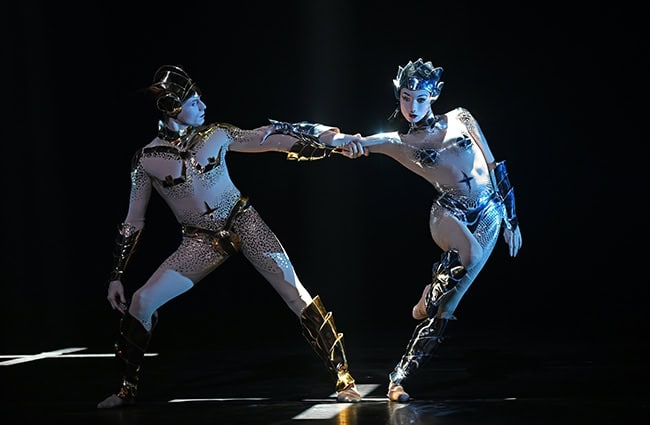
Wayne McGregor claims responsibility for choreography and direction in the world première of McGregor + Mugler, while Manfred Thierry Mugler takes on the art direction and costume design. It is the latter that predominantly occupies our eyes while McGregor’s choreography — never strong in classical content or partnering — succeeds in making Edward Watson and the Bolshoi’s prima ballerina Olga Smirnova look as if they are performing a pastiche of an under-rehearsed pas de deux to tracks by Holly Herndon and Nils Frahm. While Watson is clearly not at his best, Smirnova is at the height of her career but she has trouble emerging from McGregor and Mugler’s framework. Mugler’s design of the flesh-like bodysuits, face masks, top knots and various reflective helmets, breast pieces, cod pieces, shin pads and amulets, effectively hides the dancers, and by making the masks so indistinguishable from their faces — certainly from a viewpoint halfway back in the stalls — we see no difference when they ritually exchange them. Perhaps that’s the point. The sophistication of Lucy Carter’s lighting is caught up in the pretension of its context, contributing to a spectacle in which the dancers are unwitting appendages to the hubris of its creators.
A Politically Correct Nutcracker for the end of 2019?
Nature’s backdrop for the first act Snow scene from Nutcracker (photo: Glenn Jacobson)
With the waves of the debate on political correctness in ballet whipped up in a storm of indignation, perhaps it’s time to change the scenario of one of the more controversial productions. For example, the national characteristics Marius Petipa chose to portray in Nutcracker, which no doubt had their special significance in the Imperial Russia of 1892, correspond remarkably well to the current political landscape for which Tchaikovsky’s score might once again be appropriated.
Petipa did not choose to portray the English in Nutcracker, possibly because the country at the time did not have a tradition of classical ballet. That, of course has changed, as has the recent political climate in the country. The first act of the ballet is set at a merry Christmas party in a wealthy family home. Given the Christmas present we have received in the election, it is tempting to see Boris Johnson in the patriarchal role with his latest paramour entertaining his Conservative friends while Etonian schoolboys run around creating mischief with their toy trumpets and miniature JCB diggers. Jeremy Corbin is in the avuncular role of Drosselmeyer who gives Clara the magic gift of speaking truth to power. Armed with this incalculable gift, Clara, who grows up to be Greta Thunberg, defeats the forces of Machiavellian duplicity and in the transformation scene the Christmas tree grows and multiplies as a symbol of reforestation. However, the melting ice caps of Lev Ivanov’s snow scene at the end of Act 1 are a stark reminder of the current state of our natural environment.
Traveling into the second act on board her tiny carbon footprint, Clara visits first Spain for the climate conference and then some of the more flagrant polluters: Russia, China and (Saudi) Arabia. Three of the divertissements from the original second act are thus accounted for — along with possible lead roles and narratives — without the need for cultural exaggeration. The European community is the network of 28 (at this time of writing) countries under the skirts of Mother Ginger Brussels while the Mirlitons as the LGBTQ+ community continue campaigning for human rights. Clara has one last dream of saving the planet in a Waltz of the Flowers seen through the eyes of Extinction Rebellion before the Grand Pas de Deux features the President and First Lady of the United States against a backdrop of Thunberg as Person of the Year on the cover of Time Magazine.
NOWhere & Be Fruitful and multiply at Chisenhale Dance Space, November 30
Leilah Simone Williams, Keity Pook, Lucie Palazot and Shum Pui Yung in Alka Nauman’s Be fruitful and multiply (photo: Anna Jockymek)
As the first of two works on this evening’s program of new choreography by Greta Gauhe and Alka Nauman at Chisenhale Dance Space, Gauhe’s NOWhere is a timely examination of ‘issues of racial and sexual discrimination and harassment.’ Gauhe has taken an autobiographical approach to structure the personal narratives of her dancers from four different countries on two continents, who express their stories through spoken word and dance. Dance theatre is the performative equivalent of mixed media or collage in the visual arts where one medium is juxtaposed with another so as to bring out a new meaning or metaphor in the whole. What Lloyd Newson’s verbatim theatre or Luca Silvestrini’s confessional theatre — not to mention Pina Bausch’s tanztheater — have all shown is how spoken word and dance can strengthen each other to create dramatic, sometimes surreal scenarios that express ideas physically, visually, intellectually and emotionally. In NOWhere, however, the notion of juxtaposition is replaced by a convergence between dance and spoken word that unfortunately blunts the impact of both; the stories don’t stand out as much as they should, and the dance is lost in trying to frame them. Through this subtle transfer of focus, even the sinister signification of the naked light bulbs at the beginning becomes an artful approach to lighting by the end. Between the ‘hostile environment’ of the current government and the #MeToo campaign, stories of racial or sexual discrimination and harassment need to be called out with a force that arouses our sense of outrage and empathy; resistance to the established order is one of art’s primary functions. In its urgent call for action in the present time and place, NOWhere needs a stronger emphasis on the stories at its heart; they are too often inaudible through a problem either of acoustics, of weak diction, or of voices having to compete with Andy Trewren’s electronic keyboard accompaniment.
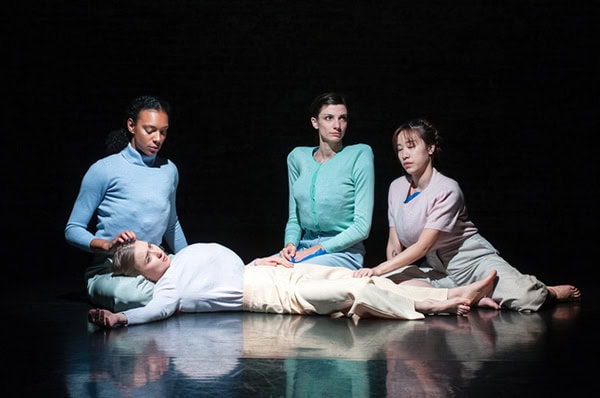
It is difficult to know if Alka Nauman’s Be Fruitful and multiply is a polemic or a paean. Lying somewhere between the two, ‘the piece focuses on the ambiguous nature of plastic bags, on their elegance and ugliness…to reveal the absurdity of our attitude towards the environment.’ Nauman’s adoption of the absurd as a creative tool (it comes as no surprise that she cites the support of Eva Recacha) reveals its purpose in destabilising our response to the work, but the integrity of conception is such that this disruption is what makes it so effective. The stage is set with a tableau of four languidly posed women — Lucie Palazot, Keity Pook, Shum Pui Yung and Leilah Simone Williams — on one side in pastel t-shirts and pants and a pile of blue plastic bags on the other. Staring out over each other into the infinite distance, the four women inch their way in silence towards the pile with calculated reserve and control, creating bemused tension by maintaining the direction of movement while eliminating any sense of motive. When they reach the bags and start to explore their buoyant, pliant qualities in slow motion caress, the previous action is resolved but the future course of the work is once again in question. In Nauman’s absurdist construction, the negative environmental connotation of plastic bags loses its signification to one of aesthetics; the four women pose, balance and swing the bags like weightless jewellery on their arms and heads. They continue their reverie — with ever serene nonchalance — in padding their t-shirts with the bags, distorting their bodies to a bloated caricature, and later drawing them out as if by surgical procedure. By confounding reverence for the environment with devotion to one of its principal pollutants, Nauman satirizes our blindness to ecological destruction. The silence finally breaks with a recording of Antonio Vivaldi’s Sileant Zephyri that is itself a musical fragment mourning the death of Christ and its effect on nature. The four women, with their heads covered in plastic bags, are poised individually in a final tableau. As they each lip-synch the recitative (sung by counter tenor Philippe Jaroussky accompanied by Ensemble Artaserse), a sense of calm descends, with only Yung’s hands and fingers showing any vestige of life.
‘Let the winds be hushed, let the fields freeze, the flowers and leaves will not be drenched with the water they love. With the river dead even the moon and the sun will be deprived of their own light.’
Svetlana Zakharova in Modanse at the Coliseum, December 3
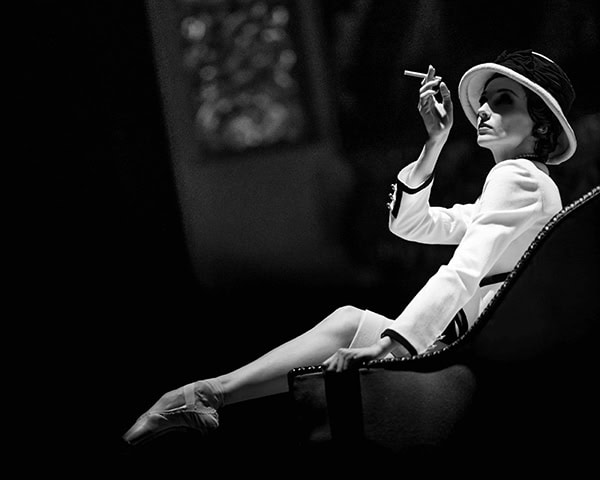
Svetlana Zakharova as Gabrielle Chanel (photo: Jack Devant)
Svetlana Zakharova is the prima ballerina of the Bolshoi Ballet and the artistic director of MuzArts, the producer of this double bill, Modanse. The program includes two works — Mauro Bigonzetti’s Come Un Respiro (‘Like a Breath’) and Yuri Possokhov’s Gabrielle Chanel — in which Zakharova is the star accompanied by two male principals, two male leading soloists and fourteen artists of the Bolshoi Ballet.
For Zakharova to present herself in a context that focuses the spotlight uniquely on her talents is in keeping with a culture of celebrity. When the Bolshoi first came to London in 1956 its undisputed star was Galina Ulanova but her artistry was subsumed in the ballets in which she appeared — Romeo and Juliet, Swan Lake, The Fountain of Bakhchisarai and Giselle; by all accounts her identity was not separate from the roles she played. The current double bill turns this notion of the star inside out; in both works Zakharova appears as herself. Bigonzetti’s Come Un Respiro eschews character for an abstract study of articulate lines and shapes — both of which suit Zakharova’s outstanding plastic ability — and while Possokhov offers Zakharova the opportunity to inhabit the life of the iconic Chanel, she fails, by her own admission, to take it.
Come Un Respiro takes the breathless beauty of well-trained dancer’s bodies as the starting point of a physical puzzle that manipulates the classical lexicon into unconventional shapes and demonstrates, with a knowing sense of wit and playful eroticism, how such manipulations of the body affect its emotional expression. The program describes the work as ‘a modern reflection of the aesthetics of the Baroque period’; it rides on a recording of Handel’s Suites for Keyboard and is enhanced by the costumes of Helena de Medeiros. The men are bare chested in tights, and the women have stylish bodices with a baroque curlicue confection around their waists. Their arms and legs are laid bare like steely tendrils of an exotic plant with beautifully curved tips that can extend endlessly into languid shapes, hinge, cantilever or wrap themselves enticingly around their partners. Bigonzetti seems to love this show of sex more than he loves the pure pleasure of movement; his choreography too often manipulates shapes in place (with the exception of variations for Zakharova and Jacopo Tissi who refreshingly expand their shapes in space) that runs counter to the current of the keyboard suites. The effect of Come Un Respiro is overwhelmingly visual to the detriment of choreographic flow.
When she was researching the subject of Possokhov’s new ballet, Zakharova visited Chanel’s apartment at 30, rue de Cambon in Paris. She writes that it was not what she expected to find; the Byzantine luxury of the furnishings confused her. In looking for Chanel, ‘at some point I started to lose her’, she continues. ‘I tried to find at least some similarity, but the more I sank into her image, the clearer I realized that there was nothing in common between us. And that thought freed me, unchained me, and gave me the freedom to invent my own Chanel…’ For Zakharova and Possokhov it is apparently immaterial in the creation of Gabrielle Chanel that the central character is irredeemably conflated with the prima ballerina of the Bolshoi Ballet. There is no further need for biographical depth; Alexey Frandetti as librettist and director guides us through a timeline of events in Chanel’s early life that Possokhov uses as choreographic set pieces for his trio of principal characters: Chanel and two of her early, wealthy lovers, Étienne Balsan and the elegant Englishman, Arthur (Boy) Capel. While the Chanel-designed costumes are beautifully styled period reproductions, and Maria Tregubova’s sets and Ilya Starilov’s video projections make creative reference to contemporary taste, Ilya Demutsky’s score seems less concerned with finding flavours of French period music than in painting a contemporary portrait of the central character. Choreographically, Zhakarova’s two duets with Tissi as Boy Capel are the highlights but Possokhov tends to default to a traditional treatment of overwrought emotions. Boy Capel’s death in a car accident is perhaps the nadir of imagination, combining a grainy video projection of a car driving at speed along a narrow coastal road, stage lights momentarily blinding the driver (and audience) and a climax of Tissi performing a double tour to the ground not unlike Albrecht in Giselle. We do not learn very much in this sumptuous work about Chanel, but that is not its purpose; it’s about the legend, and as Chanel famously said, ‘Legend is the consecration of celebrity.’
Richard Alston Dance Company, Alston At Home at The Place, November 28
Elly Braund in Richard Alston’s Red Run (photo: Chris Nash)
Richard Alston was one of the first dancers, along with Siobhan Davies, whom the dance enthusiast and philanthropist Robin Howard invited in 1968 to the building that would become The Place. Howard invited Robert Cohan to be the first artistic director of the school and to ‘form a dance company based on love’. Howard drew up a list of objectives for The Place, including ‘to use the universal language of dance to break down social, political, linguistic and other barriers’ and that ‘its standards should never, for any reason, be allowed to decline.’ It was left to Cohan to embody these objectives, both at the school and in London Contemporary Dance Company, and since the company’s demise in 1994 it has been the aim of Richard Alston’s resident company to maintain them. While keeping the school running, The Place has now seen the formation and dissolution of two resident companies, which is hardly an incentive to students in a performing art. Whatever the reason for closing Alston’s company, the cause is clearly not the company’s current form.
Alston At Home is a fifty-year perspective, from Alston’s very first choreography in 1969 — the solo and duet from Nowhere Slowly — to his latest, Bari, made for graduating students from London Contemporary Dance School. In between there is another early work, Blue Schubert Fragments (1972), something from the intermediate period, Red Run (1998), and two relatively recent works, Isthmus, made for Bob Lockyer’s birthday celebration in 2012, and Martin Lawrance’s Detour (2018). In addition, to mark the centenary of Alston’s mentor, Merce Cunningham, the evening includes two of the solos from the Cunningham Centennial Solos program presented earlier this year at the Barbican. The program is not only a retrospective but a clear mark of Alston’s appreciation to everything The Place has meant to him over the past 25 years. A visual artist of similar renown would be able to hold a retrospective in a single gallery over a period of time; as a choreographer, Alston’s retrospective extends over three programs in various venues, the last of which will be Sadler’s Wells on March 7 and 8 next year.
What this program shows are Alston’s choreographic building blocks and their spatial development over time. The solo and duet from Nowhere Slowly has a simple structure with classically derived shapes and torsions and a clean sense of line. Set to Terry Riley’s music, there is a Cunningham influence in that what happens is what happens, no more no less. Two years later Alston approaches the adagio of Schubert’s quartet Death and the Maiden with more complexity; Blue Schubert Fragments is choreographed as if each of the six dancers is a solo instrument. Such emotional music can overpower a choreographic response to it, but here Alston extracts a spatial harmony from the integrated texture of the score.
In Bari, the folk-inspired music of South Italian pizzica has a buoyancy and energy — the traditional dance was conceived as an antidote to poisonous spider bites in the field — that the London Contemporary Dance School students relish. So does Alston, who smiles his way through the work with an infectious confidence.
Alston contributed two works to Lockyer’s birthday bash in 2012, one of which was Isthmus, a quartet for two women and two men to Jo Kondo’s intimate, intricate score. The choreographic shapes are evocative of the earlier works but Alston’s adhesion to the musical rhythms creates a work with the rapid dynamics and sharp spatial patterns that define it.
Martin Lawrance’s Detour moves up the program order of the evening due to a last-minute replacement of an injured Elly Braund by Hannah Kidd. As a former dancer in the company and the current associate choreographer, Lawrance is clearly an important influence on Alston, and vice versa. Detour, created to Akira Miyoshi’s percussive Ripple for solo marimba, uses elements of Alston’s vocabulary but submits it to an aggressive, virile energy that wrenches it apart. Calm returns after the intermission, with the Cunningham solos that revel in space and chance; Siobhan Davies is perfectly attuned to it in her mysterious dialogue with the air around her while Kidd’s more grounded contribution joins the physical to the aleatory.
Red Run jolts us back to the energy levels of Lawrance but in responding to Heiner Goebbels’ Nine Songs for Eleven Instruments Alston employs a sense of luxuriant and fast-paced playfulness that challenges the musicality and technical proficiency of the six dancers. It finishes, ironically for this occasion, with a suggestion of death.
Certain Blacks, Circus Circus Circus Festival, at Hoxton Hall, November 22
Certain Blacks ‘is an East London-based arts development organisation formed in 2015 to support the work of diverse artists. Circus Circus Circus, a new festival, aims to showcase the different and exciting work from a variety of performers, artists and musicians.’ This evening’s festival finale is produced in partnership with the artistic director of Upswing Aerial Circus, Victoria Amedume.
Hoxton Hall is one of five surviving nineteenth-century salon-style music halls in London and it is in remarkably good shape thanks to a long stint in the hands of the Quaker Community. It opened its doors in 1863 and lost its performance licence eight years later due to complaints by police. Sitting in the tall, narrow hall with its elevated stage, shallow stalls, and two levels of wrought-iron galleries on three sides, it is not hard to imagine a raucous nineteenth-century crowd, eating, drinking and smoking, packed in tight on a popular night, raising the roof with their laughter, cheers and applause and spilling out afterwards into the slumbering, smoky streets.
Circus Circus Circus at Hoxton Hall reimagines this past in the present through the diverse skills of the performers and their stand-up chairman, ‘eyes on me’ Athena Kugblenu. Specialty acts were always a part of music hall, and these included aerial acts, drag artists, stilt walkers and jugglers as well as comedy routines and songs; Circus Circus Circus has a smattering of each, with acts that are either extracts from longer works, like Out of Order’s Once Standing, Sadiq and Hauk’s The Chosen Haram and Symoné’s Utopia, or scratch performances like Joana Dias’ 89 and both of Amelia Cavallo’s routines.
Contemporary circus struggles with the use of narrative; while dance brokered a deal with narrative from its beginnings, circus has yet to sort out its relationship with it; either the apparatus is too obtrusive for the narrative, or the narrative is too artificial for the apparatus. Once Standing is a contemporary fusion of physical theatre and circus that imagines the behaviour of the last two people on earth. In its opening, performers Angeliki Nikolakaki and Jesús Capel Luna, both wearing little more than gas masks, create a convincing image of near extinction through the play of acrobatic strength and articulation, but when they move to the silks the circus arts leave the narrative hanging. The next two sections, however, work beautifully as narrative imagery integrated with the means. In one, Luna dressed in a fur coat dances on a precariously balanced skate board while Nikolakaki in a red tulle bodice and skirt plays a restless interpretation of Chopin on a keyboard, and in the second Nikolakaki is rooted to the floor by Luna’s coiled body at her feet as her sinuous upper body finds the yearning tone of both Janis Joplin’s vocals and Sam Andrew’s solo guitar in Summertime. The final section returns to the imagery of the opening with various props and masks but an abrupt curtailment of Ravel’s Bolero robs the work of its apocalyptic climax.
Amelia Cavallo, aka King Tito Bone, comes closest to the spirit of music hall as ‘first and last, an intimate medium, in which performers and audience were locked in an enduring embrace.’* Cavallo, ‘your average, blind bisexual drag king’ with green glitter eyebrows and goatee, engages the audience with the force of her fearless personality and self-deprecatory humour in both works. The first is a brilliant parody of ‘I will always love you’ directed in fine voice to her white cane, that ends (in true music hall tradition) as a risqué conversation, and the second a flawless ‘fitness routine’ on silks that guides us irreverently through the feel and experience of every step and preparation as if we are the unsighted.
In between Cavallo’s two acts, Joana Dias’ work-in-progress, 89, focuses on her aerial hoop skills where the intertwined flowing lines of the Arabic numbers 8 and 9 aptly describe the circular arabesques she creates. As a former ballroom champion and singer in her native Portugal, Dias draws together the quality of her motion and the emotion of her Fado accompaniment in a rich aggregate form that leaves any narrative to the imagination of the audience.
After an intermission, Sadiq and Hauk’s The Chosen Haram is another example of narrative and circus paraphernalia crossing over but not binding together. Both Sadiq Ali and Hauk Pattison are adept at the Chinese pole but using it within an ‘exploration of a gay man’s narrative’ is not an obvious association. The opening of The Chosen Haram sketches the gay context between the two men but their subsequent agility on the poles does not corroborate it. Perhaps the extract does not do justice to the full work.
In exploring her experience of living in a cult, the means Symoné uses in Utopian are an integral part of the story. Projected instructions for each of us to find, select, pass on, inflate and let go a balloon seem innocuous enough but Symoné makes her point by having us follow the instructions without questioning. Utopian has a longeur that expresses mind manipulation and altered realities; in relating her story she offers three options for each incident with the warning that maybe only one is true. Performed with Duane Nasis and Ruby Gaskell, Symoné mixes her narrative with elements of pole dancing, voguing and fluorescent rave culture while including her signature roller-skating and hoola-hooping. It’s an extended extravaganza that has a disquieting heart, as stimulating as it is sobering.
* John Major, My Old Man: A Personal History Of Music Hall (William Collins, 2013).
SUPERFAN, Nosedive at the Barbican Pit Theatre, November 9
The cast of Nosedive (photo: Brian Hartley)
In Spring, 1967, Francis Warner, Fellow and Tutor in English Literature at St Peter’s College, Oxford conceived the idea of establishing a theatre in Oxford that would provide a platform for the work of writers, musicians, artists, performers and directors of the avant-garde and the staple diet would be new and experimental work. Warner asked Samuel Beckett if such a theatre could be named after him, to which he agreed. At the time it was supported by the leading composers, authors, artists and sculptors in the country. In 1976, St. Peter’s College passed on the management of the theatre to a charitable trust, known ever since as the Oxford Samuel Beckett Theatre Trust and in 2003 the Trust launched an award ‘in particular, to help the development of emerging practitioners engaged in bold, challenging and innovative performance and, in general, to encourage the new generation of creative artists.’ The Award allows a company or individual to create a show either for the Barbican’s Pit theatre or a site-responsive show to take place in east London or the City. SUPERFAN, ‘a new contemporary performance company’ based in Scotland, is the winner of this year’s award and its new work, Nosedive, was presented at The Pit from November 7-16.
On the face of it, there’s a disparity between the Award’s particular purpose of supporting ‘bold, challenging and innovative performance’ and SUPERFAN’s response, created and directed by Ellie Dubois and Pete Lannon. Nosedive’s proposition sounds interesting: ‘Pushing themselves to the limit, dancing with abandon, colliding into each other, children and adults perform feats and leaps that grow ever bolder, ever riskier, revealing an intricate bond of fear, resilience and recklessness.’ But in current stage performance politics, a work with ten-year-old children can neither be ‘ever riskier’ nor ‘reckless’; we need to set aside this kind of language and the publicity that simply corroborates it in order to measure the performance of Nosedive on its own terms.
What we see as we enter the theatre is Rachel O’Neill’s set with its continuous white floor and backdrop and a wall of 80 lights like portholes on one side; it’s a clean, empty space with infinite potential, while its calmness is enhanced by Kim Moore’s sound design. Only later does this light wall, designed by O’Neill and programmed by Michaella Fee, come into its own, providing what is the most memorable and poignant moment of the work. The cast has two generations, with Michelle Ross, Nikki Rummer and JD Broussé as the three older performers and Albie Gaizley-Gardiner and Lachlan Payne are the ten-year-olds. The metaphor that runs through Nosedive of younger generations ‘standing on the shoulders’ of adults to prepare for their future is also explored in the choreography. After a blackout, the lights come up on Broussé lying in a pile on the floor as if he has crash landed — the original nosedive, perhaps, from which the narrative develops. His failing, flailing efforts to levitate have a slapstick quality that is aimed at the children of all ages in the audience. Ross and Rummer help him up and they all exchange acrobatic feats as a form of dialogue that sets the physical parameters of subsequent intergenerational exchanges. When the children arrive, they initially watch their elders performing but are gradually incorporated into the action; this is where Payne stands on Rummer’s shoulders for the first time, looking out into the future. The children ‘learn’ acrobatic skills from their elders in a spirit of trust and friendship that is mutual; it’s a solicitous Payne who rescues Broussé from another failed attempt to levitate. The children then practice their skills independently, approximating poses and positions in the image of their teachers while the teachers look on. The two generations are like past and present, constantly negotiating with each other until the present is strong enough to exist on its own. There’s a magical moment when Payne is left alone on stage, looking into that light wall as all 80 lamps are turned up. This small figure full of dreams is suspended momentarily in a bright but blinding future that he cannot yet discern. He turns and runs off.
It is a moment that paradoxically transforms the work into something it isn’t. For all its intergenerational qualities, Nosedive hasn’t developed its core proposal convincingly from its egalitarian creative process in the studio — ‘embedded in playing lots of games and setting lots of tasks for each other’ — into a bold, innovative and challenging theatrical form.