Works by Robert Binet, Ludovic Ondiviela, Javier de Frutos, Christopher Marney
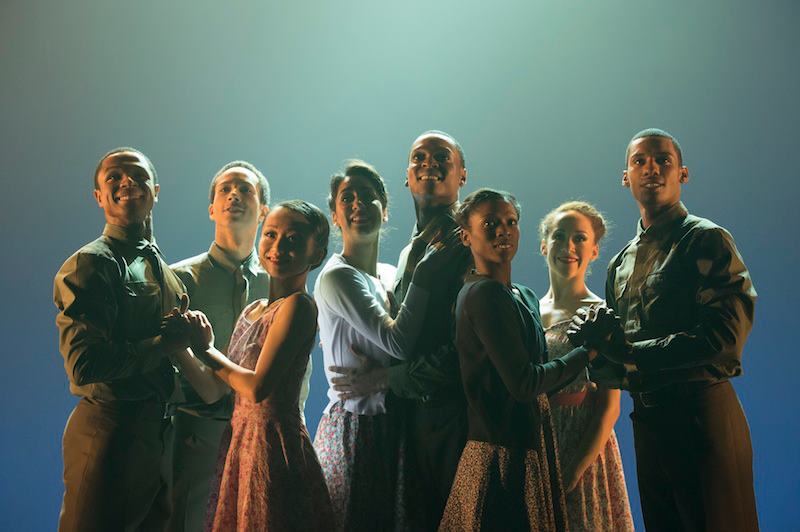
Full company in War Letters
I shouldn’t have read it before going to see Ballet Black on Tuesday. I dipped into a memoir of Isadora Duncan by Edward Gordon Craig. ‘She threw away ballet skirts and ballet thoughts. She discarded shoes and stockings too… She was speaking in her own language, not echoing any ballet master, and so she came to move as no one had ever seen anyone move before.’ As I walked to the Linbury Studio Theatre, this is what I had in mind: a new language of dance, free of conventions.
Perhaps because the classical ballet language has its roots in the courts of Europe 350 years ago, it can come across in unimaginative hands as an esoteric, affected language that conjugates incongruously with contemporary life. Robert Binet, whose EGAL began Ballet Black’s program, bends and collapses his forms like a sculptor, taking full advantage of the pliant qualities of his two dancers, Cira Robinson and Jacob Wye, but I quickly lose interest when I see a pirouette here and an assemblé there like cryptic signposts dropped into everyday parlance — or worse, as lazy abbreviations of classical dance. Binet has a great talent — he choreographed the hauntingly beautiful solo for Daniela Neugebauer, Lake Maligne, at Bob Lockyer’s birthday celebration at The Place last year — but he might well take heed of his own program note as a metaphor for his relationship to his craft: ‘Both people being strong, but for moments unsure of their relative strength, can tip the relationship easily towards conflict. However, once the strength of each individual is harnessed…the two people are able to combine physical and emotional resources to go further than they imagined possible: to soar.’
In Dopamine (you make my levels go silly), Ludovic Ondiviela happily chooses a subject (attraction, love, lust) that dance can do really well (and we can easily understand), wrapping it in Fabio D’andrea’s music that is dripping with so much sentimentality that by the time the dancing starts we are like sponges at high tide. On top of that you can sense immediately that the abundantly sensual Sayaka Ichikawa is happy and impulsive and drawn to her man, and that Jazmon Voss is equally drawn to her. We thrive on their emotional involvement and Ondiviela is good at making his dancers talk without words while keeping the conversation colloquial.
The One Played Twice is once too much for me. Javier de Frutos is in love with the genre but the acapella male-voice Hawaiian Barbershop quartet just doesn’t do it for me. Nevertheless the two couples set off along the beach together, but the weather gets really humid and enervating, a balmy day without a wave, and there’s nothing to do and they seem to be going round in circles like a hoola-hoop, until Kanika Carr’s solo resembles Sarah Kundi’s and they’re back where they started. I have seen the imaginative heights to which de Frutos can rise but The One Played Twice is as low-flying as the bass in the barbershop quartet.
Glen Miller and Dmitri Shostakovich are strange bedfellows, though they never really get into the same bed in Christopher Marney’s War Letters. One goes out dancing while the other comes back from a dangerous sortie, and so it goes on. When the Glen Miller plays, the choreographic language finds its inspiration in social dancing, but when the Shostakovich plays the choreography falls back to the default classical pastiche. There is one moment that defies the trend: Ishikawa crawling away under the coat. But the facile patterns and thin characterisations wrapped in a pseudo romanticism about war all reek of Matthew Bourne’s influence: you know what’s coming and in no time it’s delivered.
What we do see throughout the evening, and what the audience rewards with such evident relish and pride, is a company of eight dancers who are a pleasure to watch, and who can dance as if there’s no tomorrow. All that is missing on this program is a language they can embrace with all the passion at their disposal. I was waiting for that Isadora moment when someone would come on stage and dance their words. Maybe I’m just going deaf.
Retina Dance Company, Corporalis, Nottingham Playhouse, February 19
Erin Harty in Corporalis photo: David Severn
As the final episode in Retina Dance Company’s trilogy about the relationship between the body and different art forms — text in Eleven Stories for the Body (2005) and visual art in This is not a Body (2007) — Artistic Director Filip Van Huffel’s Corporalis takes architecture as its point of departure. It sets out to ‘explore the relationship between personal space, architectural space and three-dimensional space.’ The 20-minute opening section of Corporalis — in which Van Huffel effectively sets up a quintet between dancers Matthew Slater and Erin Harty, set designer Ruimtevaarders’ steel wall unit, Andrew Hammond’s lighting and Marieke van de Ven’s soundscape — is so well crafted and its unity of elements so complete that it sets up a huge expectation for what follows. Van Huffel’s vocabulary finds full expression in these two dancers — Slater and Harty have a palpable chemistry that fills the stage (and what a great stage the Playhouse is for dance)— and an aural and visual setting that evidently inspires him. The problem is what to do afterwards? Interestingly, Van Huffel had not intended to open with this section but with the solo that follows. Perhaps a further re-calibration is required to balance the entire work, for in retrospect the brightness of the opening section leaves the remaining two thirds of the show — apart from two or three exceptions — in its shade.
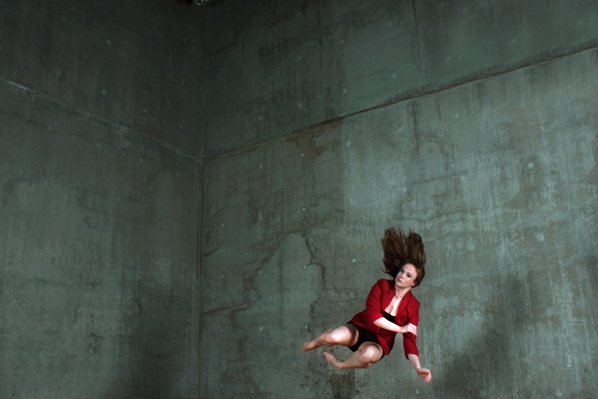
Slater and Harty begin with their backs against the steely, reflective surface that is set at an acute angle to the audience; the two dancers create a smudge of colour on the metal as they begin a series of slow introductory arm and torso movements. There is a wisp of smoke in the air that adds an even softer focus to the diffused light, suggesting a dream, but the score pricks the couple into sharper, more thrusting movement in place, repeating the same gestures with increased vigour. The metal wall, which is a series of three mobile panels, rotates to face us and the light beats on it like an anvil, changing the illumination and the spatial quality. Slater and Harty repeat earlier motifs, separately and then together until the wall moves again to articulate a slight angle between two of the panels, the tiniest suggestion of an enclosing space. The dance begins to work up with jumps from a low position until the two dancers are flinging themselves to the floor before the rush of adrenalin recedes like a tide. At one point Slater’s body is reflected in the wall as he watches Harty, whose shadow is projected on to the wall next to him, a lovely play of light and form. Harty winds up into a fury, throwing herself into the air where she seems to hang effortlessly before landing on the side of her thighs.
Throughout this section, Van Huffel integrates imaginative and expressive gestures — Slater has a passage in which his pecking head and undulating back are reminiscent of a courting pigeon — into what could be the play of two teenagers leaning against a wall wondering how the evening is going to end. Van de Ven includes a section with children’s voices that matches the innocence of the action, and as the walls move back, the movement grammar opens up with it. Slater and Harty repeat the opening sequences but they are now quite different in the larger space. Slater disappears behind the wall and Harty delivers a beautiful solo that she continues into a blackout as if she never wants to stop.
A very different, extended solo follows, demonstrating not only the effect of architecture on the body, but of the body on architecture. The wall is the same, but Steven Martin has a different energy and a more introverted dance that has its ticks and drama but feels like a rather long monologue that has been seamlessly dropped into the place of a vibrant conversation. The tone softens, and the space diminishes. We first see his bearded figure lying on the floor as if shipwrecked in a blue light, floating on the water’s edge. When he stands he seems very tall, wearing an open jacket (whose flapping competes with his own movement) over his naked torso and with a rapid frisking of his body signals he is trapped in a painful place, a prisoner in his own cell. There is an oppressive buzzing sound of an electrified fence in the score, underlining some malaise. Towards the end of his solo, Martin covers his eyes as if he is about to die, but just as he stands, Pauline De Laet arrives on the other side of the stage in the same pose and to a deep trumpet motif swims towards him like an angel. He watches his saviour getting closer, and as soon as she is within reach begins to manipulate her, sitting her finally on his shoulders like a prizefighter carrying his victor.
Harty returns to form a trio and then Slater to make a quartet, repeating phrases in canon, but it is immediately apparent that the two couples, who are now meeting for the first time, are quite different and their spaces clash. At this point, Van Huffel offers them a jewel: in the violin introduction to Handel’s aria Cara Sposa from Rinaldo that van de Ven has woven into the score, the quartet of dancers stands reverently still against the wall in a white light. The harpsichord continuo resonates with the metal wall, the counter tenor with the light, and again there is this remarkable unity between the theatrical elements. When the dancers move with the emergence of the voice, their backs leave a damp stain on the wall from which the music seems to arise.
In the closing sections of Corporalis, in which there is still plenty of action in various convolutions, Van Huffel has one surprise and a treat. When the two boys carry De Laet off, Harty is left to dance alone, but now the wall is moved all the way to the side, so the stage recedes all the way to the back of the theatre in black. At the same time van de Ven introduces the sound of traffic, as if we have just opened the door to go outside into the street. Harty repeats earlier phrases, but interestingly the change of stage size engulfs her; we begin to lose the sense of what she is doing: a reminder of the effect of three-dimensional space on our actions. When the wall comes back there is a brief opportunity to gather back the momentum, a moment in which De Laet dances alone, a bright and sparkling juxtaposition of outward reflection and internal process. It is as if we are seeing her for the first time, but it is tantalizingly brief. She tries to break through the wall but we hear the return of the electrified fence. The lovely light on her and in her fades too quickly to black.
The Royal Ballet, La Valse, ‘Meditation’ from Thais, Voices of Spring, Monotones I and II, Marguerite and Armand: Royal Opera House, February 13
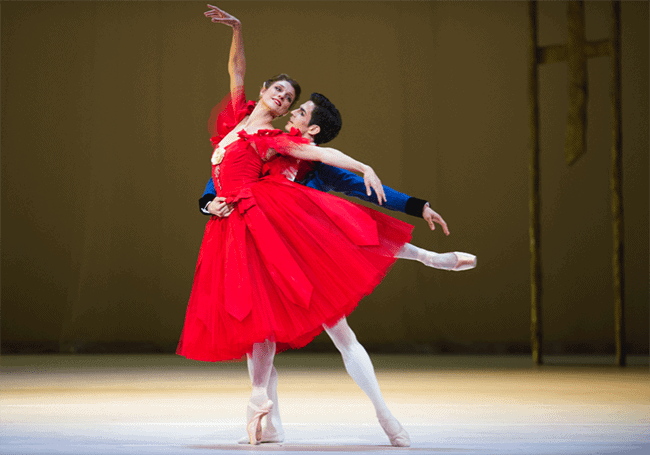
Zenaida Yanowski and Federico Bonelli in Marguerite and Armand (photo: Tristram Kenton)
The beauty of line in Sir Frederick Ashton’s ballets is one of the defining characteristics of his work, even if the steps can be excruciatingly complex. What goes on in the feet is one thing, but in The Royal Ballet’s evening of six works by Ashton, there is ample opportunity — particularly in Monotones I and II — to see the lines of the body beautifully expressed with grace and precision. Unfortunately those qualities were not always in evidence the night I went, though the stretch body suits may have had something to do with it, deforming rather than streamlining the natural joints of the body. The real problem lies elsewhere, however.
Geraldine Morris, in her book, Frederick Ashton’s Ballets: Style, Performance, Choreography, spends some time discussing the ballet training Ashton would have received, particularly the Cecchetti system that was the basis of his technique. She quotes Cecchetti scholar, Toby Bennett: ‘Cecchetti-trained dancers not only have strength and flexibility in the torso, they also have an appreciation of the subtle rhythmic variations between different steps, coupled with a profound understanding of épaulement.’ Épaulement is not an intellectual concept that needs profound understanding; its profundity is in its manifestation in the body: it is as fundamental to classical form as the double helix is to the structure of DNA. In ballets like Monotones I and II, dancers who do not have ‘a profound understanding of épaulement’ — or who sacrifice it to flexibility — will not be able to maintain the purity of line Ashton’s choreography demands. Romany Pajdak possibly had an off night, but her difficulty in maintaining equilibrium in certain passages of Monotones I may have had its source in a failure to implement Ashton’s — and Cecchetti’s — indispensable ingredient. Mark Monahan in his discussion of Ashton in the evening’s program describes épaulement as ‘that irresistibly feminine angling of the head and shoulders.’ It is not; he is mistaking the flower for the stem.
A few pages further on in her book, Morris discusses the differences she sees in the way Ashton’s original casts performed his works compared with today’s. ‘What stands out is the speed at which the dances are performed. Today’s slightly slower tempo gives rise to an alteration of the choreography. While the steps are ostensibly the same, their appearance is not. What is lost is the sense of dancing. The poses, moments of stillness and turnout are emphasized in the later version but the sense of motion is absent and the dances are seen more as a set of links between positions.’ I cannot agree or disagree with Morris as I have not seen footage of the original casts, and she is not necessarily referring to any of the ballets on this evening’s bill, but her comparison turned a light on my own reaction to the evening’s middle section, which included ‘Meditation’ from Thais, Voices of Spring, as well as Monotones I and II. In ‘Meditation’ from Thais, Sarah Lamb and Rupert Pennefather had a rather bloodless quality that put precision ahead of expression, shape ahead of form, position ahead of flow. The juice remained in the music under the direction of Emmanuel Plasson with concert master Vasko Vassilev playing the violin solo. The highlight of this middle section, however, was seeing Alexander Campbell and Yuhui Choe in Voices of Spring. With their sensitivity, exuberance and evident joy in dancing together, they were as close to spring as one could wish at this time of year.
The evening opened with La Valse and closed with Marguerite and Armand. After Ashton had choreographed the latter on Margot Fonteyn and Rudolph Nureyev, it remained, as David Vaughan writes in the program, the ‘exclusive property of Fonteyn and Nureyev for many years.’ It is a flawed ballet that can only be saved from a whimpering melodrama by the passionate interpretation and charisma of its two protagonists. But the sparks were simply not flying between Zenaida Yanowski and Federico Bonelli, if there were sparks at all. It is not a ballet in which there can be any notion of pretense. Bonelli’s passion needs unlocking so that Yanowski has a chance to spar. I wanted to shout out to him, Embrace her as if you really love her! Compare the photographs in the program: Bonelli and Yanowski are beautifully captured by Tristram Kenton, with foreheads passionately furrowed, but then look at the photograph by Anthony Crickmay of Fonteyn and Nureyev in rehearsal and you see a world in which the entire body explodes in passion. Marguerite and Armand — and its creator — demand no less.
Deborah Light, HIDE, Chapter, Cardiff, February 22
Rosalind Hâf Brooks in HIDE photo: John Collingswood
Since she left Laban in 2001, Deborah Light has been researching the notions of inside and outside, what is revealed about a person and what is hidden. She would have agreed with the painter René Magritte that ‘There is an interest in that which is hidden and which the visible does not show us.’ Using the body and mind as material, Light is concerned with the deeper layers of the human psyche; the program note for HIDE says it ‘delves beneath our outer shell, revealing internal worlds, and exposing the multiplicity of human nature.’ The three performers (Jo Fong, Rosalind Hâf Brooks and Eddie Ladd) have already marked out significant journeys in dance theatre and their experience is a vital ingredient in HIDE. They work close to that boundary of fearful and fearless, following the notion of abandonment of inhibition as a way forward.
The three meanings of ‘hide’ are printed in the program and become immediately apparent in the auditorium: Fong stands naked on a pedestal on stage as we file into our seats. From our darkened hide in the audience we see her hide that she cannot hide. She may be shivering from the cold air, but she is definitely out of her comfort zone, and we witness her struggle as she experiences that psychological barrier between clothed and unclothed, private and public. If she cannot hide her body, what is she revealing? That metaphysical question — and its obverse — is a central theme in the work. While Fong is on her pedestal, Ladd is kneeling with her back to us writing on the floor something we cannot read (and which she later rubs out) and Brooks is facing the back corner crouching in her underwear on a loudspeaker. All three women are materially visible, but their internal worlds are obscured. In the course of HIDE these three charged characters collide like atoms in an accelerator releasing in the process facets of their own inner worlds that interact and reform as new layers of experience.
There is an element of Huis Clos here: three characters confined in one space without the possibility of leaving. The stage (designed by Neil Davies with lighting supplied by five mobile studio lamps manipulated by the performers) is their cell, and over the course of HIDE their initial detachment breaks down into a mutual dependence (as in climbing into each other’s clothes) that is broken only when Fong abruptly announces ‘I’m off’ and leaves. Unlike the Sartre scenario, there is a way out of eternity.
The soundscape by Sion Orgon is a driving, frenetic electronic score with a quality of crossed wires that weaves in recorded sounds of children in a playground, distorted voices, dream-like fragments, birdsong, cavernous Morse code, and Bach’s Mass in B Minor. Given its non-narrative, almost random nature, it is all the more remarkable when the score, the choreography and the characters suddenly coalesce to create a moment of extraordinary power and beauty like an ascending mountain path that suddenly opens on to a breathtaking vista. Ladd is describing, with appropriate sounds and words, the cutting up of a carcass, hanging from its two back legs, while we hear repeated snatches of Bach’s Crucifixus from the B Minor Mass that Fong seems to control as she swoons and sings, twitches and falls. Brooks, to whom reality is revealed through her olfactory sense, is endlessly sniffing around like a fly around the carcass. Magical.
Ladd puts in a powerful performance, acting as the central narrator (in both official languages); perhaps it is her personality, or the force of her presence, but she anchors the dramatic action. She weaves aspects of her life story through the work, from the length of her hair over the past decades, to changing her name to learning how to walk like a man — all strategies for hiding, it seems, but she carves her way through the performance with blinding confidence. As she says at the end with quiet determination, ‘I am a Welsh speaking female. I should not hide.’ Fong has a fluid quality — like water to Ladd’s fire — that flows from wild abandon to introspection and Brooks is air, breathing out animal exhalations like a dragon when she is not taking in the scents around her.
Some of HIDE’s material comes from Light’s solo work: one can recognize idioms from Cortex in Brooks’ crazed scrabbling on the floor, her fluttering hands in a gesture of abandon, in the references to animal behaviour, and the flirting with nakedness. In HIDE Light has taken her research to another level, an original voice with a stark, uncompromising vision and the ability to coax out of her performers the material they need for their long journey — one that is never quite finished because, as Magritte points out, ‘Everything we see hides another thing.’
Fong finally turns the performance on its head, demurring that ‘It’s not me you came to see. You came to see a show.’ She leaves and Brooks disguises herself as a powerful inert image in black (see the photo above), part animal in platform hoofs and part hooded human. With no further interaction possible, Ladd is left to turn out the remaining lights, one by one, clothing us all in darkness. And with nothing left to see, we leave our hide.
What a lovely printed program: well designed by Marc Heatley, with no hype, lovely photography by John Collingswood and just enough text…even if the proof reader missed the printing schedule.
Dan Canham: 30 Cecil Street and Theo Clinkard: Ordinary Courage, Pavilion Dance, February 21
Watching Pavilion Dance’s inspired double bill of Dan Canham’s 30 Cecil Street and Theo Clinkard’s Ordinary Courage I had the stimulating if somewhat unnerving experience of sitting with a playwright (Nell Leyshon) and a theatre director (Jessica Swale). Where dance merges with theatre, these are the kinds of eyes and ears and intelligence — attuned to what makes theatre alive and sensitive to any dramatic inconsistency or to anything remotely artificial — that choreographers need to work with if their creations are to effectively merge the two disciplines. Canham’s 30 Cecil Street triumphs because all its elements hang together within an intelligently delineated frame which leaves abundant room for his sometimes haunting, sometimes comic and always heartfelt response to the life once lived in the theatre whose walls he traces in white tape on the stage floor like an architectural drawing. Clinkard’s Ordinary Courage, however, divides along the fault lines of dance and theatre. The six performers each have a solo that is very much the property and personality of the individual dancers, but the framework of the piece, even though it is much tighter than when I first saw it, does not hold together. It is for the most part a loose assembly of loosely disguised rehearsal exercises that are decidedly un-dramatic, which leaves the individual solos unsupported by a context. When I first saw Ordinary Courage at Laban, I felt the overall tone was muted, and even though I was happy this time to return to each solo like returning to a favourite painting in a gallery, the integrity of the work still fails to coalesce. It is Clinkard’s first work, and one in which he himself performs. As he ruefully admits in the Q&A afterwards, it was only after he saw a filmed version of the work that he saw for the first time what he had created. He has made changes that have improved the work, but I don’t imagine he will repeat the dual role for his next creation.
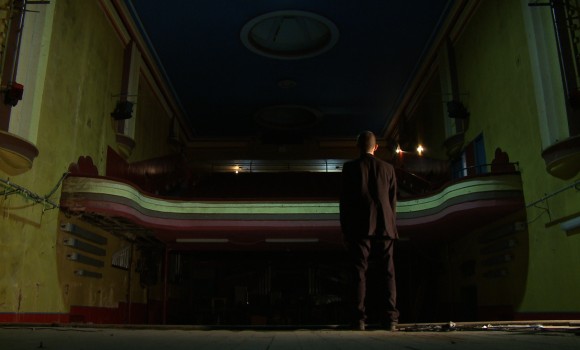
There is also an illuminating difference in the initial inspiration for the two works. With Canham it is direct and physical: he had come across the near-derelict Theatre Royal in Limerick after finishing a tour with DV8, looking to replenish his inspiration. He was immediately attracted to the place and began to explore his feelings about it in movement in the street at night or in the early morning when nobody else was around. He then filmed some of his choreography in the building itself before creating the stage version. The soundtrack, played on a reel-to-reel tape deck, is a collage of interviews with people associated with the theatre, snatches of music, bingo calling, glass harmonica, music hall and opera that had once been heard there. John McCormack singing Down by the Sally Gardens is particularly poignant. Canham’s movement seems to originate as much from the dank walls and drunken conversations as from the foot shuffling music hall routines and there is a section where his hands tune in to the invisible waves of past performances that crackle into being on the tape and disappear again as he moves around the stage. Although it is only Canham we see, it is the theatre that is the subject of the piece, the heart of the piece and out of respect he removes himself from the stage at the end (by the steps and the door he has marked), leaving us to hear the resigned tones of a conversation about the end of the theatre.
The inspiration for Ordinary Courage is more spiritual and indirect. As he explains himself, Clinkard felt he was ready to choreograph but was searching for a theme. While teaching in Chile, he saw an illustration of a heart with the words Without Fear inscribed inside and took this at his theme for the new work. The theme is recognizable — specifically the courage to face loss — but the message is internalized, inward looking. Clinkard had lost a friend, the choreographer Tanja Liedtke, and his mother Robin (to both of whom Ordinary Courage is dedicated), which may explain his almost private response. Canham draws us in — indeed he wants to draw us in — but Clinkard seems more focused on the crafting of the dance, as if our eyes never quite meet. The lighting (by Zerlina Hughes), based on photographic soft boxes suspended from the lighting bars, also tends to flatten the dance, though there are moments when the colours and textures of the costumes benefit beautifully. The central series of six solos is linked to keyboard partitas and sonatas by Bach and Scarlatti — played live by Clíodna Shanahan — which sit elegantly within an elemental sound design by Alan Stones that conjures up a rising squall at the beginning that gradually overpowers a Bach partita and against which the group tries in vain to advance. Helka Kaski’s beautifully nuanced dance of helplessness and Charlie Morrissey’s wild despair succeed best in capturing a state of grief in movement; I enjoy watching Clinkard’s solo for its intimacy and lyricism, though I wonder to what extent his expression of loss is coloured by the inherited vocabulary of previous work. Maho Ihara’s sensitivity is a joy to watch, her mime — a mother’s memories of nurturing a child — a delight, and her singing to calm the enigmatic bear an inspired addition. Margarita Zafrilla Olayo’s solo is an attempt to break free of the ‘family’, to grieve alone, while Adam Blanch’s solo, which he heralds by leaving the stage and returning in black shoes, is danced with bravado, but feels more technically formal and less integrated into the theme than the others. We are also expecting it, as he is by now the only one not to have danced a solo (the element of surprise is quite low in Ordinary Courage).
This is Clinkard’s first ensemble work, and he will be relieved to have given it birth. But if he wants to hone his dramatic skills on the next piece, I know just the people to give him feedback.
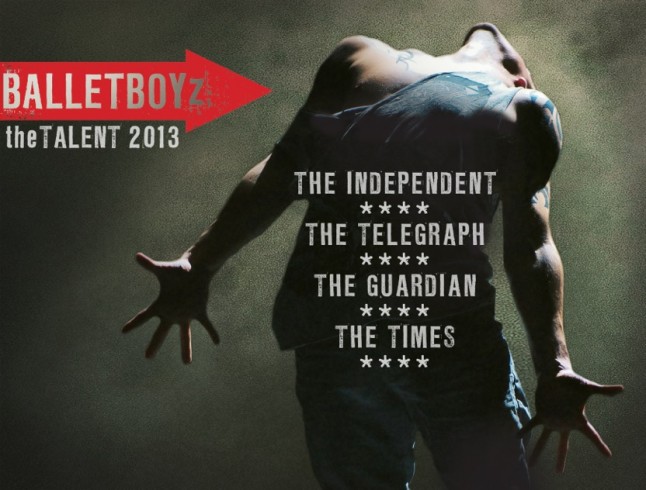
BalletBoyz, the Talent 2013, Arts Depot, February 18, 2013
When I was living in Montreal there was I restaurant I enjoyed every now and then whose attraction was its single menu. If you wanted a lettuce and walnut salad to start, steak and chips as a main course and profiteroles for dessert, this was the place to go. The food was always good, the surroundings elegant, and you always had to book a table. It was called L’entrecôte Saint-Jean, it was centrally located on Peel Street and it’s probably still there and thriving.
Co-founders and artistic directors William Trevitt and Michael Nunn have adopted the same strategy for BalletBoyz: you know what is on the menu, the meat is fresh, the service is good, and it’s best to book in advance. I saw the company in 2011 when it was just The Talent and Russell Maliphant had reworked Torsion for the company with lighting by Michael Hulls. What has changed this year is the commissioning of a piece by Liam Scarlett, recently appointed Artist in Residence at the Royal Ballet and arguably ‘a hot ticket’. BalletBoyz has an unequivocal finger on the zeitgeist.
The short film projected before the show is at once an introduction to the brand and an ad for the product. The filming (by Nunn and Trevitt) is excellent at capturing a lively, smiling camaraderie among the dancers; youth, strength and beauty are the message. Also innovative is a filmed interview with each of the choreographers that screens before their respective works. Scarlett says that in his choreography for the Royal Ballet it is the women who drive the work. What will he make of the men? Can he teach them to drive? He seems unsure. As Serpent proceeds from languid, swan-like arm work and rippling backs through a series of duets, quartets and solos, male sinuousness and strength have by default taken the wheel, but the snake seems satiated and ends up going to sleep in the position in which it started. Scarlett seems satiated, too, seduced perhaps by the hypnotic sameness of the BalletBoyz physique into creating a homo-erotic conflation of the myths of Icarus and Narcissus that raises the display of male bodies to a level of advertising but never stays far off the ground. Neither does the pastiche of Max Richter’s saccharine tracks from Memoryhouse and neither, surprisingly, does the lighting of Michael Hulls, which seems a little uninspired here (there was a delay of 30 minutes in the start of the show due to ‘technical problems’, so perhaps he was not able to deliver what he had intended). Choreographically, it is not so much what Scarlett has been able to do with BalletBoyz, but what they have been able to do with him.
Maliphant has worked with Nunn and Trevitt and BalletBoyz for 11 years, so he knows what’s expected. His choice of music by Armand Amar makes sure Fallen starts on a stronger beat than Serpent, and the boyz are put through their paces on the floor (where it is always difficult to see them) and in the air as they climb and spring up on each other but there is still a sense of not letting too much hang out, keeping the body beautiful in its sculpture form (more of Rodin’s influence, perhaps) with a circular, inward-focused choreographic development. No single dancer stands out; the ten men are unsurprisingly uniform in appeal, dressed in t-shirts and combat pants in battle green, echoing the palpable element of chic violence. Michael Hulls’ lighting design has more punch here than in Serpent, and has reminders, if not enough evidence, of how effective his lighting can be.
The printed program handed out to the public contains good publicity images, headshots of the 10 boyz on a first name basis, a list of tour dates and some wicked hyperbole like ‘This is dance at its most riveting and fearless. Talent? I should say so” from the Independent on Sunday. It is more like a flyer than a program. Perhaps it is the flyer. If you want to know what works are being danced, however, you have to buy a glossy program but surprisingly there is nothing in it about the works — apart from the credits for choreography, music and lighting — but lots about the company and the dancers: BalletBoyz seems to be all about image over content. The glossy program is prefaced by a high-pitched message to ‘Dear Audience’ signed, ‘love Michael and Billy’. So what is the message? ‘Welcome to our latest show…which sees us carry on from where we left off last season…’ The menu hasn’t changed, but looking at the 29-date tour, BalletBoyz, like L’entrecôte, have clearly got a winning formula.
Corp de Ballet: Triple Bill, January 18, Village Underground, Shoreditch
Ronald Corp’s setting of verses from the Dhammapada is playing as we enter. The feeling is liturgical and as cavernous as the magnificent (but rather chilly) vaulted brick space that is Village Underground in Shoreditch. There are strips of painted wallpaper in fading yellow hanging like scrolls from the sides of the central vault that serves as the stage, and a double bed in an abundance of white at the end. Corp himself welcomes everyone, and explains the eponymous link between his music, which makes up the entire program of three works, Francis Booth, who wrote, translated or adapted each of the texts, and the choreographer, Paul Chantry of Chantry Dance Company.
The text of the first piece, The Yellow Wallpaper, is adapted from the short story by American author Charlotte Perkins Gilman. It is a nineteenth century semi-autobiographical story about a writer who is persuaded by her husband to undergo a ‘rest cure’ (Gillman had in fact a serious case of post-partum depression following the birth of her daughter), involving confinement in a stifling room in a country house. It is story of a descent into madness as a result of the prescribed cure, and stands as a spirited protest against the medical profession’s oppression of women. Corp and Booth have divided the story into six scenes, which all take place in the same room with the yellow wallpaper. Chantry himself plays the husband, a sallow, dry-white character like an Ashton husband but with less blood. His stage wife is played by two people: dancer Rae Piper and actress Lindsay Dukes, who together mirror the dual personality misdiagnosed as dissociative psychosis. The two women are described in the program as Narrator (mind) and Narrator (body). There is also the beautiful, rich voice of Rebecca de Pont Davies singing Booth’s text — Corp scored the work for mezzo-soprano and string quartet — who is in effect a third narrator. A fourth character is the spirit of the wallpaper, played by wild-haired Chandelle Allen.
What is interesting is that Dukes, who doesn’t dance very much, feels more true to the character than Piper, who has rather too much unbridled dancing that owes more to a display of classical dance vocabulary than to harnessing that vocabulary to express the internal drama. The principle character, after all, is constrained; Piper in her range of movement is anything but. If the dramatic intelligence of Dukes could have informed the choreography, it might well have expressed something approaching the ambivalence of the text and the tensions clearly expressed in the score. I believe this is what Chantry intended, but it didn’t manifest; instead the choreography lies rather too self-consciously on top of the music, which is strong enough to support it but gains little from the association.
Lullaby for a Lost Soul is a collection of short poems by Booth on the theme of loss, grief and helplessness. Corp has set it for counter tenor, cello, vibraphone and flute in the manner of John Dowland. Booth’s poems take the myth of The Fall as a metaphor for the dark emotional hole into which we may descend at a time of loss and grief. Chantry follows the metaphor rather too literally, taking the figures of Adam and Eve as his structure for this duet he dances with Piper. Chantry’s choreographic imagination, based as it is on the classical vocabulary — and on Piper’s technique in particular — again defaults to a display that is more alphabet than lexicon. Chantry appears to have got his creative process the wrong way round. He needs to find the true emotional value and only then express it in form — classical or otherwise. The problem is that if the emotions aren’t embodied in the movement, they appear superficially in mime — rather too often in a pained facial expression. There is also a curious inversion of the end of the tale. Adam and Eve were naked in their innocence and clothed themselves with the taste of knowledge. Here the consumption of the apple, replete with vampire-like smudged red lips, leads Adam and Eve to strip each other to the waist. Inverted half measures all round.
Francis Booth’s translation of five texts from the Buddhist Pali canon provides the setting of Songs of the Elder Sisters. Corp’s music employs the lovely voice of Rebecca de Pont Davies once again in a more religious, mystical setting with baritone, clarinet, alto flute and viola, and it sounds lovely in this vaulted space. Three acolytes (Piper, Allen and Emma Cole) are sitting in the presence of the nun, Ambapali, who is sharing her wisdom and advising her juniors on how to overcome temptation on their upcoming pilgrimage. The role of the nun is played by Piper’s mother, Gail Gordon, and once again her life experience and subtle range of dance movement makes her the focal centre of this piece. As with Dukes in The Yellow Wallpaper, Chantry has uncovered a strength in choreographic language that these two collaborators naturally offer and which might be a starting point for future exploration. When faced with too much flexibility and extensions, Chantry gives in to them rather than restraining them to adapt to his dramatic purpose or the nature of the texts. Piper may be the culprit here, but the choreography is the loser. Corp’s music and Booth’s texts are the overall winners.
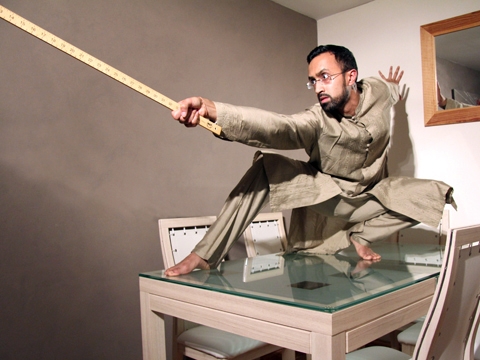
As with the popular evolution of wine, dance has gone from its traditional forms through international styles to ethnic cross-fertilization. Hetain Patel’s Be Like Water is such a delight that it reminds me of a recent comment by a wine writer who said that thirty years ago the idea of the best-tasting burgundy coming from Hungary would have been unthinkable. Be Like Water’shumour andintelligence, conceived as a Bruce Lee-inspired autobiographical fragment by a Bolton-bred first generation Indian video artist and a Taiwanese dancer, make it one of the most refreshing works I have seen in a long time.
Patel is a visual artist whose video installation To Dance Like Your Dad was included at Dance Umbrella last year. Parts of that installation find their way into Be Like Water, which was originally conceived as a video work but passed through several transformations before emerging as a dance theatre work with a multitude of elements and a deceptively simple path. All credit to Patel and Yuyu Rau for the text, and to Eva Martinez and Michael Pinchbeck for the dramaturgy, seamlessly weaving together a video tour of father Patel’s coach building factory with the son’s superimposed guide to his stage set, Bruce Lee with the erhu, China with Bolton and Kung Fu moves with Rau’s spirited solo of childlike enthusiasm that closes the performance.
As varied and beautiful as the individual elements of Be Like Water are, what ultimately holds it all together is the theme, which is contained in the title. In his To Dance Like Your Dad, Patel is clearly in awe of his father, and in Be Like Water he conjures out of the air the words Every now and then in my life I have tried to be like my father. Trying to be someone else has its hazards: as a student Patel adopts a fake Indian accent and grows his hair and moustache like his father which allow him to get a discount in Indian stores but he finds the moustache is so out of proportion to his own face that it makes him forget who or what he is trying to be. In imitating Bruce Lee he ends up in a police station for disorderly behaviour delivering a kick to a dustbin in the street (an action picked up ironically on CCTV). On a residency in China he learns a paragraph of Chinese from a Chinese woman, but discovers that he has picked up his teacher’s inflections (Patel has a particularly acute sense of mimicry) that make him sound to the Chinese like a woman. Throughout the work, Patel uses his self-awareness and humour to reveal these inconsistencies of expression through anecdote and well-conceived video work (with the aid of digital artist, Barret Hodgson).
At the beginning he speaks in Chinese — to avoid any assumptions, he says, about his northern accent — and Rau translates into English. He then admits what we have begun to suspect, that he only knows one short paragraph of Chinese that he repeats on all subsequent occasions with varying emphasis while Rau dissembles by delivering a consistent English text. Patel thus wraps himself up in disguises that fool nobody but himself. On the other hand, one senses his father, an Indian immigrant who speaks with a broad Bolton accent, has no need of disguise and is very much himself. Rau reminds us that Bruce Lee found in Kung Fu the only way he could most honestly express himself and Rau herself learned classical ballet as a child in Taiwan but only when she started studying contemporary dance in London did she find her true expression (which makes her final solo dance to erhu accompaniment so poignant). Patel’s moment of realization seems to come as he sits listening to Ling Peng ‘translate’ his Chinese into notes on the erhu. As Ling Peng plays (beautifully), a live projection of her hands on the bow arching across the strings expresses the oneness that exists between musician and instrument. It is as if Patel himself finds his voice in soaking up the influences of his collaborators, in assimilating his own experiences and in reaching his conclusions; he becomes one with his work. Be Like Water has the wisdom of a modern fable, expressed imaginatively and generously, speaking to us all.
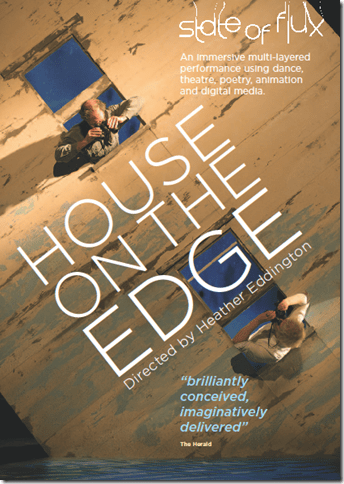
Heather Eddington: House on the Edge. First performance February 8, Jerwood DanceHouse, Dance East
photo: Chris Nash, Design: Tom Partridge
I have not been able to write about many performances so far this year as I have been working on a new production at Heather Eddington’s State of Flux in Ipswich. It is Heather’s House on the Edge, which has its first public outing this Friday, February 8 at Dance East’s Jerwood DanceHouse. In a recent telephone interview (it starts 49:33 into the broadcast) BBC Radio Suffolk’s Stephen Foster introduced me as the lead male dancer, which sounds rather grand; I am in fact the only male dancer and Ann Dickie, who plays my wife in House on the Edge, is the only female dancer. The third character is the actor, Pradeep Jey, who plays with great versatility both an envoy from the local council and nothing less than the sea itself.
Heather had asked me to add blogs on the creative process for her State of Flux site, where you can also see some photographs from a publicity shoot with Chris Nash and some of our own. Nearly all this material is copied from, or derives from that blog.
House on the Edge has its origin in the erosion of the Norfolk and Suffolk coastline that Heather knows well, and in particular the effects of erosion on the community of Happisburgh, What was once far from the edge of the cliffs is now closer to the edge, and what was once close to the edge is either in danger of falling or has already fallen into the sea. It is a very slow process where nothing appears to be changing until the invisible forces within the cliffs suddenly manifest. Heather’s narrative takes Happisburgh as a metaphor for living on the edge in a precarious balance between the physical (solid ground, security, responsibility, conventional wisdom) and the spiritual (the elements, the unknown, irresponsibility, intuition). Life is never either black or white, nor is this balance a matter of keeping to one side or the other. The elderly couple at the heart of House of the Edge — Edward, who has lived in the house all his married life and wants to stay and his wife Lucy who is torn between looking after her husband who has terminal cancer and accepting what the council calls managed retreat — are in a constant turmoil as to how to harness the elements that encroach on their precarious lives.
Much of House on the Edge is built up through the creative use of improvisation. The text by Anna Selby was sketched out during discussions and improvisation exercises last year. As a dancer, I had always preferred to be told what to do by a choreographer, but this new experience has been a revelation. My first improvisation was with Ann. It was a verbal improvisation in which her contribution was limited to one line, ‘We should leave’ and mine was limited to ‘We should stay’ and we had to continue until one of us conceded. I could not understand how this could possibly resolve, but it did. Since that first attempt, many of the qualities of our respective characters and of the relationship between us have been suggested through similar improvisations — some more successful than others — but each time there is something to learn. Verbal improvisation has led to physical improvisation to find external expressions of internal ideas. In the course of creating the work, some of these movement phrases have been reworked as set pieces and we go through an awkward phase of losing the spontaneity that improvisation gives until we find that spontaneity again in rehearsal and performance. Only recently did I realise that improvisation is at the heart of our entire social interaction; our goal in rehearsing is thus to return to this fundamental form of communication.
‘Here’s a poem. It is 18 lines long. Each line has between one and 10 words. Find a single movement or phrase for each line.’ This was my task one day, and I had the luxury of working in one of those beautiful studios at the Jerwood DanceHouse to complete it. A friend has cancer of the esophagus and thinking of her I found a phrase for the first line — ‘illness’ — quite quickly. ‘Eyes in the grass’ was another line I was able to translate, if rather literally. ‘Pouncing on you when you are relaxed’ was clear in my mind but I couldn’t find a way to do it physically. For ‘pushes you to a point of no return’, I had in mind something between a Martha Graham back release to the floor and an image of a sculpture by Ernst Neizvestny (from John Berger’s book, Art and Revolution). Others proved more difficult to approach: ‘us’ and ‘shapeshifting’ were two (‘bellyflop’ I didn’t attempt). By the time Heather came up to see how I was getting on, I had a repertoire to show her, though I was less than confident it would be of any use. She numbered each line and my corresponding movement phrase, making only one critical observation: I had to purge my phrases of anything from a previous choreography or style I had known. The Martha Graham release was out, but a little of Neisvestny left in. Then she said, ‘Put 1 and 3 together, then add on 6, then 4. ‘What have you got for ‘us’?’ I did the first thing that came into my head. ‘Great. Put it after 4. Repeat 1 from that position, then again kneeling. Add another 3, then a prolonged version of ‘shapeshifting’ into ‘moment of stillness’. She helped me find a way to ‘pounce’ and that was added on, followed by another ‘eyes in the grass’, ‘moment of stillness’ and ‘us’. Two variations of 1 (illness) rounded it off. While I had been working in the studio, Heather had been working in the theatre exploring material with Pradeep that she wanted to overlay on the Illness dance. The interaction between Edward and the Sea is a vital relationship in House on the Edge, and this weaving of the two characters became a key dramatic scene near the end of the piece. We ran the two together later in the afternoon.
Last Friday we ran the piece from beginning to end for the first time, in costume (by Sarah Beaton), working with the lighting and projections (by Magali Charrier with technical assistance from Ben at GaiaNova) and with various musical choices. Having worked on individual sections intensively for the past week (under the guidance of theatre director Laura Farnworth), it was difficult to maintain that intensity going through the junctions and intersections, but going from beginning to end with the occasional ‘where do I go now?’ gave us at least a physical and narrative arc on which we can work for the final week up to performance on February 8. We are beginning to inhabit the characters, to make them our own and that in turn informs our physical interactions. What remains is a process of further filling out of both character and movement, moulding all the elements together until they have a logic and arc — and a life — of their own.
Before starting the project I had not heard of Happisburgh and was not aware of this phenomenon of cliffs collapsing and houses falling into the sea. One of the first resources we dipped into was Richard Girling’s book, Sea Change: Britain’s coastal catastrophe, a good starting point. Last weekend I had a free day and decided to go to Happisburgh. Heather had already taken us to Dunwich to get a sense of the effects of coastal erosion, but most of mediaeval Dunwich is already well under the sea. Happisburgh is still a community of solid houses, a school, the Hill House Hotel, an operational lighthouse painted in bright bands of red and white, St. Mary’s Church and an Arts and Crafts era manor house. There is also a broad swathe of caravan park located between the village and the cliffs where at least one caravan stands perilously close to the edge. The cliffs are high and susceptible not only to the external battering of the sea but also to the internal buildup of groundwater. For now there are some sea defences in the form of rocks and wooden revetments, though the latter are in dire need of repair — or have they been abandoned? To counter the groundwater risk, drainage channels have been dug along the cliffs from which plastic tubes project at intervals to channel off the water. It is difficult to imagine the cliffs crumbling, but photographs and studies tell of the brutal reality. The edge of the coastline has been receding inexorably and unless human ingenuity and political will can together find a solution, this beautiful town may, like so much of the once-flourishing Dunwich, disappear under the sea. I fell in love with the place, as have many others before me, but I imagine it takes a certain stoic optimism and perseverance to live so close to a crumbling edge. Certainly my visit has given me images with which to work in preparing House on the Edge, and beyond that perhaps Heather’s work can draw more attention to the cause of preserving such beautiful towns and villages — and the lives and livelihoods of their residents — along the North Sea coast.
A curtained cubicle in hospital green with a single pillow and a basin of water is not the kind of setting that immediately comes to mind for a work with the provocative title, Throb: A Cardiovascular Romance, but choreographer Joseph Mercier juxtaposes sexual and clinical connotations in this meditation on the proximity of love and care, life and death, light and darkness.
Based on Mercier’s personal experience, Throb: A Cardiovascular Romance is a celebration of a significant event in a commonplace, clinical environment: a carer guides his terminally ill patient through the final stage of his life. It is ‘dedicated to Erin Mercier and many others.’ Throb refers both to the relationship that develops between the carer (Mercier) and his patient (Tim CJ Chew), and to Chew’s heart which is suspended in a jar with a breathing red light that he keeps close to him at all times. As the supine Chew restlessly changes position, Mercier swiftly places the pillow under his head, the two tracing Escher-like patterns on the floor. As Chew’s movements are driven by discomfort, Mercier’s are always tender and solicitous, feeling Chew’s forehead and stroking his temple. As their intimacy grows, Mercier rests Chew’s head on his lap instead of on the pillow and they exchange looks, smiles and sotto voce conversation. The fragile cardiovascular meter glows intermittently, beats and fades, mirrored in the growing pliancy and languor of Chew’s body. We hear the sound of a dog barking but there is no danger in this quiet room. Chew takes off his clothes and Mercier bathes him with a flannel and (one hopes) warm water in the basin. There is a sense of a Pietà in the attitude of the two bodies, the one supporting and the other pliant in decline, though the powerful physical bond is contrasted with the banal sound of the weather forecast on the hospital TV (sound design by Dinah Mullen). Mercier helps Chew on with his clothes and lays down next to him. Their intimacy is highlighted with a kiss before Chew gets weaker and needs to be supported in his efforts to move around. The sounds of a game of billiards and teeth cleaning impinge on the quiet and then a music box plays. As Mercier moves Chew to a new position, Chew no longer has the strength to move his jar; it is now Mercier who holds his friend’s life in his hands. Chew motions to Mercier for his jar, which Mercier places in front of him. It is still faintly alight and beating, but not for long.
Ji-Eun Lee: Play. Back. Again. Then.
From a hospital cubicle we move into an abstract space delineated at its four corners by two dilapidated metal-framed, plastic-seated chairs stacked on top of one another, and a couple of roles of packing tape stuck or looped on to the upturned legs. It is an unsettling image of decay or abandon, yet when Ji-Eun Lee appears on stage as if by accident it is transformed into one of strange beauty and mystery. Lee is tall and thin with a serene, commanding expression that imbues every movement she makes with stillness and purpose. She is aware of her audience, confides in them and draws them inexorably into her intent.
She walks in cradling what appear to be three large oranges; one falls to the ground and she picks it up apologetically, only to drop another and so it goes on until she scoops them up into her skirt and sways across the stage like an exaggeratedly pregnant woman. The oranges are made of soft clay and she places each one carefully on the floor in a diagonal to one of the chairs, stepping back with exaggerated precision, one foot length at a time, crouching lower with each step, like a lioness about to pounce. She returns to her clay oranges and shapes one into a primitive human figure. She takes her time, time that is constantly slowing down to a ritual stillness. She concentrates on modeling each one in turn, working her fine fingers into the flesh of each, three incarnate forms. She steps back from her work and stretches her blouse over her head, looking at us as if through a shaman’s mask. She then marks out an arena by using each chair as a corner and pulling the clear tape from one corner to the next and on round three times. She climbs into her ring and places one clay figure on a chair at the back, and one on each of the front chairs. She now adds another level of meaning by marking out on the stage three small taped squares with an opening on one side with their openings facing each other. She hurries a little with the finishing of the third (the only inkling of an external constraint — the musical line — impinging on her ritual). She places each clay figure in its respective taped enclosure and surveys her work, regarding them each in turn. She responds to each with semaphoric arm signals, increasing the intricacy until she breaks into a beautiful whirlwind phrase of dance that seems to come out of nowhere, a rising storm that breaks and then reverts to stillness as suddenly as it starts. She collapses in front of one of her creations and looks at it with a private intensity, spreading her fingers, investing life into the figure. She frees it, placing it just outside its taped enclosure, and considers carefully. She looks at us to signal her desire to place herself in the enclosure. Having done so, she changes her mind: unlike her clay figures, she has the power to decide her own destiny. She looks at the figures, looks at us and makes her final move: out of the enclosure, out of the taped ring and off the stage. Play. Back. Again. Then is a breath of fresh air in which Lee has created a work of haunting beauty even as she questions her role as creator.
B-Hybrid Dance: Independently Dependent
An element of minimalism has pervaded the first two pieces. Mercier builds up his simple tale in broad pale green strokes with skin tones, while Lee’s work is more akin to calligraphy. Both are quiet and focused, but the final offering on the program, Brian Gillespie’s Independently Dependent, is neither one nor — more importantly — the other. There is no lack of movement among the six dancers but a serious lack of intent. Perhaps the program note threw me: ‘Independently Dependent…explores a girl’s transition as she is swooped from the comfort of childhood and engulfed by a system where independence and dependency go hand in hand. The pressures placed on this youth permits few things to pass into growth.’ The description on The Place’s website does nothing to alleviate the confusion: ‘A bitter-sweet performance in response to a following where innocence is stripped, imagination restrained, and simple play is modernised and materialised. Place in our code-ridden society conflicts with blissful childhood.’ With two such convoluted briefs it is no surprise the resulting choreography passes by without any apparent grasp of its own scenario. What is left is movement that is energetically inarticulate.