Posted: May 15th, 2015 | Author: Nicholas Minns | Filed under: Performance | Tags: Alessandra Ferri, Beatriz Stix-Brunell, Federico Bonelli, Francesca Hayward, Lucy Carter, Max Richter, Moritz Junge, Mrs. Dalloway, Natalia Osipova, Orlando, Ravi Deepres, The Waves, Virginia Woolf, Wayne McGregor, Woolf Works | Comments Off on The Royal Ballet: Woolf Works
The Royal Ballet, Woolf Works, Royal Opera House, May 13

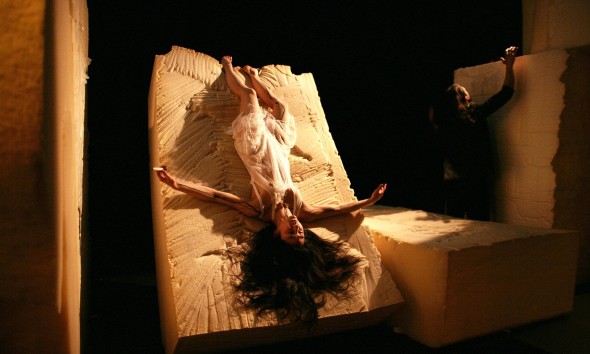
Federico Bonelli and Alessandra Ferri in Wayne McGregor’s Woolf Works (photo: Tristram Kenton)
Anyone who knows Wayne McGregor’s work to date would be hard pressed to guess he is the choreographer of the first act of Woolf Works, infused with literary weight and embodied in the lithe, tragic figure of Alessandra Ferri as Virginia Woolf. The act dances like a story; characters enter and leave through giant wooden frames that revolve slowly as they wait to be filled with or emptied of portraits from the past: lovers, her husband, and a soldier killed in the First World War. By her presence alone, it seems, Ferri holds McGregor’s hand and gently traces her movements. Her quality has a stillness that is foreign to the choreographer but he has made this work with her in mind and appears to follow her lead whenever she is on stage. In an interview with Sarah Crompton, Ferri, who returns to the Royal Opera House stage at the age of 52, puts her finger gently but firmly on the phenomenon we are seeing: “You have baggage which a young dancer cannot have because it comes with experience in life and on stage. I feel I am refined to the essential. Companies now, the world over, are very young. When I grew up here in this Company we had dancers like Antoinette Sibley and Merle Park who had a lot of experience. Michael Somes was still here. They had theatrical weight. Now, because the repertory requires these 20-year-old bodies, companies are very young and I think there is a link missing.’ She fills that gap; when she is alone, as she turns in on herself with soft, beguiling spirals, she is at her most expressive. As soon as the men begin to partner her — Federico Bonelli as her young lover or Gary Avis as her husband Leonard — McGregor’s choreography does not maintain those qualities and like a flower that is inexpertly pruned she withdraws from being Woolf to being manipulated. In her sapphic relations with the playful Francesca Hayward and Beatriz Stix-Brunell she is more at ease; women in McGregor’s universe know how to relate to each other.
Max Richter’s score is at its most refined in the first act, flowing like memories and ticking like time. The literary nature infects the scenic elements, too, not in its linear narrative but in the painting of inner emotions and thoughts, the stream of consciousness for which Woolf’s output was celebrated. Lucy Carter moulds Ferri and her lovers in an almost palpable emotion of light and haze and Ciguë’s frames change the perspective of now and then with a simplicity that belies — or because of — their scale. However, the panorama of Woolf’s garden at Monk’s House that is projected through the frames onto the backdrop takes us into the realm of an exhibition (for which much of the program resembles the catalogue).
Woolf Works is called a triptych because it joins three scenes from three of Woolf’s novels like an altarpiece of her life. The first, I Now, I Then is based on Mrs Dalloway, the second, Becomings, on Orlando and the third, Tuesday, on The Waves. Apart from Watson’s histrionics as a shell-shocked soldier, the fragile sensibility of I Now, I Then gives way to an excuse for McGregor’s standard overextended vocabulary in the time-travelling, shape-shifting central depiction of Becomings. Needless to say Ferri is nowhere to be seen, replaced by a willowy Natalia Osipova who, despite the choreographic desecration of the Woolf altar, makes an extraordinary statement of hyperextended sensuality. Around her is a chaos of couples and brutish couplings (McGregor has not mastered the idea of partnering) racing across a black reflective floor in exotic costumes of the centuries (by Moritz Junge) like figures by Hieronymous Bosch on ecstasy. It looks as if the choreographer has thrown everything he can into Becomings that the presence of Ferri elsewhere would not permit. It is also an occasion for a high-quality light show unleashed by both Carter’s ingenuity and the Opera House’s resources. The function of lighting is traditionally to illuminate the dancers but the level of production here puts lighting on a choreographic level.
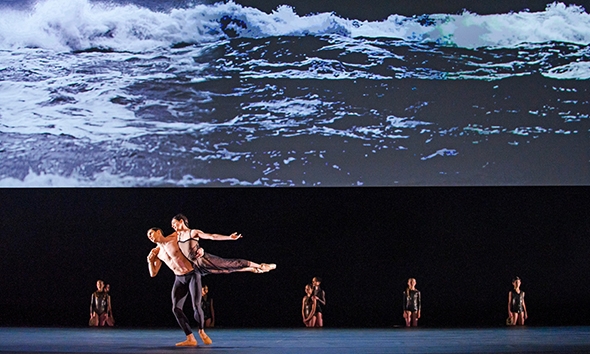
The final panel, as Ravi Deepres’ slow motion film of waves suggests rather redundantly, is from The Waves. Ferri is the central character again so McGregor is on his best behaviour, or almost. This is the scene where Woolf ends her life (she drowned herself in 1941 by walking into the river Ouse weighted down by stones in her pockets). The panel opens with a reading by Gillian Anderson of Woolf’s final letter to Leonard, a scene that doesn’t immediately suggest Ferri being partnered by a semi-naked Bonelli; it is an interaction that interferes with her lonely, tragic state of mind. There are children who rise on a lift at the back underneath the waves and play games on the shore with rope. They are the children of Woolf’s sister Vanessa Bell (though this is only evident if you read the program) in the form of Sarah Lamb. Ferri sits contemplating, then turns to watch her sister and nieces playing. She gathers her shawl and wanders slowly around the stage while other characters rise on the lift as if arriving on a platform at rush hour to surge on to the stage. McGregor revels in choreographic distraction so it takes concentration to follow Ferri as she keeps her meditative pace around the stage until she arrives in front of the crowd, facing them. Then she is inextricably upended by assorted men and passed between them as if her final parting were a social event. In The Waves she writes about death as ‘active, positive like all the rest, exciting; and of great importance — as an experience. The one experience I shall never describe.’ The choreography fails to take up the challenge. The projected waves gather velocity, the chorus retreats and Bonelli is left to drag Ferri’s dry body to its resting place.
When the curtain rises Ferri is alone on stage to receive the applause; it is apt, not only out of respect for the artist she is, but because she is the saviour of Woolf, not only of the Works but of the woman.
Posted: May 11th, 2015 | Author: Nicholas Minns | Filed under: Performance | Tags: Contemplating Distraction, Fenia Kotsopoulou, Giulia Tacconi, Interpares Project, Jonjo Keefe, Julie Havelund and Agnese Lanza, Julie Schmidt Andreasen, Kaleidoscopic Arts Platform, Konstantina Skalionta, Lucia Schweigert, Mara Vivas, Paul Vernon, Rian Dance, Rosa Manzi Reid, The Body Canvas, Trace, Urban Constellations | Comments Off on Kaleidoscopic Arts Platform
Kaleidoscopic Arts Platform, Testbed 1 @ The Doodle Bar, Battersea, May 6

Konstantina Skalionta and Lucia Schweigert (photo: Abigail Yue Wang)
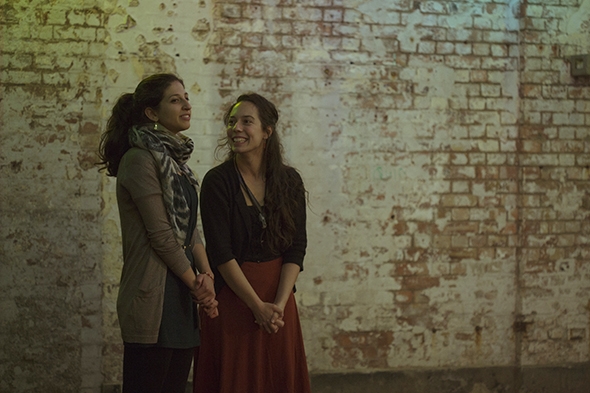
The Kaleidoscopic Arts Platform is ‘a new dance platform showcasing topical, physical and experimental dance works by emerging female choreographers.’ Its two producers are Konstantina Skalionta and Lucia Schweigert and this is their second event (a third is being planned for November). In a competitive cultural environment where initiatives seem to come to fruition or quietly die by virtue of their success or failure at the hands of Arts Council funding, it is heartening to find such entrepreneurs taking their dreams into their own hands and finding a way to make them work. There is no home theatre so the platform is conceived to take place in spaces not traditionally intended for dance. This one, part of Wandsworth Fringe 2015, is at Testbed1 @ The Doodle Bar in an old industrial building just behind the Royal College of Arts campus in Battersea. Three traps of black Marley on a concrete floor with vertically hung, coloured neon tubes mark the stage area but dancers are not confined to this. In other spaces of the building there are film projectors and fabric installations (by Bea Bonafini and Laura Elias) so the audience can mill around during the event.

Giulia Tacconi in Chance (photo: Abigail Yue Wang)
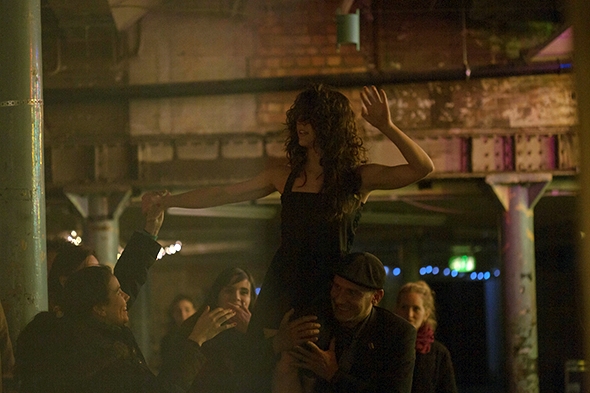
I was only able to attend the dress rehearsal so I missed the full promenade performance by Giulia Tacconi called Chance in which she dances around, amongst and with audience members. ‘When our body scans and researches movement, the most interesting and satisfying moments are the moments of surprise when the body creates new actions, gestures and feelings. They are so-called ‘chances’… From what I understand in talking with Tacconi, the ‘surprise’ is in both the body of the dancer and of the audience member with whom she chooses to interact: improvised contact in which both dancer and audience emerge with new experiences. Sorry I missed it.

Mara Vivas in Trace (photo: Abigail Yue Wang)
The first work on the program is a solo, Trace, conceived and danced by Mara Vivas and inspired by photographer Jon Crispin’s Willard Asylum Suitcase Project in which he has photographed suitcases stored in the Asylum long after the deaths of their owners. Photography is all about memory, a sliver of experience that remains alive for as long as the photograph lasts. In Crispin’s project he is not only recording the present but opening up the past. Vivas translates the suitcase into a freestanding dress (conceived by Matthias Strahm) in which she is both the contents and their stored memories. It is an idea that translates beautifully into dance and Vivas has the clarity of language to bring it to haunting reality. Her strong features remind me of photographs of Frida Kahlo and the intriguing black dress she wears has a bodice with vertical grillwork reminiscent of a cell door. Vivas traces memory, fixing her eyes on the past and using her arms as feelers around her, at one moment obsessively picking out details of her dress and at another searching space for a familiar compass sighting. She is both constrained by her dress and then excitedly dances it to a Hugo Diaz tango. There is a weight in her presence and a lightness in her sensibility as she sails out over the water, finally stepping out of her dress on to dry land and releasing the memories; she has gone but the dress and its traces remain.

Vasanthi Argouin, Francesca Sgolmin and Rosa Manzi Reid in Contemplating Distraction (photo: Abigail Yue Wang)
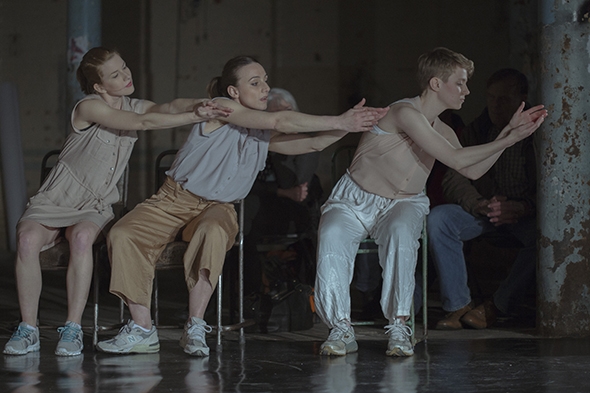
Rosa Manzi Reid’s Contemplating Distraction ‘explores the close relationship between focus and distraction in improvisation.’ The three performers — Reid, Vasanthi Argouin and Francesca Sgolmin — form Rian Dance. Coincidentally, ‘rian’ is an Irish word that means ‘trace’ or a path made by the passage of movement. The three women enter one by one and sit quietly on chairs as if in a waiting room. The movement is minimal, starting with half a smile and a surreptitious gaze and accumulating with successively larger movements of hand and body set to a musical hum arranged by Jonjo Keefe. Contemplating Distraction has a clear grammar with points of emphasis and stasis that keep it moving along its path in a playful way until it wanders off beyond the iron columns and the lights. All that is missing is the alchemy of presence that invests each gesture with a meaning beyond its physical expression.

Agnese Lanza and Julie Havelund in Acts of Attending (photo: Abigail Yue Wang)
In Acts of Attending Julie Havelund and Agnese Lanza draw inspiration from their audience through observation. As there were only two photographers and a ahandful of artists watching, their rehearsal may not be representative of their performance but they demonstrated the idea. ‘We take information from what we see, what we hear and what is around us and elaborate them through movement.’ Lanza holds a voice recorder as the two stand together on stage observing and recording the detailed movement and attributes of (in this case) the cameraman. They had previously recorded their observations of the space in which they will be performing and it is these two recordings that form the aural structure of their ‘elaboration.’ It is part of their Interpares Project which ‘allows a sense of “inter-pares” between ourselves and the shared space to emerge from the work.’ Spatial observation is one thing, spatial awareness another; it is these two elements that play with each other and sometimes in contradistinction during the performance. The use of Handel’s Lascia Ch’io Pianga suspends the space on another dimension but the choreography here remains grounded. Then we are back to the physical attributes of the cameraman that Lanza and Havelund enact from their recording before switching off the recorder and turning out the lights. Perhaps it is the quantitative rather than qualitative approach to their observation that restricts their response; something is holding them back, but it may again be the lack of a sufficient pool of human material.
Another coincidence of the platform is that one of the two films on show is about observation and movement. The Body Canvas, co-directed by Julie Schmidt Andreasen (who danced in Mara Vivas’ Triptych at Resolution! 2015) and Paul Vernon, makes a compelling visual link between the graphic artist’s eye and the dancer’s body: both are performing and the film is in turn a performance of their interaction, a depiction of the body drawn in space. The other film is Urban Constellations by Fenia Kotsopoulou in which dance and urban space are juxtaposed: wildness of movement against a concrete landscape, improvisation against choreographed architecture. The screen is divided by a line that descends slowly over the course of the four-minute film like an image being scanned; above is black and white that slowly displaces the colour. The Kaleidoscopic Arts Platform moves in the other direction, displacing the black and white of cultural expectations with the colour of creative realization. Bravo.
Posted: April 30th, 2015 | Author: Nicholas Minns | Filed under: Performance | Tags: Ahnen, Christiana Morganti, Ditta Miranda Jasjfi, Dominique Mercy, Julie Anne Stanzak, Lutz Förster, Marion Cito, Michael Strecker, Peter Pabst, Pina Bausch, Tanztheater Wuppertal Pina Bausch | Comments Off on Tanztheater Wuppertal Pina Bausch: Ahnen
Tanztheater Wuppertal Pina Bausch, Ahnen, Sadler’s Wells, April 25

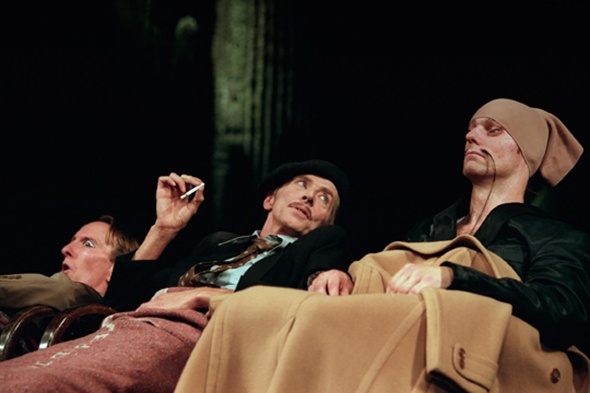
Dominique Mercy, Lutz Förster, Michael Strecker in Ahnen (photo: Laszlo Szito)
Pina Bausch once said in an interview, “Don’t try to understand me. Pay attention to the piece and then you’ll know.” At two hours and 30 minutes, some critics have found it difficult to pay attention to Tanztheater Wuppertal Pina Bausch’s Ahnen and resolve the issue by suggesting the work would be improved by editing (which means shortening). When asked what he was trying to say in a work he had just played, Beethoven apparently simply played it again. With digital recording technology we can listen to music over and over again whenever we wish and come to ‘understand’ it in the way Beethoven meant, but this is not the case with dance. In one viewing one cannot possibly understand the complex layering of fragments that constitute Ahnen; but you can pay attention. In the same way we cannot possibly understand the complexity of daily life but we can pay attention to what is going on around us. We can notice how people walk in the street, how they hold themselves, how they look, how they sit at a café table sipping coffee, what they are eating and what dietary trend they might be following; how people argue amongst themselves, how violence can seep into a conversation and how gestures speak volumes. How old age has its serenity and its loneliness and how desperately funny some situations are. How unconnected events carry on in the background while something else is happening right in front of us and yet in the visual plane, like a photograph, they are connected. How we think, how fear can dominate our thinking, how memories hold us in their powerful gaze, how the erotic can manifest so suggestively or be suppressed, how rituals can inform our way of life, how the actions of others can appear to start and end without warning as we pass by. How we victimise others in our thoughts and imagine ways of dealing with them; how appearances can be deceptive; how we might hide our true feelings; how music affects our perception, how landscape affects our mood. How newspaper images can appear surreal in the context of our viewing. Bausch is an acute observer of human life and she trained her company to observe. Each of her works is the sublimation into a theatrical form of months of observation by the entire company, of choreographic ideas, of questions and responses, of images, of musical suggestions, possible set designs and endless editing. And yet what may have started as personal observations or reflections has a universal value. If we pay attention we may even see ourselves.
Bausch once said, “Each person in the audience is part of the piece in a way; you bring your own experience, your own fantasy, your own feeling in response to what you see. There is something happening inside. You only understand it if you just let that happen; it’s not something you can do with your intellect.”
Like a beautiful photographic image, Ahnen, like all of Bausch’s works, is wrapped in a seductive visual package; each small element — costumes (by Marion Cito) and props (from café tables to sewing machines to a full size walrus) — and the overall design that Peter Pabst makes into a single set like a frame through which we see the characters but which is also an integral part of the action. The stage is a forest of cacti, some giant some smaller, some like caricatures of silent semaphore and others, like the one dead centre, light-heartedly phallic. According to Sarah Crompton’s interview with Pabst in the program, there was a lot of fun in the making of this set. ‘The inspiration was “just a photograph of a landscape full of cactus which I thought was nice. Somehow Pina liked it too.”’ To make the model Pabst ‘went to the café where Bausch bought cakes each day and asked for a piping bag, which he filled with soft plaster and piped his cactus — all 60 of them.’ Once the production company had made them stage size, Pabst found the solution for the needles: an old factory on the outskirts of Wuppertal where they made brooms with nylon bristles. Helped by ‘everyone in the theatre’ to fix the needles in time for the opening, Pabst then blasted each spike with the heat of a paint stripper to make it less regular. “I started a third career as a hairdresser to cactus…It was very silly and very funny.” It is worth remembering this ludic creativity so as not to approach a work like Ahnen with too much seriousness. It is a notion that Christiana Morganti touches on: ‘I really don’t have anything to say; I just wanted to show you how I look…Actually I don’t give a shit. Actually I do give a shit but it doesn’t matter, right?’
Bausch again: “Dancers ask me always ‘What are we going to do; what will it be in the end?’ I can never answer this, because the thing is I don’t know too what it’s going to be. And somehow it happens. I just make the way it happens.”
There is a poignant sense of looking back in Ahnen, a respectful nostalgia that the music conveys, that Julie Anne Stanzak embodies so hauntingly with a love heart painted on her face looking wistfully at her past as she tries to rub clean her slate; that the great wind machine suggests as it blows newspapers across the stage while a stoic Jean Laurent Sasportes in American Indian headdress guards his ancestral ground; that is enshrined in Ditta Miranda Jasjfi making offerings to the egos of the house and the squirrels and touched with humour as Dominique Mercy, wrapped in a deckchair, sings L’Amour Est Un Oiseau Rebelle from Carmen while Lutz Förster next to him translates it phrase by phrase to an impassive Michael Strecker replete with Manchurian whiskers and elongated eyes. There is an added poignancy to this nostalgia: Ahnen shows the company dealing with its own past while living fully in the present.
Posted: April 22nd, 2015 | Author: Nicholas Minns | Filed under: Performance | Tags: Image, Jacksons Lane, Natalie Reckert | Comments Off on Natalie Reckert: Image
Natalie Reckert, Image, Jacksons Lane, April 18

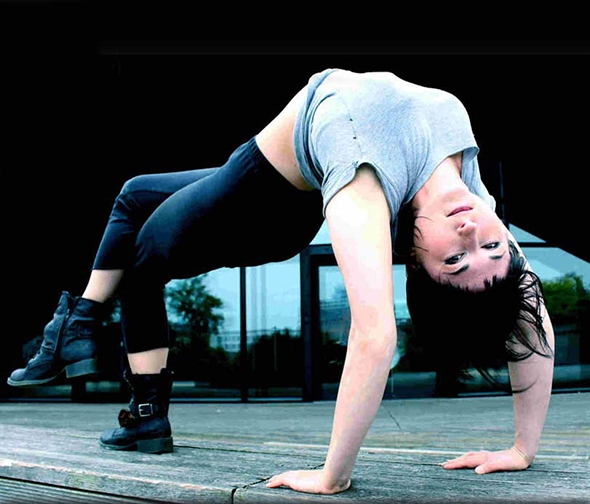
Natalie Reckert
Natalie Reckert graduated from Circus Space in 2007 with hand balancing as a main discipline. Wanting to broaden her horizons, she spent a year at a dance school in her native Germany called Visions in Motion. Back in the UK she has performed with Stumble Dance Circus, The Sugar Beast Circus, The Generating Company and Collectif and Then (also on this Jacksons Lane Frantic Evening program with Acrojou). Image is, I believe, Reckert’s first attempt at creating a solo that brings together her skills and experience. ‘The desire to make a solo show came out of the research project Labor Cirque in Köln in 2013, an interdisciplinary attempt to understand the composition, dramaturgy and specific movement vocabulary of contemporary circus.’
Her skills in hand balancing are phenomenal and she is bubbling with ideas and ‘stability experiments’ to try out in front of us. At the very beginning she banishes us to the lobby with instructions to return after a minute. ‘It’s a social experiment,’ she says later. When we return she is standing on her hands and remains so until we are all seated and quiet (some time). Reckert has enough air in her lungs to maintain a monologue in whichever orientation she happens to be, and her monologue is carefully conceived to act as a rhythmic device for her performance. Phrases will repeat (‘My name is Natalie and I like doing handstands’) with engaging self-confidence and delivered with a devilishly dry sense of humour.
She has a predilection for stalking upside down amongst a dozen eggs with an accuracy of a mother hen (her agility has a birdlike quality) and to prove they are raw she deliberately falls on them one collapsing, messy handstand after another, like Michael Strecker sitting on the balloons in Tanztheater Wuppertal’s Auf dem Gebirge. But Pina Bausch framed Strecker’s actions in a surreal setting with a surreal costume and he is deadpan in his delivery. Also there is very little skill in popping a balloon by sitting on it. Reckert’s skill is evident in making the handstand and she is breaking the eggs to make a point. There is no point in Strecker’s act; that’s the point. Reckert also dances in Image, though she limits her movements to a gestural language that she performs upright and upside down to an electronic beat.
Now for an apparently controversial aspect. At the beginning of Image Reckert pulls from the wings a paper confection in the form of a flat-topped pyramid. When the time comes she drags it to centre stage and sets to ripping off the paper to reveal….a handstand table with its instantly recognizable invitation to perform a specific circus skill. Why is this controversial? She tells me afterwards that her fellow circus graduates are sharply divided as to whether to admit to the stage the props on which they learned their art or to leave them off (it would certainly be easier for Reckert to abandon the handstand table than for Collectif and Then to abandon their ropes or for Acrojou to abandon their German Wheel). Reckert decides to keep it in Image and performs some remarkable balances on it while keeping up her monologue or dancing her legs and a free arm with the coordination of a conductor, but whatever she does cannot hide the unmistakable circus signpost. It is as if she is still pulled between the desire to perform the skills she has learned so well and the desire to find a new form for her circus art.
Thinking of Bausch again, I wonder if before the form must come a creative, imaginative process to bring out unique elements within Reckert that will allow her physical skills to coalesce into an engaging, funny, visually coherent, skillful whole. She is quite capable of it; we all have many images, and this is only her first.
Posted: April 22nd, 2015 | Author: Nicholas Minns | Filed under: Performance | Tags: Alexander Ruth, Amy Hollinshead, Artur Grabarczyk, Audrey Rogero, Aya Steigman, Fleur Darkin, Francesco Ferrari, Miann, Naomi Murray, Quang Kien Van, Scottish Dance Theatre, The One Ensemble | Comments Off on Scottish Dance Theatre: Miann at Queen Elizabeth Hall
Scottish Dance Theatre, Miann, Queen Elizabeth Hall, Southbank Centre, April 9

Amy Hollinshead in Fleur Darkin’s Miann (photo: Brian Hartley)
The word ‘miann’ is Gaelic for ‘the ardent desire to know God.’ Ardent is the operative word in Fleur Darkin’s new work for Scottish Dance Theatre not only in terms of the choreography but in the music of The One Ensemble who play live on stage. Miann is also a spiritual work that battles with death and separation not in philosophical terms but in a visceral, personal confrontation that commemorates Darkin’s stepfather. Darkin’s description of the work is every bit as passionate as her choreography: ‘I wanted to create a space that we could share. I wanted the music of The One Ensemble to ring out like a thunderstorm shaking our bodies. I wanted the dancers to remind us that life is felt before it is thought about. I wanted us to taste the fresh water, breathe in forest air and feel the willow under our bare feet. I wanted to prove that feelings are real. I wanted a space where the invisible might be felt. I wanted a space to honour my parent…I wanted to create a gift out of dance.’ Seeing Miann is to embrace these words in physical form.
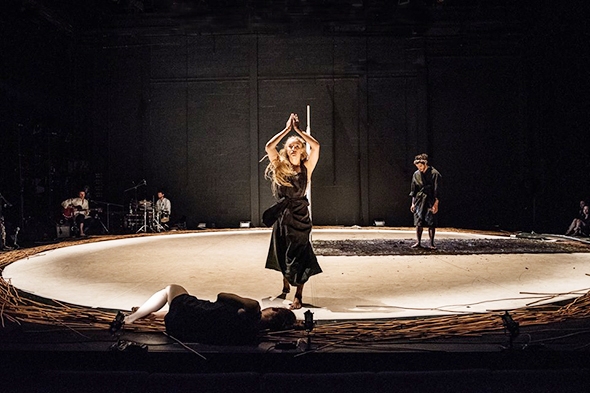
With no curtain at the Queen Elizabeth Hall we have plenty of time to contemplate the set. Designed by Alexander Ruth and lit by Emma Jones, it looks as if it was conceived for in-the-round performance: a circle of white floor in the middle of which is what looks like a sundial or a sail on its mast. All around the white circle are bundles of dry branches and beyond them towards the back are the spaces for the four musicians and their instruments. On either side at the front of the stage are two urns of flowers that Audrey Rogero and Naomi Murray pick up and hold like living statues at the entrance to a cemetery. The smoke that issues from the urns is probably dry ice that looks like incense for there is no fragrance. I suspect Darkin’s original idea of immersing our olfactory senses in the production has been compromised by health and safety (another administrative incursion into the production is that after Rogero and Murray circulate with their urns through the audience and return backstage the QEH reminds us to turn off our mobile phones).
In her program note, Darkin references the Callanish stone circle on Lewis, a landscape in which she ‘wanted us all to get lost…with no story, no orientation points, only beckoning paths.’ When Amy Hollinshead first appears on stage she has muddied limbs and hands as if she has been running and slipping among the stones on a wet day; she carries with her the evidence of the wild countryside but it is not embodied in Ruth’s clean and dry construction; I keep wishing for a simple stage of turf or peat. Hollinshead sets the physical tone of the choreography in jumping frenziedly, repeatedly, exhaustively to the sound of her exertion. It is a motif that will return poignantly at the end suffused with uncontrolled grief and anger. On this occasion it is the anticipation of Francesco Ferrari’s arrival — the loved one — who wraps her, after some trepidation on her part and some coaxing on his, in his long cloak (Ruth’s costumes, as one might expect from a fashion designer, excel here). The other dancers enter as different manifestations of filial grief: a stoic Quang Kien Van in a dance with ritual overtones, a tentative or agnostic Matthew Robinson and a maternal Aya Steigman carrying her child (Murray) clasped to her front. The ensuing mêlée of dancers running, rolling and hurling themselves to the floor is like a wild mating game of sensual, brutal proportions. But this is not narrative; this is raw, primal emotion expressed in familiar human patterns; the message is in the rawness not the patterns. Steigman and Murray work like demons to rip up part of the floor to reveal turf: a funeral plot before the grave is dug. Artur Grabarczyk dances a powerful, erotically charged duet with Murray while Steigman remains motionless on the grave and the other dancers make their reptilian way around the branches like the circular path of life. When Ferrari has completed his circle, Murray brings in a crown of flowers with which she finally crowns him like a chosen one. He watches Hollinshead don a black mourning shroud and the sundial/sail element becomes a metaphor for the river Styx that the Greeks represented as the division between life and death. As Ferrari passes through to the other side, Hollinshead tries to follow. Her final outburst and the communal response is an apotheosis in dance and music of heroic proportions.
The depth of Darkin’s emotion is clearly a powerful creative force. Her physical movement phrases have the authenticity of grief and anger and she has harnessed the force of the music to amplify them. She seems to drag her dancers into the ring and they give themselves fully to this production, a quality in Scottish Dance Theatre that is impressive. When I first saw them it was at the very beginning of Darkin’s appointment in a double bill of Jo Strømgren’s Winter, Again and Victor Quijada’s Second Coming; it was a wonderful cast but one of the difficulties with a change in artistic direction is a possible (some may say inevitable) shakeup in dancers. I hope Darkin can keep the present dancers together; they are well worth watching. In a performance like Miann there are enormous benefits when the dancers are used to each other, open to each other and familiar with the way they each move.
If only the setting could descend to the earthy intensity of the music, costumes and the choreography…
Posted: April 20th, 2015 | Author: Nicholas Minns | Filed under: Performance | Tags: Andreas Eisenschneider, Auf dem Gebirge, Ditta Miranda Jasjfi, Dominique Mercy, Hannah Weibye, Lutz Förster, Matthias Burkert, Michael Strecker, Peter Pabst, Pina Bausch, Sarah Crompton, Tanztheater Wuppertal Pina Bausch | Comments Off on Tanztheater Wuppertal Pina Bausch: Auf dem Gebirge
Tanztheater Wuppertal Pina Bausch: Auf dem Gebirge, Sadler’s Wells, May 17

Tanztheater Wuppertal Pina Bausch in Auf dem Gebirge (photo: Karl-Heinz Krauskopf)
What a pleasure to see Pina Bausch’s Tanztheater Wuppertal again at Sadler’s Wells; quite apart from the stimulation of Bausch’s scintillating and dark imagination it is the quality of performance that is so refreshing. Dominique Mercy and Lutz Förster’s soft shoe duet in the second half of Auf dem Gebirge is brilliant in its shabby simplicity, in its evocation of master and servant, of old friends, of two clowns or tramps, all in one. Michael Strecker’s, fleshy, disfigured presence doesn’t miss a menacing beat throughout and Ditta Miranda Jasjfi’s tearful stand interrupted by the audience piling out to the bar in the intermission is theatrical presence on a stoic scale. The entire company is as note perfect as a fine symphony orchestra and they perform without their conductor. They reveal themselves in all their simplicity and complexity; that is what Bausch wanted of them. It occurred to me that for each member of the company the performance of Bausch’s works since her death must be a form of re-living her constant enquiry and coaxing (however hard that might have been) that are at the heart of each work. In her obituary of Bausch in 2009, Deborah Jowitt mourned for the company as ‘a particular, intimate extension of her own body and creative mind.’ Fortunately, like a family that has survived the departure of a parent, her company is still performing in her spirit.
Another aspect of a Bausch performance is the completeness of the elements. The music is never simply an accompaniment but a calibrated tuning of the drama through Bausch’s long collaboration with Matthias Burkert and Andreas Eisenschneider; Auf dem Gebirge’s score comprises a crackly recording of Billy Holiday’s powerful Strange Fruit, a symphonic anthem by Mendelssohn, rock and roll, songs sung by the dancers and a brass band playing on stage. And then there are the settings, the visual frame of the dramas. In an interview with set designer Peter Pabst in the program, Sarah Crompton reveals the way he worked with Bausch: ‘Pabst would spend time in rehearsals as Bausch asked the dancers questions and they responded. As he watched, ideas and images would come into his mind, and he would begin to place drawings and photographs on the large table where Bausch sat. “If she didn’t say anything, I would just take it away and try something else because apparently it was not good enough. I would never try to push anything — it had to be so good that she would react.” Pabst describes Auf dem Gebirge as a ‘collection of images which are created by the dancers on stage, so I don’t think I made a model.’ He found himself thinking of a ploughed field. “It was a period where Pina was interested in reducing dance. She liked the idea of having really difficult ground — grass in 1980, carnations in Nelken, and this” — ‘this’ being a stage with a slight rake covered in 10 cubic metres (or 2 tons) of soil.
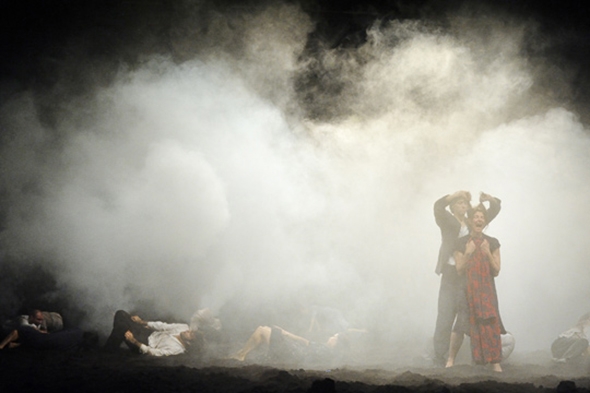
Auf dem Gebirge (or to give it its full name, Auf dem Gebirge hat man ein Geschrei gehört, which translates as On the Mountain a Cry Was Heard) is stark, both in its burnt earth landscape with felled fir trees and smoke and in its choreographic imagery. The title refers to Herod’s murder of the innocents (Hannah Weibye nails it precisely) but even without this knowledge it is Bausch’s imagination — by definition outside the realm of rational dissection — that allows us the freedom to respond to her work in our own way. If we laugh — and there are moments of parody and surreal imagery in the darkness — cry, are outraged or annoyed, we will not be unmoved.
This is perhaps because Bausch shares her work with her dancers; she does not direct them to illustrate her observations (as a painter might direct his or her own imagination on to the canvas) but allows them to respond to her questioning. An idea in her head might appear on stage diffracted through a dancer’s own sensibility even if it remains anchored to her original stimulus. The resulting images, edited scrupulously by Bausch, do not form a linear narrative but are imbued with a time and place, many times and places, or the same time and place repeatedly. She deals in the perception of vertical time on stage — the intensity of fragments of time —while we in the audience might be concerned with horizontal time, looking for the links between those moments. In this sense her work is filmic, moving forwards, backwards and sideways, up and down to capture a form for her imagination. Perhaps Pabst’s style of working with Bausch is similar to the way the dancers worked with her. If they responded in a way that caught her imagination she could work with it. If not, it didn’t appear. It says a lot that these dancers were raised to always strive to bring out their full potential for Bausch; she was the choreographer but also, as she insisted, part of the audience. Now she is gone, they can strive only to perform these works to the best of their ability. It raises questions for the future, but for now we are fortunate to be able to see them at work.
From Thursday until Sunday this week the company will be performing another work from the 1980s: Ahnen. Treat yourself to a ticket if you can.
Posted: April 18th, 2015 | Author: Ian Abbott | Filed under: Performance | Tags: Ian Abbott, Jasmin Vardimon, MAZE, Turner Contemporary | Comments Off on Jasmin Vardimon Company: MAZE
Jasmin Vardimon Company & Turner Contemporary: MAZE, Winter Gardens, Margate, April 11
By Ian Abbott

An scene in Jasmin Vardimon Company’s MAZE (photo: Martin Godwin)
‘Show not what has been done, but what can be. How beautiful the world would be if there were a procedure for moving through labyrinths.’ (Umberto Eco)
Nothing has shifted.
MAZE offers no prologue, no rules and no explanation; therefore everything is permitted. As the audience (30 capacity) are de-coated, de-bagged and de-shoed in airlock settings and broken down from 30 to 10 we are eventually granted permission by a MAZE Guardian to enter. A labyrinth has but one path; to qualify as a maze there must be choices and it is when we’re finally permitted to enter one at a time that we are presented with our first choice. Left or right? Philosophically this idea of choice is central to the work; MAZE is an offer to engage, to play, to look and to share as much or as little as you’re willing to in a cathedral of foam with 20 performers for 35 minutes.
I entered MAZE twice (the one in the afternoon is a place where children are welcome and the one in the evening has some amended content and is suitable for adult eyes only). In the afternoon I gobbled up experiences and was hungry for content; I frenzied around MAZE, mimicking the intensity of the performers. The eruptions of movement, the slamming of self and others into foam walls was enhanced by the close proximity of my witnessing. The brutal and technical physicality which Vardimon’s choreography demands resonated much deeper for me than when it has previously been presented on a stage. I left MAZE drunk, having thrown, rolled and foamed myself senseless in this new world.
‘It is the cardinal difference between gift and commodity exchange that a gift establishes a feeling-bond between two people.’ (Lewis Hyde)
For my second entrance I chose to behave differently; to dwell in spaces more, to follow performers, let experiences unfurl, deepen my interaction and actually taste the MAZE. This approach offered a rewarding and embedded experience; more akin to the agency experienced in a computer game. I oscillated between two single characters who were giving me tasks to complete with miniature rewards in return and it was this ability to alter the course (not of the whole) of my experience that created a tissue of connection between myself and MAZE. One time I alone witnessed a depraved act and after it was complete the perpetrator buried me in foam and escaped from me and the echoes of the space.
In both performances, as I poured myself into the moment I was choosing to commit to, I recognised that there are many other moments (hidden exchanges, group choreographies, intimate moments of revelation) that are happening and I could be experiencing, but was not. I resolved this envy of the other and resisted the pull of what could be as these were the internal ceremonies and external theatres that I had chosen to be a part of.
The level of preparation and the ability to improvise when the performers had no control of what was going to happen or what an audience member would say to them left me feeling confident that they were able to deal with any interaction. This confidence and ability to shift and flex alongside the material triggered an instinct in me to acknowledge the intensity of the gaze and fix my eyes onto theirs.
You can decide to stand still and in that same act, you can decide you’re waiting for something. Nothing has shifted. Everything has shifted.
In such a highly controlled entrance and immersion in a space, the ending and exit of this clearly defined world felt inconsistent. We were offered the possibility of an awkward wedding dance duet outside the structure with one of the company and then left to drift away of our own accord. However, it will be the previous 35 minutes that linger longer as those exchanges are embossed on my skin and still ricocheting around my brain.
‘If you follow your bliss, you put yourself on a kind of track that has been there all the while, waiting for you, and the life that you ought to be living is the one you are living. Wherever you are – if you are following your bliss, you are enjoying that refreshment, that life within you, all the time.’ (Joseph Campbell)
Posted: April 16th, 2015 | Author: Nicholas Minns | Filed under: Performance | Tags: Avatâra Ayuso, Bayadère - The Ninth Life, Dance Making in the High Street, Dance UK, Gabriel Prokofiev, Shobana Jeyasingh, Sooraj Subramaniam, Teerachai Thobumrung, The Point | Comments Off on Shobana Jeyasingh: Bayadère – The Ninth Life
Shobana Jeyasingh: Bayadère – The Ninth Life, The Point, April 2

Shobana Jeyasingh’s company in Bayadère – The Ninth Life (photo © Beinn Muir)
I have to admit Shobana Jeyasingh’s new work, Bayadère – The Ninth Life baffled me at first; I couldn’t see a line through it. It is divided into three seamless acts but the first two look backwards in order for the third to move forwards. The past, like the ballast that it is, creates a certain resistance.
The work references the classical ballet, La Bayadère, choreographed in 1877 in Imperial Russia by the French ballet master Marius Petipa to a score by the Austrian composer Ludwig Minkus based on a story of Indian devadasi, or temple dancers. Jeyasingh’s attention is on the cultural inaccuracies in the production she saw some years ago: ‘I was bewitched by the choreography and the dancing. The poetic Kingdom of the Shades had me mesmerized. However I left the performance unsettled and with many unexpected questions. Why did the characters greet each other with such an un-Indian gesture? Why did the holy man (the fakir) move in an animal-like and servile manner? Why did the attendants of the golden dancing idol have blacked-up faces and dance so naively in contrast to the rest of the cast? Why was the Hindu temple dancer more reminiscent of an Ottoman Odalisque with matching water pot? I wondered just how much information about India was available to Europe at the time of the ballet’s creation in 1877.’
Such questions underlie a deeper concern, something Jeyasingh elaborated in a challenge to the dance community called Dance Making in the High Street at the recent Dance UK conference. The challenge is to cultural authenticity. Jeyasingh suggests the inaccuracies in La Bayadère stem less from ignorance in the west about India as from a deliberate manipulation of the facts to fit a contemporary image of the country’s culture. Jeyasingh cites a story from the nineteenth century ballet critic (and author of the scenario of Giselle) Théophile Gautier. Having seen a performance in London by Marie Taglioni in the role of a devadasi, Gauthier was perplexed by the appearance in 1838 of a troupe of genuine devadasi on tour in Paris. He tried to reconcile his vision of Taglioni with the genuine article in the person, particularly, of one of the dancers, Amany, about whom he wrote at length. Whatever his own feelings about Amany, Gautier realised that Parisian society was less interested in the real person than in the romantic fiction.
As an Indian choreographer living in England with an established company of dancers of several nationalities, Jeyasingh states that such cultural attitudes are still at play. ‘In dance we have an urge to see Indians produce art that delivers the comfort of knowing that it fulfills somebody else’s idea of what Indians do.’ At the conference two of her dancers, Avatâra Ayuso and Teerachai Thobumring, perform fragments of her Bayadère choreography that derive from what she calls ‘the high street’ of British choreography, a place where ‘people are in a constant stage of emergence.’ The dancing is authentic, luminous, intricate and emotionally powerful.
In effect, Jeyasingh has put these three elements together in her new work: it begins with the historical context of La Bayadère — a kind of lecture demonstration in which a blogger describes his experience of seeing a recent production as the dancers take on the roles of the scenario — followed by an exotic tableau of a devadasi (subtly embodied in the male body of Sooraj Subramaniam) being sniffed, tugged and inspected by an adoring public, and a final section in which Jeyasingh gives free rein to her own choreography. It is not without irony that the dancers enter in similar fashion to the famous entrance of the Kingdom of the Shades. Gabriel Prokofiev’s score samples that of Minkus but like Jeyasingh’s choreography finds its own contemporary identity.
I was more convinced of Jeyasingh’s position watching her Dance UK talk than watching Bayadère – The Ninth Life; at the conference the ideas and the choreography had a magical unity whereas the performance was like seeing the argument processed through three different choreographic filters. Of course at the conference she is addressing the dance community and its governing bodies — with whom she clearly has outstanding issues — whereas the new work is aimed at general audiences. But I am not convinced she needs to do this at all; Strange Blooms that I saw at the end of 2013 had already jettisoned any extraneous cultural identity. Jeyasingh has one of the most interesting minds working in choreography today but this recent effort to justify her position detracts from her full potential; poetry is one of the first elements to submit to the dictates of rational argument. Perhaps Bayadère – The Ninth Life is simply one of those necessary stages of Jeyasingh’s creativity that, once expressed, will lead to new work that will speak unerringly for itself.
Posted: April 12th, 2015 | Author: Nicholas Minns | Filed under: Performance | Tags: George Balanchine, Hofesh Shechter, Holly Waddington, Laura Morera, Lee Curran, Nell Catchpole, Paul HIndemith, Royal Ballet, Sir Kenneth MacMillan, Song of the Earth, The Four Temperaments, Untouchable, Zenaida Yanowsky | Comments Off on The Royal Ballet: Triple Bill (Balanchine, Schechter and MacMillan)
Royal Ballet, Triple Bill, Royal Opera House, March 30

Hofesh Schechter rehearsing The Royal Ballet corps and soloists in Untouchable
The history of a ballet is fascinating but it’s not what you see on stage. A work might be a masterpiece in the canon of ballet history but if it is not danced as a masterpiece what have we just seen? George Balanchine’s The Four Temperaments, with a brilliantly melodic, syncopated score by Paul Hindemith, is ‘a dance ballet without plot’, and is based on the ancient notion that the human organism is made up of four humours or temperaments: melancholic, sanguine, phlegmatic and choleric. Balanchine (who commissioned the score) said of his ballet that he had made a negative to Hindemith’s positive plate but as danced by the Royal Ballet this evening something seems to have gone awry in the darkroom. The positive aspect of the score is there, with pianist Robert Clark and the Orchestra of the Royal Opera House under the baton of Barry Wordsworth, but the dancing, with one or two exceptions, is not as closely matched as Balanchine designed it. Writing in 1952 Edwin Denby described The Four Temperaments as ‘developing a ferocity of drive that seems to image the subject matter of its title: internal secretions.’ Apart from Yuhui Choe and Alexander Campbell in the second theme, a moment when Federico Bonelli comes alive in the second variation and Zanaida Yanowsky’s arresting performance of the Choleric variation, Denby’s ‘ferocity of drive’ is replaced by a pusillanimous parade of Balanchine steps; the jazz-inspired hip movements barely register, the wit is missing and the precision of the choreography abandoned in the execution of the steps. The production is credited as staged by Patricia Neary, but that was possibly when she first set it in 1973. I wonder when it was last visited by Neary or anyone else from The George Balanchine Trust. In its present manifestation, it feels like Balanchine by numbers — or in choreographic terms, by notation.
Hofesh Schechter’s Untouchable, his first work for the Royal Ballet at the invitation of director Kevin O’Hare, is borrowed from his previous work; rather than developing new ideas inspired by new dancers he has simply drawn the new dancers into the comfort of his own mould. Untouchable has costumes with a military theme by Holly Waddington and apocalyptic lighting by Lee Curran who uses industrial amounts of haze and banks of lights to create a total scenography from which the dancers emerge at the beginning and into which they disappear and reappear throughout the work. But Schechter’s swarming choreography and Nell Catchpole’s score (to which Schechter contributed) fuse so seamlessly that Untouchable lacks any contrast; it looks like the staging of something that should be happening but never does. One interesting aspect of the work is that Schechter works only with the corps and soloists: there are no officers in this army as the choreography emphasises. No doubt the administration is happy to have sold out these performances but the programming of Untouchable seems to have less to do with the future of ballet — a topic O’Hare is discussing at the Dance UK conference this weekend — than with making money from a popular choice of choreographer.
The psychological baggage of Untouchable may have a closer affinity to Sir Kenneth MacMillan’s Gloria than to his Song of the Earth but it is the latter ballet that the Royal Ballet choses to program this evening. Song of the Earth is, like Balanchine’s The Four Temperaments, a milestone in the choreographer’s creative output, a beautiful work that sets Mahler’s symphonic song cycle Song of the Earth to dance. It was not thought acceptable by the Board of the Royal Ballet at the time to choreograph Mahler so MacMillan had to create it on John Cranko’s company in Stuttgart. Happily the value of Song of the Earth has been vindicated since the Royal Ballet took it into its own repertoire 100 performances ago. Not all performances are equal, however. This evening, Laura Morera as the woman in white is the only vestige of transcendent beauty against a rather dense barrier of emotional inertia. Nehemiah Kish’s entrance as The Man — the very first entrance in the ballet — does not augur well and Edward Watson’s subsequent entrance does little to suggest he is the powerful messenger of death. The corps of men has a fey element or two that disturbs an otherwise grounded chorus into a discordant group; the women fare much better and Morera has some strong support in her chorus but she has to struggle too much to establish her emotional credentials with her Man and Death. In a score that is so thoroughly imbued with Mahler’s own struggle with love and death the conviction and sensitivity of this trio is essential to the success of MacMillan’s choreography. Morera’s force of character is convincing but the relationship is not.
Posted: April 2nd, 2015 | Author: Nicholas Minns | Filed under: Performance | Tags: Alisa Boanta, Benjamin Hooper, Cornelia Voglmayr, Dani B Larsen, Elisa Vassena, Jack Bishop, Nina Kov, Robert Guy, Rosie Terry, Tim Casson, Tim van Eyken, Tom Butterworth, Wild Card | Comments Off on Wild Card: Tim Casson & Friends
Tim Casson & Friends, Wild Card, Lilian Baylis Studio, March 18

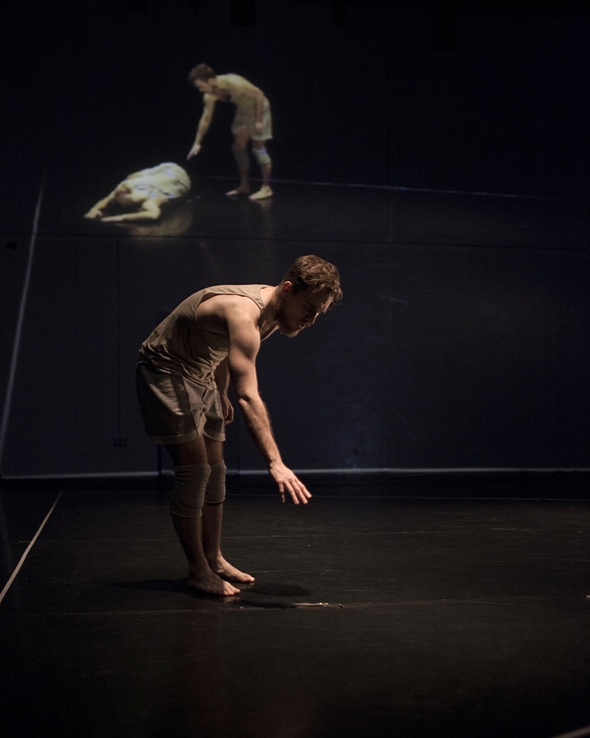
Tim Casson on stage and on film in Fiend
There is something so ebullient about Tim Casson that his Wild Card evening at the Lilian Baylis Studio is bound to be a lively occasion. He takes over the Garden Court Café, the Khan Lecture Theatre as well as the Studio stage and fills them with dance appetizers and main courses that will cater for a broad range of tastes. Oliver Fitzgerald, Chloe Mead, Sarah Blanc and Jen Irons collect stories (in the nicest possible way) from people in the café prior to the main performance to gather material for a dance they will perform later on stage; this is the latest incarnation of Casson’s groundbreaking, record-breaking The Dance WE Made. While we are watching the first part of the evening on stage, these four dancers are editing and rehearsing their accumulated phrases for performance in the second half.
In the half hour before the main performance (it is also repeated in the intermission) Casson curates what he calls First Contact in the Kahn Lecture Theatre, bringing together two pairs of artists who have not worked together before, one a dancer and the other an artist from another discipline. Each pair has been given a speed-dating two days to come up with a collaborative work (collaboration is the name of this evening’s game). The first pair is filmmaker Alisa Boanta and dancer Robert Guy, the second actor/musician Tim van Eyken and dancer/choreographer Dani B Larsen. In Dust You Are Boanta projects a film on to Guy’s bare back that makes him both tactile screen, a live chakra model and actor in his own drama. The film is so cleverly filmed and projected that it is difficult to differentiate the filmed movements from Guy’s own. Van Eyken sings a ballad of a young man lost at sea while Larsen embodies his lover in her interaction with both the story and the storyteller.
On the Studio stage Casson presents three works that continue the theme of collaboration: works by Nina Kov, Cornelia Voglmayr and his own Fiend. Kov’s Copter was first seen as a Place Prize commission in 2012 but she has subtly reworked it from being a duet between a dancer and a remote controlled helicopter to a fable of human interaction with machine. Kov has also removed herself from the protagonist role, allowing her the distance to mould the choreography on Rosie Terry while the copter pilot is the ace Jack Bishop. I remember seeing the original and being more aware of the copter than of the dancer but Kov has now balanced the work to show a charged relationship between the two that runs the gamut from touchingly playful to coldly voyeuristic.
In Voglmayr’s Sonata in 3 Movements dancer Elisa Vassena and violist Benjamin Hooper create a deconstructed sonata in which the dancer’s body, the viola player’s body, the viola and the bow all have a significant and interchangeable role to play. Hooper begins by laying his viola on its side and lying on his back behind it. He reaches over his head to pluck the opening phrase of the glorious Prelude to Bach’s cello suite No. 1 with Vassena dancing her torso on his upturned knees. Throughout the work Voglmayr mischievously sets Hooper an obstacle course, both physical and mental, that tests his ability to return to the Prelude. In the second movement, Vassena gives Hooper a lesson in dance imagination: ‘take your sitting bones for a walk’, ‘imagine your pelvis coming out of your mouth’ ‘imagine yourself a pillar of ashes and your cells are disappearing in the universe’ to which Hooper valiantly submits with hilarious results. In the third movement Vassena holds the bow between her foot and her ear and Hooper presses the viola strings against it to play Bach’s notes in unfamiliar but recognizable fashion. It is a blurring of the familiar demarcation between musician and dancer that is witty and rewarding. Hooper gets his virtuoso moment in the coda while Vassena sits at his feet seemingly unmoved until she gets up and nonchalantly walks him off.
Casson’s Fiend (his definition of wild card?) is a collaboration between himself and computer programmer/operator Tom Butterworth with whom he shares the stage. The work is based on Nijinsky’s ballet L’Après-midi d’un faun where Casson is the faun but his nymphs are multiple images of himself captured in various poses and phrases by an onstage camera that Butterworth then loops on to the backdrop screen when the choreography demands: Butterworth improvises the transference of Casson’s movements on stage so that his screen image interacts with his nymphs. It is complex and the only way to see the logic of it is to watch the screen. Casson is using the technology to explore the dual nature of watching and being watched in an environment of digital manipulation and his adoption of Nijinsky’s lecherous faun adds an element of voyeurism — a subsidiary theme of this Wild Card — to the work’s theme.
The time arrives for The Dance WE Made, which references those who valiantly contributed their stories; it is short and sweet and danced with fun and enthusiasm that makes a strong point of contact with the audience. Casson comperes this part of the show, adding a final coup in which he divides the audience into pairs for a choreographic task: the first partner asks a predetermined question (Where do you live?) and the second answers in purely physical language. The second then asks ‘What kind of house do you live in?’ and the first responds with another phrase of movement. The two responses are then performed together (on stage or in the seats) to form a simultaneous series of short choreographic phrases. Hey presto, the choreographer has demystified choreography in such an unpretentious, engaging way and in doing so has possibly broken another world record for the number of new works created amongst a dance audience in one evening.