Posted: October 29th, 2012 | Author: Nicholas Minns | Filed under: Performance | Tags: Anna Mae Selby, Baptiste Bourgougnon, Damian Goddard, Forgetting Natasha, Heather Eddington, Josephine Darvill-Mills, Kit Monkman, KMA, Melissa Spiccia, Tom Wexler | Comments Off on State of Flux: Forgetting Natasha
State of Flux, Forgetting Natasha, Patrick Centre, Birmingham, October 25

Melissa Spiccia in Forgetting Natasha photo: Chris Nash
I should start by saying this may constitute a conflict of interest and an egregious case of self-promotion as I am rehearsing State of Flux’s new work that will première in the Jerwood DanceHouse in Ipswich at the beginning of February. There, I’ve said it. We have been rehearsing for the last week in Birmingham’s Patrick Centre, where DanceXchange presented State of Flux’s Forgetting Natasha on Thursday and Friday. We ‘front’ the performance with a public sharing of the fruits of our first week of rehearsal, after which I scuttle into the audience to watch the show, which I am seeing for the first time although it has been touring to critical acclaim over the past two years. My six-day experience of artistic director Heather Eddington’s creative process has undoubtedly influenced the writing, though after the sharing her process is no secret.
Forgetting Natasha is about remembering: the nature of memory, what it means to lose it, the attempt to recapture it, and the effects of its loss on the individual and those around him or her. The further back the events and the stronger the emotions, the easier they are for Natasha to remember, but as the remembered past drifts closer to the present, so events lose clarity and form. Although Natasha is played by three performers (Melissa Spiccia, Josephine Darvill-Mills and Baptiste Bourgougnon) so as not to identify her too closely with any one person or gender, it is Spiccia who principally inhabits her with a bewitching mix of frailty and passion. All three are dancers by training, so they bring a broad and confident movement vocabulary to their acting roles.
I am reading Jonathan Meades’ collection of criticism, Museum without Walls, in which I came across this description of the relationship of memory to place: We create, often without realizing that we are doing so, narratives of our everyday topographies – these are personal to us and mnemonically potent. The shaping of memory and imagined memory, of self or the self we longed to be, of self in relation to place as much as in relation to people…Nostalgia is a basic human sentiment. It literally means merely the yearning for a long-lost place we once knew.[1]
It is the narrative of Natasha’s life that is unraveling. Eddington’s original stimulus for Forgetting Natasha was thinking about how memories shape who we are and how they, like places, become the pegs on which we hang our identity. When memories disappear, we become disoriented and lost. This is doubly so in Natasha’s case because, as she says, ‘When they first told me I was losing my memory I was petrified. I wrote my whole life in a book. Where the fuck have I put it?’
As Natasha shines a pool of light on the definitive moments in her life, her alter egos relive them as cameos: crying because she can’t go to Nana’s funeral; a snail race; her teacher – the big, fat Mr. Clues – who said she wouldn’t come to much; going to art school, getting kicked out for smoking pot (‘Everyone smokes pot; why did I have to get caught?’) and wondering how to tell Mother; leaving home for the first time; her first commission; losing her virginity; love, betrayal, and marriage; the birth of her daughter and their subsequent, strained relations. Bourgougnon and Darvill-Mills portray these beautifully. Then there is a moment when we realize we no longer have a perspective on the past; it is merging with the disintegrating present.
This is not the story of any particular individual; Natasha’s memories are gathered from the performers as part of the creative process in which each writes down or improvises their recollections. It is then the task of poet, Anna Mae Selby – a long-time collaborator of Eddington – to sift through these memories and create a consistent language and a credible narrative, like a collage of memories that threads through the work. Memory is thus the underpinning of the work, and one of the means by which it is informed. Eddington’s principal role is to direct the diverse creative talents towards her vision for the work, and she also provides the input of the dance sequences – fluid, lyrical and at times explosive – that are themselves analogous with memory: transmitted, learned and expressed through muscle memory, an ephemeral bridge between the mind and body.
Eddington evokes Natasha’s nostalgia not only in the beautiful text by Selby but also in her choice of music (tracks from Balanescu Quartet, Murcof, Sylvain Chauveau, Deaf Centre and Ludovico Einaudi), the lighting by Damian Goddard and in the immersive projections by Kit Monkman and Tom Wexler, aka KMA. Images are projected on to a backdrop and a front scrim, giving them extraordinary depth. As a particular incident is remembered, the performers may relive it within an isolated frame of light like a window on the front scrim – as when Baptiste reenacts the snail race – or fleetingly within a moving page of a diary. On the backdrop, family photo albums or 8mm movies with grainy images pass by with dates and annotations, images of scribbled notes on paper: all the paraphernalia we use for recording events. As Natasha says, ‘I am searching. Life rushes past me. Sometimes the most enjoyable thing about doing things is remembering them.’
As the work progresses we get closer to the heart of Natasha’s whirlwind mind, with her struggle to remember, her frustration at the gradual loss of any mnemonic reference points. Here the visual animation comes into its own, not simply as illustration but as an integral part of Natasha’s process. Images are reminiscent of banks of data bytes with their potential to corrupt, brain functions, and the flurries and eddies of thought as they escape from Spiccia’s mind like bubbles under water or snow flakes in a storm or a swarm of bees, all brilliantly coordinated with her actions. One section of Forgetting Natasha is given over entirely to the animation, a depiction of a fluid universe of memories like the Milky Way that swirls and sweeps across space.
As the effects of memory loss deepen, and the anchors of daily life get pulled from their sea bed, Natasha can’t remember who her daughter is, nor the strange man who always tries to get into her bedroom; she rejects both her daughter and husband and becomes angry when they remain in her house. She finds a note in her pocket on which is written Your name is Natasha. She looks puzzled. ‘I don’t know anyone named Natasha.’
She is haunted by the memory of the book, and continues to search for it. It is under her nose (Bourgougnon runs on with book to place it before her) but outside her grasp (as Spiccia reaches for the book, Bourgougnon passes it to Darvill-Mills). The cruelty is in the games the mind plays with us. Once Natasha has finally laid hands on the book she cannot decipher it. She reads a letter she had written to her daughter, saying this disease would take her daughter away from her, and her away from her daughter. But she no longer knows to whom she was referring. ‘I’ve always wanted a daughter. I would have called her Isabelle. We had fun today. Who is that girl in the photo?’ The events in the book no longer make sense to her, but she is unaware that this book is all she has left of her fragile self. In the final moment, she sees someone hovering in the shadows. ‘Is this your book?’ she asks.
[1] Jonathan Meades, Museum Without Walls, Unbound, p 20.
Posted: October 26th, 2012 | Author: Nicholas Minns | Filed under: Performance | Tags: Alexandru Catona, Andrea Catania, Aurora Lubos, Benita Oakley, Charlotte Vincent, Greig Cooke, Janusz Orlik, Leah Yeger, Liz Aggiss, Motherland, Patrycja Kujawska, Robert Clark, Ruth Ben-Tovim, Scott Smith | Comments Off on Vincent Dance Theatre: Motherland
Vincent Dance Theatre, Motherland, The Point, October 11

Andrea Catania and Benita Oakley
Life is a messy business, starting, as Charlotte Vincent does in Motherland, with menstruation. Aurora Lubos, elegantly dressed in black evening wear and high heels walks on to the bare, white stage with a bottle of red wine. She unscrews the top and slops it against the pristine backdrop at seat level: a dripping red splash. She puts down the bottle, hitches up her tight skirt and slides her back down the wall until she is sitting over the red stain. She remains there for a moment looking at us, challenging us to accept what she is representing. Soon after, an exhausted Andrea Catania walks in and collapses on the floor, like a bag from which the wind has been suddenly removed. Patrycja Kujawska walks across the back playing an elegy on her violin for the two women. It is a sequence that repeats throughout Motherland, Vincent’s examination of ‘the complex internal and external relationships that women have with their bodies, with their sense of self and with men.’ The latter are represented a few seconds later by a carefree Greig Cooke who walks on with his bottle of wine, smiles at us as he unscrews the top and takes a swig before continuing on his way.
I heard a little of Vincent’s pre-performance presentation in the theatre lobby by four young women reading and declaiming their hopes and determinations for their future growth. One of them mentioned a desire to be equal to men, to be respected in society for who she is. It reminded me of a quote attributed to Marilyn Monroe: women who seek to be equal to men lack ambition. In other words, if men and their example are simultaneously a benchmark of success and a target of criticism, being equal to men carries within it a paradox. In Motherland, however, Vincent has no truck with this paradox, destroying it in one blow by altering the creation myth: once Eve is with child, Adam is transformed into the serpent. In a form that is somewhere between a modern-day morality play and a cabaret, Motherland, written by Vincent and her co-writer Liz Aggiss, with the collaboration of dramaturg, Ruth Ben-Tovin, sees the sexual revolution from an unashamedly female point of view, and for men it is a wakeup call.
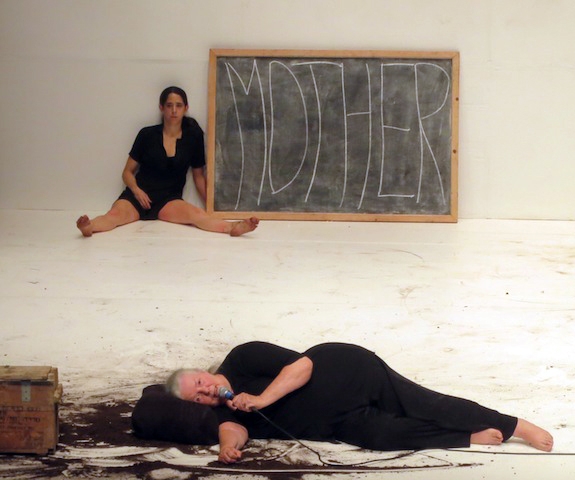
Vincent states in the program that Motherland is driven by sex, birth and death, though death takes up very little space compared to sex and birth. A principal leitmotif in the work is the association of female fertility with that of the land. The two are embodied by Lubos with a bellyful of earth hitched high up in her skirt that she empties on to the floor at intervals throughout the work: more mess. This earth becomes the land that Andrea Catania is toiling to nurture, like countless women around the world. At one point the entire cast joins in a ritual fertility dance to the accompaniment of Scott Smith on guitar singing Ready for Green. As Smith sings of ‘sowing the seeds of joy’ Cooke is screwing Catania on the ground. Making love might be stretching the imagination too far: the fertility cycle is in progress, but Catania is soon abandoned by Cooke, crawling off unnoticed to a corner of the stage next to a blackboard on which Cooke had written MOTHER in big letters. Vincent is not sparing on the irony.
Another, more urban illustration of the fertility cycle shows Lubos and Janusz Orlik arriving for a picnic, with a hamper and the Sunday paper. They relax on the grass, but instead of reading, Orlik takes prodigious amounts of cotton wool from the hamper and stuffs it under Lubos’s dress to a high-decibel distress signal played by Alexandru Catona on a gong. Lubos screams in pain. Kujawska appears holding up a speaker through which we hear applause. Orlik stuffs more cotton wool into Lubos’s expanding dress. She screams again and there is more applause, after which everybody takes a bow. Orlik’s newspaper is now stained with blood. Lubos pushes away both Orlik and Catona (more canned applause) and she takes a solo bow. She kisses Orlik and runs off. The applause continues.
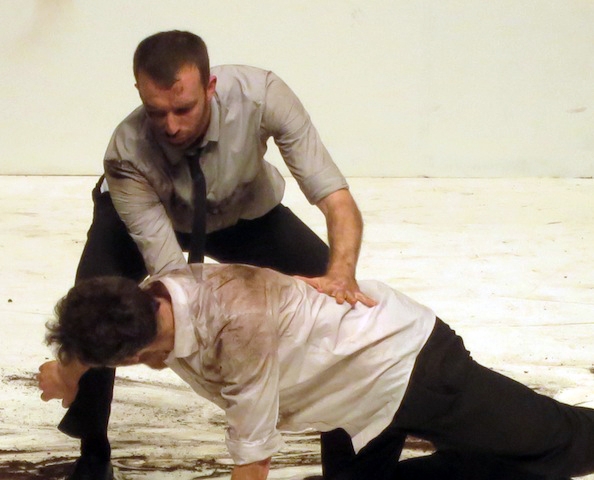
Although men are an integral part of the fertility cycle, their social role comes in for particular censure in Motherland. Consider the depiction of carefree Cooke when he pulls down his zip and knowingly extracts his…banana. He peels it and eats it with gusto: no need to look up Freud’s interpretation. Retribution comes to Robert Clark when he opens his wooden box and pees into it; he carelessly closes the lid on his dick and screams in agony. Pulling out a blackened banana from his flies he begins to eat it, but loses his appetite.
Elsewhere, men are depicted as sleazy purveyors of sexual innuendo in the Manhood Music sequence, and generally as congenital misogynists who take advantage of women for their own pleasure and gratification. While it is the women in Motherland who punch their emotional weight, only the men dance. Cooke dances as if he is the master of his destiny, a charismatic charm offensive with his elaborate reverence and sleight of hand, but he is unaware that he moves in a series of hesitations; nothing is fully realised, and in his eyes is a look of perplexity. This contradiction is expressed after he plants Catania in the earth when he says excitedly to her: ‘I’m in control. I’m here for you right now’ after which he immediately abandons her. Only Clark is allowed any signs of compassion towards women. His duet with Lubos has a tenderness that is perhaps the one concession that men can behave with respect towards women. Not even this, however, can save the three men later from crawling like serpents through the earth on their way to hell.*

Robert Clark and Greig Cooke
Men playing women get more sympathetic treatment, as Orlik performs a drag routine that has Janowska applauding again. (When she attempts the same routine a little later, she ironically raises no laughter and no applause). Two men who play a rather privileged if tainted role in Motherland are Catona and Smith, the two-man band of troubadours, clowns and accomplished instrumentalists that adds both a lyrical and poignant element to the tableaux, making Vincent’s uncompromising stance more palatable. What lends this polemic of the sexes an air of authority, however, is the introduction of two key characters: 12-year-old Leah Yeger, through whose eyes the world of men and women is filtered and absorbed, and 75-year-old Benita Oakley, whose accumulated experience provides a sense of perspective and dignity.
Yeger is the one who arrives at critical moments in Motherland to question her colleagues, and thus forces them (and us) to examine what they are doing and why. It is her simplicity and lack of antagonism to either sex that brings people together. She tames Clark, who protects her and it is she who signals a truce to the (hilarious) slow-motion battle of the sexes (in which Catona excels as a victim of the invincible Kujawska), and rallies everyone together for a rousingly beautiful rendition of Woodie Guthrie’s children’s song, Why Oh Why.
Oakley’s contribution is based on her own experience. She begins her story lying on her side on the earth, with her head propped on a brown velvet pillow. Smith gives her a microphone and then accompanies her story on guitar with Catona on harmonica. She talks of her first pregnancy in 1956 and the difficulties she faced being unmarried. Lubos is making baby gurglings into the microphone on the other side of the stage. As the baby girl is born prematurely, she is taken away from her mother until she becomes stronger; Oakley cannot stay with her. She sleeps in the open but visits her baby regularly to give milk, until she can take back her baby with her. Oakley is dignified and calm, and every word has the unadorned simplicity of truth. After she finishes her story, she crawls back with slow deliberation to stuff the cushion back in its box, and carries it off like a memory. The second part of her story occurs a little later. She outlines her mouth with imaginary lipstick, pulls out her long silver hair, remembering how beautiful she was (without realizing how beautiful she is), feeling her figure and stomach. She relates the births of her next two children, in 1957 and exactly twenty years later. Both daughters are in the audience.
The function of a morality play is not to preach as much as to encourage or actively promote reflection on our present condition. There is much to be done, and many pitfalls still to negotiate, like the relation between wanting to be attractive and becoming an object of attraction and confounding a product with its advertising values. As Yeger says at one point, ‘It’s not about the look; I’m a person.’ The presence of Yeger prompts a reflection on the future and Oakley’s story shows that what she has experienced has been happening for longer than we care to remember.
The piece ends as it begins, with its charismatic cast of characters parading on to the stage, with the men looking a little the worse for wear. Have we learned anything from what we have seen? The ultimate success of Motherland depends on it.
Motherland is currently on tour. See www.motherland.org.uk for details.
* I have amended this paragraph after seeing Motherland again in London in November. Its emotional coherence made the balance between men and women clearer.
Posted: October 19th, 2012 | Author: Nicholas Minns | Filed under: Performance | Tags: Aakash Odedra, Akram Khan, Andy Cowton, Constellation, Cut, In the Shadow of Man, Jocelyn Pook, Michael Hulls, Olga Wojciechowska, Rising, Russell Maliphant, Sidi Larbi Cherkaoui, Willy Cessa | Comments Off on Aakash Odedra: Rising
Aakash Odedra, Rising, Pavilion Dance, October 18
Before Aakash Odedra performs the three contemporary works on the program, he demonstrates his dance roots in Kathak. Nritta, meaning pure dance, is a variation he created for himself and for which he arranged the classical Indian music. In my previous post, I mentioned that dance is expressed in the intellectual, the physical and the emotional bodies. Here in Nritta, Odedra manifests them all in perfect harmony within the complex rhythm of the music. As he writes in the program notes, ‘Here the movements of the body do not convey any mood or meaning and its purpose is just creating beauty by making various patterns and lines in space and time.’ It is pure dance.
Just perceptible in the smoky apse of light is a figure with his back to us, dressed in loose, grey cotton kurta and pants, his body still but for his arms and hands rising slowly, palms and gaze turned upwards as if offering a libation to the gods. The dance develops with dizzying, virtuosic turns – there is something of a Dervish in Odedra – and his lightning movements of the torso and arms make those statues of Shiva with multiple limbs make sense. How else can you capture this kind of movement in a statue? I had always thought of Kathak as grounded, with upward movement expressed in the body as an opposition to the energy directed into the floor, but the name Aakash means sky, and upward for Odedra means airborne: it is part of his personality, a trait his teacher in India recognized and encouraged. He has a slight frame, taut and elongated, so there seems to be no apparent force in his dance; what comes across is his love and thrill of movement and his freedom to jump and turn effortlessly around a still point. It is the physical expression of being in the moment.
Odedra does not come to contemporary dance through training in contemporary dance. He comes to contemporary dance through his training in Kathak. This makes his collaborations with Akram Khan, Russell Maliphant and Sid Larbi Cherkaoui a unique occasion. Khan has already developed a remarkable body of work from the same dance roots, so creating a solo on Odedra is a fast track process to a place way beyond the beginning. In the Shadow of Man is indeed a work that challenges Odedra in ways he may never have imagined, but his sensibility and integrity, not to mention his innate virtuosity, rise to the challenge. In the program notes, Khan muses on their shared Kathak tradition: ‘I have always felt a strong connection to the ‘animal’ embedded within the Indian dance tradition. Kathak masters have so often used animals as forms of inspiration, even to the point of creating a whole repertoire based on the qualities, movements, and rhythms of certain animals. So, in this journey with Aakash, I was fascinated to discover if there was an animal residing deep within the shadow of his own body.’ I don’t think there is any doubt that he found it, and the way Odedra reveals it is remarkable.
The opening image is difficult to make out, a shell or shield of an insect that is alive in that expressionless way insects busy themselves with the act of living: a movement of the eye, a leg, an antenna. But as the lighting of Michael Hulls gradually reveals this shield, we see it is Odedra’s crouched, naked back, and the insect eyes are his scapula rippling under his skin and the antennae his elbows. Jocelyn Pook’s score is suddenly riven by a piercing shriek from Odedra taken on the inbreath, scorching the lungs. He comes alive, unfolding like a wild man and stretching out his angular arms and legs like an emaciated saint stretching. The lighting picks out these body shapes, following the tearing movements of this hunter-gatherer, mouth gaping and blind eyes engaged. As in Nritta, we see the velocity of the turns, the arms whipped into the form of a double helix, and then the stillness. The insect develops into a loping monkey, to which the hissing and shrieks now belong, as do the whirling arms at the limits of Odedra’s circling torso, and the arching backbends that put his wild eyes upside down staring at us: traits of the atavistic figure consumed by the animal Khan has embedded – or revealed – in him. Pook’s score adds a sense of calm and order, rounding off the corners without disturbing the angular, feral nature of the beast. What gives this performance an otherworldly quality is the lack of any ego; Odedra has given himself over to the dance, and his bow at the end is one of genuine humility.
In Russell Maliphant’s Cut, Maliphant doesn’t so much create movement for Odedra as structure it. We see Odedra’s undulating, double-helix arms, his ability to rise from the ground as if pulled up by an invisible thread, his lightning dynamics, his ability to spin and his generosity of spirit. What distinguishes Cut – and gives it its name – is that Maliphant has Odedra dance with the light patterns of Michael Hulls which cut his body into zones of light. Hulls is a visual magician, creating a virtual scrim of light and smoke through which Maliphant thrusts and weaves Odedra’s movements, first his hands and arms and later his full, whirling body. The lighting also supports Odedra’s gestures, as when he pushes down magisterially on two columns of black light that are the vertical shadows underneath his own hands. A third element is Andy Cowton’s score, which is as intimately related to the choreography as the lighting. When Hulls’ triangle of light takes on three dimensions, opening up a vista of latticed blinds on the floor, there is a suggestion in the music of the blinds opening and closing as Maliphant contrasts Odedra’s crawling motif with the horizontal bars of light. Hulls rolls up the blinds leaving Odedra in silhouette in open space, and then raises the lighting level so only his skin is visible as his clothing blends into the smoky light. The final sequence is pure Odedra, whirling fiercely downstage across the blinds and arriving at a stillness in which he grasps the shadows of his hands and pushes them down once again, keeping his dark gaze on us, as he turns up his palms and closes his fingers slowly into a fist.
The order of the program is decided more by the technical aspects of the lighting than by a considered approach to the choreographic content: a little bit too much of the lighting tail wagging the choreographic dog. The last work, Sidi Larbi Cherkaoui’s Constellation, is the most mystical of the three, and belongs more in the middle than at the end, except for its lighting demands. It is also the work in which there is less of Odedra’s own movement vocabulary and more of Cherkaoui’s conceptual framework: a constellation made up of patterns of sound and light with Odedra as the locus, an ‘astral body generating its own rhythms and luminosity.’ The rhythms are provided by the lovely score of Olga Wojciechowska, and the luminosity by Willy Cessa’s suspended light bulbs of differing intensities that provide the only illumination for Odedra’s motion. He is more a presence in Constellation than a performer of Cherkaoui’s movement phrases. At one point Odedra swings a single bulb in front of his head that illuminates the alternate sides of his face as it rotates, like two phases of the moon. Constellation is a meditation on space and spirituality, and Odedra provides a performance of mystical serenity. Towards the end he sits in meditation and instead of Cessa’s lights fading to black at the final moment, they all increase to full illumination. How appropriate.
Posted: October 17th, 2012 | Author: Nicholas Minns | Filed under: Performance | Tags: Beth Gill, Dance Umbrella, Electric Midwife, Jon Moniaci, Madeline Best | Comments Off on Beth Gill’s Electric Midwife: Lost in translation
Beth Gill, Electric Midwife, Platform Theatre, Central St Martins, October 9
Perhaps I am not sitting in the right place – not directly in the centre and too close to the front – or perhaps the theatre is just too wide, but for some reason Beth Gill’s Electric Midwife, presented by Dance Umbrella at the Platform Theatre of Central Saint Martins, is not translating well. In a work so totally committed to the mirror symmetry of six performers in two trios, the question of viewpoint is crucial, because if the symmetry is not evident, there is little else to appreciate. Where symmetry is often valued in a context of non-symmetry – the country house in its parkland, a corps de ballet in a narrative setting – Gill explores symmetry as the sole choreographic underpinning of Electric Midwife, relying on its visual aspect above all others. Gill, it seems, has always found it interesting to present her work in a visual art capacity.
The piece opens as the audience arrives, with the two trios of dancers against the wall on either side of the bare stage, matching their poses in mirror image. There are two taped, black tramlines, the width of a chair, running up the middle of the stage from front to back. The dancers, all women, are in practice clothes; there has been no attempt to create a symmetry of identical body shapes and there is some disparity in the amplitude of their respective movements. One dancer starts a movement, which is mirrored by her counterpart on the other side of the stage, though the stage is just too wide for me to see both at the same time. My viewpoint improves as the dancers approach the tramlines. Essentially, one trio is choreographed, and the other acts as its mirror image. When the dancers are in eye contact, there is a good chance their mirror symmetry is effective in both space and time, but when they are not, the beatless score by Jon Moniaci is not particularly helpful. Perhaps part of the choreographic process is to work out a telepathic sensory system between the dancers so they can initiate movements at the same time. Generally the timing is maintained remarkably well, though the errors are all the more evident and prove a needless distraction.
There are formations that remind me of the columned, sculptured entrance to a Baroque building, and at other times there are references to Michaelangelo’s ideally proportioned man in his circle, and shapes based on the first position in ballet. Patterns repeat, and there are a periods of stillness, but because there is no emotional force in the movement, these static forms have no life; the stillness has nothing to retain. Towards the end there is a promising increase in the dynamics of the work, as if Gill wants to bring off a final, juicy variation before the return to stillness at the end. Her symmetry begins to get a workout as the dancers have their first contact with each other, like a planar intersection, with a seated couple falling through the open legs of a standing couple. There is a feeling of a development here, but instead the music stops soon after and the dancers make their slow, symmetrical way off stage in a rose light.
Electric Midwife could fall into the meditative experience if it wasn’t for the intellect working so hard to perceive and appreciate the symmetry. The sound score by Jon Moniaci is certainly meditative and Madeline Best’s lighting reminds me in its opening gradations of a monochrome Rothko canvas. Interestingly, the lighting is the one element that forms variations on the symmetrical theme. At one point the overhead lights create intersecting circles on the stage, with the shadows of the dancers cast on them at asymmetrical angles. At another point the front lights project the shadows of the dancers on to the back wall, warping the floor symmetry out of alignment. The meditative aspect seemed to pick up in the latter part of the work, with the use of different mudras. A dramatic pose by one couple had something of a Bharatnatyam influence and the two girls ringing out ceremonial cloths into the bowls of water is perhaps another reference to Eastern meditative practice.
Dance includes the intellectual body, the physical body and the emotional body. At most Electric Midwife includes the intellectual and the physical, for there is little trace of the emotional (I don’t mean crying, laughing, fear and joy, but simply the emotional body which conveys the sense of dance). Without the emotional body there’s a kind of lethargy in the movement, like balloons with insufficient air. Electric Midwife is predominantly physical and intellectual, so the dancers don’t have much to do apart from being in precisely the right shape at the right time to retain the symmetry of the piece. It is essentially static. What is missing is the dynamic interaction of patterns, shapes and forms.
What a surprise, then, to see the video monitor in the bar area an evening or so later, showing a clip of Electric Midwife on a narrow stage seen through a single lens. Suddenly the patterns and their interactions make sense. It is like looking through a kaleidoscope as the dancers merge and disperse, form and reform in almost mechanical precision. Even without looking at the screen from directly in front, I could appreciate the patterns. Gill has made symmetry a guiding idea in Electric Midwife, but she has not, as the performance showed, overcome its visual limitations. But film, with its single, shared viewpoint, seems to resolve them very effectively.
Posted: October 12th, 2012 | Author: Nicholas Minns | Filed under: Performance | Tags: Dance Umbrella, Mette Edvardsen, Michael Donaghy, Notsume Soseki, Rosemary Lee | Comments Off on Mette Edvardsen: Time has fallen asleep in the afternoon sunshine
Mette Edvardsen: Time has fallen asleep in the afternoon sunshine, Central Islington Library, October 9

Mette Edvardsen (photo: Ida Ramberg)
In Ray Bradbury’s book, Farenheit 451, firemen do not put out fires; they start them in order to rid society of books, which are considered subversive because they carry insidious thoughts and ideas that may run counter to authority (451° farenheit is the temperature, Bradbury believed, at which book paper burns). Learning from books is like an infectious virus that transforms the victim into a carrier. In our present society, health authorities marshal their forces at this time of year to eradicate flu by offering immunisation jabs. In Bradbury’s world the social health authorities were trying to stamp out books. Any that were found were burned, and owners prosecuted. Of course there were defiant readers who hid their books, but one of the most effective ways — one that went under the fire brigades’ radar — was to commit the books to memory. Mette Edvardsen started a group that does just that, and Dance Umbrella had the good sense to invite her to perform in the Central Islington Library.
As a former dancer, Edvardsen realised there are parallels between the way books are memorised and the way dance is passed on. You can’t destroy a dance because it lives in the muscle memory of a dancer, who can then pass it on to another. The act of reading to somebody else is also similar to a performance, and in the same way a dance takes on something of the life and character of the dancer, the book is subject to the mind of the person memorising it. For her Dance Umbrella project, Edvardsen gathered a wonderful group of readers to give a series of readings from memory of selected books, be it a story or a collection of poems. You reserve a time and when you arrive at the library your reader is waiting for you. ‘So you have come to read me,’ said Edvardsen. She was, for this performance, Natsume Soseki’s I am a Cat, a satirical view of the human condition through feline eyes. We search for an empty corner of the library with a couple of comfortable chairs, and settle in like a couple of cats on a sunny afternoon ready for a nap, but only time falls asleep. When Edvardsen begins to perform her book, she sets aside her own identity for the voice of the author. It is as if Soseki himself is present.
Edvardsen’s first language is Norwegian, but her English is faultless. I am a Cat is a translation into English from the original Japanese, so the ideas of Soseki have taken a circuitous route to Edvardsen’s memory. However, the images she passes on through the spoken word are clear, colourful and full of satirical humour. I was so taken with the experience that I booked the last available spot for Michael Donaghy’s Collected Poems read by Rosemary Lee. Lee knew Donaghy, who died in 2004, so there is another very personal connection that colours her performance. She says she can hear Donaghy’s inflections and rhythms as she recites. Lee has chosen the poems in no particular order, taken from the three volumes of Donaghy’s collected poems. She reads a poem twice to allow it to sink in, but if you don’t want her to repeat it, that’s fine, and if you want her to go back to one you particularly like, that is fine too. It’s a performance like no other, a discovery of a beautiful state of mind in a transmission of life to life. Donaghy’s life, Lee’s life, and now mine.
Seeing a performance in a theatre, of course, should be just like this. Any dance performance is in effect the transmission of an idea or ideas from the choreographer to the audience through the medium of dance. The transmission also requires, on behalf of the audience, the conscious desire to receive, and not simply to be entertained. It is, after all, a performance not a production (with all the overtones and undertones of a product to be sold, to be marketed, to be consumed). Edvardsen’s project has returned to the very core of dance.
Posted: October 9th, 2012 | Author: Nicholas Minns | Filed under: Performance | Tags: Antonia Grove, Probe, Small Talk, Wendy Houstoun | Comments Off on Antonia Grove: Small Talk
Antonia Grove, Small Talk, directed by Wendy Houstoun, Soho Theatre, October 2
It was an inspired decision for Antonia Grove to hitch her star to that of Wendy Houstoun. An original ten-minute sketch of Small Talk was worked out by the two of them in 2010, and the version performed at the Soho Theatre upstairs last week evolved from that sketch. If anyone can get a grip on a mercurial, conflicted, miasma of a personality and create from it a compelling piece of theatre that makes us laugh while keeping us unsettled, it is Houstoun. This is not one of her own solos she has adapted for someone else; she has got under Grove’s skin, into her psyche and coaxed out something that is not a portrayal, nor a story, but Grove as you will never be able to know her. Houstoun says of the work that it ‘hovers around the territory of theatre but it sidesteps character and motivation and instead pushes for an immediacy that I often feel is missing from acting.’ Grove sees her role more from the performer’s perspective: ‘The woman, the women, they are all me and they are not me. They are themselves and they are not themselves. They know something and they don’t know anything.’ Small Talk is the confluence of these two complementary ideas.
Grove’s first line of defence for her many personae is a line of disguises. She begins in neutral territory, arranging her props and costume changes on a table to the side of the stage. She pulls out a chair into the centre of the room and wanders back to her table. She puts on earphones and a pair of high heels, checks her phone and takes off her tracksuit top to reveal a slinky mini dress. Attractive and voluptuous, the starlet Grove nonchalantly wanders out to her seat. She looks out at us but doesn’t see us. It is as if we are looking at her through a two-way mirror. Her eyes are very dark and piercing, or would be if they were brought into focus. Instead they seem to stare into the indeterminate foreground that stops just where the audience starts. Instead of looking out from her face, her eyes seem to be drilling back in, trying to get their bearings, trying to find out who is in control. We in the audience are wondering, too.
A self-help relaxation tape is playing. Allow your mind to relax and sink deeper into this place…even deeper…you are in an open body position, legs uncrossed (she crosses them). Just breathe in and let it out. Grove closes her eyes and smiles enigmatically. With her iPod she selects some breathing music. Her voice cuts through it with a nasal American accent, giving us a movie scenario about sweet young American school girls being caught up in a European torture ring, and dying in horrible ways, delivered in a tabloid-dispassionate way. ‘We create whatever we want to be…Lauren lives in the moment…Heather is such a good actress…’ As her small talk threads through self-help, self-realisation and self-delusion in a flawless continuum, she crosses and uncrosses her legs as if they are somebody else’s, slips off the lip of the chair and recovers, in one long, slinky move. She shakes out her hair, laughing self-consciously and steps behind her chair, keeping her gaze on the imaginary screen between us. ‘Exelle seems very innocent, but she knows how to get what she wants…’ Grove dips down as if her legs give way, keeping the small talk going as her mercurial body recovers its glittery poise. Sitting down again, she blows away a strand of hair from her face, traces her finger down the front of her chest, crossing and uncrossing her legs. She continues the scenario about fighting mutants, ‘rocking them and killing them,’ she laughs, opening her eyes and closing them again. She changes to a motivational tape and moves the chair to the side. What do you want to become? Who do you want to become? You have the power to change… She changes shoes, another pair of sexy high heels. She puts on a tiara and takes a single rose stem, poses at the back of the stage, a camera without a film. A new persona emerges, and more small talk to camouflage it. She steps forward like a model, over-crossing each step but slowly, balancing unsteadily on each forward movement. ‘I guess I’m shallow,’ she concludes. ‘I think I’m kind of a chicken actress.’ Her eyes are glaring (and she can glare convincingly), as she picks off rose petals distractedly, speeding up, madly dismembering the stem and discarding the remains at the feet of the front row. Nobody dares touch it.
She sidles to the microphone and sings. ‘Some say I’m a devil, some say I’m an angel, but I’m just a girl in trouble’, her voice a crevice of vulnerability from an emotionally turbulent soul. She throws off her shoes and the tiara and puts on another disguise, taking the time to get ready. Grove takes a sip of a drink and dances a spin to the appropriately named Foggy Notion by Jonathan Richman and the Modern Lovers before downing another shot, losing herself in uncontrolled laughter when she is already lost. Her wig unseats during the turbulent dance, and she adjusts it back in place. We hear the same warning shots as in Houstoun’s own 50 Acts, though here they miss their mark; Grove seems unaware of any danger. Status Quo plays Down Down as the tape continues: And you allow yourself to drift down to this warm comfortable and safe place. Down deeper, letting go, down deeper. She crouches on the balls of her feet and pushes her knees forward slowly to the ground, then bends back revealing quite obliviously her black trunks and smooth legs. She rolls over and lies exhausted. Time for a change of persona. Taking off her wig, she puts on a cowboy shirt, and replaces the short wig for a long one. Donning a leather jacket she stands at the microphone. ‘Funny comes from smart…accidental funny comes from not so smart.’ She tells a crap wedding story she alone finds funny, her eyes looking around, mouth in a grimace. We hear a lot of people laughing, but she is not; her eyes are lost and sad while the mellifluous female self-help voice assures her she is on her way to being able to make other people laugh. Grove steps into the shadows away from us and turns back to reveal a large red clown nose. Good, says the voice. She begins to clown around with crazy moves while the woman’s voice continues to encourage her. Her mouth is in a grimace, then a smile, going through the motions of a twitching guitarist, a crazed rock and roll musician. Punching the air, jumping, bouncing, her wig falling over her nose, she throws off her jacket, and her wig follows. More taped laughter. Another shot rings out; Grove grinds to a halt and puts her wig back on, taking stock. Over at the table she opens a beer and drinks it. At last you love your life. Notice how your outlook on life is enhanced. You are calm (as she drinks a beer). You are working towards the person you were always meant to be. The new you.
Grove puts on her cowboy boots and hat and sings beautifully accompanied by a toy xylophone. The song is interlaced with the other voice. Grove seems to be herself when she sings, but the voice talks of ‘leaving everybody permanently’. We are not sure who she means by everybody. The many personae, perhaps. One marvels that Grove can inhabit them all so convincingly. Perhaps she will be left with herself. Perhaps not. She puts on her jacket, gathers all her accessories, her shoes and tiara into a plastic bag. ‘I want to say thank you to so many people…I’m just trying to matter… I’m just trying to make work that means something to people.’
It is a stunning performance from Grove; for more performance dates, see her website. And if there is any doubt about Houstoun’s ability to make work that means something to people, she was the dramaturge for h2dance’s Duet that recently won the audience vote to participate in The Place Prize final; her Imperfect Storm (based on The Tempest) for Candoco can be seen next week at the Laban Theatre, and her own solo, 50 Acts, is at Dance Umbrella this Friday and Sunday.
Posted: October 8th, 2012 | Author: Nicholas Minns | Filed under: Performance | Tags: Beyond Silence, Dance Umbrella, John Cage, Jonathan Burrows, Matteo Fargion, One Flute Note, Richard Bernas | Comments Off on Jonathan Burrows & Matteo Fargion: One Flute Note
Jonathan Burrows & Matteo Fargion, One Flute Note, Studio Theatre, UAL: Central Saint Martins, October 5
‘There is nothing to say, and I am saying it.’ This is the opening statement of John Cage’s Lecture on Nothing and in Jonathan Burrows’ and Matteo Fargion’s One Flute Note presented by Dance Umbrella last night at the suitably pared-down Studio Theatre in Central Saint Martin’s there is an echo: there is nothing to do, and I am doing it.
I recently was introduced to John Cage’s ideas after hearing Richard Bernas’s radio program, Beyond Silence, celebrating the centenary of Cage’s birth. I hadn’t realised the vigour and humanity of Cage’s discourse on music, sound and life. I feel Burrows is a similar voice in dance, and in Fargion he has found a co-creator to give form to their ideas. As Burrows writes in his book, A Choreographer’s Handbook, ‘Collaboration is about choosing the right people to work with, and then trusting them. You don’t, however, have to agree about everything. Collaboration is sometimes about finding the right way to disagree.’ Anyone who knows the book will recognise the balanced form of his axiomatic advice, and Burrows’ fruitful collaboration with Fargion since they met in 1989 is proof of the validity of this particular axiom. They have been creating duets together since 2002: Both Sitting Duet (2002), The Quiet Dance (2005), Speaking Dance (2006), Cheap Lecture (2009), The Cow Piece (2009) and Counting to One Hundred (2011). Dance Umbrella is presenting a mini-retrospective of five of them.
This is the first performance of One Flute Note, and evidently there are some (permitted) errors that one can sense only from the occasional lapses into self-conscious smiles. Burrows and Fargion are so comfortable with each other on stage; seeing them in the bar afterwards, it is as if drinking a cold beer is as natural as the performance on stage: no makeup to remove, no costumes to change out of, no barrier between performer and audience. This naturalness is encapsulated in one of the maxims for ‘beginnings’ in the Handbook: ‘we walk on as though we were walking into Matteo’s kitchen.’ Another is that ‘we walk on in a formal way that is unexpectedly informal.’ The simplicity of these two statements belies the complexity of what we have been watching for the past thirty minutes. Burrows and Fargion play predictability against unpredictability, the expected against the unexpected, action against stillness, silence against non-silence, narrative against abstract, and absurdity against a sense of normal. In the intersection between these opposing ideas they find the space for both tension and its release in laughter.
The program notes underline the importance to Burrows and Fargion of the structure of Lecture on Nothing, proposing that One Flute Note is ‘at once a homage to and questioning of a way of thinking that has underpinned so much dance and performance in the last 30 years.’ Presumably this is the continuing decoupling of dance from the classical form and the corresponding embrace of everyday movement in dance vocabulary. It is also the liberation of thinking about dance that allows endless permutations. There is certainly a sense of freedom in One Flute Note, somewhere between a Peter Cook sketch and a rigorously intellectual approach to dance performance. It involves amongst other elements a surreal array of sound inputs that vary from the one flute note to the sound of 45 choirs, two versions of a chair dance (one without and one with the chairs), and a constant disequilibrium that is kept in play within an absurdly rational structure.
That structure is a paradox of Cage’s lecture: his ‘way of thinking’ liberates, while the form in which it is delivered is carefully constructed. ‘This is a composed talk for I am making it just as I make a piece of music. It is like a glass of milk. We need the glass and we need the milk.’ It is the first time I am seeing a duet by Burrows and Fargion, and I find it liberating. At the same time it is clear that One Flute Note is highly organised and heavily cued; the sound engineer is in effect a third performer. There is no room for improvisation or chance occurrences, nor is there any notion of dissociating the movement from the score, which is one of the central ideas of Cage’s partnership with Merce Cunningham. Burrows and Fargion are forging their own path of questioning and coming up with their own ‘handmade and human-scale’ answers. One Flute Note owes something to John Cage’s Lecture on Nothing, something to Lee Scratch Perry’s Bucky Skank (it’s in the Handbook if you want to know why) and a lot to the intellectual rigour and integrity that Burrows and Fargion bring to their work.
At the end of his radio program, Richard Bernas says that after a performance by Cage his mind and ears are ‘refreshed, more at ease, more balanced, more alert to the world than when it started.’ I feel the same after watching One Flute Note. It is as if Burrows and Fargion have fashioned a way of performing that is a metaphor for living with more freedom within the conflicted confines of our daily lives.
Posted: October 5th, 2012 | Author: Nicholas Minns | Filed under: Performance | Tags: Bernd Skodzig, Claude Vivier, Continu, David Chipperfield, Edgard Varèse, Iannis Xenakis, Martin Hauk, MAXXI Museum, Mies van der Rohe, Neues Museum, Pia Maier Schriever, Sasha Waltz, Sasha Waltz & Guests, Thomas Schenk, Zaha Hadid | Comments Off on Sasha Waltz and Guests: Waltz in a box

sketch of 1929 Barcelona Pavilion, Mies van der Rohe
Sasha Waltz & Guests, Continu, Sadler’s Wells, September 28
In 1928, the German architect Mies van der Rohe was commissioned to design the German Pavilion for the Barcelona International Exposition. The building became known as the Barcelona Pavilion. In writing about his design, van der Rohe expressed his belief in the ‘necessity of incorporating works of sculpture (or painting) creatively into the interior setting from the outset. In the great epochs of cultural history this was done by architects as a matter of course and, no doubt, without conscious reflection.’ Photographs and sketches of the Barcelona Pavilion show an open plan structure with unadorned vertical and horizontal planes that give a sense of infinite freedom of movement. Standing in a pool of water is a female form, a statue by Georg Kolbe that van der Rohe incorporated in his plan. What is interesting − and pertinent to Sasha Waltz’s work − is that the architectural space is defined by the sculptural form, and at the same time the sculptural form is enhanced by the architectural space.
Waltz is clearly engaged in this play of sculptural quality in an architectural setting, using her dancers as sculptural elements and theatres or non-theatre spaces as her architecture. Parts of Continu,the work she presented at Sadler’s Wells last week, were first created for the opening of Zaha Hadid’s MAXXI Museum in Rome, and others for the opening of David Chipperfield’s reconstruction of the Neues Museum in Berlin, a stunning space in part recreated and in part restored from the original nineteenth century structure of Friedrich August Stüler. I can only imagine what Waltz’s work might have looked like in the Neues Museum, with its variety of architectural elements, the different materials and, above all, the light. Museums and galleries are all about light, and it is often natural, as in Chipperfield’s Turner Contemporary Museum in Margate and the Barcelona Pavilion itself. As the director Robert Wilson said recently, “Without light there is no space.”
Transferring Continu from such architectural spaces to the traditional proscenium stage at Sadler’s Wells must have taken some rearrangement and reinvention. The bare black walls and white floor (conceived by Thomas Schenk, Pia Maier Schriever and Sasha Waltz) make the stage as large as it can be without being bare, but there is very little space for the dancers to get on and off stage. Apart from the two doors built into the side walls at the back, there are two awkward gaps at the front end of the wings on either side of the stage that tend to constrict the flow of movement. At the end of the first act, the two men run off the front of the stage into the auditorium. It is the only quick escape possible.
Continu is in two acts with three movements; each movement is built around music by 20th century avant-garde composers: the first is to Rebonds ‘B’ by Iannis Xenakis played with choreographic wizardry by Robyn Schulkowsky; then Xenakis’ Concret PH leads to three works by Edgard Varèse (Arcana, Hyperprism, Ionisation) that form the core of the second movement, and the third movement comprises Zipangu by Claude Vivier along with a musical anomaly, the adagio from Mozart’s Oboe Quartet, played almost too quietly to be heard, like a breeze wafting in through the window from a neighbouring room. The music sets the scale of each movement, and at the same time, Waltz’s settings allow the music an appropriate context for us to appreciate these rarely heard works.
Music and dance in Continu are spatial elements in dynamic juxtaposition. The vast resources of the Varèse music (requiring in live performance 120 musicians and a panoply of percussion) swirl around the space, sometimes massed together, and sometimes splitting into streams of sound, just as the dancers often merge into a group from which smaller groups derive, couples form, or from which a necklace of dancers extends around the perimeter walls. The percussive music of Xenakis (who was an architect as well as composer) is more like a structural element, around which Waltz creates her own spatial rhythms. Architectural space would normally be an equal element in the choreography, but here at Sadler’s Wells that element is missing, giving a sense that Continu has been squeezed into a box that is a couple of sizes too small. When the movement sequences are performed in silence, the dance and the space remain in equilibrium, but when the forces of the Varèse (in particular) are unleashed, the combined scale and energy of music and dance overflows the limits of the stage.
The twenty-three dancers are all mature performers, an international mix that has individuality and yet forms a harmonious group. They do what all good dancers do: they move beautifully and Waltz moulds them beautifully into flowing forms, enhanced by Martin Hauk’s superb lighting that washes the interior space in a bright, diffused light. Some dancers stand out like accents in the course of the evening: Delphine Gaborit in the first movement, and Niannian Zhou in the second, measuring herself at one point with a fine, imaginary thread. Edivaldo Ernesto has remarkable muscular control that Waltz exploits in his exuberant, jester-like solo in the second movement that is pure delight. Virgis Puodziunas is a tower of strength and intensity, while Juan Kruz Diaz de Garaio Esnaola has the kind of presence that can anchor an entire performance. In the execution sequence at the end of the first half, he is the only one who could outlive the executioner.
It is as sculptural elements that the dancers really shine, and the way they interact is key. Waltz doesn’t seem to be interested in virtuoso performance, but in the harmony of all the elements. In this she is perhaps more in line with Bronislava Nijinska than with Pina Bausch, to whom Waltz is often compared. In the opening movement, the women in their loose, black dresses and bare limbs, carve out sensuous shapes with their torsos and rippling arms; the four men at the beginning of the second half − Shang-Chi Sun has a remarkably articulated, turned-in solo at the beginning − are like nude sculptures in a gallery: figures by Henry Moore with fingers and toes. In some of their forms they might even pass for structural elements…until they clap their feet. Apart from these four, the dancers are fully clothed by Bernd Skodzig, whose stylish costumes are drawn from a narrow palette of colours. The only problem for me is the unfortunate association of his shade of brown with the livery of United Parcel Service.
The third movement has a different quality from the first two: a smaller scale with more narrative elements. The use of a chorus of dancers brings to mind a setting of a Greek tragedy with the lone, almost naked figure of Orlando Rodriguez as Orestes. Three women supported on the shoulders of their partners walk horizontally along the side walls; Xuan Shi in black shuffles in a figure-of-eight pattern around the perimeter, while two women paint their path on the floor with black and red paint on the souls of their feet. Shi then adds to the design with a charcoal stick, drawing around whatever feet are in his way. Ernesto seems to be giving more instructions, drawing in space, after which the chorus retreats, leaving six dancers at the back who pick up the upstage edge of the floor above their heads so we see only their hands. The floor and its design now forms a backdrop to a final, soft duet with Todd McQuade and Zaratiana Randrianantenaina to the Mozart quartet, after which the scale of movement reduces even further to the rapid passage of six pairs of hands along the top edge of the floor to one corner, leaving the other corner wilting. Ernesto lifts this corner above his head and runs with it diagonally across the stage, creating a billowing wave of white behind him that, as he kneels, envelops him in its undertow. The life has disappeared; all that is left is the empty box.
Posted: September 30th, 2012 | Author: Nicholas Minns | Filed under: Performance | Tags: Eva Recacha, Gemma Nixon, James Alaska, Jonathan Goddard, Michael Hulls, Michael Picknett, Robbie Synge, Seke Chimutengwende, The Place Prize | Comments Off on The Place Prize semi-final 4

photo: Benedict Johnson
The Place Prize semi-final 4 (Eva Recacha, Robbie Synge, Goddard Nixon, Seke Chimutengwende), The Place, September 22
Martha Pasakopoulou stomps around the stage in a yellow dress proclaiming in a language I don’t understand, fist clenched in the air as if she is leading a demonstration of one. She has a clear, strident voice that is not afraid to climb into the higher registers, and there is something of the gamine in her unselfconsciously ebullient performance; she is evidently unaware anyone is watching. When she finishes her song there is a ringing silence in the theatre, and then laughter as she walks to the back, and steps carefully into the corner like a gymnast ready to begin a diagonal routine. With these two opening sequences, juxtaposed with disarming innocence, Pasakopoulou has captured our full attention; like an ingenuous child she can now lead us wherever she wants. This is Eva Recacha’s The Wishing Well, in which ‘a woman creates her own particular ritual to obtain her wish in order to get a direct line with the gods.’ It is full of observations and insights into the nature of hope and faith on the one hand, and of the superstitions and tricks we use to subvert them on the other. Recacha acts as storyteller and observer, commenting on the (at times) recalcitrant, (always) whimsical Pasakopoulou in her devout double-dealing, and demonstrating, in the poignant, final moments, the futility of her self-deception. Pasakopoulou’s character is called Martha, who begins by making three wishes, in lyrical, animated mime. It doesn’t matter what they are but rather what strategies she uses to achieve them, and the beauty of the work is in the imaginative mime Recacha devises for all these strategies that she incorporates into a body language Pasakopoulou so hearteningly delivers.
The stage is lit by Gareth Green like a game board, edged with a white band of light that forms the limit of Martha’s world; she never steps out of it. Martha has spent so much of her life in an unwinnable competition with God that she arrives at old age without ever having achieved her wishes. As an old crone, legs bent, she shuffles off to the corner of her world, as if to cross the road; only then does the white band recede, and after some hesitation Martha crosses; the band of light closes behind her.
The Wishing Well has been chosen for The Place Prize Final.
Robbie Synge’s Settlement is a piece for two performers and three sheets of chipboard, with a score by James Alaska. At the beginning the three sheets are centre stage, leaning tentatively against each other, lit by Brian Gorman as an architectural form. Settlement develops as a game between Erik Nevin and Robin Dingemans in which one creates an equilibrium of sheets, and the other knocks it down; one proposes, the other disposes. Settlement can apply both to the built elements of a community and to an agreement between two entities in a dispute. Synge’s work covers both meanings in a seamless structure, as he explores the effect of the everyday built environment on our physical and mental states. It would be easy to see the rivalry between Nevin and Dingemans as a personal narrative, but if one understands the chipboard sheets to be a metaphor for the built environment, then both characters are reacting to it in their respective ways, which in turn affects them individually, like neighbours arguing over a fence or, on a much larger scale, townspeople suffering from an ill-thought planning scheme: one person’s order is another person’s chaos. There are also elements of cooperation: Nevin and Dingemans stand side by side, each holding a sheet upright on the ground. They let go of their respective sheets and change places. Moving the sheets further and further apart they repeat the game, with surprising and unpredictable results. Later, the sheets become islands and the two performers help each other move from one to the other. In the end, Synge reflects on the sense of loss: one might rejoice in the destruction of a house, for example, while the other may be lost without it. After Nevin kicks down a final chipboard structure, Dingemans leans against the back wall as if wounded.
The title of Goddard Nixon’s Third, is taken from a line in the T.S. Eliot poem The Waste Land: “Who is the third who walks always beside you?” Eliot apparently included this line after hearing of a mysterious encounter experienced by the explorer Ernest Shackleton and his men on his famous 1916 expedition. It is now known as ‘the third man factor’, a psychological phenomenon also linked to guardian angels or divine intervention. Michael Hulls’ extraordinary lighting and set design place the context of Third quite literally, on a blue-white, ice-bound floe that Lawren Harris might have painted. He even brings on a snowstorm at the end that envelops the dancers and the space around them. But the weather conditions Hulls so brilliantly evokes are inimical to the nature of the duet, to the loose-fitting, urban, hooded costumes (by Alice Walking) and to the often floor-bound choreography. Jonathan Goddard and Gemma Nixon are not dressed for this level of cold, their duet does not belong in the Antarctic – even if the subject matter derives from an expedition there – where lying on an icy floe would be unthinkable. Hulls has taken his inspiration and run with it, but he has outrun the duet on which it is focused.
The duet itself is intimate and warm, the flow of movement soft and pulsing; Goddard and Nixon are two dancers who move with extraordinary agility, speed and precision but who also possess a lyrical quality that appears effortless; their performance is anything but cold, and in this context, the pulling on and off the hoods becomes an unnecessary distraction. However, their artistry is just a pleasure to watch, radiating enough heat to melt even the most inhospitable conditions.
The evening ends on a warmer note with a smile of a work from Seke Chimutengwende, The Time Travel Piece. This one is too tongue-in-cheek to make it to the finals, but sends us home feeling that much better for having felt its infectious irreverence. The stage is lined with banners that are reminiscent of the recent Olympics, and Chimutengwende is our amiable dance commentator. He has been fortunate enough to travel forwards in time to see dance performances at three different but not consecutive periods, 2085, 2501 and 2042. He is thus in a position to comment on, and illustrate, the styles of dance in those respective eras for our benefit. He has a troupe of the ‘best available’ contemporary dancers on whom he has restaged the dances from memory; it proved impossible for him to record what he saw as our technology doesn’t work in the future. Due to the huge financial costs of his government-sponsored time travel, he could only spend an hour at each performance.
By 2085, scientists are probing smaller and smaller objects – far smaller than atoms – and choreographers are similarly interested in smaller and smaller movements. Fortunately the audience’s powers of perception have increased dramatically. Chimutengwende introduces a trumpeter and five dancers who start performing. If nothing seems to be happening, it is all to do with our reduced powers of perception, though it is clear that the dancers have a remarkable control of their movement vocabulary and one can see in the choreography an evocative blend of influences from the early part of this century. The score is rich in tonality, and beautifully played on the trumpet by its composer, Michael Picknett.
By 2501, everyone has access to time travel; it’s as easy as texting today, which makes the idea of a rehearsal period obsolete; you can rehearse one day and return to it the following day, which means that choreographers can spend unlimited time on making work. Another trend, and one that was realized in the performance Chimutengwende saw, is the development by each dancer (over an unlimited period of rehearsal) of a movement sequence that perfectly expresses their essential nature, which is then the only movement they need to perform. This is what Chimutengwende presents, though due to limited rehearsal time the essential nature of each dancer is only approximate. The same goes for the trumpet accompaniment by the time-traveling Picknett.
2042 is an extrapolation of only thirty years from our current situation, when the pace of life has accelerated to such an extent that there is barely any time to make work, and what work is made is made very quickly because the dancers and choreographers need to move on to the next thing. At the performance Chimutengwende attended, the choreographer was teaching the performance on stage, as he had no time to rehearse. This is clearly a cause for concern, as the performance demonstrated.
Posted: September 26th, 2012 | Author: Nicholas Minns | Filed under: Performance | Tags: A Short Lived Alteration of an Existing Situation, Ben Wright, Copter, Darren Ellis, Neil Paris, Nina Kov, Revolver, The Devil's Mischief, The Place Prize | Comments Off on The Place Prize semi-final 3

photo: Benedict Johnson
The Place Prize semi-final 3 (Nina Kov, Neil Paris, Ben Wright, Darren Ellis), The Place, September 20
There’s a buzz of excitement in the front row as we notice a model helicopter on the very front of the stage. The copter’s blades flutter briefly in response, perhaps, to the stage manager calling ‘places’ just before the lights go down. Nina Kov, choreographer and the other performer in Copter, settles down on the floor in the dark. The first flood of light projects a silhouette of the copter on to the backdrop, to a suitably throbbing, reverberating soundscape by Paul Child that sounds as if it was recorded in the depths of a real copter. Then our little star whirs into action within its own spotlight. Copter is essentially a duet and solo variations between Kov and the copter, thanks to the pilot and battery charger, Jack Bishop, (who remains in the wings throughout). Lucy Hansom lights the stage perfectly to keep the diminutive, buzzing copter visible at all times as it flies its missions. Bishop can land the copter on Kov’s hand, fly it between her legs and fly it just out of reach when Kov tries to retrieve it. As you may have guessed, all the attention is on the copter, which Kov imbues with character by virtue of her interaction with it. At one point Kov rescues the copter, sets it on its skids for it to make its escape, and at another she blows it from her hand, like a bird. At times her arms appear to command the copter, and at others the trajectory of the copter influences hers. We easily forget that it is Jack Bishop in the pilot’s seat. The closest we get to being inside the copter’s eye is when Bishop pilots a sturdier model to carry a tiny camera that projects images on to the screen. So much for the copter; but what of the participation of Kov herself? If her final, heroic image of whirling around a large blade above her head is meant to suggest a transference of life from the copter to the human, Kov’s movements have not prepared us sufficiently to make this jump of the imagination. Her movement phrases bear little relation to any evolutionary process, and her costume (by Alice Hoult) belongs more in the studio than on the airfield. There is something, however, in the interaction between Kov and the copter that works; Bishop is a skilled pilot, but can he teach Kov how to fly?
In the pause, the stagehands place lots of milky-white conical paper hats on the stage with seemingly random precision. It’s like a designer moonscape, lit by Aideen Malone. The backdrop is a light red digital projection by Dan Tombs with a floating amoeba-like image at the top that makes me feel I’m looking up at the surface of the water from inside the tank. It’s the last time I notice it. Carly Best creeps in wearing an identical conical hat with a big letter D. None of the other hats on the stage seem to have letters. Best surveys the hats, crouching down to examine them as if visiting a graveyard. Sarah Lewis enters from the other side; she has a G on her hat. Dolce and Gabanna? No, the Devil and God, for this is Neil Paris’s The Devil’s Mischief, based on the book of the same name by Ed Marquand.
There is an obvious tendency to see the two women as punished schoolchildren sent to sit on their stools in their respective corners, but their identities suggest a broader scenario: instead of being the dunces, they are the progenitors of this sea of ignorance and common misunderstandings that divide them. Having arrived in their separate roles, in similar styles and colours of clothes (by Kate Rigby), they now realise, rather sheepishly, that it’s time to resolve their differences and act in unity. With palms up, Best steps among the cones, carefully at first, but as her confidence and assurance grow her limbs start to dislodge the cones in jabbing, fleeting spasms of emotion that have the quality of a human puppet – Petrouchka comes to mind. The more phlegmatic Lewis, overcoming an initial hesitation, joins forces with her erstwhile rival and they manage to overturn many, but not all the cones. There is very little physical contact between the two, but at the close of The Devil’s Mischief, the caps of G and D touch in a gesture of solidarity and embrace.
Paris’s choreography and the accompanying music – the beatless soundscape of Stars of the Lid’s Apreludes (in C Sharp Major) and Jolie Holland singing the hauntingly beautiful ballad Rex’s Blues – together create a dream-like meditation on the nature of good and evil (how closely those words resemble god and devil), too open-ended to go through to the final of The Place Prize, but a lovely essay on form that will, I am sure, resurface somewhere else in SMITH dancetheatre’s work.
Ben Wright’s bgroup entry is another essay, Short Lived Alteration of an Existing Situation, on a theme of the common ephemerality of dance and music, according to Wright’s entry video. He talks of ‘playing with the moment where sound and movement respectively move away from and into the constancy of silence and stillness.’ The stage has no edges, apart from the light that Guy Hoare provides, which is soft at its circumference, suggesting infinity beyond. The inside of this circle of light is an arena, in which Sam Denton and Lise Manavit perform. To begin with, a red curtain of light (suggested by Alan Stones’ sound with Hoare’s dramatic lighting) cuts off our visibility of the interior, and as it fades we see Denton on all fours crawling forward, animal-like, then running backwards in his circle of light and coming to an upside down stasis on his shoulders and head. The primitive imagery continues with Manavit’s beating her chest, rippling through her torso, and rather dispassionately engaging with Denton as they test and extend each other’s limits. There is a moment when Manavit picks Denton up from flat on the ground to rest on her lap, an amazonian feat that, for sheer power and fluidity, takes the breath away.
It is difficult to avoid ascribing a narrative to the action, and it is probably not what Wright is interested in here. For ten minutes he creates a flow of movement that ‘defies the inevitable pull of gravity and immobility’, just as a musical phrase defies silence. There is very little movement for movement’s sake in Wright’s duet; one phrase flows thoughtfully into another, without the use of choreographic prepositions, creating a flowing, sculptural dynamic which he sustains in silence. Then there is a magical moment when John Byrn’s playing of the opening chords of Rachmaninov’s Prelude (in B Minor, op 32 No. 10) merges with the movement like a swimmer entering water. The emotional quality of the Prelude seems to affect the two dancers, or, to be more accurate, to affect my interpretation of the relationship of the two dancers. What is clear is that the music and dance are mutually reinforcing. This change is perhaps the short-lived alteration of an existing situation in the title, which continues until the repeated, sonorous note at the end of the Prelude after which the curtain of light comes down once again and the duet fades into oblivion. I feel Wright still has ideas he wants to develop in this work; he will, but for now he has left us with a miniature gem of pure dance that needs an appropriate setting.
Darren Ellis’s Revolver (from the Spanish, not the wild west) is just that, a sequence of turning motifs, always clockwise (I read that; I wouldn’t have noticed) by two unstoppable dancers, Hannah Kidd and Joanna Wenger to a rock guitar accompaniment by The Turbulent Eddies. The two guitars provide the constant (read relentless) rhythmic patterns, within which Kidd and Wenger perform their variations. Costumed in white phosphorescent dresses and tops (an in-house collaboration between Ellis and Kidd) and lit by Lee Curran, they begin a first, accelerated sequence in strobe lights (to slow it down) followed by three more sequences that get gradually smaller and quieter. They then extend the first sequence, and with a change in the music, they each move to their respective circles of light, executing sequences in harmony, in counterpoint, adding to them, varying them, and changing direction, but always in a clockwise direction. That and the guitar thrust are the two constants, apart from the energy of Kidd and Wenger that flows out from the stage into the audience. Ellis suggested in his original submission that the two women would transform and morph into one another, a concept taken from Ingmar Bergman’s Persona, but the psychological nature of the idea has been dropped in favour of a purely physical treatment within a mathematical framework. Impressive as Kidd and Wenger are, one wonders what Revolver might become with a Bergman treatment.