Posted: April 10th, 2015 | Author: Nicholas Minns | Filed under: Film | Tags: Algernon Charles Swinburne, André Semenza, Andrew M. McKenzie, Anna Mesquita af Sillén, Fernanda Lippi, Lívia Rangel, Marcus Waterloo, Renée Vivien, Sea Without Shore, The Hafler Trio | Comments Off on Zikzira Physical Theatre: Sea Without Shore
Zikzira Physical Theatre: Sea Without Shore, Birkbeck Institute for the Moving Image, London, March 19

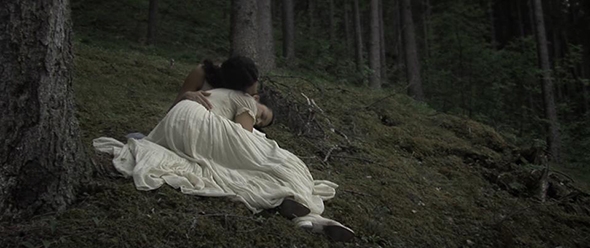
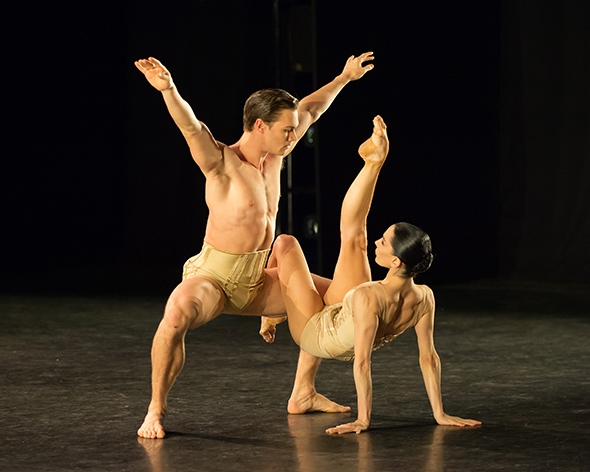
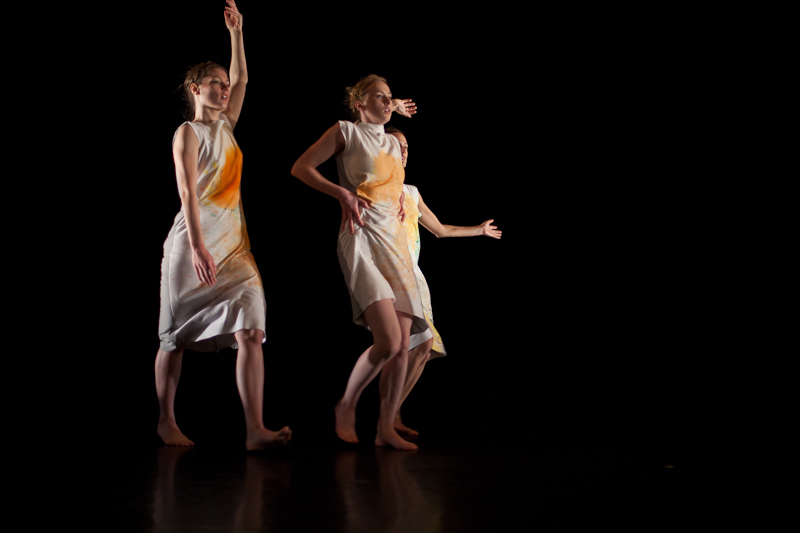
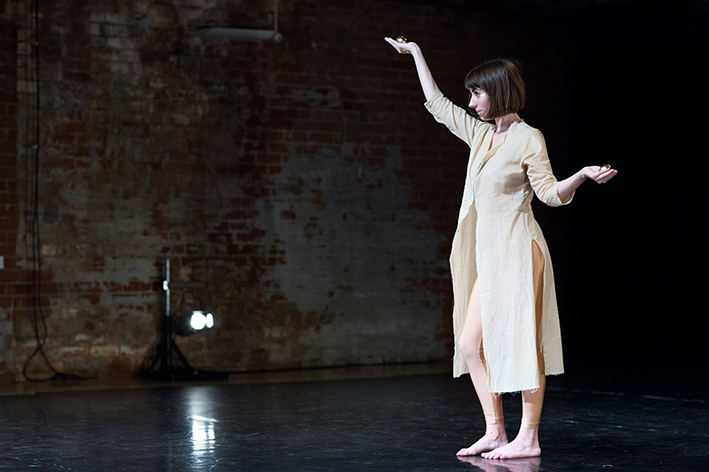
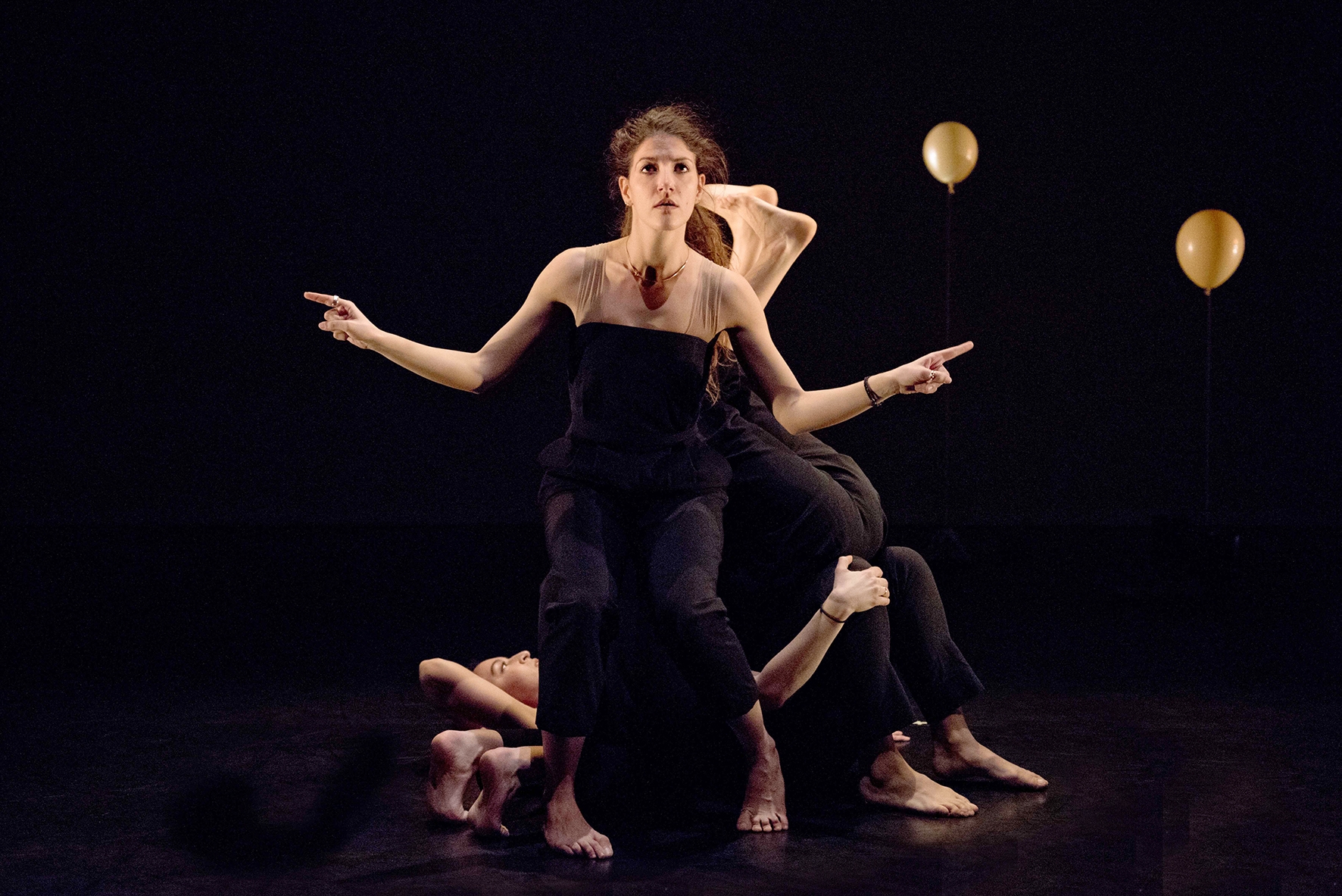
Lívia Rangel and Fernanda Lippi in the film Sea Without Shore
The term ‘dance on film’ can conjure up banks of onstage cameras, screens, computers, technical wizardry and animation in which dance and technology interact like self-conscious collaborators, but here is a dance film on a cinematic scale that simply eschews dialogue for movement. Sea Without Shore is the second film of director André Semenza and choreographer/dancer Fernanda Lippi; the first was Ashes of God. Both films have a fluid narrative driven by intricate direction, superb camera work, fine performances, sensitive scores and breathtaking locations. None of the action takes place on a stage — the stage is the screen — but in countryside or in buildings with an air of abandon or infused with the dying breath of a bygone era. Sea Without Shore is set in rural Sweden, in a summerhouse on a small island built by a wealthy 19th century publisher. The scenery is romantic, remote and ideally suited to the nature of solitude, love and death of which the film speaks. ‘Dissolving under the impact of the loss of her soul mate, a woman is drawn by unknown forces into the depth of mid-winter forests, into spheres of her subconscious.’ While there is no dialogue, Sea Without Shore is not a silent film; it has a score composed by The Hafler Trio (aka Andrew M. McKenzie) threaded with Chopin nocturnes, Parisian accordion and a Swedish folk dance band, and there are two narrators who recite lines of sapphic verse like a stream of consciousness from the 17th century poet Katherine Philips and the fin-de-siècle poets Renée Vivien and Algernon Charles Swinburne. In the version I saw, the narrators recite these fragments in Swedish over English subtitles but the images are so strong and contain within them such poignant clues to the story there is barely any need for the subtitles, even if you don’t understand Swedish. The poetry — and the way it is read by Lippi and Marcela Rosas — adds an ethereal, otherworldly dimension.
As soon as we see the opening image of dense green forest it is clear there is someone with an extraordinary eye behind the camera. Marcus Waterloo is not simply behind the camera but very much immersed in the countryside and in the lives of the film’s characters. His camera work is an integral element of Lippi’s choreography and Semenza’s direction; we see everything through his eye and his eye sees everything through the prism of the poetry. It is this depth of integration between all the film’s elements that makes Sea Without Shore so rich.
“Till the secret be secret no more” is the opening line of the film, taken from Swinburne’s Triads, that opens us to the sense of space and loneliness, of love and loss, of a mysterious beauty within a beauty that is all around. Sea Without Shore, like its title, has no clear boundary; it’s primary narrative is the relationship between two women whom we first see (but do not hear) conversing intimately on an elegant turn-of-the-century sofa that has seen better days. This initial image is suffused with the suggestion of life and decay, ease and dis-ease, love and death, light and dark, past and present that emerge and recede throughout the film: the two warm-blooded horses trudging through the snow with the bodies of two women draped over their backs; Lívia Rangel’s faded, fraying dress that matches the brocade wallpaper against which she stands, and Lippi and Rangel floating head to foot fully dressed in the water, like two Ophelias.
The images carry the film forward and back like horizontal time but there are several choreographed soliloquies in which the power of dance drills down into the consciousness of the individual. In her choreography Lippi focuses on the torso, on the emotional core of the body; Rangel is eloquent even when her movement is understated or still and Waterloo knows precisely when to close in or to keep his distance, as if he were part of her inner dialogue. There is a memorable, dark duet in the woods in which Rangel and Anna Mesquita af Sillén work themselves into a trance of grief.
Sea Without Shore is created in such a way that the sense of impending crisis is never far away; the film doesn’t build in a narrative way but instead adds layers of intensity upon images of ethereal beauty to the point of exquisite pain. If death is a release, it is where the poetry, the images, the dance and the music resolve in Rangel’s final, fateful decision. Sea Without Shore raises the level of dance on film to dance as film. Shot in luscious CinemaScope, it is a production that is best experienced in an intimate, comfortable cinema. There are still opportunities to see it in this way; just check venues, dates and times on the Sea Without Shore Facebook page.
Posted: April 2nd, 2015 | Author: Nicholas Minns | Filed under: Performance | Tags: Alisa Boanta, Benjamin Hooper, Cornelia Voglmayr, Dani B Larsen, Elisa Vassena, Jack Bishop, Nina Kov, Robert Guy, Rosie Terry, Tim Casson, Tim van Eyken, Tom Butterworth, Wild Card | Comments Off on Wild Card: Tim Casson & Friends
Tim Casson & Friends, Wild Card, Lilian Baylis Studio, March 18

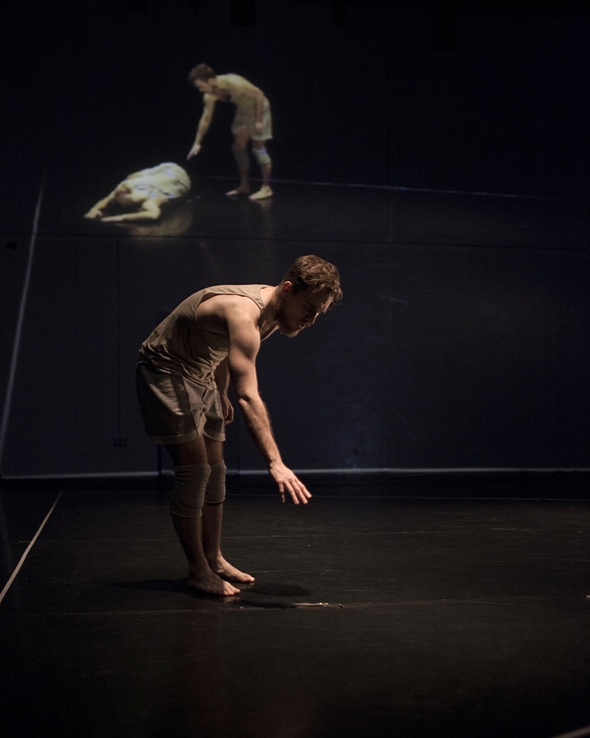
Tim Casson on stage and on film in Fiend
There is something so ebullient about Tim Casson that his Wild Card evening at the Lilian Baylis Studio is bound to be a lively occasion. He takes over the Garden Court Café, the Khan Lecture Theatre as well as the Studio stage and fills them with dance appetizers and main courses that will cater for a broad range of tastes. Oliver Fitzgerald, Chloe Mead, Sarah Blanc and Jen Irons collect stories (in the nicest possible way) from people in the café prior to the main performance to gather material for a dance they will perform later on stage; this is the latest incarnation of Casson’s groundbreaking, record-breaking The Dance WE Made. While we are watching the first part of the evening on stage, these four dancers are editing and rehearsing their accumulated phrases for performance in the second half.
In the half hour before the main performance (it is also repeated in the intermission) Casson curates what he calls First Contact in the Kahn Lecture Theatre, bringing together two pairs of artists who have not worked together before, one a dancer and the other an artist from another discipline. Each pair has been given a speed-dating two days to come up with a collaborative work (collaboration is the name of this evening’s game). The first pair is filmmaker Alisa Boanta and dancer Robert Guy, the second actor/musician Tim van Eyken and dancer/choreographer Dani B Larsen. In Dust You Are Boanta projects a film on to Guy’s bare back that makes him both tactile screen, a live chakra model and actor in his own drama. The film is so cleverly filmed and projected that it is difficult to differentiate the filmed movements from Guy’s own. Van Eyken sings a ballad of a young man lost at sea while Larsen embodies his lover in her interaction with both the story and the storyteller.
On the Studio stage Casson presents three works that continue the theme of collaboration: works by Nina Kov, Cornelia Voglmayr and his own Fiend. Kov’s Copter was first seen as a Place Prize commission in 2012 but she has subtly reworked it from being a duet between a dancer and a remote controlled helicopter to a fable of human interaction with machine. Kov has also removed herself from the protagonist role, allowing her the distance to mould the choreography on Rosie Terry while the copter pilot is the ace Jack Bishop. I remember seeing the original and being more aware of the copter than of the dancer but Kov has now balanced the work to show a charged relationship between the two that runs the gamut from touchingly playful to coldly voyeuristic.
In Voglmayr’s Sonata in 3 Movements dancer Elisa Vassena and violist Benjamin Hooper create a deconstructed sonata in which the dancer’s body, the viola player’s body, the viola and the bow all have a significant and interchangeable role to play. Hooper begins by laying his viola on its side and lying on his back behind it. He reaches over his head to pluck the opening phrase of the glorious Prelude to Bach’s cello suite No. 1 with Vassena dancing her torso on his upturned knees. Throughout the work Voglmayr mischievously sets Hooper an obstacle course, both physical and mental, that tests his ability to return to the Prelude. In the second movement, Vassena gives Hooper a lesson in dance imagination: ‘take your sitting bones for a walk’, ‘imagine your pelvis coming out of your mouth’ ‘imagine yourself a pillar of ashes and your cells are disappearing in the universe’ to which Hooper valiantly submits with hilarious results. In the third movement Vassena holds the bow between her foot and her ear and Hooper presses the viola strings against it to play Bach’s notes in unfamiliar but recognizable fashion. It is a blurring of the familiar demarcation between musician and dancer that is witty and rewarding. Hooper gets his virtuoso moment in the coda while Vassena sits at his feet seemingly unmoved until she gets up and nonchalantly walks him off.
Casson’s Fiend (his definition of wild card?) is a collaboration between himself and computer programmer/operator Tom Butterworth with whom he shares the stage. The work is based on Nijinsky’s ballet L’Après-midi d’un faun where Casson is the faun but his nymphs are multiple images of himself captured in various poses and phrases by an onstage camera that Butterworth then loops on to the backdrop screen when the choreography demands: Butterworth improvises the transference of Casson’s movements on stage so that his screen image interacts with his nymphs. It is complex and the only way to see the logic of it is to watch the screen. Casson is using the technology to explore the dual nature of watching and being watched in an environment of digital manipulation and his adoption of Nijinsky’s lecherous faun adds an element of voyeurism — a subsidiary theme of this Wild Card — to the work’s theme.
The time arrives for The Dance WE Made, which references those who valiantly contributed their stories; it is short and sweet and danced with fun and enthusiasm that makes a strong point of contact with the audience. Casson comperes this part of the show, adding a final coup in which he divides the audience into pairs for a choreographic task: the first partner asks a predetermined question (Where do you live?) and the second answers in purely physical language. The second then asks ‘What kind of house do you live in?’ and the first responds with another phrase of movement. The two responses are then performed together (on stage or in the seats) to form a simultaneous series of short choreographic phrases. Hey presto, the choreographer has demystified choreography in such an unpretentious, engaging way and in doing so has possibly broken another world record for the number of new works created amongst a dance audience in one evening.
Posted: March 28th, 2015 | Author: Nicholas Minns | Filed under: Festival, Performance | Tags: Alexander Michael, Alexandra Waierstall, Alexia Nicolaou, Aneesha Michael, Arianna Marcoulides, Cyprus Contemporary Dance Platform, Elena Antoniou, Evie Demetriou, Fotis Nicolaou, Hamilton Monteiro, Harry Koushos, Julia Brendle, Konstantina Skalionta, Machi Dimitriadou-Lindahl, Marios Konstantinou, Milena Ugren Koulas, Petros Konnaris, Roula Kleovoulou, Vicky Kalla, Zoe Georgallis | Comments Off on 15th Cyprus Contemporary Dance Platform
15th Cyprus Contemporary Dance Platform, Limassol, Cyprus, March 6-8

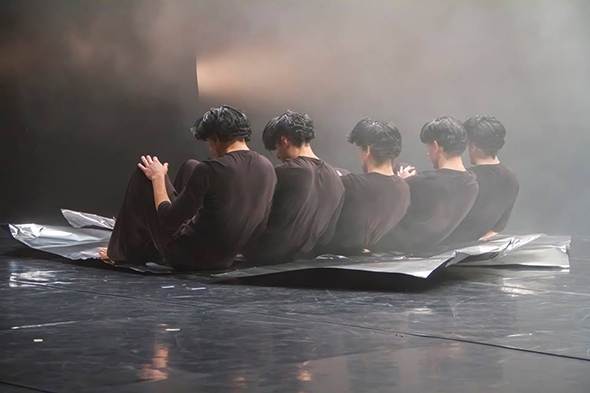
The final scene in Harry Koushos’ MAN-OEUVRES (photo: Arsham Rafiei)
The Cyprus Contemporary Dance Platform takes place annually over three days, with fifteen main stage performances in the Rialto Theatre and four parallel events at Dance House Lemesos next door. The event is supported generously by the Ministry of Education and Culture to whom I am indebted for being able to attend.
Limassol is a city on the southern coast of Cyprus in which dance is flourishing thanks to the pioneering work over the last fifteen years of the Rialto’s former director, Georgia Doetzer and a stronghold of dedicated dance teachers. The platform is open to the public, the theatre seats 550 and is well attended.
The dance community in Cyprus is close, with choreographers sharing dancers as well as dancing for other choreographers. There is also a pool of dramaturgs, musicians and various designers of sound, lighting and costumes on hand to prepare new works for performance. There seems to be no hierarchy but rather a collective desire to develop the art form; for a relatively small community the variation in ideas and dance forms is diverse.
Two points of emotional contact on the second night set me free from any geographical limitation. One is the final tableau of Harry Koushos’ work, MAN-OEUVRES that brings to mind the laying to rest of five identical brothers-in-arms with their shiny metal shields on a field of smoke to a glorious anthem by Henry Purcell. The movement has finished, the brothers lie in a row and the smoke is dissipating, but the images keep rolling through my imagination as the trumpets ring out over the battlefield: Koushos has captured an essential element of theatre, that of making images of mythological proportions from the artifice of its components. When he can bring all the elements of a work to this level it will be stunning. The other is watching Julia Brendle in a work that begins from the audience and stays in the audience, appropriately titled within and between. It is a duet with Brendle on one side of the auditorium and Marios Konstantinou on the other; they never make it to the stage. It begins very naturally from the premise of self-consciousness at the moment the two performers identify and separate themselves from the audience in which they were sitting and make their way to their respective aisles. It is such a simple idea that takes self-consciousness on a journey from introspection and nervous apprehension to a joyous celebration of gesture that raises the audience to a moment of euphoria. The careful sound design by Panos Bartzis based on a MEW instrumental track supplies the musical structure on which the dance builds. Watching it is like watching a game of tennis, following the performers from one side of the auditorium to the other, but my eyes are focused on how Brendle’s movement spreads by degrees throughout her body and beyond without ever betraying the gestures from which it derives.
There is an interesting cross-fertilization between choreographers Fotis Nikolaou and Hamilton Monteiro. Nikolaou presents his work called Inland (in which both he and Monteiro dance) that derives its mystery and power from the decision to have each of the five performers wear the same masks (designed by Martha Foka). With the elimination of facial expression, it is the posture and gesture of the body that communicates and Nikolaou sets the tone with his initial appearance alone standing almost naked on a platform under top lighting. With the weightless articulation of a bird he steps off and back on to the platform to fetch one item of clothing at a time until he is fully attired. On the same program, Monteiro creates a solo for Nikolaou, Marika’s dress, in which he utilizes a similar quality of movement to depict a controversial society figure (I am relying on the notes) who reacts in solitude to his/her pariah status. Mariko’s dress is more delineated as a piece of dance theatre than Inland — for all its intricate details it is too much like a choreographic maze to be coherent to the end — but the quality of movement in both is distinctive.
Machi Dimitriadou-Lindahl’s Gate for three women and two men is a mature work that celebrates flowing dance movement with patterns of dynamic form and clear imagery linked to a powerful score (two works, by Dimitris Savva and Julia Kent). Dimitriadou-Lindahl heads one of only five dance companies in Cyprus, Asomates Dynameis (Incorporeal Forces/Angels) which she founded as a way of exploring through contemporary dance and martial arts the inner energy and presence of the body. Gate deals with states of consciousness and has the sensitivity of ebbing and flowing energy in the group that ranges from collapse to support, from alienation to spiritual consolation.
Three works share a predilection for stillness, even though their averred creative sources vary, respectively, from sound frequencies to Samuel Beckett to philosophy: Arianna Marcoulides’ solo, Stomach Rumblings, Elena Antoniou’s solo more and (most starkly) Roula Kleovoulou’s duet, Standstill. Each work raises questions about the treatment of silence and about its effect.
Marcoulides lies motionless on what appears to be a thin catafalque as if she is awaiting burial. The lighting by Rialto’s resident designer Aleksandar Jotovic is deliberately somber so we can see the transmission of a crackling green light over her body to which she reacts by slowly raising her chest and feet before shuddering faintly and returning to the supine position. From a visual perspective this happens three times with minor variations but the concept, developed by Marcoulides and sound designer Panis Bartzis, is to relate sonic frequencies to their physiological effect on the human body. This discrepancy between visual and conception means either the science is simply more accessible in the reading than in the images Mercoulides chooses to give us, or the science is a shield for something more mysterious and unspoken to which she is not yet ready to give form.
Antoniou’s more is also divided into three distinct phases: as we enter the auditorium she is standing statuesquely on stage in a black leotard, kneepads and socks. She doesn’t move except for the infinitesimal impulses in the body that manifest in her torso down to her fingers. The kneepads give away Antoniou’s intention to descend to her knees which is a contradiction; the beauty of stillness is in not knowing what, if anything, will succeed it. The light fades very slowly to blackout and when it returns suddenly in full force Antoniou is on her way down to the floor. Interestingly she uses a sketch drawing of a figure by Francis Bacon as her program image; it is this fluid transition to an animalistic posture on her hands and knees that she captures though she doesn’t go for the tortured image of Bacon’s figure in which there appears to be a naked light bulb suspended above it, as in a squalid chamber. Antoniou’s floor movement eschews animality, deriving its form from the stomach or solar plexus with her head restlessly thrashing from side to side, but this doesn’t have sufficient force to justify the descent. She drags herself forward on a diagonal path but stops to stand, quite still, as before. This pattern is repeated with variations twice more until she takes off her socks and steps out of it, as if out of Bacon’s frame.
When the curtain opens on Kleovoulou’s twenty-minute duet, Standstill, there are two standing figures (Arianna Marcoulides and Milena Ugren Koulas) in close proximity and they don’t move for what seems the longest time; my first concern is that the music cue has failed. Ugren Koulas is looking out beyond the audience and Marcoulides is drilling her eyes into the side of her head expecting her to respond; she doesn’t. Panayiotis Manousis limits his lighting to the two faces thus concentrating the intimacy of this standoff but when Marcoulides inclines towards her partner/adversary the lighting opens up to the full stage and the tension starts to dissipate. An offstage fan ruffles the costumes and then stops. Marcoulides fixes her eyes on her partner as she sways like a heavily weighted pendulum, building up a tension that is oppressive, but it is not she who releases it: it is Ugren Koulas who begins to laugh. Suddenly the standoff that has kept the two women and the entire work together becomes meltdown as Marcoulides is reduced by slow, calculated degrees to a wounded, hysterical figure shaking uncontrollably. As soon as she stops the lights drop to black.
On the first night Zoe Georgallis presents For your entertainment only… in which she dances with Konstantina Skalionta and Typhaine Delaup. The work romps through the question of an artist’s identity without really addressing its serious, sometimes tragic nature, so the humour lacks depth (which is what gives it its bite). There is lots of movement referencing flappers and cabaret, but like the humour it lacks context. It is no wonder the disembodied voice of the choreographer as God is not sympathetic.
A trenchant and altogether darker treatment of the dual nature of existence is Alexia Nicolaou’s I will dark you down. I love the quote from Nikos Kazantzakis that headlines her program note: “What is light? Staring with a fearless eye into the darkness.” Nicolaou writes in a highly physical, visceral language that takes I will dark you down to the edge of madness but the distinction between light and dark is not always apparent even though she separates them by using Roza Maria Pantzis as her demonic alter ego. The dark side is well expressed but I am not sure by the end if Nicolaou has developed that ‘fearless eye’ or if her alter ego has got the better of her. One great asset of I will dark you down is the live soundscape by Dimitris Spyrou who transforms an array of found objects into a spooled orchestra of sound.
Vicky Kalla presents Big laugh for ever on which she collaborated with co-dancer Yoav Greenberg. Despite its title, this is more of a playful young love ritual than a big laugh and it is tinged with a sadness, or loss of innocence (symbolized by the pile of hats Greenberg loses one by one to Kalla) that saves it from being cute. There is a third character who sits from beginning to end on the top of a ladder with his back to us. We never see his face but we can see he is writing on a laptop. If he is the author, and Big laugh forever is his story, I don’t know what he adds to the performance; if the dance is his stream of consciousness, it is implicit in the dance. Now if he could cross out a phrase or sentence and rework it, his participation would warrant his inclusion in the work.
Alexandra Waierstall’s Lightless is, according to the program, part of a choreographic study that will lead to a full evening performance to premier in Dusseldorf in the fall, which makes it perhaps two stages away from completion. Nevertheless its otherworldliness is covered by Waierstall’s description of it as ‘minimal science-fiction with humans, plants, objects and feelings.’ The setting appears to be the stage itself after the audience and stagehands have left, a murky lifeless scene but for the spectral presence of Waierstall among several potted palm trees, scattered stage lights, electric fans and three microphones on stands. Fotis Nikolaou and Harry Koushos constitute the human element, the one moving low and stealthily around the stage, the other lighting him with a hand-held lamp but with very little to suggest any emotional relationship between the two. It is as if Waierstall is manipulating her elements — human, vegetable and mineral — to generate arresting images that derail our search for narrative and leave us finally to ponder the sound of the fans blowing the suspended microphones recording the swaying palm fronds: a storm of perception that ‘questions the relationship between man and the environment, ecology and theatre, archaeology and future utopia, the visible and invisible.’ There is clearly more in the description than is contained in this segment of Lightless, so it will be the Dusseldorf audience who benefit from its full evolution.
Konstantina Skalionta’s In the likeness of… is a compassionate observation of the complex relationship between mother and daughter. Ten minutes is not enough time to delve deeply into the relationship but Skalionta conveys her sentiments succinctly in a series of images that flow easily from one to the next. She is helped by Bea Bonafini’s fine red costume that embodies maternal love in the form of a womb and umbilical chord by which Typhaine Delaup emerges from under its voluminous folds. This is not a beatific vision of motherhood — Skalionta doesn’t shy away from the daughter’s struggle for independence and the cat fights — but it does celebrate it in a heartfelt way. She also links the work to her own childhood by singing a traditional Cypriot lullaby which is then taken up by Irma Vastakaite on violin. By the end the roles of mother and daughter seem to reverse but it is ultimately the umbilical chord that draws them together and erases any differentiation.
Alexander Michael’s Diluted Intentions is perhaps the first neo-classical dance inspired by grant applications. The set is a permutation of a chessboard with black and white squares on the floor and corresponding grid-like variations projected on the backdrop. The white squares on the floor turn out to be sheets of paper representing the grant application form whose wording appealed to Michael’s sense of humour, or to his sense of the absurd. Official documents can do that, but he appears to have navigated them well enough to be included on the platform. Diluted Intentions also refers to the nature of the creative process: ‘The artist, who claims to create a work that reflects society must embark on a creative process during which the artist, being open to intuitive choices, inevitably discovers new intentions during this process, resulting in Diluted Intentions.’ So while this is cerebrally a work about funding applications, the choreography explores a strategic game — something between chess and hop scotch — for four dancers, Julia Brendle, Rania Glymitsa, Dara Milanovic-Michael and Alexia Perdikakis, in which they watch each other intently before deciding on their next move. The footwork is fast and the lines long, but the gestures are what distinguish the work, especially in the extended improvisation by Brendle at the end.
Gestures are what bring the platform to a close in Happiness by Milena Ugren Koulas in which she performs with her husband, musician George Koulas. The program note relates the title to Aristotle’s philosophy of happiness, but looking at Ugren Koulas’ dance as language, happiness is a physical condition in which the body is a finely-tuned instrument of expressive power that the dancer can ‘play’ for the benefit of self and others. It is therefore fascinating to see the interplay between dancer and musician — Koulas on drums and singing — in which first one and then the other take the lead until they are both performing in rapturous harmony, a tour de force of gesture and percussion.
During the three days of the platform there are two parallel events at Dance House Lemesos. It is a studio and performance space set up in 2007 by five Cyprus-based dance companies with a common vision to create a structure that would allow dance art to develop on the island and also act as a portal for international collaborations and exchange. There are four performances staged in Dance House and the intimate, relaxed environment is ideal for them.
Take a marble torso of a young maiden from the archaeological museum and bring her alive with a piercing gaze, expressive limbs and a red bonnet and you have an idea of Aneesha Michael’s hauntingly serene presence. Her Quest is performed in a metaphorical landscape of a whitewashed block of four miniature steps and a small pile of talcum powder. The negotiation of these steps represent the obstacles Michael challenges with perilous equilibrium (she is not dissembling but presenting herself with problems of balance that she then resolves) and the powder that releases its particles and fragrance into the air as she passes with swirling patterns and fluid arm gestures is the transfiguration of her experience into mystical delight. Quest is a work whose qualities are invested in the performer; Michael is, as a colleague suggested, as much a medium as a dancer, channeling values that seem to come from somewhere beyond our mundane experience. Consciously or unconsciously we are all on this quest; Michael in her unornamented simplicity is showing us the way.
Another refreshing work in Petros Konnaris’ Nude Tree that is the most honest expression of the nude body I have yet seen. In a round table series of introductions on the opening morning of the Platform, he says he dances without clothes because he simply loves to be naked and it is this enthusiasm and lack of artifice that makes his work so engaging. Through careful manipulation of his body — he maps his way around the floor, usually upside down, with his hands and feet like a cartographer’s calipers — he creates forms that reveal the body, particularly his back, in startling beauty and yes, there are similarities between his upturned torso and supporting arms to the trunk of a tree. The latter part of his work is more playful but could be interpreted as a statement of his choice to be naked. His pants and shirt lie on the floor and he sets out to superimpose his body on first the pants and then the shirt, without ever putting them on. Lying on his back he lifts the hems of his pants in his prehensile toes so they fall over the contours of his legs then joins them meticulously to his shirt. He finishes by defiantly screwing up both into a ball with his feet and walking off the stage into the sunlight outside.
Evie Demetriou was pregnant when she created the duet Double Days (a term that refers to the ‘workload of men and women who work to earn money, but also have responsibility for unpaid, domestic labour’) and it is the experience of motherhood that not only links the three women — Demetriou herself and performers Milena Ugren Koulas and Rania Gymitsa — but informs the creative process. Questions about the female body, about desire and sex after giving birth, about husbands (‘they are all beautiful….from a distance’) are all exposed through graphic demonstration, satirical text and Ugren Koulas as radio commentator fielding listeners’ accounts of sex in extraordinary places. Double Days is framed in a highly physical language that puts the female body into the role of commentator, heroine and victim but it clearly derives its significance from the context of feminist politics, albeit of a good-humoured, non-judgmental variety.
The final work of the parallel events is a work in progress by Harry Koushos, the time quality. It continues Koushos’ exploration of the visual and aural qualities of thin metal sheeting. In his MAN-OEVRES he uses the same metal sheeting to create a thunderous interlude that we hear from behind the stage, but here the dancer is only ten feet away. At the same time Koushos projects images on to the metal sheet, abstract when it is at rest and a series of buildings raining down when the sheet is in rapid motion. The dancer, tall and thin like Koushos himself, makes his elongated way around the stage on variations of all fours, followed by another dancer lighting him with a mobile stage light. Both sound and light have a harsh, apocalyptic quality that is not expressed to the same degree in the movement. As in MAN-OEUVRES, Koushos is searching for a complete scenographic expression in which the dancers play a visual role.
Posted: March 22nd, 2015 | Author: Nicholas Minns | Filed under: Performance | Tags: Canciones del Alma, Charlotte Edmonds, Larry Cuba, Lingua Franca, No Strings Attached, Robert Cohan, Unfold to Centre, Yolande Yorke-Edgell, Yorke Dance Project | Comments Off on Yorke Dance Project’s Figure Ground: A Tribute to Robert Cohan
Yorke Dance Project, Figure Ground, Lilian Baylis Studio Theatre, March 10

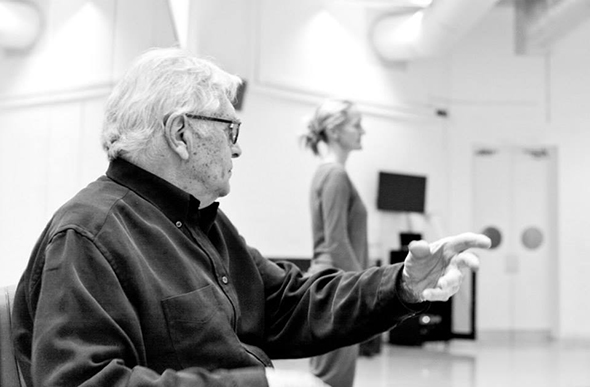
Robert Cohan and Yolande Yorke-Edgell in rehearsal (photo: © Pari Naderi)
A lot of attention is being paid to choreographer Robert Cohan as he approaches his ninetieth birthday: there’s a biography by Paul Jackson, The Last Guru – Robert Cohan’s Life in Dance; a birthday celebration at The Place at the end of March and these performances of new and old work by Cohan performed by Yolande Yorke-Edgell and her company Yorke Dance Project. Cohan studied dance at the Martha Graham School and joined the Graham company in 1946, becoming a soloist and partnering Graham herself. You can’t get much closer to the sources of modern dance than that. At the invitation of Robin Howard in 1967 Cohan came to London to pass on his experience and knowledge as the founding artistic director of The Place, London Contemporary Dance School and London Contemporary Dance Theatre (LCDT) for which he created works for 20 years. On The Place website there is a wonderful photograph of him in the rehearsal studio, with an intense, intelligent expression that somehow captures the excitement of those early years of contemporary dance in England.
The first of Cohan’s works on the program is Canciones del Alma, set to a poem of the 16th century mystic St John of the Cross by composer Geoffrey Burgon. It cannot be anything but a spiritual work with the poem’s vocabulary of the ‘living flame of love’, ‘tender wounds of the soul’, ‘deep caverns of feeling’, and the ‘tender swelling of the heart’. Cohan clearly feels this text profoundly and his choreography is the vessel for that feeling. Like Graham’s work, the shapes come from and are inhabited by the deeply felt emotion of the performer and the cohesion of the choreography depends on the sequence and flow of emotions. Yorke-Edgell performed Canciones del Alma last year in the same theatre and she evoked movingly a battle between divine love and the wounds it imposed. At the very end she resolved it in a final gesture of cupped hands to her womb that seemed to free both her and the work. On Tuesday the emotional coherence wasn’t as apparent and the work remained unresolved. There was indeed a heaviness in the evening’s performance that capped the level of emotional intensity.
Even Charlotte Edmonds’ intelligent work, No Strings Attached, lacked the spring in its step that I remember last year. In creating the work, Edmonds was inspired by the spatial relationships between the dancers (the term ‘figure ground’ applies to the spatial relationship between figures on a canvas). The dancers have changed which may have upset the balance; the steps are there, the mature musicality is there but the life of the work is subdued. Set to Michael Gordon’s Weather One, which has both a rhythmic structure and an atmospheric feel, No Strings Attached weaves three men and three women in a series of rich groupings and patterns connected by grounded steps that give a sense of energy rising from the ground, with frequent yoga positions that add a layer of calm spirituality. Lucy Hansom’s lighting enhances the forms, gently bathing the bare arms and legs left exposed by Peter Todd’s costumes. Edmonds derives the dynamics of her steps directly from the music (Weather One employs plenty of canon form that Edmonds seems to enjoy) which in turn informs the nature of her shapes; they are abstract but inherently musical; she doesn’t require her dancers to inhabit them, as Cohan does, with emotional meaning. Her partnering is less interesting, but as a first professional commission No Strings Attached is impressive in its unpredictable play of form, dynamics, musical phrasing.
Cohan’s Lingua Franca is a new work, albeit inspired by an earlier one, Agora, from 1984. It is set on four dancers — Yorke-Edgell, Jonathan Goddard, Phil Sanger and Laurel Dalley-Smith — and responds to their ‘unique physical language’ but the visual package looks back to an earlier era when making the stage resemble a studio was a way of including the audience in the choreography. Lingua Franca opens with all the dancers entering ‘the rehearsal studio’ in their practice clothes, with their own accessories, warm-up routine and greeting, and with Yorke-Edgell preparing for rehearsals from a video on her laptop. By contrast a stagehand wheels in a video screen (that looks as if it was brand new in 1984) on which we see a small film of Cohan in rehearsal. What few studios have, however, is a grand piano, and tonight’s pianist, Eleanor Alberga, was for many years the musical backbone of LCDT. Before she sits to play, she runs (literally) through her own warm up of punching the air and touching her toes. While the dancers prepare Alberga plays her own composition over which we hear the voice of Cohan instructing the dancers. The stage clears except for Goddard who stands at the open piano. He signals to Alberga who starts Busoni’s transcription of Bach’s Chaconne in D minor as Goddard starts to move, except that he is frowning at Alberga as if she is playing the wrong piece. His solo reaches as high as it sinks low into the ground, like the music itself; Sanger enters with a twisted cabriole step, Yorke-Edgell begins her solo with both men lying on the floor and when Dalley-Smith enters she looks at all three wondering what she can do. It’s an artificial setting in which the dancers’ lingua franca — their styles of movement — are too diverse to give coherence to Cohan’s choreography, giving a sense that Alberga’s powerful interpretation of the Chaconne covers the entire piece like a heaven and earth in which the four figures are searching for paths in unfamiliar territory.
Yorke-Edgell’s own Unfold to Centre is clearly influenced by Cohan; even its title is redolent of the days of LCDT. It is perhaps the choreographer’s acknowledgement of her mentor’s generosity in supporting the project and of the investment of his creative time in its fruition. Unfold to Centre takes as its starting point a 1978 computer animated film by Larry Cuba, 3/78, in which ‘sixteen objects, each consisting of one hundred points of light, perform a series of precisely choreographed, rhythmic transformations.’ An edited version of Cuba’s film is projected on the backdrop and floor, providing a kind of blueprint for the choreography. Goddard is the centre figure who initially suggests movement that the others transform, a mixed image of a king and his deferential courtiers or of a planetary system. There are arm gestures that are pure Cohan and port de bras that are based on the classical fifth position. With all the movement of Cuba’s 3/78 projections, the bodies of the dancers appear monolithic as if participating in a science fiction ritual and only regain their humanity as they come together at the end.
There is so much to admire in what Yorke-Edgell has accomplished here: the place of honour given to Cohan as creator and mentor, the support of Edmonds as an aspiring choreographer and the reminder of the foundations of contemporary dance in England. The figure ground changes between these elements but it is Cohan who comes most clearly into focus.
Posted: March 21st, 2015 | Author: Nicholas Minns | Filed under: Performance | Tags: Alejandro Virelles, Alina Cojocaru, Cesar Corrales, ENB, In The Middle Somewhat Elevated, Jiří Kylián, John Neumeier, Max Westwell, Modern Masters, Petite Mort, Spring and Fall, Tamara Rojo, William Forsythe | Comments Off on English National Ballet, Modern Masters
English National Ballet, Modern Masters, Sadler’s Wells, March 11

Max Westwell and Tamara Rojo in Jiří Kylián’s Petite Mort (photo © ASH)
The three modern masters represented in English National Ballet (ENB)’s triple bill at Sadler’s Wells — Jiří Kylián, John Neumeier and William Forsythe — are all related in that they learned their trade in John Cranko’s Stuttgart Ballet before forging their own distinctive styles of classical dance in their respective companies: Kylián in The Hague, Neumeier in Hamburg and Forsythe in Frankfurt. The three works performed this evening are like cousins, having their beginnings in a rich artistic period in Europe within two years of the fall of the Berlin Wall and have since been staged by companies around the world.
Kylián’s Petite Mort (1991) is already in the ENB stable since its acquisition in 2013 but its wit and elegance is worth seeing again. Well, it would be if the wit and elegance were in evidence, but on Wednesday night the elegance is hijacked by a display of overly muscular male torsos swishing fencing foils and the witty eroticism sidelined by their narcissistic posing. The six women, looking decidedly out of scale, don’t stand a chance, not even Tamara Rojo who is positively engulfed in Max Westwell’s physique. Not all the men suffer from this muscular overdevelopment — Junor Souza balances strength with lithe form and he is well suited in his duet with Laurretta Summerscales — but with six of them in nothing but high-waisted trunks the impression of bulk is overwhelming. One of the subtleties of Petite Mort is in Kylian’s use of the parallel qualities of the supple steel foil and the male body; petite mort is, after all, the French euphemism for orgasm and the analogy of death from the thrust of a foil with the little death of the final thrust in love is central to the imagery of the work. The foils haven’t changed since 1991 but the male bodies have; if these studs don’t rein in their weight training their future work with foils will be like watching Arnold Schwarzenegger sewing. Which makes me think of the poor costume department…
What a welcome relief to see Alejandro Virelles and Cesar Corrales in the first act of Neumeier’s Spring and Fall, choreographed to the five movements of Antonin Dvořák’s Serenade in E major. Here are two male dancers whose physique appears to be formed by classical training alone; they both move effortlessly and quietly from the inside, which is a totally different approach from the gym-enhanced school. With its pastel colours and white costumes (Neumeier’s own conception) the setting of Spring and Fall suggests a happy, youthful memory in which an ardent Virelles and a flirtatious but spirited Alina Cojocaru express their burgeoning love against a chorus of friends. Virelles and Cojocaru are beautifully matched in their ease of technique and lack of pretence that comes from the mastery of their art. The choreography is abstract but it is not hard to read. As Neumeier says, ‘As soon as there are two people there is some kind of relationship. And those human relationships are what interest me as a choreographer.’ Apart from the three principals, the supporting cast prove a little ragged, but Anjuli Hudson stands out with her uninhibited enthusiasm.
Forsythe’s In the Middle, Somewhat Elevated was first choreographed on the Paris Opéra Ballet in 1987 when Rudolph Nureyev was artistic director. Forsythe remembers ‘the whole atmosphere there was electric.’ The first cast included a young Sylvie Guillem, Laurent Hilaire, Isabelle Guérin and Manuel Legris. Imagine those long legs arriving at the height of a percussive climax in Thom Willems’ electronic score and what Forsythe’s elongated, dynamic, off-balance shapes must have looked like. There is also a chic cool in the way the dancers wander in and start their variations, something the French do so well. It is still a thrilling dance to watch with its spatial dynamics and visceral physicality, though Wednesday’s cast is less tall, less elongated than its ideal execution demands: the dynamics of the steps don’t quite match the dynamics of the score. In terms of coolness, Tiffany Hedman seems to have the measure of the work but the same can’t be said about James Streeter, fresh from fencing, who mistakes open-mouthed, brazen posing for cool assurance. It’s that bodybuilding thing again.
Posted: March 6th, 2015 | Author: Nicholas Minns | Filed under: Performance | Tags: Alex Mugler, Ana Pi, Butterz, Cecilia Bengolea, Elijah, Élisa Yvelin, François Chaignaud, Skillam, TWERK | Comments Off on François Chaignaud & Cecilia Bengolea: TWERK
François Chaignaud & Cecilia Bengolea, TWERK, Lilian Baylis Studio, March 5
UK première

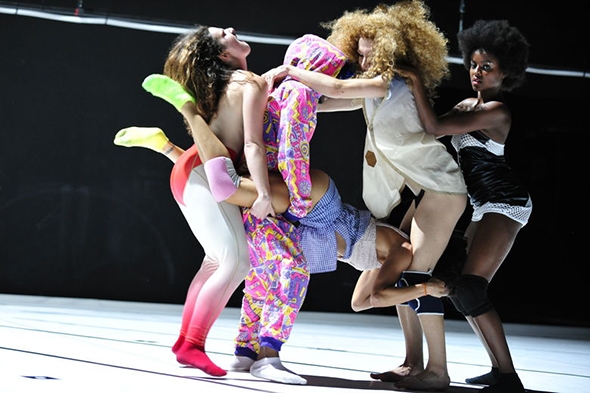
Élisa Yvelin, Alex Mugler, Cecilia Bengolea (horizontal), François Chaignaud and Ana Pi in TWERK (photo: Jean-Marie Legros)
TWERK, or to call it by its full, willfully punctuated name, altered natives’ Say Yes To Another Excess — TWERK, is a riot of the senses: visually vibrant, aurally dubbed, sexually provocative, intellectually wicked, it’s all there: an off-the-wall experiment in writing dance from a purely physical perspective. As choreographers François Chaignaud and Cecilia Bengolea write in the program, the challenge for the performers in TWERK is to ‘trust dance and its expressive, brotherly, poetic, preconscious and discursive powers.’ That’s an interesting selection of adjectives, but by the end you realise the dancers have convincingly demonstrated the value of each one.
It is notable that the French ‘write’ dance whereas we talk in terms of ‘creating’ dance. I like the idea that dance can be written with a density of poetic imagery as text without words. TWERK is something of a collision of images, ideas and of history; I couldn’t help but associate Chaignaud in a crimped blonde wig, sparkly eyes and holey tights with Louis XIV cavorting at a masque and his reverence at the end is a masterpiece of elegant wit. But in between his initial appearance and his final bow, Chaignaud’s enigmatic presence, his formidable classical technique, his expressive face and leering eyes are from another century altogether. The dancers are like a band of traveling commedia dell’arte players transferred to the Ballroom Community, or performers in a lascivious Punch and Judy show for adults. This juxtaposition of fantastic imagery is what makes TWERK such a rich arsenal of visual stimuli.
Above the dancers’ heads is a tent-like framework (it is in fact the lighting rig of fluorescent tubes) that reduces the effective height of the stage and increases the stature of the dancers. Chaignaud and Bengolea spare no time entering this imaginary world; they have already begun by the time we enter the theatre. To one side DJs Elijah and Skillam (Butterz) from the London Grime scene are mixing their thunderous dance music while the five dancers are getting dizzy spinning around the white floor in wigs, wacky costumes, kneepads and socks, colliding like bumper cars at a fairground. Their arm gestures are informal, almost thrown away, and as the strain of endlessly turning takes its toll there are held breaths, blown cheeks, careering paths and tottering derailments. But it doggedly keeps going until we are completely immersed in the bodies, colours and chaotic rhythms. A blackout leads to a stroboscopic flash of Chaignaud holding his leg high to the side as he begins a devil-may-care grunge solo that has the agitation of a Polichinelle figure flinging his arms out or being flung into the air to land in the splits and includes him standing on his head and crawling off like a dog lifting his leg at every lamppost.
Costumes and makeup, for which Chaignaud and Bengolea are responsible, play a vital role in TWERK as an additional layer of immediate sensory gratification. When Bengolea in fluorescent green fluffy jacket and matching slippers dances a sultry, sexual duet with New York voguer Alex Mugler in pink pajama suit, it is not just the movement that reads but our sense of colour and form; watching the animated Élisa Yvelin’s facial expression is heightened by her exaggerated punk makeup. While the costumes themselves are a feast, the careful subtraction of parts of them during the performance is equally expressive. When all three women (Bengolea, Yvelin and Ana Pi) dance bare chested the sensuality is palpable, and when Chaignaud appears like a naughty boy without his tights it is the eroticism of Aubrey Beardsley’s drawings that comes to mind.
Each dancer has his or her moment on stage and it is an occasion to let the dance show the person rather than the other way round. There is a sense of improvisation in these solos and the dancers take pleasure in watching each other. When Ana Pi is twerking up a storm I notice Chaignaud peeking through the side curtains with a smile on his face, and when Mugler jumps on the prone Yvelin, it is Pi who is laughing at his antics.
Despite its surface of rollicking fun, TWERK has an undercurrent of tension and sensuality that derives from its investigation of and interaction with Grime music. It is visceral, full on, witty and in the best sense of the word, camp. You can’t get away from the exaggeration of posture, gesture and situation but it never dissipates into parody; there is always a ground of intellectual curiosity (in its physical form) on which the entire work is predicated. How refreshing.
Posted: March 3rd, 2015 | Author: Nicholas Minns | Filed under: Performance | Tags: Eleesha Drennan, Guy Hoare, Julian Warburton, Kenny Wing Tao Ho, Mark Bowden, Nia Thomson, Simon Haram, Viivi Keskinen | Comments Off on Eleesha Drennan: Channel Rose
Eleesha Drennan, Channel Rose, The Place, February 28

Viivi Keskinen in Eleesha Drennan’s Channel Rose (photo: ©Nicole Guarino Photography)
Eleesha Drennan’s Channel Rose (as in a TV station for Utopia-related content) is one of those rare physical statements with an intelligence that develops along a unique and mysterious path in which all the elements — the movement, the lighting and the live music — come together without faltering. Its completeness is the kind of unity characteristic of classical art: harmony of form and content. Drennan has dug deep into her choreographic heart to find a harmony that lies at the core of the disparate elements of her work; she calls it Utopia, but I think in looking for Utopia she has discovered something else: inspired creativity. “I am motivated to create a dialogue between thought and physical sensation”, she writes, but what if physical sensation — and dance in particular — is a way of thinking? Wouldn’t dialogue then give way to a physical stream of consciousness? It seems this is what Drennan has convincingly achieved; she forces us to think without words.
Although Channel Rose is predominantly abstract, there are material elements — a pile of sand, one red stiletto shoe, a fish bowl with water on a stand — that are sufficient to anchor a sense of narrative. At the beginning Drennan (who performs Annabeth Berkeley’s role this evening) sets the stage with a scenario that could go anywhere: to a variation of La Vie en Rose, Viivi Keskinen (‘a wild witch woman…struggling for control and power’) is building a wedding cake of a sandcastle next to the fish bowl; Kenny Wing Tao Ho (‘an ethereal wizard…who wants nothing more than to fly’) is lying on the floor exercising his wings and Drennan (‘a free-spirited gypsy woman’) is coming to terms with having lost one of her smart red stiletto shoes. Each of the dancers will interact with the water, the shoe or the sand — or all three — in the course of the work. Saxophonist Simon Haram stands modestly to one side in front of his music stand and percussionist Julian Warburton is the commander of an impressive array of instruments whose architecture is beautifully outlined by Guy Hoare’s lighting.
Keskinen destroys her sandcastle in a fit of pique, washing the sand off her hands in the fish bowl, and as the music starts – Fragment for solo saxophone by John Woolrich – she walks back towards Drennan but Drennan is hobbling gracefully forward to the front and Wing Tao Ho gets up to calm Keskinen, setting off a fit of trembling hands like a fringe of madness around her. She brushes him off and falls at Drennan’s feet, wrapping around her legs like an anchor while Wing Tao Ho tries to take off across the stage with the wind in his face and arms like propellers. Over the next 60 minutes this trio with their individual goals and strong, contrasting characters will remain true to themselves while playing off each other with endless variations. The performers (musicians included) are so caught up in the movement that it is impossible to watch them all and catch the ebb and flow of energy flowing through each, but wherever you focus there is something remarkable going on internally that is reflected in the face and gestures on the outside. Keskinen in particular has a rich supply of expression both in her face and body that constitutes a coherent trail of thought from beginning to end, from her possessed, finger-frenzied passages through the sly sense of wonder when she puts on the rose-tinted glasses to the climactic moment when she lifts Wing Tao Ho and spins him wildly before propelling him on his way.
Mark Bowden is responsible for the musical choices from John Woolrich, Andy Scott, Iannis Xenakis, Louiguy and Graham Fitkin, and provides three of his own, one for solo saxophone, one for solo percussion and one for saxophone and vibraphone. The quality of the works and the artistry with which Warburton and Haram play them create a dynamic structure for Channel Rose through which the dance flows and in which it sometimes gets thrillingly entwined. The influence works both ways: when Haram sits out the final Rebonds B for solo percussion he puts on the rose-tinted glasses to watch the dance.
There are only three costumes and Nia Thomson has entered into the imagination of the work to create three ‘characters’ that reflect their wearers and the way they move. They also respond beautifully to Hoare’s lighting which in turn sculpts the space around them and sets them free.
Channel Rose is a work that is governed by its search for freedom and finds it unexpectedly under its own feet. In the end the rose-tinted glasses are unnecessary; rather than being an ideal beyond our reach, Drennan shows us that Utopia is a reality to be discovered in our dancing bodies.
Eleesha Drennan is the recipient of the 2014 Sky Academy Arts Scholarship
The creative producer of Channel Rose is Tess Howell
Posted: February 27th, 2015 | Author: Nicholas Minns | Filed under: Performance | Tags: Adieu, Anda Winters, Cree Barnett Williams, David Ledger, Hannah Hall, Hubert Essakow, Kirill Burlov, Mbulelo Ndabeni, Naomi Sorkin, Nathan Young, Piedad Albarracin Seiquer, Rob McNeil, Tamarin Stott | Comments Off on 1898: Contemporary Dance Festival
1898: Contemporary Dance Festival, Print Room at The Coronet, February 23

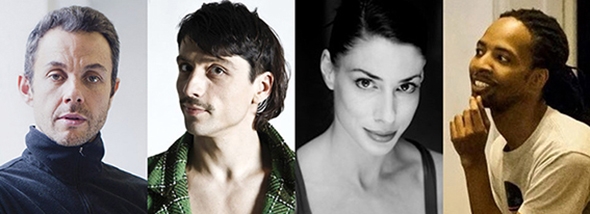
Choreographers of 1898: Hubert Essakow, Kirill Burlov, Tamarin Stott, Mbulelo Ndabeni
The good news is The Coronet Theatre in Notting Hill, built by WGR Sprague in 1898, has a new lease of life as Print Room at The Coronet under the artistic direction of Anda Winters. Winters, who founded Print Room in Westbourne Grove in 2010, is planning to bring her new home to its original splendor as a cinema and performing arts space. If you are lucky enough to get tickets for the current show, 1898: Contemporary Dance Festival, curated by Winters and Artistic Associate Hubert Essakow to celebrate the theatre’s founding, you are attending the first live performance there in almost a century and sitting on the very stage where Sarah Bernhardt and Ellen Terry once performed.
Because the auditorium is being renovated, both the audience and the performing area are arranged across the old stage; if we could look through the wall on the left we would see the auditorium. What designer Hannah Hall has devised is a stage at one end like the corner of a box, all in white, with a side wall that curves seamlessly round to the back and a white floor that flows from the curved baseboards to the open front and side of the stage area. The wall allows for projections and is solid enough to take weight; the open sides are for seating. Any reserved seating is for the performers, including a dilapidated period sofa next to me that looks as if it could tell a few stories. The feeling is intimate, and the whiff of fin-de-siècle intoxicating.
This is immediately evoked in Essakow’s Adieu; Erik Satie’s wistful Gnossienne No. 3 and some Debussy songs of romantic sensibility, sweet suffering and passion swirl around ‘the ghosts of past performances at The Coronet…’ which include a sensual, all-embracing femme fatale, Naomi Sorkin, looking remarkably like Sarah Bernhardt in a long silk dress, black cape and wide brimmed hat. There are two beautiful youths (David Ledger and Cree Barnett Williams) whose promising hold on each other is undermined throughout by Bernhardt’s seduction of them both: those passionate, half-closed eyelids know no limit. We even hear Bernhardt’s own voice returning to the stage in a ghostly recording. Adieu is not so much saying goodbye as immersing the characters in the fleeting sense of beauty, love and parting that the word — especially in French — brings to mind.
While the trio wafts silently into the night, Kirill Burlov appears somewhat disheveled, dressed in a white collarless shirt and black high-waisted breeches that were in better shape earlier in the evening before he started getting in to the absinthe. The appropriately named Absinthe is essentially a solo for two dancers, with a similarly disheveled Rob McNeil as the demon of the infamous green goddess seeping out of the walls and plaguing Burlov’s poetic imagination. All the choreography is reflected in their eyes, the dazed lids, the staring expressions, the desperate searching for reality in an increasingly hallucinatory phantasmagoria. This inner state is reflected in Platon Buravicky’s manic score but the focus of the work is Burlov’s dark, unhinged choreography and the partnering with McNeil; despite the hallucinations their awareness of each other’s presence is so attuned that the partnering is, to the sober, like a dream until Burlov passes out between O’Brien’s legs and the green goddess dematerializes.
Tamarin Stott’s response to the theatre, Scene to be Seen, is more tightly choreographed, but then her subject is the contrast between tight-lipped etiquette and freedom, what she calls the social exterior and the private interior. She begins with her feet at either end of the century, dressed in a corseted cream dress with a smartphone in her hand as she sits on the side of the stage where her beau (Nathan Young) is getting annoyed with her apparent disregard for him. This simmering antagonism informs the undercurrent of violence in the partnering, one misunderstood gesture following another until it seems something has changed forever. That would be enough for a short piece, but on top of this Stott wants to ‘reflect on…the extraordinary changes witnessed over (the theatre’s) lifetime…’ which is more the role of an archivist than of a choreographer. Neither is she helped by Ryan Cockerham’s score that is so densely signposted and annotated that it leaves little room for the dance or our imagination. A little dip into Burlov’s absinthe might have helped both.
In Beholder of Beauty Mbulelo Ndabeni also spans a century, between the first opera performed at The Coronet in 1898, The Geisha, and the 1999 romantic comedy film, Notting Hill. The opening is thrilling with an exotic Ndabeni in a white face with pursed red painted lips and a geisha’s red robe dancing with a breadth of movement that fills the space with an excitement that makes you feel you know what is going on inside. When he lets his head back and screams silently you feel he is crying for help. The score by Shirley J Thompson is intense but non-obtrusive; it is Ndabeni’s image that fills the stage. But then Notting Hill enters the picture, and for me the spell is broken. The appearance of Piedad Albarracin Seiquer in contemporary rehearsal clothes is a literary idea that doesn’t translate choreographically. When Ndabeni as geisha dances with her he clearly doesn’t speak the same language and when she dances alone, expressive as she is, she has no connection to him. It is rather prosaic after the poetry but Mdabeni turns back to the exotic by dancing in front of a projection of a lily in the process of opening. He seems to be both looking back to the spirit of 1898 and forward to the flowering of this new performance space.
Posted: February 26th, 2015 | Author: Nicholas Minns | Filed under: Performance | Tags: .2Dot, Angela Frampton, Antonio Branco, Gilly Hanna, Hege Eriksdatter Østefjells, I'm sorry you're leaving, Jill Connick, Mara Vivas, New Tapestry, Resolution! 2015, Riccardo Tarocco, Roger Cox, Susanne Stangl | Comments Off on Resolution! 2015: New Tapestry, Mara Vivas, .2Dot
Resolution! 2015, New Tapestry, Vivas, .2Dot, The Place, February 19

Hege Eriksdatter Østefjells in Potatoes & Sauce (photo: Andreas Bergmann)
Resolution! is The Place’s annual festival of new works presented by a range of diverse emerging dance artists…For every evening of the festival there are three short pieces where you get to see a snapshot of brand new work.
I put the above introduction from The Place website as a starting point for this piece because I am confused about the nature of Resolution! It seems less a ‘festival of new works’ than a festival of choreographic ideas in search of a work. On the other hand there are some works — like Hannah Buckley’s Woman with Eggs and .2Dot’s I’m sorry you’re leaving — that are not ‘snapshots of brand new work’ but the brand new work itself. So does Resolution! encourage the making of new works or the experimentation with choreographic ideas and form? If the former, not all the works on show appear complete, and if the latter, what is the difference between Resolution! and The Place Prize competition which is currently calling for choreographic ideas to be developed into new work?
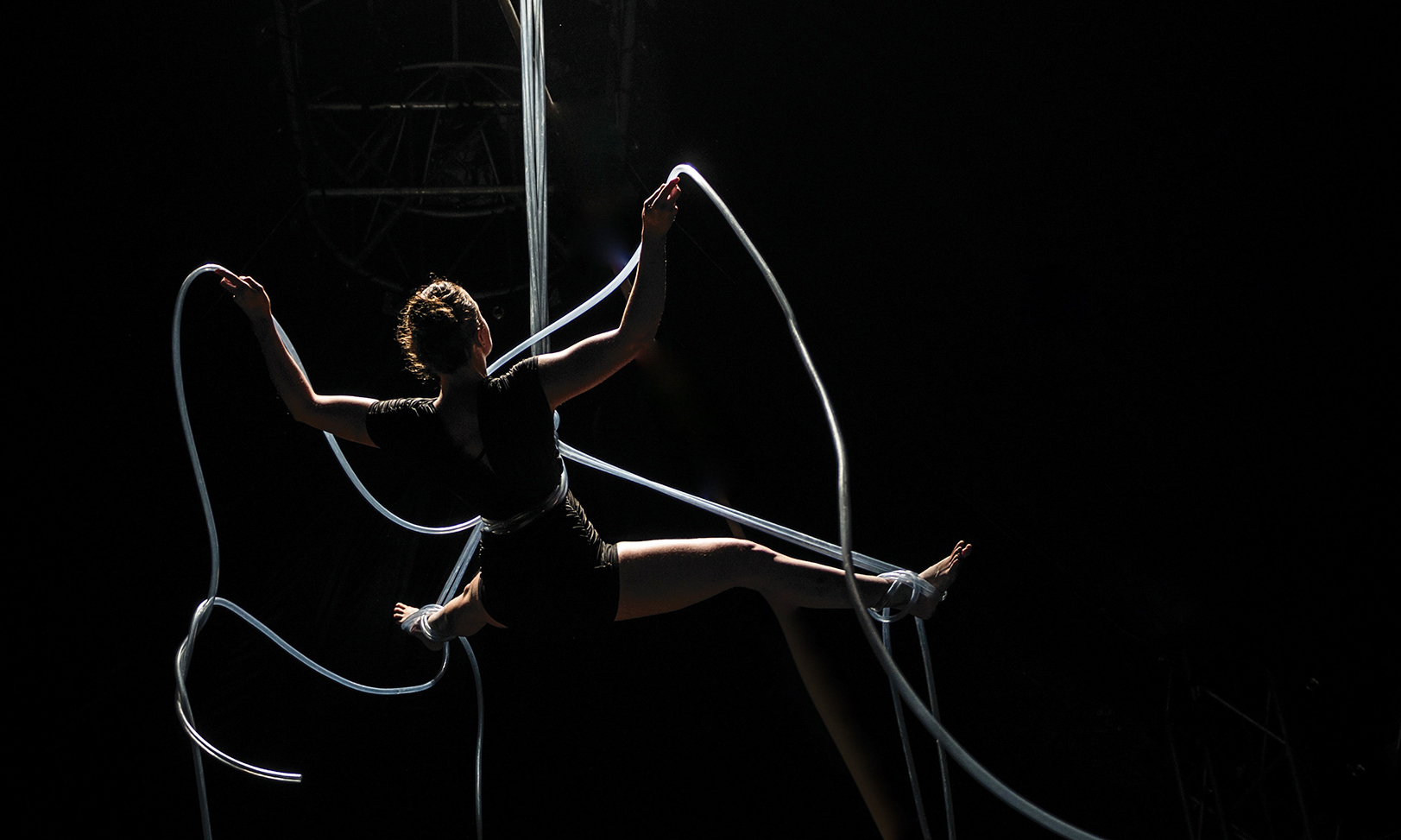
But back to this evening: the more I think about New Tapestry’s Potatoes & Sauce the more complex I realise it is. It begins by concentrating our attention on the tactile sensation of skin on plastic as Hege Eriksdatter Østefjells’ feet and hands explore a rectangle of plastic sheet taped to the floor like an elongated entrance mat. This relates not only to Østefjells’ subsequent aerial work for which she uses a cascade of plastic tubing but also to the first section of (rather indistinct) recorded fragments that originate in coma dreams. There is thus a double suspension in which the dreams float in the air while Østefjells’ body appears to float and swim in a vertical current. The score by Tim Hecker adds another level of mystery to the eerie weightlessness of the whole that plays a gentle dance on the imagination. It is only the manipulation (and sound) of the tubes as Østefjells prepares a body or foothold that reminds us of the mechanics of aerial work but Potatoes & Sauce (the title is somewhere in the coma dream, too) is a welcome exploration of an under-appreciated dimension for dance.

Elisabeth Schilling, Julie Schmidt and Fabiola Santana in Triptych (photo: Karolina Bajda)
Mara Vivas’ Triptych uses memory rather than text as the driver and keeps the physical language unflinchingly minimal. The three women (Elisabeth Schilling, Julie Schmidt and Fabiola Santana) are standing in a single sidelight almost shoulder-to-shoulder with their backs to us as we return to our seats. An unintended consequence of the material and fit of the costumes (by Susanne Stangl) is that the nervous muscle activity of the women’s bodies as they wait to start sets up a trembling choreography of its own on the surface of the fabric (the slow gestural arm movements that begin this triptych of three graces seem huge by comparison). Not wanting to suggest any narrative or direction Vivas keeps our focus on the three bodies as one moving sculpture by keeping their gestures in a similar register but at the same time the three women are subtly playing with their spatial relation to one other; at first they remain united, but as the work progresses their gestures interact, touch, break off and follow individual paths. The gestural language is also related to time; it is as if Vivas has slowed down the heartbeat of the work to focus on the here and now but the women cannot keep from straying — be it to the past or the future — from the sculptural continuum. This is partly intentional and partly unintentional: the attention given to gesture does not always extend to the dancers’ eyes which at times are commenting on the performance rather than expressing the choreography. Nevertheless the choreographic idea remains valid and intact.

Angela Frampton, Roger Cox, Jill Connick and Gilly Hanna in I’m sorry you’re leaving (photo: Karolina Bajda)
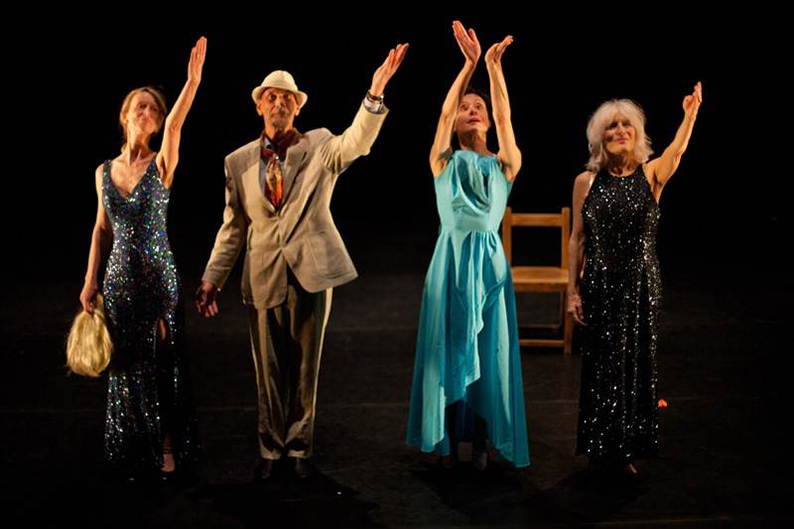
I’m sorry you’re leaving by .2Dot (the duo of Antonio Branco and Riccardo Tarocco) is dance theatre with a rich — not to mention mature — imagination for four exceptional performers: Jill Connick, Roger Cox, Angela Frampton and Gilly Hanna. Based on their lives and stories, it builds on the celebration of the art of age that the Elixir Festival featured last year. The program note reads in part, ‘Real people, with real stories, doing real dances.’ The three ladies in I’m sorry you’re leaving hold nothing back in their embrace of their roles — even if they are telling their own stories — and I can’t help feeling they are giving a fuller account of themselves than they would off stage. As Hanna explains in her guide to introducing yourself, ‘Give an audience an insight into what excites you.’ Roger Cox is less demonstrative but his calm, sometimes diffident exterior and dry humour is a natural counterbalance to the ladies. The stories they each tell, both poignant and funny, have the immediacy of truth delivered in circumstances and (wonderful) costumes that are pure theatre, but their dances and songs are real: Connick’s tap routine, Hanna’s dance to Holding out for a hero, Frampton’s cover of Frank Sinatra’s Fly me to the moon and Cox’s tango with Hanna are highlights of a work that Branco and Tarocco have clearly had fun making. I’m sorry you’re leaving, too; it seems all too soon. Perhaps if the idea had come later you might have made the selection process for The Place Prize. What’s the difference again?
Posted: February 20th, 2015 | Author: Nicholas Minns | Filed under: Performance | Tags: Fabio Filipe, Hannah Buckley, Happening, Maria Cassar, Pensar é Destruir, Rachel Burn, Red Tape Dance Company, Resolution! 2015, Woman with Eggs | Comments Off on Resolution! 2015 : Red Tape Dance, Hannah Buckley & Rachel Burn
Resolution! 2015: RedTape Dance, Hannah Buckley & Rachel Burn, The Place, January 16

Hannah Buckley in Woman with Eggs (photo: Sara Teresa)
I’ll begin in the middle because Hannah Buckley’s Woman with Eggs — ‘a solo about women’s ability to be many things’ — is worth celebrating. It tackles what many women see as the social imperative of having children with a poignancy that is balanced by Buckley’s uncompromising argument for freedom from its tyranny.
I am not sure at the beginning where she is going to take us; she is crouched with her back to the audience scratching around on the floor, her hair covering her face that is following intently the actions of her hands. But very quickly Buckley transforms all these elements into one of the most intelligent works I have seen at The Place. By accumulating gestures and revealing clues as to where she is going, Buckley builds up over the course of the work a layered argument so complete and irreverent that by the end we can’t help but stand smiling with her and marvel at her accomplishment.
The first spoken clue is a quote from an Inuit folk story, Kakuarshuk: ‘Long ago women got their children by digging around in the ground…’: immediately all that intense scrabbling assumes meaning and from this point each element of her performance — her costume (courtesy of Lauren Reyhani), her hair, her voice, her angular way of moving with turned-in stance and the articulation of her arms — now uncannily combine to inform her subject. Having related the Inuit tale about a barren woman’s quest to find a child she introduces extracts from two interviews, one with a seven-year-old girl and one with her grandmother aged 90: two amusing and refreshing perspectives on ‘women’s ability to be many things’. Buckley dances in her own idiosyncratic way to an Alex Drewchin cover of Kate Bush’s Babooshka, and then suddenly changes tack, dragging herself to a floor microphone to give away her next clue: a refreshingly honest view of children by artist Sophie Calle: ‘…I don’t like the terrorism of children. I don’t like the lack of freedom it gives to the parents…’ She lies still to let the sense of her monologue filter into our consciousness and then takes two gold-painted eggs from a bowl and begins to groove to Grimes’ appropriately titled track, Oblivion, letting the eggs balance precariously in her open palms until she ramps up the rhythmic pulse to the point the eggs spill on to the ground and break. She nonchalantly picks up two more and repeats her dance until the dozen or so eggs lie splattered on the ground around her, a breathtakingly trenchant image of a tyranny overturned with Buckley in the unassuming role of liberator.

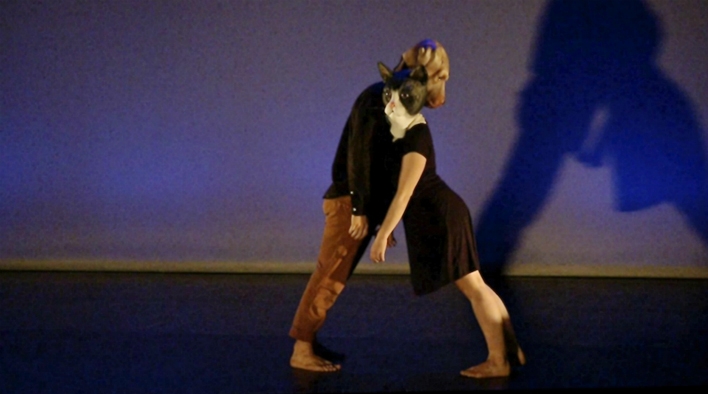
Fabio Filipe and Maria Cassar in Red Tape Dance Company’s Pensar é Destruir
Red Tape Dance’s Pensar é Destruir (thinking is destruction) courts the philosophical using the power of masks: Fabio Felipe as a dog and Maria Cassar as a cat enact the lines of the poem by Fernando Pessoa that inspired the work:
“Living life with a façade of a cat or dog,
is the only way that regular man can live life
…with the satisfaction of a dog or cat.”
In their masks, Felipe and Cassar carry on an animalistic social dance with the cat appearing the stronger of the two and not in the least afraid of the dog. After sequences of walking patterns, swings and lifts, they end up falling against each other mask to mask for the longest time, their expressions fixed. Masks have a particular power and Felipe and Cassar exploit them well. It is only when they take them off that Pensar é Destruir loses its force, becoming two people with some interesting but not compelling partnering (but isn’t that the sense of the three lines from Pessoa?). Strange, isn’t it, the power the face can have in dance. The unmasked section is accompanied by a Bach concerto (as opposed to Oli Newman and Anstam in the first section) which plays a parallel, playful role to the choreography rather than a structural one. Then just as the partnering gets going in rolling lifts across each other’s backs, both the music and choreography abruptly fade out. There’s more to be achieved with this idea, and I hope Red Tape Dance continues to explore.

Alejandra Baño and cast in Rachel Burn’s Happening (© Camilla Greenwell Photography)
The evening closes with Rachel Burn’s Happening, a piece inspired by the stories of twelve men and women that Burn has transformed into dance. The cast consists of only four women, so each interprets three stories across the two genders. Finding a common theme among the twelve stories is clearly one concern and finding a setting that can frame that theme is another; in fact the latter can only be explored following the success of the former. What Burn has done is the reverse: she has found a setting before finding the theme, and although her idea of transparent balloons tied with long strings to as many boots as there are story donors and performers may indeed be an intuitive response, it is not enough to make Happening coalesce. The other issue is that because there are only four in the cast, the work appears to consist of only four stories arranged as a collage. It is a shame, because the abstraction of the words into dance — the choreographic nucleus — is lovely and the performances by Helen Aschauer, Alejandra Baño, Marianna Mouaimi and Ana Mrdjanov emotionally strong. Perhaps adding a man or two to the cast would add more definition to the men’s voices, but finding the right form for all twelve stories remains Burn’s principal challenge.