Posted: July 13th, 2015 | Author: Nicholas Minns | Filed under: Performance | Tags: Anna Tsygankova, Basil Twist, Christopher Wheeldon, Cinderella, Craig Lucas, Daniel Brodie, Dutch National Ballet, Julian Crouch, Matthew Golding, Nadia Yanowsky, Natasha Katz, Remi Wörtmeyer | Comments Off on Dutch National Ballet, Cinderella
Dutch National Ballet, Cinderella, London Coliseum, July 8

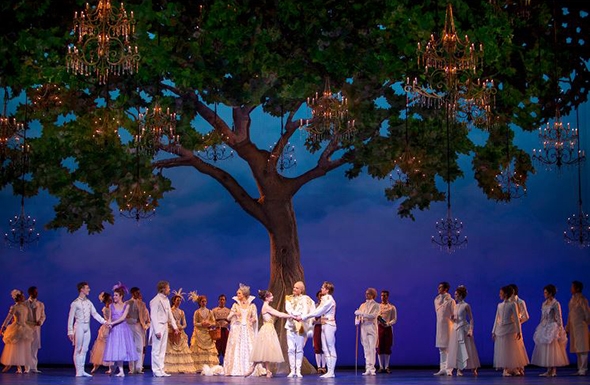
The cast of Dutch National Ballet in Cinderella in front of Basil Twist’s tree (photo: Angela Sterling)
“Many things in the world have not been named; and many things, even if they have been named, have never been described. One of these is the sensibility — unmistakably modern, a variant of sophistication but hardly identical with it — that goes by the cult name of “Camp.” Indeed the essence of Camp is its love of the unnatural: of artifice and exaggeration.” Susan Sontag, On Camp
Cinderella, whether in the version of the Brothers Grimm or of that of Perrault, is an uplifting tale of virtue overcoming adversity that lends itself perfectly to the romantic nature of classical ballet. Or at least it did; perhaps it is contemporary sensibility that militates against the creation in balletic form of fairy tales with their wide-eyed wonderment and youthful innocence. Christopher Wheeldon’s version of Cinderella that the Dutch National Ballet brought for the first time to the UK at the London Coliseum last week as part of the Sadler’s Wells season still uses Prokofiev’s uplifting score to anchor its heart (and it still does, despite the editing to fit Wheeldon’s and Craig Lucas’s libretto), but his choreography has a sense of artifice that inflates subtlety into exaggeration. Nothing illustrates this better than the entrance of Matthew Golding as the Prince into Cinderella’s lowly cottage in the third act. He has been searching for the girl with whom he has fallen in love at the Ball and who mysteriously disappeared at the stroke of midnight without a trace — except for a golden slipper. The Prince is visiting everyone on his guest list to find the foot (and the girl) that matches this slipper and he springs into the room like a bull (one can imagine him preparing along the pathway outside) in a series of jetés culminating in a double saut-de-basque and a flourish in the middle of the kitchen. The exaggeration of the step and the seriousness with which Golding performs it is pure Camp. I am not suggesting Wheeldon is making fun of the situation but it does suggest a failure to get to grips with the fairy tale on its own terms. The fault is not helped by Golding’s difficulty in finding subtle shades of princely character. The one time the Prince relaxes is when he is played as a young boy by Mingus de Swaan (a student at the National Ballet Academy Amsterdam) dashing along the palace corridors wooden sword in hand and jumping over the back of the sofas. What happened, one wonders, to that prankster charm in the older prince? It resurfaces briefly in the first act when he mocks the ancestral portraits and when in the guise of his equerry he mimics the stepsisters in front of Cinderella but later at the Ball when the music wills him to soften in the presence of the effulgent Cinderella Golding gets all serious in the partnering demands Wheeldon imposes that leave no room for (dare I mention it?) an expression of tenderness. This leaves Cinderella (Anna Tsygankova) in a fix because she doesn’t get a chance to see the Prince — let alone communicate with him — as he manipulates her almost clinically across his back and over his shoulders in what is a show of lifts and steps rather than a show of relationship through the lifts and steps (something Sir Frederick Ashton was brilliant at doing with equal artifice but more subtlety). With such a tentative chemistry between them, the fairytale loses its heart.
The one moment we get to see Tsygankova as a radiant Cinderella is when the court slowly recedes to reveal her entrance at the Ball; she doesn’t have to do anything but be herself. It is the first time I have seen her dance, but that moment is enough to suggest Wheeldon has for the rest of Cinderella obscured her in steps rather than revealed her in choreography and for much of the time she is transported by a quartet of muscular male ‘fates’ instead of being allowed to determine her own path. (If she can hide her slipper on the mantelpiece by herself, why does she need the four fates to push her atop the kitchen table to retrieve it?)
The one character to whom Wheeldon gives a sense of freedom is the Prince’s friend Benjamin (Remi Wörtmeyer) who keeps in character with his rambunctious younger self (Floris Faes) while pulling off some of the most challengingly fluid variations of the evening. But he is not allowed entirely off the hook: he falls rather improbably for stepsister Clementine (Nadia Yanowsky) who has been used by Wheeldon for comic purposes (along with sister Edwina and mother Hortensia) to the point of caricature. It is as if Wheeldon has worked with each of the characters separately in different rooms without developing a credible relationship that unites them over the three acts.
This is not the case for the scenic elements. Thanks to the team of Julian Crouch, Basil Twist, Natasha Katz and Daniel Brodie one scene flows imaginatively and seamlessly into the next through a scrupulous balance of lighting (Katz), scenic elements (Crouch) and video projection (Brodie) — even if the projected map of Europe the Prince is studying appears the wrong way round. Twist’s contribution is the magical image of the carriage that flies Cinderella out of Act 1 and a tree that we see grow from Cinderella’s tears on her mother’s grave into a glorious green arbour that embraces the entire wedding party at the end. It is this tree that reveals the true arc of the story.
Wheeldon’s version of Cinderella is a co-production with San Francisco Ballet and Dutch National Ballet. Both companies wanted a new full-evening work from Wheeldon; the former settled for a new Cinderella and the latter didn’t have one in its repertoire. Clearly fairy tales (not to mention Shakespeare’s and Lewis Caroll’s tales too) and ballet go together and have commercial appeal, but the formula is essentially looking backwards. I can’t help feeling Wheeldon’s talents would be better used to look forward to a new kind of work on his own terms. His imagination seemed to blossom in his single-act non-narrative works for San Francisco Ballet — Ghosts and Number Nine, in particular, that the company presented at Sadler’s Wells in 2012. British ballet has been searching for a new form of full-evening classical work ever since the death of Sir Kenneth MacMillan almost 25 years ago. With his experience of the classical form, his creative team, and as both Sadler’s Wells Associate Artist and Artistic Associate of the Royal Ballet, Wheeldon is in the right place at the right time to find it.
Posted: July 4th, 2015 | Author: Nicholas Minns | Filed under: Performance | Tags: Agostina Califano, Alberto Ruiz, Brink Festival, Clare McGarrigle, Eleanor Sikorski, Igor Urzelai, James Morgan, Laureline Richard, Lola Maury, Moreno Solinas, Royal Central School of Speech and Drama, Two to Tune | Comments Off on Lola Maury, Two to Tune
Lola Maury, Two to Tune, Royal Central School of Speech and Drama, June 24

James Morgan and Laureline Richard in Two to Tune (photo: Richard Davenport)
“The value of the theatre consists not in proclaiming rules for human behaviour, but in its ability to awaken, through this mirroring of life, personal responsibility and freedom of action.” Rudolf Laban (The Mastery of Movement)
Choreography is already a participatory art, both in its process and in its performance, so when Lola Maury — Visiting Alumni Artist at the Royal Central School of Speech and Drama choreographing for their Brink Festival — adds participatory game concepts into the choreographic mix of Two to Tune, it is the game that gives the work its unique character. Rather than a linear narrative the work consists of a succession of gestural images, improvisational in quality, that form a physical dialogue between the two players, James Morgan and Laureline Richard. It is a game in which mutual understanding and acceptance rather than winning are the goals, which gives the ludic nature of the work both a physical and a spiritual aspect. In this I am reminded of Charlie Chaplin’s description of a dancer as a cross between a nun and a boxer, though Richard in particular has the lean muscularity of a long distance runner. Costume designer Clare McGarrigle concurs, giving the players shorts and singlets that speak of both sport and of stylish comfort.
Two to Tune is a small-scale work with abundant energy and a pared-down aesthetic that needs the intimacy of a pared-down theatre for us to read the expressions and catch the details. With the limited rig in the Webber Douglas Studio lighting designer Agostina Califano has sculpted a perfectly scaled underground tryst where Morgan and Richard spar. The game is divided into seamless acts, starting with a prelude in stillness as the two stand side by side looking out at the audience with a gesture of hand over heart as if listening to an invisible umpire reading them the rules. The score by Alberto Ruiz shrouds the freeze-frame actions that follow in neutral sound but as the game develops he incorporates the voices of Igor Urzelai, Moreno Solinas and Eleanor Sikorski into a choir that sounds as if it was — convincingly for the setting — recorded under a bridge at night. It provides a vault of sound in which attention can focus on the interaction of the two players and their gestural references to wrestling, swordplay, boxing, dueling and perhaps to arcane arts. The way Richard articulates her gestures gives them the appearance of a spell that Morgan deftly parries, but the way she comments on her gestures with her expressive face gives her the upper hand, whether curling her lip in distaste or transforming a biking gesture into a narrative of tough individuality. Morgan is more neutral in his use of facial gestures but his endurance keeps Richard on her toes as she finds ways to wear him down, reducing him at one point to a pummeled, willowy adversary to her boxing.
The nature of the game is unclear until the very end; we are left to deduce the rules and the goal from the actions of the players. In this way, Two to Tune relates as much to the tuning of Morgan and Richard as to the tuning of the audience into the nature of their contest. They appear to be stalking each other in a game of strategy, less on the level of a board game (though they make carefully considered moves and react to the moves of the other) as on the physical gestural game of scissor/paper/rock but there is also an ominous, intangible subtext that the brooding score captures. Gestures develop in intensity and complexity, sometimes resting in mid expression then continuing as if in the process of declaiming a speech or waving an arm in defiance. Between Morgan and Richard there is also a sensual, sometimes tender, element to the game, an unspoken attraction and repulsion as they strive to enter the each other’s comfort zone. The speed and space of their moves increases until they are running to the rolling, pounding drumming in the score; they come close to colliding but one of the rules of the game appears to be they cannot touch even in close proximity at high speed. It makes for an exciting dynamic as they constantly test each other, learn about each other and tune in to each other. The way the game resolves, quite suddenly, as they come together in partnership is quite magical, suggesting everything that has happened in the prior 35 minutes has been working towards this moment: the accord of two instruments. It is also a resolution for the audience: we share in the harmony and are reminded of the origins of gesture and dance.
Posted: June 28th, 2015 | Author: Nicholas Minns | Filed under: Performance | Tags: Alexander McQueen, Brisk Singing Duet, Ihsaan de Banya, Joseph Toonga, Liam Riddick, Martin Lawrance, Mazur, Oihana Vesga Bujan, Opening Gambit, Overdrive, Rasengan, Richard Alston, Terry Riley, Unease | Comments Off on Richard Alston Dance Company: Alston at Home
Richard Alston Dance Company, Alston At Home, The Place, June 10

Nancy Nerantzi, Elly Braund and Oihana Vesga Bujan in Overdrive (photo: Chris Nash)
As a portrait of Richard Alston in the twentieth year of his company, Alston At Home shows his recent and current preoccupations with just one short work to anchor the perception of change over time. Without the revival of the miniature, Brisk Singing Duet danced by University of Michigan students Maeve McEwen and Michael Parmelee to the music of Rameau, the program shows an unfamiliar landscape on both the musical and the choreographic front. There are six works in all, three by Alston, one by Associate Director Martin Lawrance, one by Joseph Toonga and one by company dancer Ihsaan de Banya (the last two commissioned by The Place). Of the six works four are world premières.
Having just that afternoon seen the Alexander McQueen exhibition, Savage Beauty (highly recommended), what immediately strikes me in all these works is not simply the bareness of the stage but the blandness of the costumes. When Alston chooses to portray two Polish expatriate friends dancing to Chopin’s mazurkas in Mazur the inelegant costumes — a wan-coloured suggestion of a waistcoat by Peter Todd over army green chinos — immediately temper the emotional connection between the dancers and their context. If these are two friends ‘sharing what they love and what they feel they have lost’, their camaraderie is rather strait-laced; no vodka shots here, no dark passions or even live ones: the odd touch here and the odd look there are all that connect them. Take away the idea of Polish expatriates altogether and you have an interesting double concerto for two accomplished dancers (Liam Riddick and guest Jonathan Goddard) whose connection to the mazurkas (played onstage by Jason Ridgway on an elegant grand piano) is primarily through its rhythms rather than through any emotional content with which Chopin imbued his music. What is left is their angular, swirling movement and the precision of their musical phrasing in an otherwise bloodless setting.
The third work by Alston is a restaging by Lawrance of Overdrive (2006) set to Terry Riley’s score Keyboard Studies #1. It is, as Alston writes, ‘one of a series of works I made responding to the excitement and energy of pure rhythm.’ It requires you to sit back and concentrate which, as the sixth work and following the second intermission, is a tough call. But then none of the works this evening belong in that category of program ‘closer’ because they all congregate around similar pallid visual settings and emotionally purified choreography without beginnings or ends. Riley’s score — and Alston’s choreography — starts at a running pace and continues relentlessly till it suddenly stops. There is an intellectual rigour here, a physical argument in which Alston follows Riley’s structure, but the appearance of Overdrive is not so much paired down as dry.
Lawrance created his new work, Opening Gambit, as a birthday offering for Alston’s anniversary but it is choreographed on the muscular music of Julia Wolfe’s Dark Full Ride Part 1. It seems an odd coupling, one that celebrates Alston’s rigour but falls short of being a celebratory work. Lawrance has tamed the music rather than letting its natural force get away; he is helped in this by the capacity of Riddick to dance precisely on the musical beat without losing any detail (amongst the women Oihana Vesga Bujan shares this gift). Riddick brings a stillness to the heart of each movement, however quick, that gives each shape its full value. The opening line of ten dancers leaning nonchalantly against the bare back wall under Zeynep Kepekli’s lighting is the one inspired scenic element of the evening.
Ihsaan de Banya’s new work, Rasengan, begins as if he and the two other huddled dancers (Vesga Bujan and Nicholas Bodych) are standing in an underwater current, growing their small hand gestures to whole body undulations. The score by Ryoji Ikeda gives little for the dancers to feed off; the sound and the movement glide along on separate parallel paths. De Banya has pliant material to work with and brings out their physical attributes — Bodych’s never-ending back bend is an image that remains — but he is less inventive with the space in which they move and the dynamic patterns they create. He might want to take himself out of his future work so he can see the broader dimensions of his choreography.
Joseph Toonga’s Unease sets up a spatial intrigue immediately with de Banya alone in a corner talking to himself about something serious while four others stand in the opposite corner watching him. As he slowly sidles off stage deep in thought, the quartet moves as a counterbalance in a solo for four dancers that in its physical isolations has the appearance of muscular angst within a classical dynamic. Unease seems to trace the assimilation of de Banya into, and his influence on the quartet; Nancy Nerantzi is instrumental in her duet with him in winding him closer to the group until they are all moving together. Mirroring the beginning, the quartet with de Banya now sidles off in slow motion while one woman distances herself to dance alone but she too is drawn back into their rhythm before the work finishes in slow motion lighting.
Unease suffers from being too similar in feeling (though not in detail) to the other works on the program. Alston at Home is broad in solicitude for the future direction of the company but on this showing the forms of creative endeavour show a remarkable sameness. The musical choices may be one factor but there is also an over-reliance in the choreography on the purely physical nature of dance which under-exploits the musical and spiritual qualities of the dancers.
Posted: June 26th, 2015 | Author: Nicholas Minns | Filed under: Performance | Tags: Engmeng Song, Flavia Hevia, Gypsy Snider, Les Sept Doigts de la Main, Lucas Boutin, Shana Carroll, The 7 Fingers, Traces | Comments Off on Les 7 doigts de la main: Traces
Les 7 doigts de la main, Traces, Peacock Theatre, June 13

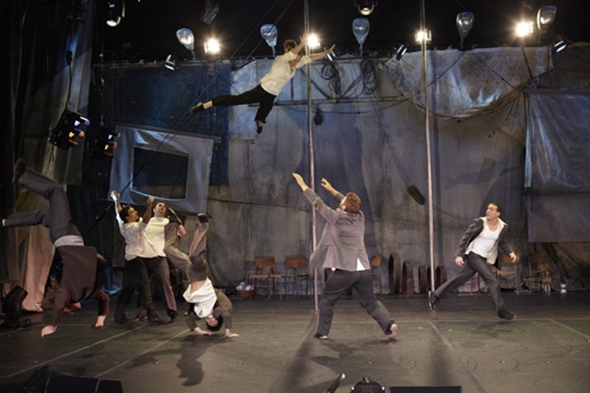
Les 7 doigts de la main in Traces (photo: Michael Meseke)
Any show that is billed as ‘the electrifying circus sensation’ demonstrates two aspects of its nature: its commercial success and its artistic hubris. And after ten years of touring there is a danger of a third: creative fatigue. Les sept doigts de la main (The 7 Fingers) is a circus troupe from Montreal set up in 2002 by seven founders to ‘bring a human scale to circus.’ It now has 15 creations and eight touring shows with which it has ‘extended its grasp around the globe.’ The company mixes such diverse circus forms as ‘acrobatics, avant-garde dance’ (whatever that is), ‘acting, physical comedy, music, song, spoken word, interactive video production, live DJ-ing and personal story telling.’ The seven performers (Kevin Beverley, Lucas Boutin, Anne-Marie Godin, Kai Johnson, Yann Leblanc, Harley McLeish and Enmeng Song) are trained in various forms of acrobatics — Cyr Wheel, Diabolo, Aerial Strap, Dance Trapeze, Chinese Pole, Hand to Hand, Hoop Diving and Teeterboard — which represent only the first circus form in the company mix. The others seem to have been picked up on the fly (Beverley is the only one to include dance in his biography). It is surprising the term ‘clowning’ does not feature anywhere in their training for the seven artists are required to keep the show moving with what the art of clowning can do so well: physical comedy, music and songs. The lack of any artfulness between the acrobatic acts of Traces (the piano playing is particularly hokey) is a structural weakness and makes the six men look like an immature boy band — all good-looking and powerfully built — with their one moll. In the creation of Traces, directors Shana Carroll and Gypsy Snider appear to have concentrated first on the acrobatic acts and then strung them together with a strip of narrative to make a show. In the ten years since then circus companies have worked to bridge this creative imbalance (I was impressed with Circa recently) but however revolutionary Traces might have been in 2006 its story line seems dated now: ‘Traces takes place in a makeshift shelter, an unknown catastrophe waiting outside the doors of tarp and gaffer tape. In the face on an impending disaster they have determined that creation is the only antidote to destruction.’ So there you have it, and you can forget about it as soon as you have read it because it bears no pertinent relation to the show at all.
The set (conceived originally by Flavia Hevia) is indeed reminiscent of the inside of a makeshift camp with its layers of canvas hanging on the back wall held together with ropes, scaffolding and wires complemented with lights, a few school chairs, a battered upright piano and a dusty plush armchair. It is effective in its suggestion and possibility without the least hint of a circus environment. The theatre announcement is a clever, sardonic parody of the standard mobile phone/recording spiel and touches a rebellious note that makes the audience actually listen to it through their laughter. The show then begins with an eruption of restless energy as all the performers run in, spin, tumble and launch themselves and each other into the air. The youthful exuberance and skill is infectious, but the individual introductions that follow dispel any sense of impending doom and replace it with a saccharine bonhomie that remains for the rest of the show. Most of the present cast has joined the show only this year. Boutin is the old hand with three years experience and Godin has two years. So the majority of the cast of this ten-year-old ‘electrifying circus sensation’ are just beginning to break in their skills on the road. And it shows; the performers make up for a lack of experience with a youthful enthusiasm and bravado that palls. Only Boutin and Song stand out as mature performers: Boutin in his primary discipline of Chinese Pole in which he demonstrates a quality that is exciting in its seeming lack of effort and Song in Diabolo where he mixes dazzling skill with an assured presentation. Godin’s comic skit reading a book in the armchair starts off well but is not sustained, which is how Traces comes across as a whole; after ten years it is past its prime and adding two members to the cast since it was last seen in London in 2009 doesn’t disguise it.
Posted: June 15th, 2015 | Author: Nicholas Minns | Filed under: Performance | Tags: Echo Beach, Fatherland, Hannah Sullivan, Jane Mason, Life Forces, Nic Green | Comments Off on Jane Mason, Nic Green & Hannah Sullivan
Jane Mason, Nic Green & Hannah Sullivan, The Point (June 5) and The Place (June 2)

Jane Mason in Life Forces (photo: Magali Charrier)
…”the manipulation of images in memory must always to some extent involve the psyche as a whole.” Frances A. Yates, The Art of Memory
There have been three recent performances choreographed around and shot through with memory: Jane Mason’s Life Forces at The Point and Hannah Sullivan’s Echo Beach and Nic Green’s Fatherland in a double bill at The Place in collaboration with Battersea Arts Centre. All three women have woven memory around the presence of a father. In Sullivan’s case the starting point of Echo Beach is recollections of family life in which her father is the one who puts on the records; in Green’s case it is a father she met only once at the age of 16, and Mason delves into her father’s creativity through the discovery of his slide projector and archive of slides. Each work has, like memory itself, its clarity and obscurity, its fragility and solidity.
All three works are memorials, acts of remembering, but each takes on a very different form. Mason builds an intimate structure with elements her father would have used — paper straws, nails, a plumb line, a projector and two portable heaters — bringing them to life as the means of remembering like a memory room based on the ancient art of mnemonics. Devised with writer Phil Smith, whose onstage role is a father figure, Life Forces is a profound meditation on the roots and influences of creativity. It is a work that builds and maintains an intriguing dialogue between past and present, between the act of creating and what has already been created. And there is an element of Alice in Wonderland as the paper straws are first strewn across the stage and later grow into small columns and you feel the construction could go on forever. Mason has a quiet intensity about her that is the life force of the work, developing it element by element with concentrated deliberation, with Smith as a touchstone, an emotional base on whose shoulders she can climb with confidence.

Nic Green in Fatherland (photo: Oliver Rudkin)
For Green that emotional base is missing and hers is an assertive struggle to find herself in what remains. Fatherland is the most radical of the three works because of this desire to impose an impression that has already faded from memory. Through text, song and live music (and a tipple of malt), what she finds and celebrates in a ritualistic way is her paternal Scottish heritage — represented by the imposing onstage presence of drummer Alasdair Campbell and piper Edward Seamn — to which she bares herself as if to stamp it with her own identity. It is the uncompromising nature of this identity and the sheer force of Green’s character that gives Fatherland its stature. Dramaturg Deborah Richardson-Webb has evidently worked hard to keep Green’s expansive passion so succinctly on the stage without reducing its power.

Hannah Sullivan in Echo Beach (photo: Paul Samuel White)
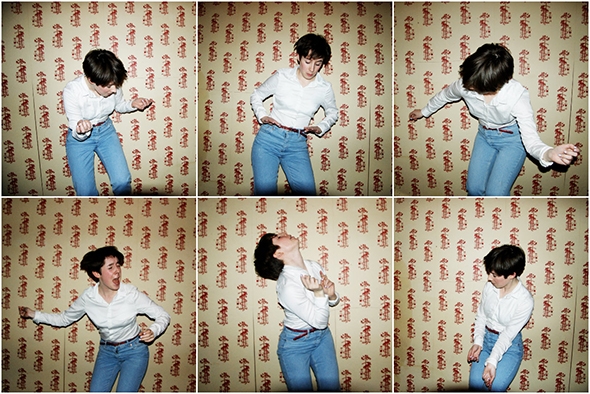
Sullivan’s memory is festooned with white pennants like a tent at a village fête; some have phrases cut into them like, ‘You Are Your Years’. One of the records her father played at home was Echo Beach by Martha and the Muffins that gives the work its name. Sullivan’s preoccupation is social dancing and she lays out what she calls her ‘dance collection’ that she has been gathering since 1999 and which she describes as ‘dancing like everyone I know.’ It is memory made up of keen observation — of seeing her parents dance in the living room, of her granddad teaching her to waltz, of friends dancing at a wedding or strangers dancing in a bar — and a lively sense of humour that transforms her collection into living snapshots. She moves and groves quietly, alternating her dances with talking about her collection and her memories. It is interesting to read that Dan Canham has provided Sullivan movement advice — not, I think, in terms of her dancing but for everything in between. There is a clarity of purpose Canham brings to his own work that keeps the fragility of Echo Beach together with minimal resources. Credit goes also to dramaturg Alice Tatton-Brown.
Memory is highly personal and essentially internal. What Life Forces, Echo Beach and Fatherland have in common is they externalize memory, transforming an intimate structure into a theatrical presentation. Mason is the only one to go a step further by placing the audience on the stage, seating them in front of her with the curtains drawn behind them as if inviting them into her father’s attic or workshop at night. Of course it limits the number of people who can see Life Forces at any one time, but through this means Mason effectively draws us into her memory. Fatherland is bold enough in its imagery to withstand the spatial conventions of a full stage but Echo Beach has a dilemma: Sullivan has created it on the scale of a living room that suggests a floor lamp, a sofa and a gramophone but the stage bathes the room in too much space, too much light and replaces the imaginary gramophone with Yas Clarke’s sound design. There is nothing amiss with these production values in themselves, but with them Sullivan’s memory room tends to lose its bearings.
Posted: June 6th, 2015 | Author: Ian Abbott | Filed under: Performance | Tags: Alisdair Macindoe, Dual, Ian Abbott, Robin Fox, Sara Black, Stephanie Lake, Théâtre Chaillot | Comments Off on Stephanie Lake: Dual
Stephanie Lake, Dual, Théâtre de Chaillot, Paris, June 4
Ian Abbott

Alisdair Macindoe and Sara Black in Stephanie Lake’s Dual (photo: Byron Perry)
“We are like islands in the sea, separate on the surface but connected in the deep.” William James
How can a single body act as a vessel for another?
Act I. Enter Alisdair Macindoe. He moves as if the floor is electrified and his body the conductor. Unable to commit to stillness and rest, pulses fizz through him — he’s physically dancing alone as a wild mass of trembling limbs for a dozen or more minutes. However, his mind is dancing elsewhere. As the driving, syncopated soundtrack by Robin Fox frenzied the air in the hot basement of Théâtre Chaillot, Macindoe with clean isolations and crisp pops would begin motifs before an invisible vacuum cleaner would suck him back to the start. It’s here in the unwinding and rewinding that the central inquiry of Dual lies: the surrender of control. Exit Macindoe.
ACT II. A shift in lighting design. The overhead stark white makes way for six warmer booms. Enter Sara Black. Her delicate solo of physical lyricism offers a tonal difference but her eyes are even further away and a sense that her body is not within her control. Black’s execution is flawless, disconcerting and the emotional detachment bordered on the dangerous but it is eminently watchable and strangely addictive. I imagine Lake, like a glowing maniacal brain, sitting at the lighting desk feeding telepathic signals to control her dancers.
“We adore chaos because we love to produce order.” MC Escher
Act III. A solo plus a solo equals what? Dual lets bodies inhabit the same space — at first alone and then together. What can two bodies achieve that a single body cannot? Together they build connections, make invisible pathways detectable and their bisections add extra layers to a previously presented solo narrative. Now we see a fit and a tessellation. The essence of this duet is alchemy.
“Placing one work of art near another makes one plus one equal three. Two artworks arranged alchemically leave each intact, transform both, and create a third thing.” Jerry Saltz
To forge a connection, we search for the eyes of another. Eyes are an important part of Dual. Here Lake considers them, erases their emotion, blurs their focus and limits their expression to see if we, the audience, can connect in a different way. Black and Macindoe’s eyes are possessed with intentional vacancy. A disconnection is reinforced.
At a little over 40 minutes Dual was an intensely satisfying experience filled with A x B = AB. In this equation, is the audience the = ? The staging for the evening is configured in traverse so throughout the work I’m able to see half an audience whose eyes are alive to shifts in light and speed and are tracing the movement on stage. It’s OK to surrender; Stephanie Lake is in control.
Posted: June 4th, 2015 | Author: Nicholas Minns | Filed under: Performance | Tags: Claudine Hébert, Complexe des genres, Isabelle Arcand, Luc Bouchard Boissonneault, Peter Trosztmer, Simon-Xavier Lefebvre, Sophie Breton, Virginie Brunelle | Comments Off on Virginie Brunelle: Complexe des genres
Compagnie Virginie Brunelle, Complexe des genres, Teatro Astra, Turin, May 25

One of the three couplings in the opening section of Complexe des Genres (photo: Marie Philibert Dubois)
For a second year I attended the Interplay Dance Festival in Turin, drawn by the beauty of the city and the inspired programming (of which more later) of festival director Natalia Casorati. This year there is an added attraction: a work I hadn’t seen before by Montreal choreographer, Virginie Brunelle.
I was living in Montreal when Virginie Brunelle came to the attention of its dance audiences with her first work, Les cuisses à l’écart du coeur. Raw and passionate in its physical language, it was hailed as the precocious choreographic progeny of Dave St-Pierre. Since then Brunelle has completed three other works, the second of which is Complexe des genres. Whereas St-Pierre appears to have extrapolated sensation in his later works, Brunelle has quietly matured as a choreographer, returning to the familiar relationship theme of Les cuisses but treating it with a spatial and emotional dimension that deepens its theatrical leverage. She has translated the complexity and tension of sexual relations from internal dialogue to physical form, observing it with keen psychological insights balanced by an earthy sense of humour.
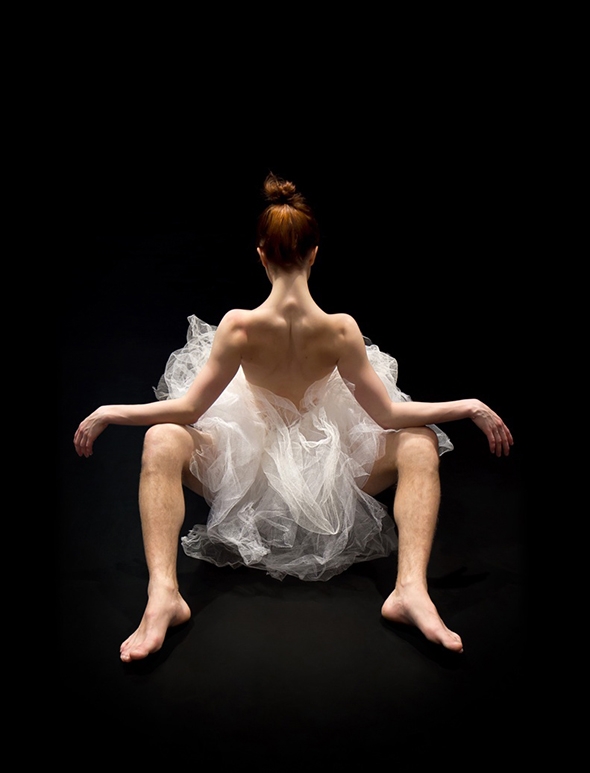
In a visually stunning opening section set to Mozart’s Requiem Aeternam and Dies Irae, three women, naked from the waist up, sit circling and gyrating their torsos in wild abandon on the thighs of their supine, somnolent men. At the point of contact between the men and women is a swathe of tulle mesh though it is not clear who is wearing it. The men finally get to their feet with the women still attached dangling upside down inside the tulle with their legs around their partners’ waists. While the men meet above in a gaggle to grunt and roar, the women giggle and scream below: a suite of royal playing cards from a mixed gender pack.
The presence of the tulle skirts in Complexe des genres is not gratuitous: although her dancers move on stage with the weight and swagger of walking in the street or entering a room, Brunelle has based her choreographic structure — and some steps — on classical ballet. In her ensemble work, solos and in duets her classical steps are loose and give way easily to force and gravity — what Brunelle calls ‘ballet cassé’ or broken-down ballet — while her gestures share an affinity with daily life even if their dynamics are pushed (and pulled) to extremes. It is a hybrid physical language whose emotional clout is immediate: eloquent in its informality and emotional in its punch.
The cast of Complexe des genres is ideally suited to this vocabulary. The men (Simon-Xavier Lefebvre, Luc Bouchard Boissonneault and Peter Trosztmer) are as capable of predatory brute force as they are of vulnerable introspection and the women (Isabelle Arcand, Claudine Hébert and Sophie Breton) have a bruising self-assurance that keeps the men in check. Neither side wins this battle of the sexes but each gains in the exchange of experience. The first duet with Boissonneault and Hébert is a concentrated study in physical and psychological complexity that is the seed of the entire work and one of the most powerful, emotionally convoluted dialogues I have seen. At the end Brunelle has Boissonneault as a bulky Virgin Mary lay the petite Christ figure of Hébert in the form of a pietà, but with characteristic inversion the spirited Hébert gets up and carries Boissonneault off on her back.
The men have trouble coming to terms with the women’s strength and equilibrium; in their partnering they test both with some brutal manipulation but to little avail; they are worn down by the effort but they also start to react positively to the women’s endurance. Arcand’s solo surrounded by male testosterone shows a remarkable ability to throw herself off balance and keep her feet on the floor, gestures that seem to express both longing and of being lost. The men become protective and rush to catch her when they think she’s gone too far. Brunelle borrows a device from Pina Bausch: events happen in threes, and by the third catch, the men start returning to a more threatening mode. Boissonneault ends by lifting Arcand under her arms above his head; Lefebvre and Trosztmer enter with Hébert and Breton in the same posture and we are suddenly aware of three crucifixions in three spotlights. Descended from their crosses the women gather like three graces and behind them we see the naked figure of Lefebvre. Nudity in Brunelle’s work, as in St-Pierre’s, is a metaphor for human fragility and observational transparency. In Complexe des genres Brunelle uses nudity sparingly but when she does it carries an emotional charge, as in the opening statement and here where it appears the women, crouching over Lefebvre’s body, are about to lay his manhood to rest.
If Complexe des genres were a feminist manifesto this might be the climax but I feel Brunelle is a hardcore romantic (her musical choices include Chopin and Schubert) who wants to bring both sides of the complexity together. The end is what a romantic might hope for as Lefebvre and Breton dance a slow waltz while the other four launch hundreds of paper aeroplanes over the stage in celebration, an activity in which the audience can join thanks to the aeroplanes left on our seats when we arrived. It is a celebration of the happy ending and of the battles fought to achieve it, but also of the totally committed performance that brings the audience immediately to its feet.
Posted: May 24th, 2015 | Author: Nicholas Minns | Filed under: Performance | Tags: Boris Charmatz, Christophe Tarkos, Dalila Khatir, manger, Musée de la danse, Sadler's Wells, Yves Godin | Comments Off on Boris Charmatz: manger
Boris Charmatz / Musée de la danse, manger, Sadler’s Wells, May 20

The setting of Boris Charmatz’s manger (photo: Ursula Kaufmann)
That Boris Charmatz has based his choreographic research in manger on the mouth and its functions is not as inhibiting as might at first appear. From the mouth issue words and song and the mouth is the entrance to the alimentary canal that affects swallowing, digesting, excreting and any ailments associated with their functioning. In other words there is plenty of scope for creative development and Charmatz seems to relish the possibilities, both physical and conceptual: “Creation, as I now see it, is increasingly tending towards a form of disappearance: treating food in terms of swallowing it, blotting it out.” What we actually see, however, is the physical manifestation of the eating process and the only item on the menu is rice paper — reams of it.
Charmatz has reduced the boundaries of the main theatre at Sadler’s Wells to the stage itself, divided from the auditorium by the safety curtain. We are seated on four sides of the stage that allows an intimacy a proscenium arrangement would not have allowed: digestion is, after all, an intimate act. The dancers arrive from the ranks of the audience informally dressed, distinguished only by the sheaf of rice paper in their hands. Dotted around the performance area and hitting a pose, they either arrange their sheets on the floor, let them fall to the ground or hold on to them. One of the dancers begins to tear at the rice paper with his teeth, and one by one they each start chewing, sucking, nibbling and ripping their paper. It occurs to me that the duration of the performance will be dictated by the time it takes the performers to finish their meal. Merging with the sounds of digesting paper is a sophisticated a cappella polyphony by the dancers of what is called sound material: brilliant arrangements by Dalila Khatir of a range of styles from Josquin des Prez’ Qui Habitat, Beethoven’s Seventh Symphony and Corelli’s La Folia to The Kills’ Ticket Man, Daniel Johnston’s King Kong and Sexy Sushi’s Je t’obéis. As the food enters the alimentary canal and begins its descent, so do the bodies of the dancers bend towards the floor where polyphony gives way to a digestive cacophony. It is as if the company has been given the task of visualizing the digestive system as they writhe, contort, groan and occasionally regurgitate. It’s a messy scene with bodies littering the stage in introverted examination. There’s an interesting self-referential text about a man who is full of shit (Le bonhomme de merde by Christophe Tarkos) with the line, ‘everything he danced was shit.’ Is Charmatz making fun of himself? He is known as a provocateur and manger is certainly provocative albeit in a playful way.
Continuing on the theme of mouths, dancers suck and lick their own flesh — arms, breasts, feet or whatever they can get within range of their tongues with contortion and imagination, not to mention abandon. Initially all the dancers perform in isolation but gradually individuals self-propel like seals towards a partner. Duets constitute a game in which the upper partner uses all parts of his or her body to balance and slide over a slithering lower partner without touching the ground. Once all the dancers are thus ensconced, two duets roll slowly into a wrap that gathers a third into a duodenal sextet. Meanwhile one of the women starts a vocal rhythm while a second bites her backside (a function of the mouth that has been unexplored till now). The singer is unfazed and continues to eat paper while leading the development of a stunning seven-part motet that is followed by Aesop Rock’s Leisure Force with a solo hip hop accompaniment. Corelli’s La Folia emerges like a divine anthem while the lighting levels of the suspended neon tubes (courtesy of Yves Godin) rise and fall and the dancers improbably slither back to their opening places, lying like dying warriors on a battlefield of paper and pulling up their shirts to reveal distended stomachs. The sound of high-pitched inbreath gives way to a bluesy rendition of Daniel Johnston’s King Kong and digestion gives way to energy in an episode of elevated turns and split jumps that accompanies a chorus of vocal punctuation. The manual vacuuming of paper continues and my initial suspicion is confirmed. The stage is being picked clean and the sheets of paper are almost gone. The dancers gather in the centre, massaging their throats like geese as they digest the remaining paper and sing part of Hey Light by Animal Collective with the line, You have made me smile again. manger certainly has its smiling moments; the dancers are fully and delightfully engaged in Charmatz’s choreographic proposal but it is the incongruity of the physiological exploration with the uplifting nature of the vocal (the one goes down while the other goes up) that keeps manger in concentrated tension. How do you end such an orgy of the senses? A violent gastrointestinal attack in a blinding flash of light, then complete darkness.
Posted: May 24th, 2015 | Author: Nicholas Minns | Filed under: Performance | Tags: Janina Rajakangas, Kip Johnson, Martha Pasakopoulou, Promises of Happiness, Robert Clark, Sir Ken Robinson, Stephen Moynihan | Comments Off on Robert Clark: Promises of Happiness
Robert Clark, Promises of Happiness, The Place, May 15

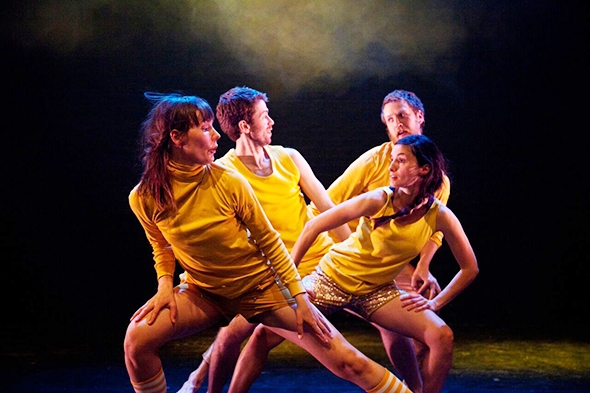
Janina Rajakangas, Stephen Moynihan, Martha Pasakopoulou and Kip Johnson revealing the colour of happiness (photo: Bronwen Sharp)
There are two ways a choreographer can affect an audience: by leaving the impact of a work to the imagination of the viewer or by dictating what he or she wants to achieve. Promises of Happiness falls into the latter category though Robert Clark does it in such a fun, warm-hearted way that the audience appears happy to accept his proposal (which is the goal of the work). Over two years ago Clark started a project in which he looked at the idea of happiness, what causes or provokes it in us and how it exhibits itself physically, both internally and externally. Clark is a dancer not a neuroscientist so he has approached the subject primarily through the body — through gesture and other physical manifestations of happiness — on the basis that it takes an external cause to bring about an internal reaction. In effect, Clark has made Promises of Happiness a kind of sensory sounding board for stimulating a reaction from each member of the audience. While it is the nature of dance to inspire this kind of interaction, Clark wants to make sure his audience leaves the theatre neither neutral nor upset; he wants them to come out smiling and in his quartet of dancers (Kip Johnson, Stephen Moynihan, Janina Rajakangas and Martha Pasakopoulou) he has every chance of succeeding. Clark does not preach happiness but suggests ways of experiencing it by irresistible example.
It starts in the bar (a good place to start) before the show; the cast collects responses from the audience for their happiness survey. What makes you happy? On our way into the auditorium we receive a gold envelope with A Promise of Happiness printed on it like a formal invitation and on stage Pasakopoulou is at a microphone reading out some of the responses to the survey while Johnson brings in fresh data.
With a mixture of wit and heartfelt sincerity, Clark tries hard to reach everyone in the audience throughout the performance, either by direct challenge (hugs, a five pound note or a cup of tea), indirectly (the revelation of secrets like the colour of happiness), by suggestion (the sensual appeal of the kiss) or by appealing to the crowd (inciting the audience to get to their feet to applaud Pasakopoulou’s dance solo ‘because that is what she doesn’t get enough of’.) Once you start to enter into the spirit of Promises of Happiness you begin to smile (that’s the idea) and from the start the four dancers makes it easy with exuberant slapstick (silly walks and running), unabashed self-awareness and an irrepressible sense of humour.
You could argue that for the price of a ticket to The Place you could buy a self-help guide to happiness in which you could pick up some useful tips on the subject, but Clark’s work suggests something more, something that is elusive in our society. In using dance to express notions of happiness, he is highlighting the vital link between an expressive body and our sense of self (if you haven’t already heard it, listen to Sir Ken Robinson’s TED talk on the subject). It is not that those members of the audience who are not dancers should immediately sign up to a dance class (though why not?) but that they should not miss in Clark’s promises the physical means to express them; we are not, as Sir Ken Robinson points out in his talk, ‘brains on sticks.’
In the midst of Clark’s physical stimuli he reminds us that emotions (the words ‘motion’ and ‘emotion’, I learned recently, come from the same root) are also an essential ingredient of happiness and, of the emotions, perhaps the strongest is love. Pasakopoulou asks us to close our eyes and think of someone special. ‘Imagine this person standing in front of you; notice the details. How do you feel about this person? Think of three reasons why this person is so special.’ When the moment comes to open the gold envelope with its promise of happiness, we return to this person. “We invite you to take this feeling, consider it a little more…and when you are ready, to call them and share your words and that feeling with them.” In the closing moments of Promises of Happiness the dancers slowly withdraw leaving us to listen to recordings of each of them in poignant phone conversation with their special person; you can sense the happiness these messages afford, both for the giver and the recipient. But if you prefer to give your message in person, Pasakopoulou has provided a recipe for Martha’s Greek Cheese Pie that you can cook and present on that auspicious occasion. If anyone would like the recipe, I would be very happy to send it to you.
Posted: May 15th, 2015 | Author: Nicholas Minns | Filed under: Performance | Tags: Antonia Grove, Charlotte Vincent, Gavin Bryars, Greig Cooke, Janusz Orlik, Jason Taylor, Josh Wille, Patrycja Kujawska, Phil Sanger, Robert Clark, Silvia Mercuriali, Underworld, Vincent Dance Theatre | Comments Off on Vincent Dance Theatre: Underworld
Vincent Dance Theatre, Underworld, Brighton Corn Exchange, May 12

Vincent Dance Theatre in Underworld (photo: Julia Parsons)
Charlotte Vincent’s set is beautiful, the kind that draws you in so you don’t realise you’re sitting in a theatre; you’re in the set. In fact you are sitting in the apse of a cathedral looking down the nave with its endless rows of chairs to a refectory table at the far end around which the performers are gathered. It’s all beautifully lit (by Jason Taylor) to give weight and depth and there’s a mist hanging over the nave as if we are on a battlefield. Underworld seems to borrow from both these landscapes in its depiction of humanity trying to rise above the level of the sordid earth to heaven. Well, maybe. Vincent has always a perspective or two up her sleeve that she drops into the action until you’re not quite sure what you have just seen.
Underworld ‘draws on the myth of Orpheus & Eurydice and explores the art of not looking back.’ For the life of me I don’t see this though there is a mythological aspect to the work, not least in its duration of two and a quarter hours (there is a longer version) without a break. The audience is invited to ‘come and go as they please’ but the action never lets up so there is no need for a break unless you really need to have a pee. Besides, you wouldn’t want to miss anything. It’s a perpetual motion event in which the performers never leave the stage; they come down the nave or retreat to their table that is lit like a Caravaggio painting to keep the smaller details ever visible. One senses the energy back there; whoever happens to be at the table forms a small chorus seated in repose or in attention to their friends’ performance. They cajole, applaud, encourage or disparage with equal vehemence and once refreshed — at one point a chef noisily serves up a chalky concoction they tip over their heads — they return to the battlefield to fight or pray. There is a lot of praying at different moments in Underworld and in the kneeling and abasement you can almost feel the coldness of the flagstones. The gestures are similar but what they recite seems to follow a laissez-faire religious policy covering Christianity and Buddhism (perhaps more). Gavin Bryars’ score captures all these elements: mystery, violence and redemption, coloured with sound design by Mic Pool over which Patrycia Kujawska adds from time to time her own soulful voice on violin. Underworld shows Vincent seamlessly marrying scenography, music and action to produce a monumental mythic vision; it’s a remarkable achievement.
Underworld is primarily physical; the events and actions, sometimes distressing sometimes morbid mixed with a strong sense of sardonic humour, elicit a physical response from the audience and it argues its case in body language that defies translation. The location does not change, nor the overall dichotomy of light and dark, heaven and hell. It has a musical structure akin to a theme and variations rather than a dramatic one; it is not linear but circular.
All eight performers deserve mention: Robert Clark, Greig Cooke, Antonia Grove, Patrycja Kujawska, Silvia Mercuriali, Janusz Orlik, Phil Sanger and Josh Wille. Mercuriali, Sanger and Wille were part of Phoenix Dance Theatre when Underworld was first commissioned in 2012 as a collaboration between Vincent Dance Theatre and Phoenix; the trio has returned for this restaging. It is the unity among all eight performers and the intensity of their punishing, bruising performance that keeps our attention; they are all warriors of the stage who have fought many a battle together under the banner of Vincent’s leadership.
At BDE in 2010 I saw Vincent’s If We Go On. It was an uncompromising (and I mean uncompromising) dissection of the performance process, reducing the theatrical presentation to a point of no return: a case of theatrical existentialism. Vincent had the courage to take her proposition as far as she could take it, coming up against the nature of performance (and some hostility in the audience) in the process. If We Go On couldn’t go on, and in Underworld there are traces of that questioning of theatrical convention. How far can you go to set alight a funeral pyre of chairs on stage? How close can Clark come to setting himself alight? How naked can Kujawska be to step into a bath on stage and have a shower (courtesy of Clark with a watering can)? None of these events go to their full conclusion but the attempt is made. This is not a matter, respectively, of health and safety, of the sanctity of life or of modesty but a statement of how artificial theatre can be. There is also a Brechtian scene where Kujawska performs in a makeshift proscenium of chairs and sacking to an audience of Sanger who claps as she makes successive entrances. So while the energy and exhaustion of the cast hurtling into each other and hurdling over the chairs is palpable and real, these mock events hold us back from reality and remind us we are in the theatre. And yet at the end of the action the performers eschew the conventional bows and simply retire to their table while Orlik adusts the chairs in their rows, leaving the audience unsure of its relationship to the cast and to what has just happened. It is Vincent’s playful, destabilizing intelligence at work, pulling the theatrical rug from under our feet yet again.