Russell Maliphant Dance Company, Maliphantworks4 at The Coronet, September 11, 2025
Russell Maliphant in In A Landscape (photo: Dana Fouras)
As the title of this evening suggests, this is the fourth in a series of performances by Russell Maliphant Dance Company at The Coronet, and there is a mysterious yet palpable relationship between Maliphant’s style of choreography and the architectural atmosphere or inner world of the theatre. The stage is small but suspended to the level of what was once the theatre’s Circle (the parterre has become the raked bar downstairs), giving an other-worldly intimacy to the space. It’s ideal for Maliphant’s program that comprises two solos, created 16 years apart, that form, in terms of dance time, a reflection on his creative development. The program starts with Maliphant’s latest work, In A Landscape, which premiered in the same theatre in February, and reaches back, in AfterLight, to an early, fully-formed crucible of Maliphant’s choreographic style; every aspect of In A Landscape has its seed in AfterLight. Seeing the two works in the reverse order of creation is to take the long way round to the beginning.
In a Landscape (a homophone for Inner Landscape?) is a collaboration with visual artist Panagiotis Tomaras, a break from the long-time partnership between Maliphant and lighting designer Michael Hulls. While it is not always clear in a long-term partnership the extent of one influence over another, it is refreshing to see Maliphant, dressed simply in chic overalls by Stevie Stewart, stepping into a new landscape of light and shadow, one in which he inhabits the character of a seasoned wanderer in search of enlightenment. The voluminous, cream-coloured material hanging in parabolas at the back of the stage — the one suggestion of colour in this landscape — gives a spatial sense of Greek simplicity and order and a metaphysical sense of fate. Tomaras creates in light and shadow the image of a man shaping his destiny, first in a series of still poses interspersed with blackouts — like a table of contents — and then merging these poses in the swirling, spiralling patterns Maliphant makes with the material. Is he emerging from the womb or returning to it? Is he young or is he old? Time is fluid in this landscape as Maliphant journeys neither forwards nor backwards, neither freely nor fully constrained by the screens Tomaras drops down in front of him on which his movements are projected. There is an Eastern flavour to the electronic score from Maliphant’s long-term partner and muse, Dana Fouras, who seems to will Maliphant forward with her music through the maze of light and shadow until he merges quietly back into the engulfing darkness. We are not aware if he has found what he was looking for, but only of the journey taken.
Daniel Proietto in AfterLight (photo: Hugo Glendinning)
AfterLight begins where In A Landscape ends, in the deep shadows of light. This work from 2009 is an inspired collaboration between Maliphant and Michael Hulls with the equally inspired dancing of Daniel Proietto. Its origin is in the circular drawings of Vaslav Nijinsky that he drew during a mental breakdown following the First World War. For Nijinsky the circular motion links the spiral musculature of the dancing body with what he saw as the perfect symbol of life and art. These two elements of the physical and the spiritual pervade Maliphant’s choreography and Proietto’s performance. He begins in the dark, turning imperceptibly against the direction of the revolving particles of light projected overhead (video projection by Jan Urbanowski), setting up a breathtaking spiral movement not only in his body but in the space of the theatre itself. His red-capped head and torso are visible but his feet are in darkness so his revolving body and blade-like arms give the illusion of a slow and uniform figure planted on a turntable. Proietto’s costume is a subtle reminder of Nijinsky’s portrayal of the tragic doll, Petrouchka, and Hulls’ lighting in the first section seems to set up the scene of the doll trapped inside the solitude of his cell. Set to Erik Satie’s Gnossiennes 1-4 for solo piano, mystical dances that have no set time signature in a recording by Dustin Gledhill, Maliphant’s choreography and Hulls’ lighting bring to the score a visual reality that Proietto further enhances with his limpid breadth and grace. I saw him dance this in 2010 and have never forgotten its impact. This performance lacked nothing of the original, nor was its impact in any way diminished. That speaks to what can happen between artistic collaboration and performance at the highest level.
Julie Cunningham: To Be Me, Laban Theatre, November 9
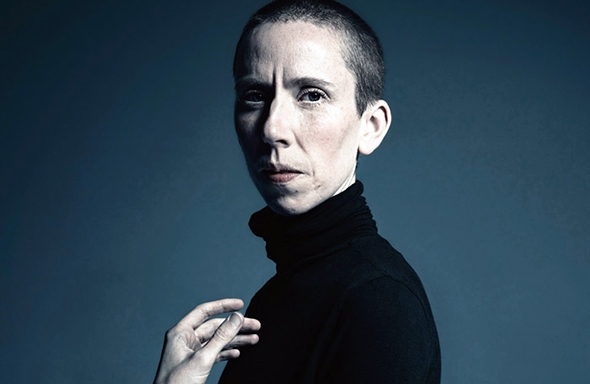
Julie Cunningham by Rick Guest
Julie Cunningham’s program, To Be Me, presented at Laban Theatre, follows less than a month after her performance of m/y that was part of Reckoningsat Sadler’s Wells. Both performances are a celebration of self, in part inspired by Monique Wittig’s 1973 novel, The Lesbian Body, in which the author articulates ‘feminine desire’ through her experimental use of language. In the 1990s Judith Butler questioned the idea that gender is biologically innate suggesting that it complies instead with the individual’s adherence to social norms, that it is in other words performative. Whilst we all to various degrees articulate our own identities around existing cultural narratives, Butler argues for the freedom to express one’s own gendered life.
This is the choreographic challenge Cunningham takes up in the first half of the program: a solo created on herself, m/e, that borrows from Wittig’s experimentation in language and Butler’s intellectual argument to confer on her dancing body a confidence and freedom that surpass the physical. Wittig’s novel seems to have set Cunningham free to unravel the multifaceted performative possibilities of her body as if she has emptied herself of the outward trappings of any previous dance form she has known — Merce Cunningham and Michael Clark are strong influences — and kept only what is necessary for her own ‘writing’.
m/e opens with Cunningham facing back; dressed casually in a t-shirt, track suit top and pants, she tries out steps to the nimble rhythms of Fever Ray’s To the moon and back, demonstrating the fluid possibilities of free choice through her ability to move in whatever direction at whatever moment and speed. Her style is sparse but with an understated eloquence that derives from her singular choreographic instrument: not only a body that is articulate and beautifully extended but a gaze that remains within the confines of the stage rather than projecting itself beyond it; when she looks in our direction it is as if she is in a studio and we are behind the mirror. It is this duality of extension and containment, of exterior and interior, that makes the section she dances to the Andante of Shostakovich’s piano concerto No. 2 such a revelation. She does not allow the emotion of the music to move her but imposes her own quiet will on it; it is her spatial relation to the musical phrasing that attunes her sense of identity. After this meditative interlude Cunningham interrogates the first of two pieces, Triangles, by composer Nell Catchpole in which she experiments with vocabulary as Wittig may have experimented with language; she plays a conceptual game with a blue ball that makes a re-appearance from m/y before returning to her upbeat exploration of space to Catchpole’s second piece, Skipping, where you can almost sense her changing her mind, dodging and darting like a sprite with dizzying self-confidence. Having exhausted her experimentation she walks forward as if to say, ‘I still haven’t really showed you who I am’ and walks calmly into the wings. True to the spirit of containment, she does not return for a bow.
To Be Me is also the title of the second work, set to Kate Tempest’s spoken word, in which Cunningham is joined by Hannah Burfield, Eleanor Perry and Seira Winning. They are all costumed (by Stevie Stewart and Cunningham with a hint of Clark) as mirrored pairs, one pair in red tops and black tights, the other in black tops and red tights. At the beginning the lights stay up in the auditorium as Cunningham arrives on stage with her cast to exchange knowing glances with every one of us as we listen to Antony and the Johnsons song, For Today I am a Boy; she lets the song and its message play over us on its own terms. The inspiration of To Be Me is the ancient myth of Tiresias, the blind clairvoyant who was turned from male into female and back into male, in which Cunningham continues from m/e to further recite the fluid embodiment of both male and female narratives in a choreographic pairing, mirroring, crossing and rupturing between the four performers. She doesn’t have quite the same freedom of self-expression as in her solo, but her musicality enables her to harvest the images, narrative threads and the rhythms of Tempest’s language and to translate them for the quartet into a counterpoint of movements whose precision and abstraction embody the sheer potential of gender performativity. And she does so with wit and joy, the occasional half smile testifying to the pleasure and confidence of self-discovery.