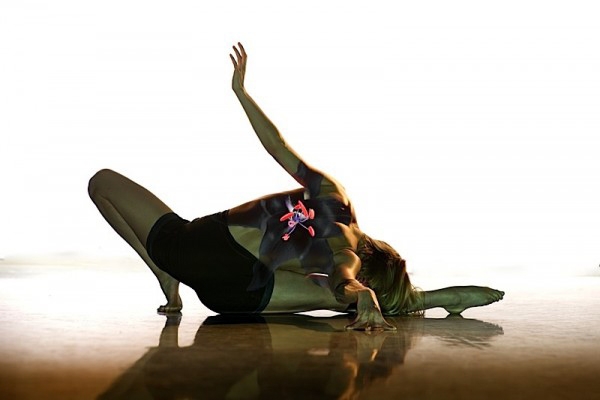
Russell Maliphant Dance Company, Maliphantworks 4 at The Coronet
Posted: September 20th, 2025 | Author: Nicholas Minns | Filed under: Performance | Tags: Dana Fouras, Daniel Proietto, Dustin Gledhill, Erik Satie, Gnossiennes, Jan Urbanowski, Michael Hulls, Panagiotis Tomaras, Russell Maliphant, Stevie Stewart | Comments Off on Russell Maliphant Dance Company, Maliphantworks 4 at The CoronetRussell Maliphant Dance Company, Maliphantworks4 at The Coronet, September 11, 2025

As the title of this evening suggests, this is the fourth in a series of performances by Russell Maliphant Dance Company at The Coronet, and there is a mysterious yet palpable relationship between Maliphant’s style of choreography and the architectural atmosphere or inner world of the theatre. The stage is small but suspended to the level of what was once the theatre’s Circle (the parterre has become the raked bar downstairs), giving an other-worldly intimacy to the space. It’s ideal for Maliphant’s program that comprises two solos, created 16 years apart, that form, in terms of dance time, a reflection on his creative development. The program starts with Maliphant’s latest work, In A Landscape, which premiered in the same theatre in February, and reaches back, in AfterLight, to an early, fully-formed crucible of Maliphant’s choreographic style; every aspect of In A Landscape has its seed in AfterLight. Seeing the two works in the reverse order of creation is to take the long way round to the beginning.
In a Landscape (a homophone for Inner Landscape?) is a collaboration with visual artist Panagiotis Tomaras, a break from the long-time partnership between Maliphant and lighting designer Michael Hulls. While it is not always clear in a long-term partnership the extent of one influence over another, it is refreshing to see Maliphant, dressed simply in chic overalls by Stevie Stewart, stepping into a new landscape of light and shadow, one in which he inhabits the character of a seasoned wanderer in search of enlightenment. The voluminous, cream-coloured material hanging in parabolas at the back of the stage — the one suggestion of colour in this landscape — gives a spatial sense of Greek simplicity and order and a metaphysical sense of fate. Tomaras creates in light and shadow the image of a man shaping his destiny, first in a series of still poses interspersed with blackouts — like a table of contents — and then merging these poses in the swirling, spiralling patterns Maliphant makes with the material. Is he emerging from the womb or returning to it? Is he young or is he old? Time is fluid in this landscape as Maliphant journeys neither forwards nor backwards, neither freely nor fully constrained by the screens Tomaras drops down in front of him on which his movements are projected. There is an Eastern flavour to the electronic score from Maliphant’s long-term partner and muse, Dana Fouras, who seems to will Maliphant forward with her music through the maze of light and shadow until he merges quietly back into the engulfing darkness. We are not aware if he has found what he was looking for, but only of the journey taken.

AfterLight begins where In A Landscape ends, in the deep shadows of light. This work from 2009 is an inspired collaboration between Maliphant and Michael Hulls with the equally inspired dancing of Daniel Proietto. Its origin is in the circular drawings of Vaslav Nijinsky that he drew during a mental breakdown following the First World War. For Nijinsky the circular motion links the spiral musculature of the dancing body with what he saw as the perfect symbol of life and art. These two elements of the physical and the spiritual pervade Maliphant’s choreography and Proietto’s performance. He begins in the dark, turning imperceptibly against the direction of the revolving particles of light projected overhead (video projection by Jan Urbanowski), setting up a breathtaking spiral movement not only in his body but in the space of the theatre itself. His red-capped head and torso are visible but his feet are in darkness so his revolving body and blade-like arms give the illusion of a slow and uniform figure planted on a turntable. Proietto’s costume is a subtle reminder of Nijinsky’s portrayal of the tragic doll, Petrouchka, and Hulls’ lighting in the first section seems to set up the scene of the doll trapped inside the solitude of his cell. Set to Erik Satie’s Gnossiennes 1-4 for solo piano, mystical dances that have no set time signature in a recording by Dustin Gledhill, Maliphant’s choreography and Hulls’ lighting bring to the score a visual reality that Proietto further enhances with his limpid breadth and grace. I saw him dance this in 2010 and have never forgotten its impact. This performance lacked nothing of the original, nor was its impact in any way diminished. That speaks to what can happen between artistic collaboration and performance at the highest level.