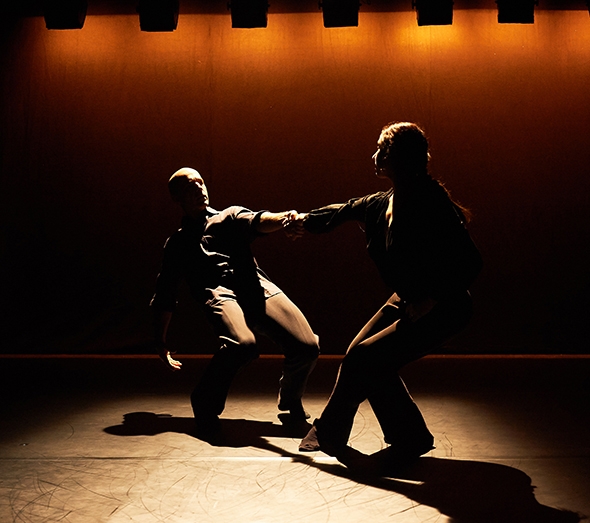
Russell Maliphant Dance Company, Maliphantworks4 at The Coronet, September 11, 2025
Russell Maliphant in In A Landscape (photo: Dana Fouras)
As the title of this evening suggests, this is the fourth in a series of performances by Russell Maliphant Dance Company at The Coronet, and there is a mysterious yet palpable relationship between Maliphant’s style of choreography and the architectural atmosphere or inner world of the theatre. The stage is small but suspended to the level of what was once the theatre’s Circle (the parterre has become the raked bar downstairs), giving an other-worldly intimacy to the space. It’s ideal for Maliphant’s program that comprises two solos, created 16 years apart, that form, in terms of dance time, a reflection on his creative development. The program starts with Maliphant’s latest work, In A Landscape, which premiered in the same theatre in February, and reaches back, in AfterLight, to an early, fully-formed crucible of Maliphant’s choreographic style; every aspect of In A Landscape has its seed in AfterLight. Seeing the two works in the reverse order of creation is to take the long way round to the beginning.
In a Landscape (a homophone for Inner Landscape?) is a collaboration with visual artist Panagiotis Tomaras, a break from the long-time partnership between Maliphant and lighting designer Michael Hulls. While it is not always clear in a long-term partnership the extent of one influence over another, it is refreshing to see Maliphant, dressed simply in chic overalls by Stevie Stewart, stepping into a new landscape of light and shadow, one in which he inhabits the character of a seasoned wanderer in search of enlightenment. The voluminous, cream-coloured material hanging in parabolas at the back of the stage — the one suggestion of colour in this landscape — gives a spatial sense of Greek simplicity and order and a metaphysical sense of fate. Tomaras creates in light and shadow the image of a man shaping his destiny, first in a series of still poses interspersed with blackouts — like a table of contents — and then merging these poses in the swirling, spiralling patterns Maliphant makes with the material. Is he emerging from the womb or returning to it? Is he young or is he old? Time is fluid in this landscape as Maliphant journeys neither forwards nor backwards, neither freely nor fully constrained by the screens Tomaras drops down in front of him on which his movements are projected. There is an Eastern flavour to the electronic score from Maliphant’s long-term partner and muse, Dana Fouras, who seems to will Maliphant forward with her music through the maze of light and shadow until he merges quietly back into the engulfing darkness. We are not aware if he has found what he was looking for, but only of the journey taken.
Daniel Proietto in AfterLight (photo: Hugo Glendinning)
AfterLight begins where In A Landscape ends, in the deep shadows of light. This work from 2009 is an inspired collaboration between Maliphant and Michael Hulls with the equally inspired dancing of Daniel Proietto. Its origin is in the circular drawings of Vaslav Nijinsky that he drew during a mental breakdown following the First World War. For Nijinsky the circular motion links the spiral musculature of the dancing body with what he saw as the perfect symbol of life and art. These two elements of the physical and the spiritual pervade Maliphant’s choreography and Proietto’s performance. He begins in the dark, turning imperceptibly against the direction of the revolving particles of light projected overhead (video projection by Jan Urbanowski), setting up a breathtaking spiral movement not only in his body but in the space of the theatre itself. His red-capped head and torso are visible but his feet are in darkness so his revolving body and blade-like arms give the illusion of a slow and uniform figure planted on a turntable. Proietto’s costume is a subtle reminder of Nijinsky’s portrayal of the tragic doll, Petrouchka, and Hulls’ lighting in the first section seems to set up the scene of the doll trapped inside the solitude of his cell. Set to Erik Satie’s Gnossiennes 1-4 for solo piano, mystical dances that have no set time signature in a recording by Dustin Gledhill, Maliphant’s choreography and Hulls’ lighting bring to the score a visual reality that Proietto further enhances with his limpid breadth and grace. I saw him dance this in 2010 and have never forgotten its impact. This performance lacked nothing of the original, nor was its impact in any way diminished. That speaks to what can happen between artistic collaboration and performance at the highest level.
Russell Maliphant Company, maliphantworks2, Coronet Print Room, March 13
Russell Maliphant and Dana Fouras in Duet (photo: Tom Bowles)
Russell Maliphant’s week at the Coronet Print Room in Notting Hill is a very intimate affair, to which the chic délabré intimacy of the former Coronet theatre is ideally suited. It is one of those theatres whose atmosphere critic Cyril Beaumont described as having a ‘warmth and friendliness that gives the spectator the feeling of being a member of a pleasant club’ and there is a sense of the membership of this particular club coming to pay homage to one of their own. It is not exactly a full evening — the first intermission is longer than the first two works — and it’s a performance of re-immersion into a body of work that has a very recognizable form of craftsmanship in which the influence of sculpture is evident in the plasticity of the dance movement. There is no indication in the program when these works were created, but it doesn’t really matter; however new Maliphant’s works may be there is always an element of the retrospective in their presentation. His synonymous association with the lighting designer Michael Hulls serves to reinforce this familiarity; it is a given that all four stage works are choreographed and directed by Maliphant and all lighting designs are by Hulls.
Maliphant creates material forms with the body that Hulls transforms in light. Their opus is at its best an exquisite aesthetic experience — as those who saw their collaboration on Afterlight with Daniel Proietto as Nijinsky might attest — but too often lacks the inspiration to rise above precious familiarity. Of the four works on the program this evening, the visual and emotional gauge is more aligned with familiarity than with the exquisite. In the duet with Dana Fouras and Grace Jabbari, Two Times Two, the sculptural forms are reminiscent of Maliphant’s Rodin Project: classical marble figures moving in a kinetic dream. Andy Cowton’s score and Hulls’ lighting subject the forms to a process of dematerialization until the final slicing arm gestures diminish to beautiful swathes of light. Critical Mass performed by Maliphant and Mbi is a meditation on balance and posture as they are redefined by tension and suspension. There is dexterity of movement as the centres of the dancers’ and that of the composition shift and hold still, building a critical mass through repetition. Hulls’ lighting here is subtle, but in Dickson Mbi’s solo section of his duet with Jabbari, Still, he is trapped in Jan Urbanowski’s animation that with Hulls’ lighting covers him in a moving barcode on a gloomy ground. When Mbi dances it is worth watching; to superimpose a light project that all but obscures his movement and reduces it to a mere plastic aesthetic is to take advantage of the choreography, and to do it in a way that is unsettling on the eyes is tiresomely self-indulgent.
The final work, Duet, is a world premiere in which Maliphant dances with his wife and collaborator, Fouras; it is the first time in fifteen years that London audiences have the opportunity to see them dance together and it is a moment worth celebrating. There is a genuine sentimentality here that is in the vein of a recording of Caruso singing Una Furtiva Lagrima that emerges from Fouras’s sound score. Interestingly, Hulls keeps a respectful distance in lighting Duet which allows a very personal narrative of two lovers to emanate from the choreography. It is a polished performance of natural elegance and carries an emotional implication that is not lost on the audience.
What to make of the fifth work on the program, Other? It is a ten-minute video installation that is played on a loop in the theatre’s smaller studio that shows Maliphant and Fouras, on their respective sides of a split screen, embroiled in the turbulent surf off the Atlantic coast of West Cork, gesturing wildly and powerlessly in their evening dress against its incoming force. It is not clear if the installation was made specifically for this week’s program or was edited from original material to bolster the length of the evening. It is ‘made from footage originally conceived, directed and shot by Tim Etchells and Hugo Glendinning’, with a sound score by Fouras. Other could well illustrate the condition of the artist flailing against the forces of contemporary society in which impotence becomes the subject of a work of art, except that without a context the very artfulness of its solipsistic concept turns the work in on itself and robs it of any wider significance.
Made at Sadler’s Wells, Sadler’s Sampled Festival, Sadler’s Wells, June 22
The Sadler’s Sampled festival is a welcome initiative by Sadler’s Wells to popularize dance that brings the concept of the BBC Proms to the theatre and adds a raft of programmed events in and around the foyer that ‘will provide a way in for audiences who many not be familiar with dance of any kind.’ There are four separate programs of dance over the two-week festival (ending July 7) beginning with Made at Sadler’s Wells that highlights three works the theatre has produced since 2005.
Russell Maliphant’s Afterlight (Part One) is all about the play between the dynamism of form in the choreography and the deconstruction of mass in the lighting and it takes a dancer who has the plasticity and precision to carve lines and shapes in space. I had the pleasure of seeing Daniel Proietto dance Afterlight (Part One) in 2010 and it was an extraordinary performance (his photograph appears in the program although Thomasin Gulgeç is on stage). For Made at Sadler’s Wells it is essentially the same work but it doesn’t quite match the unequivocal memory of something breathtakingly beautiful.
Afterlight premiered in October 2009 as part of the Spirit of Diaghilev program at Sadler’s Wells. Proietto brought to life the spirit of Nijinsky (which you can sense in the pages of Lincoln Kirstein’s superb collection of photographs, Nijinsky Dancing): introspective, sensitive, exotic. It was Maliphant’s inspired idea to marry the movement with music of similar qualities — the first four of Erik Satie’s Gnossiennes — and with Michael Hulls’ alchemy of light: choreography, music and lighting that compose a deeply satisfying unity.
Gulgeç appears with his back to us in carmine tunic and skullcap, spiraling his arms around his turning torso as if he is pressed against the glass that Hulls’ tube of light suggests. Gulgeç has the muscular ability to draw out the unctuous quality of the movement, but without quite the poetic, otherworldly element that I remember in Proietto’s performance. At the end of the second movement, he flings off his jacket in an uncharacteristically prosaic gesture and is now all in white for the third movement, which has a tone of pain or ecstasy whose ambivalence Gulgeç matches. Maliphant builds up the range of movement, exploring the air for the first time while keeping the spiraling, cutting, fluid turns that scythe through space so beautifully. The dappled lighting shrinks in the fourth movement while the dance continues to grow in elevation and expanse at the outer reaches of the solo piano, but the lighting gradually hauls Gulgeç back in to the jar until he disappears altogether.
Sidi Larbi Cherkaoui’s Faun continues in the spirit of Nijinsky, delving into and reinventing his 1912 ballet, L’après-midi d’un faune. Cherkaoui’s choreography lays aside Egyptian fresco for free form, but he keeps the lithe, muscled and animal quality that James O’Hara embodies beautifully in his opening solo. The way he first appears, tightly rolled up under Adam Carré’s lighting, gives the impression he is still coiled around another’s body. To Debussy’s evocative score he unfurls, as if waking up on a lazy morning, shaking out the orgy of the previous night and imagining the next. Nittin Sawhney seamlessly interweaves his own score into that of Debussy to introduce the new object of the faun’s desire, Daisy Phillips. Where O’Hara is sinuous, Phillips is so flexible that her articulation verges on contortion; her facility undermines the feral sense of muscle and tendons and has the odd effect of leaving the partnership emotionless: muscular articulation, it would appear, is part of the language of dance and conveys emotional sense. However, the sheer invention of the interlocking choreography is not lost, nor is the sense of mysticism overlaid with the erotic in both choreography and music. Sometimes it is difficult to tell whose leg is whose in the intricate embraces and there are animal images of a mother cradling her young and a playfulness between the couple that is a pleasure to watch. At the end, Carré focuses a very bright spot on O’Hara as he reaches down to pick up Phillips from their feral sporting, but she recedes between his legs while he remains standing, suddenly imbued with moral sense, unsure what they had just experienced.
The link to Nijinsky in the first two works abruptly disappears in the third. Wayne McGregor’s UNDANCE, as its capital letters shrilly proclaim, is an elaborate conceit: some Muybridge-inspired exercises performed between Mark Wallinger’s two side boards with large painted letters ‘UN’ equals UNDANCE. Ha. Despite the conceit (though I did at first wonder what the political overtones could be), the opening is visually promising — a feature of McGregor’s collaborative works and of Lucy Carter’s lighting — but the promise fails to deliver and the end deceives: the restlessness of the audience as the performance progresses is palpable. Wallinger’s set design, including the UN boards, consists of a screen at the back of the stage on which the dancers are projected deliberately out of synch with the choreography on stage, either a step or two ahead or a step or two behind. As a statement in itself it is visually arresting, but in the context of UNDANCE, it simply multiplies what is essentially uninteresting. I don’t think Mark Anthony Turnage’s music helps the attention span, either. We are told that his score was inspired by a text written by Wallinger, which was in turn inspired by American sculptor Richard Serra’s Compilation of Verbs and the work of photographer Eadweard J. Muybridge. McGregor picked up on the Muybridge but his choreography is inconsequential in the company of his two mutually inspired artistic collaborators who appear to be doing their own thing in their own time.