Posted: January 18th, 2014 | Author: Nicholas Minns | Filed under: Performance | Tags: Abigail Reynolds, Carolyn Bolton, Catherine Yass, Emika, Hannah Rudd, Kirill Burlov, Kym Alexander, Malcolm Glanville, Mark Baldwin, Michael Craig-Martin, Rambert, Rosalind Keep, Simone Damberg Würtz | Comments Off on Abigail Reynolds: Double Fold
Abigail Reynolds, Double Fold, Rambert Studio, Upper Ground, December 9

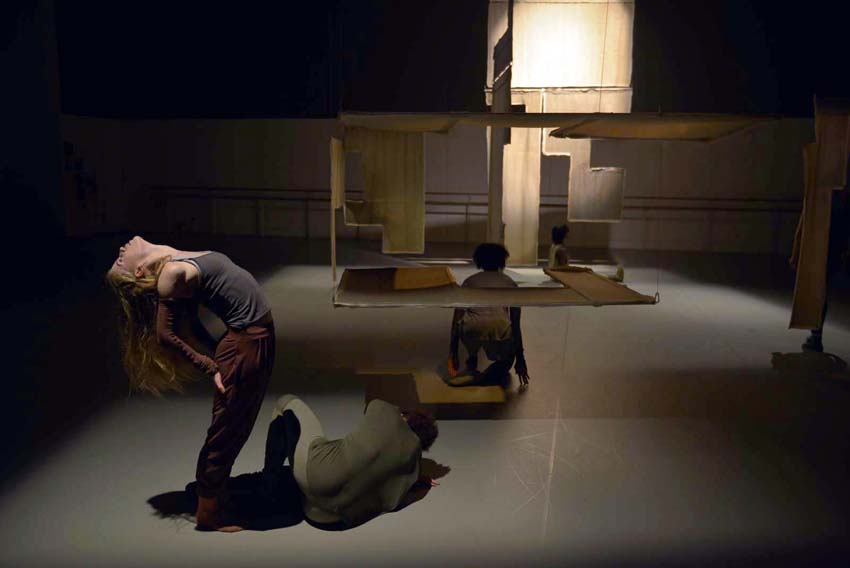
Double Fold installation
Abigail Reynolds is the current artist-in-residence at the Rambert Dance Company and to celebrate the company’s move to their new home on Upper Ground, she conceived Double Fold as a choreographic work in response to an installation of suspended acoustic panels that were cut out from the walls of the company’s old rehearsal space in Chiswick. In their recycled form they hang in the centre of the magnificent new Rambert Studio like an exploded axonometric view of soft interlocking planes. What attracted Reynolds to these panels was their symbolism: they contain — if only we could decode their stored experience — the voices, breath, sweat (and smoke) of thirty years of rehearsals: a material history of the company that provides a somatic link between old and new.
Chairs for the audience arranged around the installation define the performing area. The panels and Malcolm Glanville’s clean lighting create a sense of architectural design reminiscent of the intersecting planes in Gerrit Reitveld’s work, which was in turn influenced by the ideas of Piet Mondrian and the de Stijl movement. The positive and negative spaces create a small theatre within this expansive studio, focusing our attention from architecture to dance.
Hannah Rudd is the first of the five dancers to ‘enter’ the installation, bowing deferentially in front of a horizontal plane before crawling under it and following a maze-like path through the panels, mirroring the material shapes with her own. The fabric panels are hung to the scale of the dancers’ anatomy and the other four (Kym Alexander, Carolyn Bolton, Patricia Okenwa and Simone Damberg Würtz), loosely costumed in earthy colours by Rosalind Keep, likewise respond to the shapes with their bodies: placing their arms either side of a panel, kneeling or back-bending to fit neatly into an open space, the delicate planes broken or enhanced by sculptural movement. How you see the dancers in relation to the panels is a question of perspective, so after the fifteen-minute work is performed once, the audience is asked to move seats to see it again from another angle. It is an idea drawn from the art gallery, where the public has the freedom to wander around an object instead of contemplating it from a fixed point. It also derives from the cubist construct of seeing a single subject simultaneously from different angles. The gesture is reciprocal: while Reynolds is feeding the dancers with the richness of her visual training, the dancers define the visual elements with the quality of their dynamics.

Hannah Rudd, Patricia Okenwa, Kym Alexander and Carolyn Bolton in Double Fold (photo: Abigail Reynolds)
The movement for Double Fold was conceived by Reynolds in close collaboration with Kirill Burlov, a Rambert company dancer and choreographer, whose role was to bridge whatever gap existed between visual and movement vocabulary. The unity of the dance and its environment is evidence of the clarity of Reynolds’ vision and of the subtlety of Burlov’s contribution: the panels interlock in the same way the dancers interlock; body images are formed in and through the cutout spaces, like photographs; a torso here, a foot there, endlessly rich in visual imagery. The five dancers move through the spaces as if through a piazza on a sunny day, alone, in duets or trios, framing and being framed by the light and shade, never separated from their architectural environment. Boundaries were challenged in the creative process: Reynolds had not initially conceived the panels as being part of the dance, but Burlov instinctively suggested the dancers wind themselves up in them like coats or scarves (Rudd, under the watchful eye of Okenwa, for a moment seems to revisit the fate of Isadora Duncan).
‘Double fold’ is a librarian’s term for testing the brittleness of paper by folding it one way and folding it back again. Seeing the dance from a different angle, we are in a sense folding the dance back on itself, but its resilience is enhanced. Dancers that had been in shadow are now in the light and choreographic processes are revealed afresh, countering the ephemeral nature of dance. No live performance is the same as another, and even here, back to back, Double Fold reveals new qualities and images, and the score by Emika, which begins in dense electro-acoustic sound and softens to a solo piano, filters more clearly into our consciousness as yet another overlapping, interlocking element.
After the performance there is a panel discussion hosted by Rambert’s artistic director, Mark Baldwin, on art and dance with Reynolds, Michael Craig-Martin and Catherine Yass. The discussion both derives from what we have seen and suggests a basis for continued exploration, something Rambert does so well.
On the way out, in the light-filled lobby, are two portraits of Madame Rambert, one more formal, the other quite free in the style of Isadora Duncan. Reynolds created the distinctive frames, and seems to have framed her dance within these very parameters of Madame Rambert’s image.
Posted: December 23rd, 2013 | Author: Nicholas Minns | Filed under: Performance | Tags: Benyounes Quartet, Chris Fogg, Configurations, Fabrice Serafino, Gabriel Prokofiev, Guy Hoare, Jan Urbanowski, Jane Chapman, Lucy Carter, Michael Nyman, Shobana Jeyasingh, Strange Blooms, Ursula Bombshell | Comments Off on Shobana Jeyasingh Dance: Strange Blooms & Configurations
Shobana Jeyasingh Dance, Strange Blooms & Configurations, Queen Elizabeth Hall, December 3

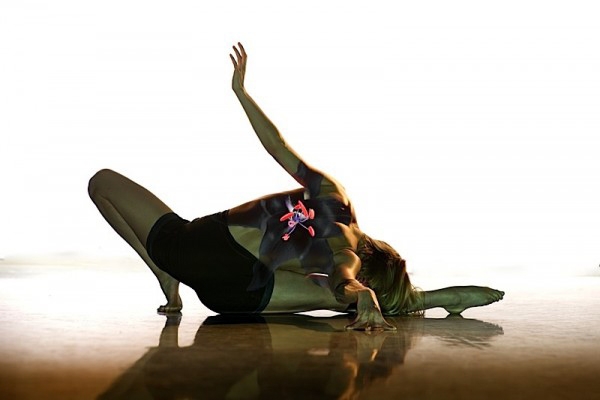
Noora Kela in Strange Blooms (photo: Chris Nash)
This review was commissioned by Pulse Magazine and first appeared online at www.pulseconnects.com. It was subsequently published in the Winter issue of the magazine. It is reproduced here with the kind permission of the editor.
It is no coincidence that Shobana Jeyasingh chose the biology of plants to underpin the twenty-fifth anniversary of her choreographic debut and the birth of her company. The program at Queen Elizabeth Hall included her first work, Configurations, as well as the world première of Strange Blooms. If the latter is the flowering of her artistic development, her bold collaboration with Michael Nyman in 1988 that became Configurations illustrates the clarity of the process by which she achieved it. Dylan Thomas used the metaphor of a ‘force that through the green fuse drives the flower’, and there is a very real sense in both works of Jeyasingh’s rich, fertile imagination driving the creative process towards fulfillment. Her initial use of the traditional bharatanatyam dance form has broadened – she spoke candidly in the question and answer session following the performance about feeling ‘over-defined at the beginning by race and culture’ – but she remains focused on generating meaning in dance without recourse to stories. Her materials are space, time and the bodies of her dancers; her process is one of consummate design.
The members of the Benyounes Quartet sit patiently in the shadows before the start of Configurations. They will be playing Nyman’s String Quartet No. 2 which itself is based on a rhythmic score in six sections that Jeyasingh had prepared as a brief for the composer. Such close artistic collaboration is key to the unity of purpose in each work. Lucy Carter’s lighting design projects a series of rectangles on to the floor that change pattern in rhythm with the music and create pathways for the four arching, spiraling dancers whose steps are so precisely choreographed to the music that they are as much human instruments as they are indefatigable interpreters. Two years ago Jeyasingh reworked the choreography. ‘I wanted to say the same thing but find a simpler way to say it.’ It is this economy of means and her painterly use of space that give the music such a rich visual quality that is further enhanced by Ursula Bombshell’s costumes in reds and orange. The dancers never falter as they carry the lyrical forms, beauty, patterns and colour – even a moment of deadpan humour – through to the work’s conclusion.
A similar organic line is at work in Strange Blooms, not only as the basis of its design but in the subject matter itself. It is organized in four sections based on different aspects of plant biology: the first on the way tendrils curl and swirl in their frenzied search for support; the second on the algorithms of branching; the third on cellular instabilities within plants that help them to move, and the fourth about hybridity or cross breeding. From the very first moment these eight strange blooms unfold before our eyes as if we are looking through a microscope or at a time-lapse film, with Guy Hoare’s patterns of light reminiscent of Rothko in fauve colours suffusing the choreographic development. Graphic projections are not easy to get right in a dance context, but Jan Urbanowski’s laser-like etchings of plant forms play beautifully on the dancers’ bodies while Fabrice Serafino’s costumes subtly harmonise gender and reveal the dance. One can still see the low plié of bharatanatyam but the dance vocabulary belongs more with the urgency of natural forms than with any particular style.
If Strange Blooms reveals the hidden life of plants, Gabriel Prokofiev’s score simulates the process in music. By dissecting a recording by Jane Chapman of Louis Couperin’s harpsichord piece, Chaconne la Complaignante, Prokofiev lays bare its mysterious internal processes before putting it all back together again in pristine form. Like the design of Strange Blooms, it is a remarkable journey that reminds us of the richness hidden in the depths of life. As Jeyasingh says, ‘Choreography is a way of revealing what is already there.’
Posted: December 23rd, 2013 | Author: Nicholas Minns | Filed under: Performance | Tags: A Winged Victory For The Sullen, Atomos, Lucy Carter, Random Dance, Ravi Deepres, Studio XO, Wayne McGregor | Comments Off on Wayne McGregor⎪Random Dance: Atomos
Wayne McGregor⎪ Random Dance, Atomos, Brighton Dome, November 8

Atomos: photo Rick Guest with Olivia Pomp
I wonder — and this is just a hunch — if choreographers who are elevated to a position of high visibility very soon in their careers have a problem managing expectation; if, in the absence of anything new to say, they tend to fall back on what was initially successful. By ‘anything new to say’ I mean anything new to say through the work rather than about it. Wayne McGregor is certainly not short of words when it comes to talking about his work, but I feel he falls into the category of having little new to say through his work, and thus the impact of his most recent choreography has much the same effect as his last, whether you love it or are bored by it.
What you can expect in a work of McGregor is first and foremost a packaging that is lit beautifully (usually by Lucy Carter), is dressed by someone on the cutting edge of fashion, has state of the art projections, presents a voguish contemporary score and is performed by beautifully edgy dancers with plastic (one might say elastic) qualities — whether McGregor is dipping into the willing side of The Royal Ballet (where he is resident choreographer) or into his own company. Apart from the physical aspect, one is inevitably caught up in the intellectual side of his work; the printed program tends to read like a parallel universe of research in cognitive science that reveals McGregor’s curiosity as well as his intelligence and seems designed to link these qualities to the choreography — which is an illusion, for the link is only to the research. I think what we see in a McGregor work is the result of his absorption in his research rather than the fruit of his imagination, which explains perhaps the lack of empathy — communication with an audience. McGregor might well say he never intended it to be there.
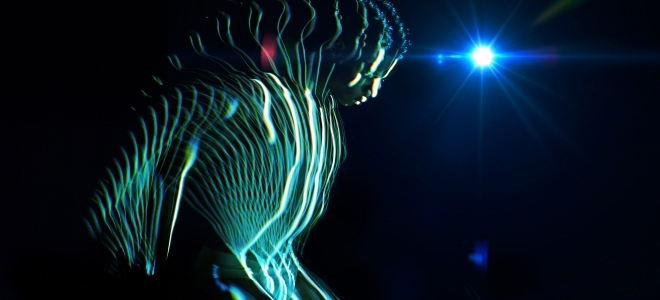
His latest research-laden work, Atomos, continues the trend. The essay in the printed program by social anthropologist James Leach, under the heading What is a body? makes you wonder if you will understand anything at all, but on a closer reading the text runs alongside the work without ever touching. “We feel bodies. They have presence. Their stance, position, intention, emotion, desire, reach, shame, passion, expansion and contraction are recognisable and compelling because this movement, this life, is already part of the common shared space. The only way the self is known and experienced is with others, as presences or absences. The material that the company creates has this quality.” But doesn’t all dance have this quality? He finishes with, “McGregor insists the body is fascinating. He insists it is intelligent. It thinks, solves, makes and creates. He strives to recognize and organise this intelligence — an intelligence that is in and between the dancers, emergent from the relation not the individual. His work both reveals and challenges our sense of what it is to be a human with others, a body that is always there in its concern with, constitution by, and presence among our own and other kinds. Thinking is also movement.” You read that, you see the show and you say to yourself, that was really intelligent. Or you say, with much trepidation, what was all that about? I once heard an audience member ask McGregor in a post-show talk following Far what the work was about. “What do you think the work is about?” came the immediate retort.
Atomos is a fairly typical McGregor thoroughbred: choreographed on his own dancers, lit by Carter, costumed by the fashion and technology duo Studio XO, scored by A Winged Victory For The Sullen and with projections by Ravi Deepres, it has a sexy array of techno packaging, including the option of 3D viewing. It turns out the glasses are needed only for the projections, not for the dancers. So when the five screens eventually slot into place, we don the glasses to see a pink square traveling through the dark auditorium towards us. Is this a distraction to the choreography? Not according to McGregor, who apparently responded to one of his dancers that it is only a distraction if you think the dance is the only thing. Is McGregor having so much fun with his collaborative team that he has turned his back on his audience? At a Hay Festival event this year, the ‘legendary’ McGregor was scheduled to be interviewed by Sarah Crompton with Audrey Niffenegger, author of Raven Girl that McGregor had just adapted for the Royal Ballet. He didn’t show up. Dance is of small but growing interest in the world of literary festivals and his presence would have helped the momentum. Crompton made no comment on his absence but a Royal Ballet aficionado in the audience had come to hear McGregor and wondered out loud where he was. The two women looked at each other sheepishly, apologised and Niffenegger added, “To the best of my knowledge Wayne is madly at work.”
McGregor’s research into the nature of movement may well be useful, even groundbreaking, but for whom? Atomos was created with the help of an ‘artificiallly intelligent, life size, digitally rendered “body”’ in the studio, in effect another dancer provoking new movement creation through technology. It begs the question of what is feeding into the system. What if it responds in kind to a poverty of choreographic input?
With much contemporary choreography in which ideas are pulled from observation or study of the natural world, it is illuminating to glimpse the processes the choreographer uses to arrive at the final product we see on stage. But interesting research does not in itself equate to stimulating choreographic work. In the pushing of boundaries originality can be lost.
Posted: December 3rd, 2013 | Author: Nicholas Minns | Filed under: Performance | Tags: Antonia Grove, Beky Stoddart, Brad Birch, Charlie Morrissey, Fabrice Serafino, Greig Cooke, Jo McInnes, Lee Ross, Scott Smith | Comments Off on Probe Project: Running on Empty
Probe Project, Running on Empty, The Place, November 5

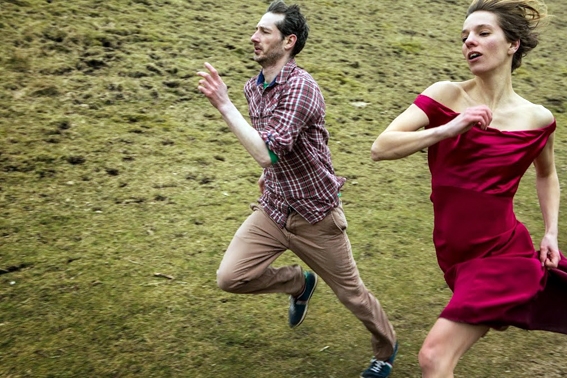
Greig Cooke and Antonia Grove in Running on Empty (photo: Matthew Andrews)
The printed program doesn’t give much away about the nature of the piece, but it’s immediately apparent that Running on Empty has a full tank of collaborators: apart from the three performers (Antonia Grove, Scott Smith and Greig Cooke) there is a director (Jo McInnes), writer (Brad Birch), choreographer (Charlie Morrissey), songwriter (Lee Ross), composer (Smith), set and costume designer (Fabrice Serafino) and lighting designer (Beky Stoddart) — an array of creative inputs that begs the question of who exactly has a handle on the direction. The marketing material features an enigmatic image of Cooke and Grove running together across a landscape as if escaping from a party: intense, focused, out of breath. That snapshot is replaced on stage by another indeterminate place but without a specific flight path. The set suggests a no man’s land where paths meet, an intriguing dreamland with a detrital heap of old furniture on one side with a tree of lights behind and a low wall delineating the unknown beyond. The set and lighting together create a sense of expectation as Smith takes his place behind a keyboard amongst the furniture as if sitting at a bar. He plays some doleful minor chords on the guitar as a prelude to a song remembering a relationship that Grove sings in a voice that is out on a husky limb, aching and velvety especially in its higher register: “Are we too close or too far apart?” with a bluesy harmonica accompaniment from Smith.
Cooke can just be made out lounging on the wall at the back, listening to Grove’s words: “I’d dive into the abyss if I thought I’d save your life”, she continues, glancing at Smith. Cooke stands, his hands and face caught in the narrow pane of light, and responds in dance, swishing and swirling in an intense solo in which he manifests his force and self-doubt in equal measure. Grove looks over at him for the first time. Smith, who plays both confidant and analyst to Grove, asks her: “What do you remember?” She shines a light underneath her chin, then at something unknown beyond her. Death? “What colour are its eyes?” asks Cooke. Grove is bathed in a subtle, fragile light, her arms raised and slightly behind her as if she had just been shot, and launches into a solo that is based on that arching back, wild and abandoned. With tenderness in his eyes Cooke comes to her rescue. “What are you doing?” “Bang, bang, arms, fuck,” is what I hear. The diction is rather muffled, perhaps a function of the portable mikes. “I’m building a boat,” she adds, kneeling, “to get you out of here. Just trying to build you a boat.” Evidently the running idea has been subsumed by metaphors of the sea, of boats and rafts.
The sound of breakers colours the clashing duet that follows, both Groves and Cooke forcing their limits (running towards empty) yet never touching; blowing each other away, shouting and screaming over the sound of sea. Smith pulls out a wooden pallet that serves as a raft on to which Groves and Cooke clamber. They look at each other. Is it over? Cooke leans out over the edge of the raft, hanging from Grove; she pulls him in; he takes her head as they fit into each other’s forms, but are they strangling or comforting? The Stevie Smith poem comes to mind,
‘…I was much too far out all my life
And not waving but drowning.’
The danger games persist. Who will fall off first? They kneel on the front of the raft and step with their hands and knees into the water. Smith reels in the raft, casting them away on the beach. Cooke and Grove embrace roughly then he chases her round the island, catching her, lifting and releasing her in a fury of entanglement and abandon. The sound of a storm whips up the action until it finally abates in an attempt at reconciliation: “Please forgive me” and “Where are we going?” but it’s impossible for Cooke to brake and he ends up — as I noted detachedly in my notebook — ripping her head off. It happens quickly, and its violence is unexpected. Grove crawls away; Smith brings her a glass of water and returns with the raft, dropping it with a bang as if offering a means of exit. “It’s not your fault,” he says, adding something about chance. She is in no mood for philosophical argument, so Smith goes back to his microphone and begins a song about an otter and a trout. It begins in surreal fashion with a pinwheel blast on his mechanical whistle, and prompts a series of surreal crustacean images: Cooke conjures up a lobster on its back as he crawls upside down towards Grove who scuttles in sympathy, or perhaps in fear. He crawls on to the raft, blowing out his cheeks like a conch shell, eyes popping, sounding like an angry elephant. Their duet develops into a tour de force of fragments of dialogue and screeching fitting into behavioural tics: snorting, itching, scratching, spitting, leaping, At the end, Smith as analyst or agony uncle, brings Grove a beer: “You’re having problems.” She denies it. “Maybe that’s your first problem.” She counters: “Do you understand what it is to be me?” He mimics her itching, tentacle-like fingers that he then extrudes into the shape of a gun, the trigger caught in the light. Cooke is back on the sea wall. There’s text about illness and disease, the problems and insecurities of old age — all highly relevant but I’m not sure how it fits in here. “Will I recover, is it too late?” asks Grove. Smith smiles. It’s clearly too late for rhetorical questions. He rubs his hands and pushes away the microphone with his hip.
Grove and Cooke in smiling mood embrace and explore each other. After they have been through so much, the question arises of where this is going. The mood is playful, producing a natural, infectious laugh from Grove before she appears to confront her present. “Do you drink?” asks Cooke, followed by a question about dreams. “This is where my dreams are set,” she responds. Her final words to Cooke are, “Can you do me a favour? Stay away from the cliffs.” It is the first time the cliffs are mentioned, the landscape described beyond the rear wall, and in this place above the sea she starts to dance, scooping, twisting and turning to Smith’s guitar accompaniment that is somewhere between flamenco and hillbilly banjo. She throws herself into her moves, repeating phrases with a mix of courage, abandon and hopelessness and finishes by running around the stage, running out of steam. She prompts Smith into a last song (which repeats the melody of the opening song), dragging the microphone to centre stage, pouring all her emotional exhaustion into the lyrics: “So slowly now you bow into eternity… How long can you keep running?” with that gutsy, velvety voice running full on empty.
At the close, we are left elevated by the visual and aural imagery but there’s a disconcerting sense of gaps in the narrative cohesion. We learn later that Cooke has fallen off the cliffs to his death, but this loss fails to register. Does it matter? Death offstage seems a uniquely theatrical concept that dance can’t do by itself, which leads me to think that the narrative and the dance in Running on Empty are like oil and water; they are not blending. Grove suggests in the program that the work moves ‘from the dark and surreal world of dreams to the intricate and sometimes absurd nature of our daily human interactions.’ This is something that dance can do really well, and Grove is particularly adept at drawing the drama out of dance. Perhaps Running on Empty simply suffers from too many creative inputs; dreams inevitably have a consistency because all their fragmented elements can be traced back to the individual psyche. Running on Empty needs to forge a unity of its own creative psyche before its dream will ring true.
Posted: November 19th, 2013 | Author: Nicholas Minns | Filed under: Performance | Tags: Angela Woodhouse, Between, Caroline Broadhead, David McCormick, Martina Conti, Stine Nilsen | Comments Off on Angela Woodhouse: Between
Angela Woodhouse, Between, Studio Theatre, Central Saint Martins, November 7

Stine Nilsen in Between (photo: Hugo Glendinning)
There are two kinds of perception in Angela Woodhouse’s Between: that of events at our own human scale and that of an intimate aural, visual and sensual kind. These broadly reflect the respective artistic disciplines of the two collaborators; Woodhouse in dance and Caroline Broadhead in textiles and jewellery. The challenge of creating a work based on these different ways of seeing is the space in which it is performed: theatre is designed to enlarge the small into something heroic whereas a gallery space is conceived around our relationship with what is small and can be observed up close. Between, which has been performed in both kinds of environment, requires elements of each but I suspect the Studio Theatre — a rather cavernous black box with black hangings that have been drawn in to reduce its scale — is not entirely comfortable in its intimacy.
Lying on the floor as we enter the dimmed space is a body under a coat; our small group gathers round, not knowing quite what to expect. Darkness descends and a small light picks out a pair of feet traveling upright under the coat into invisibility and silence. From the same direction comes the sound of a rustling material that manifests under an intense halogen beam as an animated coat isolated against the blackness, a magical image that attunes our senses to a disembodied human scale. Between is a series of such sensory adventures creating an intimate relationship between the three dancers (Stine Nilsen, David McCormick and Martina Conti) and the standing or ambulatory audience that is both observer and participant. The role of the dancers with their pared-down gestures and calm, controlled movement slows down time and increases our powers of perception, leaving us somewhere in between theatrical experience and the intimacy of our own space, between the known and the unknown, light and dark, comfort and discomfort, clarity and obfuscation.
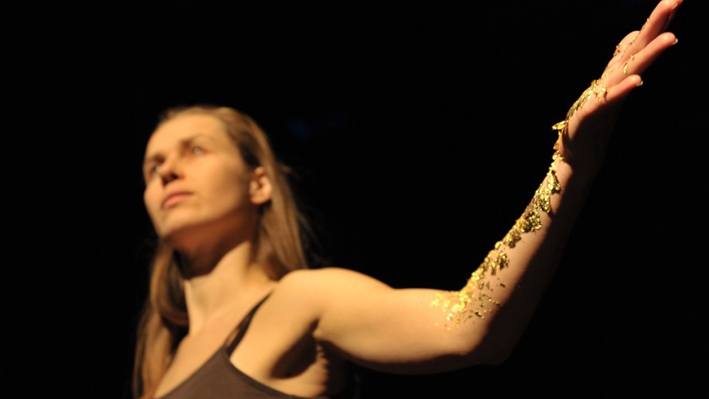
Nilsen in a diaphanous black gown moves silently into an arena of light. Conti sidles up to her, puts her arm in Nilsen’s sleeve, then the other, slipping the garment deftly off Nilsen’s shoulders onto her self; we are voyeurs in an intimate act. The two women take turns removing and replacing the gown, accelerating the seamless transference like a dynamic sculpture. Nilsen takes a hand to her necklace and pulls it hard. It breaks and the pearls scuttle on the floor. Our aural concentration kicks in with the sudden stillness of the moment. McCormick gives Conti a similar necklace but holds on to it as they pull away from each other, stretching it to the limits of its elasticity; the sense of expectation in the space is palpable. Conti finally reclaims the necklace as she approaches McCormick with a smile and puts it on the floor while McCormick moves towards a square of light projected on to someone’s pocket. He puts his hand in the beam of light to reveal a filigree pattern of gold leaf on the inside of his hand like a decoration or a mark, shining and glinting as he turns his hand slowly, following the light’s moving path until it is extinguished.
Conti and Nilsen embrace without quite touching, like a form within a form. They select a member of the audience to include within their enfolding arms and choose my daughter. It is an arbitrary choice, but the confluence of time and place in this encounter is profoundly moving for me, highlighting one of the key elements in the work: pinpointing a privileged relationship between the lives of the performers and the lives of those attending.
McCormick stands among us with his arms raised, walking forward with space as his partner and returning to repeat the same meditation three times, without conclusion. Conti approaches a man to touch hands. McCormick circles Conti in slow motion, drawing her into a gentle, spiraling dance, chest to chest, arms to head, like two docile stags with locked horns. Conti circles away but moves back to McCormick whose hand is behind him like an angel’s wing. She pushes on his outstretched arm as if on a turnstile, but it is he who spins off. Nilsen leaves, leaving Conti in place withdrawing her arm from one sleeve of her sweater, then the other, her fingers slowly disappearing in the light. It appears she is turning her sweater back to front but then she takes out her slip from underneath, offers it to the woman in front of her and leaves. Nilsen returns to reveal a pattern of gold on her forearm. She takes the arm of a young woman and by gently rubbing their two arms together attempts to transfer the gold as a ritual gift. After Nilsen leaves, the young woman shakes her arm as if waking from a dream.
Posted: November 11th, 2013 | Author: Nicholas Minns | Filed under: Performance | Tags: Aideen Malone, Allen Fisher, Archana Ballal, Bharatanatyam, Carl Pattrick, Chris Fogg, Gemma Bass-Williams, Roger Kneebone, Subathra Subramaniam, Under My Skin | Comments Off on Sadhana Dance: Under My Skin
Sadhana Dance, Under My Skin, The Place, October 18

Archana Ballal, Gemma Bass-Williams and Carl Pattrick in Under My Skin (photo: Marc Pepperall)
What we wish for sometimes manifests in ways that are as unpredictable as they are inexorable. Choreographer Subathra Subramaniam wanted first to be a doctor but found her expression in the classical Indian dance tradition of Bharatanatyam. Her latest work, Under My Skin, returns to her first love, which gives the title a certain ambiguity: it refers not only to what happens to a patient undergoing surgery but also to an emotional attachment that is hard to shake off, as in the Cole Porter song, I’ve Got You Under My Skin. Subramaniam’s involvement is both: undoubtedly passionate in transforming surgery into choreographic form, she also demonstrates a vicarious curiosity in the operating theatre through a program of simulations, craft demonstrations and haptics that precedes the performance.
Enter Dr. Roger Kneebone, professor of surgical education at Imperial College London, whose mission to disseminate a greater understanding of surgical procedures dovetailed seamlessly with Subramaniam’s research into Under My Skin and gives it a rich context. There is evidently no pain in Subramaniam’s work, nor the emotion of dealing with the balance of life and death — something that even the surgical simulations bring affectingly to the surface. Her skill is in extracting the beauty of the movement from the operating theatre and in interpreting the essential trust that is a perquisite for any surgical procedure. In doing so, she not only expands the boundaries of Bharatanatyam but provides Professor Kneebone with an expressive medium to further his own research.
Through the surgical simulations (staged at The Place as part of the Bloomsbury Festival) we begin to understand the critical importance of close and accurate communication within a team of specialists providing an acute level of care for a patient undergoing surgery. This will involve the surgeon, at least one assistant surgeon, a scrub nurse, an anaesthetist, and an OTP (operating theatre practitioner). Sometimes the team will meet each other for the first time around the operating table, but they must work meticulously and intimately on matters of vital importance to the patient. In the course of her research for Under My Skin, Subramaniam witnessed this teamwork as an observer, and although there are only three dancers in her work, their relationship to one another is as tightly choreographed as that of the operating theatre team.
As in other works of Subramaniam there is text, here a poem about the nature of blood by Allen Fisher, whom Professor Kneebone commissioned. Its clinically precise language takes on a sense of mystery in the recording of Chris Fogg’s sonorous voice emanating from the dark. The reading of the opening lines is superimposed on a single red light like a drop of blood under a microscope to the sound of baffles, plungers and artificial breathing apparatus, the beginning of a parallel collaboration between lighting designer Aideen Malone and sound artists Kathy Hinde and Matthew Olden.
Malone also observed the operating theatre environment (and as a consequence has been asked to propose improvements to the lighting system). Her three rectangular corridors of light form distinct environments for the three medical personnel (Gemma Bass-Williams, Archana Ballal and Carl Pattrick) in blue surgical scrubs (assimilated by Kate Rigby) who adjust imaginary controls and instruments with minute accuracy and concentration: three routines that develop freely and beautifully into extended dance movement. Ballal is clearly at home with the flow of Bharatanatyam that underlies the choreography — especially in her solo to the violin of Preetha Narayanan — and adapts the gestures of the operating theatre as if putting on a pair of latex gloves. Bass-Williams and Pattrick, while clearly immersed in the style, work towards the flow of Bharatanatyam from the task-based material. What unites the three dancers is the clarity and precision of their gestures.
As the trio merges into the central corridor of light, Malone expands it into one large theatre in which the trio breathes with the breath of an imaginary patient preparing for an operation. Taking the weight of, supporting and balancing each other’s body are all metaphors for the mutual dependency of the team.
Bass-Williams and Pattrick abstract the meticulous washing of hands and the precise order of gowning into a ritual dance. Malone’s lighting moves like a film from one scene to another; in the light at one moment is Ballal in a dynamic dance while in the semi-darkness the surgeons continue their preparation, a solo of life superimposed on a duet of support. The dance vocabulary immerses itself increasingly in the current of Bharatanatyam; Bass-Williams and Pattrick join Ballal in a trio of rhythmic turning steps accented with the deep plié and completed by the rich arm and hand mudras.
The focus is narrowed to a circle of yellow light in which we see — as if we are in the team — just the hands the colour of latex taking and placing instruments, sharing actions, cutting, stitching, checking, swabbing, and cleaning in a silent, concentrated rhythm. Subramaniam once again transforms these gestures away from the operating theatre into the performing theatre, adapting the ability of Bharatanatyam to tell stories through gesture and dance. One aspect that is less developed here is the traditional use of the face as an expressive instrument, especially the eyes. The dancers look at each other, but their eyes are not always eloquent.
An acceleration in the music returns us to Bharatanatyam’s rapid, rhythmic footwork; the influence of Indian classical dance is strongest here and the dancers are stripped down to their essential natures. This is the pleasure of movement where flow is everything; it feels like a coda of growing complexity and technical achievement, but Subramaniam returns us once again to the routine operating theatre where poetry is supplanted by the sounds of the machines, the broad wash of light by a circle of yellow light and dancing by a silent concentration on gestures of intimacy and healing. Pattrick finishes his task and leaves. Bass-Williams and Ballal stay on to accompany the patient’s recovery, then Bass-Williams hands over to Ballal whose head is bathed in the opening blood-red circle of light. She withdraws her head as Fogg’s voice intones the final lines, ending neatly with, “This is blood clotting that will help to save your life.”
Posted: October 23rd, 2013 | Author: Nicholas Minns | Filed under: Performance | Tags: Bellyflop, Dan Watson, Dance Umbrella, Flora Wellesley-Wesley, Jacket Dance, Matthew Winston, Ridiculous Dancing | Comments Off on Dan Watson’s Jacket Dance
Dan Watson’s Jacket Dance, Founders’ Studio, The Place, October 12

Dan Watson in a jacket (photo: Brian Archer)
This year there was a big heart beating at Dance Umbrella, epitomized not only in such works at Gunilla Heilborn’s This Is Not A Love Story and Robyn Orlin’s Beauty Remained For Just A Moment Then Returned Gently To Her Starting Position, but in a rather special Fringe element curated by Bellyflop Magazine. This is Heart with a capital H, accompanied by a printed program (only £5) in which the collaborative artist-led team produced a delightfully informative and refreshing approach to dance. What caught my attention was Flora Wellesley-Wesley’s article on Ridiculous Dancing, a name that summoned up a David and Goliath challenge to the neuroscientific-banks-of-research approach to choreography prevalent in some of our more serious (and well-funded) dance establishments; Ridiculous Dancing, it seems to promise, takes the ‘&’ out of R&D.
As an advocate of Ridiculous Dancing and the choreographer of Jacket Dance, Dan Watson explains to Wellesley-Wesley, ‘I genuinely enjoy watching people who feel compelled to express themselves in the moment: these spontaneous little personal dances that have nothing to do with rightness or composition and everything to do with humanity and physicalising internal states, whether that be a reaction to music or the moment itself….You can see the person more than the movement. The movement is a vehicle to see the humanity.’
There is an intimate scale in Watson’s approach, so it is appropriate that Jacket Dance is performed in the Founders’ Studio, a large living room with the audience packed in at one end and a floor-to-ceiling muslin backdrop at the other — what traveling players might once have set up in the village square. Watson and fellow dancer Matthew Winston are warming up as we enter. The signal to start is the donning of their jackets that hang on either side of the room.
Jacket Dance comprises a handful of scenes in a single fifteen-minute act, a ludic exploration of impulsive dance that favours exultation over technique. As Watson further explains: ‘Jacket Dance is a lot to do with joy: kids dancing to their favourite music, drunk old men dancing for each others’ enjoyment, comedians — both alternative and more traditional — provoking laughter in their audiences.’
Watson starts to riff on a shuffle and Winston picks it up and adds to it. They alternate, playing off each other like a Vaudeville team before establishing a single rhythm that one of them then muddles up. Part two develops individual sequences quite independently of each other, short dance phrases with interlinking shuffles and silly walks until Watson limps away with the choreographic equivalent of a throwaway line. Watson and Winston each wear their character like a mask: Winston’s is over-concentrated effort, while Watson’s is more abandoned though there is an underlying sense of fun in both. They watch each other and surreptitiously copy each other but for the most part they sense the space between them with the eyes of the body.
The next section explores contact in the context of Ridiculous Dancing: Winston and Watson fall against each other, embrace, and shake down. Watson picks Winston up, loses interest and drops him. The dropping and the getting up are treated as movement not story, so there are no recriminations. They judder together, jump like beans, and riff on silly walks until Watson knocks Winston down. Punch and Judy? No matter, they are up and shaking again until they both fall as flailing angels in the snow. A brief musical interlude follows, in which the two men alternate, one playing itsy-bitsy spider on his fingers while the other sings. The songs have an unselfconscious rawness — not to mention breathlessness — about them that goes hand in hand with the movement. In the coda the gloves come off in a dance of one-upmanship that adds the element of extreme to Ridiculous Dancing in some knee-crashing landings until both men are ready to drop, which they do, tracing angels in the snow again. Winding down further, they walk round the room to face each other as at the beginning. The only way to stop is to take off their jackets. Naturally.
Posted: October 21st, 2013 | Author: Nicholas Minns | Filed under: Performance | Tags: Amy Cutler, Army of Me, Brian Cox, Brychan Tudor, Drew Hawkins, Filipe Sousa, Gwyn Emberton, Joanna Young, John Collingswood, Karol Cysewski, Kirsty Arnold, Neil Davies, Sion Orgon, Wonders of the Universe | Comments Off on Joanna Young and Karol Cysewski
Army of Me by Joanna Young and Wonders of the Universe by Karol Cysewski, Borough Theatre, Abergavenny, September 18

Kirsty Arnold in Joanna Young’s Army of Me (photo Iain Payne)
The power of theatre is not only in the images we see in front of us but in what memories they inspire; the two are inextricably linked. The image of Kirsty Arnold standing barefoot in her printed cotton dress in the corner of the stage, slightly in the shadows as if not quite daring to come out, is just the beginning of a delicate journey — ‘distorted echoes in a world made of small pieces’— that choreographer Joanna Young weaves, that Arnold traces, that John Collingswood illumines and that Filipe Sousa’s sensitive soundscape evokes. It is the stuff of memory made manifest in all its clarity of detail. Through the phenomenon of recall, Young places us in the life of a young woman at a moment of intense significance, a shift in maturity perhaps, or a pique of rebellion.
The space in which Arnold stands so pensively is itself the suggestion of a room, in which she stands at a window looking up at the birds flying overhead, thinking perhaps of her future. Collingswood’s lighting projects three shadows of her on the back wall, one progressively taller than the next, like a chart of imagined growth. She crosses her arms in silence then places her hands on her hips looking up. A winsome young girl with red hair, beautifully self-contained and playful, she kneels, shaking her head, then lies stretched out on the floor. Getting up, she shakes her head again, with an arm gesture of dismissal. She is anticipating what we can now hear, the sound of feet crunching up a gravel path, up wooden steps, approaching or walking around. Sousa’s score includes recordings of footsteps by Brychan Tudor, one of Young’s inspirations along with Amy Cutler’s visual art. Arnold moves out of the light into silhouette, but Collingswood finds her, defines her in a wash of light. It is as if we are watching her as she plays in her own room; she pauses, then slides playfully to the side, skipping across the floor, independent, on the verge of experience, arms raised defiantly, running, turning like a dervish, not wishing to surrender her freedom; there’s that dismissive gesture again. Her figure moves into silhouette then back to the light, a little helpless, brushing away the distractions, faster and faster, in her journey of awakening. The steps are getting louder, closer. She runs across the room, suspended in time like the tolling church bells we hear. Her toes play, she kneels, bends forward, prays, but with a sense of an impending closure. In the darkening room she contemplates her hands until they disappear.

Gwyn Emberton, Karol Cysewski and Drew Hawkins in Wonders of the Universe (photo John Collingswood)
Karol Cysewski’s Wonders of the Universe is another kettle of (prehistoric) fish, an exploratory look at the origins of the universe through the agency not of NASA but of three comic crustacea in jackets and jeans (cleverly designed by Neil Davies) whose sexual proclivities at this stage of creation are openly acknowledged. John Collingswood lights and clouds the murky depths of the universe and ocean in which the three performers (Cysewski, Gwyn Emberton and Drew Hawkins) take evolution for a spin with a suitably elemental sound score by Sian Orgon. Cysewski is clearly having fun, but he is careful to moderate the cartoon-like characterization by harnessing the awe and excitement of Brian Cox’s commentary from his series Wonders of the Universe (the starting point of the work). Cox’s theories lend context to the choreography and at the same time Cysewski’s choreographic treatment reduces those vast theories to a more manageable size. The mouthpiece of Cox’s voice is Cysewski’s midriff, manipulated into blind lips by his fellow anthropods and through these lips pass some of the great evolutionary theories of our time which the trio then plays out: the Big Bang as a writhing form that is suddenly zapped and Emberton demonstrates the survival of the fittest by knocking his fellows on the head, a favour they return as they dance in solo or pairs: gametes and zygotes in a primeval mating ritual with attendant cluckings and horn-like siren calls.
In this grand scheme of evolutionary fervour there is suddenly an amoebic fart, an infinitesimal bang with a bad smell. The trio looks at each other accusingly. Cox is silent on the subject but Orgon is clearly having a ball with a techno riff on farts, snores and whistles.
Our evolutionary trio rushes forward from the oceans across the growling African plains to the point at which they stand on the Borough Theatre stage this evening — thousands of generations later — illustrating their miraculous journey. The midriff oracle speaks again; we hear the wonderment in Cox’s voice as he describes the stars evolving and dying, time unfolding and how nothing lasts forever. It’s a ‘majestic story’ and a lot to ponder, but the cheers and applause at the end signal an engagement by the audience not only in the science but in the dance. It’s a heady mixture.
Posted: October 18th, 2013 | Author: Nicholas Minns | Filed under: Performance | Tags: Andrius Stakele, Aura Dance Theatre, Birute Letukaite, Deborah Light, Gotaute Kalmataviciute, Marius Pinigis, Mary Anning, Neil Davies, Solveiga Vasiliauskaite, The Curio Cabinet | Comments Off on Aura Dance Theatre
Aura Dance Theatre’s double bill of Birute Letukaite’s Am I The One Who I Am? and Deborah Light’s The Curio Cabinet, Chapter, Cardiff, October 15

Andrius Stakele and Marius Pinigis in The Curio Cabinet (photo Noel Dacey)
How refreshing to see a new company that hails from off the beaten cultural track. Such is Aura Dance Theatre from Kaunas in Lithuania that presented a double bill at Chapter in Cardiff with a recent work by their director Birute Letukaite (Am I The One Who I Am?) and new choreography by Deborah Light (The Curio Cabinet).
The title of Letukaite’s piece is a little convoluted, which may be a translation problem or an indication of the complexity in dealing with the theme of identity. Certainly there is a lot going from the very beginning of the performance as we enter the theatre. On the way down to my seat, I pass a line of four women in costume and makeup draped against the wall and sit in the front row next to a tall young man in makeup wearing a skirt and jacket, and wonder if I will be part of the performance. He gestures to the seat as if to say it’s ok and I trust him. On stage a woman lies in the steely blue light looking as if she is having contractions. Another woman sits facing the back apparently naked in an office chair next to a textile clock (I thought of the painting by Dali I had just seen — The Persistence of Memory — that features his melting watches). Four moulded-textile anatomical forms (by Almyra Bartkeviciute-Weigel) hang lifeless on a rail at the back as if waiting for a body to fill them. Imprinted on each is an office chair in lurid, silky blue.
The woman with contractions (Gotaute Kalmataviciute) sits up and marks the space around her with precise, repetitive, bird-like gestures of the head and arms with breathtaking sensuality. The young man next to me (Andrius Stakele) gets up to join her and is immediately sniffed by the bird-like head and hands before he introduces himself in a solo of large gestures that blur the lines around him with a bull’s force to Kalmataviciute’s avian curiosity. In the posture and gestures of a second man (Marius Pinigis), there is a suggestion of Nijinsky’s introverted prankster Tyl Eulenspiegel, gestures of illness or instability delivered with uninhibited force. Letukaite has nurtured the identity of these three characters convincingly, enhancing their natural stage presence and ability to make beautiful shapes. Delve under the surface of identity and you come quickly to the sexuality and eroticism of gender and these are explored as well in the repeated interlocking and piling of bodies, but there is an equality of sexual expression between men and women, even if Kalmataviciute’s mastery of space makes her identity dominant.
The other seven dancers are used less forcefully, more to illustrate a point than to express their inner selves. In a secondary theme of identity in the workplace, a woman concentrates on repeating a series of mechanical gestures and there is a comic reference to our reliance on mobile technology to promote and enhance our identities. These clichés are underlined and explored further in an accompanying film, though the medium’s ability to draw our attention tends to eclipse the action on the stage. We are left with a woman dancing to a repetitive beat who nevertheless reveals a tenacious spirit of individuality and the quiet woman in the office chair who has been wheeled around by a trio of acolytes is finally revealed to be pregnant: the regeneration of life, a new identity in a complex world.
Identity of course goes far deeper than the shadow of an occupation, of the clothes we wear or of any other external cause. Perhaps the three main characters come across so well because their identity is allowed to develop from the inside in its genuinely anarchic, sometimes anti-social way. As soon as identity is processed, it loses its richness. The success of Am I The One Who I Am? is divided along this fault line.
Identity also infuses Deborah Light’s The Curio Cabinet, though in terms not so much of individual expression as of the gender issue. Light, one of whose ‘guilty pleasures’ (her term) is reading historical novels, drew her inspiration for The Curio Cabinet from the story of Mary Anning, whose name is little known outside the world of palaeontology to which she devoted her life in the first half of the nineteenth century. Her significant contribution to the science of fossils — then called curios — was acknowledged in her time though not officially recognised by the male-dominated scientific circles in which she would have moved had her gender not been a barrier. In The Curio Cabinet there is not a curio in sight, no delicate pick in Anning’s hand, for this is no historical tale. The one indication of Anning’s fieldwork is the ruggedness of her outfit: a bodice, corduroy pants, woollen socks and hiking boots.
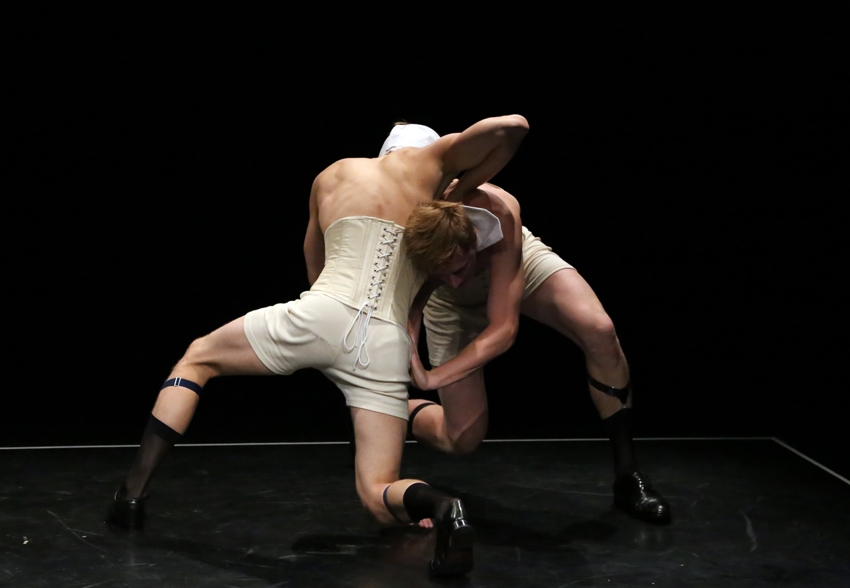
Light takes us straight onto the un-level playing field, marked out by a white taped square within which Anning’s two male counterparts (Andrius Stakele and Marius Pinigis) search, strut and squabble. They are conceived as a homoerotic Tweedledum and Tweedledee and costumed with unsparing satire by Neil Davies in old school black shoes and socks with suspenders, woollen underwear, boned corsets and an exaggeratedly high Etonian collar. Anning (Solveiga Vasiliauskaite) with her flaming red hair moves for the most part outside the white taped square, keeping her nose to the ground, but her feminine alter ego (the beautiful Gotaute Kalmataviciute) dressed in a black lace body suit finds a way in that sends the two males into a tailspin. Light is uncompromising in championing Anning as a model for the female cause, but she never lets her sharp wit upset the tone of the story: at one point she repeats a motif where her characters chip away at the rock; Anning and the men make the percussive sound with their feet but the über-female uses her hand, sensing precisely where the hidden curios lie in this game of opening up opportunities.
The imagery is both striking and beautiful, with an erotic charge that drives the action. Anning is left on the sidelines after the heat of battle, as she was in her professional life, but Light has chipped away at the fossil of male chauvinism to reveal her rightful identity. Perhaps Anning herself has the last word: like the curios she so painstakingly released from the rock, the identity of the choreographer is inherent in the choreography. Keep chipping.
This performance is the result of the first stage of a collaboration between Deborah Light and Aura Dance Theatre supported by Chapter and Wales Arts International. A full version of the work will be developed and performed by Aura Dance Theatre in Kaunas in November.
Deborah Light’s HIDE can be seen at the Traverse, Edinburgh on January 31 as part of the 2014 British Dance Edition.
Posted: October 8th, 2013 | Author: Nicholas Minns | Filed under: Interview | Tags: Subathra Subramaniam | Comments Off on Subathra Subramaniam

Subathra Subramaniam photo: Simon Richardson
This interview, commissioned by Pulse Magazine, was published in its September edition. It is reprinted here with the editor’s kind permission.
Like two tributaries that feed into a great river, Subathra Subramaniam’s paths of science and dance feed into the work she has been creating since she started Sadhana Dance in 2009. She has danced since the age of seven when she was still living in Malaysia and later found her guru – Prakash Yadagudde – in 1988 at the Bhavan Centre after her family had moved to London. Dance in the classical form of bharatanatyam was always her passion but she never considered dance as a career. Subramaniam wanted to be a doctor.
While studying medical biochemistry at King’s College, London, she continued to dance with Shri Prakash and it was there she met Mayuri Boonham with whom she was to form Angika Dance in 1997. Following her degree, she spent two years dancing with various companies but the current of science flowed continuously and in the early years of Angika she studied for a PGCE to become a science teacher and taught science in secondary schools for five years. When Angika became successful, however, something had to give and it was the teaching. The company continued until it was folded in 2008 but the work Subramaniam co-created in that decade – deeply rooted in the bharatanatyam form but based on a desire to push its boundaries from within its own aesthetic tradition – honed the formal basis of her dance style.
After the break, Subramaniam knew that she still wanted to work within the form, but to make dance that was fundamentally important to her, something that would answer the essential question: why do I make dance? It was at this point that the two streams of her life fused: she began to make work that reflected the way the world works based on scientific concepts that asked questions to make us think.
Sadhana derives from the Sanskrit word for the pursuit of a spiritual goal, combining perfection of execution with study and reflection. Subramaniam’s methodology has evolved accordingly, employing rigorous research, immersing her dancers in the subject and finding new ways to generate appropriate movement material. Her first work, The Shiver, was born out of her experiences on five expeditions to the Arctic with Cape Farewell, an organization that parallels Subramaniam’s goals in bringing scientists and artists together to look at the environmental impact of human activity. Her first expedition was in 2003 and she subsequently undertook the role of co-director of educational activities for the organization. When she later met Lemn Sissay, who had made a radio documentary called The Shiver — and whom she subsequently commissioned to write the text for her piece — she discovered he, too, had been on a Cape Farewell expedition. She spent a year as artist-in-residence at the Environment Institute at University College, London, and a period of time observing the activities of the NGO, WaterAid, in India before creating Elixir, and her latest work, Under My Skin, entailed months of research working with surgeon Roger Kneebone both in the studio and on simulations of surgical operations, and spending two days in the operating theatre observing not only the actions of the surgical team but the relationship of trust between the surgeon, the anaesthetist, the scrub nurse, the assistants and the patient. ‘I am capturing their movements in dance, not simply describing what happens in an operating theatre… I feel I am starting to find a movement language that engages with subjects like surgery without being too literal and without being so abstract as to distill down the concept to a point where it is unrecognizable. Under My Skin is a way in to the subject, not the subject itself.’
She insists she is not trying to teach: ‘I don’t want dance to be educational; I want to create good work, interesting work, work that people can enjoy aesthetically’, though she insists that ‘dance has a role to play in the public engagement of science’. To prove the point, Under My Skin was the first dance performance presented at the Cheltenham Science Festival and she presented Elixir in Sofia, Bulgaria, to a sold-out audience that was interested primarily in the science.
Subramaniam surrounds herself with a team of collaborators with whom she has built up a relationship of trust over the last three productions: Kathy Hinde and Matthew Olden on music and projections, Kate Rigby on costumes and Aideen Malone on lighting design. She feels fortunate as not only do they all understand her aims, but, as she says, ‘good art comes from good collaborations’. Another part of her team with whom Subramaniam shares a special relationship is Quentin Cooper, her husband, whose interests closely correspond to her own. He is best known as the presenter of Radio 4’s former science program, The Material World, but was at one time a film critic and a reviewer of dance and puppetry for The Stage before he produced Kaleidoscope, the BBC Radio 4 program for arts and science. He and Subramaniam met at the launch of a Cape Farewell voyage at the Royal Society for the promotion of Arts. Cooper often chairs the post-show talk – called appropriately a Café Scientifique – at Sadhana Dance performances, stimulating discussion of both dance and science with characteristic enthusiasm.
Subramaniam is currently working on the early stages of a new piece as part of The Place’s Choreodrome project. Her research will involve spending an extended period of time working with psychiatrists, neuroscientists, therapists and patients at the Child and Adolescent Unit at the Maudsley Hospital in London. She was recently in the studio at The Place exploring the bharatanatyam form ‘to see if it has another way into tackling the subject in terms of its abhinaya, or expressive element’. This parallel way of creating dance allows her to channel all her experience into each work. ‘If you just want to come and see the dance, that’s what I am passionate about: making dance and making dance work. But I am equally passionate about making dance on science-related subjects.’
Under My Skin will be performed at The Hat Factory on October 15 at 7:30pm, and at The Place on Friday 18 and Saturday 19 October at 8pm with a Café Scientifique and a series of events around the theme of surgery and the arts. Under My Skin is also touring in the spring of 2014. For more details visit Sadhana Dance.