Posted: February 24th, 2018 | Author: Nicholas Minns | Filed under: Performance | Tags: Aakash Odedra, Aakash Odedra Company, Alessandro Barbieri, Lou Cope, Nicki Wells, Ryan Dawson Laight | Comments Off on Aakash Odedra Company, #Je Suis (European première)
Aakash Odedra Company, #Je Suis, Patrick Centre, Birmingham, February 16

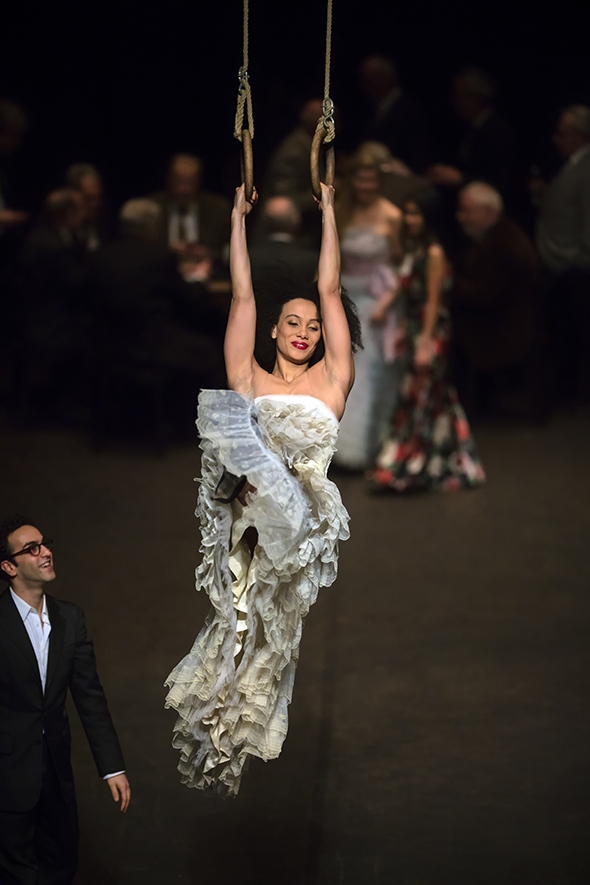
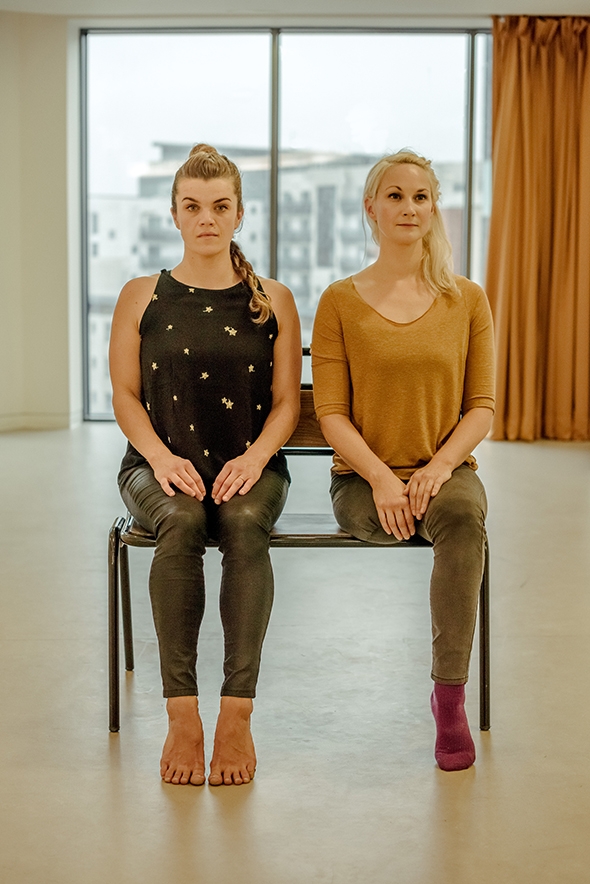
Aakash Odedra Company in #Je Suis (photo: Sean Goldthorpe)
Perhaps it is no coincidence that I picked up recently a copy of Arundhati Roy’s 2001 polemic The Algebra of Infinite Justice. About the role of the artist in our post-9/11 society she writes: ‘Painters, writers, singers, actors, dancers, film-makers, musicians — they are meant to fly, to push at the frontiers, to worry the edges of the human imagination, to conjure beauty from the most unexpected things, to find magic in places where others never thought to look. If you limit the trajectory of their flight, if you weight their wings with society’s existing notions of morality and responsibility, if you truss them up with preconceived values, you subvert their endeavour.’ Roy’s concern here is the insidious nature of censorship, a form of oppression that is the subject of Aakash Odedra’s new work, #Je Suis, created for the post-hashtag-Charlie age and given its European première at the Patrick Centre in Birmingham. Having met a group of Turkish dancers while teaching in Istanbul, Odedra promised that when he had his own company he would create a work for them. As he writes in the program, ‘#Je Suis began as a conversation with these extraordinary dancers about what it is like to be living in Turkey right now, but quickly grew to occupy a much more universal landscape.’ In its seamless unity of artistic and polemic intentions, #Je Suis suggests a direct lineage from Kurt Joos’s The Green Table — to which there are references — but also from Roy’s ethical thinking in Odedra’s questioning of cultural bias. ‘The piece explores oppression in all its guises, layers and contexts. It acknowledges that some acts of oppression are more loudly heard and deeply felt than others. While #JeSuisCharlie brought solidarity, comfort and solace to a world grieving the horrific attacks in Paris 2015, other equally appalling attacks took place in Kabul and Istanbul, but failed to capture the attention of (social) media in quite the same way.’
The result is a work in which the feral quality of the choreography and the mastery of the dancing match the intensity of its subject. #Je Suis erases the divide so often seen between narrative and framing because these dancers are the subject of both. There is just enough setting — a long table and chairs, a radio, a hanging lamp, a pile of papers, a rubber stamp and a microphone — and costumes (all conceived by Ryan Dawson Laight) to suggest, with Alessandro Barbieri’s dense lighting, a claustrophobic interrogation room that is everywhere and nowhere. The lighting works with the choreography in the way its thick haze can dissolve unnecessary details into the dark or illuminate them when needed. Clearly the creative team, with Nicki Wells as composer and Lou Cope as dramaturg, are all on the same page, but it is the dancing that holds the attention in the space because it gets under the surface of both terror and resistance. As Odedra writes, ‘Notions of oppression are not specific to any time, country or religion. Sometimes the oppressor is a political figure, sometimes a culture or sometimes a friend; and sometimes, of course, it is inside us: our fear, cowardice, expectation and doubt.’ In their shifting relationship to each other the seven dancers invoke the ambiguity in these forms of oppression with an intensity and fluidity that blasts through the fourth wall and buries their emotional generosity in our hearts and minds, reminding us not of a specific narrative but of a disturbingly pervasive and volatile phenomenon.
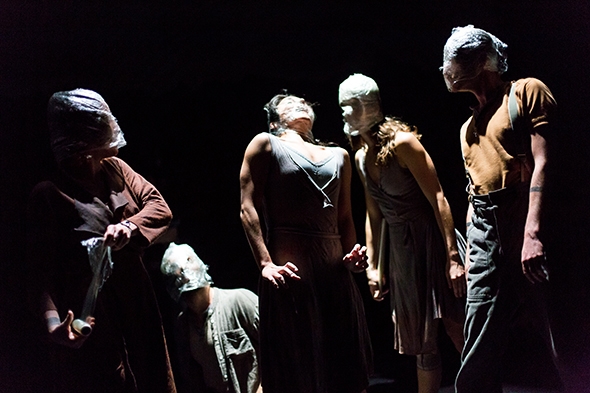
#Je Suis is constructed on an appeal to apparent contradictions — the freedom of expression to convey a state of oppression is central — and the dual symbolism of physical language and of everyday objects. Animal gesture becomes an expression of both domination and subservience and virtuosity is the pitch of both. The radio set becomes, in white-gloved hands, a puppet that is either a source of solidarity or the voice of authority; the lamp is both instrument of illumination and of interrogation, and the headpieces of wrapped plastic hint at the facelessness of oppression while protecting specific identity. This thread of duality maintains a tension in the work that the dancers weave into a rich fabric of experience enhanced by their humility of approach. They do not set out to change the world, nor to propagandize, but to express their life in all its fullness from a perspective of freedom and its absence. Odedra dedicates #Je Suis ‘to all people whose stories and plights have not yet been “hashtagged”…It comes from the belief that the strength of the collective, and our ability to speak out and together, will see us through to brighter times.’
In short, #Je Suis is both vital and unforgettable.
Preview performances of #Je Suis at the Edinburgh Festival Fringe last year won the Amnesty International Freedom of Expression Award 2017.
Posted: February 19th, 2018 | Author: Nicholas Minns | Filed under: Performance | Tags: Andy Newman, Bruce Currie, Drowning, Francis Knight, Greta Gauhe, HILT, Journeys of Internal Migration, JulZin, Kashish Gaba, Luigi Ambrosio, Mil Vukovic Smart, Resolution 2018, Simona Scotto, Terri Biard | Comments Off on Resolution 2018: The Follow Through Collective, Counterpoint Dance Company, Mil Vukovic Smart
Resolution 2018: The Follow Through Collective, Counterpoint Dance Company and Mil Vukovic Smart.

Terri Biard, Kashish Gaba, Mil Vukovic Smart & Luigi Ambrosio in HILT (photo: Donna Ford)
The purpose of Resolution is to allow choreographers to try out their ideas on a public platform (though its artist-led marketing strategy means audiences are heavily weighted with friends and family). Research and exploration are welcomed as in The Follow Through Collective’s Drowning, which ‘evolved around the subject of marine pollution’. For an ambitious project combining the forces of six musicians, six dancers and the work of visual artist Clara Boulard, Drowning has a single message and a single central image that fit the nature of the work as environmental polemic and proactive appeal. On the corner of the stage is a selection of plastic bottles wrapped for some reason in paper as a reference to the ‘over 51 trillion micro plastic particles’ in which our oceans are drowning. Choreographer Greta Gauhe has harnessed an array of visual and acoustic elements in Drowning to evoke a sense of underwater marine life, from the eddies and currents of the dancers’ movement to the ripples of water on Boulard’s filmed images matching the arms of the dancers. The balance between the island of chamber musicians and the ocean of dancers is more ambiguous, and adding the sound of surf to the chamber strings is aural tautology, but all this becomes secondary to the appearance of a clear plastic bubble with Gauhe trapped inside trying desperately to beat her way out. The suffocating imagery goes to the heart of marine pollution and is thus the true starting point of the work.
From a collection of plastic bottles to a pile of assorted shoes: Simona Scotto’s Journeys of Internal Migration uses shoes as the underlying signifier of migration and identity. In a seamlessly intergenerational cast, performers in bare feet initially gather round the pile of shoes as if around a campfire, reaching in to take out their shoes as stories. Individuals take on the character of their footwear by dancing out their ambulatory and olfactory tales to recorded voice-overs — Bruce Currie the smells and Andy Newman his Doc Martins — and in doing so reveal a breadth of human emotion that belongs to embodied experience. Francis Knight cuts through any pretense of dance by expressing compellingly the value of gesture along with Annabel Knobbs, while Oemi Soeyono dances a delicate, pensive duet with her shoes on her hands. These transactions of sensibilities, generational differences and sexual orientation are some of the personal elements Scotto playfully weaves into her treatment of both internal and external forms of migration. From play arises the sense of humour that pervades the work and draws the audience into the action — particularly in the section of gestural dances to recorded instructions and in the unison patterns that career in new directions like dowsing explorations. Yet underneath the ludic quality lies an altruistic desire to make of migrations not an endless path but a rich and flexible community. Scotto’s achievement is enhanced by the colours of her costumes, the selection of René Aubry’s music and Marine Le Houezec’s carefully focused lighting.
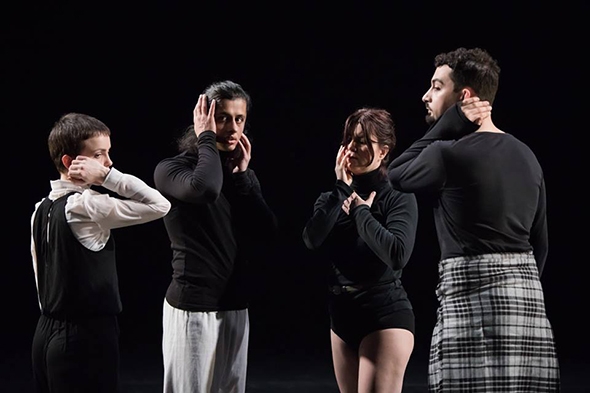
After the ritual tipping out of the audience into the bar, we return to a bare stage and the disembodied voice of former Rambert ballerina Beryl Goldwyn talking to Claire Izzard about dancing the role of Giselle. In a monochrome colour scheme Terri Biard walks in and stands with her back to us; Kashish Gaba strolls in, then Luigi Ambrosio wearing a kilt. When Mil Vukovic Smart joins the group with bare legs in black trunks we are acutely aware of a disconnect with the romantic ballet. Or is there? When the four turn to each other in silence with signs and gestures of alienation — Ambrosio is eloquently withdrawn — it is clear Vukovic Smart’s HILT (with dramaturgical support from Paul Hughes) is not simply inspired by the Mad Scene from Giselle but seeks to recreate the interior landscape of Giselle’s mind that JulZin’s sampled, reverberating extracts from Adam’s original score so eerily suggest. Independent of the ballet’s narrative (that Goldwin has already re-told), Vukovic Smart drills down into the depths of derangement to concentrate on what it might look like just below the surface of the tutus and pointe shoes. In stark red light the four dancers reference a classical ballet class in a key of concentrated distraction to Muse’s rock version of Feeling Good and Biard essays some of Giselle’s choreographic phrases to JulZin’s samples. Elsewhere there are arms like wilted flowers, silent screams, searing suspicion, brooding, gliding monologues, and a febrile energy that overflows in slides, jumps and turns. Biard finally succumbs and is laid to rest, leaving Goldwyn’s voice to remind us of life on the performative surface. In the boldness of its conception and in its sympathetic yet graphic imagination, Vukovic Smart is on to something here, and if HILT isn’t quite fully formed it is tantalizingly close.
Posted: February 18th, 2018 | Author: Nicholas Minns | Filed under: Performance | Tags: BARBERDANCE Luca Braccia, Dystopia, Elinor Lewis, Johnny Autin, Laura Vanhulle, Luca Braccia, Neus Gil Cortés, Nuria Legarda Andueza, Orchard, Resolution 2018, Where is my border? | Comments Off on Resolution 2018: Autin Dance Theatre, Elinor Lewis and Nuria Legarda Andueza, BARBERDANCE Luca Braccia
Autin Dance Theatre; Elinor Lewis and Nuria Legarda Andueza; BARBERDANCE Luca Braccia, Resolution 2018, The Place, February 2

Elinor Lewis and Nuria Legarda Andueza in Orchard (photo: Tom Elkins)
On the Resolution 2018 platform this evening are three works that explore tension in quite different environments. The first is Autin Dance Theatre’s Dystopia, a duet with Johnny Autin and Laura Vanhulle and dramaturgy by Neus Gil Cortes that goes over the familiar ground of an embattled relationship but in a dynamic, almost brutal physical vocabulary that is nevertheless refined in its emotional heft and tender in its resolution. Autin is a powerful, acrobatic dancer whose fluidity allows subtle narrative interpretations to permeate his choreography and in Vanhulle he has found a match in strength and breadth of styles with a naturally fluent expression; the two can stare each other down, explode in frustration or melt into understanding with equal measure. Dystopia is, according to the program note, ‘looking at our human need for connecting and belonging, in opposition with our modern anxieties based on fear and violence.’ In terms of the physical language of dance, connection is common to both ‘belonging’ and to ‘violence’, which is what creates the tension in Dystopia. The distance between Autin and Vanhulle is constantly stretched or diminished with a force that, until the very end, remains unresolved. Richard Shrewsbury’s sound plays a parallel role in the work, at first creating a thick aural atmosphere then piercing it with words as emotions (though I’m not sure they are necessary) and finally distilling it delightfully into a Scottish reel. Having given all they have got, and given as much as they receive from each other, Autin and Vanhulle expel the tension between them in a final gesture of belonging.
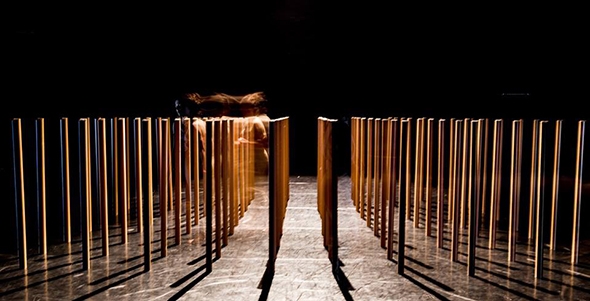
Elinor Lewis and Nuria Legarda Andueza’s Orchard is a deceptively calm oasis of a work constructed and performed with a fine precision that becomes its focus. The set, designed by Lewis, is a precise grid of identical, chest-high vertical poles that have an air of solidity in the stillness and silence of the opening image of Lewis and Andueza standing like Egyptian statuary in a cornfield looking across at each other over the top of the stalks. Their game is to move towards each other without touching any of the poles but they move so meticulously and almost imperceptibly it’s like watching paint dry except for the inherent risk of miscalculation. I calculate it will take five minutes for them to meet in the centre aisle of the grid and it does. But then the trajectories change; the women back up, rock slowly side to side, and then dart like a knight in a chess game to a new space. The sense of tension builds in the audience as the nature of the game wrestles constantly with the stability of the poles and as subsequent spatial challenges are overcome relief and disbelief are equally expressed in laughter. Orchard is a simple concept that is paced to perfection; Lewis and Andueza calm us down by lying like twin halves of a pediment fitted neatly between columns and then slide gently through the grid as if the game is over. When we least expect it, with quick birdlike movements of the head they suddenly roll over and knock down the poles around them. With a look of sheepish surprise they confirm in this one stroke the true nature of their game and of their achievement.
It’s ironic to follow a piece about topographical limits with a work called Where is my border? but the two couldn’t be further apart in content. From the silence and precision of the one we lurch to the emotional turmoil and disorder of the other. The subject of Luca Braccia’s work is not conceptual but visceral, the deleterious effects of Post-Traumatic Stress Disorder (PTSD) in war veterans. However, in appropriating the physical language commonly associated with the symptoms of PTSD — such as the jerked repetitive movements and contractions from shell shock victims in World War 1 hospital films and from the visual currency of news reportage and Hollywood blockbusters — he fails to acknowledge the psychological pain that underpins it. The result is a depiction of trauma that lacks its visceral quality. To succeed in finding an artistic means of expressing trauma that can engage the spectator with its emotional disarray, effect has to give way to the impenetrability of a disorder that ambushes the sufferer with its mental and physical anguish (think of Crystal Pite’s Betroffenheit). Braccia’s sound montage gets closer to creating a dark, suffocating aural environment but his dancers are too robust and in control to render with equal force the distress of PTSD. For all its energy, Where is my border? moves us not towards the affect of trauma but away from it.
Posted: February 14th, 2018 | Author: Nicholas Minns | Filed under: Performance | Tags: 300 el x 50 el x 30 el, Belgium, London International Mime Festival, Nina Simone, Noah's Ark, Paul Kuijer, Toneelhuis/FC Bergman | Comments Off on Toneelhuis/FC Bergman, 300 el x 50 el x 30 el
Toneelhuis/FC Bergman, 300 el x 50 el x 30 el, Barbican, January 31

Paul Kuijer in 300 el x 50 el x 30 el (photo: Kurt van der Elst)
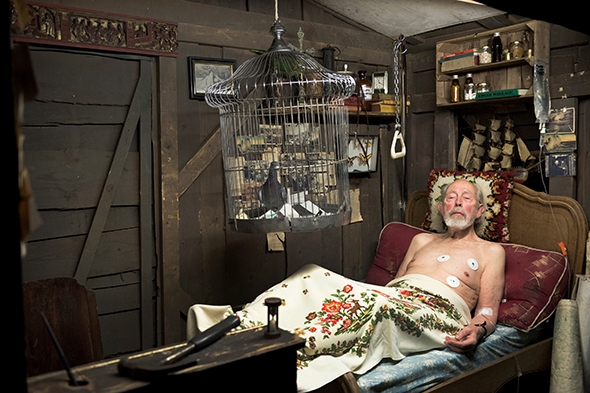
In the book of Genesis the dimensions of Noah’s Ark are given as 300 cubits long, 50 cubits wide and 30 cubits high, but Toneelhuis/FC Bergman’s 300 el x 50 el x 30 el, presented as part of the 2018 London International Mime Festival, has left biblical history to the imagination and focuses instead on the current environmental and political crises facing Western society. Not that there is any sense of impending doom in the opening scene of a fisherman by a pond in sedentary contemplation and endless cigarette smoke. On any one of three screens, however, we see an old man (Paul Kuijer) lying in bed in a small wooden hut, an incarnation perhaps of Noah himself. As the black scrim rises to reveal a community of six ramshackle huts tottering around the perimeter of a leaf-covered clearing, we watch Kuijer unstick the monitors on his chest, pick up a hammer and plod outside into the clearing where cinematic space and theatrical space merge for the first time. Kuijer disappears into the pine forest to build his ark — we hear his hammer blows — while a camera and crew travel continuously around the community staring into the back of each hut long enough at each pass to reveal, with mordant exaggeration, successive tableaux vivants of unfolding domestic dramas. Lingering on the surreal, these portraits of ‘ordinary madness’ are a reflection — and there is no shortage of reflection in this allegory of the Ark — of such contemporary malaises as insatiability, depression, sexual dysfunction, escapism and estrangement. The seamlessly integrated live screening makes members of the audience voyeurs in a community that is, like the show itself, a product of our own making; we are peering ineluctably into our own lives.
So entrenched is the sense of habit and gnawing oppression that the only way out is an act of rebellion. We learn the secret of the young woman at the piano who sneaks across the clearing to play war games with her lover. They plan their escape using the map on his hut wall and attempt to leave with their suitcases commando-like across the clearing. The small community, however, is sensitive to any danger to its hermetic boundaries and emerges into the clearing to close ranks around the lovers, punishing the young man by forcing him back to his hut and nailing it shut. The accompaniment of Vivaldi’s Winter from The Four Seasons adds an additional chill to the staging and yet there is a certain comfort in the music, a recognition of a familiar composition that exists only for the ears of the audience watching from a distance. But how far away are we and where does Toneelhuis/FC Bergman place us in relation to the unfolding narrative?
If the story of Noah’s Ark alluded to in the title can be used as a clue for interpretation, one can read 300 el x 50 el x 30 el in light of current European political events (even though it was created well before Brexit, in 2011). The small insular community becomes a metaphor for tightening border controls while the mood of suspicion and isolation reflects a right-wing xenophobic mentality brooding with violence. Over the course of the performance the voyeurism of the camera subtly turns to vigilance and surveillance as the rhythm of filming matches the unfolding moral tale. The event that brings the community together is the death of the young man, who blows himself up with his stash of gunpowder fuses. The fisherman, moving off his seat for the first time, initiates an act of penitence by immersing his head repeatedly in the pond; other characters emerge slowly from their huts with buckets of water and join in the ritual. Nina Simone’s Sinner Man provides the mood and rhythm of a simple, redemptive dance in which the entire community participates.
Of course the flood is still on its way; these are intimations of disaster, not the disaster itself and penitence is the beginning not the end. Toneelhuis/FC Bergman suggests that if redemption is at all possible in the sense of a desire to heal society’s current ills it cannot be achieved through such rituals of seclusion, but rather by the opposite, by opening hearts and minds to ‘others’, to the establishment of a common humanity. The last-minute emergence into the clearing of an entire village of ‘outsiders’, let in by one of the young women, suggests such a change to the social and political equilibrium. Today’s hope, in other words, is an ethic of inclusion.
Posted: February 12th, 2018 | Author: Nicholas Minns | Filed under: Performance | Tags: Andrey Berezin, Eddie Martinez, Julie Shanahan, Marion Cito, Matthias Burkert, Ophelia Young, Peter Pabst, Pina Bausch, Tanztheater Wuppertal Pina Bausch, Viktor | Comments Off on Tanztheater Wuppertal Pina Bausch, Viktor at Sadler’s Wells
Tanztheater Wuppertal Pina Bausch, Viktor, Sadler’s Wells, February 8

Eddie Martinez and Ophelia Young in Viktor (photo: Meyer Originals)
Peter Pabst’s set locates Viktor in a deep underground cavern surrounded on three sides by high earthen walls on which wooden ladders lean like the interior of a fortified rampart; at intervals during the performance Andrey Berezin shovels earth from the top on to the stage, an aural as much as a visual rhythm of burial. At the foot of one of the walls, rather incongruously, stands an upright piano. Even more incongruously Julie Shanahan enters armless in a scarlet dress, coming to rest like a smiling Roman goddess as Khachaturian’s Masquerade waltz swirls around her until Dominique Mercy brings a fur coat, places it over her shoulders and escorts her out. In this starkly beautiful opening scene, Pina Bausch merges the conceptions of Pabst’s sepulchral set and Marion Cito’s bright, witty costumes in her choreographic evocation of Rome, the Eternal City that inspired Viktor following an invitation to coproduce with Teatro Argentina di Roma and a company visit. There is none of the city’s classical columns or grandiose baroque architecture here but an imaginary locus in which Viktor’s symbiotic themes of death, antiquity, life and beauty play out over the next three hours, ricocheting from one surreal association to the next: from a living statue to a marriage ceremony for the dead, from bargaining two sheep on the black market to furniture auctions, from flirtations to sexual assault, from undressing to cross dressing to the men sitting in a row putting on makeup, from fur coats stored in a fridge to a human fountain. The imagination wanders deliriously from entrance to entrance, each one setting up the expectation of a narrative that never quite fits with the previous one and brings time to a temporary halt. It’s an exquisitely judged choreographic rhythm to which the musical inputs by Matthias Burkert add a range of emotional highlights, from Russian symphonic music to New Orleans jazz to Italian folk songs.
Three hours may seem a long time, but in identifying the underlying nature of time and experience in these traces of her exploration — and those of her dancers who helped create the material — Bausch has synthesized them by condensing the time and experience into a theatrical setting. We are re-living those experiences in their reconvened form. Bausch was aware of the significance of the present moment as a tangible appearance on the surface of history, and in Viktor she has chosen rather to delve into that fertile ground of the past — underneath the streets — to portray what lies above. It is a miracle she accomplishes this in a mere three hours.
There is no doubt that death hangs over Viktor but there are also the luscious, smiling processions, the ensemble gestural dances and the rapturous swinging that are like shoots appearing above the ground after winter, and the bright colours and flowing design of Cito’s costumes on the elegant dancers are themselves a sign of radiance that punctuates the darker layers of Bausch’s vision. And she never fails to highlight the small absurdities of life that she presents on stage for our delight.
Bausch died nine years ago, so all her works the company has performed since then are, in a poignant yet real sense, memento mori — perhaps none more so, given its themes, than Viktor. It thus has a double resonance, reminding us of Bausch’s genius at transforming experience into a transcendent choreographic language of Tanztheater and of the indivisibility of life and death. We shall never again know what Bausch is thinking in the present, but only what was in her mind at the time of a particular work. Unlike a photograph that sets the past exactly as it appeared at the moment it was taken, a choreographic work can only be an approximation of what it was during the choreographer’s lifetime. For Tanztheater Wuppertal Pina Bausch we would seem to be on safe ground — some of the performers were in the original work — and although the level of performance is uneven in terms of experience, Viktor is shot through with conviction and colour to the extent we can see what the work must have been like from its creation in May 1986 up until Bausch’s death in June 2009.
Early on we learn that Viktor is itself a voice from the grave, a ghostly presence who through a woman’s lips in a man’s voice asks permission to remain for the performance insisting he is very quiet and closes the door when there is a draught. How tantalizing to imagine Bausch writing her spectral self into each performance.
Posted: February 8th, 2018 | Author: Nicholas Minns | Filed under: Festival | Tags: Alexander Whitley, Ben Wright, Break-in' Convention, Candoco, Caroline Bowditch, Eddie and Terra, Harry Barnes, Humanhood, Jenna Roberts, Jesús Carmona, Jodelle Douglas, Marco Goecke, Mathias Dingman, Nafisah Baba, Sadler's Wells, Sampled, Victoria Fox, Welly O'Brien, Yeah Yellow | Comments Off on Sadler’s Wells Sampled
Sadler’s Sampled, Sadler’s Wells Theatre, February 3

Victoria Fox and Welly O’Brien in Caroline Bowditch’s Dedicated to…(photo: Brian Hartley)
As Alistair Spalding writes in his welcome note to Sampled, the evening offers audiences ‘the opportunity to experience a range of world-class artists and dance styles in one evening, at a reduced price’. There is also an educational element in the filmed interviews with artists or directors before each work on stage that help to bridge the gap between dance and audience. The nine works on display are eclectic so there is something for everyone, from Mikhail Fokine’s Dying Swan through Jesús Carmona’s flamenco Soléa Del Campanillo to Yeah Yellow’s b-boy Sunshine. It’s a performative smorgasbord, but unlike a restaurant menu it is impossible to pick and choose what you want to see. This may be partly what Sampled hopes to achieve — the possibility that an unfamiliar taste might develop into a new craving — but such a rich menu of performances is not the kind of dance programming that favours the taster who is after a gastronomic experience. It doesn’t take long to realise the programming idea is less a format designed to inspire young dancers and encourage new audiences than a marketing ploy to promote the upcoming season, a point at which public relations acumen clashes with the art form itself.
In a bid to market the season, Sampled is crammed so full of a season’s worth of extracts that it cannot add up to a coherent program and at two and a half hours it risks choreographic overload. With its staged works, free front-of-house films, VR offerings and workshops, Sampled is a cross between a festival and a convention; what it achieves, however, is getting people through the doors into the foyers and auditorium — the place is packed and what a wonderful idea to make part of the stalls a promenade area — but the success of Sampled will be measured in quantitative rather than qualitative metrics, as in how many of these newcomers will become new audience members at Sadler’s Wells.
There are interviews in the printed program with some of the performers in which one of the standard questions is about their first experience of dance. Inevitably they respond that it was a single evening’s work that inspired them to dance. It makes the case for underwriting opportunities for younger children to see the truly world-class repertoire Sadler’s Wells puts on throughout the year rather than making Sampled their point of entry. The tired little ballerina in front of me who had to wait almost two hours to see the four minutes of Zenaida Yanowsky’s The Dying Swan might have been hoping for a more propitious path to inspiration.
The majority of works in Sampled are extracts, and some that look like extracts are just very short works, like The Dying Swan and works by BBC Young Dancers Nafisah Baba, Jodelle Douglas and Harry Barnes. Marco Goecke’s Wir sagen uns Dunkels for Nederlands Dans Theater 2 is a full work, though it could have been easily — and advantageously — reduced for Sampled to one of its four movements. When Baba rises joyously into the air in her solo, Inescapable, it is the first time in 30 minutes that dance’s vertical dimension has been explored and Carmona reminds us soon afterwards, on top of his virtuosity, how many choreographic dimensions there are to be explored. Alexander Whitley’s Kin, a duet for Birmingham Royal Ballet’s Jenna Roberts and Mathias Dingman, suffers the fate of many extracts in that however beautifully constructed and danced, it has an air of being lost, while Humanhood’s photograph in the program is far more enigmatic than the extract of their production, ZERO, which seems drowned in production values. The extract from Caroline Bowditch’s Dedicated to… for Candoco is, despite its orphaned state, still a little jewel beautifully danced by Welly O’Brien and Victoria Fox (and co-director Ben Wright’s witty, avuncular introduction augurs well for the company), while Yeah Yellow’s Sunshine is rich and loud in b-boy virtuosity. Whitley features again in a pre-performance showing in the Pina Bausch room of Celestial Bodies, a VR film of an extract from his 8 Minutes, a collaboration between the Guardian’s VR team and Whitley’s company. Just outside the room, on the film wall, are two screens, one showing the National Youth Dance Company (run by Sadler’s Wells) in sequences from Damien Jalet’s Tarataseismic on location in Hull, and the other showing two young b-girls, the sisters Eddie and Terra talking and dancing on Terra’s 8th birthday. Directed by Ben Williams for BCTV (Breakin’ Convention’s professional development course for film makers), the film has unsurprisingly won multiple awards. Now that’s an inspiration worth sampling.
Posted: January 31st, 2018 | Author: Nicholas Minns | Filed under: Performance | Tags: Alice White, Belinda Papavasiliou, Bite Dance, Hannah Pickett, Harley Ovens, Jessica Miller, Pickett Improv, Rosa Firbank, Score 10, Zoë Bishop | Comments Off on Crying with Laughter and Score 10 at The Old Market
Crying with Laughter and Score 10, The Old Market, Hove, January 27

Belinda Papavasiliou, Harley Ovens, Rosa Firbank and Jessica Miller in Score 10 (photo: Alice Underwood)
The double bill, Crying with Laughter by Bite Dance and Score 10 by Pickett Improv, at The Old Market theatre in Hove presents two pieces that ask similar questions from different perspectives about action and interaction in performance. Zoë Bishop and Alice White do so by looking at physical comedy and laughter; director Hannah Pickett with dancers, Belinda Papavasiliou, Harley Ovens, Jessica Miller, Rosa Firbank and composer Iain Paxon, through sound and dance improvisation.
Crying with Laughter opens with a black-and-white video of Bishop and White making exaggerated facial expressions inspired by the repertoire of Charlie Chaplin and Laurel & Hardy as they themselves sit on stage watching it with their backs to us, like giggling spectators at their own performance. At the end of the video, at the sound of bursting applause (far too loud) Bishop and White bow effusively to the audience. The enactment is reminiscent of vaudeville — a rather incongruous mixing of genres — to which the immaculate, matching costumes by Michelle Bristow also seem to allude. Bishop and White then sit again, this time facing us, to impart a gallery of silent gestures and postures of laughter that turn into laughing audibly at an invisible act in which we, the viewers, are implicit. This is the basic alternating structure of Crying with Laugher that Bishop and White repeat with small variations to crackly 78 recordings, including another video based on their slapstick. Towards the end the laughter veers into hysterical crying — the opposite poles of comedy and tragedy to which the title of the work refers. What is missing throughout this choreography of laughter and crying is the comic act itself, the situational context that is the galvanizing element between action and interaction, between the performer and the audience; without it, all that remains is a superficial focus on gestural mimicry. With their final dance routines there is a return to vaudeville where both Bishop and White appear more at ease; it is as if they are skating on the surface of the dark undercurrents of comedy without wanting to fall in, leaving them neither entirely in nor entirely out of its grasp.
Pickett Improv’s Score 10 uses percussive and electric sound as the basis for the interactive improvisation both between Paxon and the dancers and among the dancers themselves. Arranged around a score of choreographic instructions, the dancers initiate or respond to each other’s movement, develop it or remove themselves from it in an alternation of duets, solos, and quartets. It’s a fascinating process to watch for like a five-way conversation made up of physical and spatial interventions and observations, nobody quite knows what the other is about to say nor how she is going to react. Paxon provides the percussive continuum, gently coaxing responses from the performers rather than dictating — apart from a couple of time cues — while the performers start and stop, enter or leave as they feel the desire to complete the current phrase. The art of improvisation is to join these phrases into a credible arc of communication over the whole work rather than making a series of independent expressions; to succeed requires experience and a marked physical and spatial intelligence (dance is, after all, a mode of thinking through the body). In this way the nature of Score 10 sets in motion a circular frequency that passes from Paxon’s percussion through the dancers and back, throwing up images and phrases that thrive on the very absence of narrative association to allow, when all goes well, for something organic to emerge between sound and movement. Miller and Firbank have the stronger ‘voices’, excelling at the compositional immediacy allowed by the improvisational structure while supporting and challenging the interventions of Papavasiliou and Ovens. Their familiarity with improvisation and with each other (as part of Swallowsfeet Collective) shows in their individual contributions and in their partnering. When Miller’s hand finds the semaphore equivalence of one of Paxon’s sounds, it seems so right it sets up an alternating rhythm that leads to a dynamic thrusting and resisting duet with Firbank like a heated argument that ends in smiles of complicity. By the end all four dancers are taking their improvisation for a walk with the freedom of familiarity and experiment. As an audience we enter this circulation of actions not so much by trying to figure out how much of the piece is improvised and how much is rehearsed, but rather by sharing the interactive flow of movement and sound.
With Paxon’s final time cue the dancers begin to wind down, settling with a slow metronome mark to stillness and then silence.
Posted: January 29th, 2018 | Author: Nicholas Minns | Filed under: Performance | Tags: Brandon Lagaert, Charlotte Clamens, Eurudike De Beul, Gabriela Carrizo, Hun-Mok Jung, Maria Carolina Vieira, Marie Gyselbrecht, Moeder, Mother, Peeping Tom, Simon Versnel, Yi-Chun Liu | Comments Off on Peeping Tom, Mother (Moeder)
Peeping Tom, Mother (Moeder), Barbican Theatre, January 24

Hun-Mok Jun and Charlotte Clemens in Peeping Tom’s Mother (Moeder). Photo: Oleg Degtiarov
Peeping Tom’s Mother (Moeder), directed by Gabriela Carrizo and presented as part of this year’s London International Mime Festival, is set in a family-run museum where everything is linked by a creative umbilical cord to the literal, symbolic and surreal notions of motherhood. At the back we see through a glass window into a cubicle that suggests both the clean, aseptic delivery room of a hospital and, on the opposite end of existence, a morgue. It is here, in the opening scene, that a mother (Eurudike De Beul) breathes her last while her family and friends gather in the darkness of the space outside to mourn. The daughter (Marie Gyselbrecht) breaks down on the floor; her tears become a puddle of water in which she splashes but there is no water on the stage. Borrowing from the cinema, Carrizo matches Gyselbrecht’s every gesture with the amplified sounds of Maria Carolina Vieira’s hands splashing in a bowl of water inside the cubicle that has become, in the absence of the corpse, a Foley studio.
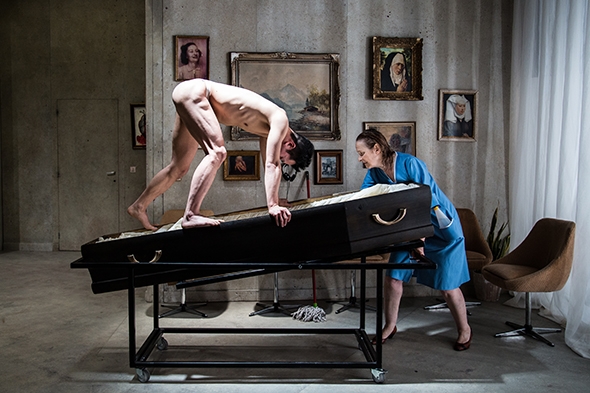
Thus begins a series of associative details within dream-like tableaux that exploit the inseparable link between the aesthetics and the affect of the uncanny as a physical language that intensifies the theatrical experience. We are in the hands of magicians of the unconscious who work in time (marked by birthdays and the closing hours of the museum) and a unity of space like a classical setting warped by the Eros and Thanatos of Freudian theory. Water is the substance of tears but also the substance of amniotic fluid in the womb; death and life are never far apart in Moeder, and are even at times superimposed. In a room off the main gallery art imitates life in an exhibit of a coffin with a naked man (Hun-Mok Jung) poised on all fours above it (see photo). It is called One Foot In The Grave, and the cleaner (Charlotte Clamens) clearly has a delightfully erotic attachment to it. As the museum closes for the day the attendant (Brandon Lagaert) covers it in a plastic sheet. Only then does Jung climb down, but he gets caught in the voluminous plastic and thrashes around to get free. “Fucking job”, he says as he gets up. “You were great today”, responds Lagaert. Life is a performance, or so it seems.
Of course theatre is an illusion, but Peeping Tom is adept at making the visceral illusion so convincing that it hurtles against our understanding with all the force of an uncomfortable reality. The treatment of Moeder is not a compassionate look at motherhood but a fractured, fragmented assault on our relationship to it and therein lies its force. The physical vocabulary of disintegration and dislocation as states of mind is phantasmagorical with an anchor resting on the very deep bed of the unconscious. Carrizo is aware of this and sprinkles accents of humour here and there to soften the blow, and watching her performers is to marvel at their abandoned energy and hyperflexibility as much as to flinch at the emotions they are expressing. The duet of Lagaert and Vieria that evinces their despair at the pathological condition of their daughter while De Beul plays damning chords on the organ is literally and emotionally staggering. Music is also a palliative, especially in De Beul’s rich, mellifluous voice singing Erbame dich from Bach’s Saint Matthew Passion or in the powerfully pitch-perfect association of Vieria’s final scream of giving birth in the Foley-studio-turned-birthing room with her gravelly rendering of Janis Joplin’s Cry Baby.
Moeder wades powerfully into a question that relates to the purpose of theatre; it weaves a path between making the shock of its revelations entertaining and clothing its entertainment in shocking imagery. When Gyselbrecht reaches into a still life on the wall she delivers the damp, resisting head of Jung; a drawing of a heart bleeds and the coffee machine is a much loved female called ‘baby’ with whom Gyselbrecht has a torrid affair (to the Sinatra song, I’m a Fool to Want You) that leads to a deadly electric climax. Perhaps because of the richness of creativity in Moeder there is also a danger that the humour extends to self-congratulation — after Gyselbrecht’s tears, the water becomes a Foley exhibit in itself — and in a cast of such extraordinary performers that their abilities become independent extrusions from the physical narrative. But as in the duet of Lagaert and Vieira or when Vieira amplifies the idea of distracting her crying baby by repeatedly somersaulting on to her back, the shock and the entertainment are seamlessly integrated.
Simon Versnel as the father and widowed husband, and Yi-Chun Liu as the pregnant mid-wife complete an extraordinary cast, and those are only the people we see on stage. Moeder is clearly an exceptional collaboration between Carrizo and her team that creates a flow of haunting images about motherhood from which there is no way out but on a gurney of contrasting emotions.
Posted: January 23rd, 2018 | Author: Nicholas Minns | Filed under: Performance | Tags: Aaron Robison, Begoñia Cao, Crystal Costa, Daniel Kraus, English National Ballet, Isaac Hernandez, Jean Babilée, Jurgita Dronina, La Sylphide, Le Jeune Homme et La Mort, Sarah Kundi, Walter Benjamin | Comments Off on English National Ballet, Le Jeune Homme et La Mort and La Sylphide
English National Ballet, Le Jeune Homme et La Mort, and La Sylphide, London Colisseum, January 20

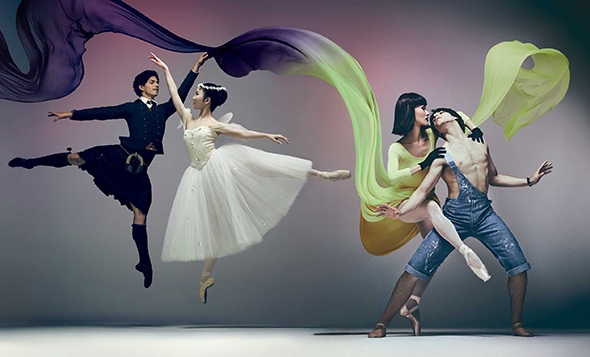
Publicity photo for English National Ballet’s double bill (photo: Jason Bell)
There are several elements that link Roland Petit’s 1946 creation, Le Jeune Homme et La Mort and August Bournonville’s 1836 creation, La Sylphide that English National Ballet presented at the Colisseum. Both are set in the past, both treat the fragile nature of life and death, and both exteriorize the anguish of the principal characters (the unnamed young man in his Parisian garret and James in his Scottish baronial hall) in the figure of a femme fatale who exists largely in the imagination of the men but manifests in ethereal or earthly form on stage. These can be thought of as contemporary human sensations conveyed within a historical setting, but the historical setting — its sets, lighting and costume — however beautifully conceived, is never enough to convince an audience of the authenticity of the re-staging.
Le Jeune Homme et La Mort was created in Paris one year after the end of the second world war when most of the audience and performers would have experienced five years of either fighting, losses, German occupation or all three. That kind of experience is impossible to recreate, but it can be translated. Walter Benjamin makes a case in his essay The Task of the Translator, that transmitting information (in this case, the choreographic and visual elements) is to transmit the inessential. The essential is contained in what is additional to the information, the original emotional force of the work. In Le Jeune Homme et La Mort there is no chemistry between Isaac Hernandez and Begoñia Cao which gives Hernandez nothing to rage against. He rages against gravity, but not against his inner turmoil and Cao plays her role so outside his existential head that in showing him the noose she could be a member of cabin crew demonstrating safety procedures before takeoff.
In La Sylphide, despite the impeccable qualifications of Frank Andersen, Eva Kloborg and Anne Marie Vessel Schluter who have brought the production from its home at The Royal Danish Ballet, the performers lack the emotional sensitivity to astonish. Here the story is not so far removed from contemporary experience — unrequited love, the illusion of attraction and the despondency of having made the wrong decisions — but these need to be expressed in the context of romanticism whose principal aspects, as Jane Pritchard writes in the program, are ‘the dual fascination with the supernatural and the customs of remote exotic countries.’ It’s difficult today to conceive of Scotland as exotic, but the supernatural still has its allure. As the Sylph, Jurgita Dronina dances with all the technical precision one could want but there is something hard-edged about her interpretation that cannot be compared to what Théophile Gautier wrote of Fanny Elssler in a production of the original La Sylphide in 1838, that she ‘appeared and vanished like an impalpable vision, now here, now there’. Similarly, both Aaron Robison as James and Daniel Kraus as Gurn are convincing in their translation of the Bournonville style but Robison has difficulty differentiating between the presence of Dronina and the illusion of the Sylph, which leads to him expressing his feelings with contemporary shorthand gestures like snapping his hand and head as if to say ‘Damn, I missed her again.’ Kraus doesn’t have the same difficulty because Effie is flesh and bone in the form of Crystal Costa, a last-minute substitution for Connie Vowles. But Costa’s costume gives her the perplexing appearance of a school girl which withholds all belief in her betrothal to either James or Gurn, and Sarah Kundi’s mime as Madge may be accurate in terms of text, but lacks the conviction to convey the darkness and savage predictability of internal fate. By contrast, the two older men, Bimse and Bumse (James Streeter and Fabian Reimair) feeling the aches and pains from being pushed hither and thither, are entirely successful in imparting to the audience their condition.
If the older ballets are not stories that belong exclusively to the era of their creation but have what Benjamin called the essential element of ‘translatability’ then the question is how to translate them so as to make them relevant to the performers (for it is the performers who ultimately translate a ballet). Perhaps in the quest for technical brilliance the development of the psychological and emotional aspects of a character might be seen as secondary. Looking from today’s perspective at extracts of Jean Babilée in the original production of Le Jeune Homme et La Mort, his technique is dated but his muscular conviction translated into the steps defies time. The language of the feet, as Gautier wrote, may be universal and everywhere understood, but something in this double bill has been lost in translation.
Posted: January 22nd, 2018 | Author: Nicholas Minns | Filed under: Performance | Tags: Dominique Dardant, Le Récital des Postures, London International Mime Festival, Yasmine Hugonnet | Comments Off on Yasmine Hugonnet, Le Récital des Postures
Yasmine Hugonnet, Le Récital des Postures, Lilian Baylis Studio, January 19

Yasmine Hugonnet in Le Récital des Postures (photo: Anne-Laure Lechat)
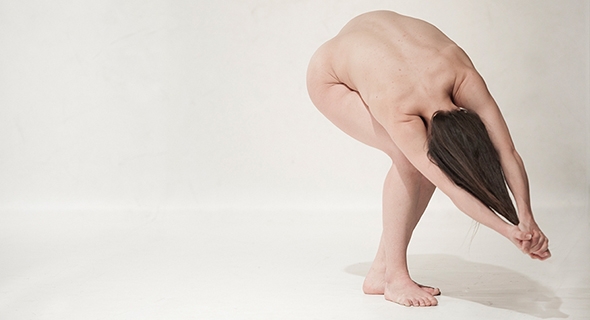
Presented as part of the London International Mime Festival, Yasmine Hugonnet describes Le Récital des Postures as ‘a silent concert for one instrument – the human body’. As the lights come up in the silence of the bare stage we know from the program that the human form we see is that of Hugonnet but even if you know what she looks like this image would not corroborate that knowledge because her face is well hidden by her hair; under Dominique Dardant’s lighting her hair becomes a black extension of her black top and grey tights. She is standing in profile with her upper body bent forward, her hair almost touching the ground and her hands resting just in front of her knees. The longer she remains immobile in this pose the more our eyes adjust to seeing a living sculptural form with no passport-like identification. Hugonnet descends by subtle stages to lie prone like a stain on the floor recalling the shapes of Francis Bacon’s melting figures. She seems to empty into the shadow of her own body what once filled it. And then her two arms rise eerily from the shadows like two periscopes idly surveying the audience, her legs and flexed feet articulate the space behind her like beaks that Dardant subtly highlights, and her back ripples as if subjected to an invisible, childlike hand playing with a favourite toy. In this ‘slow burn’ evolution of postures Hugonnet intensifies the subtle stillness of being through the suggestion of touch, the thinly veiled threshold of pain, and the slow sensuality of sliding and crossing limbs.
Regaining her initial pose, she slips her black top effortlessly over her head to the ground. But how can you do that with tights? Her gesture immediately transforms to the utilitarian as she takes her hands to her waist to slip them off one foot at a time. At the moment she discards her clothes she makes an artistic decision that changes the development of the work; she can no longer maintain the formal approach she has used up to that point. Briefly after she rolls up her clothes, grey within black, and brushes them in a single abrupt gesture to the side of the stage, she keeps her hair pulled forward over her bowed head, naked but still faceless. But as soon as she unfurls to the point we can identify her she has moved from Bacon to Matisse or Bonnard; she has entered the figurative. She has also entered into the recognizable aesthetic of the female nude. She has, in a sense, let the cat out of the bag when she could have kept it inside to more effect, the cat being not simply the clothing but more importantly the self-identification. The abstraction of form and the blurred edges of autonomous movement that she evokes while covered are lost in her nakedness. Once set adrift on this broader stage, Hugonnet is never again able to disguise her identity, even though she pulls her hair in fanciful arrangements with hands and feet and even, in a whimsical gender reversal, twirled carefully and held as a moustache between nose and pouted lips. Where she had begun by forcing us to change the way we see her body, slowing down our vision to take in the full ambiguity of the postures she was making, she is now in the cross hairs of our sight and fleeing the newly-emerged clarity of her bodily form. She sets off on a journey of plastic shapes, borrowing from Egyptian friezes and dance vocabulary that through motion become sculptural fragments but she leaves us no time to take in her postures; her exposure has changed the dynamic of our gaze.
Intriguingly Hugonnet reclaims her original ambiguity through aural means. In the final section she kneels facing the audience in a single posture with a dispassionate, neutral gaze. Out of the stillness and silence we hear an eerie disembodied voice, animate yet inanimate for it seems to arise from Hugonnet’s mute posture. “We are going to dance together”, says the voice, “Let your imagination dance.” As she had once made us search for the human agency of her postures through our eyes, she now confounds our ears by being both ventriloquist and doll and challenges them rather than our eyes to search for the truth of her imposture.