Posted: September 10th, 2012 | Author: Nicholas Minns | Filed under: Performance | Tags: Aranis, Filip Van Huffel, Layers of Skin, Retina Dance | Comments Off on Retina Dance Company: Layers of Skin
Layers of Skin, Retina Dance Company, Theatre Royal Nottingham, September 8
It is one of those cases where you shouldn’t read the program notes before seeing the performance. I did, and I spent some time looking on stage in vain for what I thought I was going to see. The painter, René Magritte, once said, “If one looks at a thing with the intention of trying to discover what it means, one ends up no longer seeing the thing itself, but thinking of the question that has been raised.” I was at Nottingham’s Theatre Royal to see Retina Dance Company’s Layers of Skin, choreographed by artistic director, Filip Van Huffel. In his notes for the work, Van Huffel suggests skin is not only what we see but what covers what we don’t see: our feelings, our characteristics. Magritte again: “Everything we see hides another thing; we always want to see what is hidden by what we see. There is an interest in that which is hidden and which the visible does not show us. This interest can take the form of a quite intense feeling, a sort of conflict, one might say, between the visible that is hidden and the visible that is present.”
Putting aside the ideas of skin, the intensity of conflict is closer to what I actually see in Layers of Skin. The explosive quality of the dancing is in a sense the development of conflict in choreographic form. Created on Retina’s core of six dancers and three apprentices, Layers of Skin also has a supporting cast of eighteen local dancers of differing ages and abilities who have been rehearsing intensively with the company for the last four days. It doesn’t sound like a formula for success, but it works. One could not have asked for a more complete performance in terms of its energy and drive. The six dancers are the heart of the matter, a fearless sextet that courses through the performance with unrelenting attack and endurance. The apprentices allay the tensions with beautiful, lyrical movement, and the local artists provide the balm. When they all come together, as in the final scene, the conflicts are seemingly resolved.
There is also a transformation from initial research to final choreographic form through the score by the Belgian band, Aranis (www.aranis.be), consisting of two violins, a double bass, accordion, piano, flute, and guitar, which has an earthy, gypsy grounding that swings, syncopates, jumps and celebrates. The joy is in the music. The thrill is in the dancing.
The stage is set as an arena with three sides along which are ranged rows of chairs. In between their bouts of participation, the apprentices and local artists sit here (and sometimes the core sextet, though they have little respite), which provides a physical and spiritual continuity throughout the work, as if what is going on in the arena is of concern to everyone. The setting has the starkness of a Shaker Meeting House and the excitement of the circus. When the seven musicians play live on stage (for this performance the music was recorded, but played back with remarkable fidelity) they take up the rear wall, like a row of dancers. This would be the ideal staging, but since the band is based in Belgium (like Van Huffel himself), the cost of bringing it over is a serious financial consideration.
The performance begins in silence and the light reveals a pile of bodies, lots of layers of skin in imperceptible, slithering contact, though modest black underwear covers those areas of skin still uncommonly revealed in our theatres. Kristina Alleyne mounts the pile and backbends over the top, sliding down to the floor to begin a new one, like a replicating cell. The other contingent of dancers enters one by one and surrounds the now upright and dressing group, like a crowd of onlookers witnessing a commotion in the street. By the time the core sextet begins its first dance, the onlookers have taken their seats to watch this performance within a performance. And what a performance it is. Van Huffel’s movement vocabulary demands a total immersion in its volatile gesture, its flying, flipping and horizontal spinning, its daring partnering and its seemingly effortless recovery from high voltage falls to the floor. Contact between the dancers can appear quite violent were it not for the absence of any kind of struggle for dominance; the relationships are dispassionately physical rather than emotional, though the appearance can be ambiguous. Van Huffel is careful to counter the sextet’s surfeit of energy with a nicely balanced arrangement of solos, duets and trios and with passages of calm and balm involving the apprentices and local dancers. Kristina Alleyne, Erin Harty and Pauline De Laet are the three core women, and Steven Martin, David Michel and Matthew Slater the men. Of the three promising apprentices (Andrea Lund, Josefien Noske and Elín Ragnarsdóttir), Noske suddenly catches my eye during the performance as she takes control of her movement and gives it sinuous life. Van Huffel has an evident talent in attracting good dancers into his orbit and bringing out the best in them.
If skin is a form of boundary, these dancers are dancing outside their skin with a raw and transformative energy that effortlessly crosses the theatre’s fourth wall. In the final moments the entire cast walks slowly downstage performing a kind of mass reverence in balletic form with a decidedly expressionist flavour, but a reverence nevertheless. It is a powerful, cathartic moment.
And if you are still wondering what it is all about, I leave Magritte with the final word: “My painting is visible images which conceal nothing; they evoke mystery and, indeed, when one sees one of my pictures, one asks oneself this simple question, “What does that mean?” It does not mean anything, because mystery means nothing either, it is unknowable.”
Posted: September 8th, 2012 | Author: Nicholas Minns | Filed under: Performance | Tags: 12, Candoco Dance Company, Claire Cunningham, Marc Brew, Parallel Lines | Comments Off on Candoco, Marc Brew, Claire Cunningham: Unlimited
Candoco Unlimited, Unlimited Festival, Queen Elizabeth Hall, September 6, supported by The Brazilian Embassy.
Unlimited is a project at the heart of the London 2012 Cultural Olympiad that celebrates disability, arts and culture on an unprecedented scale. Twenty-nine new works were commissioned to encourage deaf and disabled artists to push boundaries, by creating work which opens doors, changes minds, and inspired new collaborations. (Arts Council England)
The Unlimited Festival at Southbank Centre is an encouraging, life-affirming project that parallels the sporting premise of the Paralympics, and it finds a fullness of expression in the two works commissioned by Unlimited and presented by Candoco Dance Company at the Queen Elizabeth Hall on Thursday evening: Parallel Lines by Marc Brew, and 12 by Claire Cunningham.
The motivating idea behind Brew’s Parallel Lines is the lines of communication between the 2012 Olympics host country, its predecessor, China, and its successor, Brazil, and it uses dancers from all three countries. The cables we see suspended and stretched across the stage are both the lines that unite by carrying this communication, and the lines – like race, physical ability or national borders – that can demarcate. Parallel Lines is thus an idea that works on an intellectual level as well as on stage, thanks to Brew’s creative, all-embracing magic. He has the dual experience of being an able-bodied dancer (he used to dance with Candoco) who now finds himself in a wheelchair, so he has a profoundly nuanced understanding of what it means to have unlimited movement and what it means to be physically constrained.
Another force that leads Parallel Lines forward is its score by Michael Galasso (Scenes), creating a series of delightful variations that allow space for the dancers to move in between its layers. Brew has caught the dynamics of the music beautifully in his own treatments of duet, trio, quartet and ensemble, mixing male and female, male and male, able and disabled, with an overarching theme of support, be it from the ground or from a partner. The duet with Darren Anderson and Edu stands out as an expression of courage, strength, caring and love, with a delightful sense of humour. Brew transforms disability into an emotional quality that imbues the partnerships he sets up with an equality and universality that is surely the summit of his achievement. The creative elements of set design (Sam Collins), costumes (Jo Paul) and lighting (Ben Pacey) complete the unity of this work.
Claire Cunningham takes a different tack in her creative process. She is used to choreographing work on her own body and drawing material from her own life, incorporating the crutches on which she relies. She said in a Q&A after the performance that the prospect of creating work on a group of dancers filled her with misgiving and fear. There was the double challenge of creating for both disabled and non-disabled dancers and of assigning the movement’s ownership to someone other than herself. Her solution to the first was, like Brew’s, an emotional one: finding in the crutch a symbol of our forms of dependence, something with which we can all associate. Cunningham’s answer to the second was to get the dancers to create autobiographical material of their own by giving them improvisation tasks in the studio, and taking from the movement what she and her assistant director and mentor, Gail Sneddon, felt was right for 12. The advantage of working in this way is that it has allowed Cunningham to break through a psychological barrier to realizing a much broader palette. The danger, however, is that the material escapes her creative control, as with Pandora’s box, and cannot be enticed back. 12 is thus uneven in its pace, abstruse at times, but never lacking in visually arresting imagery. Crutches are used as guns and as air guitars, and in a particularly oppressive scene, as elements of violent manipulation and submission: emotional dependence has a decidedly dark side. Crutches are also used in less sinister fashion as elements of an animated conversation between Welly O’Brien and Mickaella Dantas, and as puppet sticks in the scene with the bookish Ming Hei Wong and the voluptuous Annie Hanauer who dances around a candy cotton microphone to Mozart’s Laudate Dominum. Dan Daw, whose dramatic talent shines here, is mesmerising as he strives to control an errant arm while seated in a chair. Shanti Freed evidently had a lot of fun with the costumes, and Matthias Herrmann’s score hung on to Cunningham’s roller-coaster vision by the seat of its pants. Karsten Tinapp lit it all admirably through the billowing fog.
What Marc Brew and Claire Cunningham so convincingly affirmed on Thursday night is that there is no notion of disability in terms of artistic expression, and the dancers are all brilliant performers. Candoco’s reputation has been sufficiently established that it is perhaps time to quietly remove its label of disabled and non-disabled dancers. And where, oh where, are the designer crutches?
Posted: September 3rd, 2012 | Author: Nicholas Minns | Filed under: Performance | Tags: Ben Ash, Dan Howard-Birt, Dance South East, Dog Kennel Hill Project, Henrietta Hale, King's Wood, Stour Valley Arts, Turner Contemporary | Comments Off on Dog Kennel Hill Project: Marks, Measures, Maps and Mind
Marks, Measures, Maps and Mind is a promenade performance created by Dog Kennel Hill Project, co-commissioned by South East Dance, Turner Contemporary and Stour Valley Arts as part of RELAY, and produced by South East Dance and Stour Valley Arts, August 27.
Marks, Measures, Maps and Mind celebrates the physical body through a range of sports-driven tasks, in a breathtaking natural setting. Sporting challenges and actions form the basis for a dance that showcases the human drive for precision and perfection within the wild and epic locations of the forest, rekindling the timeless relationship to our natural environment (from the program).
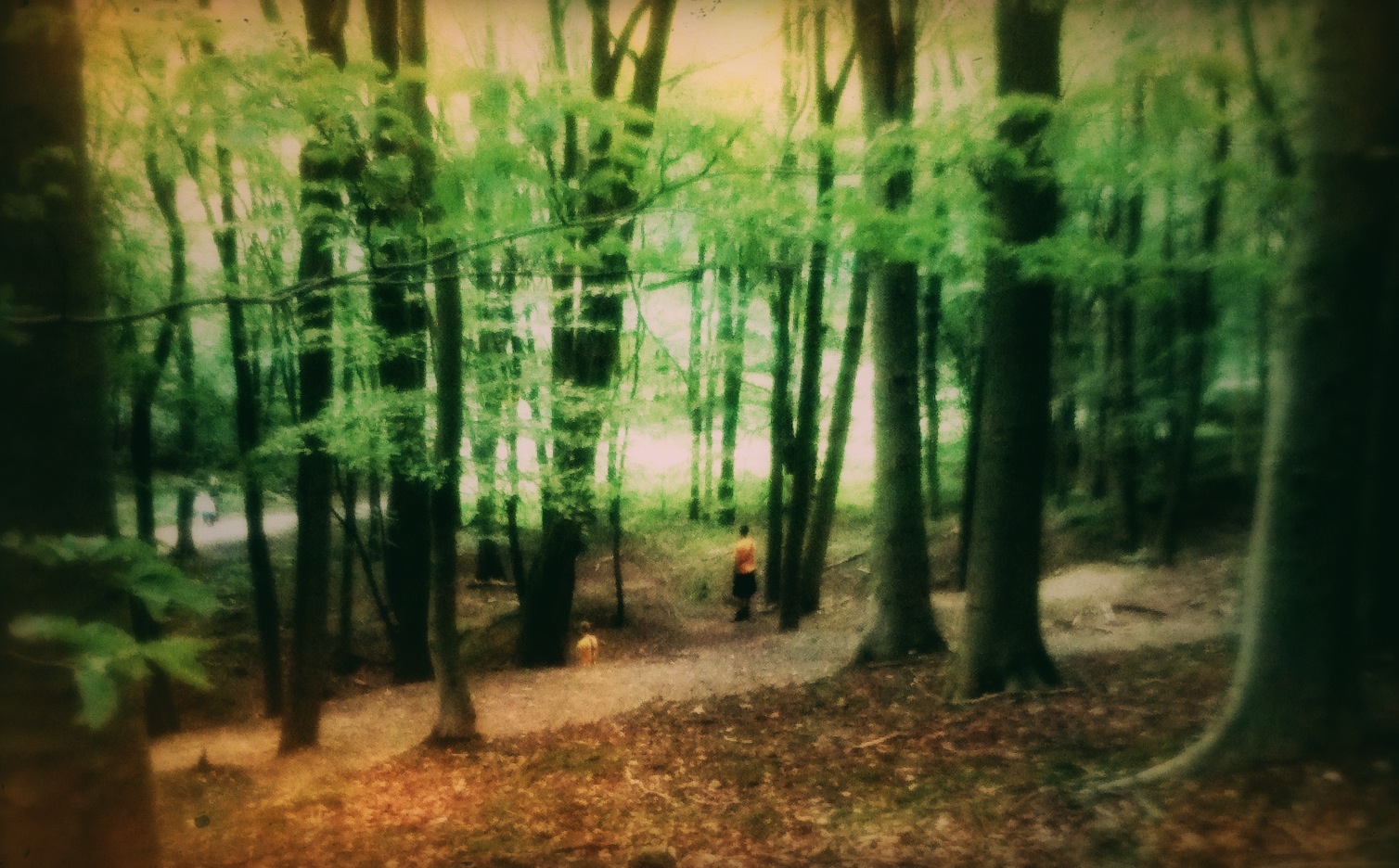
I’ve seen some impressive theatres, but King’s Wood near Challock in Kent beats them all for size, natural beauty and lighting. The forest serves as Stour Valley Arts’ principal gallery for outdoor visual arts commissions, but this is the first time it has worked on a dance performance. With the Olympics looming over every aspect of our cultural life, Dan Howard-Birt, assistant curator at Stour Valley Arts, makes the analogy between the natural and improved in terms of sports training and the natural and improved in terms of the Forestry Commission’s management of King’s Wood. ‘Dog Kennel Hill Project approach the subject of the natural and the improved through dance and the human body…trained and scripted to enact movements and gestures of particular exactness, which when seen sequentially or en masse reveal the artists’ ordered design.’
King’s Wood is thus transformed from a vast gallery into a vast theatre. Front of house facilities are housed on the edge of the car park in a tent with cupcake bunting that is home to an enthusiastic team of production staff from South East Dance and Stour Valley Arts, while in an adjacent silver Airstream a filmed interview with Ben Ash and Henrietta Hale of Dog Kennel Hill Project – creators of this promenade performance – is showing on a screen. It’s not easy to hear the interview as there are children running up and down the ramp to the caravan and launching themselves off the steps with wild enthusiasm. What I do catch is Hale talking about absurdity in their work – ‘a purpose with lack of purpose’ – and according to Ash, there is an umbrella theme in Marks, Measures, Maps and Mind of progress and decline around the notion of work. They talk of the different textures of the forest, of the sense of order and repetition in nature. The theme of sport seems to have taken a back seat. The short interview finishes with an invitation to ‘feel the forest, feel the performance.’
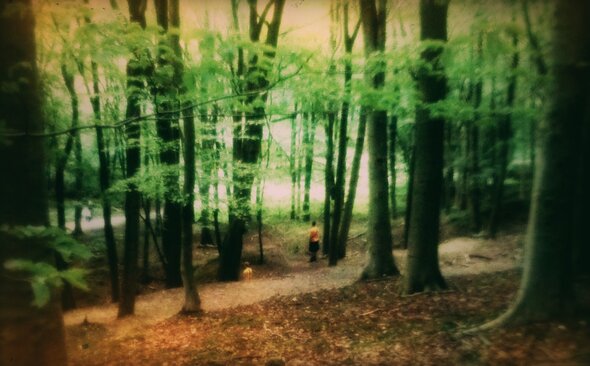
Outside we are formed into two groups of thirty people, each with a guide. It is oversubscribed this evening for the last performance. After a briefing, the two groups merge into the forest like a straggle of pilgrims, some with staffs and walking sticks, some dressed for the theatre, some for hiking. We trek for fifteen minutes through King’s Wood, along a path through the meadow, past the beech trees, sweet chestnut trees, larch and shoulder-high ferns. Little Robin Hoods with their sticks run off into the undergrowth and back, birds sing, and the air becomes danker and cooler and the light more muted as we enter further into the forest. There is no fourth wall in this theatre; there is no wall at all.
After fifteen minutes, we turn right and climb a long and grassy path, the final ascent to the beginning of the performance. At a gateway of green string tied between two trees we divide into our groups and enter along the path. In the dappled light we encounter male and female dancers in groups of two or three, dressed in blue and yellow tops with black or white skirts, standing still among the trees on either side of the path, staring ahead, hands open as if we have come across a group of pagans in a solemn ritual. The figures stand out in the forest, sculpting the space with their bodies, though their costumes are too wooly to make their shapes precise. And then they overtake us, running to the next event in energetic disarray. Our groups stop in front of a dancer precariously wedged between the trunk and an outcropping stem of a tree, with two pieces of wood knotted to either end of a green string balanced over her head; as her head moves dreamily from side to side, she resembles the pendulum of a grandfather clock. We move on and the group splits into two, approaching the next event from two sides. In the clearing a dancer with a giant wooden measuring compass creates heroic geometric shapes, pointing up towards the tops of the trees, or at right angles to the ground, while the other two women jump and circle her as wild, dynamic satellites: images of some cosmic drama, a vestige, perhaps, of Oscar Schlemmer’s Bauhaus experiments.
We move off down a sloping, winding path of rare natural beauty beneath the forest that dwarfs our movement. We come to a ridge of back-lit trees where two dancers manipulate articulated, rectangular frames that make the clacking sound of folding deckchairs. This is more musical than measuring and insufficiently epic to influence the space. If you put small movement in a forest, it is the forest that dominates. Yet a figure standing still throughout the interlude who suddenly runs off down the hill – a tiny figure running amongst the monumental trees – takes our breath away.
We continue our path down, past two performers balancing sticks and come to a turning. A sign says ‘Do not play on the sculptures’, but the sculptures are so much a part of the forest’s natural forms that the sign is our only indication they exist. We are at the bottom of the valley and our guide turns us to look back up the incline to see an impressive array of figures like statues on this vast stage of sloping forest floor. On a shout – the first introduction of any human sound – the dancers run up and down within their delineated space and as suddenly come to rest, their arms marking slowly the four cardinal points. Only the muffled roar of jet engines far above the canopy of trees remind us of the world we have temporarily left. On another shout the dancers flee in all directions, rushing past us and on to the next event. We climb again, a fairly steep climb up the opposite slope and stop before a single introspective figure in white and blue, one knee anchored to the leafy forest floor as she turns slowly with angular arms and arching torso to a faint, watery score that we strain to hear over the brooding silence of the forest. We rustle off in search of our next sighting. Accustomed now to the stillness of the forest, it is easy to spot a running figure. He is circling round the rim of a crater (this is a sculpture) in which water has collected. A woman perches on the rim balancing a triangular construction of string and sticks, as if she is fishing. The man runs round and comes to a stop opposite her to watch.
We meet the other group at an intersection of paths where, in the clearing, two women perform with sticks as extensions of their arms and a giant crossbow-like structure strapped to their backs. They move their extensions like feelers, sensing and searching our invasive presence. They might also be, according to the program, ‘investigating a relationship with space and time through the marking and mapping of points in rhythmic sequences’, but the forest does not suggest such cerebral analysis: the dancers are more like giant insects, who retreat to safety under a canopy of trees. We follow like hunters on the trail of some exotic fauna, now trapped and buzzing, then let them go, and enter another opening off the path, to sit in the bowl of what may well be our second sculpture scooped out of the forest floor with an ordered arrangement of branches and the trunk of a tree. Bird song stands out from the ambient sound as the dancers surround us on the rim, watching us who are watching them. One by one the dancers begin to gyrate their shoulders and raise their heads and arms to the sky in a silent benediction, and then they are gone. As we regroup, we hear them chanting down the path, like a small crowd of victorious football supporters. It is as if the dancers emphasise the nature of the forest by what it is not: trained human shapes, human voices and social activity.
We move off again and come to a circle of trees and the sense of a finale. From the slope above us, the array of dancers descend closer to take up new shapes. One girl does a handstand against a tree. The sound of birdsong from the speakers seems extraneous. As they sweep past us to take up positions further down the slope, the dancers lay red sticks at the edges of our group, marking us. Standing with their backs to us they look out over the sloping forest below. We are once again a part of their ritual. Rain begins to fall, real rain; it sounds like distant applause from under the high canopy of leaves. It is the cue for the dancers to move off down the hill, disappearing over the ridge and leaving us with a tiny crescendo of rain that stops as magically as it began. The sound of our clapping in the forest is surreal, bringing us back to the conventions of a theatre. As we humans file back refreshed in mind and weary in body to the starting point, there is enthusiastic discussion of meaning and experience. I wonder what the forest was thinking as it observed the performance: small, animated figures rushing amongst the trees and gesturing, viewed by two groups of figures following at a different rate, but not doing anything: not feeding, not fighting, not sheltering, not growing. Scripted, ordered, unfathomable. Let’s see that again.
Posted: August 19th, 2012 | Author: Nicholas Minns | Filed under: Performance | Tags: Alexander Balanescu, Anne-Marie Smalldon, Arcadie Rusu, Armand Amar, Dance Holland Park, James Streeter, Janine Forrester, Katie Ryan, Naomi Deira | Comments Off on Dance Holland Park: emerging choreographers’ showcase
Dance Holland Park: Emerging Choreographers’ Showcase, July 7 at 1pm
Dance Holland Park is a joint project between English National Ballet and Opera Holland Park as part of Big Dance 2012. The mandate for each of the choreographers is to create a dance work on an opera theme. The setting is the same for each: a broad expanse of stage with Holland House as a natural backdrop and its dramatic porch as the principal entrance and exit.

Alice Gaspari in Hunted Devotion (photo: Nicholas Minns)
Romanian choreographer, Arcadie Rusu, opens the afternoon with his Hunted Devotion, based on Verdi’s opera, Falstaff, or, more accurately, based on the character of Falstaff himself. Rather than using Verdi’s own music, Rusu has chosen that of his compatriot, Alexander Balanescu, whose Aria, Life and Death, and New Beginning – like all the live music for this choreographic showcase – are beautifully played by Esther King Smith, Simeon Broom, Helen Sanders-Hewett and Carina Drury, conducted by Thomas Kemp.
A group of five dancers huddled together and holding on to each other peer out uncertainly through the grand porch of Holland House, under the taut tent-like structure, edging their way down the broad steps, looking around for signs of danger or distress. They are clearly on unfamiliar ground. A jester (Christian Coe) comes bounding from the side of the stage and offers his posy of flowers to whichever girl will take it. The girls run away, and the men keep their distance until the jester senses failure and runs off. Based on the distaff side of Falstaff, Rusu shows the many traits of this jovial figure through these six dancers. The jester is clearly Falstaff’s sense of humour, and the flowers are a symbol of his purity, in the sense that Falstaff is fully devoted to his desires and hunts them with the uncompromising desire of a hunter. The remaining two couples form duets, one energetic with Alessia Cutigni and Chris Knight, and the other lyrical with Alice Gaspari and Nuno Almeida, to the same music. Opposing desires do not end well, and Gaspari and Knight end up lying side by side, head to foot like corpses. Mattia Di Napoli, a bare-chested, manly figure in a full-length earthy-coloured skirt (Falstaff’s wisdom, perhaps), revives Gaspari, who begins an introverted, lyrical solo in silence. Where her head moves, her body sways in subservience, yet her guiding hand suggests a searching for the light in the darkness. In the meantime, the other five characters quarrel and make up, attract and reject each other in equal measure, as parts of a single conflicted psyche. Di Napoli is a grounded, powerful trait, Gaspari a poetic one. Knight is a clever schemer, quick to somersault and twist and turn, while Almeida is simplicity itself, and Cutigni a worldly muse. When all these meet together in different combinations, the drama of Falstaff is revealed. Later in the work, the men dance bare-chested, adding an air of passion and male pride, which is ready at any time for a fall. Falstaff’s dominant trait, his sense of humour, finally breaks down the differences in his character, and the six dancers make their way back through the doorway with more wisdom and understanding, we hope, than when they arrived. Such an approach to Falstaff is necessarily intimate, and the broad expanse of the Holland Park stage tends to dissipate the effect of this carefully wrought choreography. Fortunately there is a beautifully filmed trailer of Hunted Devotion that shows not only the sensitive camerawork of Takako Nakasu but the ability of Rusu to direct. http://vimeo.com/43110678

This Wicked Desire © James O Jenkins
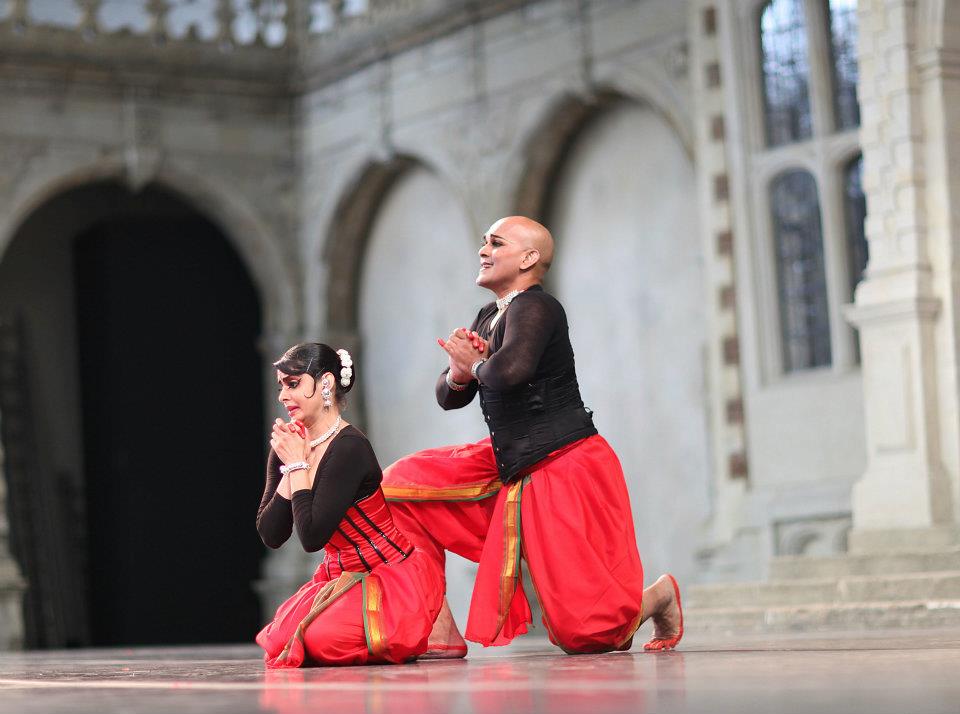
I had never thought of crossing classical Indian dance with Fiordiligi’s aria, Per Pieta, from Mozart’s Cosi fan tutte, but Katie Ryan’s This Wicked Desire, a playful duet between Kali Chandrasegaram and Khavita Kaur, brought out the delicious spirit of the music as if they belonged together. The two dancers are a study in complementary opposites that is clear as soon as they make their entrance through the Holland House doorway, the voluptuous Kaur leading the way in her black-bodiced, high-waisted costume and the imposing Chandrasegaram a step behind in lyrical support. The program notes say the dance is a playful struggle between the opposing forces of desire and virtue, but it is difficult to know if Kaur is overflowing with desire or virtue, and Chandrasegaram, a dancer of strength and delicacy in equal measure, has a mischievous joy in all he does that is as irresistible as the music. Their duet is thus rightly ambiguous: desire and virtue are not such opposing forces after all. What Ryan does so well, and the two dancers embody, is to show the constant interplay between the two in a way that Mozart clearly understood.
Naomi Deira’s Buoso is inspired by the story of Buoso Donati, the patriarch whose will is the contested event around which Puccini’s one-act opera Gianni Schicchi revolves. Deira’s cast is two women (Nicole Geertruida and Heli Latola) and two men (Eric Lamba and Kiraly Saint Claire), though any direct link between Puccini’s characters and Deira’s cast seems tenuous. Death and its effects, however, are central to the work. Deira makes this clear by beginning Buoso with music by Armand Amar from a film score to Hors La Loi, a pounding, haunting, percussive score that expresses the 1945 massacre of Algerians in Sétif. It is the way Saint Clair sneaks on to the stage, his lithe movement, arched back and disdainful manner that suggest a force of evil. The charismatic Lamba’s powerful physique, especially when he gets going, suggests a lion to Saint Claire’s cobra, both images of force and rivalry that are far removed from Schicchi’s cunning but kindly trickery. When we hear Puccini’s pleading aria O mio babbino caro, however, the healing begins. Lamba and Latola are like the young lovers in Puccini’s opera, while Geertruida and Saint Claire are Buoso’s quarreling relatives. At the end, Geertruda bends towards us from Saint Claire’s back as he mounts the steps, leaving the lovers in peace. Now that’s a happy ending.
A change in the order of the program means that Lucia is next, choreographed by Anne-Marie Smalldon, artistic director of Combination Dance Company. It is inspired by Donizetti’s Lucia di Lammermoor, a tragic tale of love between Lucia and Edgardo, of Lucia’s betrayal by her family and her ultimate madness. Smalldon approaches the opera’s story in a straightforward manner, choosing three scenes, but sharing the role of Lucia between her three women: Briar Adams, Julie Ann Minnai and Toni-Michelle Dent. Before the work begins, heaps of rose petals – a symbol of love as well as loss – are strewn on the steps and on the front of the stage. Lucia in white descends the steps, kneels in front of petals and bathes in their fragrance. Edgardo in kilt and pale lemon shirt joins her and tries to distract her, kneeling beside her, lying and rolling with her. They create beautiful lines between them in their steps and lifts. A second couple joins like a second musical theme, until the first couple reappears to form a quartet on the theme of love. The two Lucias dance briefly together before one leaves and Julie Ann Minnai is left alone with the two men (Thomas McCann and Travis Clausen-Knight), who are no longer the lovers but have morphed into rather manipulative members of her own family. The men manhandle Lucia, throwing her between them and sharing her in a decidedly unpleasant way. The program notes tell us that Lucia is forced to submit to a marriage against her will, though there is no way of knowing that from watching the dance. In the final scene, Lucia plays with the flowers and rose petals, watched by the other four characters. Her descent into madness is marked by a lovely arabesque line that Smalldon uses to emotional effect in an otherwise contemporary language of distress. Lucia runs from one figure to the next as they close in on her, throwing petals over her head. For a moment she remains still, grasping her flowers to her as they dance around her but she soon throws down her flowers and breaks away. The four characters follow her movements and close in for the last time, their hands all over her, covering her in petals before they retreat. The child sitting next to me understands everything and says ‘bye-bye’.
After the rose petals have been swept up, there’s more red in the form of a powder poured in a semi-circle around the front half of the stage, a bloody arena in which the two men, Richard Bermange and Daniel Hay-Gordon, enact a concentrated version of the doomed friendship between Lenski and Onegin from Tchaikovsky’s opera. ContraVersus, choreographed by English National Ballet’s James Streeter, is an intense miniature in which each movement is concise, reduced to its emotional essentials in the manner of a Schiele drawing. The figures are bare-chested and in black tights, at once masculine and vulnerable; the closeness of their friendship is expressed in an almost contorted vocabulary and Streeter keeps the steps to initial themes that repeat or change direction within the proscribed red circle, setting up a sense of foreboding. Lenski repeats Onegin’s opening steps, as one instrument might pick up a tune from another, and later they dance the same steps but in different directions. Both men look the part, drawn towards each other naturally as equals but tragically linked by an inability to compromise. After the duel, Onegin supports the dying Lenski to the floor and then repeats his opening steps as if nothing has changed. If Streeter’s choreography is impressive, the score by Janine Forrester – Onegin: the duel and death of Lenski – is equally so. A gem on both counts.
Posted: August 10th, 2012 | Author: Nicholas Minns | Filed under: Performance | Tags: Jonathan Ollivier, Joseph Losey, Lez Brotherston, Matthew Bourne, Paule Constable, Play Without Words, Terry Davies, The Servant | Comments Off on Matthew Bourne: Play Without Words
Matthew Bourne’s Play Without Words, Sadler’s Wells July 31

Anabel Kutay and Richard Winsor in Play Without Words (photo: Alastair Muir)
Being an avid film buff, Bourne took his inspiration for Play Without Words from a 1963 Joseph Losey film, The Servant (based on Robin Maugham’s novel of the same name), starring Dirk Bogarde as the manservant, Barrett; a young James Fox as the wealthy Peter; Wendy Craig as his fiancée, Susan; and Sarah Miles as the maid, Vera. It is a tightly structured drama with a screenplay by Harold Pinter that takes place almost entirely within Peter’s Chelsea house that is transformed in the course of the action from a damp shell into a comfortable home as Peter is transformed from its comfortable master into a decadent shell. It is a study of class barriers raped, values turned upside down and trust betrayed.
Bourne enters this territory like Barrett in the film: he knows what he wants, slowly assimilates the material and moulds it in his own image. For a start he changes the names: Barrett becomes Prentice, Peter becomes Anthony, Susan becomes Glenda and Vera becomes Sheila, but since this is a play without words, the names are not as important as the costumes (by Lez Brotherston) for identification purposes. There is however one interesting addition to the cast, the man called Speight (Jonathan Ollivier). He is listed in the program as ‘an old friend’, though whose friend is not clear. He doesn’t have a corresponding role in the film, but his function in Play Without Words appears to provide the emotional ballast (strong and assured, controlling, self-confident and charismatic) that Bourne does not invest in either Anthony or Prentice. As such Speight appears to be the one fleshed-out — if amoral — character in the play.
Bourne’s characters tend to be rather one-dimensional, bordering on caricature. That is part of his style. Losey’s Peter is a well-to-do, emotionally insecure apprentice of the old-boy network. Bourne’s Anthony by comparison is an emasculated character in nerdy glasses for whom we have no sense of past or present. The other characters, apart from Speight, are similarly insubstantial. Thus Bourne’s device of creating the four principal characters in triplicate multiplies but does not necessarily clarify or deepen them. Bourne had already tried this idea effectively with two groups of characters in the Brief Encounter section of Town & Country, where the only variation was in the conclusion, but with four characters multiplied by three facets, in constant but irregular orbit like thought bubbles in a comic strip, the problem is not only clarity but where to look. Nevertheless, it makes Play Without Words, choreographically, the most interesting work of Bourne’s I have seen. The first act, especially, has an integrity of its own. With the second act the thread begins to unravel and move off in other directions before it arrives at its conclusion.
Brotherston’s set looks like an illustrated London pop-up book that has not quite unfolded: squinty street perspectives with sixties’ iconic landmarks, including the Post-Office Tower and Centrepoint (plus Big Ben for good measure) rising above the horizon, three telephone boxes standing at rakish angles, a bus coming up the hill towards us, and two billboards, one for beer, the other for cigarettes. The landscape is more North London than Chelsea, but a street sign in the foreground reads Beaufort Street: at the heart of London’s swinging sixties. There are several stage levels accessed by curving staircases linked to Brotherston’s centerpiece, a revolving, see-through entrance unit that serves, among other things, as the front door to Anthony’s newly-acquired home. In front of this entrance, on the inside of the house, is a leather armchair partially covered in a white dust sheet. To the side of the stage, outside the house, is a café with more chairs and tables under covers. This functional setting, admirably lit by Paule Constable, thus seamlessly links inside, outside, upstairs, downstairs, down the road, and in the pub, keeping the various locations effectively in one place, as if we are watching a film being made on a Shepperton studio set. In terms of the play, the set effectively removes Pinter’s claustrophobic sense of space and allows Bourne to develop his own, lighter treatment of the story. The music is a jazz score by Terry Davies played with smoky intensity by Michael Haslam, Sarah Homer, Mark White, Steve Rossell and Justin Woodward.
In the dark as the show begins, we hear sounds of city life, street activity, and a lone trumpeter poses against the top railing of the staircase playing to the night sky, waking up the neighbourhood (it’s really Mark White in the orchestra pit). Downstairs a man lies across the arms of his armchair and two other men snap their fingers to the jazz. There are others too, though nobody is as yet defined. Someone arrives at the door; if you know the story, you might think it’s the new manservant, but it’s only the estate agent handing over the keys to Anthony who has by now identified himself as the new homeowner (Adam Maskell, Christopher Trenfield or Richard Winsor). There is activity, too, across the road at the café: the patterns of two men flirting with two girls at the tables.
A second Anthony has just had a shower and rushes into the living room girded in his towel. Glenda, his fiancée, arrives in tripartite glamour (Madaleine Brennan, Saranna Curtin and Anjali Mehra). The telephone rings. One Glenda plays with Anthony as he answers. What the other two were doing I didn’t notice. A third Anthony materializes, and all three Anthonys and their respective Glendas leave by the stairs and descend seamlessly into a sixties’ happening just around the corner. Speight, whom we recognize as the trumpet player, mocks and humiliates Anthony on the dance floor in front of his fiancée(s). Anthony is browned off but is incapable of responding. In rare unity of spirit, all three Anthonys put the coats on all three Glendas and return home to light each other’s cigarettes and dance three duets in which all Glendas are standing and two of the three Anthonys are engaged in floor play. After some elementary skirt groping and a goodnight kiss, the Glendas adjust their barely ruffled skirts, put on their shoes and earrings, and leave.
Anthony snoozes on the armchair and is woken by three men looking distinctly shady. It is the new manservant, Prentice, divided into three (Daniel Collins, Alastair Postlethwaite and Neil Westmoreland). Bourne makes fun of his own convention by making Anthony think he is hallucinating. Anthony is joined by his two alter egos and the three masters show the three prospective menservants around the house. To the striking of cymbals and a handshake, Prentice is hired.
Bourne now adds to the already complex patterns by introducing the new maid, Sheila (played in duplicate by Anabel Kutay and Hannah Vassallo), who is actually the sidekick and lover of Prentice. The music picks up a few beats with her arrival, as she is a live wire. Speight seems to pick up too and assaults the stairs with the agility of an acrobat attacking an obstacle course, slides down the bannister, grabs his trumpet and kicks the furniture on his way out.
Anthony enters in his underwear to a Davies/Bach air. The juxtaposition makes it sound and look like an advertisement (Y-fronts and classical music were a seminal combination in Bourne’s early Spitfire). Bourne makes a symmetrical vignette of two tailors dressing two of the Anthonys in bespoke suits, one being dressed on the same musical rhythm as the other is being undressed. This is what Bourne does so well: abstracting action into its component parts and putting them back together in comic combination. A similar vignette in which Prentice hands the newspaper to Anthony in his armchair and puts on his slippers becomes a slick acrobatic routine, impeccably carried out.
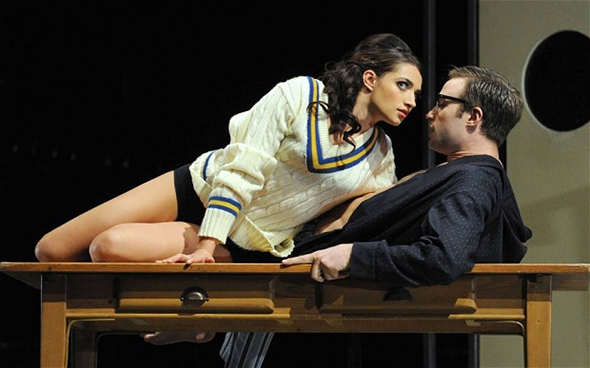
Meanwhile, the third Anthony is having a shower and arrives in his towel as Sheila makes an entrance. In the Losey film, there is sexual tension in the scene where Sarah Miles brings the bare-chested James Fox his breakfast in bed. Bourne defuses the sexual tension by having Anthony cover his nipples. Everyone laughs. This is also trademark Bourne: the urge to giggle when the sexual temperature rises, as if the spirit of Kenneth Williams is on hand to send up the moment. We see it again in the second act seduction of Anthony by Sheila on the dining-room table. In Losey’s film it is an erotically charged moment; in Bourne’s version, Sheila’s foot inches along the table toward Anthony’s hand like a famished caterpillar.
One of the maids sits on the trolley and is wheeled off; another is sorting the washing as Glenda marches in imperiously. She is refurbishing the new home but her haughty manner has evidently raised the hackles of both manservant and maid. Whatever Glenda brings into the house, Prentice or Sheila moves or removes behind her back. Sheila puts on a record: ironically, the theme music to Housewives’ Choice by Eric Coates. Prentice sets about cleaning the house as Sheila wraps streamers around the bannisters in preparation for the forthcoming house-warming party. Prentice dances a Hollywood number over the furniture until Glenda reappears and abruptly changes the music. She is in a foul, condescending mood. She drops her coat impetuously on the floor, pointedly places a vase of fresh flowers on a table and complains about the dust. Anthony appears in his new suit, and tries to calm Glenda’s nerves. The guests arrive, with drinks served all round. Anthony reappears in a dinner jacket, out of place amongst the ultra-trendy guests; everyone ignores him. Speight arrives and slaps everyone heartily on the back and starts dancing with the girls. Anthony is about to make a speech but nobody wants to hear him. He has a funny dance with a woman who seems to have a fixation on him, and then makes a fool of himself by launching into a seriously uninhibited sixties’ number. Someone organizes a game of charades and then blind man’s buff in which Anthony, of course, is blindfolded. It is the one poignant moment of the evening as he follows the rules of the game that his guests play at his expense. While Anthony feels his way around the room all the guests leave quietly by the stairs, Speight seduces Glenda, and only Sheila is left on duty, whom Anthony finally finds and gropes. Glenda is outraged and leaves the house to the sound of a cat’s hiss and followed by the trajectory of her vase of flowers. The audience shuffles out for a drink.
On our return, the television is on. It is an episode of the Avengers. There have been eleven murders in six months…Prentice descends the stairs with a drink in his hand, smoking, looking at photos with the relaxed air of the new master of the house. He switches the channel to the horse racing. Glenda rings the doorbell, but Prentice doesn’t move. She rings again and he goes angrily to the door and sends Glenda packing. The location changes to a bar in The Salisbury. Bourne creates a digression here, using Losey’s scene in which Peter considers picking up a pretty girl in a pub as an opportunity to comment on the sixties’ gay scene, with reference to Basil Dearden’s 1961 film, Victim, in which Bogarde also stars.
Back at home, Sheila in an oversized tennis sweater and Anthony in pajamas are eyeing each other around the dining room table. We see Glenda call from the phone box outside, but Anthony doesn’t pick up. A thunderstorm breaks as Glenda leaves the phone box and bumps into Speight. Three Speights seduce three Glendas while the two Sheilas – one now lying on the dining room table and the other on the stairs – prepare to seduce Anthony, who pours a glass of water and leaves the tap dripping (as in the film). The drip becomes a musical motif accompanying the smooth saxophone line throughout the seduction. Anthony is clearly in two minds, but Sheila is not. This is the moment her foot reaches out to his hand on the table, which makes everyone laugh. He places his hand on her leg; her arm is like a serpent reaching for his face. Anthony submits, while the other Sheila descends the stairs and another Anthony appears. As the first couple reach climax, the second couple starts their lovemaking, watched by the first Anthony. The second Anthony throws his glasses away but then can’t see his Sheila very well and breaks off to search for them on the floor (laughter). At the moment of climax the first Sheila returns.
It all gets a little confusing here. Everyone is making love in a raucous, rhythmic turmoil punctuated by climactic trumpet blasts, and then silence. A trumpet solo, like a reveille, follows the silence and Speight is the first to wake up; he has been sleeping with Glenda on a mattress on the floor. He gets up, gets dressed and leaves. Glenda wakes up. Two Anthonys run in chasing after the two Sheilas. Prentice appears and sees with some satisfaction what he has unleashed. Anthony, in shock, thinks he is still in control and orders Prentice to do something, but the latter doesn’t react. Instead he lies down on the recently vacated mattress and reads. Anthony is incensed but ill equipped to reestablish his authority. Class revolution breaks out on the stairs to an appropriately swashbuckling music. Bourne turns this into a comic rout until a truce is declared. The three Prentices are now in control above stairs and, as the entrance/stair unit revolves, we see the three Anthonys cringing below. The doorbell rings. It is Glenda. She puts her arm round Anthony but he breaks away when he sees Prentice together with Sheila and then sees Speight (where did he come from?) kissing Glenda. Prentice is now sitting in the master’s seat. The Sheilas arrive with bags. Everyone is running, but are they coming or going? The trumpeter returns to his initial spot and blasts a tune to the sky while Anthony remains inert on the soiled mattress.
By Bourne’s own admission, Play Without Words is one of his ‘most unique and unusual pieces’. It is also unusual in that it was commissioned by Trevor Nunn at the National Theatre for a season that encouraged experiment: Bourne allowed himself to take risks, to try something new. ‘Unlike any other dance company in this country’, he states rather disingenuously in the program, ‘everything else I’ve done has had to make its money back.’ Is there perhaps a part of Bourne ‒ one of his tripartite souls ‒ that admires his accomplishment in Play Without Words and senses his commercial success might have moved him further away from what he had shown he was capable of doing? And what might that individuated soul be thinking on the opening night of Bourne’s new Sleeping Beauty?
Posted: August 5th, 2012 | Author: Nicholas Minns | Filed under: Performance | Tags: Anna Finkel, Ben Duke, Chris Evans, Holly Waddington, Home for Broken Turns, Ino Riga, It Needs Horses, Jackie Shemesh, James Keane, Laura Pena, Lise Manavit, Lost Dog, Raquel Meseguer, Sita Ostheimer, Solene Weinachter | Comments Off on Lost Dog: Circus diptych at the Almeida Festival
Lost Dog, It Needs Horses and Home for Broken Turns, Almeida Theatre July 28

Anna Finkel and Chris Evans in It Needs Horses (photo: Benedict Johnson)
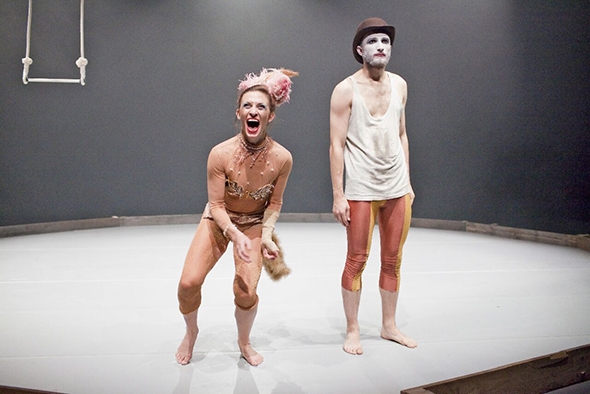
The Almeida Theatre has a stage like the apse of an old, disused church with stripped plaster walls that adapts perfectly to the circus ring of Lost Dog’s It Needs Horses with its wooden boarding in a semi-circle around the perimeter, beautifully lit by Jackie Shemesh. A rudimentary trapeze hangs to one side. Because of a last minute injury, Sita Ostheimer is replacing Anna Finkel. She has had only one day to learn it all, but at least she knows her partner, Chris Evans. Only weeks before they were performing as a couple in search of an idea in a lighthearted work, Accompany, for the Hofesh Schechter evening, In Good Company.
Drum roll. Cymbals. Lights up. Nothing. Ostheimer is standing on the trapeze as if she has been left there overnight, dressed in a rather seedy grey body suit with shiny, silver embroidered breastplates and crotch, a feather headdress and a rather mangy tail. Her face is painted white, her haunted eyes smudged black by tears, and her mouth enlarged by more than one application of lipstick. Evans, the ringmaster, in slightly better state, stands below her in the ring in yellow and red jester tights, white tee shirt and bowler hat (both costumes pulled lovingly out of an old circus bin by Holly Waddington) looking at his partner with a measure of contempt and futility, his shoulders bowed by impending defeat. His bearded, white face and expressive black eyes urge her to perform. Her eyes plead with the audience: she can’t get down. She whimpers a few notes of a song and Evans takes off his hat for contributions. Laughter, but no money from the crowd. He puts his bowler back on and helps Ostheimer slither down from her perch. The band starts up, and they begin a surprisingly energetic music hall routine as if on automatic, playing off each other’s rundown state until she falls. He continues dancing, trying to heave her back into action as part of the routine, kicks her to the music, pulls her, but she’s out for the count. Rushing to fill the ever-widening gap between expectation and fulfillment, the grim Evans tries juggling his pirate knives and apples, bungling both. He mimes in quick succession smoking a cigarette, fishing for the big one and steering a car, which he drives, and then reverses, over Ostheimer’s body, still to no effect. His last fragment is swimming, but the game is up. He offers his hat. Nothing.
Turning his attention back to Ostheimer, he runs his finger down her tail and miouws. He sits her up and feels her zipper. He unzips her enough to pull off one shoulder of her costume. As excited as he is inspired, he sits behind her and manipulates her hands like a puppet to caress her own breasts and thighs, then gets carried away by rubbing her crotch with animal passion. Aroused, she wakes up and hits him in the chest and then as they both get up, kicks him in the backside. All kinds of energy are beginning to flow. They struggle, the band strikes up again and they vaguely remember where they are. Continuing their routine to a crackly, slow foxtrot, she jumps in his arms but he tries to undress her more. She hits him again, knees him; he has his arms round her neck: a real catfight. She pulls his tee shirt off and thinking this might be the moment he pulls his tights down to his knees. His white Y-fronts look as if they have been washed rather too recently. Both parties catch their breath as they take stock of the situation. Whatever is going on has less and less to do with a desperately failing circus act and more to do with laying bare the emotions coursing behind the makeup and costumes: the frustration, the sexual energy, the passion, the madness, the fading dream.
Ostheimer takes the initiative, coyly slipping off her tail and launching into a sinuous display of unbridled libido as Evans remains rooted to the spot playing a muted mouth trumpet to her undulations. Her act really gets going, mouth wide open in animal abandon with associated guttural sounds, hands all over her body, her tongue on fire. She pulls Evans down on all fours and energetically humps him from behind with appropriate vocals. Ever the opportunist, Evans offers his hat for contributions. Nothing. He knocks her over, picks up one of his knives and puts it to her throat. He must regain control of his act, but she is all he has. To a simple musical theme that grows in emotional intensity and orchestration, he gets her running around the ring like a horse, to which he responds as ringmaster cracking his whip and whistling. He launches into a solo of excitement bordering on abandon, then joins Ostheimer jumping exuberantly around the ring though she is beginning to look and sound exhausted. She stops and won’t continue. He threatens her with the knife, but she is beyond being threatened. She walks off and he remains in the centre of the ring, letting the knife drop at the beginning of a final fitful dance of frustration leading inexorably to collapse.
It Needs Horses, conceived and directed by Ben Duke and Raquel Meseguer, won the 2011 Place Prize. It is performed here as part of the Almeida Festival with a second, consecutive work, Home for Broken Turns, which is conceived, directed and choreographed by Duke himself. It is, in Duke’s own words, a work in progress, though more advanced than the day before.
There is no program for the evening, so we are left to figure it out. First is the transition: a trio of girls (Lise Manavit, Ino Riga and Solène Weinachter) clean up the knives and apples and assorted clothes from the ring to an ethereal banjo score (by James Keane); they dismantle the perimeter boards, stacking them neatly at the back. On a bare stage a fourth girl (Laura Pena), dressed to look older in country clothes of a distinctly Latin American flavor, plants herself authoritatively centre stage, legs apart, cigar in mouth, calling incessantly and distraughtly for ‘Anna’. The other three girls, similarly dressed, unfold two sun chairs and seat a skeleton in one with a bottle of wine. They then unroll a black road with a white-painted centre line along the front of the stage. This is the link to the outside world. Ostheimer stumbles along this road like a ghost, still in her costume. Perhaps she was making her way here at the end of It Needs Horses, but she doesn’t seem to recognize the place and passes unnoticed: the three girls are too involved in their wild harvest dance to look up. She returns from the other direction, crosses the stage and is gone again. The sound of an approaching bus catches the girls’ attention, bringing them expectantly to the side of the road with a begging bowl, speaking French and Spanish. No luck. The girls berate their imaginary customers, asking one after the other for money, a bus ticket, or a pen, while the cigar-smoking, gap-toothed matriarch – we’ll call her Mama – at the back keeps a constant eye on the proceedings. A gentleman evidently asks one of the girls if Anna lives there. No, désolée. One girl expresses frustration bordering on madness, the second girl comforts her, and the third is just pulsing with pent-up emotion. After the bus has gone, Ostheimer walks by again. Is she Anna? It is not clear, but we will assume so. There is a cockerel on a tall pole in the yard to which Mama prays in forcefully pious Spanish. One girl plays distractedly at riding a horse, a second drives a car that crashes. Another bus stops, but nobody gets off. Mama says life is like a shit biscuit and each day we eat a little bit of it, then she collapses from lack of food and a loss of hope; two of her girls try to revive her, turning her upside down and throwing her to the third, but Mama slides down her body to the floor. Anna drifts back along the road like a vision, and this time the girls grab her and throw her in the direction of the matriarch, who has a catatonic fit in voluble Spanish and the vision is carried off just before another bus arrives – this is a busy thoroughfare. Mama says I’m sorry, Papito veni, but with a gesture of resignation, picks up a chair and the bottle of wine and settles at the back. One of the girls barks, which sets off the pack of girls barking at passers by (where did they all come from?), and when they aren’t barking they’re smiling and begging for coca-cola, a fag or bubble gum, raising their skirts, and offering their favours. Two of the girls dance a desperate duo while the third moves sensuously, practicing the tongue gymnastics we saw in the ring earlier. This is evidently where it is all learned, the school of desperate performance. The girls monitor each other’s progress and success, both of which seem limited. Mama is now drunk and breaks up the party. The girls pretend to ply the skeleton with drink and wrap its bony arms around Mama: a macabre variation on the dance of the dead to a ghostly piano variation on the Pink Panther theme. The skeleton’s arms smack her backside then grab her from behind, doggy position – another image we have seen earlier in the ring – until a roaring, throaty climax. One of the girls removes the skeleton and takes Mama back to her chair; a second rehearses another dance of seduction while a third, hands gripped and fingers tense, dances on one leg. Anna is back again, and this time the three girls follow her in a reverential line on their knees, hand to ankle, but they can’t keep up. On Anna’s return Mama finally greets her, kisses her, hugs her. “Anna?”, she asks. Anna kisses her and retreats. The girls look to where Anna left, then gather up Mama for a ritual peasant dance to an earthy drum rhythm.
Graduation time has arrived, and one of the girls is chosen to dress up. She puts on her headdress, and slips out of her jeans and top into a costume exactly like Anna’s. How do I look?, she seems to ask, proudly. She leaves along the fateful road, another graduate on her way into an uncertain world, and meets Anna coming in the other direction. They stare at each other. The desperate cycle is completed, and repeats.
After seeing It Needs Horses, there is a sense that Home for Broken Turns is related (if only because the Ostheimer character reappears in it) but the stylistic relation is more difficult to see. Going from one to the other is like going from the structural tautness and poetry of a Beckett play to a narrative in a nineteenth century novel, of which most is in a foreign language with a high level of emotional distortion. The first has coalesced as a form, has found its particular place and character, and is complete in itself, while the second is still searching for its identity, like the characters themselves. Home for Broken Turns is for now an emotional outpouring of an imaginary precedent for an uncertain future, a bringing together of past, present and future in an inflammable alliance of passion and despair: a vibrant, gutsy performance in search of its true form.
Posted: August 1st, 2012 | Author: Nicholas Minns | Filed under: Performance | Tags: Alasdair Middleton, Alastair Marriott, Chris Ofili, Christopher Wheeldon, Conrad Shawcross, Jonathan Dove, Jonathan Watkins, Kim Brandstrup, Liam Scarlett, Mark Wallinger, Mark-Anthony Turnage, Minna More Ede, Nico Muhly, Royal Ballet, Wayne McGregor, Will Tuckett | Comments Off on Royal Ballet: Metamorphosis: Titian 2012
Royal Ballet in Metamorphosis: Titian 2012, broadcast live in Trafalgar Square, July 16
Minna More Ede, curator of the Metamorphosis: Titian 2012 exhibition at the National Gallery, had a clear idea of what she wanted – if not what to expect – when she suggested a collaborative project with the Royal Ballet, but I am not sure the Royal Ballet did: there are three paintings, three artists, three composers, three dances and seven choreographers.
The idea for contemporary artists together with a group of choreographers and composers to collaborate on three dances in response to three paintings by Titian was, as the French say, géniale. The three paintings – on display for the first time since the 18th century – are Diana and Callisto, Diana and Actaeon, and the Death of Actaeon. The voluptuous, vengeful Diana, goddess of the hunt and of the moon, is common to all three.
The exhibition is a delight, full of colour, humour and poetry. Chris Ofili’s paintings on a theme of Ovid are stunning, and his stage setting for Diana and Actaeon is a forest of bright colour and luscious forms. Mark Wallinger’s voyeuristic meeting with the bathing Diana makes us all Actaeons peeking into forbidden territory, though this Diana cannot see us and is sufficiently constricted within her locked bathroom not to do us any harm; we survive the confrontation though not, perhaps, the stigma of peeping. Conrad Shawcross has refurbished an industrial robot once used in the manufacture of cars to be his Diana, with lightning rod eye carving out a pair of antlers. It takes a little adjustment to associate this with the Titian paintings, but that is the beauty of such an experiment: one never knows where it will lead. There is an excellent film of the dancers in rehearsal but apart from the piano excerpts in the film, we do not hear sufficiently from the composers – Nico Muhly, Mark-Anthony Turnage and Jonathan Dove (with librettist Alasdair Middleton) – to bring their contribution into equal focus.
So how does all this response to Titian, so enticingly displayed and suggested in the exhibition, translate into the choreographic works? Dance is an ephemeral medium, so the effect of choreography has to fuse all the elements together immediately. Whatever program notes there may be, or however volubly a choreographer may talk about his creative process, it is ultimately the completeness of what we see on stage that counts.
All three works focus on the story of Diana and Actaeon. Titian’s painting of the banishment by Diana of the pregnant Callisto was ignored, which has something to do, perhaps, with the all-male creative team. It’s a bit of a mystery how these fourteen artists were matched into three teams, and how they developed their collaborative ideas within those teams. The principal metamorphosis seems to have come from the visual artists, who ran with the idea and came up with four distinct ideas (Wallinger’s Diana locked in her bathroom was for the exhibition only). The composers provided a vital, expressive link between the artists and the choreographers, though it is not clear who was negotiating these interactions and at what point in the process they started. Since this is a choreographic project, however, it falls to the choreographers to bring together the various inputs and ideas in the final collaborative metamorphosis to be presented on the Royal Opera House stage. The seven choreographers are Will Tuckett, Jonathan Watkins, Liam Scarlett, Kim Brandstrup, Wayne McGregor, Alastair Marriott, and Christopher Wheeldon.
Only the Shawcross/Muhly/McGregor/Brandstrup collaboration on Machina offers a work that has a cohesion of elements from beginning to end. Muhly’s lovely score situates itself in Titian’s sixteenth century Venice, Shawcross’s robot is programmed to the movement of the dancers through data transmission – right up McGregor’s street – and in using Carlos Acosta, Leanne Benjamin, Edward Watson and Tamara Rojo, the two choreographers have an appropriately contrasting and expressive quartet of principals. Costa and Watson appear to represent two qualities of Actaeon, and Benjamin and Rojo two qualities of the goddess Diana. Costa’s opening duet with Benjamin is a sinuous and powerful coupling, with his bull-like body dominating her, his arms wrapping around her vulnerable form, sometimes gentle, sometimes forceful, but never forced. Their qualities contrast with the Shawcross Diana, though Rojo’s steely-black presence hints at that implacable, don’t-mess-with-me side. Watson’s Actaeon is more innocent that Costa’s, more inquisitive, and more likely to get into trouble. He wants to melt on Rojo’s Diana, but she won’t melt. Costa’s solo and his duet with Watson are other conspicuous moments, but there is a lot of movement from the ensemble that seems to escape both the music and the scope of the work.
Wallinger’s idea of surprising Diana in her bath was an idea worth pursuing, but for whatever reason, its challenge was not taken up. His analogy of the moon landing works well for the set, but the team of Wheeldon and Marriott don’t seem to have followed it through; they have rather superimposed their own interpretation of Titian’s paintings on the moon landing idea, as if trying to pull Wallinger into their own orbit. Trespass is thus a muddle of ideas and inputs with an interesting mirrored set, a jazzy score by Mark-Anthony Turnage and an all-too familiar vocabulary of contemporary classical ballet in body tights, pointe shoes and swept back hair. Nehemiah Kish and Stephen McRae are the two Actaeons, though they could be two squeaky-clean brothers, and the two Dianas – Sarah Lamb and Melissa Hamilton – look like twins. This narrowing of the dramatic possibilities inherent in Titian’s light and shade, his nuanced poses, the passion of the flesh and the destructive force of Diana’s fury are rather lost in this etiolated space drama.
The Ofili/Scarlett/Tuckett/Watkins/Dove/Middleton team’s Diana and Actaeon presents Marianella Nuñez as Diana and Federico Bonelli as Actaeon, though the mythological story of Titian’s couple has been reinterpreted here as an on-again-off-again love duet with a mordant ending. The Chris Ofili backdrop is beautiful, sensual and colourful: not a world of arabesques, extensions and classical mime – a point lost on the choreographers and, needless to say, an opportunity missed. As the curtain rises, Nuñez stands with her back to us in a long robe and red bonnet, almost unidentifiable, a cross between Carabosse and the Firebird. One painted root rises, Nuñez leaves, and Bonelli walks out in purple with a quintet of dancers as his pack of hounds, their puppet heads a little too small to be effective (but wonderful in filmed close-up). He commands them like servants, in classical mime: Go! And there in the giant, Freudian-symboled forest he performs a solo straight out of Royal Ballet’s book of princes. Where is the princess? Nuñez is in red, so we can see her in discreet abandon, bathing in blue light. Four lines of nymphs protect her (no such lines in Titian). Bonelli arrives, and Nuñez is not happy: she screams, then jumps into Bonelli’s arms. Titian is scratching his head. A pas de deux follows with a square of nymphs close by. Nuñez puts her hand to Bonelli’s eyes, then pushes him away and mimes No, then ends up in his arms being lifted: more partnering, a love duet. She bourrés, he runs off like a distraught prince. Nuñez has a brief respite with her nymphs, cogitating in the undergrowth with wrapped arms, looking sexy and disdainful. Arguably she is aroused by Actaeon’s uninvited gaze, but has to balance that with her role as keeper of the virgin nymphs. No double standards here, but inner confusion nevertheless. Her water nymphs are rippling in her defence. Bonelli returns. Who knows what he’s been doing amongst the steamy plants. Move aside, I see her, he commands. He lifts her on his shoulders, puts her down, slides her. No no, she says (lift). They are reaching their climax and embrace. Exit Bonelli, while Nunez walks around again with her nymphs, deliberating, arms crossed, hands either side of head, feet expressing a no no no bourrée (but so beautifully). No wonder Bonelli keeps coming back – as he does now – but that’s the danger. She backs up; she’s made up her mind: no no (hold me). More lifts; she is sitting on his shoulder. She is mad, there is one more lift and then she throws water in his eyes. The nymphs run in diagonals then a circle; he lifts her again, and pirouettes to the floor. His dogs come in. Bonelli looks worried. His dogs mistake him for a stag (though they have to have imagination because he has no antlers) and are at him. The pack jumps, kicks, swings. Bonelli jumps with them; part of his costume comes undone (flesh ripped and hanging off) and he falls. He gets up: arabesque! Turning his back, crumpling to the floor, he dies a dramatic death. Nuñez is triumphant, gesticulating and undulating over him, which momentarily wakes him up before he slumps to the ground for good. She turns in a perfect arabesque, and walks forward as in a funeral march, asking in a final gesture, what have I done?
It is a question the choreographers of the last two works should ask of themselves, for whatever metamorphosis had previously taken place has in their hands metamorphosed back into standard ballet vocabulary and gestures taken from the Giselles, Swan Lakes, Sleeping Beauties, Balanchines, from the princes and princesses, from the court and its attendants. It is as if the Royal Ballet has drawn Titian into their mould and squeezed him dry.
I saw the performance not at the Opera House but at the live broadcast in Trafalgar Square. The camera can get close up to the dancers, which is like having the best (if not the most comfortable) seat in the house, but you are subject to the eye of the cameraman, and if he wants to follow the women, then the men simply vanish from the stage. The broadcast is also susceptible to technological hiccups, of which there were one or two, but otherwise the performance transmitted really well.
At the end of the screening, the girl sitting next to me on a BP poncho offered me a glass of red wine (thank you), something that could never have happened in the Opera House. Cheers.
Posted: July 26th, 2012 | Author: Nicholas Minns | Filed under: Performance | Tags: A Month in the Country, Birthday Offering, Bronislava Nijinska, Emma Maguire, Les Noces, Royal Ballet, Sir Frederick Ashton, Zenaida Yanowski | Comments Off on Royal Ballet’s Birthday Offering, minus the occasion
Royal Ballet: Birthday Offering, A Month in the Country and Les Noces, Royal Opera House, July 4.
Sitting in the stalls is a completely different experience from being on my usual perch in the top of the upper circle. The orchestra sound is emphatically full, and there is enough light from the stage to see the notes I am scribbling without overwriting them. When the curtain opens on Sir Frederick Ashton’s Birthday Offering, I feel I am on the stage; seven couples enter the ballroom to a Glazunov waltz in a grand elliptical curve. From here they are fourteen people dancing rather than the fourteen figures dancing one sees from the upper circle. The facial expressions are clear, too, and there is one face that is not smiling during this grand opening, standing out like the proverbial sore thumb. The ellipse becomes two lines, the men behind and the women in front – the cream of the Royal Ballet’s ballerinas, please note. At least, that was the idea behind Ashton’s ballet: a party piece for the leading ballerinas to celebrate the 25th anniversary of the company, and there were seven in the original cast: Elaine Fifield, Rowena Jackson, Svetlana Beriosova, Nadia Nerina, Violetta Elvin, Beryl Grey and Margot Fonteyn. The Royal Ballet as of this evening has ten principal women, with one on maternity leave. Nine into seven doesn’t go, and Zenaida Yanowsky is dancing the lead role of the next ballet, but there are four principals missing from the present lineup (Marianella Nuñez, Alina Cojocaru, Leanne Benjamin, and Lauren Cuthbertson), three of whom one might have expected to see in this particularly show-off work. Their places are taken by three first soloists, so the whole nature of the work has shifted: the proud party piece becomes a challenging exercise without a celebratory occasion.
The challenge for the dancers is not only in the steps. In creating Birthday Offering, Ashton worked closely with each of his ballerinas, moulding steps to their respective technical abilities and responding to their individual characteristics in order to show them off in their best light. It is effectively an intimate portrait of the seven ballerinas with whom Ashton worked in 1956; it is not a portrait of the seven ballerinas on stage this evening, who are dancing the portraits of the seven original ballerinas. So however well they dance the steps, they do not have the confidence that the variations are tailored for them; they can shine, but they cannot show off.
After the seven couples repeat the opening mazurka, the women leave and the men walk elegantly to the back of the stage to watch the variations, the very core of this work.
Yuhei Choe dances the first variation, originally created on Elaine Fifield. Choe has above all a refined, delicate quality, and an ability to turn, notably in a sequence of a quick turn to the left, then a turn to the right followed by a double. Laura Morera enters backwards on pointe to begin the second variation, created for Rowena Jackson, a vivacious and smiling performance, bright and fast. Sarah Lamb assimilates the qualities of Svetlana Beriosova in a generous offering of beats, balance and renversé turns ending with the lovely, expansive gesture of offering to the audience. Roberta Marquez, who stood out in the opening for her dynamic épaulement, is full of exuberance, shining in the spirit of Nadia Nerina’s fourth variation with ease and warmth. She finishes the variation calmly in arabesque. Hikaru Kobayashi has control over some difficult adage steps in Violetta Elvin’s tricky fifth variation, but lacks sufficient juice this evening to mould them together seamlessly. I sense Helen Crawford has an affinity with the spirit of Beryl Grey’s pizzicato variation: she has a strong, dramatic quality, a quiet jump, and executes the piqués and difficult beating steps brilliantly.
The men now disappear, signaling the arrival of the ballerina of the ballerinas, Tamara Rojo, who bourrées in like a doll – a teasing reference by Ashton, according to Zoe Anderson’s program notes, to Margot Fonteyn’s weak feet. Rojo has the assurance of the prima ballerina, but is quite business-like, generous but constantly monitoring her own performance. We know if she is doing well, and we also know if she knows she is doing well. She takes an expansive bow and looks back at the audience as she walks off, her last classical variation for the Royal Ballet.
The men reemerge in a mazurka, with Federico Bonelli taking the lead once danced by Michael Soames. He is barely stretched by the series of double tours, pirouettes and beats.
In the grand pas de deux – a presentation within a presentation – Bonelli and Rojo begin with a shaky, almost nervous grip. The violin must have caught the same chill for one brief moment. Bonelli partners Rojo in barely supported bourrées on a diagonal. She has a perfect poise and balance, but looks this evening as if she is working at it, so the overall impression is not as open as one would like.
To the final music, the ballerinas arrive with their respective partners, first Choe and Morera, then Kobayashi and Marquez, Lamb and Crawford. Rojo enters on her own path from the back, like an entrance from one of the classic ballets, and joins Bonelli and the other six couples for a grand, smiling finale.
When the curtain opens on Ashton’s adaptation of Ivan Turgenev’s play, A Month in the Country, Julia Trevelyan Oman’s wonderfully detailed period design, lit beautifully by William Bundy, sweeps us instantly, actively into the Yslaev home; the choreography has started before anyone has made a move (the effect is the same with Oman’s design for Enigma Variations). A footman (Sander Blommaert) serves drinks. On stage right, Natalia Petrovna’s husband, Yslaev (Christopher Saunders), is sitting in a chair reading a newspaper, and their son, Kolya (Ludovic Ondiviela), is sitting writing at a desk behind his father. On stage left, Petrovna’s admirer, Rakitin (Gary Avis), is lounging on a divan at her feet engaging her in idle conversation, and the Yslaev ward, Vera (Emma Maguire), is at the piano in an alcove. The music is by Chopin, admirably played throughout by Kate Shipway in the orchestra pit. As we look at the stage, the active protagonists of the story are on the right, and the passive victims on the left. All the introductions are made in those first moments and the scene is set: provincial life at the country house, languid, slightly bored. The maid (Sian Murphy) enters, and curtsies. She invites Yslaev out into the garden. He crosses the room to give his wife a kiss on the forehead and leaves by the patio doors at the back of the room. Petrovna (Zenaida Yanowsky) gets up from her divan impatiently, unable to contain her emotions, launching into a spirited, lyrical dance that is both flirtatious and sensual. Rakitin, unsettled and unsure of the source of her unfamiliar emotion, tries to forestall it by taking her hand and kissing it, bringing the dance to its conclusion. It is now Vera’s turn to dance her own emotions on the same musical variation, a young girl with huge spirits, on the verge of womanhood, with dreams of love. Maguire, who looks the part, and for whom the role seems tailored, expresses it all with natural grace and joie de vivre. Kolya watches her until she finishes sitting in Yslaev’s empty chair, dreaming, perhaps, of being mistress of her own house one day. Yslaev returns, fussing over having lost something. Everyone starts looking for whatever it is, roused by the physical contact, bumping into each other, stepping over Kolya who is on all fours, lifting each other out of the way. It is like a delightful game to relieve the building tensions. Only Petrovna and Rakitin seem uninterested but they soon join in and it is Petrovna who locates the keys and Yslaev leaves once again.
Kolya lets off steam, his boyish sense of fun expressed in a playful dance, juggling and bouncing a ball. The lace curtains flutter in the breeze as a premonition of the storm about to burst on the family: the entrance of the new tutor. Beliaev (Rupert Pennefather) appears at the open door with a kite he has built for Kolya. He is tall and elegant, with blonde hair and a moustache, but looks as if he has been over-exerting himself with the kite, as there is a weariness in his face and in his demeanour. He salutes Petrovna, Vera blushes, and Rakitin, who is still trying to piece together the puzzle of Petrovna’s recent capricious humours, eyes him with disdain. Petrovna engages Beliaev in conversation and the latter responds with dance language that has all the suppleness and romance that Rakitin lacks. The arabesque is used to beautiful effect, a purity of line emerging from the surrounding turmoil. Petrovna does not watch but notices every nuance. Rakitin leaves abruptly on some pretext, leaving Petrovna and Beliaev to dance together to a polonaise, evidently cherishing the moment. Vera comes in and immediately joins in the dance with Beliaev, while Petrovna disengages, collects herself and observes Vera’s innocent love bubbling over. Kolya joins in, making everyone laugh, and all four dance together, searching for the relationship each craves. Beliaev shows off in the heat of embarrassment and attention, while Petrovna is carried away by her feelings. All but Petrovna leave, and the applause is well deserved not only for the performance of the four characters, but for the clarity and emotional power of the choreography.
Rakitin returns, sees Petrovna alone in a flush of emotion and checks to see if the tutor is anywhere nearby. He takes her shoulders from behind, a gesture Petrovna misinterprets as that of the returning Beliaev. Her reaction encourages Rakitin to continue his amorous pursuit and to share in her aroused state, but once she realizes her mistake, she will have none of it. She goes through the movements, but without a trace of passion. She breaks off. Rakitin stubbornly or perhaps desperately redoubles his efforts, frustrating Petrovna more. On hearing the footsteps of Yslaev they break apart, but entering the room, Yslaev sees his wife out of sorts and wonders what is wrong. Rakitin reassures him it is nothing and escorts Yslaev into the garden. Petrovna leaves and Kolya, the one who is innocently unaware of the storm descending, runs in from the garden and rushes around the room with his kite and out again into the air, a beautifully eloquent choreographic moment. Vera arrives, evidently in love, and Beliaev, noticing Vera, quickly checks to see if Petrovna is around. Vera offers herself to him for a kiss. Dancing together, Beliaev tries to keep her occupied and happy, going through the actions as Petrovna had just done with Rakitin, but Vera sees his involvement as acquiescence to her wish. As the duet becomes more entwined, we know Petrovna is going to arrive at any minute. Vera gives Beliaev a hug, and he puts his arms tentatively around her.
Petrovna sees this as she enters in a serious, overwrought, dramatic state. She lectures Vera, but Vera is naive, and head over heels in love. She admits to Petrovna her love for Beliaev, kneeling in front of her and crying on her lap. Maguire’s emotional power here is utterly convincing, bringing tears to my eyes. Petrovna, however, is moved differently; she is aghast, and slaps Vera’s face. Vera runs out into Rakitin, who is clearly reeling from the events that have overtaken his tranquil, if slightly unusual way of life. Have some tea dear, no come for a walk, he seems to say to Petrovna: anything to get her out of the house. They step together – the Fred step – out into the garden. Beliaev appears, clearly exhausted. He sees Rakitin and Petrovna walking arm in arm in the garden, and sits in Yslaev’s seat, musing on his fate. Another complication is about to arrive in the form of the maid, Katia, with a basket of raspberries. We see her outside the window with the footman, who thinks he is on to a good thing, but once she sees Beliaev, the maid pushes the footman away and rushes to flirt with the tutor, feeding him raspberries one by one. They dance together, in more peasant mode, to a polonaise. Sian Murphy is ecstatic and shows it. Without any unwelcome interruptions, the dance finishes; she picks up her basket of raspberries and runs off, leaving a pensive tutor to dance his heartache, beautifully expressed in his body and arm movements. Petrovna arrives, unseen. She approaches Beliaev and pins a rose to his tunic, then backs away as if to leave. Now it is Beliaev who takes her hand to stop her. This is the beginning of their duet to the Andante spiniato, all emotion and interlocking arms, hands searching each other’s bodies, lifts with opening legs and skirt flying, elongated lines and willing submission. She melts in his embrace. She pulls away; she goes to kiss him, then changes her mind again and runs to the garden door. He stops her, gently bringing her back into the room in a series of gliding bourrées on shallow diagonals down stage. She responds and they embrace, his head resting lovingly on her chest when Vera rushes in and the dénouement begins, to Chopin’s Grande Polonaise.
She separates the couple, and calls everyone in, openly accusing Petrovna of leading on ‘her’ lover, Beliaev. Petrovna denies it: Vera must be crazy. Vera accuses her of lying, but Petrovna shrugs it off as fanciful, dancing distractedly between her husband and her admirer. Unable to contain her deception and anger, Vera rushes from the room, followed by everyone but Rakitin and Beliaev. Rakitin points to the flower in Beliaev’s lapel, at which Beliaev has nothing to say, and Rakitin understands what he has to do. It is the one moment in the ballet where Ashton resorts to conversational mime. They leave the room together and Petrovna returns alone, aware of the speed at which her life is unraveling. Yslaev comes in and tries to console his wife, partnering her briefly in her fraught steps until she faints in his arms. Rakitin and Beliaev return dressed in overcoats and with packed bags and say goodbye to a non-plussed Yslaev; Kolya is bewildered and angry at the imminent loss of his tutor. Beliaev looks back for Petrovna but she enters too late to see him go; she dances a final, anguished solo, powerful in its simple choreographic structure, but it proves the one weakness in Yanowsky’s performance: adept at masking her emotions in the presence of others, she is unable in this most private moment to let them go. As she cries on the back of the chair, Beliaev returns, unseen, takes her trailing dress ribbon and kisses it. She doesn’t notice. He wants to say something but can’t. He takes the flower from his tunic and casts it on to the floor beside her and rushes out. She sees the flower and picks it up, runs to the door, but too late. She lets drop the flower that once symbolized Rakitin’s love for her, then her love for Beliaev, as she walks forward lost in her own loss. “Surely it is possible to love two people at once?” she asks in the play. “… I don’t know, though . . . perhaps it only shows one doesn’t love either.”
Ashton’s choreographic action follows the structural pattern of the play: short lines of dialogue, full of detail. The only long passages are Beliaev’s four pas de deux with Petrovna, Vera and Katia. Ashton has cut from the play any characters and situations that are not essential for the telling of the story, and that cannot be translated clearly into choreographic language. Oman’s design and the music of Chopin complete this unity to perfection.
Bronislava Nijinska’s choreographic setting of Stravinsky’s Les Noces closes the program. Created in 1923 for Diaghilev’s company, the abstract, ritual wedding festivities make for a stark and rather incongruous contrast to A Month in the Country, but Les Noces is, in its own right, a powerful work. Its geometric construction and grounded, massed choreographic language, as well as its percussive score, make it unique in the ballet repertory. It is also an unemotional work for those dancing: Nijinska did not want expressive faces, but expressive body shapes, and the power of the work derives from the ensemble working rigorously and harmoniously together. The designs of Natalia Goncharova are simplified, abstracted architecture that serve to enhance the primitive rituals of the four tableaux: Consecration of the Bride, Consecration of the Bridegroom, Departure of the Bride, and the Wedding Feast. Ryoichi Hirano is the stoic bridegroom, and Christina Arestis as the bride has just the right enigmatic look that seems to convey the mystery and fear of what she experiences, without attempting to express it. Indeed, there is no room for personal expression apart from Nijinska’s calculated movement. There are some weaknesses in the performance. In the second tableau, none of the men seem quite sure where to look, so their ensemble work lacks its maximum force. There is also an unevenness in the men’s physical engagement with the grounded leaps: to keep on the music, the form in the air is sometimes incomplete, and the dynamics not sufficiently brutal to convey the primitive nature of the ceremony. There is one curly-haired dancer – I wish I could identify him – who is clearly giving it his all, and is a pleasure to see. Les Noces is a work that demands such total concentration and dedication from everyone. The third tableau is beautiful, and during the fourth the ensemble really begins to work as one, finishing the work on a magical high.
Posted: July 19th, 2012 | Author: Nicholas Minns | Filed under: Performance | Tags: Christopher Bruce, Dance GB, English National Ballet, Itzik Galili, Martin Lawrance, National Dance Company Wales, Scottish Ballet | Comments Off on Dance GB: Olympic fever
Dance GB, Old Royal Naval College, Greenwich, July 6, 19:30
From the press release: The UK’s three national dance companies – Scottish Ballet, English National Ballet and National Dance Company Wales, will perform together for the first time in an Olympian inspired program featuring three specially commissioned works from leading contemporary choreographers.
In a parallel project with sixty young dancers from Scotland, England and Wales, three separate but related works involving both dance and parkour have been created in their respective countries and spliced into a heartwarming film by Nic Sandilands called Dancing Parallel which is shown at the beginning of the evening.
The setting in the big tent at the Old Royal Naval College in Greenwich is more like a large Punch and Judy show, with a faded blue velvet curtain drawn across the broad stage with a space above for a giant puppet master. In front of the tiered seating is a carpeted area for audience members to sit on pillows, blankets, inflatable mattresses or cushions. The tent flaps of the main entrance let in plenty of light, even when closed, but when the film starts it is just dark enough.
We see a hand reaching down to retrieve a partially submerged, wooden school chair out of the water and a young Welsh boy runs with it to a deserted building where he sets it down on a stone floor as a pommel horse and dancing partner. Welcome to the art of the sport of parkour. We see the boy’s legs, arms and torso arching over the chair during his routine, and when he finally sits, the camera pulls back to reveal his face. Cut to a windswept expanse of beach at low tide near Aberdeen. A boy gathers a chair from the wet sand and takes it to join his friends who have found similar chairs, which they form into a choreographic obstacle course on the beach. Cut to inside a dimly lit concrete basement, where these same friends put on a dance performance (choreographed by Emma-Jane McHenry and Lorraine Jamieson) for an audience of empty chairs. Cut to the same space with all the kids sitting in the chairs watching an empty space. Cut to an industrial, dockland warehouse in east London. The now familiar wooden chairs are bobbing in the water and a hand fishes them out one by one, passing them up a line of kids on a metal stairway into a vaulted brick space. We see the kids assimilating their dance movement phrases (choreographed by Laura Harvey, Danielle Jones and Hayley Arundel) then performing them all together for another audience of empty chairs, to the sounds of squeaking rubber soles. Cut to a close-up of an eye, that of the Welsh boy at the beginning. A fully expressed, sometimes wild and always poetic dance with chairs follows, choreographed by Jem Treays to street accordion continuum in the old NatWest Building in Cardiff. It begins with simple seated moves in unison, followed by a passage of movement around and over the chairs, then the kids lay them down, and a couple of boys dance with the equilibrium of the chairs on their feet. The performance is interrupted by the sound of an intruder; all the kids scatter to the recesses of the abandoned lobby. One hopes they will all have the courage to return to continue their dance.
I scoured the program for evidence of a clear mandate for the creation of the three commissioned works by Scottish Ballet, Dance Company Wales and English National Ballet, but if there is one, it is not elaborated. Christopher Bruce is unique in proposing to celebrate the Olympics and the Diamond Jubilee together, and his Dream “is also a celebration of the sheer enjoyment of highly physical movement in all its forms.” For Martin Lawrance, choreographer of Run For It for Scottish Ballet, “The Olympics – like any live dance performance – challenges and celebrates an individual’s physicality and mindset. How do you just push that effort? How do you get to the next step, and the next, and the next? And if that ties into Einstein’s vision of dancers as God’s athletes, it also connects into our own lives whatever we do. You just have to get out there, run for it – and hope to win through on your journey.” Itzik Galili was more elusive when asked what the link was between the Olympics and his work for English National Ballet, And the Earth Shall Bear Again: “I feel like I am in the Olympic Games, just being in such a company!…2012 is a year of many beginnings, with potential for new world records…To me, it’s like the earth having its birth again.”
The work takes its title from one of the pieces for prepared piano by John Cage, composed in 1942, that Galili has used as his inspiration. There are various recordings, with a range of percussive tones, but the one used here by Boris Berman is more athletic than most and the amplification for this performance gives a particularly bass, almost distorted tone. Other works by John Cage used by Galili are Prelude for Meditation, The Perilous Night (4 & 6), Primitive, 3 Dances for prepared piano (excerpts), A Chance Operation, and Three Dances for Two Prepared Pianos, Dance #1.
Outgoing artistic director of English National Ballet, Wayne Eagling, intended to make Galili’s work the final offering on the program, as performed in Theatre Royal, Glasgow and Cardiff’s Wales Millenium Centre, but for technical reasons here in the tent it has been put first. Reading in the program how Galili uses light as a choreographic tool, I wonder where the lighting is going to come from as I don’t see any sophisticated lighting rig in the tent and there is evidently no fly tower. When the curtain slides open, the mystery is solved: designer Yaron Abulafia’s rig is an integral part of the stage design, some of the more sculptural elements being in plain view. I can see why you wouldn’t want to be setting this up during an intermission.
The stage is filled with atmospheric fog and we are immediately drawn into the murky darkness. What Abulafia has created is remarkable: a theatrical black hole from which dancers emerge into the light, or recede into latency at the will of the lighting designer and choreographer. As our eyes search for familiar form, we see the back of a dancer, too indistinct to know if it is male or female. This figure backs towards us into the diffused, triangular downlight, one fifth position at a time, the feet as closely spaced as the keys on a piano. The costume (designed by Natasja Lansen) is androgynous, worn by both male and female dancers: a black, transparent, sleeveless, net jerkin with its hem barely covering the buttocks. Legs and arms are bare, and reflect the light, while the torso absorbs it. The figure emerging from the mist is Esteban Berlanga. On the first brutally amplified note of Cage’s score, a girl walks across downstage from right to left. A line of dancers cross in the other direction, like a keyboard advancing across the stage, leaving a dancer in the centre with Berlanga, duplicating his movement. The line returns, sweeping away the first dancer and leaving another in her place. Others arrive; there are six on stage who are then joined by another twelve to complete the full complement of eighteen. The percussive nature of the score lends itself to fierce physicality and staccato movement. On two consecutive notes a girl jumps and is caught in the boy’s arms, like two pieces of a puzzle locking together, a movement repeated five times with five other couples. The limbs, because they reflect the light and are used in exaggerated extension, are the principal elements of the dance. Faces are not revealed as clearly, adding to the effect of a gesticulating forest of limbs emanating from mobile trunks. The girls are on point, accentuating the already attenuated lines. The movement is predominantly linear, launched in all directions, so when Nancy Osbaldeston pulls off a beautifully controlled multiple turn, sculpted to perfection in the light, its spiral form takes the breath away. If there is a sense of the title in the movement, it is this emergence of form from chaos.
If the energetic, athletic movement is a constant, Galili modulates it with a succession of male and female duets and trios – although the ultra-flexible movement of overextended legs and arms common to both male and female dancers blurs the sexual distinction – and with interesting dynamic juxtapositions: a mass of movement pauses leaving one girl dancing alone. Towards the end, Berlanga returns to a solo after which he is engulfed once more in the vapour from which he emerged, and a girl walks quickly from left to right across the stage. In the end is the beginning.
In Christopher Bruce’s Dream, the opening is all heart and amateur athletics from a bygone era: a tug of war, egg-and-spoon races, wheelbarrow races, leap-frog, three-legged races and sack races, overlaid with the sound of children’s excited voices. One couple takes a tumble and gets back up to continue the fun (they do it again later, so it’s not an accident). The backdrop is divided horizontally into two sections. The top three quarters is black and the bottom strip is white. All the races take place in front of it, giving the impression of an early home 8mm movie being spooled from one side of the stage to another. Guy Hoare’s lighting adds a touch of faded yellow to the action to complete the effect. This is Bruce looking back on his first memories of the celebrations and street parties for both the 1952 jubilee and coronation the following year, the only work on the program to anchor itself in a specific time and place. As the opening music finishes, one man is caught half way across the stage in his sack race; a poignant moment, as if the era had suddenly passed and he was unsure where he was going. After the festive events of the day, all the participants are standing in the street looking out at us – the future – dreaming of a better world.
The black backdrop descends, covering the white filmstrip: this is the real thing, set to the last movement of Ravel’s Valses Nobles et Sentimentales. Bruce takes simple body moves like stretching, running in place, rubbing shoulders, wave patterns and cartwheels as phrases that will be developed throughout the work. Four boys enter, good sports running around, practicing sprint starts, then joining together, arms around the waist, walking forward towards us. We hear a crowd roar at the scoring of a goal. The men run off, and Camille Giraudeau enters, her long red hair accentuated in the circle of light. To the rhythm of the introductory phrases of Ravel’s Boléro, Gaudreau shakes out her feet and legs. Such disarmingly natural movement makes this over-familiar music fresh again. Four other girls join, each performing a different exercise that develops into dance movement. Gaudreau, with Ravel, repeats the opening phrases, and the five girls dance together in a beautiful, musically precise, off-balance variation. The boys return; a duo of kicking and boxing morphs into wrestling and deliciously into a waltz before another boy breaks it up. Two girls are joined by a third in a bowling motif, after which they link arms and swing their hips as they sway upstage. Four boys play football; the girls lie on the ground in a circle kicking their legs in the crawl; two boys fence and shake hands; a basketball gesture becomes a dance phrase with more swinging hips, then a duo enters skating, in an inevitable reference to Torvill and Deane’s gold medal performance at the 1984 Olympics. Two boys sprint across the back to the trombone solo. A trio of two boys and a girl, then all six girls build the physical complexity of the dance with the music, though Bruce pulls back to repeat that opening phrase once again. The javelin throw is followed by a group of four men in a marathon walk, handkerchiefs on head, which develops into a brilliant canon of girls who then pose while the sparky Naomi Tadevossian performs a lightning solo, leading the girls into a line. Now four men jump and a team of oarsmen cross the stage, two girls spin, the four men hurdle and the crescendo culminates in a triple black flip to a rock solid gymnastic pose, arms raised in celebration. There is applause, as the Boléro has ended, but there is an epilogue, to Grace Williams’ upbeat second movement from her Penillion, Allegro (and how) con fuoco. The men and women return to the street sports, to the sack races, the egg and spoon races, the three-legged race (the couple falls again), wheelbarrow races, and leapfrogging. In a final fling, eggs are tossed – and caught – before the street party winds up and the participants resume their opening positions in the dusk, looking dreamily out and up at the audience. Dream is full of heart, infused with a sense of humour and a nostalgic sense of sportsmanship without being soppy, and not so literally sporty as to be imitative, but rather celebrating the proximity of sport and dance.
Martin Lawrance’s Run For It is aptly named and with a score like John Adams’ Son of Chamber Symphony the wind is behind the dancers, blowing them along relentlessly. There are apparently subtle quotations from the Olympic sports though I only noticed the swimming gestures. It is is a very musical piece, though because of Adams’ pace and because Lawrance seems to have choreographed most of the accents in the many layers of music, the dancers have to maintain an inexorable momentum to keep up. As in Galili’s work, the movements of men and women are equally athletic and supple, with the girls on pointe, though the speed-enhancing costumes (by Yumiko Takeshima) clearly differentiate the sexes. The slow movement provides a respite, musically and choreographically, with a series of duets and trios with swapping partners on contrasted sequences – one lifting, the other turning – to the same music. Arabesques and deep lunges flow nicely with lovely lines, the technique is clean and the rhythms bright, but aerial shapes are less interesting. When four men lift one of the women, she appears (perhaps understandably) more manhandled than partnered and her shape is lost. Once the men have put her down and left, she recovers in a solo to deserved applause before the finale kicks in. A man’s flying entrance heralds a succession of energetic entrances but the movement vocabulary begins to run low on inspiration and the energy seems to flag, though the dancers regain their control of the score supported by what sounds like an entire farmyard of instrumentation with an energizing dose of percussion. By the time the rapid marching band of cymbals starts up, all the dancers are on stage, finishing in a tight group, with one man circling around them and dancing off at a tangent into the wings; a winding down, as in the music.
The sculptural stage design by the 2011 Turner Prize winner, Martin Boyce, incorporates a Greek column to remind us of the origin of the games. The column, which commands a good portion of the stage, supports a roof of interlocking, transparent forms like a collection of identical 1960’s white lampshades. Indeed, the lighting (by Charles Balfour) is diffused through this honeycomb ceiling, lending it various suffused shades of red and blue. Its height from the stage – perhaps a function of the tent’s limited vertical space – tends to press down on the dancers and Adams’ music belongs to another era and another kind of landscape: an odd contest in which there is no clear winner.
Posted: July 15th, 2012 | Author: Nicholas Minns | Filed under: Performance | Tags: Andrey Berezin, Christiana Morganti, Dominique Mercy, Jorge Puerta Armenta, Julie Shanahan, Palermo Palermo, Peter Pabst, Pina Bausch, Rainer Behr | Comments Off on Tanztheater Wuppertal Pina Bausch: Palermo Palermo

Andrey Berezin as the boxer drag queen in Palermo Palermo (photo: Laurent Philippe)
It’s the wall. It’s the long-limbed elegant women in high heels and colourful printed summer dresses picking their way over the rubble and dust with handsome men in white shirts and black trousers attendant on their every whim (and there are many) carrying café tables and chairs like a corps of waiters. It’s the church bells and the power of black in the languid streets. It’s the figure of a boxer turned drag queen with a bloody eye who comperes the event from his dressing room just this side of a passageway between stage and wings. It’s the ripe tomatoes, and the sensuous hint of skin beneath the dresses. It’s the promise of spring when the cherry blossoms descend but may not last forever and the cycle of a feather blown across the stage and caught precisely in its fall. It’s the proud, dazzling machismo dancing in the streets. It’s the light of day flooding the scene, the glimpses in the sunlight of a life lived fully in the streets, passions flaunted and hung out to dry, and the shadows of taunts and twisted arms, drugs and jealousy (even the violence is funny and beautiful). It’s a (not so mangy) dog sniffing among the rubble to find his own picnic: movement of a very different kind. It’s the music: no formally-dressed classical choice, but songs of the street, love songs, songs of the people, of the heart, but it’s also Tchaikovsky’s piano concerto played by six pianists on six upright pianos side by side. It’s the irrational, the irascible, the overflowing of passionate argument like wine spilled from a glass and as unresolved as a revolver pointed at any number of human targets and never fired. It’s the rubbish pitched in the street with such beguiling charm by a cohort of dancers. It’s the beauty of every gesture, the refinement of every passion, the joie de vivre of every smile. It’s the arms, especially of the women, loose and long and supple, winding like tendrils around head and hair and body. What is it like to drown? What is the feeling of being buried? What is it like to be shaken from your passion by an earthquake?
Earthquake or psychological release, the breezeblock wall that fills the entire proscenium collapses in what must be one of the most dramatic openings of any dance theatre work. The beautiful Julie Shanahan stumbles over the rubble gesturing wildly while the sultry voice of Billy Holiday sings Why don’t you do right? Two men run in and lie Shanahan down. ”Pick me up.” “Damiano! Take my hand! No not like that! Hug me!” She pushes him away. Another man brings her a bag of earth that she tips over herself: burial, self-effacement, the promise of spring. “Bring me a chair!” (He does). “Take my hand!” “Fernando!” “Go!” (He does). Both men return with a bag of overripe tomatoes from the market. “Throw them at my face!” (They miss) “In my face, I said, in my face!” she screams. “Hug me. Take my hand”, but she pulls her hand away. “Take me off!” (They do). The tomatoes slide to the floor from her stained and clinging dress. She is smiling. Church bells ring and men are scrambling over the ruins as they begin to clean up.
While bodies are laid out and other victims reenact their escape, an elegant Jorge Puerta Armenta in a cross between a priestly red garment and butler’s tails brings in a table with wine and glasses. He rings a glass like an angelus bell and the victims rise again and walk off over the rubble: faith, resurrection, communion. The church bells ring for a full ten minutes; we are soaked in the cultural dominance of the Catholic faith.
If the mayor of Palermo asks you to create a work about his city and you insist on including the pervasive mafia and the drug trade, how do you do it? Dominique Mercy walks past a girl and stops, without turning round to face her. The girl kicks him up the backside twice, and he drops two packets of white powder on the floor. Not enough. She kicks him again, and Mercy reaches for another packet from his inside pocket and drops it. Not enough. Another kick, another packet, this time from inside his shirt. Two more kicks and two more packets from his right sock, then two more from his left sock. We all laugh, but the point is made.
Supported by her four sons, a widow dressed in black makes her way over the rubble towards a man. Stopping in front of him, she takes a bottle of water from one of her sons, opens it between her thighs and holding it there pisses the water on to the floor, waggling the end up and down with a bob and a hitch to finish. Keeping her eyes on the man, she gives the bottle to her son and the four men escort their mother back over the rubble.
Journalist, raconteur, cinematographer, choreographer; Pina Bausch is all these things, and her dancers are as much her material as they are the source of her information and imagery. During the initial, preparatory visit to Palermo Bausch and her dancers scraped away the superficial to discover the deeper urban strata, to develop an archaeology of the culture and mores, to collect impressions and sketches from daily life and to relate chance encounters. Bausch would then assimilate and sort these impressions by asking questions. Dominique Mercy, a dancer with the company for over 35 years and co-artistic director since Bausch’s death three years ago, explains the process to Sarah Crompton in the program: “What was important for Pina was to have our reactions and our impressions as soon as possible. It was sometimes a bit difficult for us because sometimes we thought we needed time to get more sensation and flavor from the place. But for her it was important to be confronted with things straightway.’ She would ask ‘complicated questions, or simple ones. And then we tried to respond with a little scene or with words. When she wanted movements out of the questions she would say so very clearly.’ It is this idiosyncratic questioning that is the catalyst for Bausch’s choreographic process and it is the answers that form its raw material. The answers are then filtered and distilled through the bodies and voices of her dancers on to the living stage, so by the time the work is complete, the initial reality of a scene may be four or five times removed. Palermo Palermo lasts two hours and twenty minutes, so there has been an enormous amount of distillation and filtering that gives the work not only a cubist – rather than surreal – quality, but its rapid transitions from one scene to the next, the torrent of impressions and images, the juxtaposed viewing angles and multi-faceted approach give it a distinctly cinematic flow. Bausch has this unerring ability to focus our attention on the smallest details as much as on the movement of the entire stage.
An elegant Japanese woman brings a chair on to the stage and sits at a café table. Palermo is a café society, so she is one of many taking an espresso in the morning overlooking the street, but we do not see the others for this is a close-up shot of a ritual divorce to the plucked strings of the koto. The woman removes her wedding ring and ceremoniously swallows it with a sip of coffee, then repeats with the engagement ring. A single espresso is all it takes.
The sonorous voice and powerful persona of Christiana Morganti with her wonderful monologue on the spaghetti that is hers and hers alone, effectively eliminates any other stage detail.
At other times the lens pulls back, revealing the entire scope of Peter Pabst’s inspired design. The collapsing wall at the beginning is an obvious and dramatic example, but later a line of girls do handstands against the back wall in their tee shirts and underwear, a colorful line of symmetry and grace, except for the one who can’t manage upside down at all. It is a delightful moment of pure farce. At another point the cast bombard the same wall with apples, extrapolating the dynamics of the body to that of projectiles.
If there is one overriding theme in Palermo Palermo, it is love: self-love, the need for love, the expression of love, the love of food and power. There is also an erotic charge in many of the scenes, heightened by the beauty of the dancers and the costumes. The statement in the program that costume designer Marion Cito ‘persistently explores the delicate balance between elegance and the everyday, and ensures that the company’s appearance remains colourful and sensuously rich’ is an understatement. The costumes clothe the body in a way that undresses it as much as dresses it. At the beginning of the second act, Regina Advento has a blue ball that she launches into the air from the lap of her red dress in which she catches it again as she runs, like a childrens’ game. The contrasted colours against her dark skin are already beautiful, but how free and erotic is the image as her dress rises into the air as she launches the ball. Advento then ups the erotic ante by changing into a tight-fitting black dress under her red one, hopping through this convoluted procedure with grace and knowing expertise.
Another woman takes out a pair of underpants from a plastic carrier bag and puts them on under her skirt then shakes a bottle of carbonated water and looks coyly at the audience as she twists the top. We can hear the fizz in the silence.
Waving a coloured boa, Andrey Berezin paces affectedly in his corner dressed in a fox stole, black trunks and high heels, while in the cleared space the dancers compete with one another in couples with total abandon, one idiosyncratic movement phrase at a time, replacing their competitor with the touch of a hand. The dresses move beautifully around the dancers, heightening the intensity and the men are on fire, especially Rainer Behr.
There are also elements of pure violence as when Berezin enters from his dressing room in a red silk boxing gown, sitting down to cut a piece of flesh from his forearm and cook it on the upturned iron. He eats it, and does it again. The audience is stirring uneasily. “C’est déguelasse,” I hear behind me. Shanahan in a stocking mask with a gun in her hand sits on the floor and points at whomever she wishes.
One can sense the end. The images and stories of Palermo give way to two processions, as if a travelling troupe is packing up after the show and rolling out. Cherry trees in blossom descend from the sky, slowly, beautifully. The stagehands take them down and undo the ropes that attach them. Two lines of dancers with an apple on their head gently sway towards us, arm in arm, to the sound of a village band playing Verdi. They exit and reappear crossing the stage from left to right in pairs, in a measured, repeated hopping phrase to a rousing finale of bagpipes. Red sand is cascading in streams against the sky. Once the procession has passed, a man tells the story of the fox and the geese. The fox has been fooled into allowing the geese to pray before he eats them. There is nothing he can do but wait until the geese are finished praying. Ga, ga, ga, ga, ga. It is a story without end.
As we absorb the intricate layers of images and sounds, colours and senses, ideas and absurdities, we discover not so much Palermo but Bausch herself in all her mysterious, brilliant complexity.