Posted: February 15th, 2015 | Author: Ian Abbott | Filed under: Performance | Tags: Damien Jalet, Fleur Darkin, Ian Abbott, Jean-Paul Lespagnard, Jim Hodges, Scottish Dance Theatre, YAMA | Comments Off on Scottish Dance Theatre: YAMA
I have invited my friend Ian Abbott to contribute to these musings on dance. As some of you will already know, Ian was until recently Head of Creative Programs at Pavilion Dance Southwest in Bournemouth and I was always grateful for his encouragement through invitations to review various shows or summits he had planned there. We would also cross paths at performances elsewhere. If there was something I really enjoyed I would say to him, Ian you should program this. ‘I already have’ was the inevitable reply. Ian has now moved to Scotland and I am very happy to welcome his thoughts on performances he is seeing there.
Scottish Dance Theatre, YAMA, Dundee Rep Theatre, February 12

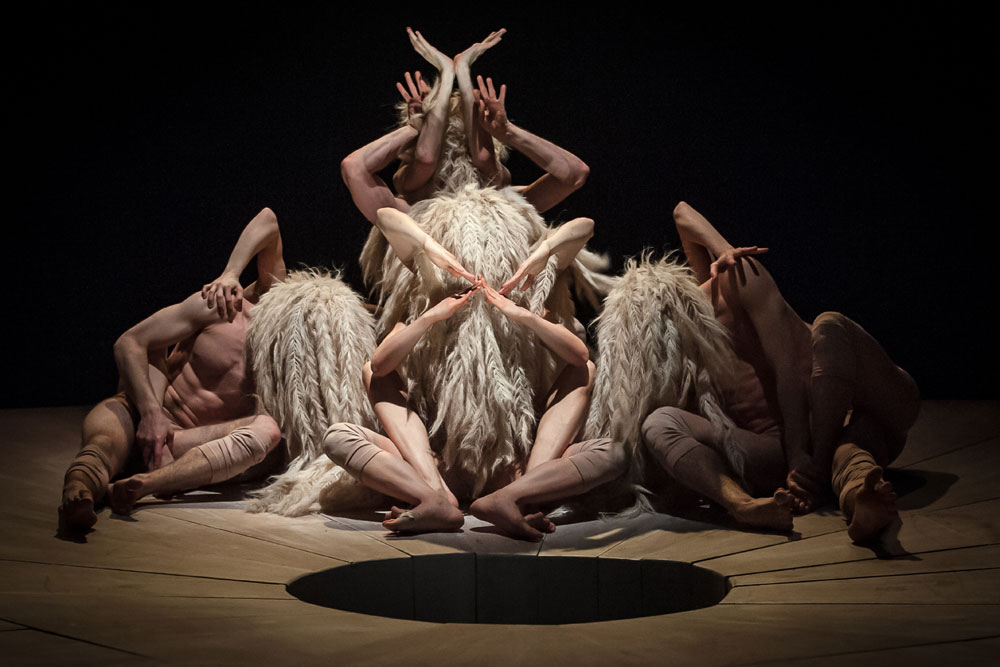
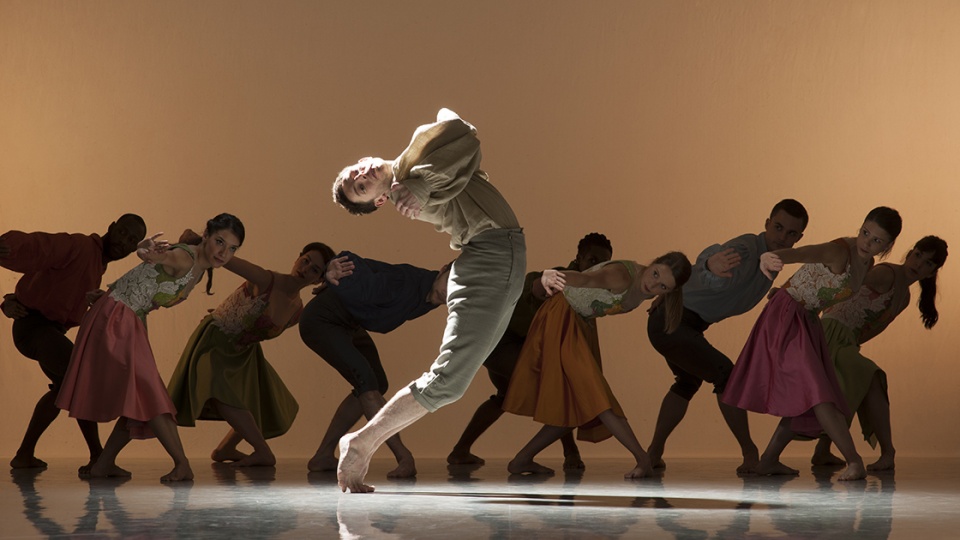
Scottish Dance Theatre in Damien Jalet’s YAMA (photo: Brian Hartley)
“Entering a novel is like going on a climb in the mountains: You have to learn the rhythms of respiration – acquire the pace. Otherwise you stop right away.” Umberto Eco
Mountains invite a challenge.
Scottish Dance Theatre, under the artistic direction of Fleur Darkin, at first commissioned Damien Jalet to create YAMA (Japanese for mountain) as half of a double bill, a munro if you like, in February 2014. Originally inspired by his trip to Japan and the Yamabushi’s (a practising group of ascetic monks) pagan and animalistic rituals, Jalet was invited back to re-build and re-birth a new mountain in the shadow of Dundee’s extinct volcano, The Law.
With a low, rumbling electronic soundscape provided by Winter Family, the opening frames of YAMA created a set of the most striking and original experiences I’ve come across in a theatre. As an opening and immovable central focus, the revelation and consistency of Jim Hodges’ ‘abstract geometric form’ sink hole provided the only channel through which the Scottish Dance critters could arrive or depart. Legs began to slither and ooze from the surface leaving me unsure of the number of bodies present. A giant amorphous flesh ball – with each individual covered by Jean-Paul Lespagnard’s nude shorts and torso-brushing horse-hair facial stockings – started to divide into smaller iterations, writhing and mesmerising me for over 20 minutes: I realised I was already on the journey with them, halfway up the mountain. Through a careful handling and guiding of my attention, I realised I’d been sucked in by the physical concatenation and snap and flow of bodies; the way they’d scurry and come together like a hairy chorus drawn from the brush of Busby Berkeley’s undulating worship of geometric forms and patterns was verging on sorcery. I didn’t want to leave this brave and unusual world.
“Never measure the height of a mountain until you have reached the top.” Dag Hammarskjold
YAMA is the total theatrical realisation of a mountain; the dizzying and breathless ascent, the embrace of the summit and a dawning that the journey home will never contain a place so high again. Ritualistically the performers removed their hair and revealed their faces for the first time. The sonic and visual world was broken. An evolution had taken place and the final 25 minutes consisted of what others would recognise as contemporary dance. The intensity of the choreography – the dancers matched what Jalet painted on their bodies – increased until the striking finale of the channel reclaiming the bodies which had birthed them 55 minutes ago. I left with an increasing sense of regret of what might have been. Had that strong and pioneering world that was so well crafted in the first half been continued I believe YAMA would have been an incredibly courageous and special work.
YAMA invites a challenge and it’s a work that deserves to be encountered and conquered. Scottish Dance Theatre is a rare company in the UK – they house a set of dancers equal to any choreographic challenge – and are traversing a daring choreographic path with confidence and without fear.
“Great things are done when men and mountains meet.” William Blake
Posted: February 13th, 2015 | Author: Nicholas Minns | Filed under: Performance | Tags: Dance Touring Partnership, Édouard Lock, Gilles Maheu, ICTUS, Peter Vermeersch, Sadler's Wells, Thierry de Mey, Ultima Vez, What the Body Does Not Remember, Wim Vandekeybus | Comments Off on Wim Vandekeybus – Ultima Vez: What the Body Does Not Remember
Wim Vandekeybus – Ultima Vez: What the Body Does Not Remember, Sadler’s Wells, February 10
If I could collect and access my favourite dance performances as easily as I can my favourite music on an iPod, Ultima Vez’ What the Body Does Not Remember would be one of them. The era in which it was created — the latter half of the eighties — was one in which many creators were devising dance-theatre works with a rich, contradictory vocabulary of tension, harmony, tearing apart and coming together. Many social and political barriers were beginning to fall (not least of which the Berlin Wall at the end of the decade) and dance was part of that tectonic change. In the same year (1987) Wim Vandekeybus first presented What the Body Does Not Remember, Pina Bausch’s Palermo Palermo opened prophetically with the collapse of a huge wall filling the entire proscenium arch. Vandekeybus was clearly not working in a vacuum; he was tuned in through contemporary philosophy (particularly the social theorist Jean Baudrillard) to an understanding of his time and he developed a movement language that was a highly physical expression of emotional turmoil, chaos and freedom from establishment ethics. It was in the same period in Montreal (where I was living at the time) that Édouard Lock created Human Sex (1985) for LaLaLa Human Steps (with the extraordinary Louise Lecavalier) and Gilles Maheu created Le Dortoir (1988) for his company Carbone 14, in both of which action prevailed over narrative to provide thrilling, visceral spectacles that caught the public imagination and propelled their creators to mythic status overnight. Vandekeybus took the dance world by storm with What the Body Does Not Remember and he has since continued to make works in theatre, film and dance. It is not often his work is seen here (most recently at Southbank Centre with his booty Looting in 2013) but fortunately someone at Dance Touring Partnership loves his work, for DTP toured Blush in 2004 and Spiegel in 2007 (the last time Ultima Vez was at Sadler’s Wells). For those outside London who want to see What the Body Does Not Remember, these performances are just the beginning of an extensive UK tour.
This version is a revival with a fine new cast of dancers who clearly enjoy the challenge and, for the London performances only, with live accompaniment by ICTUS of Thierry de Mey and Peter Vermeersch’s brilliantly percussive score (there is even an encore of De Mey’s Musique de Tables, a composition for six hands on three tables).
I never saw the original cast but I didn’t pick up from this performance what Vandekeybus calls the ‘fear and catastrophe’ inherent in the work. Perhaps that is the passage of time or the more refined training of these nine dancers (or both), but I got the impression of wild games played by fearless children with beards and muscular legs. It doesn’t detract from the work, but the original revolutionary force may have been replaced over time by a more ludic intensity. Vandekeybus acknowledges that “It’s not limited to a time or age-related; you can show it to kids and the kids enjoy it! It’s something universal.”
The most menacing sequence is the opening in which two women are manipulated by the hand movements on a sound table of a manic puppet master (Zebastián Méndez Marin). The amplification is powerful and the percussive gestures on the table transmit violent phrases of tension and collapse in the two women writhing on the floor, the one on the right (Maria Kolegova) controlled by Marin’s right hand, the one on the left (Livia Balážová, if I remember rightly) by his left hand. He is relentless and merciless in his game, watching them intently as they respond to his control. Satisfied with the game, he simply leaves the stage while Kolegova and Balážová meekly remove their tormentor’s table and chair.
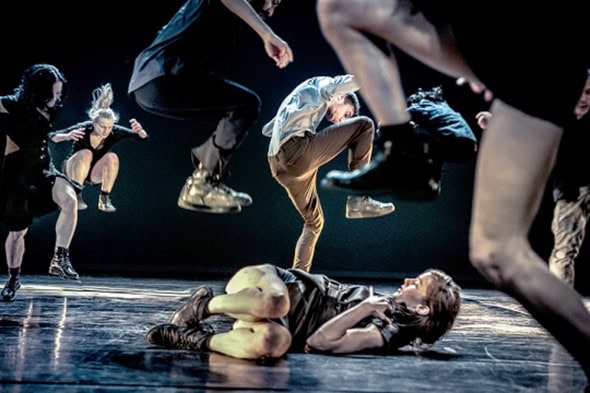
The subsequent sequences are fast-paced variations on daredevil games of risk in which the dancers compete with and taunt each other by throwing or catching bricks, endlessly removing and putting on each other’s jackets and towels with split-second dexterity as they pass, annoying each other, riffing on the airport body search, keeping feathers airborne, circulating the stage at high velocity, hurling themselves to the floor, stamping on each other or taking evasive action to avoid imminent impact (early on one disdainful critic termed the genre ‘eurocrash’) that makes the head spin from the sheer energy and effervescence. The final sequence is a reprise of the menacing opening but with Germán Jauregui Allue as a foot-stamping puppet master who has lost his power. When the last woman has walked off he is left stamping tempestuously all alone, a final dose of impish humour spread throughout the evening that makes the show (let’s admit it) so irrepressibly entertaining.
Posted: February 11th, 2015 | Author: Nicholas Minns | Filed under: Performance | Tags: A Picture of You Falling, Anne Plamondon, Crystal Pite, Hofesh Schechter, Kate Prince, Kate Strong, Natascha McElhone, Peter Chu, Robert Sondergaard, Sadler's Wells, Smile, the barbarians in love, Tommy Franzén | Comments Off on The Associates, Sadler’s Wells
The Associates, Sadler’s Wells, February 6

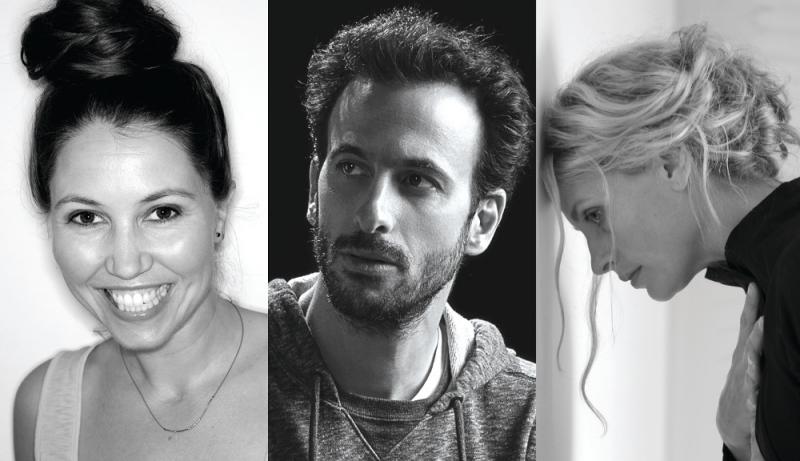
The Associates themselves (l to r): Kate Prince (photo: Simon Prince), Hofesh Schechter (photo: Jake Walters) and Crystal Pite (photo: Michael Slobodian)
Over the last ten years Sadler’s Wells has developed a roster of 16 Associate Artists reflecting the different genres of dance it produces. Artistic Director Alistair Spalding is not in the habit of putting together a program of Associates’ work but this particular one came about through the almost simultaneous request from two of them, Hofesh Schechter and Kate Prince, to test run their works in front of their home audience. Seeing an opportunity, Spalding called on the most recent Associate, Crystal Pite, to complete the program.
I am not familiar with Kate Prince’s choreography but here she directs Smile, a solo choreographed (with a little help from Shaun Smith) and performed by Tommy Franzén. He starts out as Charlie Chaplin’s famous tramp in a delightful riff on those familiar gestures but very quickly loses his way amongst the storage room full of props. It is only in the final scene nine tracks later that he wipes off his white face and black mustache, but he could have done it much earlier. If Chaplin’s tramp is the peg on which Smile hangs it is soon overwhelmed by all the imagery Prince/Franzén/Smith heap on it. There is clearly an attempt to contrast the comedic with the tragic without realizing (as Chaplin did) that both reside within the same gestures and postures. Prince separates the two with the result that Franzén can never gain the stature of the tragic because he is too busy trying to be funny.
There is only a pause between Smile and Crystal Pite’s A Picture of You Falling (2008) but the contrast is marked. Pite’s writing of dance has the clarity of a Joni Mitchell song or of a photograph by Henri Cartier-Bresson: the focus is unmistakable and immediate. The writing is intelligent and meaning is built up with each creative element, from choreography to setting to costumes to light and sound. Linda Chow, who created the carapace-like costumes for Polaris in the Thomas Adès program, is here in more casual mode but dresses the dancers in layers they then discard as the story is revealed. In the hands of Robert Sondergaard light becomes a metaphor for space and time, and can speak as demonstratively as a dancer’s gesture, as it does at the opening when a roving light seems to embody the voice of Kate Strong recalling aspects of a relationship. Peter Chu and Anne Plamondon are the couple whose history is Pite’s subject and although it is broken up like snapshots shuffled from an album the emotional core is beautifully expressed through movement. “I am fascinated and convinced by the shared narratives that live in our bodies,” writes Pite, “the familiar, repetitive storylines that move across cultures and generations — and the body’s role as illustrator.” It is Pite’s ability to mine this illustrative potential of the body with such finesse that sets her apart as a remarkable choreographer.
Hofesh Schechter has a new commission for the Royal Ballet at the end of March and I wonder if he is either testing out some ideas here or if he is getting this piece out of his creative system to make way for the new. The barbarians in love is more delicate than his previous work, perhaps influenced by his embrace of François Couperin’s music, and comes across as a meditation on the past without setting out in any new direction. Lee Curran’s lighting through levels of mist and the white tops and dark jeans devised by Merle Hensel enhance a sense of searching for purity or redemption. The final section in which the six fine dancers emerge from the darkness naked or semi naked strikes me as an intensely personal statement; the dancers remain in the half shadow facing us self-consciously, using their arms in eerily simple gestures redolent of departure without wanting to go. The barbarians in love — the title itself is infused with ambiguity — is a strung together on a series of ethical imperatives or lessons intoned with intimate sensuality by Natascha McElhone that culminate in a recorded dialogue between her in the role of a teasing God and a skewered Schechter trying to justify his work. It borders quite heavily on the self-indulgent but there are mitigating factors. Whether the barbarians in love signals a turning point in Schechter’s creative output will not be known until the end of March with his new commission at the Royal Opera House.
Posted: February 8th, 2015 | Author: Nicholas Minns | Filed under: Performance | Tags: Bennet Gartside, John Cranko, Kurt-Heinz Stolze, Matthew Ball, Matthew Golding, Natalia Osipova, Onegin, Pushkin, Royal Ballet, Tchaikovsky, Yasmine Naghdi | Comments Off on Natalia Osipova in Royal Ballet’s Onegin
Royal Ballet, Onegin, Royal Opera House, January 30

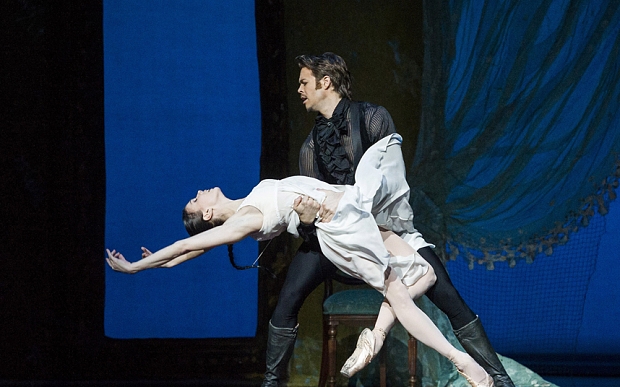
Natalia Osipova and Matthew Golding in John Cranko’s Onegin (photo: Alastair Muir)
It is the first time in recent years that I have been gripped by the dance drama on the Royal Opera House stage and it is the interpretation by Natalia Osipova of Tatiana in John Cranko’s Onegin that is responsible. From my seat in the upper amphitheatre, each gesture she makes is clear, however subtle, and when she throws herself at her Onegin — as she does frequently — the effect is like wearing 3D glasses: she flies into the auditorium. I am too far away to see her eyes but I know exactly where they are focused at each moment. Her performance has the naturalness of improvisation — like her plonking down on a bench as she gazes at Onegin in Act 2 to her child-like intensity of stabbing the pen in the inkwell before writing her letter — and the rigour of a beautifully crafted, flawless interpretation of the steps.
Perhaps it is Osipova’s Russian soul responding to Pushkin and Tchaikovsky, but Cranko was not a Russian choreographer and the role was created on Marcia Haydée. There is something nevertheless universal in Tatiana. In his biography of Cranko, Theatre in My Blood, John Percival observes that Haydée’s Tatiana was ‘a character who grew through the work and was in every moment entirely convincing as a portrait of an exceptional but credible person.’ He could have been writing about Osipova last Friday night but I can’t help feeling she was able to infuse the role with a spirit that both Pushkin and Tchaikovsky would have recognized.
Because Osipova lives the character of Tatiana so fully, her relationship with Onegin requires a heightened sensibility from her partner. Matthew Golding acts his part with less dimensions than Osipova; he appears to remain quite tightly locked into his role — more prince than profligate. He is most at home in the beginning of the first act because he is setting up his character but in the bedroom scene where he is transformed into the dream-like persona Tatiana desires, he cannot leave his aloofness on the far side of the mirror. Osipova is superb here and Golding partners her brilliantly but he never seems to enter into the dream. In the second act Golding fails to colour Cranko’s gestures with a degree of willful petulance that will give Lensky no choice but to challenge him to a duel; we are left wondering what all the fuss is about. And while Tatiana’s stature has risen by the opening of the third act, Onegin’s hasn’t descended which creates an imbalance because the pathos of Act 3 is in the intersection of their divergent paths. At the end Golding runs off and Osipova runs after him, checking herself as she reaches the door. What I didn’t know is that Pushkin never finished his verse novel, and neither does Osipova clarify her emotional state at the end of the ballet. It is left floating in turmoil; however kind and distinguished Count Gremin may be (played with grateful devotion by Bennet Gartside), Tatiana’s heart is more her master than her mind.
There are just five principal characters in Onegin who are responsible for the development of the plot. Cranko paints Tatiana’s relationship to her sister Olga (Yasmine Naghdi) with the lightest of touches; the opening scene where the two are introduced in Jürgen Rose’s idyllic country setting reveals a tender competition, with Olga the more effusive of the two; she dances a lovely solo full of joyous bouncing steps surrounded by friends while Tatiana relaxes with feet up on a wicker bench devouring her romantic novel. Olga’s fiancée Lensky (the elegant Matthew Ball) is a finely drawn character, a romantic suitor whose attention is devoted entirely to pleasing Olga. There is no indication of any flaw in his character that will make his jealousy explode so violently in Act 2, nor is there any trait in Olga, apart from her natural ebullience, that suggests her willingness to flirt with Onegin. All this has to be whipped up at the party, and it is left to Cranko’s choreography to make this happen without the full emotional investment by these three characters. These may seem minor details but with an artist of Osipova’s calibre in the cast the standards are set very high.
I can’t imagine the ballet Onegin being created to Tchaikovsky’s opera score; what Kurt-Heinz Stolze created with his orchestral arrangements of some of Tchaikovsky’s lesser-known piano compositions and orchestral poems allows the choreography to weave together the characters of Pushkin’s novel seamlessly and leaves the beauty of Cranko’s choreography to match Tchaikovsky’s arias.
Posted: February 3rd, 2015 | Author: Nicholas Minns | Filed under: Performance | Tags: Ajani Johnson-Goffe, Benamin Britten, Burning, Christopher Smart, Ihsaan de Banya, Madcap, Martin Lawrance, Nancy Nerantzi, Nicholas Boydich, Nomadic, Peter Todd, Rejoice in the Lamb, Richard Alston, Zeynep Kepekli | Comments Off on Richard Alston: 20th Anniversary Performances
Richard Alston Dance Company, 20th Anniversary Performance, Sadler’s Wells, January 26
The idea of celebrating 20 years of his company with a retrospective program of highlights is not, I imagine, one that Richard Alston would countenance. But clearly a lot of careful thought has gone into the program at Sadler’s Wells — modestly titled ‘20th Anniversary Performances’ — that says less about the past than the present. Alston has created a new work, Rejoice in the Lamb, which receives its London première, and associate choreographer Martin Lawrance has his own London première of Burning in addition to Madcap from 2012. The remaining slot on the program is filled with the world première of Nomadic, a joint adventure in which Alston shares the choreography with dancer Ajani Johnson-Goffe. Those who prefer a more concentrated Alston program will have to wait for the company’s upcoming UK tour.
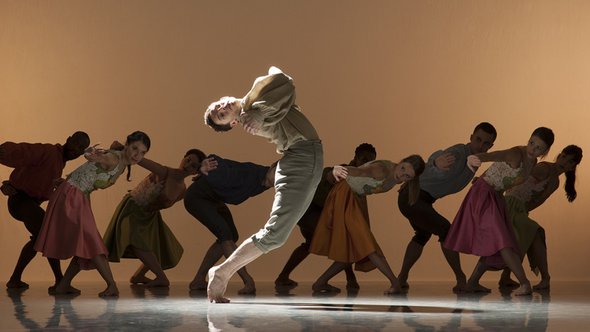
At the end of 2013 Alston produced an evening of work that celebrated the music of Benjamin Britten to mark the composer’s centenary. It was as much a celebration of Alston’s choreography as it was of Britten’s music because their sensibilities seem so well matched. Rejoice in the Lamb, which Alston created perhaps in that same flush of inspiration to Britten’s 1943 setting of Christopher Smart’s poem of the same name, opens under a pale blue light with a circle of dancers woven head to toe on the floor and a pensive Nicholas Bodych crouching like a luminous gargoyle to one side. He is Christopher Smart, 18th century poet and man of fervent religious faith who was susceptible to bouts of depression; his sustenance was music and poetry. He also had a steady companion in Jeoffry, his cat, danced here in tabby colours by Ihsaan de Banya. Smart and Jeoffry are the only two named characters; the remaining cast of five women and three men are possibly an expression of the joy and simplicity of Smart’s mind. As soon as Bodych begins to move, the measure of Alston’s own peace of mind is clear; there is a quiet economy in Bodych’s gestures, unadorned and free, that extends to the entire cast, giving Rejoice in the Lamb a serenity that the pastel colours of the costumes by Peter Todd and the lighting by Zeynep Kepekli enhance. Alston is evidently still in love with making dances and his dancers respond with a clarity that is a pleasure to see. This is quiet dancing with moments of stillness and humour; Alston does not have a repertoire of difficult steps but they are precise and when danced well, as they are by the entire company, they move effortlessly with the music.
Martin Lawrance’s Burning is a piece in the style of Alston but without his most endearing qualities. Set to Franz Liszt’s Dante Sonata played on a grand piano by Amit Yahav, Burning is about the composer’s relationship with Countess Marie d’Agoult (Nancy Nerantzi) and his many other liaisons with adoring women. As soon as Liam Riddick (as Liszt) begins his introductory solo it is clear we are in for a bumpy ride; Lawrance’s choreography is simply not on the same plane as the music. Not only that but he translates Liszt’s relationships into bruising, harsh duets that read as serious abuse. Lawrance may have historical evidence to justify it but if he does he is imposing this on the music and it jars. Gestures and dance are separated from the music, solos begin without narrative intent and there’s just too much choreography that gets lost on the floor. Burning may well refer to Liszt’s passion for Marie but it is expressed in the music rather than in the dance.
Nomadic is Alston’s first-ever joint choreographic venture, but his stake in it is unclear. Co-choreographer Ajani Johnson-Goffe, who also dances in it, has an idiosyncratic way of moving that separates him from the rest of the cast; when he dances the choreography makes sense, but when his movements are embodied by others it doesn’t. Alston’s dancers weave their patterns and their duets tirelessly but the energy of Nomadic is drawn down by an internal gaze that give the impression the dancers are listening to the music of Shukar Collective through earphones. What is missing is a sense of cohesion, that intangible element that nomadic tribes must cultivate in their wandering lives.
Alston offers the place of honour on the program to Lawrance’s Madcap, set to ‘possibly two of the most challenging pieces I have ever tackled’ by Julia Wolfe (Lick and Believing). Just as with Liszt’s Dante Sonata, Lawrance’s choreographic form tends to write over the music with his ideas rather than delve into its structure and some of the elements that weaken Burning reappear here: a concentration on highly physical male solos (for de Banya and Riddick) in a company of lyrical women, an overdependence on floor work and an unsettling violence in a duet between Nerantzi and Riddick. This is not a natural closer to an evening of dance, let alone to a 20th anniversary of what Alston and his dancers have achieved. Whatever the reasons for the order of program, the memory of Alston’s beatific Rejoice in the Lamb eclipses what follows.
Posted: February 1st, 2015 | Author: Nicholas Minns | Filed under: Performance | Tags: Archive, Arkadi Zaides, B'Tselem | Comments Off on Arkadi Zaides: Archive
Arkadi Zaides, Archive, Salle Maurice Béjart, Théâtre National de Chaillot, Paris, January 29

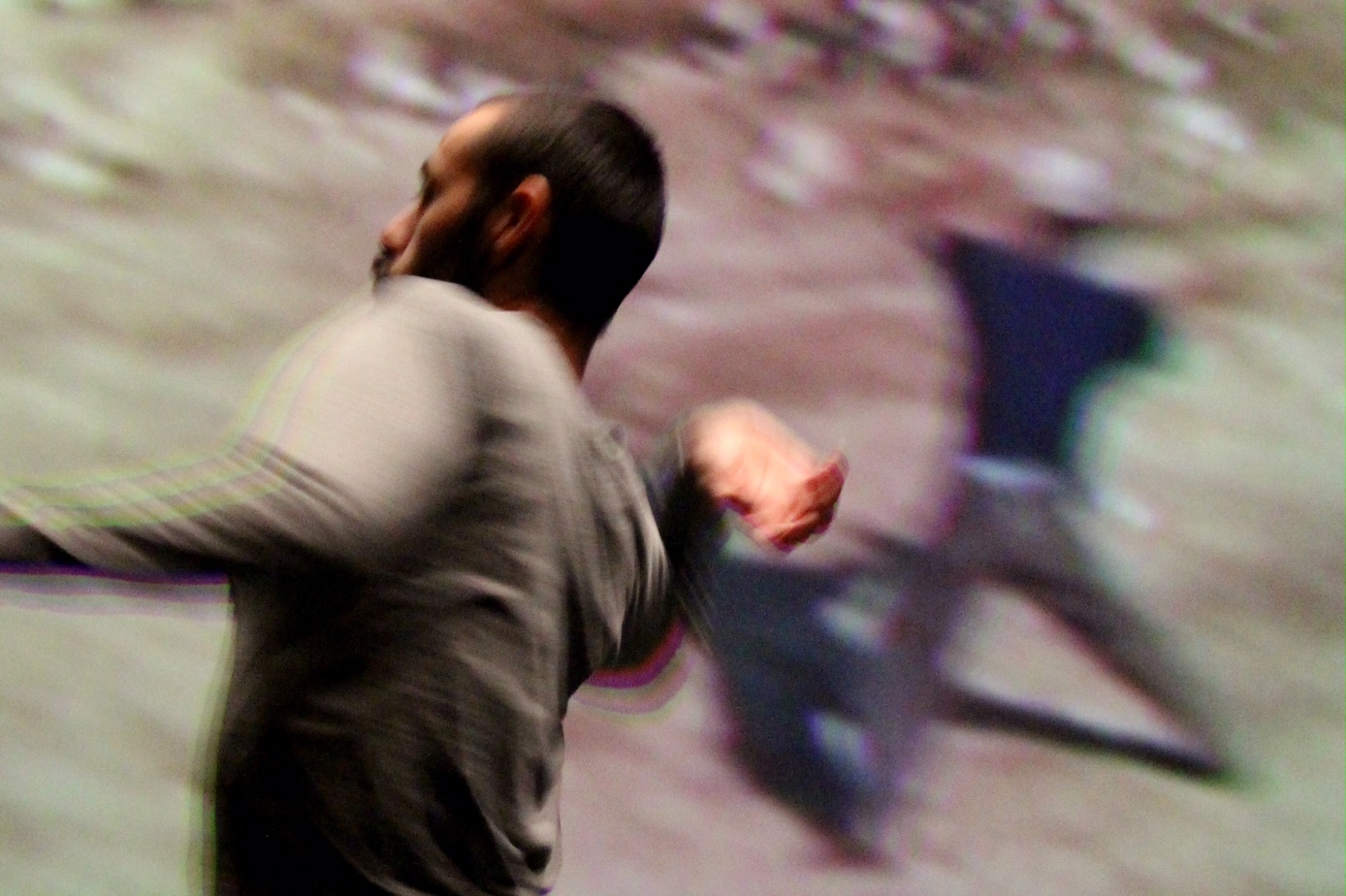
Arkadi Zaides in front of the screen in Archive (photo: Jean Couturier)
The Palais de Chaillot in Paris is where, on December 10 1948, the United Nations General Assembly adopted the Universal Declaration of Human Rights. The Palais de Chaillot is now the Théâtre National de Chaillot, and in its basement theatre — Salle Maurice Béjart — Arkadi Zaides is performing Archive in which he borrows a Palestinian perspective to view transgressions of human rights by Israeli soldiers and settlers against the indigenous Palestinian population. The significance of the place is not lost on Zaides but he doesn’t reveal it until the post-show discussion: the context of Archive is undoubtedly human rights but it is not the main focus of this work.
Zaides is not an Israeli by birth, having emigrated from what is now Belarus, where he was the only Jew in his school class, to Israel at the age of 11 where he was the only immigrant in his class. To better assimilate into his new environment he joined at the age of 13 an Israeli folk dance group and later trained in contemporary dance where he developed his individuality. In 1999 he became a member of the Batsheva Ensemble and joined the main company in 2001 until 2004. In a country where military service is obligatory, he refused to join the army. It was a decision he admits with characteristic understatement that required a lot of determination to sustain. Zaides is thus an insider on the outside or an outsider on the inside, which is what gives Archive its trenchant focus. Now an independent choreographer living in Tel Aviv, Zaides performs his works in Israel and is often invited to perform throughout Europe (though not yet in the UK), in North and South America and in Asia.
Like the late Aleksandr Solzhenitsyn writing about the gulags, Zaides is not saying anything about Israel’s actions towards the Palestinians other than what the Israelis themselves are saying with their own bodies. The archival film that is the starting point of Archive is rough footage of transgressions by Israeli settlers and soldiers seen through the lens of cameras given to Palestinian citizens by the Israeli Human Rights Organisation B’Tselem for the express purpose of documenting them. Zaides is in turn looking at the corporal and vocal gestures of the aggressors and exploring the genesis of those same gestures — stone throwing, sheep scattering, olive branch destruction, verbal and physical intimidation, among others — in his own body. The result is visceral, poignant and disturbing to the point you wish it would stop. That is almost certainly what Zaides wants to achieve.
Two weeks after the brutal attack on a Jewish supermarket in Paris, there were efforts by Jewish right-wing activists to prevent the show from opening, but thanks to the stand of theatre director Didier Deschamps, the eight sold-out performances have, in the spirit of Charlie, gone ahead as planned. Zaides is used to confrontation; he now sees it as part of his work. Performing Archive in Israel (most recently in Tel Aviv) he has met with opposition, sometimes physical, from those who find his ethical stand politically unacceptable. He has discovered attempts to shut down his funding sources in Israel and has experienced riots in Jerusalem at a talk he was giving about his work. But there is something about Arkadi Zaides that will not back down because he believes so strongly in what he is doing. You only have to look at his eyes to know that. He is not an angry man pointing self-righteously at others but uses his own body as a mirror to the society in which he lives. In Paris it is the first time he has performed this many performances together and the duress of taking on gestures of violence is taking its toll on his own body and mind.
During the performance he first mimics the actions of selected individuals in the footage (and there are only Israelis in the footage; the Palestinians are behind the cameras); then he rewinds the clip and plays it again embodying in front of the screen the gestures he sees on it. He has seen the clips many times and has studied them assiduously; he has seen hundreds of hours of footage from about 4,500 hours held in the B’Tselem archive. He then shuts off the projector and repeats the actions as if they are a short choreographic phrase. Remarkably there are recognizable elements of what we in the UK might call Israeli choreography. As this sequence of footage and gestural extraction progresses Zaides adds to the physical phrases vocal elements (shouting, taunts and other fragments from the recorded footage) that he vocalizes and captures on a digital loop, accumulating over the course of Archive a choreography of violence, of brutality, of inhumanity that in its starkness is deeply disturbing. This, Zaides suggests, is what we are doing to our bodies when we take on these forms of aggression. As anthropological as it is polemical, Archive takes dissent to a choreographic level that is neither abstract nor pure imitation but part of what Zaides calls his search for the real choreography: is it what we see in the theatre or is it manifest outside? Archive blurs the distinction between the two and in doing so makes a powerful, devastating statement.
Posted: January 27th, 2015 | Author: Nicholas Minns | Filed under: Performance | Tags: Arno Veyrat, Aurélien Bory, Joan Cambon, Kaori Ito, Pierre Dequivre | Comments Off on Aurélien Bory / Kaori Ito, Plexus
Aurélien Bory/Kaori Ito, Plexus, Sadler’s Wells, January 22

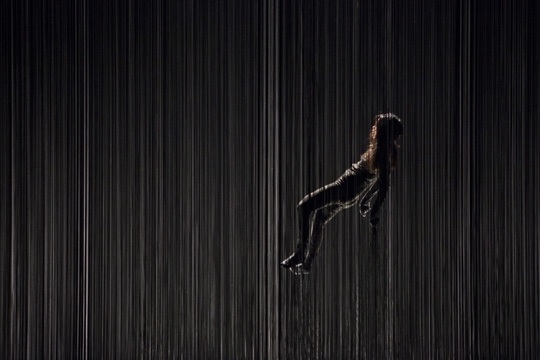
Kaori Ito suspended in Pierre Dequivre’s forest of cables in Plexus (photo: Aglae Bory)
Aurélien Bory’s Plexus is, according to the choreographer, an exploration of ‘the memory of a body substantially shaped by dance.’ The body in question belongs to Kaori Ito and it becomes the player inside a fabulously stringed instrument dreamed up by Pierre Dequivre and constructed by the Atelier de la fiancée du pirate: a forest of 5,000 tensile cables covering the stage from floor to ceiling that moves in its entirety as a giant swing. Ito and the set are as united as musician and instrument: Ito is its heart and sets it free.
Appropriately it is with heartbeats that the work opens. Ito in a creamy silk chemise appears in front of a black parachute silk fabric with an amplified stethoscope that she places over her heart to take her pulse. We hear her heartbeat and the sound of silk. She takes her jugular pulse, pulls the instrument over her hair, claps it roughly over parts of her torso, sending it into convulsions like a puppet being moved violently by an invisible hand: this is the body of the musician who now withdraws through the fabric into the stringed instrument as if into a womb, pulling the silk behind her.
‘Plexus’ comes from the Latin meaning ‘intertwining’. From this point Ito’s physical play is entwined not only with the cables but with Joan Cambon’s electronic score and Arno Veyrat’s lighting. As she stands still in this steel forest, her world is crushed and expanded in quick succession by rotating planes of light. She leans forward and back against the wires, coming to rest without any visible form of support and then like a trapped, wild spirit strikes out at the cables as if she is plucking them, pounding on the amplified floor before suspending herself horizontally.
Veyrat can make spaces transparent or opaque, can pick out Ito’s form behind the cables, merge her with them or make her disappear like a magic trick. He can make the cables look like a downpour of thin, vertical rain through which Ito walks, or like branches through which she has to find her path. And yet Ito is never dominated by the scale of the set; she appears to control it, even setting it in motion like a child on a giant swing, thrashing from side to side to increase the momentum until the entire Sadler’s Wells stage seems to be in motion. When we see her naked, striated torso advancing through the cables in a shallow zigzag path, halting at each side of the stage to part the wires and step through, the set shrinks to her stature.
Bory also makes ‘intertwining’ a metaphor for the ‘dialogue between Kaori’s inner world and the outside world.’ Returning to images of the womb, Ito weaves a silk cloth like an umbilical cord through the cables to form a circle in which she stands, her head just visible above the cloth and we see her floating above the stage as if suspended in fluid, slowly sinking and rising again to the surface. Wanting to break out Ito begins to swing the set front and back like a sailor aloft on the rigging. She descends to the floor and is tossed ashore as if the ship has gone aground to the sound of waves washing up and crashing. She reappears in a long black crepe cape and flies up the cables to dive down like a fish with exotic fins. Underneath her cape she manifests a protective skin of metallic squares that glisten in the light and rustle like gravel in a thunderous tide as she moves within it. She merges one last time into the dark while Veyrat sets the storm clouds swirling over the cables. Just light remains now, a golden light that slowly fades. The body has metamorphosed and left; the instrument is still. Magical.
Plexus is presented as part of the London International Mime Festival
Posted: January 27th, 2015 | Author: Nicholas Minns | Filed under: Performance | Tags: 4x4: Ephemeral Architectures, Camerata Alma Vira, Gandini Juggling, Guy Hoare, London International Mime Festival, Ludovic Ondiviela, Nimrod Borenstein, Sean Gandini | Comments Off on Gandini Juggling, 4×4 Ephemeral Architectures
Gandini Juggling, 4×4: Ephemeral Architectures, Linbury Studio Theatre, January 13

Gandini Juggling in 4×4: Ephemeral Architectures (photo: Beinn Muir)
Directed by Sean Gandini with four jugglers and four classically trained dancers choreographed by Ludovic Ondiviela, a score by Nimrod Borenstein (Suspended opus 69) and lighting by Guy Hoare, 4×4: Ephemeral Architectures relishes its cross-fertilization of art forms to give us a glimpse beyond conceptual ideas to what dance and juggling do so well: spatial stimulation. Gandini’s program note itself is an inspired expression of collaboration: ‘This piece is a return to our love of pure patterns and mathematics, our roots in imagining juggling as a form of dance.’
After the Camerata Alma Vira take their places at the back of the stage — a setting that suggests both classical concert and travelling band — the four dancers and four jugglers enter in a line. This is the opening proposal that sets the tone for the subsequent development. The jugglers begin juggling balls while the dancers’ arms circle above their heads and drop down to slap their thighs, together setting up spatial and aural rhythms enhanced by light. There are solos, the first by Kieran Stoneley that is expansive with lovely lines and then by Owen Reynolds who states the mathematical formula for a juggling act and then performs it. With the introduction of Borenstein’s music (hopefully it will be recorded by now) there is an additional mathematical layer: when the jugglers exchange clubs across a line of advancing dancers it is as if arms, legs and clubs are all dancing to the musical rhythms.
Although the Gandini jugglers are brilliant technicians (I can’t take my eyes off them any more than they can take their eyes off the objects they are juggling), they are relaxed and in their relaxation they dance. There is something in their insouciant virtuosity that reminds me of the dancers in a Pina Bausch work. Every now and then they drop a ball or a club or a ring but it doesn’t seem to matter; they have a self-deprecating humour that is built into the art. There’s a scene where Owen Reynolds juggles three or four balls perfectly. Dancers Erin O’Toole and Kate Byrne are either side of him on pointe like malevolent fairies urging him to juggle more balls. He does and while he’s juggling they bourrée in place with a vengeance. When Reynolds succeeds, they clap enthusiastically but when he drops a ball they stop with a loud sigh of disappointment. The audience laughs. But is there a parallel scene where two jugglers stand round a dancer urging more and more pirouettes? No, and this signals the one flaw in 4×4: Ephemeral Architectures: the four jugglers are at the height of their art and constantly push its limits but Ondiviela and his four dancers seem constrained by their classical dance; they can’t simply let go of their training and enter into the movement with the same freedom as the jugglers accomplish their feats.
But there are so many moments in the work that are infused with a ludic sense of exploration. O’Toole hones her juggling skills and the jugglers dance a phrase of Scottish dance; the rhythm of the coloured balls is continued in the girls’ underwear; Byrne dances quick phrases while the balls Reynolds is juggling are in the air; both dancers and jugglers use their voices to state mathematical patterns as well as to comment on their skills (‘A bit wonky’ says Sakari Männistö as one of the balls flies off its orbit). The most impressive moments occur when the jugglers exchange clubs over the heads of the dancers like a canopy of flying tears enhancing the musical rhythms. Hoare’s lighting is an essential ingredient: he makes the rhythms visible. Gandini refers to Hoare’s passion for geometry and architecture and writes that they quickly found they spoke similar languages. 4×4: Ephemeral Architectures is all about the similarities in languages and how they can be brought into a creative focus, but in its exploration it inadvertently asks the same question of classical dance as the Mock Turtle asks of Alice: ‘Will you, won’t you, will you, won’t you, will you join the dance?’
When Reynolds stands alone on stage suggesting five possible ways to finish the show, the fourth (I can’t remember the first three) is to expound on the profound similarities between the two art forms. He means the two art forms of juggling and dance, but as we have seen, 4×4: Ephemeral Architectures comprises four art forms that each contributes to the creative vision of the work. Reynolds avoids the issue by choosing the fifth option which is a juggler standing alone on stage deciding how to finish the show.
4×4: Ephemeral Architectures is presented as part of the London International Mime Festival
Posted: January 16th, 2015 | Author: Nicholas Minns | Filed under: Performance | Tags: Catarina Carvalho, Kenny Wing Tao Ho, Leafcutter John, Max Baillie, Michael John Harper, Nina Kov, Vuong 10 | Comments Off on Vuong 10
Vuong 10, JW3, January 14

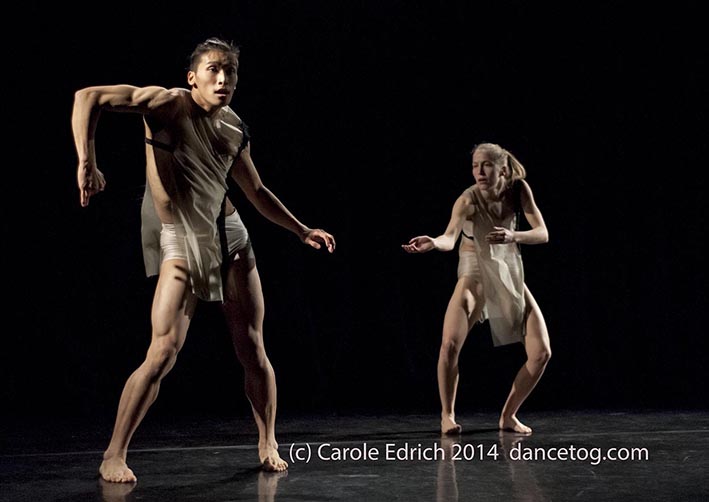
Kenny Wing Tao Ho and Maren Fidje Bjørneseth in Vuong 10 (photo ©Carole Edrich – ceimages.co.uk)
Vuong 10 is the creation of a core of choreographers and dancers who came together at King’s Place in 2013 on the occasion of the first evening of Randomworks curated by Wayne McGregor: Catarina Carvalho, Michael John Harper (both dancers with Wayne McGregor|Random Dance) and Nina Kov. They presented a short piece to music composed by Leafcutter John and violist Max Baillie called Vuong 10 and what we see this evening at JV3 is a development of that auspicious beginning with dancers Kenny Wing Tao Ho and Maren Fidje Bjørneseth. Of course in hindsight one could say that from this particular group something fascinating would surely evolve, but the process was probably not so clear (neither, if we discount the role of God, was the creation of the world). Seeing Vuong 10 on only its second outing (it premiered at Rich Mix in December) it is now evident that something rather remarkable did emerge from this collaboration, a kind of spark-made-flesh that thrills the imagination and challenges the ephemeral nature of dance. Given the primeval — rather than the proposed futuristic — content I feel the costumes by Bella Gonshorovitz are a little fussy; costumes that aim for a naked look can sometimes distract more than nakedness itself. The stage also appears too clean and the lighting by Karl Oskar Sørdall is constrained by this neutral staging, but there is no doubt about the movement language as interpreted by Bjørneseth and Wing Tao Ho: it has a visceral sense of entanglement and intrusion that is enthralling.
Vuong 10 is an intimate work both in subject matter — an exploration of the sense of touch at a time when it has been lost — and in its details: malleable facial gestures and frail, tendril-like fingernails like Hoffmann’s Struwwelpeter. If you’re not up close you miss it. It is a work that is nevertheless complex in form, the overall arch of experience torn into fragments of intense physical exploration that may be movement or sound or both. As the publicity states, Vuong 10 is a contemporary music concert as well as a contemporary dance piece.
It is also a disquieting work, perhaps intentionally. From the very first image of the two dancers facing each other across the stage in silent, animated communication, we are not clear what relation they have. They could be Adam and Eve arguing or the last two beings left alive coming across one another by chance, trying to grapple with the unaccustomed act of meeting. Their physical vocabulary evolves in part from this contorted attempt at speech and in part from the windswept landscape of the score that acts as the exegetic soundtrack of their minds. Not knowing exactly how the task of creation was shared between the three choreographers, it is remarkable they found a coherent physical language to embody the score. Their courage to explore the musical language and the uncompromising presentation of their findings combine to make Vuong 10 an intoxicating, at times erotic experience, not least because Bjørneseth and Wing Tao Ho remove their own boundaries and inhibitions to express the rawness of the choreography. Wing Tao Ho’s solo, in particular, is the spark that lights the entire production. The conflagration from that spark would be, to put it mildly, mind-blowing. It doesn’t quite happen here, but Vuong 10 is pointing in a very exciting direction.
Posted: January 10th, 2015 | Author: Nicholas Minns | Filed under: Performance | Tags: Adrian Heafford, Alexandrina Hemsley, Andy Webb, Battersea Arts Centre, Dad Dancing, David Hemsley, Giulio D'Anna, Helena Webb, Parkin'son, Rosie Heafford | Comments Off on Dad Dancing
Dad Dancing, Battersea Arts Centre, November 13, 2014

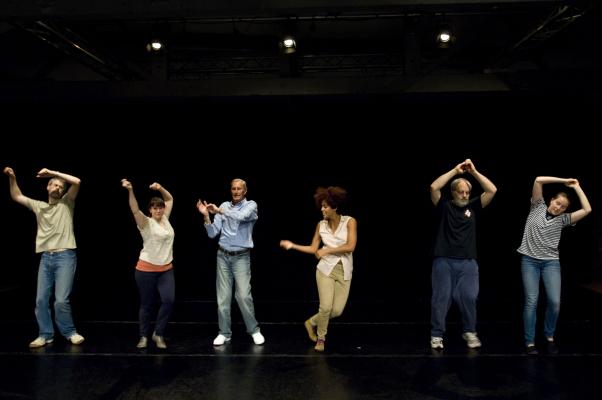
Left to right: Adrian Heafford, Rosie Heafford, David Hemsley, Alexandrina Hemsley, Andy Webb and Helena Webb
There were two December performances in London about dads, quite different in scope but united in focus. One was Dad Dancing at the Battersea Arts Centre and the other was Giulio d’Anna’s Parkin’son at The Place (which I have written about when it was performed as part of the Sick! Festival in 2013). The former is about the relationship between three dancing daughters and their non-dancing fathers (though the fathers successfully challenged the non-dancing aspect) and the latter about the relationship between a dancing son and his non-dancing father who has Parkinsons. In both performances the dads are on stage (except for the choreographed absence of Andy Webb), and both works are beautifully crafted and emotionally charged. Dad Dancing sets out to highlight the positive aspects of the father-daughter relationship but in the process the dads reveal a sometimes vulnerable underside that is touchingly human. Parkin’son is built around a more combative relationship that nevertheless contains a mutual love and respect but after close to 100 national and international performances and the creeping effects of the disease, father and son have to consider winding down. I hope Dad Dancing has a shot at 100 performances because it opens up a dialogue with the public about fathers (whether present or absent); the candour of the discourse and the raw enthusiasm of the onstage dads are cathartic.
The form of Dad Dancing is loosely set up as a theme and variations. The opening theme is all the daughters (Rosie Heafford, Alexandrina Hemsley and Helena Webb) with their respective fathers, Adrian, David and Andy (Andy actually never appears except on film as he is working but his contribution is full of surprises). So there are three pairs of pointed feet and two pairs of not so pointed feet doing a little shuffling, heel-and-toe routine. They are well rehearsed and move pretty much in unison until it comes to bending forward.
In the next section, Andy in a filmed message asks for an understudy. No volunteers, but a unilateral choice by the cast. This was my moment; I had the honour that evening of being Andy Webb, to walk in his footsteps. Literally. I was given written instructions as to how many steps to take in answer to certain quantitative questions that are displayed on a card for the benefit of the audience. ‘How many times have you been married?’ I take one step forward; David to my left takes a few more. None of the girls move. ‘How many children have you had?’ Three steps for me. The girls are rooted to the spot. I can’t remember where David ended up. For ‘How many jobs have you had?’ my instructions are to walk to the front of the stage.
Now for the solo variations; one of the daughters chooses three pieces of music from their iTunes playlist so whoever is dancing has to improvise. David hasn’t danced since his days in the Royal Tank Regiment; not promising for a solo performance, but he takes to the stage with natural rhythm. Having completed his three variations — one jazzy, one classical and one dubstep — he capers off jauntily to a waiting chair.
Rosie, Alexandrina and Helena establish their credentials by dancing like leaping gazelles after which the local supporting cast of seventeen (of all ages) joins in a long line to relate anecdotes about their respective fathers (when I saw the preview of Dad Dancing there were only the principal five on stage with Andy still at work). This is where the Dad Dancing Project is like a touchstone; nobody speaks ill of their father but there are some notable gaps in some of the relationships. Dad Dancing started off as a small-scale collaboration between three dancers and their fathers, but it has developed into a social phenomenon that recognizes the role of fathers in the lives of their children even if they have been absent. Hearing these anecdotes provides a welcome moment to reflect on our own fathers.
Each dad dances his three variations (Andy is filmed) as does each of the girls. The most candid moment is when the dads talk about the birth of their daughter, a place in which humour mitigates their emotional recall. Helena calls Andy on speakerphone to share another personal memory: his reaction to her disclosing she had started using the pill. She told her dad first on the understanding he would tell her mother.
At one point the entire cast has prepared a card on which each has written his or her hope for their respective father. They stand in a line presenting these cards to the audience and read them aloud, one by one. It is what Roland Barthes might call the punctum of a photograph, the moment when Dad Dancing reaches its emotional pinnacle and draws the evening to what might be a close. But then Adrian rides his bike around the stage with a light on his helmet to talk about his work as a geologist. It is true he hasn’t had this opportunity like the other dads, but its place in the show makes it seem one story too many. After Adrian the full cast returns to the stage to dance and invites audience members to join. Many do, and there is a celebratory feeling in the room. We all have dads but not only is it uncommon for children to perform with them, it is similarly uncommon to see them honoured in this way. Dad Dancing should be a national campaign; a lot of good can come out of it.
Dad Dancing is a co-production between Second Hand Dance and Battersea Arts Centre, co-commissioned by Battersea Arts Centre and South East Dance. Supported by Arts Council England, The Thistle Trust, Awards for All and Wandsworth Council.