Posted: December 30th, 2015 | Author: Nicholas Minns | Filed under: Performance | Tags: David McCormick, Mark Coniglio, Michael Mannion, The Chapter House, Zoi Dimitriou | Comments Off on Zoi Dimitriou, The Chapter House
Zoi Dimitriou, The Chapter House, Laban Theatre, November 26

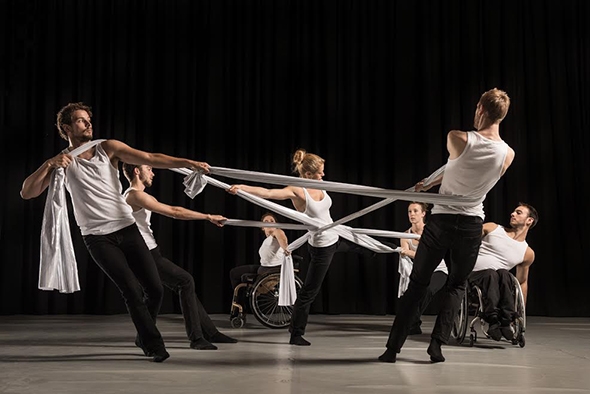
Publicity image for Zoi Dimitriou’s The Chapter House
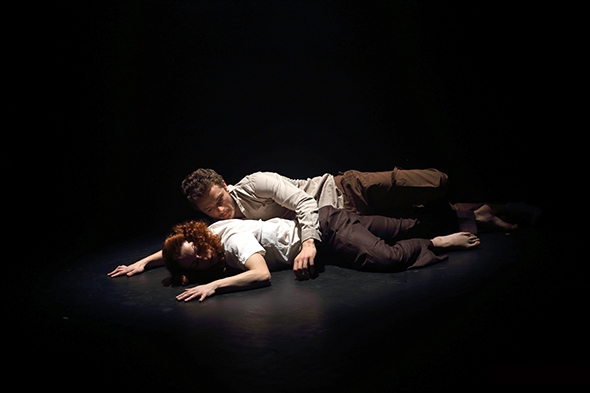
Watching Zoi Dimitriou’s The Chapter House at Laban Theatre recently is like taking part in a formal ritual. It is a calm work, lit to stillness by Michael Mannion and dressed in planes of white and lines of wire; an abstract world punctuated by the stormy lyricism of the musical score formed of pieces by Pluramon, Conlon Nancarrow and Caccini.
In such an austere and well-lit environment every detail of the performers’ gestures is magnified, which lends itself well to the nature of this solemn enquiry into the nature of creation. As Dimitriou asks rhetorically in the program note, ‘…what does it take to make (or remake) an art work in and for the digital age?’
The Chapter House is a kind of retrospective with a twist. It began as an idea to revisit five of Dimitriou’s past creations to assess the path she had taken and where she found herself at the end of it. It was an artistic and intellectual act whose prime concern was evaluation rather than creation but in inviting media/performance pioneer Mark Coniglio to help her with the documentation of her project she discovered in the process of recording her five ‘chapters’ that the transformative effect of the camera realigned her original goal into its performative continuation and development.
The ‘chapter house’ of the title is the structure of the work, a framework like the memory theatres of old; in the first half of the performance, a textual score Dimitriou reads backwards at a music lectern with an almost ecclesiastical lilt precedes each selective re-enactment. She shares the stage with video artist David McCormick who is recreating Mark Coniglio’s original role.
A nod from McCormick is the signal for Dimitriou to start; she approaches the lectern where she reads her first score. In silence the two performers approach each other across the stage to perform a ritual cleansing of hands, she with a glass bowl, he with a glass bottle of water and a white towel that he lays carefully on the floor. After the ceremony Dimitriou places the bottle on the floor with the exactness of protocol and returns to the lectern to read the next score. This time she performs the score alone — lying on the floor and rotating her position every ten beats of a metronome until her hand finds the water bottle; she drinks from it for ten beats — while David circles to record her with a tablet-sized camera on the end of a pole.
At this point we do not know what he will do with the recordings; for subsequent scores McCormick moves with the camera as a participant in the choreography but we do not see the images until later when we understand that, like Dimitriou’s textual scores, the captured images serve to transfer past memories into the plane of the present. But they are more than that: in the latter half of the performance the recordings, filtered through a complex algorithmic software (originally designed by Coniglio) that divides them into the five chapters, are simultaneously projected on to five screens — five sheets that Dimitriou and McCormick meticulously unfold and peg to the overhead wires. You can marvel at this magic while you see Dimitriou perform a beautifully slow, languid solo that is qualitatively different from what had come before as if the entire process of recording and playback has changed the intrinsic nature of her dancing. While watching this process of digital creation and re-creation unfold we can also perceive the embodiment of an idea that in the sparse surroundings of serene but minimal gestural movement makes a compelling statement of life’s richness and a reminder that at the source of ideas is the unity of mind and body.
Zoi Dimitriou will perform The Chapter House again at Laban Theatre on April 12, 2016
Posted: December 21st, 2015 | Author: Nicholas Minns | Filed under: Performance | Tags: Anna-Lise Marie Hearn, Chantal Guevara, Cloud Dance Festival, Cloud Dance Friends, Daniel Whiley, Elise Nuding, Estella Merlos, Humana Productions, Jacob O'Connell, Jason Mabana, John Ross, Mike Williams, Miranda MacLetten, Yukiko Masui | Comments Off on Cloud Dance Friends
Cloud Dance Friends, New Diorama Theatre, November 29

Miranda MacLetten and Daniel Whiley in John Ross’s Blink (photo: Chris Jackson)
Chantal Guevara’s birthday celebration this year includes, before the chocolate cake, a performance at the New Diorama Theatre by Cloud Dance Festival alumni and friends; it is the kind of event for dancers and choreographers to try out new work in as relaxed an atmosphere as any public performance can be.
Elise Nuding, who opens the evening with a first performance of her I, object, bravely juxtaposes linguistics and wordplay with choreography. She writes, ‘This little nugget emerged during a particularly frustrating period of article writing, as I grappled with the slipperiness of words and their implications.’ The struggle is apparent both in her semantic parsing and in her accumulative gestures. As she arrives at each breakthrough in her argument, Nuding takes off a layer of clothes; by the end she has only got to the level of underwear, which suggests this slippery little battle has not yet reached its logical conclusion. Nevertheless I, object reveals a sophisticated aesthetic at work that, depending on what Nuding does with it, makes this nugget either ‘a small lump of gold’ or ‘a valuable idea or fact.’
I am not sure why Mike Williams titles his work 4’33 after the famous John Cage piece of music and makes it last 8 minutes. Why not call it 8’? Besides, a dance in the spirit of Cage’s 4’33 would have no movement but there is plenty in Williams’ angular, long-limbed plasticity though (at least in this evening’s performance) there is a lack of pliable technique to get the most out of it. Cage’s 4’33 contains a world of ideas — his love of silence, the withdrawal of music from the score, his delight in incidental sounds — but Williams’ dance, for all its movement, lacks this kind of philosophical integrity; he points in the right direction but doesn’t embody what he wants to convey and his final gesture for silence underlies the self-conscious conceit of the whole.
Jason Mabana’s Hidden, a duet for himself and Jacob O’Connell, is driven by a tactile quality, part ferocious, part gentle, that describes ‘the ambiguity of a relationship between two conflicted and dominant people.’ Mabana’s choreography carries its imagery with great strength and poetry like a smooth, rich baritone in a youthful body. There is both a singing quality to Mabana and O’Connell’s movement and a silence in the way they dance that leaves our visual and visceral senses free to enjoy the movement without unwanted punctuation. Hidden achieves what it sets out to do with a purity and sincerity that are refreshing.
Humanah Productions’ Egress starts off with a pile of bodies from which the one underneath slithers out with great difficulty to stand but collapses from its independence and returns to the heap. It is a metaphor of growth and departure in the form of a game, one of many ludic adventures in the work that lead the performers to set out on their own paths without forsaking their social cohesion. The games take the form of a structured improvisation but despite the energy of the performers and the inspired live music Egress never really evolves beyond that initial phase of innocent play.
I saw Anna-Lise Marie Hearn’s Our Physical Intentions at the Kaleidoscopic Arts Platform at the Galvanizers Union pub not long ago where the intimacy of the setting enhanced the intimacy of the thought processes that weave their way through the work and where the intensity of Eleanor Mackinder, in particular, was palpable. It was as if we were watching a conversation between three people in the same room. Even though the stage at the New Diorama is not exactly large, the dancers appear isolated in space. Perhaps there is something else at work: the nature of Our Physical Intentions is an ‘exploration of how our thoughts directly determine and influence our emotions’ but on a seemingly subcutaneous level. The costumes (by Inês Neto dos Santos) resemble the patchwork system of the body’s nervous system and the three performers (Mackinder, Laura Boulter and Lydia Costello) are as much a ‘cognitive pattern’ of thoughts, emotions and reactions as they are flesh and blood. Danced stories have traditionally read from the outside to the inner emotions whereas Hearn turns the process inside out: you follow the process to arrive at a story. In a larger space, however, the internal processes (Mackinder’s intense expression, for example) are less easy to read, distancing them from the story on which they are based.
Yukiko Masui’s Unbox is an ‘investigation into cross-genre movements which aim to be unidentified as a dance genre’ in which she is ‘searching for a place that people cannot put me in a category as a dancer or a person.’ Indeed all we see of her at first is the fingers of one hand playing in a circle of down-light, and when she steps into the light we see a heavily clothed and hooded figure with the physical mien of a young man. She moves in a macho, feline way, mixing contemporary and street dance with androgynous strength and sensitivity though by the time she develops her beautiful, spiral movements the female is in the ascendant. Having expressed so succinctly in dance form the strength and ambiguity of her presence, the conclusion of Unbox appears to contradict the latter part of Masui’s goal: she makes a point of categorizing her identity by letting down her hair and removing layers of clothing. The mystery has evaporated.
In John Ross’s work, Blink — a single chapter previewing a longer work — the symbolic and the expressive are both present in the gestural body. Loosely based on a short novel by Mitch Albom, ‘The five people you meet in heaven’, Blink follows the sensory trail of Eddie (Daniel Whiley) who, having just died and before entering heaven, meets five important people from specific periods in his life. This episode involves his wife (Miranda MacLetten). I have already written about Whiley’s ability — in Sally Marie’s I loved you and I loved you — to plumb the depths of a movement to present us with the clarity of the imperceptible. In Blink Ross works with this ability, exploring the form and substance of a man whose memory is so far detached from the living as to borrow from a spectral world. At one point MacLetten calls his name, which sends a shudder of recognition through Whiley and brings out tears of distant recollection. His body is the material of this dematerialization, a duality Ross expresses in and out of light, seen and not seen. The intriguing power of Blink is the way Ross brings together these contradictions to make visible a relationship that MacLetten remembers all too well but Whiley only senses through his faltering gestures: his nose nuzzling her shoulder, his dancing with her on her toes as if he has no weight or motion of his own or in his tremulous singing an old, shared song. Ross is adept at creating these kind of in-between experiences, between life and death, between remembrance and loss with a subtlety and sensitivity that both MacLetten and Whiley embody so convincingly and that composer Greg Haines nurtures with a haunting, other-worldly solo piano score. Blink may be a fragment, but it contains the promise of something substantial.
I can’t help sensing Estela Merlos is slaying some of her demons in her solo, UKOK, so fiercely provocative is it. Merlos has a lot of fire in the flash of her eyes but there is also a poetic flow in the powerful dislocation of space her movement provokes. While she writes that the work is ‘inspired by the alliance of women with nature in nomadic culture’, Merlos clearly identifies viscerally with the ‘intuition and vigilance of the feminine figure’: she transforms it into a force that surges through her body to the extremities of her splayed fingers and stamping feet with total conviction. It is a fitting conclusion to an evening that celebrates Chantal Guevara’s love of and determination to promote the rich seam of independent dance.
Posted: December 4th, 2015 | Author: Nicholas Minns | Filed under: Performance | Tags: Chelsea Theatre, Chris Langton, Dinah Mullen, Jordan Lennie, Joseph Mercier, Laura Dannequin, PanicLab, Rachel Good, Sacred, Sam Halmarack, Swan Lake II: Dark Waters, Sylvia Rimat, Tanya Steinhauser, Ziggy Jacobs-Wyburn | Comments Off on Swan Lake II: Dark Waters & This Moment Now
Paniclab, Swan Lake II: Dark Waters & Sylvia Rimat, This Moment Now, Chelsea Theatre, November 25

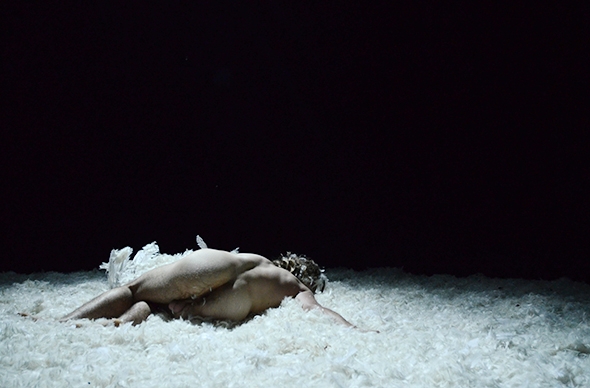
Jordan Lennie on his island of feathers in Swan Lake II: Dark Waters (photo: Nicola Canavan)
This is a Swan Lake that is perhaps closer to the Imperial Russian court and Siegfried’s hunting party than you might think but admittedly miles from the choreography of Petipa and Ivanov. When you hear Tchaikovsky’s overture you might be forgiven for thinking director Joseph Mercier is taking cheap shots at a classic ballet but this is more like a surreal 55-minute preface to Swan Lake: what is happening at home in the nest while Odette fights for her freedom against the demonic control of Von Rothbart in the royal palace. Presumably her mate is unaware of her true identity.
As we enter the auditorium we see an island of white feathers on the stage with its sole occupant, Odette’s cob (Jordan Lennie) lying naked on his feather bed brooding languidly on the eggs while awaiting her return. It is a startling homoerotic opening image that joins a long history of erotic swan associations. Hanging from a rope above him is the body of another swan, the collateral damage, perhaps, of the royal hunting party. The stark beauty of Rachel Good’s set is like the swan itself: elegant on the surface with all the workings hidden underneath. Lennie is a tidy, industrious mate who keeps his feathers pristine and buries his domestic appliances out of sight in the soil beneath the feathers: an electric hob, a frying pan, a spatula, a dressing tent, a mobile phone and an old pair of tights.
One of the characteristics of Joseph Mercier’s work is that he presents performers on stage without any distinction between self and character: in Swan Lake II: Dark Waters Lennie is a swan keeping the nest eggs warm but when he is sexually roused he signals climax by crushing an egg in his hand, when hungry he eats one raw, rustles up an omelette or peels a chocolate egg and eats it while watching the audience watching him. There is no slipping in and out of character for it is all undifferentiated Lennie.
Despite Mercier’s description of the work as an ‘estranged ode’ there are moments when he has his tongue firmly in his cheek — his use of Dusty Springfield singing I just don’t know what to do is one — but there is something deeply creative and satisfying in his imagination and the work provides Lennie with moments of extraordinarily beautiful imagery. There is a brief quote from The Dying Swan, a more extended one from Nijinsky’s Faun in which Lennie finds comfort among the wings of the dead swan (to the Springfield track), but the overpowering image is the naked swan staggering blindfolded on pointe among the feathers of his nest screaming for Odette. Mercier might well be expressing aspects of his own psyche but I can’t help feeling he is also touching on aspects of Tchaikovsky himself. Swan Lake II: Dark Waters lives up to its name, swimming from one emotion to another — from sensuality to loss, from frailty to strength, from the clarity of laughter to the loneliness of self-reflection — lapping ever closer to the edge of madness. Lennie’s performance shines but this is an inspired team effort: Good’s set, Ziggy Jacobs-Wyburn’s lighting, Dinah Mullen’s sound design, Lennie’s choreography and Mercier’s direction.

Sylvia Rimat with drummer Chris Langton in This Moment Now
Swan Lake II: Dark Waters is part of Chelsea Theatre’s season of contemporary performance, Sacred. It is the kind of programming that challenges and demands an investment of time, which is the subject of Sylvia Rimat’s This Moment Now that opens the evening. Rimat is as caught up in her subject as Mercier is in his but its nature — the elusive concept of time — demands a more analytical if playful approach. Rimat in her delivery is as precise as the metronomes set ticking at the beginning of her performance though these stand no comparison to the notion of atomic time to which she introduces us from outside the theatre via skype at the beginning of the show. She writes that the work is inspired by conversations with three eminent professors but it is her way of research to start with the highbrow and then find lowbrow, ludic ways to express her findings. She expresses time through spoken text, demonstrates it palpably through the beat of drummer Chris Langton and slows down the performance itself by serving tea half way through. We experience vicariously the present moment of a live cockerel on stage (thanks to the skillful stewardship of stage manager Alasair Jones) and watch filmed interviews with the elderly Eileen Ashmore (who also dances up a storm) and the young sisters Lola and Marlina Steinhauser Somers (clearly influenced but not prompted by dramaturg Tanya Steinhauser). Despite the arcane nature of the science Rimat keeps all her explanations within the framework of performance. It is what might be termed performative science: time is the subject but Rimat’s intelligent stagecraft makes it the unassuming star.
Posted: November 25th, 2015 | Author: Nicholas Minns | Filed under: Festival, Performance | Tags: C-12 Dance Theatre, Co_Motion Dance, Dance I made on my Bathroom Floor, Dialect of War, Duvet Cover, Emerge Festival, Gemma Prangle, Jean-Pierre Nyamangunda, Left, Maëva Berthelot, Neus Gil Cortés, Omar Gordon, Sia Gbamoi, Tamsin Griffiths, Viviana Rocha, What Is Written Dance Company | Comments Off on Emerge Festival, Week 3
Emerge Festival, Week Three, The Space, November 17

Maëva Berthelot and Omar Gordon in Neus Gil Cortés’ Left (photo: Patricio Forrester)
This is the third program of the three-week Emerge Festival curated by C-12 Dance Theatre at the intimate venue, The Space, on the Isle of Dogs. These small-scale festivals, like Cloud Dance Festival and Kaleidoscopic Arts Platform, give opportunities to young choreographers without any hierarchic selection process: it is a raw mixture of work from around the country that is never less than interesting and can include some gems. There has been a lot of discussion recently about the absence of female choreographers, but in the two programs I saw at Emerge, the majority of choreographers are women.
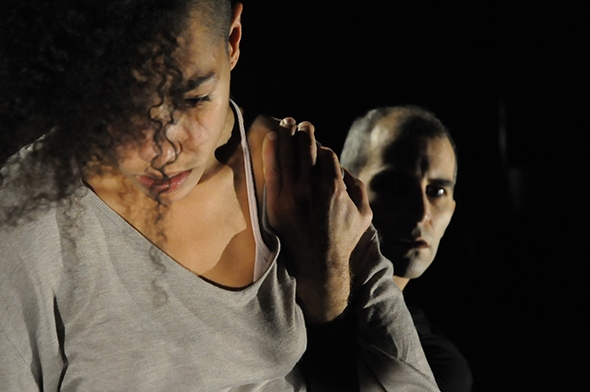
The only exception this evening is Dialect of War by Jean-Pierre Nyamangunda and Viviana Rocha of What Is Written Dance Company who join Sia Gbamoi to make a trio that starts off quite innocuously but grows in menace. Described as ‘the story of a warrior tribe whose lives are brutally disrupted’, the energy of disruption is carried in the choreography but the narrative of violence is carried in the presence of the dancers, most completely in Nyamangunda whose eyes convey both terror and pain. In Don McCullin’s war photographs it is the eyes of both victims and perpetrators that convey the ultimate darkness of the soul; the use of the face as an integral part of choreographic intent is no different.
Gemma Prangle’s Dance I made on my Bathroom Floor is about as far away from Dialect of War as a programmer could manage. Prangle starts behind a shower curtain in silhouette to the sound of running water and when she raises her arms above the curtain for a stylised soap dance the sound of lathering pervades the room. When she reaches outside the curtain for her towel we can see it is not there; it is a moment of expectation, a simple but effective piece of theatre. Prangle conceived the piece when she noticed how much time she spent dancing in her bathroom compared to the studio, but the attraction of such an idea is that she should be unaware of anyone watching. Who dances in their bathroom to an audience? By emerging from the shower (bone dry) and shielding her naked body with her arms, she acknowledges our presence. She then compounds the artifice by apologizing for leaving her towel in the audience and asking for the person sitting on it to throw it down before continuing her ablutions in all propriety. We are now effectively sitting in her bathroom and the inherent humour and absurdity of the idea has been flushed away.
Co_Motion Dance (choreographers Catherine Ibbotson and Amy Lovelock) present a quartet of women in FORCE, a highly energetic battle for power that relies on the strength and spatial precision of the performers. Some of the jumps also rely on split-second lighting cues for that are too demanding for the limited technical resources available and too much of a gimmick for the level of choreographic sophistication. The force of the work comes from the force of the performers: why contrive this brute physicality? Presumably to make it more interesting to watch, but I would argue that the construction and theatrical intent of the work have to be more interesting first.
The title of Tamsin Griffiths’ work, Duvet Cover, appears to follow a similarly domestic theme as Dance I made on my Bathroom Floor, but the duvet in question is a metaphor. It is the place of comfort, ‘an emotional home’ in a work that expresses the volatility of depression and bi-polar disorder. The piece begins with a film clip projected on to a white sheet showing Griffiths climbing into a giant duvet and relishing its warmth and comfort; the fuzziness of the image makes it look like an ultrasound image of a baby in a womb. At the moment the film ends Griffiths pushes from underneath the screen to lie supine on the stage. Her initial movements remain close to herself as she goes through the motions of adjusting drowsily to vertical and following the path of a hand that seems to have an agency of its own to a score that is dreamy if not hallucinatory. Griffiths’ entire body explodes into action as she follows a volatile narrative; there is no ‘why’ in these shifts of mood, these ‘phases of depression’ as they progress in a certain direction and then suddenly change course. Duvet Cover is a work that can be read on two distinct levels: one that doesn’t make sense and one that does. Griffiths is perhaps playing unconsciously on the ‘invisibility’ of depression and how that plays into misunderstanding about the nature of the disease. She controls her performance even when it seems most chaotic: she displays an effortless virtuosity in her ability to throw herself to the limits of her balance and return to equilibrium. Although she takes emotional risks, Griffiths is not challenged sufficiently in Duvet Cover to extend her range. Perhaps it is one of the challenges of working alone but one of the rewards is to see that raw honesty in a dynamic physical form.
The most complete work of the evening is Neus Gil Cortés’ Left, a duet for Maëva Berthelot and Omar Gordon (Cortés shares the role with Berthelot on subsequent evenings). It has a simple starting point: ‘When we are alone, all we have left is our thoughts…’ ‘All’ is the operative word, for in this fifteen-minute duet there is a great deal to inhabit our imagination and Cortés leaves open that vital gap between choreographic intent and audience reaction. Gordon, who has the dark lines of a character in an El Greco painting, is the manifestation of a relentless, demonic aspect of Berthelot’s psyche. Despite herself, Berthelot circles around him like a moth around a candle and when he finally dissolves into the darkness she is left eerily reliving his gestures. They are two but they are not two, and their partnership is mesmerisingly intense. As a choreographer, Cortés handles the frailty and domination with a freedom and depth of detail that anchor the work in a youthful maturity. She also proves her intuition as director in creating an enveloping sound score around the music of Philip Samartzis and Mica Levi, costumes that enhance the narrative and in managing to create magic from the available lighting resources.
Posted: November 16th, 2015 | Author: Nicholas Minns | Filed under: Performance | Tags: Dance Umbrella, Enric Planas, Jacques Rancière, La Veronal, Manuel Rodríguez, Marcos Morau, Pablo Gisbert, Roberto Fratini, Saint Augustine, The Emancipated Spectator, Voronia | Comments Off on La Veronal: Voronia
La Veronal, Voronia, Dance Umbrella at Sadler’s Wells, October 20

La Veronal in a scene from Voronia (photo © Josep Aznar)
If the old paradox is correct that there is no theatre without a spectator, what exactly is the role of the spectator? One writer who develops the idea of the relationship between the choreographer/performance on the one hand and the spectator on the other is French philosopher Jacques Rancière in The Emancipated Spectator. Rancière begins by positing two difficulties about being a spectator. ‘First, viewing is the opposite of knowing: the spectator is held before an appearance in a state of ignorance about the process of production of this appearance and about the reality it conceals. Second, it is the opposite of acting: the spectator remains immobile in her seat, passive. To be a spectator is to be separated from both the capacity to know and the power to act.’ To overcome such difficulties Rancière positions the spectator differently in relation to the performance by recognizing his or her active knowledge and agency, what he calls the ‘emancipated spectator’. He compares this to a teacher-pupil relationship in which the pupil will learn not what the teacher knows but what the teacher can encourage the pupil to discover what he or she doesn’t yet know. In this sense the role of a choreographer is similar to that of a good teacher. Pina Bausch allows us to make our own discoveries through her open-ended imagery, whereas Marcos Morau, the artistic director of La Veronal, whose new production, Voronia Dance Umbrella presented this season, is keen to have us understand something he is passionate about: in this case, the concepts of evil and religion.
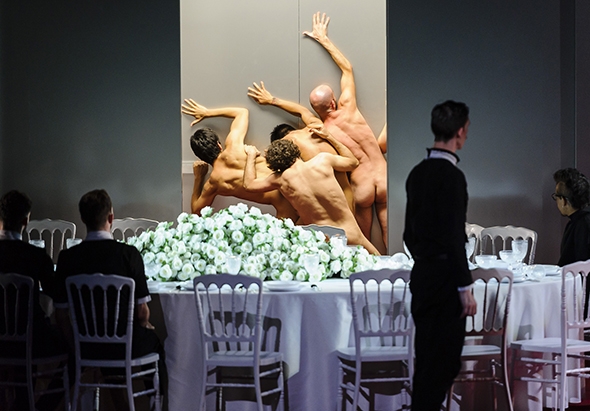
Last year Dance Umbrella presented the company’s Siena which embodied Morau’s take on art and the human body in the seductive setting of the Uffizi Gallery in Florence. In Voronia Morau has conceptually moved his world of darkness and evil to the deepest cave in the world, Krubera Voronia in the western Caucasus but the stage set is neither deep nor dark: designer Enric Planas has contrived what looks like a convention-centre setting for the last supper: a table laid for a feast in a banqueting room with its red carpet and scalloped beige curtains hiding a steel cargo elevator that doubles as an operating theatre. As we take our seats we see the company dressed in white overalls meticulously cleaning the carpet with vacuum cleaners, buckets of water, sponges and mops while a young boy (Jared Irving) dressed as a waiter looks out at the audience. Above the stage is projected the Latin phrase, ‘In girum imus nocte ecce et consumimur igni’, a riddle in the form of a palindrome that means ‘we wander in the night and are consumed by fire.’
In the program note, Morau invokes the philosophies of Saint Augustine to state that in the same way that darkness is the absence of light, so evil is the absence of good. According to Morau, ‘humanity created God to secure the boundaries of morality; God serves as the keeper of goodness and a moral refuge for humankind. But in the hands of man, religion has gone to seed. For to kill in the name of God is to kill God and the absolute moral system.’ (As I write Paris is under a state of emergency following the terrorist attacks). In its printed form this is a cogent argument — a one-on-one with the reading spectator. But what happens when it is translated into the layered imagery of the stage with its surtitled text, visual imagery, dance, operatic music and spoken word? More importantly, what happens to the relationship between performance and spectator? In such a hybridization of media in the service of such a rational argument, it appears Morau and his dramaturgs Roberto Fratini and Pablo Gisbert have meticulously prepared all the translation and interpretation in advance, leaving the spectator to unravel an intellectual puzzle in which he or she wanders passively through a bewildering set of images to return at the end, for want of clarification, to the printed proposal. Part of the problem is that some elements of the layering do not read in the theatrical space — it is difficult to take in the texts of Saint Augustine while watching the action below, for example — and others, like the choreographic language cloned from the idiosyncratic Manuel Rodriguez or the soundscape that devolves from a heartbeat into a series of rousing opera choruses are not developed sufficiently to make them integral to the creative arc. But the major problem is the withdrawal of control from the spectator by the creator. It is like a teacher whose determination to inculcate his knowledge leaves no room for the pupil to learn.
Posted: November 5th, 2015 | Author: Nicholas Minns | Filed under: Performance | Tags: Adam Gain, Alexander Whitley, Amanda Barrow, Andrew Graham, Beheld, Candoco Dance Company, CounterActs, Eva Martinez, Hetain Patel, Jackie Shemesh, Jean-Marc Puissant, Jessica Dixon, Joel Brown, Laura Patay, Let's Talk About Dis, Megan Armishaw, Tanja Erhart, Toki Broni Strandby, Valentina Golfieri | Comments Off on Candoco Dance Company, CounterActs
Candoco Dance Company, CounterActs, Laban Theatre, October 8

Candoco dancers in Alexander Whitley’s Beheld (photo: Hugo Glendinning)
There is something remarkable in the way Candoco’s dancers bring out the best in the choreographers they work with and how the choreographers bring out the best in the dancers. CounterActs is no exception, a chance to see again Hetain Patel’s witty Let’s Talk About Dis and to see a new work, Beheld, by Alexander Whitley. It is the latter that catches my attention immediately as I arrive late to see the end of a duet between Joel Brown and Adam Gain. Its virtuosity — especially from Brown in his wheelchair — and spatial ingenuity set the tone for the solo by Tanja Erhart that follows. Whitley does not so much create steps for Erhart as carve dynamic space around her; she is often in silhouette like a shadow puppet with her supports, revealing shapes that are starkly beautiful. The screen behind her, conceived by Jean-Marc Puissant and realised by Jessica Dixon and Amanda Barrow, is made up of four panels of stretched elastic material that looks like a silver metal barrier under Jackie Shemesh’s cool lighting but the dancers behind it bring it alive by pressing their faces and hands into it and lure Erhart towards them. As she approaches in a dream-like state — a quality the music of Nils Frahm conjures up beautifully — she abandons her crutches and presses herself into the material, invisibly supported on its vertical surface as if on water. Erhart shines in this subtle transference of weight and strength until the surface tension eventually gives way and the whole thing comes rippling down around her.
Whitley writes about his current interest in ‘how choreographic ideas can be extended into material forms beyond the body.’ The material the dancers handle in the opening (which thanks to the company I later saw on video) and later sections is a metaphor for bringing out not their differences but what binds them together; in their handling of the material they are all on the same footing and Whitley weaves this equality into playful, complex choreographic patterns.
Another achievement in Whitley’s work is its virtuosity, particularly in Brown’s duet with Gain where he spins on to his back in his wheelchair with a speed and precision that matches Gain; when the latter raises his legs over his head, Brown does the same effortlessly with his wheelchair. With his powerful torso and arms Brown makes his wheelchair subservient to his virtuosity until it becomes almost invisible. Beheld is a work that brings the company together in ways I haven’t seen before in Candoco’s repertoire and in doing so Whitley makes the company look brilliant.
In Let’s Talk About Dis (a witty reference perhaps to DV8’s Can We Talk About This?) Patel talks about attitudes to disability with an openness and humour that was missing from Lloyd Newson’s choreographic sermon on attitudes to multiculturalism. Patel’s idea of Let’s Talk About Dis is to throw all our preconceptions about disability up in the air, play with them, redefine them and let them fall back to the ground of our understanding. He takes his time to set the scene as the dancers wander on, take off their shoes and carefully mark out a square with white tape, a space in which a game of political correctness will be played by the home team on its home ground. Patel’s text, like all his works, is meticulously scripted and shaped (Eva Martinez helped with the dramaturgy); he loves voices both for what they say about the world and for what they say about the person. In his own solo shows he takes on any number of voices himself but here he has gifted his voice to the dancers and, like Whitley’s material, it allows them to compete on equal terms. As a gifted mimic Patel knows his way into the life behind the voice and by listening to the dancers’ stories and their banter he brings out their lives through their words, filtering their offerings through a sense of humour that verges on the absurd. The masterful trio of Toke Broni Strandby mis-translating into English Laura Patay’s story in French about what children have said about her missing arm with Andrew Graham signing in BSL is a like a Mozart aria in its witty complexity and beauty while Erhart relating her sex education in vocal harmony with Strandby is both poignant and gives the signers some hilarious moments. Patel succeeds in talking about dis, or more importantly getting the dancers to talk about dis, in a way that demystifies it, that breaks down barriers. The dancers look relaxed in Valentina Golfieri’s costumes and under Shemesh’s lighting as if their personalities have come dancing into the light, but as Gain says at the end, ‘We’re going to keep talking about it until we don’t need to keep talking about it.’
CounterActs at Dance East in Ipswich next week is sold out, but the company will be performing it again at the Bristol Old Vic on February 12, 2016
Posted: October 27th, 2015 | Author: Nicholas Minns | Filed under: Performance | Tags: Claire Cunningham, Dor Mamalia, Emma Gladstone, Give Me a Reason to Live, Hieronymous Bosch, Idan Sharabi, Jean Mouton, Karsten Tinapp, Ours | Comments Off on Dance Umbrella double bill of Idan Sharabi & Claire Cunningham
Dance Umbrella: Ours & Give Me a Reason to Live, Lilian Baylis Studio, October 17

Claire Cunningham in Give Me a Reason to Live
Quite apart from its obvious physical dimension, contemporary dance is invariably a touchstone for truths and notions from the worlds of philosophy, art, history, metaphysics, politics and whatever else a choreographer might wish to draw on as material. Claire Cunningham’s Give Me a Reason to Live is rich in resources, leading you into her landscape of preoccupations that range from the nature of sin, empathy, faith, the visibility of minorities, the depiction of cripples in the paintings of Hieronymous Bosch, Nazi euthanasia of the terminally ill and disabled and the consequences of our present government’s welfare reform. Of course all this is not readily apparent in the performance; you have to dig to find what informs the movement, but without it Give Me a Reason to Live would not be the powerful polemic it is. Cunningham does not have the range of movement of an able-bodied dancer — she suffers from a debilitating form of osteoporosis — but what she does with her crutches and her limited movement is to directly embody her ideas, to live them on stage and because she knows what she is talking about she evokes a visceral response. When she strips off her outer clothing and lays her crutches beside her to stand unaided, there is no pretense. It is a physical and mental struggle that she experiences in real time and she succeeds through sheer willpower until she can endure it no more. What differentiates this naked physical act from the intention behind it is that landscape of preoccupations I mentioned earlier. The word ‘understand’ has the meaning to stand under, or support. Cunningham’s test of endurance is not about her but about what she stands for, about who she supports. She is standing for the countless victims whose disabilities relegate them to the invisible margins of society or worse. Remarkably Cunningham achieves all this through dance.
Standing is but one of the images she invokes on this journey. When we first see her she is slowly extracting herself from a corner as if she had been placed there by history, leaning forward on her crutches as extensions of her arms against the walls. A shard of light (from the palette of Karsten Tinapp) illuminates a thin sliver of her body from head to foot, as if sunlight were falling through a high rectangle of light (the harsh angles in Daniel Liebeskind’s Jewish Museum in Berlin come to mind). Another ineffable image is her rocking gently forward and falling back balanced on her crutches (see photo) to the hauntingly fragile Nesciens Mater by Jean Mouton, after which she slowly collapses to the floor in the form of one of Hieronymous Bosch’s spindly cripples (‘a distorted symbol of human baseness’), crutches at her side. But the final image, the one to which all previous images seem to lead both physically and spiritually, is Cunningham as a Christ-like figure suspended on her elongated crutches braced against the back wall singing (yes, Cunningham trained as a singer before finding her vocation in dance and has a beautiful mezzo voice) Bach’s Cantata BWV 4, Verse 2 with a breathless purity that crowns the journey she has undertaken in light.
No one could defeat death
among all humanity
this was all because of our sins,
no innocence was to be found.
Therefore death came so soon
and took power over us,
held us captive in his kingdom.
Hallelujah!
How do you pair this extraordinarily rich 35-minute work with another without detracting from it in any way? Dance Umbrella’s artistic director Emma Gladstone’s decision to open the evening with Israeli choreographer Idan Sharabi’s Ours is a stroke of genius. On the surface Sharabi’s male duet to songs of Joni Mitchell is funny, engaging and superbly danced by himself and Dor Mamalia, but its central question of what is ‘home’ in Israeli society has a profundity and a vulnerability that shares Cunningham’s preoccupation with invisible minorities and the duet’s suggestion of homosexual love — ‘our little opportunity to find our home together’ — takes on political significance in its context of a strongly homophobic society. Sharabi and Mamalia don’t dwell on this but simply embrace it with tenderness, compassion and a sense of humour that draws the audience in to the work’s humanity. But there is perhaps another, more insidious connection between the two works: hovering in the air between Ours and Give Me a Reason to Live is a commentary on the ever-present spectre of persecution.
Posted: October 26th, 2015 | Author: Nicholas Minns | Filed under: Performance | Tags: Anna Kazsuba, Dan Canham, Dance Umbrella, Isabelle Cressy, Luke Harney, NCP Car Park Farringdon, Odilia Egyiawan, Of Riders and Running Horses, Sam Halmarack, Still House, Tanya Richam-Odoi, Tilly Webber, Typesun | Comments Off on Dan Canham/Still House, Of Riders and Running Horses
Dan Canham/Still House, Of Riders and Running Horses, NCP Car Park Farringdon, October 16

The setting of Dan Canham’s Of Riders and Running Horses (photo: Paul Blakemore)
There is something unconventional if not transgressive in putting on a contemporary folk dance event atop a multi-story car park on an October night in London, but that is what Dance Umbrella and Dan Canham have done with Of Riders and Running Horses that opened this year’s festival. It is an apt pairing, for while Canham aims with his dance and music to carve out a space for people to gather, Dance Umbrella aims ‘to be a catalyst that introduces…the audience to artists in new ways.’
Canham is one of the most grounded choreographers I know and has compelling arguments behind each of his projects. Of Riders and Running Horses is the confluence of two principal ideas: to reimagine the transformative effect of folk traditions like the Molly dances of East Anglia, the straw bear festival of Whittlesea or the tar barrels of Ottery St. Mary, and to recreate the kind of urban public space where such events might happen. In his two previous works Canham proved adept at finding language to translate tradition and geography into dance: a paean for his childhood countryside in Ours Was the Fen Country and a tribute to the ghosts of an abandoned theatre in Limerick in 30 Cecil Street. His choreographic ideas grow not from abstract ideas but from fertile soil, from the life of the countryside he knows and loves. This is what makes his works not only graspable but memorable.
In thinking about what might constitute a modern folk idiom — one that eschews ownership and belongs to the life of the community in which it is practiced — Canham has taken aspects of house, jump and street dance as his point of departure for the work. And in the age of the Internet where the concept of ‘local’ is no longer bound by parochial geographical boundaries, Canham has borrowed and adapted steps he had seen in video clips of street dance in other parts of the world.
Of Riders and Running Horses is choreographed on five dancers: Anna Kazsuba, Isabelle Cressy, Odilia Egyiawan, Tilly Webber and Tanya Richam-Odoi. To be more precise, the choreography developed through both Canham’s input and the dancers’ improvisation to the music of drummer Luke Harney (aka Typesun) and singer Sam Halmarack. These two are the ‘Riders’ in the title and the dancers are the ‘Running Horses’. In other words it is not always clear who is leading the way but once they get going there is no stopping them. It is Halmarack who cuts through the crowd’s chatter with a singing voice that instantly commands attention. Canham has each dancer in turn jump, step or fly out of the audience to begin dancing to Harney’s complex musical rhythms with a mastery of undulation and quicksilver footwork that builds into high-energy ensemble sections with thigh-slapping rhythms punctuated with calls. In between these group dances, four of the five performers merge back into the audience while a fifth dances alone, giving free rein to her personality until the group reassembles. Although there are shared elements in the vocabulary, each solo has variations in temperament; on one end of the scale Kazsuba is contemplative, winding down with sinuous grace to an eloquent whisper of movement, while the space around Egyiwan has no chance to rest. Yet when they all move together they are an irrepressible quintet.
The NCP car park in Farringdon is perhaps more exciting in theory than in practice. Its promise as a communal urban space is diluted by fixing the boundaries of the performance area at one end of the top floor, surrounded on three sides by the audience and an inner sanctum of a tent for the two musicians behind. The stage may be open to the elements but it is effectively a theatrical culture (with its ethos of watching rather than participating) transposed to the rooftop instead of an organic congregational format where people are drawn into the activity to watch, mingle and wander at will (a format suggested in Paul Blakemore’s photograph on the cover of the festival program).
Perhaps because the audience is so formally arranged around the ‘stage’ the celebratory aspect of the performance doesn’t physically ignite the audience, however hard the dancers try and however gleefully they reach out to the front row of hands as they pass. It is only at the end that the dancers breach the wall and invite the audience on to the dance floor. The opportunity to warm up may be one reason for the eagerness to join in but it also suggests a desire to engage with the dancers and musicians that has been too long withheld by imposed convention.
Posted: October 12th, 2015 | Author: Caterina Albano | Filed under: Performance | Tags: Elena Kats-Chernin, Leafcutter John, Material Men, Shailesh Bahoran, Shobana Jeyasingh, Smith Quartet, Sooraj Subramaniam | Comments Off on Shobana Jeyasingh, Material Men
Shobana Jeyasingh, Material Men, Queen Elizabeth Hall, September 16

Sooraj Subramanian and Shailesh Bahoran in Shobana Jeyasingh’s Material Men (photo: Chris Nash)
I saw Shobana Jeyasingh’s double bill of Material Men and Strange Blooms with a friend who has contributed the following review. I had seen Strange Blooms before and although it is a different cast with some changes to the production I have not written about it again.
In a time when borders are closed and fences built, Shobana Jeyasingh’s Material Men feels both poignant and topical. In the note to the performance, Jeyasingh reminds us that the abolition of slavery in 1833 caused a wave of migration from the Indian subcontinent as European colonies sought cheap labour. Inspired by such a long history of migrant displacement, Material Men is a reflection on the ways in which cultural memories transmigrate across places and generations and how individuals mediate, absorb, long for or reject them; how memories — whether integrated or suppressed — contribute to forge individual identities. How the past, which is both historical and mnemonic, roots and haunts us at the same time. Choreographed for two male dancers on an original score by Australian composer Elena Kats-Chernin (played on stage by the Smith Quartet) with sound design by Leafcutter John, the piece opens with Sooraj Subramaniam and Shailesh Bahoran slowly entering the stage wrapped together in an orange silk sari. The account of their own family stories of migration can be heard in the background. The sari that ties the dancers together is like the fabric of histories and memories that weave shared pasts across times and places. It is the fabric that binds cultural, social and individual identities, the material with which each of us has to deal. It is ‘the continuous thread’ — as Marcel Proust writes — ‘through which selfhood is sewn into the fabric of a lifetime’s experience’.
As they unwrap themselves from the sari and release it, Subramaniam and Bahoran display their different bodies and responses to the fabric of the past that links them. Tall and elegant, Subramaniam is trained in the classical bharatanatyam tradition. He is bare foot, and wears traditional make-up and jewelry. Shorter and slighter, wearing shoes and knee pads, Bahoran exudes tense physicality: he is a hip-hop dancer. These differences are indicative of the distinct styles of dance and modes of performing that Material Men bring together. Bharatanatyam is a highly formal dance that has been transmitted and refined across the centuries; hip-hop comes from street performance and a subversive mixing of influences from rock to Afro-American dance. Jeyasingh’s choreography seamlessly weaves these two types of dance into a complex tapestry of patterns that seems to follow an intersecting of symmetries and asymmetries as she elaborates the quintessentially distilled and minutely precise movements of bharatanatyam with the hybrid dynamics of hip-hop. Hence, hands and feet positions are mirrored and at the same time fractured, extended and taken in new directions as one dancer responds to the other in a physical dialogue that constantly draws upon a canopy of contrasting movements from which transpire no less conflicting feelings and emotions. Joy, tenderness, antagonism and suppressed rage intersect as limbs and gestural patterns crisscross. Subramaniam and Bahoran may be said to encounter in each other the stranger that according to Julia Kristeva we all carry within us and which forms us from histories of psychic, cultural and historical migration. The dancers variously accommodate and contend with each other, and with the ‘stranger’ that each of them reflects back to the other.
From this encounter, visual and figurative forms emerge and disappear and in-between, in the interstices between sequences, moments of stillness are perceptible, as if they were ‘formless’ spaces, gaps saturated with possibilities and contradictions. It is in such dynamic flow of movement and stillness, of tension between form and formlessness that the transcultural features of the piece become palpable. Like the pleats with which Subramaniam carefully folds the sari, the layers are many and complex. Labels such as classical and pop, traditional and contemporary are reductive for what is a reconfiguration of the significance of dance movement as a medium that conveys the deeply embodied affect of cultural trajectories, backgrounds and individual histories. The work and the quest within it, however, are never nostalgic. The cultural allusions proper to bharatanatyam and hip-hop are conducive to the present, to the highly individualized interpretation that the dancers and choreographer confer on them by generating new synergies, overlapping rhythms and gestures. The piece concludes in a slow sequence in which Subramaniam and Bahoran move sideways off stage, one next to other, the arms parallel to the floor, half squatting. The movement feels endless as if melting into infinity, as if harmony and balance between pasts and presents, histories and memories were possible. As if continuity and reciprocity were not estranged by inner or outer boundaries.
Jeyasingh’s Material Men is a thought-provoking work. And Subramaniam and Bahoran are both superb performers.
c.a.
Posted: October 6th, 2015 | Author: Nicholas Minns | Filed under: Performance | Tags: Alessandra Ferri, Christopher Akerlind, David Zinn, Francesca Annis, Herman Cornejo, Martha Clarke, Sarah Rothenberg | Comments Off on Alessandra Ferri in Martha Clarke’s Chéri
Martha Clarke and Signature Theatre, Chéri, Linbury Studio Theatre, September 30

Herman Cornejo and Alessandra Ferri in Martha Clarke’s Chéri © Signature Theatre (photo: Joan Marcus, 2015)
The combination of Martha Clarke and Alessandra Ferri seems irresistible. I remember vividly a piece by Clarke called Nocturne, a poignant portrait of an ageing ballerina. With its unerring sense of the absurd Nocturne was painted with strokes of beauty and compassion and a wicked sense of humour. What might she create with Ferri in the adaptation of Chéri, a novel by Colette describing the love between a young man (Chéri) and an older woman (Léa)? In Nocturne Clarke seemed to have taken to heart Colette’s advice to writers: ‘No narration, for heaven’s sake! Just brush strokes and splashes of colour…’ and in the opening section of Chéri she does just that: Ferri relishing the taste of strawberries at the breakfast table while her tousled partner, Herman Cornejo, gets out of the rumpled bed; the playful exchanges over a pearl necklace; the passionate airborne embraces, the petty jealousies, the smiles and the tenderness. But as Chéri develops Clarke appears to repudiate Colette’s advice in favour of narrative elements that serve to attach the dance to the story in overly literal ways.
Firstly, the set by David Zinn — a comfortably sparse, fin-de-siècle Parisian apartment — dominates the stage in its theatrical detail and reduces the dancing area to the spaces between furniture. There is a grand piano in one corner at which Sarah Rothenberg plays (mostly) French repertoire by Colette’s contemporaries with studious attention. She is on stage but she is not in the apartment; Léa and Chéri do not hear her playing — the music serves, like Zinn’s set, as an anchor to a specific time and place — but it provides a structure to which they dance. It is not Colette’s structure, however. For that, Clarke asked Tina Howe to adapt Colette’s novels and to shape a text to be spoken by Léa’s friend and Chéri’s mother, Charlotte (the actress Francesca Annis). Charlotte is thus both a nominal character in the work and a one-woman chorus. Like Rothenberg, she doesn’t seem to be in the apartment but slips invisibly into the room like a spiteful ghost to poison the surroundings with her prattle and hasten the story to its end. Her interventions are directed to and for the benefit of the audience; Chéri and Léa overhear her but remain mute. For the purposes of unity, I wonder if Charlotte’s role could have been divided into a program note and a third dancer and if the grand piano could have been replaced — with no disrespect to Rothenberg’s playing — by a gramophone.
Taken on its own level, the dancing is beautiful. Ferri may be older than Cornejo but when they dance we see two young lovers. The initial vocabulary of intimate partnering sings of romance, sex and their complexities — the two can’t keep out of each other’s arms and legs — even if in subsequent scenes the partnering does not evolve sufficiently to give a sense of development in the relationship. It is in two solos that Clarke allows her characters to express their inner feelings more completely. She translates Léa’s despair following Chéri’s arranged marriage into movements close to the floor, leaving behind as much as possible the trappings of classical ballet to reveal Ferri’s embodied experience. Nevertheless, when Ferri dances there is something of the consummate artist in her that expresses her fragile state in a body that is too confident of its ability. Cornejo’s solo is more substantial; it comes in the final scene of the work, an adaptation of Colette’s La Fin de Chéri, which portrays the unstable, frenetic mind of the young man burdened by his experiences of the First World War and aware that his relationship with Léa is over. Cornejo is very much the romantic antihero here and like Ferri his effortless technique makes him appear much stronger than his state of mind might otherwise indicate.
I read Colette at school and remember the excitement of imagining forbidden, sensual relationships at a time when they seemed so out of reach. Without advocating complete realism on the dance stage, it is rather disappointing to see Colette’s vision turned into a scrupulously censored version where Cornejo and Ferri make love in their underwear and sleep and wake in their costumes. Clarke is fully aware of this; for one brief moment she has Cornejo pull down his underwear to present his bare backside as he falls on top of Ferri in bed. It is another gesture meant only for the audience, a naughty peak in a peep show that at best titillates and at worst passes for sensuality. Colette might well be giggling in her grave.
One more ambush awaits Clarke. In Colette’s story, one of the causes of Chéri’s existential crisis is that Léa, his once beautiful courtesan, has grown plump. It is left to Charlotte to announce it to us (with unconcealed pleasure) but there is an immediate suspension of belief. We do not see Léa again on stage; we cannot. She appears to Chéri instead in a mirror as a romantic vision. Chéri’s downward spiral is thus based on an implausible abstraction and his end is reduced to little more than a dramatic artifice.
Chéri has too many contradictions to make it work as dance theatre, but in one important regard it is invaluable: it has allowed Ferri the confidence to emerge from retirement. She is at a remarkable stage in her career when the instrument of her body is working beautifully in its maturity as she searches for ways to express it. Chéri has given this great dramatic dancer a chance to find her feet once again.