Posted: February 17th, 2016 | Author: Ian Abbott | Filed under: Performance | Tags: Alon Cohen, Anton Lachky, Audrey Rogero, Dreamers, Fleur Darkin, Francesco Ferrari, Gai Behar, Jori Kerreman, Josh Wild, Matthew Robinson, Ori Lichtik, Process Day, Rebecca Hytting, Sharon Eyal | Comments Off on Scottish Dance Theatre, Dreamers & Process Day
Scottish Dance Theatre, Dreamers & Process Day, Dundee Rep, February 12

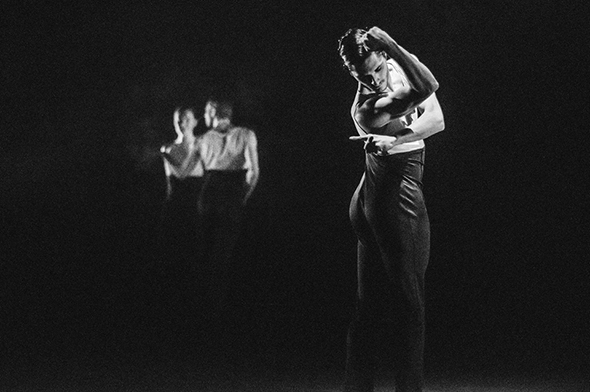
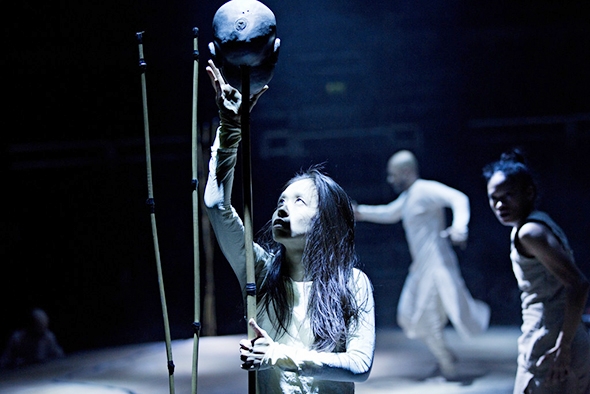
Scottish Dance Theatre in Sharon Eyal and Gai Behar’s Process Day (photo: Brian Hartley)
“Dreams have only one owner at a time. That’s why dreamers are lonely.” – Erma Bombeck
Anton Lachky’s Dreamers woke up last February in a Scottish Dance Theatre double bill with Jo Strømgren’s Winter, Again. Upon first viewing I struggled to see the fit as the pair were too similar — both showcasing lightness, comedy and a hyper-real quality. So I’ve come back to Dreamers to see how it has settled into the bodies of the dancers, into the company and how it sits with a new bedfellow, Sharon Eyal and Gai Behar’s Process Day.
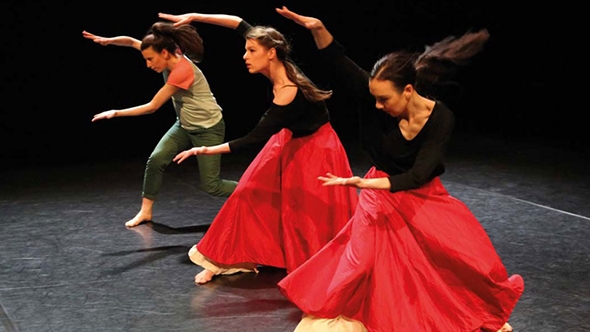
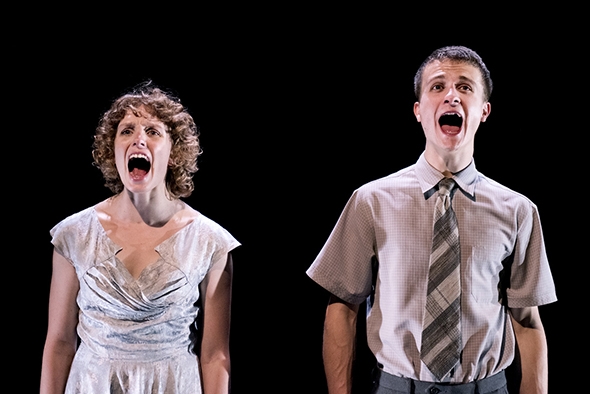
Dreamers defines itself as “making sense from nonsense and exploring links between reality and surrealism” and over the course of 35 minutes it delivers its intention well. A police line-up forms the opening image where all nine performers face front and Aya Steigman erupts from the line, fizzes with skittish urgency and delivers a hiphop-laced solo that is startling in its ferocity. This is the opening minute and I wonder whether my eyes can contain or maintain the pace. The invisible energy passed between each of the solo performers is dialled down the further away from the original source we go until everyone has had a chance or two to show us their best moves.
Nothing lingers for too long and at the same time we’re not asked as an audience to invest much either; we see two or three playful examples of what the world might look like if the choreographic power is given over to Audrey Rogero and Francesco Ferrari. The strongest visual memory from my first Dreamers was the face-melting elasticity of Rogero and 12 months on, the malleability, facial contortions and impossibly extended neck stand out again as she out-Doyles Mrs Doyle. Slapstick, physical buffoonery and bodily control are re-employed again and again with Rogero manipulating the remainder of the company at her whim; spinning, flicking, and boot-camping them. As she discovers her power and ability to transform she gifts us one of the most infectious cackles heard on stage.
“Nearly all men can stand adversity, but if you want to test a man’s character, give him power.” – Abraham Lincoln
When Ferrari emerges from the pack to take control, he’s barking orders ferociously in an unknown language and basking in the power of controlling the others — apart from when Amy Hollinshead marches out of the line like a rebellious tin soldier, frustrating Ferrari even more.
The lightness and humour shines alongside the musical choices of Bach, Verdi, Chopin and Haydn. Dreamers is a white, crisp, and frothy demonstration of personality, wild abandon and fine dancing.
“A man must dream a long time in order to act with grandeur, and dreaming is nursed in darkness.” – Jean Genet
As night follows day, dark will follow light and Process Day now follows Dreamers.
Are we in Dundee or have we been transported to a Weimar Republic cabaret, a dark world filled with luscious, crepuscular creatures, a place where gender is dissolved and eyes linger on the smallest of details? Eyal and Behar, alongside Ori Lichtik (musician), Rebecca Hytting (assistant and co-costume designer) and Alon Cohen (lighting) create an unsettling environment that either repulses or embraces the eyes that rest on the stage.
Clad in black from foot to ribs and a neutral scrim from the chest upwards, the dancers exist in a quarter light giving the impression of a floating set of torsos and amplified arms which frame and isolate each other like a vogue ball. From the nine performers, Josh Wild (apprentice dancer from London Contemporary Dance School) is a choreographic leech, creeping onto other performers, intruding and creating a series of unwanted duets before blending back into the dark. The dancers seem almost extra human and there’s a striking motif of Matthew Robinson’s controlled head-butting of Jori Kerreman’s stomach – it fits perfectly in this world and is one of the many lingering frescoes which sit amongst the larger-scale ensemble moments.
“So the darkness shall be the light, and the stillness the dancing.” – T. S. Eliot
Cohen’s lighting design aligns well with the choreographic intention; despite the lights being so dim I am noticing the slightest of movements: twitches, ankle rotations and shoulder snaps were pulling my eyes all over the stage as a thin film of haze weighs heavily on the stage.
Classical strings, abrasive bass and relentless synths offer a sonic realm that promotes difficulty. Choreographic difficulty is also on show as not all the dancers are comfortable with this hard, sinewy performance style. Eyal and Behar are a brave choice from Artistic Director Fleur Darkin as they’re asking the dancers a completely different set of choreographic questions from those of Damien Jalet’s Yama, Darkin’s own Miann or Strømgren’s Winter, Again.
“Androgyny is not trying to manage the relationship between the opposites; it is simply flowing between them.” – June Singer
I am sucked into the world of Process Day by the scenographic control that Eyal, Behar and their collaborators have over me. It is satisfying to spend 40 minutes with them in their world of heavy and dark; but if the company does with Process Day what they did with Yama — extending it from an original half bill to a full-length work — now that would be a 30th birthday present worth unwrapping.
(Dreamers and Process Day are on Scottish Dance Theatre’s double bill tonight and tomorrow at Traverse Theatre in Edinburgh)
Posted: February 17th, 2016 | Author: Nicholas Minns | Filed under: Performance | Tags: Adolphe Binder, Alistair Spalding, Chile, como el musguito, Ditta Miranda Jasjfi, Marion Cito, Peter Pabst, Pina Bausch, Tanztheater Wuppertal Pina Bausch | Comments Off on Tanztheater Wuppertal Pina Bausch, “…como el musguito en la piedra…”
Tanztheater Wuppertal Pina Bausch, “…como el musguito…”, Sadler’s Wells, February 13

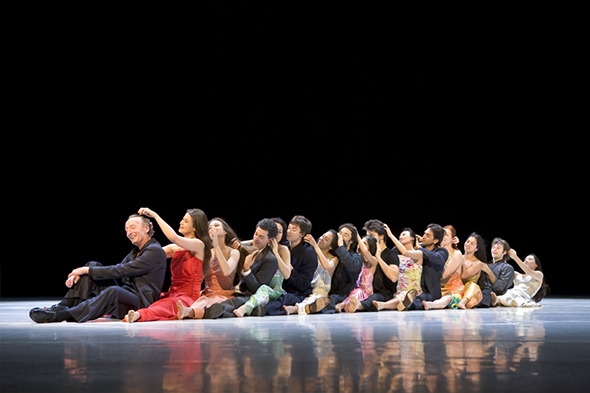
Tanztheater Wuppertal Pina Bausch in “…como el musguito…” (photo: Laurent Philippe)
To judge…como el musguito en la pedra, ay, si, si, si… as the last work of Pina Bausch would be to take advantage of history. Bausch was not aware this was going to be her last work; she died on June 30, 2009, five days after being diagnosed with cancer and just 18 days after its première. “…como el musguito…” is a continuation of a series of works Bausch made in response to the culture of a particular city or country to which she and her company had been invited; this one is based on a visit to Chile. It is a happy, smiling work that touches on a joie de vivre that is lighter in tone than many of Bausch’s previous works. Peter Pabst’s conception of the stage as a large expanse of white floor curtained in black provides a vast, uncluttered space of light in which the vibrant colours of Marion Cito’s costumes for the women create a joyous vitality. The memories of Chile and its music seem to have suggested more tanz than theater; each of the sixteen members of the cast reveals him or herself through a solo though there are similarities between them, hints of gesture in boneless arms wrapping enigmatically around a liquid torso. The women’s long hair is integral to their dance, blurring and extending body lines in unimaginably sensual ways; Ditta Miranda Jasfi is the consummate example and her ebullience pops up undiminished throughout the work. This brightness and play is offset by symbolic reminders of the darker elements of Chile’s political past, through men chasing each other across the stage or hurtling around it, by the use of ropes for aerial escape as well as for restraint, and a rape scene where a women in white is passed roughly between seven men. But the underlying menace has an aesthetic overlay that plays shock on a minor scale. The result is a work that has all the visual elements of Bausch that run together a little too easily. I have never subscribed to the notion of a Bausch work being too long or needing editing; each is rich in detail that has been distilled within her imagination from a multitude of impressions and connections and extracted through the bodies and minds of her dancers. That is not a formula for conciseness and it is not the problem with “…como el musguito…”. The problem is a gradual but inevitable dilution of the work because that extraordinary imagination is no longer present.
Bausch famously stated in an interview with Jochen Schmidt that she was not interested in how people move but in what moves them. The unique reputation of her company rests not only on her choreographic and theatrical imagination but on the quality of the artists she has trained. She built up the stature of her dancers from the inside out so they could convey even the smallest gestures with the exaggerated clarity of thought and feeling. This is her legacy as much as the choreography she or her dancers produced, but it is a legacy that, unlike the steps, cannot be maintained in its entirety without her alchemic presence and guidance. This is both the strength and the weakness of Tanztheater Wuppertal: the genius who produced such great work also produced a company of artists dependent on her genius.
This evening’s cast of “…como el musguito…” is, with one exception, the original, so the dilution I sense in the work is not a question of new artists taking over others’ roles, though this is what is happening in the company for older productions in the repertoire. One of the strengths of the company — and what has allowed it to continue performing Bausch’s works — is that many dancers who worked closely with Bausch (there was evidently no other way to work) have remained in the company either as performers or as rehearsal directors. But however experienced, they are interpreters rather than the inspiration and interpreters need the constant probing and the gaze of the creator for their artistry to evolve.
Inevitably Bausch’s works will suffer further from the impossibility of maintaining their former brilliance and balance despite the fact that audiences will still want to see them and tours will remain financially viable. In a Financial Times podcast in 2012, at the time of the landmark Ten Cities project, Sadler’s Wells artistic director, Alistair Spalding, thought the company could survive in its present form ‘another 5 or 10 years’. Tanztheater Wuppertal has evidently been thinking along the same timeline. Next year, eight years after Bausch’s death, a new ‘intendant’ appointed from the outside, Adolphe Binder, will take over the reins of the company. Her unenviable but vital task will be to safeguard the integrity of Bausch’s performance legacy and to engage this extraordinary artist-led collaborative in new repertoire.
Posted: February 16th, 2016 | Author: Ian Abbott | Filed under: Performance | Tags: Anna Woodhouse, Daphna Attias, Maya Politaki, Peut-Être Theatre, Shh...Bang! | Comments Off on Peut-Être Theatre, Shh…Bang!
Peut-Être Theatre, Shh…Bang!, The Blue Room, Southbank Centre, February 10

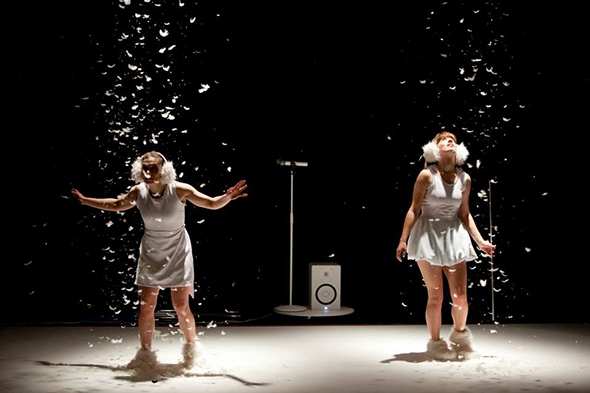
Maya Politaki and Anna Woolhouse in Shh…Bang! (photo: Ludovic des Cognets)
“Words cannot express quite a lot of feelings, whereas a noise or tone or drone or sound, an accordion falling down a staircase, can somehow capture an emotion much better.” – John Lydon
In this world I am a space invader. Shh…Bang! has been designed not for people like me but for those who are 3+ (a set of people with a different and playful response to visual and auditory stimulation) who demonstrate little fear in sharing their thoughts with fellow theatre goers and provide an uncensored reaction to work whether it engages them or not. Here they are absolutely rapt.
Artistic director Daphna Attias has carefully crafted four colourful quarters where the performers (Maya Politaki and Anna Woolhouse) discover noises, explore what their bodies sound like and encourage gentle interaction with the audience. With several collaborations in the research and creation process (Great Ormond Street Hospital and the Institute of Acoustics and Vibrations in Southampton University), the company has fine-tuned its findings and demonstrates an audience acumen; the visual and aural stimulus from the Shh…Bang! palette is never dull and always surprising. There are swift changes in the choreographic and sonic dynamic, multiple set and prop shifts, a keen awareness of pace and the performers never let a new discovery outstay its welcome.
“I frequently hear music in the very heart of noise.” – George Gershwin
Sound adds a different stickiness to memory and ensures that images linger longer; the moments that reverberate most are when unusual noises mesh with movement in scenographic harmony. When Maya bounces on her haunches like a basketball frog to the harmonica or Anna is casting high-pitched invisible spells from a thin, rosin-oiled metal tube, these were moments of pure invention. Like grains of rice ricocheting on a tight drum skin, delivering 45-minute performances (nine across three days) with an infectious curiosity for sound, energy and movement Anna and Maya were a joy to watch.
With a performance that is so entwined with sound and vision, the relationship between technician and dancers has to be sharp as isolated bodily movement triggers farting nose buttons, creaking shoulder locks and other noise eruptions. However, on more than one occasion there is some slight discrepancy between the two, although the more forgiving little eyes in the room didn’t seem to mind.
“Just the other day, it seems, the kids were running through the house, slamming doors, breaking glass, making noise. Time goes by so quickly. Sometimes everything seems so fleeting.” – Perry Como
There is a paradox in work made for young people as it has to appeal (through language, imagery and ideology) to adults — the guardians of cultural experience for young people — and they’ll only encounter work that passes their own taste and perceived risk barriers.
In the Shh…Bang! audience you already see the different audience personalities in development, even at 3+: those who having been charmed by the performers are happy to go on stage unaccompanied and will bounce, revel and embrace this personal encounter; those who will not leave the lap of the parents, who tuck their head under arms despite an unthreatening invitation to engage, and those who want to bring their adults on stage and enjoy the environment with them in a communal celebration.
Peut-Être ensure all types of audience are welcome to engage with the performance at a level at which they are comfortable. At the end there is playtime aplenty on stage with feathers, family and an ear-worm of a soundtrack; with so many noises on parade, it feels fitting to finish with something onomatopoeic:
Two fizzing popcorn kernels
Sploshing in a hot puddle
Munching a rainbow orchestra
Posted: February 2nd, 2016 | Author: Nicholas Minns | Filed under: Performance | Tags: Ben Logan, Friction Dance Theatre, Hannah Wade, Kontantina Skalionta, M Contemporary Dance Theatre, Maud Brambach, Resolution! 2016 | Comments Off on Resolution! 2016, performances on January 28
Resolution! 2016, M Contemporary Dance, Konstantina Skalionta, Friction Dance

Konstantina Skalionta in Be My Home (photo: Jonathon Vines)
The Place’s Resolution! 2016 platform programs 78 works over three weeks, with three performances each night so the likelihood of finding a similar theme on a particular evening is small. But each of the three works this evening dealt with changing, clinging to or abandoning some form of clothing as symbols, respectively, of self-worth, home or humanity.
Entrances and exits are difficult to achieve without appearing to be a utilitarian means of getting performers on and off stage. Before the audience enters M Contemporary Dance Theatre solved the problem by burying its four young women (Maud Brambach, Tabatha Longdoz, Sara MacQueen and Chloe Zambon) under a significant heap of garments. In its lengthy stillness the heap takes on an ambiguity — whether it will act or be acted upon — until it starts to breath with the life underneath. Brambach’s Sous Influence is an underworld of identity in which underwear rather than the body is the structure on which the sartorial self-image of each woman is built. The influence of the title is the effect of consumer advertising on the notion of self-image. The work has no particular shape other than the putting on and taking off of clothes and the influence this has on the independent behaviour of each woman and on the relationship between them. It is a choreography of social commonplace with a chic sensuality, showing a disaffection with dance but a desire to transpose a contentious social issue on to the stage with raw physical energy. As Brambach notes, the women ‘do not act but present themselves as they are…They do not try to tell you something but to make you reflect.’ There is a little je m’en fous in this slice of life, modeled with broad strokes but lacking in the finer detail that would make it a really engaging portrait of a contemporary phenomenon. The text in French, for example, which is partly translated into English by MacQueen, is hard to reflect on because partially inaudible. Nevertheless Brambach, who is Belgian and graduated from the Northern School of Contemporary Dance, has a strong voice and if she keeps going in this direction she will give form to something that has the force of Sous Influence with more clarity and shape.
Konstantina Skalionta’s covering is less clothing than a sculptural life belt (conceived and made by Laura Elias), a material shell she wears over a black unitard. We first see her reclining comfortably within it on a small island of salt. The shell is made of four padded, freeform, interlocking sections resembling the abdominal structure of an insect, that move freely up and down Skalionta’s body. From the moment she leaves her island ‘home’ she takes her shell on a journey around and across the barren black floor, her feet shuffling and skittering in a constant state of indecision as to whether to step out or remain attached. She forms and reforms the sections of shell around her, pulling them over her shoulders and head but never quite taking them off. It is a single poetic idea that Skalionta has the courage to maintain to the very end. Be My Home takes 20 minutes to perform and in its simplicity gains a timeless quality — reflected in Peter Broderick’s aptly named music Floating/Sinking — that extends beyond the prescribed limit for the performance. One senses Skalionta’s meditation on home could continue for a lot longer.
Hannah Wade’s concept for the dancers’ costumes in Friction Dance Theatre’s Smirk involves hiding the face in bandages and the body in two layers of stretched plastic covering. The eerie glow from the plastic and the eyeless, featureless heads make for strange beings that Ben Logan’s choreography turns into a band of prowling, infighting predators. Taking as its starting point the social phenomenon of deindividuation — a group mentality in which anonymity encourages anti-social behaviour — Smirk aims to reverse the trend. The problem is it’s all rather predictable, which translates as having few qualities beyond its description. The concept is an interesting social phenomenon and diverse in its manifestations but Logan and Wade smother it in a singular, ghoulish image. The five dancers (Suzannah Dessau, Jade Franklin, George Jennings, Jack Parry and Daisy Winstanley) group and regroup in jarring, fitful movements, crossing the stage in waves of post-apocalyptic distress from which a violent solo or duet emerges. Occasionally the dancers stare quietly into the audience with their blind eyes before returning to the fray until one of the girls signals a truce by taking off her outer carapace and undulates softly in the light and silence. She evidently influences the others and they spend the final section of Smirk struggling to strip away the layers of plastic wrap to reveal their naked torsos as a symbol of individual identity. Friction Dance Theatre is a new company and I believe Smirk is Logan’s first group work. He needs to dig deeper to find what it is he can offer that will make it stand out in a competitive choreographic world just as the dancers disassociate themselves from the group at the end of Smirk to assert their individuality.
Posted: January 31st, 2016 | Author: Nicholas Minns | Filed under: Performance | Tags: Baby, Elisabeth Schilling, Grace Kemp, Gracie-Jayne Angel, Hannah Ma, Jey Jeyakumar, Justine Reeve, Mary Cox, Outstanding and tactics, Resolution! 2016, Rhiannon Brace, Simone Mousset, Their Past, Tim van Eyken, Yuri Khanon | Comments Off on Resolution! 2016, performances on January 20
Resolution! 2016: Justine Reeve, Rhiannon Brace, Simone Mousset

Simone Mousset, Elisabeth Schilling and Hannah Ma in Their Past (photo: Bohumil Kostohryz)
Justine Reeve and Company is actually Justine Reeve sans Company, or the-one-and-only Justine Reeve distilling over 20 years of dance teaching into a satirical compendium of key principles. Reeve is a fine performer and the line she draws between performance and reality is also fine; she gets away with pointing out uncomfortable truths by offering them in a comedic routine that has us laughing hysterically. And this evening she is in full flow, hosting a mock Continuing Professional Development (CPD) seminar entitled Outstanding Dance Teaching and Tactics for Achievement, abbreviated nonchalantly to Outstanding and tactics, in which the audience plays the role of delegates. Reeve has a lot to say and she says it with delightfully-timed word play, bullet points, aphorisms, biscuit licking, a clip of her teaching a jelly-roll sequence to Chloe Mead and Corey Baker, a beached-whale dance, and a Tim Van Eyken song called Trust in Me that morphs into Trust in Reeve, while unflinchingly taking on the university dance syllabus and dreams of Michael Flatley. As a teacher she’s on dangerous ground; but behind the mordant humour of Outstanding and tactics it is not hard to sense that Reeve’s object of dissection is not teaching per se but the bureaucratic structure of dance training that sucks the life out of its teachers and replaces the oral tradition with administrative jargon. She has been teaching long enough to know the difference and in the custom of the court jester or clown, Reeve is a messenger who uses the art of performance to convey it. Outstanding and tactics is classic Reeve and the dance community should have the courage to present it and discuss its issues. As long as she agrees to share her biscuits.
Rhiannon Brace describes her creative path self-deprecatingly as ‘a clueless mother’s experience of pregnancy, childbirth and “life” after’ following the birth of her son, Dylan. Less clueless is her choice of music that inverts the meaning of ‘baby’ in pop culture to the biological phenomenon with which she has recently fallen in love. Baby thus has a similar structural reliance on popular music and the double-entendre of its lyrics as Jerome Bell’s The Show Must Go On. From Twinkle Twinkle Little Star and Brahms’ Lullaby played on a music box through a juke box playlist of Be My Baby by The Ronettes, Kooks by David Bowie (to whose memory Baby is dedicated), Baby Boy by Beyoncé, Love Me Tender by Elvis Presley, Can’t Take My Eyes Off You by Frankie Vallie and the Four Seasons, to a finale of Tina Charles singing I Love to Love, it is the music that proves the driving emotional force through Brace’s autobiographical journey. Babies don’t dance (well, they do, but that comes later) so the cast reflects an older family hierarchy with Gracie-Jayne Angel as ebullient baby, Grace Kemp as mother, Mary Cox as young grandmother and Jey Jeyakumar as teddy-bearing father. Bookending her journey with a short before-and-after solo by Kemp, Brace’s choreography celebrates the bonds of family and friends and the mutual help that makes the process of early motherhood bearable, proudly sharing the fruits of her labour with five mothers and their (very young) offspring in Snugglies who join her in a loose improvisational finale to the Tina Charles track. Never has so much applause been showered on so many babies for such a brief appearance.
The initial impact of Simone Mousset’s Their Past is a first hearing of two movements from the extraordinary Middle Symphony by Russian composer Yuri Khanon. Mousset does not attempt to counter the urgent power of Khanon’s score but along with Elisabeth Schilling and Hannah Ma she weaves an ethereal contrast to it both visually and emotionally. The music rises up suddenly out of the dark and its haunting orchestration spreads like a mist. Their Past is inspired by Mousset’s experiences of travelling, living and working in Russia, Ukraine and Lebanon and there is in her approach to the music of Khanon (from whom she asked permission to use the score) a response to the expansive and mysterious land as much as to the music. Schilling and Ma in matching black bodices and red tulle skirts are described as guides to the white-clad Mousset as she journeys through time. There are traces of a Renaissance dance and a wonderful trio of three silent voices speaking through the body. Mousset revels in the gesture of ambiguity; the women float with mysterious shivers and shudders, hesitant in their fragile relationship in which they seem ineluctably drawn to each other. As rich in imagination and as enigmatic as Khanon’s music, Their Past forges a unity of its elements that sustains its folkloric enchantment to the end. A simple inversion of the opening relationship between the three women brings the work to a close with Mousset and Ma watching Schilling’s final abandoned spiraling of red tulle under a red light until she falls to the floor on the final percussive crack of the score and the spell is broken.
Posted: January 28th, 2016 | Author: Nicholas Minns | Filed under: Performance | Tags: Alys North, Anne Burgi, Charlie Dearnley, Claire Denis, Daniele Sablone, Jean-Pierre Nyamangunda, Lizzie J Klotz, Maria Fonseca, Resolution! 2016, Roland Barthes, Sia Gbamoi, Tindersticks, Viviana Rocha, What Is Written Dance Company | Comments Off on Resolution! 2016, performances on January 19
Resolution! January 19: Lizzie J Klotz, Maria Fonseca, What is Written Dance Company

Alys North and Charlie Dearnley in To Suit (photo: Camilla Greenwell)
I first saw Lizzie J Klotz’s To Suit at The Galvanizer’s Union pub in London on the Kaleidoscopic Arts Platform. It was a well-formed miniature in an intimate setting. When Klotz talked of expanding it for Resolution! I wondered how something that was already complete could be lengthened without unbalancing it, but it has grown into a well-formed miniature in a larger setting, just as warm and just as rich. The lighting by Michael Morgan has helped keep the space intimate, but Klotz and her two performers (Charlie Dearnley and Alys North) have remained true to the spirit of the work and to the relationship between them; its warmth and sense of humour has Made in the North all over it. One of To Suit’s beauties is that it doesn’t have the self-conscious pose of a dance piece; Klotz writes that it was ‘developed through an investigation into human communication…[drawing] comparisons to animal courtship rituals, specifically exploring the behaviour of birds.’ The edges of the communication dissolve into dance and the dance dissolves into the communication. It helps that both Dearnley and North do not come across so much as dancers as two people who move (and speak and sing) their relationship. Dearnley at the beginning goes through a series of gestures in silence that suggest a human agency but when North arrives clutching a bundle of rich-coloured clothes the subsequent communication between them is expressed through an overlapping of text (by Dearnley), bird cries, social dance, over-dressing, cross-dressing and ecstatic jumps. We infer the relationship between the two from their actions in the same way we can feel Johann Sebastian Bach’s music (which Klotz uses to great effect) through its internal structure; the emotions come out of the music and the dance. All that remains is to end To Suit as simply and effectively as it starts.
IDADE in Maria Fonseca’s native Portugese means age, and is the name she has given to her work exploring the phenomenon of ageing through the relationship between herself and Anne Burgi. The rather dark, symbolic opening suggests a mother-daughter relationship as Burgi stands holding a length of coiled material that ends in a shaded pile on the floor. The pile unwinds into Fonseca who unravels the umbilical cord, winds it around her head like a tribal headdress (reminding me of Steve McCurry’s famous photograph of the Afghan girl) and dances with all the sinuous vitality of youth to a Claire Denis film score played by Tindersticks. Fonseca calls growing old ‘an infinite dance of transformation’ but with Burgi’s reading a text about ageing and a long interview in which Fonseca asks questions and Burgi answers, the transformation takes on a rather too dialogical aspect. IDADE thus has a double identity: a theatrical performance with imagination and symbolism, and a conversation that has neither. There is too little of the former and too much of the latter to make a coherent work.
What is Written Dance Company performed Dialect of War at Emerge with three dancers (Jean-Pierre Nyamangunda, Viviana Rocha and Sia Gbamoi). Here it is expanded to a fourth dancer (Daniele Sablone) but either the choreographic elements of expansion or the space has diluted some of the power I remember. Described as ‘the story of a warrior tribe whose lives are brutally disrupted’, the opening scene of four warriors at rest to a recording of battle sounds is too ingenuous, especially when they all raise their knees on cue. The four dancers can evince a powerful energy but too often they appear unable to get into gear. There is a slow, menacing beginning to a duet between Nyamangunda and Gbamoi but as soon as the music begins they suddenly speed up. We know this is a theatrical representation of conflict and violence, but such lapses of dramatic continuity make the artificiality apparent. As Roland Barthes wrote on the spectacle of street wrestling, ‘what matters is not what [the public] thinks but what it sees.’ We want to believe, and at Emerge the dancers convinced me of their state of mind but here, for the most part, it was not as evident. This is all the more essential as What is Written Dance Company is presenting a subject that is beyond our imagination; to make it work, they have to go beyond our imagination into the realms of both the human and the animal to convey the palette of emotions, and then some. I felt it before, but something too civilised has set in to dilute its expression.
Posted: January 25th, 2016 | Author: Ian Abbott | Filed under: Performance | Tags: Akram Khan, Annie Leibovitz, Ching-Yien Chien, Christine-Joy Ritter, Julian Charrière, Karthika Nair, Lloyd Newson, Roundhouse, Ruth Little, Tom Stoppard, Until the Lions | Comments Off on Akram Khan, Until the Lions
Akram Khan Company, Until the Lions, January 19, Roundhouse, London

Ching-Yien Chien, Akram Khan and Christine-Joy Ritter in Until the Lions (photo: Jean-Louis Fernandez)
“The truth is like a lion; you don’t have to defend it. Let it loose; it will defend itself.” Augustine of Hippo
We do not encounter performances in isolation and so to write about them without context tells only part of the story. Earlier on the same day I visited two exhibitions: WOMEN: New Portraits by Annie Leibovitz at Wapping Hydraulic Power Station and For They That Sow The Wind by Julian Charrière at Parasol unit foundation for contemporary art.
As an architect of mood Khan (and his creative collaborators) clearly frames our arrival into the Roundhouse with a low grumbling, electronic rumbling soundtrack and a 15m wide tree trunk splatted across the stage. Fissures run through the trunk and act as a future echo for the scenographic finale that lingers in the mind long after you’ve left the auditorium.
Until the Lions (the performance) is distilled from a collection of poetry by Karthika Nair (of the same name) who amplified the narrative and shone a light on some of the minor female character’s from the original hindu epic The Mahabharata (in which a teenage Khan performed in Peter Brook’s seminal performance). In 1966 the playwright Tom Stoppard excavated two minor characters (Rosencrantz and Guildenstern) from Shakespeare’s Hamlet and injected them with life and framed them within a play of their own. The process of ekphrasis is one that Nair practices regularly and she’s previously worked with Khan as a writer on DESH:
“Akram is not interested in my poems as poems, he is very clear that it is the story or mood, the content which he will mould into his language or languages for stage: movement and visuals and music.”
Khan and dramaturg Ruth Little attempted to stretch and deliver a slender narrative of male domination and female vengeance over 60 minutes with three dancers (Akram Khan, Ching-Yien Chien and Christine-Joy Ritter) and four musicians (Sohini Alam, David Azurza, Yaron Engler and Vincenzo Lamagna) with little success.
“Don’t ask me who’s influenced me. A lion is made up of the lambs he’s digested, and I’ve been reading all my life.” Charles de Gaulle
My ears feasted on a driving and insistent live percussive score — an evocative vocal intensity, bordering on the shamanic, intoxicated me with a fervour, tension and delicious agitation; but my eyes nibbled on unimaginative repetition, 2D characters who didn’t want to connect with me and chasms of flabby, empty space. I felt little sense of drama, found no invention or choreographic hunger and left with a jarring sense of disappointment at this mismatched marriage of sound and vision.
There were too many examples of circumference running and walking which drained any pace and sagged any momentum being created by the urgent and cohesive soundtrack. As the performance developed I saw little nous or demonstration of the craft required for performances in the round. The centre of the stage is the weakest point for a performer as it’s here that half the audience cannot see the front of the body or face; yet Khan focused so much choreographic and illuminated action on this section of the stump.
However, there was a moment (around two thirds of the way through) when I felt an equality; the compositional and choreographic power aligned as Ritter began to take on a new form to vanquish her male nemesis. Here she writhed, scuttled and possessed arachnid qualities, totally inhabiting the movement, whilst my ears were possessed with voodoo screeches and relentless twitchy beats — it was in this moment I was magnetised; I zoomed in and wanted more. As a performer Khan was consistently rigid, restive and demonstrated little Kathak fluidity and I couldn’t understand the intention behind his own choreographic choices as it served only to highlight the lack of depth in the characters and narrative.
“A lion among ladies is a most dreadful thing” William Shakespeare
Maybe Khan should follow in the footsteps of Lloyd Newson who recently announced he was taking a break. We know there is richness to be mined in Khan’s older work as exemplified by Chotto Desh (a work based on Desh but made for young people and expertly directed by Sue Buckmaster) which had no creative input from Khan and is currently touring under the banner of his company. The process of ekphrasis is already being practiced by Karthika Nair; why doesn’t Khan offer existing work to other choreographers and let them re-author it? An artist cannot constantly produce success after success and should not be beholden to a dance industry which demands new and more; otherwise fields become fallow, trees cannot grow and kittens will not become lions.
The Leibovitz portraits of Misty Copeland, Aung San Suu Kyi and others provided examples of female intimacy, power and drama that were authored by a woman whilst Charrière offered adventurous interpretations of how to merge past and present. Until the Lions explored similar territories and with the dance industry undergoing some very public reflection on the division of opportunities, commissions and performances between men and women it’s important to see how other artists are examining a similar terrain.
Posted: January 24th, 2016 | Author: Nicholas Minns | Filed under: Performance | Tags: Calle Leganitos, Family Honour, Jack Philip, Kwame Asafo-Adjei, Laurence Louppe, Oihana Vesga Bujan, Pirenaika Dance, Psychoacoustic, Resolution! 2016, Spoken Movement | Comments Off on Resolution! 2016, performances on January 16
Resolution! January 16: Jack Philp Company, Pirenaika Dance, Spoken Movement

Elly Braund and Nancy Nerantzi in Pinenaika Dance’s Calle Leganitos (photo: Pierre Tappon)
Jack Philp’s Psychoacoustic is a collaboration between neuroscience, sound and movement to ‘explore the body’s and brain’s response to sounds around us in light of particular emotions.’ Philp sets the context with a visual presentation of a mix of jarring sounds we might experience on a daily basis: pedestrians, traffic, construction, and social media. Gaia Cicolani stands immobile in front of the screen but her tensed hands and fingers prelude a growing muscular contraction throughout her body in response to the cacophonous input (audience brains are probably doing something similar but the seated bodies do not carry the movement through in the same way). By contrast, Linda Telek responds calmly to the more lyrical passages in Ben Corrigan’s acoustic environment but the reactions of both dancers fall within a narrow range of predictable gestures. It is only in their interaction with Clémentine Télesfort that the theme begins to develop as if they are reenacting the processes of the brain undergoing contrasting acoustic patterns. It is neuroscience, however, that has the leading role and the stage is rooted in the laboratory. Philp describes Psychoacoustic as ‘a culmination of the primary stages of an ongoing research project’, which translates as ‘the end of the beginning.’ In its further development Psychoacoustic might benefit from employing a less literal approach to movement and giving it less of a reactive role than an equal partnership in the collaboration.
Pirenaika Dance is Oihana Vesga Bujan, a dancer with Richard Alston Dance Company. Calle Leganitos, which Pirenaika Dance presented at Resolution!, is the first public sharing of Vesga Bujan’s choreography. Although she herself is an accomplished dancer, she has created her work on two other dancers in the company, Nancy Nerantzi and Elly Braund. The starting point is an odd one but with happy consequences: a Victor Borge performance of A Mozart Opera in which he characteristically reduces the cast and plot to a banal, farcical tale. Vesga Bujan sets off in the other direction with her two dancers to find ‘a relevant dance’ to an adagio, an allegro and a rondo for strings by Mozart. The dancers ‘will dive into the unknown…towards a place far from the glittery or the mundane…’ which is exactly what they do. Nerantzi and Braund are like spirited twins let loose on the rhythms and nuances of Mozart’s music that with Vesga Bujan’s help transport them to new levels of exhilaration. Even when Vesga Bujan plays with silence she keeps the musical line in motion with her innate musicality and lyrical sense of movement. What she adds to the dance is a lively gestural sense*; her gestures, drawn from daily life, amplify and qualify the dance in a way reminiscent of Jiří Kylián’s choreography. Like Kylián she finds through gesture new dynamic shapes, and the new shapes lead to new connections that form refreshingly new phrases and choreographic punctuation. For a first public work, Calle Leganitos is remarkably mature.
Kwame Asafo-Adjei’s Family Honour to a score of the same name by Simon Watts is a production of Spoken Movement, which is an apt description of the way Asafo-Adjei performs. His movement speaks with an intense physical articulation in the service of a narrative, the history of a father whose memory lies deep in regret and sadness. The work is full of symbolism to which Asafo-Adjei pays precise attention as if performing a ritual. He picks up a book from his desk and peremptorily tosses it out as if the written word has no place here. He talks about his mother as a ‘very, very, very wise woman’ but when he mentions his father he falls silent, looking away with a pain that has no words. He communes with his invisible mother, his source of strength, then fails once again to speak about his father. Instead his frenetic hands on the desk go through the actions of erasing, cutting, re-ordering and then with his whole body he digs out the traces of his memories on the floor in an extended, contorted solo, hammers them out with his muscled arms and shoulders until he sits once again at the desk, exhausted and exorcised. He lays his body on the desk and breathes a final, muffled incantation for his ears alone. Asafo-Adjei is a compelling performer, but what makes Family Honour disquieting is the inseparability of this life story from its theatrical expression.
* According to Laurence Louppe (in her Poétique de la danse contemporaine), a gesture is the visible emanation of an invisible physical source that nevertheless conveys the intensity of the entire body (‘Le geste est avant tout l’émanation visible d’une genèse corporelle invisible, mais porteuse de toute l’intensité du corps global.’)
Posted: January 20th, 2016 | Author: Nicholas Minns | Filed under: Performance | Tags: Agnieszka Dolata, Alex Judd, Aneta Zwierzynska, Animal Radio, Book My Face, Durgesh Srivastava, Here Body, ISH by moi, Maga Radlowska, Neil Emmanuel, Neus Gil Cortés, Resolution! 2016, Sirens, The Place | Comments Off on Resolution! 2016, performances on January 15
Resolution! 2016, January 15: Animal Radio, ISH by moi, Neus Gil Cortés

Publicity image for Neus Gil Cortés’ Here Body (photo: Patricio Forrester)
Some subjects just don’t seem to share common ground with the choreographic side of dance and social media is one of them. Animal Radio’s Book My Face begins with a powerful visual image on a screen of two large-scale faces (of the two dancers, Maga Radlowska and Aneta Zwierzynska) undergoing cartoon-like transformations (photography by Agnieszka Dolata and filmed by Neil Emmanuel). The faces endlessly morph from one tic to another, one expression to the next, but the idea gets carried away; it becomes a show in itself, lasting the entire length of the work without playing more than a peripheral role in it. The drive behind Book My Face is an exploration of how ‘virtual identity affects the inner instinctive animal in us’ and ‘the extent to which the identities we inhabit impact on our movement patterns.’ Do they? It seems to be a case of a choreographic fusion of Animal Radio’s contemporary dance, capoeira and contact backing itself into a concept. The only connection is between the dancers and the live rhythmic input of musician Alex Judd. It might be worthwhile to put the concept and the visuals aside and start again with the dancers and the music to see where that might lead.
ISH by moi’s Sirens is another kind of animal altogether. Ishimwa Muhimanyi uses a zoological analogy to establish his premise: ‘Visibility exposes an animal to the risk of attack from its enemies, and no animal is without enemies. Being visible is therefore a basic biological risk; being invisible is a basic biological defence. We all employ some sort of camouflage.’ The opening film of the striking Muhimanyi in a long black wig, bright red pants and matching trainers drinking a milky white substance from a bowl on a white floor is a defiant statement of visibility. If he is being provocative it is with a siren’s beguiling sense of humour. In the same outfit he backs on to the stage in a narrow rectangle of light, rippling and undulating with unabashed showmanship before dropping his disguise to start a cabaret-like monologue on coming to grips with and overcoming fear (in the form of a black latex mask on a stand whose potential for camouflage he rejects). His text is candid and amusing (an irresistible combination) and his gestures seem to derive from the same impish source. By the end Muhimanyi has established his sense of self without imposing it; instead, he draws us into his world, our camouflage in disarray.
I have seen three pieces by Neus Gil Cortés (most recently at Emerge Festival) and while each has been quite different there is a core that is consistent. She has that ability to evoke emotion through a minimum of means. In Here Body she puts together traces of memories and expresses each of them in her movement, one after the other, sometimes overlapping, creating a collage of gestures, acts, and stillness that together form the reality she is remembering. As in memories, there is space and time in her work and she allows us the space and time to engage our imagination to draw us in to her remembering without giving us a narrative map. At the very beginning we see an empty wooden rocking chair in the spotlight and just clear of it, in the half-light, we see Gil Cortés lying on the floor, her head, long languid arms and legs in a state of suspension, floating. In her program notes, she writes that Here Body ‘explores feelings and fears around death and decay.’ These feelings, so I learned later, are the result of two concurrent events in Gil Cortés’ life: a loss of faith and the death of her beloved grandmother. I mention it not because they provide context vital to an understanding of the work, but because I am fascinated by Gil Cortés’ process of transforming memory into choreography, finding the emotion in motion and fusing the two in their shared meaning. This is what she does so well. Here she improvises to texts read by Jane Thorne that comprise random funerary memorials found on the Internet. However, at the end of Here Body Gil Cortés unravels part of the mystery by introducing a figure in the form of Durgesh Srivastava who represents her late grandmother. As a choreographic device it is risky, making visible what the invisible presence in the rocking chair had evoked. It is a concession to materialism, but Srivastava provides one of the crowning moments of the work. On the accent of ‘ok’ in a song (Darling Deer by BRIXIA) about the acceptance of death and decay, her arms trace a circle over Gil Cortés’ head like a prayer and continue upwards. It is such moments that have the power to heal.
Posted: January 15th, 2016 | Author: Nicholas Minns | Filed under: Performance | Tags: Alexandre Hamel, Dance Umbrella, Jasmin Boivin, Le Patin Libre, Lucy Carter, Pascale Jodoin, Samory Ba, Taylor Dilley | Comments Off on Le Patin Libre, Vertical
Le Patin Libre, Vertical, Somerset House, January 13, jointly presented by Dance Umbrella and Somerset House
A Dance Umbrella Commission in partnership with National Arts Centre, Canada and Theatre de la Ville, Paris. Research supported by Jerwood Studio at Sadler’s Wells and Dance Umbrella

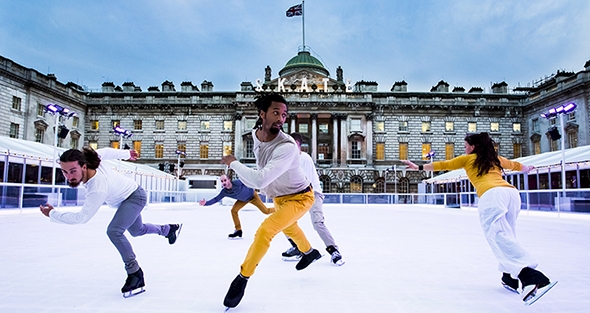
Le Patin Libre at Somerset House (photo: Alicia Clarke)
When I first saw Le Patin Libre at Alexandra Palace in Dance Umbrella’s 2014 festival I arrived late and saw only the latter part of their first half, Influences. The second half was Vertical which is the work Dance Umbrella has brought back to London for a limited run on the skating rink in its front yard at Somerset House. Renegade skaters, cutting edge ice dance performance runs the publicity with a smile. Watch the award-winning Le Patin Libre (they won the Total Theatre & The Place Award for Dance at the Edinburgh Festival Fringe 2015) carve the ice, with their signature blend of technical skill and cutting edge style (at the Quebec Delegation reception Emma Gladstone added that the group had also a strain of bloody-mindedness for forging ahead with their project despite criticism and jeering from hockey players and ice dancers at home in Montreal). Their mix of intricate footwork, wit, speed and grace pushes the boundaries of what is physically possible and carries ice-skating performance into the 21st century. There’s certainly some disambiguation to be done to separate the skating of Le Patin Libre from other forms of dancing on ice. Translating the company name — free skating — is true to its origins but doesn’t do justice to the artistic endeavor of the group and ‘artistic free skating’ sounds like an Olympic category. So until some apt description can be found the only way to know what it is they do is to see them perform. They have some work to do as well; while all five (Alexandre Hamel, Taylor Dilley, Jasmin Boivin, Pascale Jodoin and Samory Ba) dress casually (no glitter to be seen) and take care to present their work without the trappings of figure skating, they are not averse to feats of skating virtuosity, as if to reassure us they are former professional skaters. They don’t need to. The articulated solo by Ba, Jodoin’s sensuous spirals and the long, sweeping, swooping, interweaving patterns of the quintet up and down the ice are what mark the originality of Le Patin Libre: understated artistry that could not be achieved without their level of skill.
It’s not just the ice but the space that Le Patin Libre transforms with their art. Seeing what they did at Alexandra Palace was a revelation of sheer volume; at Somerset House the space is, paradoxically for an open-air rink, constrained, perhaps by the monumentality of Sir William Chambers‘ neoclassical architecture with its ice-sugary lighting in shades of blue and pink. By comparison with the performance at Alexandra Palace, Vertical at Somerset House seems more of a sampler, welcome nonetheless and well worth seeing, but not fully representative of what this quintet can do. Their ideas need the freedom and distance of the largest indoor rinks because their lines and speed and dynamics — like a flock of long-legged birds in formation — can best be appreciated on that scale. Although the development of the group originated on outdoor rinks in Montreal, the performers feel more at home navigating at high speed the vast indoor spaces of skating rinks where the theatrical effects (here by Lucy Carter) of lighting and haze, moreover, are not subject to the vagaries of outdoor weather.
Inserted like an unofficial preview into the opening of Vertical (as Alexandre Hamel told me after the performance) are some ideas the company is developing for a new show which hint at a form of minimalism, enhancing the geometry of patterns with the glistening lines of the skaters’ trajectories to expand our sense of space and time. While Vertical and Influences have gone a long way towards creating a new spatial dynamic of dance, this new work has the opportunity to consolidate the form. Perhaps by then it will have a name.
There are eight more performances of Vertical at Somerset House on Friday January 14 at 18h30 and 20h00 and on Saturday and Sunday January 15 & 16 at 18h30, 20h00 and 21h30.
Théâtre de la Ville will be presenting Le Patin Libre in Vertical Influences at the Patinoire de Bercy in Paris from 14 to 17 June.