Posted: October 10th, 2017 | Author: Nicholas Minns | Filed under: Performance | Tags: Chahine Yavroyan, François Testory, Jean-René Lemoine, Lia Prentaki, Medea, Mr. Pearl, Neil Bartlett, Nelson Fernandez, Phil Von | Comments Off on Jean-René Lemoine, Medea (Written in Rage)
Jean-René Lemoine, Medea (Written in Rage), The Place, October 7

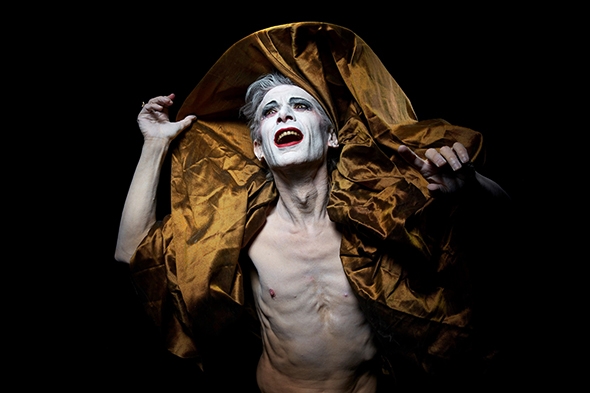
François Testory as Medea (photo: Manuel Vason)
Just how Medea (Written in Rage) ended up on the stage of The Place is an example of cooperation between a raft of organisations (NFA International Arts & Culture, SACD, Institut Français, Arts Council England, Theatre of Europe, FOLKE, Southeast Dance and The Place) that shows how Europe can work together seamlessly in the realm of arts production. The artistic team is also multi-national, where Lia Prentaki and Nelson Fernandez are the producers of a Neil Bartlett translation, adaptation and direction of a Jean-René Lemoine play — Médée, poème enragé — with actor François Testory, music composition by Phil Von and lighting by Chahine Yavroyan. There is an ironic coincidence of timing between this no-holds-barred 90-minute monologue of Medea’s vengeful family relations and the pathological UK Conservative Party seeking to subvert with similar sang-froid but less éclat the very union that made this kind of production possible.
Were Testory a demagogue, you could sense the rapt audience would follow him unquestioningly because of the commanding nature of his performance, dissolving convincingly from a male portraying a female to the female being portrayed. Von, onstage with a battery of sound equipment and musical instruments, steps in on occasion to prompt Medea to explain a particularly unsavoury action or her reason for doing it, and she obliges. Medea, in turn, asks Von to fast forward or rewind the details of her story, and he obliges. Yavroyan’s dramatic, hazy lighting and Mr. Pearl’s haute couture gown and platform shoes place the visual centre of the performance on the charismatic presence of Testory himself, specifically on his eloquent face and hands and the network of sinews and muscles that animates them. From these articulate physical instruments arises a voice that when singing the aria E lucevan le stelle has a wealth of emotion but when recounting his sordid tale has a disarmingly dispassionate tone; it is the words themselves that carry the horror of the images that Lemoine/Bartlett/Testory conjure up in giving Medea the opportunity to tell her own tale from the beginning. This is fertile and congenial ground for Bartlett who over the years has given voice to historical and literary figures, conjuring them up from oblivion and notoriety in theatrical performances that merge the personal and the political, spectacle and intimacy. Medea (Written in Rage) is no exception.
The story draws on Euripides’ play and on Medea’s famous monologues as well as from other versions of the classical legend and modern references. Medea invokes the spirit of similar mythical figures in bearing witness to the love and pain that run through her story of betrayal and bloody revenge. Lemoine riddles the text with ambivalence, layering meanings and imbuing the ancient legend with current undertones so that as a genderless, stateless, and raceless figure, Medea’s tragic story resonates with the sorrow of exile, the drama of being an ‘outsider’, of never belonging. There are echoes of the current refugee crisis, of sexual, racial and gender discrimination and exploitation that infuse the horror with grief and the desolation of a life that paradoxically seems to find a form of liberation only in violence. For the sake of Jason, Medea is disloyal to her father and kills her brother, betrays herself and becomes ‘occidentale’ in a vain attempt to please her partner. When Jason abandons her for a younger woman she punishes him by drowning their two sons and poisoning his new bride. There is neither justification nor condonation of the violence: Medea writes herself in rage. The character and the story are one and the same; rage is both the historical context and the personal response.
Medea’s fate is weighted by her actions, but even more by the aggression hidden in the biases, intolerance and double standards that society imposes on her. ‘I am not guilty’, Medea claims towards the end of her tale. ‘Life is punishment enough.’ Testory’s high platform shoes well convey the difficult balancing act of a character at the boundaries of acceptability with the constant peril of stumbling but his restrained performance does not yield to dismay, nor allow us bathos. Medea’s story is ancient but still tragically topical, a sober act of drama whose horror seems to continue to repeat itself over time, its scale no longer mythical but far too human.
Posted: October 3rd, 2017 | Author: Nicholas Minns | Filed under: Performance | Tags: Chahine Yavroyan, David Price, David Rosenberg, DeadClub, Frauke Requardt, Hannah Clark, Jordan Ajadi, Neil Callaghan, Owen Ridley-DeMonick, Ruben Brown, Valentina Formenti | Comments Off on Requardt & Rosenberg, DeadClub™
Frauke Requardt & David Rosenberg’s DeadClub™, The Place, September 15

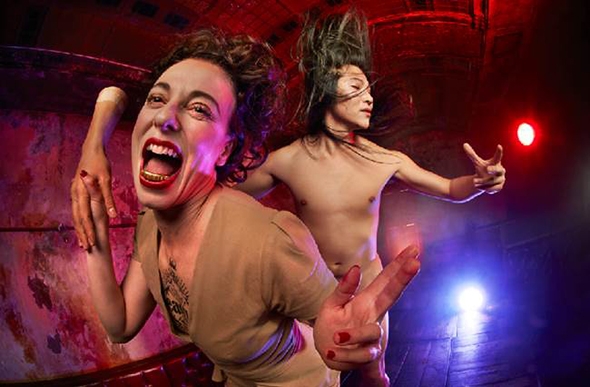
Requardt & Rosenberg’s DeadClub™ (photo: Manuel Vason)
The last time I saw a collaboration between Frauke Requardt and David Rosenberg was at night in a freezing carpark on a deserted site near the Brighton Marina in 2012. The scope of Motor Show was to rein in the forces of an outdoor venue through a binaural technology that brought the action to the space between your ears; the scale was visually heroic and aurally intimate. In their fourth and most recent collaboration, DeadClub, they have assembled a similarly scaled performance in which the heroic resides in notions of memory and dream, and the intimate in the way the auditorium of The Place has been shrunk and transformed, thanks to Hannah Clark, to a raised gaming table within David Price’s auditory den. In keeping with a theme of random processes, we are each issued a raffle ticket that corresponds to our numbered, standing-only place around the perimeter of the table/stage. It’s a unique perspective from which to see the show, not only looking up at the performers but looking across at other members of the audience. We may have arrived with a friend, but our relationships have been shuffled in the DeadClub pack.
This kind of attention to detail brings the audience together as part of the show; we are not simply spectators but collectively share in the staged experience. In each place there’s a black and white party hat to match the decor, but putting it on is optional. At intervals, a spotlight scans the inside of the four sides of the square like a ball flying round a roulette wheel to stop in front of a randomly picked person (how randomly I’m not sure, as it never stopped in front of an empty space and on one occasion picked out Requardt herself for a cameo response). The highlighted person is either asked a question or becomes the focus of a particular dance. There are a lot of sleight-of-hand appearances and disappearances of the five performers emerging through trapdoors as if from an underworld and descending back into the depths like contortionist dolls; ‘severed arms’ and ‘stuffed crows’ drop on to the stage, small-scale plaster figures suddenly arrive out of the dark and appear to speak, while microphone stands and pianos rise up from below and once played descend again with all the logic of an arbitrary event. It is a phantasmagoria of the inexplicable and the absurd that borrows as much from Sigmund Freud as it does from neuro-psychological concepts about the function of remembering which, according to current models, serve to make sense of our present, aid in our socialization and help us to imagine the future.
It is this last function that fascinates Requardt and Rosenberg. Memories are not straightforward images from the past but composite mental reconstructions that we adapt to our present and future projections. As Dr. Denis McKeown, a senior lecturer in cognitive psychology at the University of Leeds, writes in the program notes, “Memories are like dreams. They are an internal world played upon by an internal consciousness, often outside our awareness.” Indeed, the visual vocabulary of DeadClub makes the analogy with dreams overt by gesturing not only to Surrealism but to film, a medium akin to remembering not so much because of its possibility of flashback but because of the malleability of its internal procedures. Like the moving image, Requardt and Rosenberg’s imagination is a fluid element that has the possibility of flying of its own volition but when it comes into contact with so many overtly theatrical effects held together with tape, screws and hinges, and magnified by our proximity to the stage, its wings are clipped. The sheer complexity of the staging is staggering but it draws our attention for the wrong reason: the theatricality is just too clunky, making DeadClub appear to be a raft of dream-like concepts trapped in the wrong medium.
The one technical asset that mediates between the ideas and the scenic elements is the lighting by Chahine Yavroyan for he can use his palette to smooth physical edges, focus on the essential action or reduce the stage to total darkness. His use of light allies the stage to the cinema: he allows the fluid traces of ideas in Valentina Formenti’s songs of death, in Neil Callaghan’s ghostly presence and in the solos by Jordan Ajadi and Owen Ridley-Demonik to exist apart from the substantive woodwork and machinery underneath them so as to express their intrinsic aural, dramatic and rhythmic poetry. These are the overriding successes of DeadClub, but outside these contemplative moments, even Yavroyan cannot avoid the theatrical framework becoming the centre of preoccupation.
Posted: September 29th, 2017 | Author: Nicholas Minns | Filed under: Performance | Tags: Denti, Enrico Caruso, Italian Cultural Institute, Piergiorgio Milano | Comments Off on Piergiorgio Milano, Denti
Piergiorgio Milano, Denti, Italian Cultural Institute, Belgravia, September 22
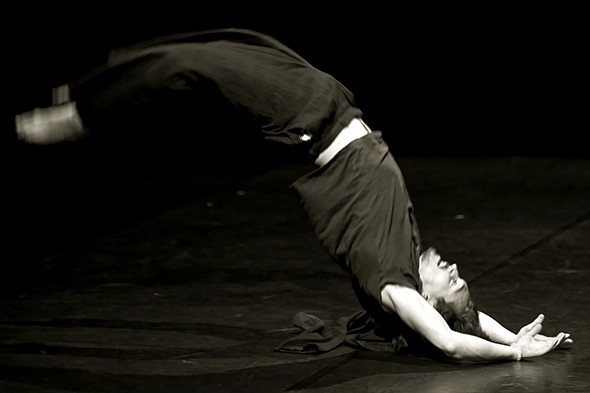
Piergiorgio Milano in Denti (© Milano)
‘Denti’ is the Italian for ‘teeth’ but Piergiorgio Milano has not created a work about this particular part of our physiognomy but rather around it. Teeth are resistant and sensitive, qualities that Milano brings to the work, and his grandmother taught him that to dream of losing your teeth signifies the subsequent loss of someone close to you. One night Milano dreamt of losing his teeth and the next day his grandmother passed away. This kind of circle of circumstances, of manifestation and extinction, memory and loss, is what Denti represents, invoking a circular space where reality and dream are looped together without possibility of resolution.
It is perhaps no accident that Milano slowly enters the piano nobile like an insect hiding under a tattered raincoat, as if he were an alter ego of Franz Kafka’s Georg Sama. The initial stealth, however, soon gives sway to a surge of movement that appears to give the coat an independent animation. Milano treats it with both violent incomprehension and as a tender memory of another being, long gone, who can nevertheless still wrap him in her familiarity and scent.
The two pieces of music that Milano uses also suggest memory and loss: the first one is an old 78 recording of Enrico Caruso singing the aria Je Crois Entendre from Bizet’s The Pearl Fishers, and the second is Valzer di un giorno by Gianmaria Testa. Milano makes the crackling sound of the 78 the dense medium through which he plunges his body into memory. He is trained in circus and has the physical vocabulary to use every part of his body to make circles, to somersault, to undulate, to spiral and to curve; it is the flow of his movement that carries the emotion of the performance. The classical proportions of the piano nobile seem to struggle to contain these turbulent eddies, but Milano has also learned how to swim through hard surfaces, kneading the wooden floor with the resilience of his body to make it curiously soft; he moulds the floor to his will and leaves us to experience the shapes he has made. Both water and air are his metaphors; his choreography is like a stormy current let loose on a weightless body until the weight finally returns with the body’s stillness. In a humble gesture of resignation Milano bows, and remains bowed with his alter ego coat obscuring his head. It’s hard to applaud after that.
Posted: September 28th, 2017 | Author: Nicholas Minns | Filed under: Performance | Tags: Kadam, Kali Chandrasegaram, Kamal Kaan, Pulse, Sanjeevini Dutta, Sita Thomas, The Rose and the Bulbul | Comments Off on The Rose and the Bulbul
The Rose and the Bulbul, Lauderdale House, Waterlow Park, July 30,

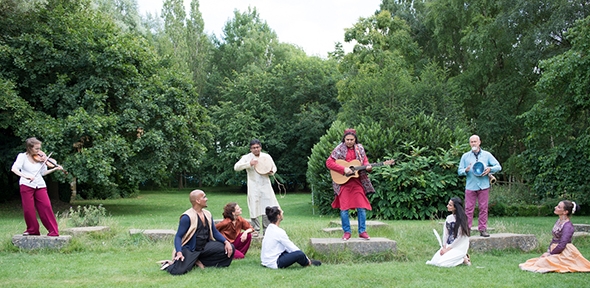
The cast of The Rose and the Bulbul (photo: Simon Richardson)
“We are far more united and have far more in common with each other than things that divide us” – Jo Cox, MP
At school I had a little notebook of historical dates in which each page was dedicated to a king or queen of England, starting with William the Conqueror. Most, if not all the events duly transcribed were battles; the more modern the monarch, the further afield the battles. This dry tally of dates and facts told from a singular imperial perspective constituted my early knowledge of history. The idea of weaving comparative history through dance, music and spoken word was inconceivable, let alone the notion of studying history in an environment of landscape gardening. Yet this is exactly what Sanjeevini Dutta and Kali Chandrasegaram dreamed up, along with writer Kamal Kaan, director Sita Thomas and producer Kadam, for The Rose and the Bulbul. It is at once a celebration of gardens, a moral tale about love and acceptance, a history of two cultures and an exuberant, fête-like procession of flowing silks, finely delineated steps and musical rhythms that bring the paths, trees and water features of Waterlow Park alive to a new reality.
The seed of the idea came from the gardens in Stockwood Park near Luton where many styles — from mediaeval to Elizabethan to Victorian — are laid out. Stockwood Park also has an Asian garden planned along the landscape principles — scaled down significantly — of India’s Mughal empire, which ran parallel to our own Tudor period and continued into the Victorian era. The creative team behind The Rose and the Bulbul has drawn together these two parallel influences by mingling Tudor music, Indian chanting and song, bharatanatyam, kathak and contemporary dance, and what Kaan has done in the scripting is to weave the history of these gardens into a modern allegory of social integration.
The history is implicit in the architectural parallels and in the cross-fertilization of literature, dance and music. The Earl of Lauderdale inherited the house around the same time the Taj Mahal, the apotheosis of Mughal architecture and landscape gardening, was being completed in Agra; the Persian word for a walled garden (a feature of Mughal gardens) came into the English language as ‘paradise’; the nightingale (bulbul) and the rose can be found in Sufi poetry as an expression of longing and creativity, and classical and contemporary dance has always embodied current attitudes to social and political discourse.
We can join in the pleasure of seeing the gardens around Lauderdale House at each stage of this promenade performance against the darkening skies and rising breezes of an English summer’s day. At the same time the story’s axiomatic philosophy (much of it based on the Sufi poet Rumi) is released like a scent by the musicians, actors and dancers as they enact one of the many tableaux before setting off on a path to the next one, adults, children and baby carriages in tow. The Rose and the Bulbul is thus a fable of cultural synergies experienced live through poetry, music and dance, but it is also a visual allegory told in colour and form projected against the history of house and garden. In a story of ‘love and acceptance of the outsider’ between two people ‘who come truly to understand their present only through a journey into each other’s past’, the intermingling of cultural expressions is an intoxicating immersion into the value of social and political unity.
This review was commissioned by and first appeared in Pulse Magazine and appears with the kind permission of the editor.
Posted: September 19th, 2017 | Author: Nicholas Minns | Filed under: Performance | Tags: Alexandra Pons, anthologyofamess, Antonio de la Fe, As We Like It, Cher Nicolette Ho, Cherylin Albert, Elle Howard, EVOLVE, Hairy Heroines, Kotzky Vendivel, Love me in chains - part 1 - Gal Dem, Mariana Camiloti, Orley Quick, Petra Söör, Robert Vesty, Ryan Munroe, Sam Pardes, Screwed, Telisha McKenzie, They, What Have I Got To Show For It? | Comments Off on Orley Quick, Screwed
Screwed, The Bunker, July 31

The stars of Screwed (photos and design: Michele Cadei)
Billed as ‘three evenings of curious, (dis)honest and unhinged dance performance’, Screwed distinguishes itself by its anti-hype. It also distinguishes itself by its entrepreneurial bravado and curatorial intuition. Orley Quick of Hairy Heroine fame has brought together this ‘weird, wild and wonderful variety of fresh, experimental performance’ as a complement to her As We Like It that she showed at Resolution in January: there are three performances of the Hairy Heroines shared with works by nine other artists over three evenings. It’s a huge undertaking, but Quick has pulled it off with unassuming flair. Introducing the evening, she explains that her choice of artists was based on a shared work ethic and respect; she has also put herself in the position of the audience in that she is seeing the works for the first time, a freshness of approach that creates its own excitement and unpredictability.
In this context of anti-hype and surprise the first work on this evening’s program is created and performed by a group named anthologyofamess which comprises on this occasion Mariana Camiloti, Antonio de la Fe, Petra Söör and Robert Vesty. EVOLVE, its title spelled in captcha form, is an improvisation based on ‘a relentless need to never ever stop’ that, while taking time to reveal its mystery, makes its journey the crowning achievement; each performer embellishes time and space with the concentrated effort to never arrive. Research that appeared at the time of the performance revealed that audiences remember moments of stillness more than movement, but in EVOLVE’s unerring line of constant evolution, these performers royally disprove it. Their spatial acuity, their inventiveness and their fluid forms may be hard to capture and slippery to hold in memory, but the effect is of a dream in which images vie with one another and superimpose in spatial freeform. But that’s the thing with dreams: they have an illogic and unreality that is memorable.
Sam Pardes wakes us up to the dream’s antithesis. Tapping. She seems in no particular hurry to prepare her performance, What Have I Got To Show For It? but as she prepares she works a seam of dogged humour with impeccable timing that keeps us laughing. She complains of aching feet, drinks some water, does a sound test and nonchalantly starts a routine that becomes the soundtrack to her life story. She’s just letting the tap motor turn over as she talks of her years in performing arts college in the U.S., her MFA at Roehampton, being a part-time nanny, her diagnosis with anxiety disorder, and of the meds that have made every part of her body balloon. She then confides that she’s prepared another dance for us, a budget dance. It’s a daily itemization of her frugal expenses with a tapped recitative but it’s just the prelude to her highly-charged and provocative message on the gap between the expectations of an arts education and its devastating economic and health implications. She takes a piece of paper from her bra and tells us the cost of her MFA in Choreography ($50,143.39), of her two loans and the calculated amounts of each monthly payment that will keep her sinking in debt for the next nine years. ‘How to begin a dance on this?’, she asks but she does, scraping, tapping, picking up speed and drumming virtuosity until she breaks off, kicks a little, shuffles and stops. She wants to say something but her glazed expression is fixed in the dying lights. Her mother was right (‘My baby’s a star’) but it’s sobering to consider the cost Pardes has incurred to put on this show.
Ryan Munroe is another choreographer who leaves the best till last, a climactic gesture on the final note of music that sets alight all that has gone before. Love me in chains – part 1 – Gal Dem is a duet in three parts for Cherylin Albert and Telisha McKenzie that the cryptic program note describes as ‘not that deep, but it’s deep.’ Albert and McKenzie are as richly expressive as the work is enigmatic, shading their imaginary world of whispered gestures, silent shouts and closed eyes with a contrasting dynamic of running, pushing and dancing to the beat. There’s a central section of read texts on cultural formism that obscures more than it enlightens, but it’s the quality of movement in Albert and McKenzie that establishes Munroe’s ability to warp space with his mix of shapes, dynamics and gesture underlaid by extracts from Sango (Conte a Todos), Merzbow (Requiem) and Astrolith (Kaisha Original Mix). Up until the moment of that final gesture I wasn’t really in Munroe’s orbit, but after it I was thirsting to see the work all over again.
Cher Nicolette Ho’s They is a duet for Elle Howard and Alexandra Pons to the well-oiled beat of Kotzky Vendivel’s Lift and is prefaced in the program note by a quotation from Isaiah: ‘They will soar on wings like eagles, They will run and not grow weary, They will walk and not be faint.’ The duet sets in motion the over-sized jackets of the two women as they take them off, swap them and share them as if exploring the limits of their friendship with an equal measure of intimacy and abandon. The partnering becomes more complex and intricate as the jackets take on the role of support; falling to their knees is a recurring motif for the two women, with its religious overtones. Having built up a sense of interdependence between Howard and Pons, their subsequent solos seem less assured until they join once again, bringing full circle the immanence implicit in the biblical quote.
I had seen As We Like It at Resolution six months ago to the day but this is an opportunity to revisit the inimitable Hairy Heroines (Diogo Fernandes de Jesus, Tyrrell Foreshaw and Elliot Minogue-Stone) in a slightly extended cabaret version. With the audience crowded around the thrust stage in The Bunker all the irreverent intimacy that Quick and her heroines had spent so much energy and inspiration putting into the work is now seen close up in riotous detail, from the febrile petulance of Fernandes de Jesus to Minogue-Stone’s ingenuous wordplay to Foreshaw’s extravagant floorplay. Adding ten minutes to an original concentrated work has its hazards, but Quick and her dramaturg Karla Ptáček have maintained the thread of Shakespearean gender politics while elongating the narrative to a more natural life span — and prolonging the fun.
There’s not a whiff of Arts Council funding on the program and the house is full; I don’t know the balance of accounts for Screwed but on a curatorial level it’s a brilliant achievement. Uncertain times demand uncertain solutions; Orley Quick has discovered one and, with production support from Silvia Scrimieri, has made it stand out.
Posted: September 11th, 2017 | Author: Nicholas Minns | Filed under: Performance | Tags: Alvar Aalto, Esa-Pekka Salonen, Ima Iduozee, Mikki Kunttu, Teemu Muurimäki, Tero Saarinen, Tero Saarinen Company | Comments Off on Tero Saarinen Company, Morphed
Tero Saarinen Company, Morphed, Royal Festival Hall, Southbank Centre, August 10

Tero Saarinen Company in Morphed (photo: Mikki Kunttu)
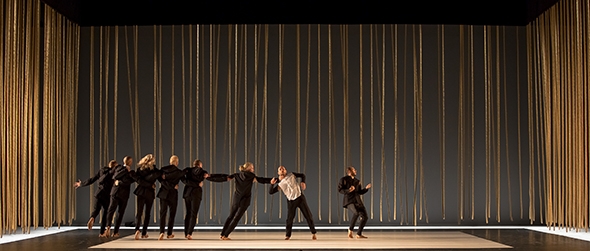
The appearance of Tero Saarinen Company as part of the Southbank Centre’s Nordic Matters brought a refined Finnish sensibility to the Festival Hall stage that reminded me of the architecture of Alvar Aalto: it establishes its individuality and subtle independence from its surroundings through the use of natural materials and sophisticated design. The stage setting by Mikki Kunttu for Saarinen’s Morphed (2014) — the one work on the evening’s program — immediately immerses us in this quintessentially Finnish quality by referencing the colours and materials of Aalto’s furniture design which in turn were influenced by the Finnish landscape. The two lines of evenly spaced ropes that hang on three sides of the stage form an enclosure around the rectangle of white on a black floor.
Based in Helsinki, Saarinen founded his company in 1996 ‘to promote a humane worldview and basic human values through the language of dance’. Perhaps because dance is performed in and on the body, it is an art that naturally eschews violence and in Morphed Saarinen traces states of mind and body from baseness and introspection to elevation and refinement in a group of seven men from his company. Despite its overtly male focus, Saarinen takes the clichés of maleness and turns them inside out. By the end we can associate with this ‘journey less traveled’ and find solace in its resolution. We first see the men in black fatigues and hoods prowling in fluid patterns of geometric complexity. For a work celebrating all aspects of maleness, this is as good a place to start as any, but with the sophisticated music of Esa-Pekka Salonen, Kunttu’s neat and beautifully lit abstraction of a forest and Teemu Muurimäki’s stylish costumes, it has to be said these men have already come in from the rugged outside. Initially Saarinen traces paths of weighted, pack-like formations but as the work develops individual performers begin to slide away from the pack to explore their own individuality in expressive gestures before they become subsumed once again within the group. Over the course of the work the gestures develop into solos, duets and trios that expand their reach and choreographic force as each man develops in his own right.
Part of the intrigue of Morphed is that Saarinen’s performers at first look less like dancers than wholesome, blonde, bearded Finnish men who exude masculinity without being macho. They could be athletes; if I recognized some sporting motifs in the choreography one of them derived from shot-putting. Placing these powerful bodies in this kind of environment is to transform them. Saarinen works with the physicality of bodies to explore the means of change; the blunt, earthbound postures of the dancers at the beginning gradually respond to the musical ideas to develop the poetry of their instruments while maintaining their connection, gaining in self-expression and articulation while allowing space for each other. Arms and torsos elongate and feet point beautifully, reminding us of Da Vinci’s maxim that beauty is in the extremities. One could almost imagine Salonen conducting the dancers to draw out their intrinsic qualities. The costumes and lighting are implicit partners in this process. Over the course of the performance the dancers remove the initial dark, heavy outer garments to reveal white shirts whose sleeves detach, like layers of skin, until it is the skin that remains. At the same time the lighting morphs in response, from somber dawn to bright sunshine. In this sympathetic depiction of maleness, all the men — all but one — change from hooded prowlers to half-naked open channels of emotion. Saarinen takes us on a journey that could be our own. Indeed, he suggests it is our own and holds up his choreography as a mirror to guide us, avoiding exaggerated movement in order to include us within its measured articulation and rhythms. And although the cast is predominantly Finnish, there are two exceptions. David Scarantino is a dark-haired American whose presence avoids a sense of cultural homogeneity (Morphed is about men, after all, not just Finnish men), but it is Ima Iduozee, whose dark brown skin and lithe movement add an exotic, feline quality to his Finnish identity, who suggests he may be the catalyst of physical transformation within the context of Saarinen’s language. It is as if he has been there before and is returning to help his comrades morph into their spiritual dimension.
Posted: August 23rd, 2017 | Author: Nicholas Minns | Filed under: Performance | Tags: A Philosophy of Walking, Firkin Crane, Frédéric Gros, Onassis Cultural Centre, Peregrination, Peregrinus, pilgrimage, Refugee crisis, Zoi Dimitriou, Zoi Dimitriou Company | Comments Off on Zoi Dimitriou Company, Peregrinus
Zoi Dimitriou Company, Peregrinus, Firkin Crane, Cork, July 20

Zoi Dimitriou in Peregrinus (photo: Nicholas Minns)
Zoi Dimitriou’s Peregrinus began as research into the notion of peregrination or pilgrimage on a residence at Firkin Crane in 2015 as part of the Blank Canvas Residency programme. While forming the work for this year’s Fast Forward Festival 4 by the Onassis Cultural Center in Athens, which also produced the work, the refugee crisis in Europe overlaid her notion of peregrination with the political, psychological and physical effects of displacement. As Frédéric Gros wrote in his A Philosophy of Walking, peregrination and displacement are joined at the root: “The primary meaning of peregrinus is foreigner or exile. The pilgrim, originally, is not one who is heading somewhere (Rome, Jerusalem, etc.), but essentially one who is not at home where he is walking.” Greece is one of the entry points for refugees who risk their lives to flee conflict zones in North Africa and the Middle East to find a new life in Europe. The official welcome policy is one of containment in refugee camps that offer exiles a level of safety while they await a political solution to their humanitarian crisis, and because these camps are outside the urban centres, the condition and fate of refugees is often only revealed through media sources. It is this mediatized relationship to refugees that Dimitriou took as the starting point of Peregrinus.
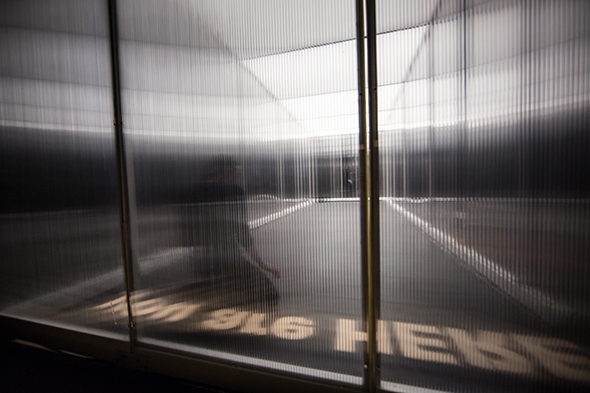
The work references the current refugee crisis through recorded stories of people Dimitriou interviewed in London and Athens who had in the past experienced forced displacement as a result of violent conflict but who are now settled in their host countries. She and her artistic team then chose as her location a run-down, disused warehouse that was part of the anonymous, industrial infrastructure of Athens and restricted the number of audience members to the capacity of a blacked-out mini-bus that transported them from the Onassis Cultural Centre (OCC) to the warehouse. The journey took just under 24 minutes, the time it took for the passengers to hear in the darkness the stories Dimitriou had recorded. Nobody knew where they were going and not even the locals recognised the destination once they arrived; the journey was designed to echo the sense of displacement in the stories. Inside the warehouse was a structure resembling a church nave and transepts with three-metre-high translucent panels for walls and a lightbox for a roof that limited the lighting principally to the interior of the structure but let it spill out through the panels. The audience remains outside looking in at Dimitriou who remains unaware of our gaze, moving in abstracted steps and gestures like time-lapse images of walking, crawling, prayer, rage, despair, resolve and stoic determination. There is a very real sense that despite her approaching the edges of the walls she is never coming out.
The translucent panels have internal baffles that are slightly angled to the line of vision: look one way through them and it is impossible to see beyond, but look the other way or straight on and you can perceive the figure beyond. If you maintain a fixed perspective (as in watching a television screen) Dimitriou moves in and out of your field of vision; you have to follow her to keep her in focus. The structure represents a medium through which we see refugees, and yet behind the screen the pacing and the daily concerns and the personal tragedies continue unheard and unheeded. By inserting herself into this mirage of displacement, Dimitriou channels empathy for the refugees and allows the audience the space to come to their own conclusions. She moves silently to a subdued industrial score — at one point a cross between turning helicopter blades and a swift, rhythmic saw — and the only overt messages are in stenciled, illuminated signs on the walls and floor of the warehouse: ‘You Are Here’, ‘You Are Involved’, ‘Utopia is Closing Down’, to which are added stark signs like ‘No Man’s Land’, ‘Foreigners This Way Please’ and ‘No Congregation In this Area’. Apart from these contextual signs there is nothing to suggest a refugee camp; Dimitriou is using the distance and abstraction of the theatrical presentation to give the audience the opportunity to focus on her references to the current social and political reality. Peregrinus thus reflects on and interferes with our western sense of carefully mediatized detachment from the crisis. To make this work effectively, the setting up of the experience is as important as the performance itself; it requires a unity of intention in the same way a politically united response to the refugee question is the only way to resolve it.
A country that through geographical fate finds itself hosting refugees might well be said to have a problem it has agreed to for humanitarian reasons but doesn’t quite know how to deal with. By an inadvertent twist of fate, Firkin Crane as host found itself in a similar role; having invited Dimitriou to perform and having received the translucent structure from OCC and set it up — with modifications — in the theatre’s auditorium, the host left the details of the production in limbo. While Dimitriou had the space in which to perform, the logistics of the production did not successfully contextualize the refugee experience for the audience. The theatre itself, despite its history as a workshop for the manufacture of butter firkins, is too laden with the implications of entertainment and leisure to destabilise an audience and the curtained mini-bus journey started in plain daylight outside the front of the theatre and arrived 25 minutes later at the stage door, mimicking the original idea but leaving little incentive for the passengers to subjectivise the experience. What remained was Dimitriou’s performance in which the notion of peregrination and exile survived in its original spirit despite a host that wasn’t quite sure how to deal with it. Art imitating life.
Posted: August 11th, 2017 | Author: Nicholas Minns | Filed under: Performance | Tags: Bouchra Ouizguen, Compagnie O, Corbeaux, Francis Kéré, Gando, Serpentine Pavilion, Shubbak Festival | Comments Off on Bouchra Ouizguen, Compagnie O, Corbeaux
Bouchra Ouizguen, Corbeaux, Serpentine Pavilion, July 14

Bouchra Ouizguen’s Compagnie O in Corbeaux (photo: Hasnae El Ouarga)
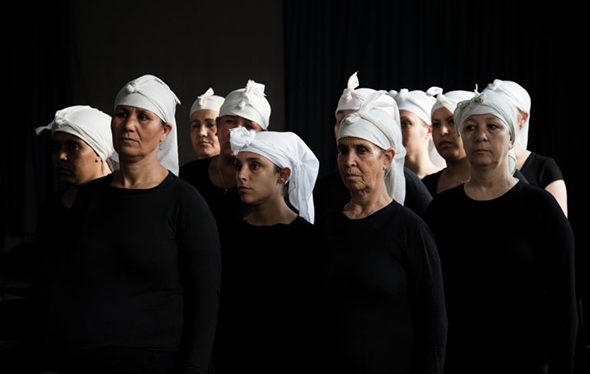
The idea of performing Bouchra Ouizguen‘s dark, brooding Corbeaux (crows) as part of this year’s Shubbak Festival in Francis Kéré’s light, airy 2017 Serpentine Pavilion in Kensington Gardens is a symbiotic one. Kéré conceived the structure with its curved blue walls made of stacked triangular assemblies of timber and an orange canopy roof as an ‘architectural version of a big tree’ in Gando, his home town in Burkina Faso, where villagers would use its shade as a locus for activities. Both the Pavilion and Ouizguen’s choreography are a form of gathering; Kéré has built a congenial space for people to congregate in the heart of London, while Ouizguen has built a work for an outside space inspired by the collective behaviour of crows. The audience assembles like villagers underneath Kéré’s tree, standing with their backs to its airy walls, watching Ouizguen’s women — ten Moroccan performers and eight London-based — enter slowly, one by one at intervals in the dark. Once in place, they perch upright in triangular patterns in relation to each other and to the audience. Dressed in black with white headscarves, they stand motionless with eyes closed until the last woman joins the group. The stillness and silence are then suddenly broken by an eruption of visceral chanting wrenched from the abdomen up to the throat of each woman. It is not age but experience that shows in their faces and a fierce insistence that drives the rhythmic pulse of their gestures. They remain rooted to the same spot throughout this atavistic ritual and it is the subtle differences in the power these women generate in their gestures that attune our eyes to ‘hear’ the force of their voices.
Based on early Persian literature, the performance shares the investment in repetitive movement typical of Sufi dance in an attempt to transcend physicality by fully embracing and expressing corporeality. Here Ouizguen’s performers achieve a similar effect through harnessing the repetition of their piercing, guttural cries with the physical rocking forwards and backwards of their heads and necks. Some of the women accent the outbreath and others the inbreath to effect a see-saw rippling of sound that ricochets against the bodies of the audience with contrapuntal force. After twenty minutes, following a hidden pattern of quietus, the performers slowly one by one come to rest till only one continues the wild, rhythmic chant and movement which finally subsides to stillness and silence like the undulations of a pebble on the surface of a lake. Once the surface has settled the women drift out into the night but leave their emotional presence carved into the space of Kéré’s pierced walls.
This is it. There is no narrative, barely a beginning and no apparent end. We are engulfed in sound and the physical force that produces it, like being overtaken by a storm that suddenly arises out of nowhere, expends its energy and moves on; it is closer to nature than to theatre. Ouizguen has stated that Corbeaux is not so much a spectacle but an escape from the traditional mode of production for the stage. “I envisioned Marrakech station with this flock of ageless crows, like a living event, a sonorous sculpture whose power and urgency flows to infinity.” Perhaps Kéré had not envisioned such a gathering under his tree-like pavilion and neither, perhaps, had Ouizguen imagined such a genial space to be the setting of her brooding, sonorous sculpture but it was a bold feat of imagination to put the two together and let them play off each other’s life-affirming qualities.
This UK première of Corbeaux was presented by Shubbak as part of Park Nights, the Serpentine Pavilion’s annual series of summer events in partnership with Serpentine Galleries and Tate Modern.
Posted: August 9th, 2017 | Author: Ian Abbott | Filed under: Film, Performance | Tags: Aoi Nakamura, AΦE, Esteban Fourmi, Happy Finish, Jasmin Vardimon, Samsung, Virtual Reality, Whist | Comments Off on Aoi Nakamura and Esteban Fourmi (AΦE), WHIST
AΦE, WHIST, Festival Theatre, Edinburgh, July 31

WHIST, by AΦE (photo: Paul Plews)
“Good stories are like those noble wild animals that make their home in hidden spots, and you must often settle down at the entrance of the caves and woods and lie in wait for them a long time.” – Herman Hesse
WHIST is the first major work for Aoi Nakamura and Esteban Fourmi who formed the company AΦE in 2013. Inspired by the work of Sigmund Freud, it invites us on a journey exploring the fears, desires and unconscious minds of a fictional family. Wearing a Samsung Gear virtual reality (VR) headset and headphones this is a solo experience (for a maximum of 20 people at a time) in the carpeted third-floor foyer of the Festival Theatre. After a pre-show briefing and orientation by the FOH staff we are invited to put on the headset and headphones and to follow the early instructions for triggering scenes by lining up our gaze with a small blue dot.
It’s made clear that there are 76 different perspectives and that who/what/where we look at when we’re ‘inside’ WHIST determines the next scene we watch; it’s a classic branching narrative device that is very prominent in non-linear video game design. Imagine a Choose-Your-Own-Adventure book where the agency rests entirely with you; you map out your own path and are responsible for your next 45 minutes.
“At times we’ll want to escape our polluted reality…not augment it with digital debris.”- Clyde DeSouza
The fantasy dream space of lust and Oedipal urges that Freud explored is ripe territory for a theatrical VR response; alongside their technology partner, Happy Finish, AΦE has created 20+ filmed scenes set variously in a dilapidated cottage, photographic studios and warehouses where you are introduced to the family gnawing on human hearts, waltzing with bird cages and evaporating into ping pong balls. With the headset on you’re limited in your ‘real’ movement and aren’t able to move through the VR space; you’re a static witness to the three- or four-minute filmed scenes from a single fixed camera perspective not of your choosing. I’m invited into this world though I’m unsure of my role. Am I an invisible voyeur? An additional family member? Something/one else? Without the clarity of who I am and my relationship to those around me it’s difficult to emotionally invest or empathise. The perspective changes across the scenes; sometimes we assume the head of the father, sometimes the camera is at knee height, sometimes on a silver platter and other times we’re inside a CCTV camera. Our virtual scale oscillates regularly but I’m unsure for what purpose.
Nakamura and Fourmi have created a number of other shorter screen, interactive and stage works before WHIST and are also members of the Jasmin Vardimon Company (Vardimon is the creative mentor for WHIST). The visually rich spectacle that has become Vardimon’s signature is laced throughout the work; be it a performer emerging from a wicker basket frantically scrawling indecipherable chalk symbols on the floor or an eerie motionless accordion player barely pressing the keys yet the sounds make it into your ear, the images stay with you.
“It is a predisposition of human nature to consider an unpleasant idea untrue, and then it is easy to find arguments against it.” – Sigmund Freud
WHIST (named after Whist House in Kent where the work was filmed) defines itself as a ‘one-hour experience merging physical theatre, interactive virtual reality (VR) and augmented reality (AR) technologies and an art installation, in an environment that blurs the boundaries between consciousness and unconsciousness, reality and fiction, the physical and the virtual’. I find this language hugely alienating; in a cultural landscape of marketing hyperbole this description signals to a niche crowd and does little to provide clear and plain English entry points to the 92% of non-arts attenders.
An audience will predominantly experience a work only once and I found my first experience of WHIST quite unsatisfying; it’s physically limiting, generates a huge sense of FOMO (fear of missing out) as there are 75 other possible scenarios that I’ve not seen, and the technological fidelity and finish isn’t as crisp as it could be (you can often see the glitches where the 360 degree cameras meet and bodies warp momentarily). However, I went in for a second time — now familiar with the rules, the technology and the characters I had the chance to play with the interactivity of the work and it was richly rewarding. I found some of those alternative branching narratives (unlocking 3 new scenes along the way) and whereas in the first experience I didn’t feel in control and had a real sense of time rushing past me, during the second time there was a chance for greater depth, focus and the ability to find some of the triggers and nuances that are artfully hidden in the work. There’s a suite of scientific research from eye tracking studies that reveals hot spots and how our eyes are often drawn to movement that emerges from stillness on a screen/stage; I made a commitment to focus on one character in my second experience, tracking their journey and watching their reaction and interactions with others even though at times I knew there were other things happening outside my 80-degree viewing angle and that the other 280 degrees would have to go unwatched.
Just before the credits roll you’re given a number on screen which if you enter into AΦE’s website will translate into a loose interpretation/analysis of the route you’ve taken through WHIST. Using some faux Freudian language it’s desired aim is ‘to inspire questions, reflections and insights into the unique meaning the performance may have for you.’ However it comes across more like the end-of-the-pier Zoltar fortune telling machine from Big dishing out the same message to anyone who’s gullible enough to feed it some money (there was a LOT of repetition when I entered my two separate numbers).
Although there is little visible dancing in WHIST, but there is a definite choreographic consideration and execution in how our solo bodies experience those that are presented to us and the world they inhabit. WHIST rewards the audience and encourages multiple viewings as it unlocks more scenes, greater depth, hidden easter eggs and more of that luscious branching narrative.
Posted: August 7th, 2017 | Author: Nicholas Minns | Filed under: Festival, Performance | Tags: Alchemy Festival, Conditions of Carriage, Preethi Athreya, The Jumping Project | Comments Off on Preethi Athreya, Conditions of Carriage: The Jumping Project
Conditions of Carriage: The Jumping Project, Alchemy Festival, Southbank, May 21

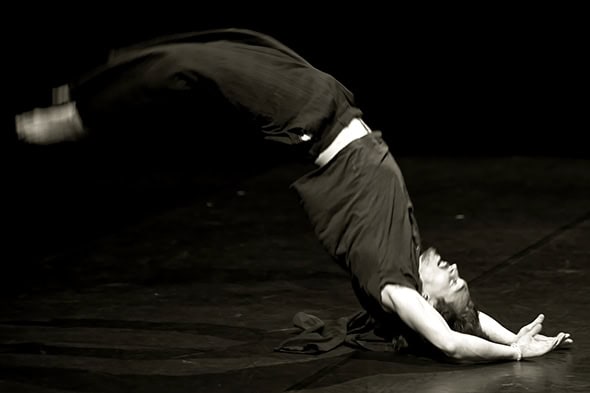
The act of jumping in Conditions of Carriage
This review was commissioned by PulseConnects and was published in the Summer 2017 edition of Pulse. It appears here with the kind consent of the editor.
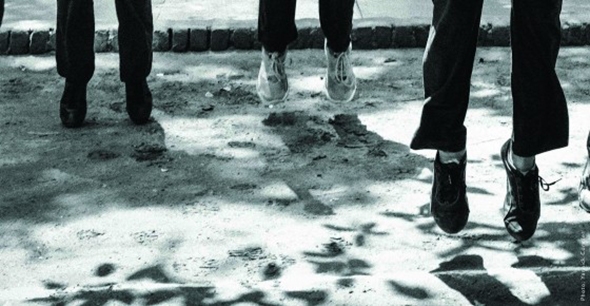
It is a game played by an invisible hand with one team of ten players on a square, red-carpeted floor with a broad, raised rim on all four sides, like a trampoline without the elastic. The height of the rim is determined by the height the players can jump, landing in a deep squat, and its width is just enough to take three players standing one behind the other. The dimensions of the floor area are roughly equal to the height of three players. Even though I am imagining these dimensions, such mathematical rules are at the heart of Conditions of Carriage: The Jumping Project, conceived by Preethi Athreya, who is also one of the players. Jumping is a dynamic physical action that is expressively neutral, and while the repetitive nature of Athreya’s game focuses our attention on the act of jumping, the patterns of the performers reveal the implicit rules governing each player’s game.
Like a chamber orchestra of athletes whose bodies are their instruments, each player has their own score but the composition of the work is evident only when they all play together. The performers are thus in a constant state of alert, watching intently when to join the game, when to leave and when to accent the score with their individual variations. In music we tend to take for granted the complexity of an orchestral score in the listening, and similarly the complexity of Conditions of Carriage is concealed in the seeing. The rhythmical texture of the ensemble has a meditative quality, enhanced by the transcendent look in the eyes of the performers. Since there is no conductor, timing is provided by a recorded musical score, by individuals calling out numbers or by internal choreographic rules.
At one point the jumping turns into variations on a traditional Indian game of kabbadi where one contestant strives to tag his or her opponent while the opponent vigorously defends from any touch by fast foot and body work. It is an exciting, virtuosic interlude played in pairs that leads into the final section that is slower, more circular, more harmonious.
The men and women are dressed alike in singlets, shorts and trainers but the massed, non-competitive nature of the choreography allays any suggestion of a sport while the repetitive use of a sports movement allays any suggestion of dance. In addition Athreya has chosen performers who do not immediately suggest the ostensible effects of training in either sport or dance and with an age range of mid-20s to mid 40’s she has also thrown out the familiar social makeup of sports teams and dance companies. Conditions of Carriage is thus a performance that rises up from the fabric of society and brings audience and performers together through a common activity in an uncommon format.
Even the venue, under Hungerford Footbridge, places the context of the performance beyond sport and dance, in a public space where any passerby can stop to watch, a reflection of Alchemy Festival’s mandate to ‘showcase the dynamic creativity and cultural connections between South Asia and the UK.’ Nevertheless, the site’s shade and air currents are not conducive to the performers’ muscular exertion; far from their habitually warm climate, they prepare as if about to run a marathon and tend to their legs afterwards with equal diligence. But for us it’s worth all the effort.