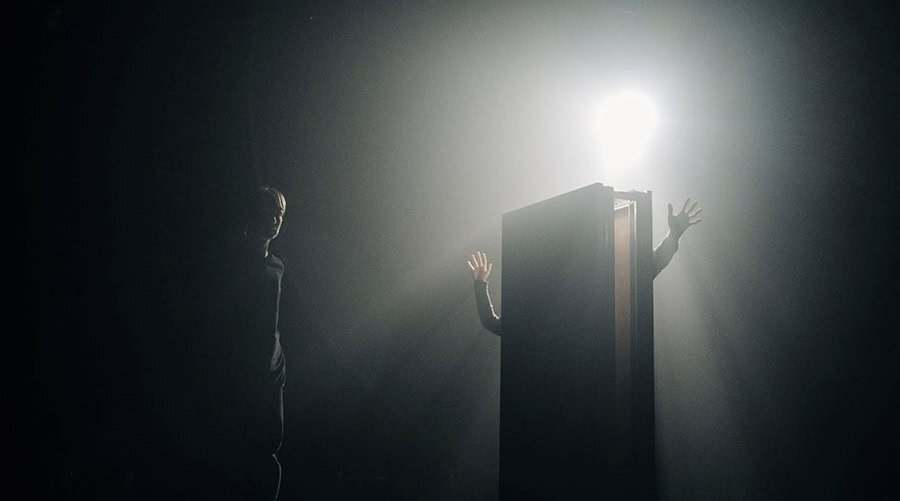
An image from Because You Never Asked by We All Fall Down (photo: Kristina Hillard)
There’s something about the way the best work you see in a festival context begins to gently dominate the other works you see; it grooves into you, you keep coming back to it, revisiting it in the dozens of two-minute queue conversations you have about your festival highlights and it’s safe to say that this same best work highlights the flaws in all the other works you encounter. This was the case with Because You Never Asked by We All Fall Down (Montreal) at Summerhall at this year’s Edinburgh Festival Fringe.
“Chronicling a moment of intergenerational exchange. Based on discussions between creator Roger White and his grandmother, Marianna Clark, about a hidden life under the Nazi regime. Blending a haunting soundscape, featuring recorded conversations of grandmother and grandson, with evocative choreography that embodies memory. A cautionary tale highlighting the perils of anti-immigrant narratives, through stories that pivot between humour and darkness, documenting the slow march toward authoritarianism. A heart-warming reminder to honour the wisdom that came before us and hold on to the memory of those we cherish most.”
The startling and most stunning thing about Because You Never Asked was the artistic cohesion, dramaturgical balance and tonal harmony running through the work. The recorded conversations played throughout the production — we’re hearing the personal testimony and historical weight of life under the Nazi regime — could so easily have skewed and distorted the rest of the production elements: how can a lighting design, score, choreography and four dancers compete with that? But to the credit of WAFD co-artistic directors Helen Simard (choreographer) and Roger White (composer) I felt held, safely held, and I could dwell in this scenographic world and focus on what these two highly-tuned artists have created, the needs of their show and the emotional spaces created for the audience.
In a strong cast of four performers, with sections split into solos, duets and group work, Maxine Segalowitz is luminous. She is that rare performer, one you come across maybe once a year, someone who keeps drawing your attention when they’re on stage. This isn’t about her hyper-extensions or physical fireworks; this is about pure performance magnetism and she has it in spades. It feels like that artistic cohesion and balance is manifesting through her, how she performs, the angle of her chin, the intensity of her windmilling arms — she is the perfect vehicle and tonal embodiment of the work.
In a festival with a host of international companies supported by their respective national/regional arts councils and other private philanthropy, I would hope there would be — at the very least — a consistency of good dancing, to assuage my unquenchable desire for cohesion, balance and harmony. I would be wrong.
Soil by Aviaja Dance (Copenhagen, Denmark) “is a powerful dance performance about identity, language and belonging. Through movement and the rhythms of Kalaallisut (Greenlandic language), it explores how we connect to culture: beyond words, across borders and through the body. A poetic and physical journey of self-discovery, Soil delves into language and the search for self and recognition. It invites audiences to experience the beauty and challenges of communication in new ways. A dance of belonging and becoming.”
In a startling act of false advertising which got this earnest Trading Standards Dance Writer heading to Dance Base on a Sunday afternoon for 35 minutes with 13 others audience members, I regret to report that there is no soil in Soil. The show should be called Tiny Black Pieces of Rubber or How I Couldn’t Think of a Dramaturgical Structure or Satisfying Narrative Device So I Kept Going Back To Sit On A Chair And Listening To A Voice-over About Roots.
Elsewhere the show — which is part of the #DANISH season — self describes as “In her first solo performance, dancer and choreographer Sarah Aviaja Hammeken explores the complexity of her own cultural background in both Kalaallit Nunaat (Greenland) and Denmark.” And it really does feel like her first solo work, and that’s OK because you don’t get to your fifth or tenth solo show without doing your first and so all those recognised tropes are present: the glitchy electric soundtrack where she moves in predictable floor patterns; the difficulty she faces learning so many languages and moving to different European countries for education, love or work, and the under-confidence I see in her bodily performance which all make it more difficult for me to connect with this work.
Sometimes, connection is less important, because sometimes entertainment is the order of the day (see my thoughts of the art vs entertainment debate at the fringe from 2024). Lenka Vagnerová & Company (Prague) take over ZOO Southside — aka the best stage for dance at the fringe — for 90 long minutes with Panoptikum which: “amazes, entertains, and frightens. It has pace, humour and a strong theme with an emphasis on humanism. Thrilling, impressive dance which is an expression of total theatre, invites the spectator to a mystically decadent, visually compact freak show, over which the magical theatre dust of something ancient hovers. The world, inspired by the phenomenon of the nineteenth century, says a lot about our contemporary world. Panoptikum is about the fear of the stranger and the unknown, but also courage and hope.”
In a noticeable choreographic shift that has taken place over the last decade or so, the amount of partner work, lifting, contact and real, stage-munching travelling is rarer and rarer. Is it because these skills are no longer being taught in conservatoires? Do choreographers under 35 think it’s a bit trad or is funding only available for tiny casts? Perhaps these skills lose their place for audiences that are served so much solo, screen-based work that fits neatly inside the frame of a portrait phone. Panoptikum bucked this trend and it felt, for one tiny moment, like I was back in the middle of Europe in 2015, when 8 strong casts were the norm, with dozens of costume changes and artists were making frictionless art and not mining their own trauma for the funding gods.
In a very uneven cast of dancers, with two or three noticeably weaker technically (who often didn’t bother to finish their lines), we’re introduced to a range of characters in a series of 4- to 6-minute dance skits featuring the likes of the elephant man, conjoined twins, snakey lady, ringmaster etc. I was bored. The novelty of the trick lasts for less than 10 seconds, the ennui of narrative predictability sets in and I’m just sat there, waiting for it to finish before the next solo, duet or group work to begin. Although there was an occasional “trick” — like pepper’s ghost, the appearing/disappearing bottle or a floating head being crushed into a top hat — it’s third-rate magic and you can see a LOT better magic and a lot better dancing at the Fringe. The thing that Vagnerová is known for (partner work, lift work, real, stage-munching travelling and contact) was satisfying when it arrived, but it was all too infrequent and at 90 minutes, Panoptikum really needed sawing in half.
Coming in at a shade over 50 minutes and with very little bodily movement happening on the 3m x 2m stage in the subterranean Former Gents Locker Room at Summerhall, Ill Behaviour by Hee Suhui (Anise) (Singapore) was in some ways the antithesis to Panoptikum but explored some of the same conceptual terrain. It self-describes as: “a deviation from the habits of the well and able. An interdisciplinary performance exploring the act of auscultation and the visceral body turned inside out, playing with qualia, the collective clinical, moving through disembodiment and discomfort to reach for tenderness and reciprocity. Amplifying the body’s interior transmutes the act of listening inwardly into an act of care and intimacy. Ill Behaviour holds an unanswered question: How do we live in and listen to the (ill) body we are given?”
Ill Behaviour is the first work from Hee Suhui (Anise), part of the new Singapore Spotlight season and it’s purposely slow and small. Only one of the performers moves for the first 15 minutes, oozing her body off the stainless steel morgue-like bench before the aforementioned auscultation in question (listening to the internal body sounds via a radio mic slowly dragged on the skin over the throat, eyelashes and mouth) kicks in. If Ill Behaviour was extensions and glacial repetitions of this it would be an ASMR dream world that was serving Clicker vibes from the video game The Last of Us and I would have loved it.
It’s in the middle section that the second performer wakes up and we get some more movementy sections where the bodies have been layered on top of each other, in nude, mesh, cheese-holed, skin-tight suits. They delivered some light and basic contact and release work which I felt was problematic in terms of the imitation and portrayal of what could be “inmates from asylum” with clichéd, self-hooking fingers in mouths, twisted limbs, toes pointed inwards etc. With an introduction in the final section of a slime balloon being crushed in the middle of a hug between them we begin to see the slime drip and leak from the table before it is scooped and tenderly applied to each performer in turn. Ill Behaviour is a first work in every sense; it doesn’t really exist outside the visual world – there’s nothing for an audience to emotionally hook into. Empty, tender-ish, slime dance with a cracking score.
Once again I return to Because You Never Asked; that’s the work that stays with me because of the feelings it evoked and because it was flawless. There was a fifth dance work I saw, Small Town Boys by Shaper Caper (Dundee, Scotland) at ZOO Southside which was part of the Made in Scotland showcase, but it was so bad, like in my bottom three of the all-time dance works I’ve seen in the last 20 years — all choreographed by white men — that I cannot write about it in less than 4000 words. All of the other works, in comparison, had flaws, either in their dramaturgy, concept, performance quality or choreographic naivety, and when you see works back-to-back in a short space of time, they will talk to each other and internally compete for the space in your head, so I’m happy to carry that one jewel with me whilst the others slowly fade into the archive. Outside of dance, there was a whole suite of strong, one-woman theatre/performance works I saw which had the holy trinity of writing, direction and dramaturgy and performance in perfect alignment (I’m looking at you in particular Chat Sh*t, Get Hit by Martha Paling), but in terms of dance, it seems like I’m entering a new era. An era where I appreciate the invisible in dance — the craft, the knowledge and expertise of intelligent choreographers who leave their footprints and fingerprints over everything and bring their concept to life in ways that are imperceptible to the human eye, but somehow, they hook us into something deeper and something more emotionally cohesive.
Here lies a reflection of some moments, performances and work that have settled in my 2019 memory bank. It was a year when we had the UK Dance Showcase — which I will come back to later — and when so many artists created work in response to institutional power and epistemic violence.
Wendy Houstoun’s Hell Hath No Fury at Wainsgate Chapel, Hebden Bridge (part of Wainsgate Dances in June) took us to her Sunday school pulpit of philosophy and rage whilst delivering us from evil in a ferociously hilarious 45 minutes of wordplay and image making. Aided by the servitude and deferential bell ringing of Charlie Morrissey, Houstoun was our High Priestess, our sermon giver offering hope, hula hoop skipping, and water to those in need; as she commanded the audience to sit, stand and listen in our pews to ripostes against the 2019 political landscape she was swift and rapier-like. With Hell Hath No Fury Houstoun has demonstrated (and built upon from her previous works 50 Acts and A Pact With Pointlessness) her gift for rhythm, distillation and an ability to hold attention; she captures a mood of how some people are feeling and lampoons it. Wainsgate Chapel as a site of performance and Houstoun as prophet is an immaculate combination; in the age of fracturing communities and the slow death of theatre buildings I imagine a world where Hell Hath No Fury is a 2020 version of a mystery play travelling to chapels, churches and cathedrals across the country, a liturgical drama serving to shame our morally unanchored institutions of power.
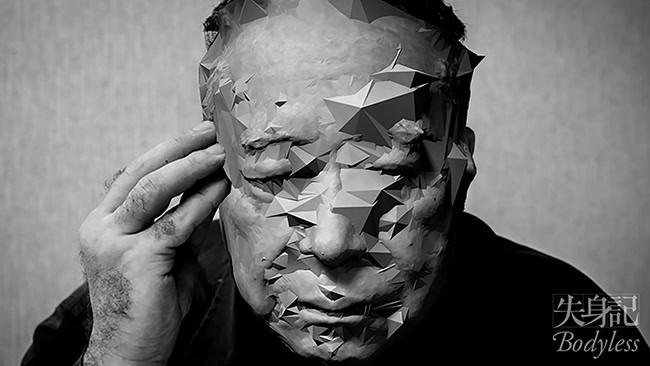
Bodyless, directed by Hsin-Chien Huang, is a single-person 31-minute VR experience I saw at the Phi Centre in Montreal (part of an exhibition of VR work from Laurie Anderson, Marina Abramovic, Paul McCarthy and Olafur Eliasson) in November. Bodyless is based on Huang’s memory and set during Taiwan’s martial law and colonial period of the 1970s. The repression and control of people through old (and new) technologies blended with pervasive digital surveillance to ensure this has a relevance now; what Bodyless achieves that no other VR art work I’ve encountered so far has done, is the technological holy trinity of embodied encounter, emotional narrative investment and graphical fidelity. As we move round a dark and oppressive system, we encounter multiple timeless episodes/scenes where we find bodies in differing states of control; polygon-twitching bodies in cells with rewilding plants growing through the bars, faded newspaper portraits of people who have been deliberately missing-ed or dozens of limp and floating bodies in a hospital or boarding school with limbs defying gravity. The intimacy of VR as a single-person experience heightens emotions as you glide, ooze, sink or float through landscapes; the fact that you have a level of agency, an ability to move, look at and focus where you want embodies this act of witnessing bodyless-ness in action. We see how people are erased from a society, and the emotional distancing that VR and screen-based work usually causes is dissolved by Hsin-Chien Huang in this fantastical response to the memory of trauma.
From the macro power portraits of Hell Hath No Fury and Bodyless to a micro power portrait of Black male mental health, Elephant In The Room by Lanre Malaolu at Camden People’s Theatre in April is proof that Malaolu (supported by dramaturg Season Butler) has created a work of total theatre. We meet man, a multi-charactered everyman in control of his external body, but this control does not extend to his internal mind. Malaolu has a Hip Hop dance technique and execution that sparkles in its clarity; his physicality is accompanied by a command of language and a dexterity in verbal delivery that would cast long shadows at the RSC. He is wav(er)ing and popping; the use of these Hip Hop dance vocabularies is a fine foil for the wider debate around mental health: scrambled muscles that erupt and contract, dispersing clotted brain fog and bringing forth windows of clarity only to close again. Stability and control are bywords for mental health, and if you’re experiencing low level depression GPs recommend activities and inhabiting the types of spaces that Malaolu offers up in multiple scenes: football (exercise), Nando’s (food), barbers (community) and gym (self-worth). From a frozen barber, moving only his eyes and wrist with an imaginary shaver to a magnetic slapping of limbs and his back onto and into the floor and wall to an almost motionless slouch in a chair talking about too chewy chicken…Malaolu has the smarts and this work could and should have an international life like Inua Ellams’ The Barbershop Chronicles. What Malaolu achieves is a transference of a heavy feeling and an internal spiralling which are sometimes impossible to give shape to; the 70-minute work whistles by and it is the monstrosity of his attack, physical commitment (which bordered on the painful), multiplicity of voices and choice of stillnesses and excesses of movement that made this a highly satisfying evening that has the ability to stimulate further discussions in this terrain.
Cardiff Dance Festival hosted Montreal-based Daina Ashbee in residence during the festival in November and over the course of her stay in Wales Ashbee spent some time researching a new work, J’ai pleuré avec les chiens, which will be ready in 2020 as well as remounting and recasting her 2016 work When the ice melts, will we drink the water? We saw around 50 minutes of When the ice melts…performed by Lorena Ceraso in Chapter Arts Centre Studio. With Ceraso on the floor, back flatted and knees triangled, we understand early that her pelvis lies at the root of the work and at the centre of this bodily discourse on survival and endurance. Time is experienced slowly and there is a sparse choreographic landscape but one that is littered with violence, perceptions of the female body and sexuality. Slow quarter-turn rotations at 3, 6, 9 and 12 o’clock see Ceraso address all sides of the audience with her ascended and descended pelvis, flickering edges and glacial eyes, but as she presents each suite of movements four times we witness multiple angles, new and unseen details that were previously hidden from view. When the ice melts…was named the best dance piece of the year at Montreal’s 2016 Prix de la danse awards and in the intervening years it has only gathered relevance with the attention drawn towards violence against women from the #MeToo movement; what it does is build an atmosphere that is so charged and so unpleasant that silence blankets the audience — we barely breathe as we pay attention to every sound and movement emitted from Ceraso’s body. The feelings of anxiety created by the work echo the pressure and internal questioning of should/will/how do we speak of violence against women when we are unsure of what it is we need to say or do in response to it.
Violence towards women was consistently visible in a lot of the works I saw by female choreographer’s in 2019; another example (and a rare one because it is made for outdoor settings) was the 30-minute Scalped by Initiative.DKF. Created by Damilola DK Fashola and Wofai, with movement direction and writing by Fashola, Scalped was part of the opening night of Greenwich+Docklands International Festival in Woolwich in June. ‘For black women one of the most common shared experiences is a passive but ever-present scrutiny. From what you wear to the way you walk, and most especially hair. Whether permed, braided, or in locs, black hair is political.’ Scalped is a work that demands your attention, holds it and then brings you in, which is credit to the company in the context of outdoor presentation when there are dozens of other distractions to compete for your eyes. Patience James, Audrey Lobe, Bubsy Spence, DK and Bimpe Pacheco climb, frame, pose and move around their scaffold set and wheeled boxes telling stories of discrimination, can-I-touch-your-hair violence and desire for freedom. The choreography is big, the performances are huge and the company is rightfully taking up space and presenting politically and narratively strong work in public spaces; Scalped is relentless in its power and energy and forces audiences to at least think about the discrimination consistently faced by Black women in British society. Representation and visibility is crucial and Scalped is one of the very few outdoor works made and performed by Black artists in the UK; Fashola has written and directed a new work Fragments of a Complicated Mind which runs at Theatre 503 in London from January 21 to February 1, and this interrogation of race, religion, sex and cultural expectations is sure to see her star shine even brighter.
Creative responses to institutional power do not always have to be heavy or filled with activist sensibilities; they can achieve just as much from a position that sparks joy, refreshes perspectives and brings people together socially. The Box of Delights by 2Faced Dance Company is a fine example of that (full disclosure: I work with 2Faced Dance Company as Executive Director and had a small performance role in the work). Running for seven nights from December 17-23 as part of their 20th Anniversary programme, what co-directors Tamsin Fitzgerald and Tim Evans have created with The Box of Delights is something that I’ve not seen before from a company in the UK; with the first act of 50 minutes taking place outdoors at night at over 20 locations and performance interventions throughout the historic centre of Hereford, they guided an audience of 80 towards The Green Dragon Hotel for a second act which contained a meat or vegan three-course meal prepared by executive chef Simon Bolsover and the continuation of the narrative taking place over 1hour 45 minutes. The seamless shift of the narrative and audience experience from outdoor to indoor, altering perceptions of place alongside the inclusion of food, is an innovative model for presenting work and place-making which suits audiences, performers and companies alike.
The aforementioned works are some of the great ones I saw across the year, but it wasn’t all as good as this. The first outing of Impermanence Dance Theatre’s dance adaptation of Bertolt Brecht’s Baal at Bristol Old Vic in April was both under and over baked at the same time; their portrayal of excess felt muted and duller in comparison to their previous successive portraits of excess in SEXBOX and Da-Da Darling. Rosie Kay Dance Company premiered the scaled-up version of 5 Soldiers…10 Soldiers (complete with 10 dancers) on the main stage at Birmingham Hippodrome in May which saw a dull 30-minute prequel tacked on to the previously successful 60-minute 5 Soldiers. The first half was meant to show the time getting in the army, but emotionally, physically and tonally it mirrored the second half leaving me questioning its purpose. The work clearly resonated with people who had a personal connection to, and involvement with, the army, but as a work at this scale, when the company hasn’t presented in this size auditorium, why would we expect it to be good immediately? Maybe after three or four shows when they understand that the intimacy, nuance and detail that made 5 Soldiers so good needs to shift considerably for grander and less subtle inferences. However, the work I had most trouble with this year was Confessions of a Cockney Temple Dancer by Shane Shambhu at Gloucester Guildhall, part of Strike A Light’s festival in March. In a year when there have been so many works of dance, performance and theatre exploring the effects of immigration/race/displacement/othering like Demi Nandra’s Life is No Laughing Matter, Akeim Toussaint Buck’s Windows of Displacement, Claire Cunningham’s Thank You Very Much or Rachael Young’s Out, Shambhu’s Confessions is a lite and frothy idiot’s guide to bharatanatyam made for White people. Peppered with anecdotes about his relationship to Indian dance and performing his arangetrum, it asks little of you and there’s little empathy, emotional investment or calls to action. Shambhu is a likeable mimic, scatting between citizenship issues and the physicalities of his family members, and while the work is well constructed it plays into the self-exoticisation that so many contemporary bharatanatyam creators attempt to repel. There are short bursts of 10-15 seconds of classical movement, which are not the cleanest and he is sometimes out of breath when coming out of a movement sequence straight into speech. There’s a nice reveal towards the end, an emotional hit that shows a duality: that this is part of him and that he wants to reject it but is unable to because it has partially formed him and how he is in the world.
…and back to the UK Dance Showcase, phase two of the Surf The Wave project conceived by Deryck Newland before he left PDSW in February 2017. The UK Dance Showcase was curated by 11 people and of those there were no women on the committee who weren’t white, there was nobody who worked in an organisation north of Salford, there were no people with a disability, no female artists and no producers. Surf The Wave is ‘the major project led by PDSW, on behalf of the National Dance Network (NDN)’ but it is telling how the other 26 members of NDN have been very public in distancing themselves from the project and choose/chose not to publicly or privately acknowledge the reality, successes or failures of Surf The Wave.
Artists and producers are always in the position of least power, least resources and least privilege in their relationships with institutions, and what has been heartening in 2019 is see how they have spoken up, back to, and in solidarity with others while forging new alliances en route. The relevance of the majority of cultural institutions and how they behave in society and with their community demonstrate at best a wilful ostriching ignorance of how society is shifting and at worst a consistent and harmful contribution that perpetuates outmoded thinking, broken systems and systemic bias.
With the total funds raised at more than £1million — on top of the other public subsidy added to the total from the time spent by salaried organisations across the UK — the narrative presented back to NDN and to other funders has been that some of the artists who attended the event have achieved some positive outcomes, built tours and new relationships. While this is brilliant for those artists who presented/pitched work that appealed to small-scale, non-dance specialist arts centres across England, the active choice not to invite international programmers rendered the entire narrative as a sweet set of Tory Leadership/Brexit analogies (taking back control of our borders/exports), and conservative leadership breadcrumbs (Jeremy Hunt’s I’m an Artist as Entrepreneur) that beggars belief. What has not been reported is the anger, frustration, bitterness and experiences of unprofessionalism in the way artists who were ‘selected’ were engaged in the lead-up to the event. Delaying the timeline of announcing selected artists (ensuring artists missed funding windows to apply for support to enable their presence at the event), offering fees to present the work, reneging on that offer and then offering a lower one to the same artists or selecting work that is not in a touring window and expecting artists to absorb the costs of remounting it, were some of the examples (there were many more) of how artists were treated. While it is acknowledged that those who programme work congratulated the PDSW team on a well-organised showcase event, the structural debris of damaged and fractured relationships has mirrored our political situation. Those holding power are ever more desperate to preserve old models and thinking, whilst those in receipt of the email vacuum of silence are left to wonder how to engage in the future.
I wrote a whole other piece (unpublished) about my experience at one of the Artist as Entrepreneur events but it follows a similar vein. Artists and producers are often encouraged by organisations and institutions of power to acknowledge their failures and mistakes in the creation and presentation of work — a growing focus and thematic consideration of a number of dance works including Epic Failure by Cultured Mongrel and The Unwanted by Shaper Caper. These and other works in development offer a personal, interesting and critical perspective on human fallibility, but until our organisations and institutions of power begin to acknowledge their own failure, or offer a public narrative about things which went well or not so well, then things will never change, and the power imbalance shall remain.