Russell Maliphant Dance Company, Maliphantworks4 at The Coronet, September 11, 2025
Russell Maliphant in In A Landscape (photo: Dana Fouras)
As the title of this evening suggests, this is the fourth in a series of performances by Russell Maliphant Dance Company at The Coronet, and there is a mysterious yet palpable relationship between Maliphant’s style of choreography and the architectural atmosphere or inner world of the theatre. The stage is small but suspended to the level of what was once the theatre’s Circle (the parterre has become the raked bar downstairs), giving an other-worldly intimacy to the space. It’s ideal for Maliphant’s program that comprises two solos, created 16 years apart, that form, in terms of dance time, a reflection on his creative development. The program starts with Maliphant’s latest work, In A Landscape, which premiered in the same theatre in February, and reaches back, in AfterLight, to an early, fully-formed crucible of Maliphant’s choreographic style; every aspect of In A Landscape has its seed in AfterLight. Seeing the two works in the reverse order of creation is to take the long way round to the beginning.
In a Landscape (a homophone for Inner Landscape?) is a collaboration with visual artist Panagiotis Tomaras, a break from the long-time partnership between Maliphant and lighting designer Michael Hulls. While it is not always clear in a long-term partnership the extent of one influence over another, it is refreshing to see Maliphant, dressed simply in chic overalls by Stevie Stewart, stepping into a new landscape of light and shadow, one in which he inhabits the character of a seasoned wanderer in search of enlightenment. The voluminous, cream-coloured material hanging in parabolas at the back of the stage — the one suggestion of colour in this landscape — gives a spatial sense of Greek simplicity and order and a metaphysical sense of fate. Tomaras creates in light and shadow the image of a man shaping his destiny, first in a series of still poses interspersed with blackouts — like a table of contents — and then merging these poses in the swirling, spiralling patterns Maliphant makes with the material. Is he emerging from the womb or returning to it? Is he young or is he old? Time is fluid in this landscape as Maliphant journeys neither forwards nor backwards, neither freely nor fully constrained by the screens Tomaras drops down in front of him on which his movements are projected. There is an Eastern flavour to the electronic score from Maliphant’s long-term partner and muse, Dana Fouras, who seems to will Maliphant forward with her music through the maze of light and shadow until he merges quietly back into the engulfing darkness. We are not aware if he has found what he was looking for, but only of the journey taken.
Daniel Proietto in AfterLight (photo: Hugo Glendinning)
AfterLight begins where In A Landscape ends, in the deep shadows of light. This work from 2009 is an inspired collaboration between Maliphant and Michael Hulls with the equally inspired dancing of Daniel Proietto. Its origin is in the circular drawings of Vaslav Nijinsky that he drew during a mental breakdown following the First World War. For Nijinsky the circular motion links the spiral musculature of the dancing body with what he saw as the perfect symbol of life and art. These two elements of the physical and the spiritual pervade Maliphant’s choreography and Proietto’s performance. He begins in the dark, turning imperceptibly against the direction of the revolving particles of light projected overhead (video projection by Jan Urbanowski), setting up a breathtaking spiral movement not only in his body but in the space of the theatre itself. His red-capped head and torso are visible but his feet are in darkness so his revolving body and blade-like arms give the illusion of a slow and uniform figure planted on a turntable. Proietto’s costume is a subtle reminder of Nijinsky’s portrayal of the tragic doll, Petrouchka, and Hulls’ lighting in the first section seems to set up the scene of the doll trapped inside the solitude of his cell. Set to Erik Satie’s Gnossiennes 1-4 for solo piano, mystical dances that have no set time signature in a recording by Dustin Gledhill, Maliphant’s choreography and Hulls’ lighting bring to the score a visual reality that Proietto further enhances with his limpid breadth and grace. I saw him dance this in 2010 and have never forgotten its impact. This performance lacked nothing of the original, nor was its impact in any way diminished. That speaks to what can happen between artistic collaboration and performance at the highest level.
José Navas/Compagnie Flak: Villanelle/S, Fleck Theatre, Harbourfront, Toronto, April 19
photo: Michael Slobodian
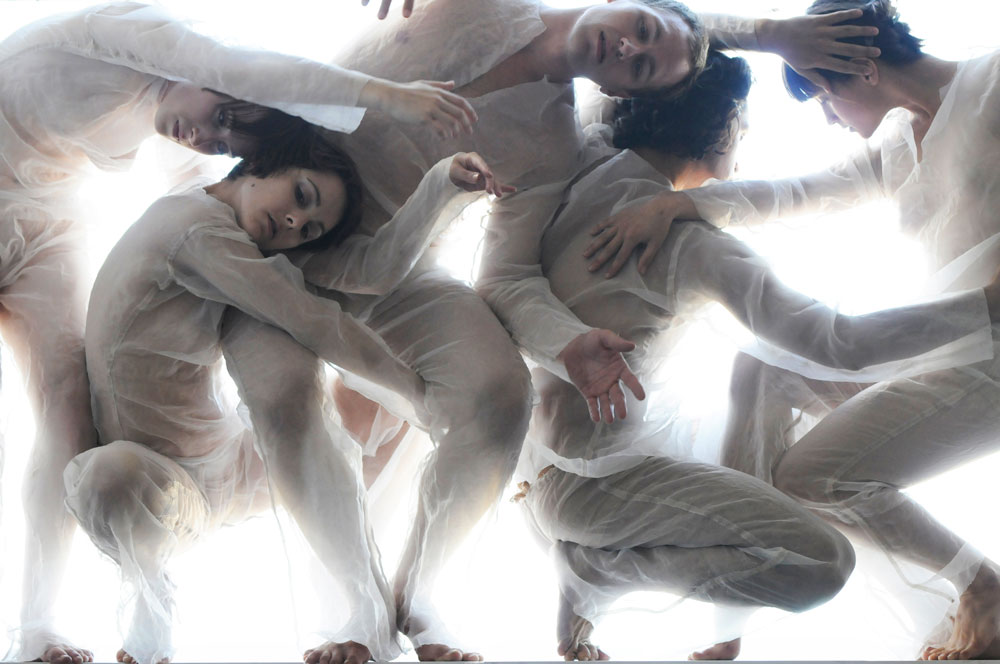
José Navas’ S and the short solo Villanelle that precedes it form a choreographic progression from a single, partially clothed, luminous figure performing the equivalent of a temple dance to a grouping of denuded, ethereal beings emerging from the darkness into light. It is a meditation — like the music of Erik Satie that inspires it — on light and beauty in which Navas harnesses a classical sensibility to a sensuous quality of movement and form.
It is a naked work: the dancers slough off their diaphanous clothing (designed by Navas himself) as the work progresses, keeping just their skin-coloured trunks to maintain a continuous sculptural body surface. But it is also a naked work in the same way the piano music of Satie is naked: without any embellishment. It requires a subtle style of dancing and despite the many opportunities for individual dancers to shine, the abstract quality of the work depends on anonymity of character, like figures in a classical frieze. Much depends on the qualities of the dancers: beauty, a fine, supple line, a lack of ego, and the ability to keep a phrase of movement alive without end. Some of the dancers are new to the company, and one can sense they are trying to assimilate Navas’ choreography; they still have to unlearn elements of their past training to dance this convincingly. In watching Lauren Semeschuk, however, I feel the qualities required by Navas are eloquently embodied.
Villanelle is danced to the music of Vivaldi, Cum dederit delictis suis somnum from the Nisi Dominus. It is spiritual music, heightened by the (unattributed) counter tenor voice to an emanation of pure, imagined divinity. The choreographic language belongs as much to eastern mysticism as to western classical style as Alex Jolicoeur emerges from the dark in a circle of light clothed in diaphanous leggings with his chest bare, sitting on his heels on demi pointe, legs turned out. He rises up keeping his head downinitially, raising his arms until his body is fully stretched upwards in a moment of quiet control and serenity. As the music begins, he descends once again into the opening position only to rise again with the lighting levels to a summit of abandon that reminds me of a photograph of Nijinsky in Scheherezade. Jolicoeur, who is substituting for the absent Navas, tries hard at times to hold on to the movement where I feel he should instead be letting go. It stems perhaps from a misunderstanding of the difference between the muscles needed to maintain a structural core and those needed to move. In the middle section of his solo he foregoes stillness to expand his spatial reach and classical technique — where he is more comfortable — until he returns once again to the opening pose, looking now at the audience as his mirror.
Although Villanelle is a solo in itself, it forms a prelude to S (S for Satie and S for silence) whose structure is like a theme and variations with the difference that it never returns to the theme in its finale but moves into new territory altogether. The theme is unity, sensuality, animality emerging from the earth and into the light. Seven dancers, fully clothed in similar diaphanous material to Jolicoeur, stand one behind the other, extending their arms and legs like a multi-limbed devotional statue of Shiva. They move across the stage changing places, all in silence, from slow movement to circular, helix shapes, to a point of stillness. Then they start again, carving out the air to stop in open positions, seated or standing. Jolicoeur joins in a section of unison phrases during which Satie’s music — sections of Gnossiennes and Gymnopédies played slowly, almost plaintively in an unattributed recording — begins like a body slipping noiselessly into the water. The quality of the movement makes it appear the dancers are performing somewhere inside the music. And yet there are also moments when a heavier quality weighs down the choreography; it wants to float, like Satie’s notes, and at its most sublime succeeds, yet gravity reasserts its hold — sometimes too much — on these souls about to leave. Anything that doesn’t flow like water, like an errant sound (a hand slapping hold of a partner’s thigh) or a moment of tension, breaks the spell. Even a tentative approach jars. This is, I think, the issue in Waldean Nelson’s first solo. He is followed by Lauren Semeschuk, now stripped to the waist, who dances an unequivocally feminine solo in which she gently pushes and pulls the space around her with a freedom of expression that is as luminous as her skin. She ends with her back to us as Sarah Fregeau and Erin Poole enter to form a trio that begins in silence and recalls phrases from Villanelle.
Navas writes in the program that ‘When you listen carefully to the Gymnopédies and the Gnossiennes, you realise that Satie is developing the same theme with all kinds of variations. It’s simple, clear, and totally abstract, but it’s also poetic and very touching. His manner of creating is echoed in my way of composing choreography from a key phrase that generates all the others.’ Solos intermingle with a flowing arrangement of duets, trios and sextets until the choreography begins to coalesce in a more solid sculptural form, beginning with Fregeau’s standing beautifully in an open fourth position, the dancers placing a hand on another’s shoulder, and walking on their heels like the nymphs in Nijinsky’s Faune. Other solos continue to play within the music and the silence — some more successfully than others, though Nelson finds his fluid form here — but we are moving inevitably towards the realization of the final octet.
To the third of the Trois Gymnopédies, the dancers, now all stripped to their trunks, gather closely together like Rodin figures, slipping around and in between each other in slow motion. Marc Parent’s lighting picks out beautifully all the skin colours and shades and shapes. There is a long rectangle of light like a road; only one person is on it at first, while the others are in the shadows, growing up from the ground, caught in the process of emergence or disappearance. The line spreads out until the dancers each have the space to begin their slow walk forward, eyes closed, letting the music guide them. It is a section of being, not doing, a spiritual, almost blind journey into the unknown. The dancers continue until the dying light finally engulfs them in dark as the last chord reverberates through the theatre.
With his ability to find common ground between the classical and the sensuous, between light and dark, weight and weightlessness, Navas is currently choreographing Giselle for Ballet BC. He has also been asked to create a work for The National Ballet of Canada that will première in November on a program of new works by Robert Binet and James Kudelka.
Thanks to Mimi Beck and DanceWorks for producing this program and for making it possible for me to reserve a ticket. Before I left London, I reserved a seat on the train from Montreal to Toronto, but there was no way I could reserve a seat at Harbourfront’s Fleck Theatre. Strange, but seeing the performance was worth any amount of frustration.