Pam Tanowitz, Pastoral, Barbican Theatre, October 1, 2026
Posted: October 8th, 2026 | Author: Nicholas Minns | Filed under: Performance | Tags: Andrew Nogal, Anson Zwingelberg, Beethoven, Bill Kalinkos, Caitlin Scranton, Caroline Shaw, Christine Flores, Dana Jessen, Davison Scandrett, Justin Ellington, Lindsey Jones, Maile Okamura, Marc Croussilat, Pam Tanowitz, Sarah Crowner, Stephanie Terasaki | Comments Off on Pam Tanowitz, Pastoral, Barbican Theatre, October 1, 2026Pam Tanowitz, Caroline Shaw and Sarah Crowner, Pastoral, Barbican Theatre, October 1
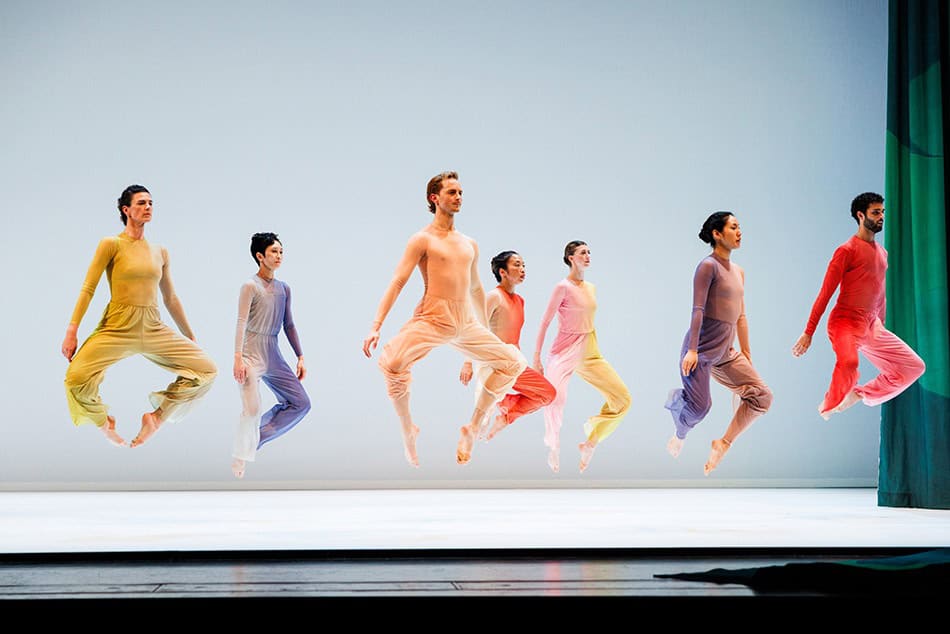
Billed as the UK première and the third co-commission between the Barbican and Pam Tanowitz Dance, Pastoral is, at its creative heart, a co-creation between choreographer Pam Tanowitz, composer Caroline Shaw and visual artist Sarah Crowner. Davison Scandrett’s beautifully lit stage transforms The Barbican Theatre into a gallery space in which seven dancers in Reid Bartelme’s diaphanous pastel colours negotiate Crowner’s pastoral screens, curtains and a swathe of green cloth with hushed precision to Shaw’s luminous, playful score. The collaboration is so intimately conceived that there’s a sense of seeing and hearing figures at an exhibition who are themselves the subject of the exhibition. When the dancers move around and between Crowner’s canvases, those canvases take on a dynamic life of their own, and Shaw’s score, a dialogue conceived between Beethoven and three musicians who are seated in front of the stage — Dana Jessen on bassoon, Bill Kalinkos on Clarinet/ Bass Clarinet and Andrew Nogal on Oboe/English Horn — forms a contemporary pastoral that in turn affects the choreography. Alongside the musicians, Shaw presents Beethoven’s most familiar phrases from his sixth symphony in diverse recordings and interpolates the sound of cicadas, the hum of traffic, or the clatter of someone washing dishes. It’s like hearing snatches of the symphony on the kitchen radio or while driving in an open convertible. Throughout Pastoral new life is constantly pulsing in an out of each collaborative art; Tanowitz’s choreography takes on sometimes the flatness of the picture plane and at others the sinuous play of Shaw’s score. That is the nature of a true collaboration.
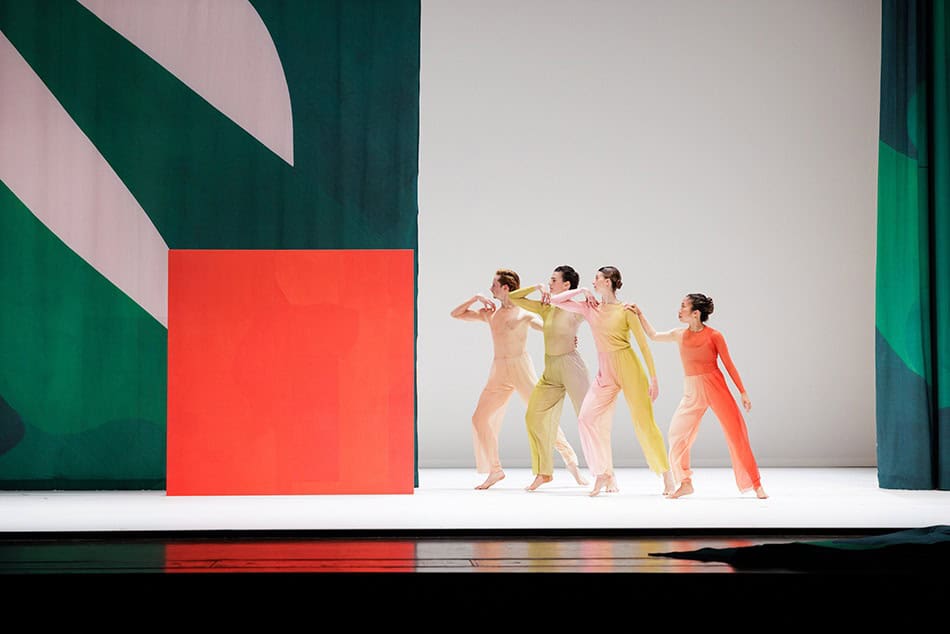
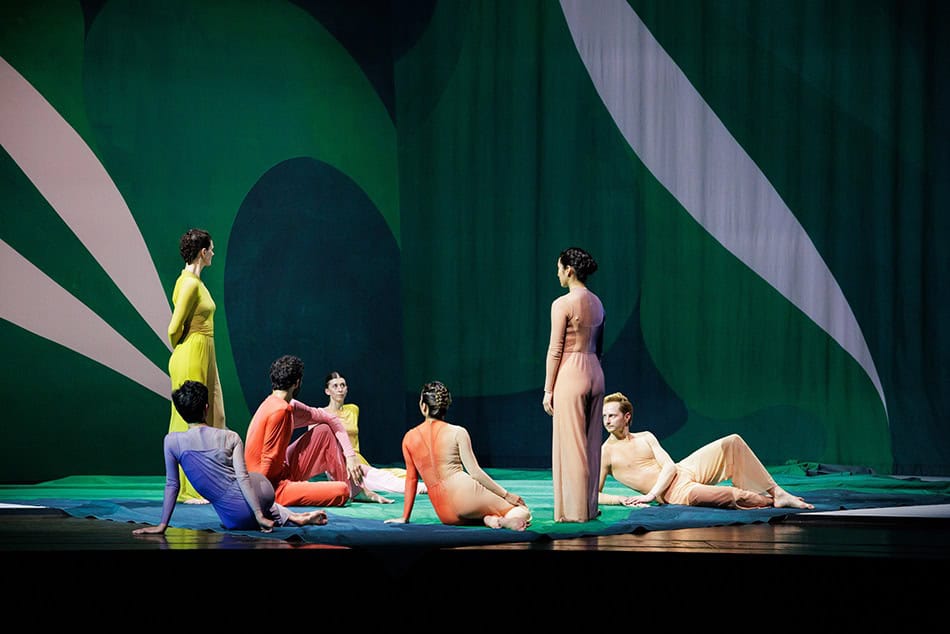
The choreography is nevertheless the most alive of the collaborative elements in that it is always in real time. Crowner’s canvases are already in place and can be moved mechanically or by the dancers, and while the musicians are also playing live, they are interacting with a recorded score integrated into Justin Ellington’s sound design. But the dancers have to deliver their movements in the moment on the stage. Marc Croussillat, Christine Flores, Lindsey Jones, Maile Okamura, Caitlin Scranton, Stephanie Terasaki and Anson Zwingelberg display a variety of techniques, with classical training in varying degrees and the influence of Merce Cunningham very much in the mix. As figures in the exhibition, they carry equal weight over the course of Pastoral, as complementary and unified as colours on a canvas, but clearly Tanowitz choreographs on the strengths and talents of each dancer. She does not hold back from choreographing deceptively simple steps that require great strength and balance, but any virtuosity appears without a note of drama; it comes across as almost nonchalant or as part of a game. It’s not too much to describe Tanowitz’s choreography as sampled in similar fashion to Shaw’s score: there are references not only to other ballets — Nijinsky’s L’Après-midi d’un Faune and Paquita — but to painting, where one grouping seated on the swathe of green cloth suggests Manet’s Le Dejeuner sur l’herbe. Like Shaw’s sound interpolations, Tanowitz’s visual allusions meld effortlessly into the movement.
For the most part the dancers’ facial features are neutral, dispassionate, their gaze throughout Pastoral staying within the stage frame, engaging with the space created by Crowner’s sets rather than directly with the other dancers or the audience. This creates the impression not of a story that we can read so much as a series of aleatory rituals or games whose rules are known uniquely to the participants. Only occasionally does one of the dancers take a stance directed at the audience, inviting us into their secret. Scranton draws our attention with her statuesque stare, and Croussillat at one point looks as if he’s trying — with the same success as Nijinsky’s faun — to catch the attention of one of the women, but generally the intentions behind the dancers’ dynamic shapes taking inspiration from Crowner’s designs and Shaw’s score remain inscrutable.
With our attention moving freely between the three art forms, there is nevertheless an emotional reading of the whole. Watching from the outside you can’t help feeling deeply involved in the work, like spending a concentrated time in front of a painting. Pastoral is a work that quietly demands further viewing so as to reveal itself over time. Whereas it is possible in this age of mechanical (and digital) reproduction to see Crowner’s art and to hear Shaw’s score, we are less likely to see Pastoral in its full collaborative setting. That is a shame. Having transformed the Barbican Theatre stage into a gallery, seeing it on screen would not be so much different from seeing it in the theatre.