Posted: September 24th, 2012 | Author: Nicholas Minns | Filed under: Performance | Tags: Ben Ash, Dead Gig, Dog Kennel Hill Project, Duet, Execute Now, h2dance, Hanna Gillgren, Heidi Rustgaard, Luke Birch, Mamoru Iriguchi, Matthew Morris, One Man Show, Rick Nodine, The Place Prize | Comments Off on The Place Prize semi-final 2

photo: Benedict Johnson
The Place Prize Semi-final 2 (Mamoru Iriguchi, Rick Nodine, Dog Kennel Hill Project, h2dance), The Place, September 18
The narrow strip of stage is littered with wires, screens, projectors and cameras, the electronic detritus of multimedia performance artist, Mamoru Iriguchi. There are four rectangular screens, two placed equally either side of centre stage, and on top of each is a seat number from the Royal Opera House: Balcony B2, Stalls A15, A16 and Dress Circle C54. Iriguchi’s training as a zoologist and his fascination with video evidently influenced his original concept of creating a ‘dramatic tapestry’ of different perceptions (from different seats in the house) of a single performance. In One Man Show Iriguchi plays both performer and (onscreen) audience but his subjective concept has turned in on itself and becomes a self-parody and his feedback a solipsistic loop. His performance is a mercilessly melodramatic dissection of Hamlet’s monologue To Be or Not To Be and his on-screen, alter-ego audience tells him if he misses a line (he does) or if his acting is up to scratch (it isn’t). What further undermines the concept is that Iriguchi’s self-deprecating humour erases any trace of ego. Every now and then thought bubbles from his ‘audience’ are projected on his screens that say things like ‘Don’t fall asleep, you snore’ or ‘what on earth is he doing now?’ Indeed, it is difficult to know if Iriguchi is taking self-deprecation to a new level of seriousness, or if he and his dramaturgs, Nikki Tomlinson and Selina Papoutsell, are pulling our collective leg. Not all is lost, however; although Iriguchi’s Hamlet and his playing of Ophelia in the traditional Shakespearean way is pure ham, the way he introduces the ghost of Hamlet’s father is a brilliant slip of technology: he knocks over his own image on a screen and the image is immediately projected on to the back wall like a giant ghost. Technician Michael Sowby slurs the ghost’s speech to almost unintelligible basso in what develops into a multimedia trio between the ghost (who doesn’t recognize his son in drag), one of Iriguchi’s alter-egos who has been drinking and offers his own version of Hamlet’s soliloquy, and Iriguchi himself who continues to declaim his lines above the chaos. In the end, one of his ‘audience’ screws up his program sheet in disgust and it drops down on to the stage with the whistle of a doodlebug; it is Iriguchi’s comment on his chances of getting to the final, but he is still smiling.
Rick Nodine’s work is called Dead Gig. He is a tall, lightly bearded American expatriate with an academically seasoned look, standing in trousers and a jacket (lovingly picked out by Eleanor Sikorski) made shapeless by a harness connected by a rope, over a pulley, to a shoe hanging in space (beautifully lit by Gareth Green). Nodine’s work ends at its beginning, but he has to take us through the story to arrive there. He starts by asking, “Why was I into a band twenty years after their heyday? Why was I born twenty years late?” As he walks across the stage, pumping his arms front and back, the shoe on the end of the pulley rises, and as he returns the shoe descends. He talks as he develops his improvised tasks, telling the story of the Grateful Dead, to which the Dead in his title refers. His clear text is accented by his movement, and the band’s live recordings punctuate the narrative. At one point he sings along into his shoe as microphone; his voice is powerful, and his singing is pretty damn good. If you consider the voice as a physical instrument, his voice is dancing. He takes the harness off and puts on his shoe as we hear another Grateful Dead song: their music, like a drug, is beginning to have an effect on me. Nodine says he was inspired to dance because of the band; this is his dance of appreciation. I said earlier he is a big man, and seeing him whip around his long, heavy limbs and torso with such power and equilibrium as he gets into the music is impressive. Green provides a light show that suggests at times a 70’s rock concert and at others a Haight-Ashbury happening with a massed flower pattern on the back wall. The more Nodine dances, the more he is out of breath, but he continues to take us through the history of the band, how it became the house band for the LSD-fueled acid test festivals that Ken Keasey staged, how their imagination was given full rein, and how he once saw a Deadhead dancing at a concert, ‘bucking like a bronco, his spine undulating, pumping his arms front and back’, as if in a trance. ‘Dancing in a Dead show could best be expressed as ecstatic dance that was communal but self-absorbed and purely focused on the pleasure of moving to music’, Nodine says in his introductory video. He keeps the beat going, whirling like a dervish, as he takes us into the heart of the matter: Jerry Garcia’s death. He lowers a disco ball covered in a veil, places the veil on his head like Garcia’s mass of hair, puts on a pair of dark glasses, and sets the ball spinning. At one moment he is on the floor in mourning weeds, then standing, listening as if in transcendent communication with the band, his elegant hands crisped, his eyes looking far away. The question at the heart of this piece, Nodine explains in his video, is how the ecstatic relates to the aesthetics of dancing on stage. His performance answers that question, and as he lets the track Death Don’t Have No Mercy wash over us, he transforms us, too, into Deadheads.
Dead Gig has been chosen for The Place Prize Final.
Dog Kennel Hill Project’s Execute Now is a polemic about values. ‘Execute now’ is a trading term used in the buying and selling of stocks and shares and the set can be seen as a metaphorical trading floor with weights instead of computer terminals. There are three performers, Luke Birch, Matthew Morris and Ben Ash, and their clothes (conceived by DKHP with Marisa Lopez de la Nieta) are the antithesis of stock exchange couture. Morris is bare-chested, displaying his full-body tattoos, with jeans and an apron, like a smithy in his workshop. Birch is in blue lab coat and pixie hat, while Ash looks like a messiah in a judo outfit with a red bandanna. The atmosphere is intense, passionate, angry and confrontational. The original concept was more about ‘pendulums, Pythagoras and purpose’, and the use to which pure mathematical numbers might be put, but the drive of the finished work has taken on the zeal of a diatribe by the environmentalist David Suzuki (I found out later from Ash) from a film called Surviving Progress: ‘The economists say if you clear-cut the forest, take the money and put it in the bank, you could make 6 or 7 percent. If you clear-cut the forest and put it into Malaysia, Papua New Guinea, you can make 30 or 40 percent. So who cares whether you keep the forest, cut it down, put the money somewhere else? When those forests are gone, put it in fish. When the fish are gone put it in computers. Money doesn’t stand for anything and money now grows faster than the real world. Conventional economics is a form of brain damage.’
On the bare stage, under Guy Hoare’s seeringly white light, we see the system of pulleys with small sandbags on the ends of three ropes, hanging inert. There is a turntable either side of the stage with amplifiers and controls. At the start the three performers swing the weights across the space and catch them according to the value reported through the ‘trading floor’: 10,000, descending to 40. As the value decreases the weights’ arc diminishes; at 40 it stops. There are other weighted ropes that the trio hoist up and down themselves from the fly rig, and they also work the turntables, playing ‘excerpts of various vinyl pressings’ to which Birch dances around the weighted sandbags that Ash and Morris manipulate. At one point each takes hold of a rope and shakes it like a trio of bell ringers to the taped voice of an auctioneer in full flood. The ropes look like wild snakes. Ash raises a bag above his head and lets it fall, collapsing to the floor a split second before it reaches him; it remains suspended just above his supine head. The significance of ‘Execute Now’ suddenly takes on a more sinister meaning. To wind up, Ash counts down with hand signals, each a sign for some activity. On four fingers, Morris demonstrates yoga at the front of the stage, rippling his stomach muscles and tattoos; on three, Ash skips across the floor and screams silently; on two Birch and Morris stand either side of two weights staring at us and on one – which also resembles a warning – the three stand back to back around a single weighted rope, like heretics at a stake.
Joining the dots in Execute Now is not easy, such is the distance between the abstracted metaphors and what they represent. What carries the work forward is the passion and intensity of the performers. Like the weights, my understanding of the work swings one way and another, never quite finding its point of repose, but perhaps that is what Ash wanted to achieve.
After a workout for the theatre crew, the stage is set for a very different kind of performance. From its original, loose, concept to this iteration, h2dance’s Duet has established a remarkably polished form as a choreographed dialogue between the cheerful Hanna Gillgren and the sardonic Heidi Rustgaard. The work is intense in its own psychological way and, as with any work in which Wendy Houstoun has a creative role, it has a rich, dark vein of comic deconstruction. It is brightly lit by Andy Hammond, and Rustgaard designed the cheerfully coloured costumes.
Once Hanna and Heidi have established, after deferring to one another, that it will be a duet – not a solo and not a trio – they begin a four-step shuffle that accompanies Sylvia Hallett’s soundscape as the beat of their first dialogue, about the couple therapy session they have just attended (‘haven’t we, Heidi?’). It is immediately clear that the therapy hasn’t improved anything in their relationship. Heidi is the rudder and Hanna the sails and it is all Heidi can do to try to keep the two on (her) course. The four-step shuffle gains a jump and an arabesque, and a little hit-the-leg dance ensues. Heidi adds a head and arms, and while Hanna takes a break offstage, Heidi looks for approval from the audience. That changes when Hanna returns, and lets it all hang out with her provocative pelvic gyrations and moans and the ever-alluring smile. Heidi leaves for a pee, the sound of which is amplified for our benefit, and by the time she returns, Hanna is feeling much better but Heidi is smouldering with frustration. Hanna is not paying enough attention so Heidi takes the smoke machine and blows smoke at her like a pesticide with barely concealed contempt, after which she lies down from the exertion. Hanna calmly stands on her back. ‘You had a breakdown, didn’t you Heidi?’ And I wasn’t there for you, was I?’ Evidently not, as Heidi launches into a calmly disparaging attack on Hanna’s cloud-nine, bubble lifestyle at the time (to a dramatic heightening of the score), while she herself was slogging away at the excel sheets and budgets and promoting the work. While she lists all she had to do and all she achieved, she goes into a routine of push ups, sit ups, neck-ups and rants about cash flow, no flow, overflow, and the Arts Council, until Hanna comes in drinking a glass of water. Rant over (‘Never heard you speak that much, Heidi’), Hanna soothes Heidi’s ruffled ego back to the feel-good four-step shuffle and a long list of analogies. ‘We’re like Gilbert and George (aren’t we Heidi?), like Morecombe and Wise, fish and chips, bubble and squeak, strawberries and cream, two peas in a pod….’ As the movement phrases and the music gradually fade, Hanna is back in control: ‘We’ll finish there, then… Andy, you can take the lights out now.’ And he does.
Duet won the audience prize, and will be in The Place Final.
Posted: September 22nd, 2012 | Author: Nicholas Minns | Filed under: Performance | Tags: Beaux, Christopher Wheeldon, Classical Symphony, Ezio Bosso, In the Golden Hour, Mark Morris, Prokofiev, Raku, San Francisco Ballet, Shinji Eshima, Yuri Possokhov | Comments Off on San Francisco Ballet: Programme C
San Francisco Ballet: Programme C, Sadler’s Wells, September 19
If this was the one performance of San Francisco Ballet you were able to see, you would have missed some of the better works in the repertoire, but you would have felt the surge of approval for the quality of dancing, especially for the female principals. Of course there weren’t any in Beaux by Mark Morris because it was a cast of men only, but Maria Kochetkova in Yuri Possokhov’s Classical Symphony, Yuan Yuan Tan in Possokhov’s Raku and the trio of Vanessa Zahorian, Sarah Van Patten and Kochetkova again in Christopher Wheeldon’s Within the Golden Hour all received rapturous applause for their performances. Kochetkova’s partner in Classical Symphony, Hansuke Yamamoto, was also singled out. It was applause for the dancing rather than applause for the dance. This was perhaps the weakest programme the company presented and not even Wheeldon could raise its choreographic temperature. I wonder if this was not one programme too many.
Economics may have something to do with this. San Francisco Ballet is a large company, and the cost of bringing over the dancers (seventy-seven dancers’ portraits grace the printed program) plus crew and administrative staff must be considerable. For it to come to London at all has to make economic sense for Sadler’s Wells and for the company, and a third programme may have been deemed necessary to whet the audience appetite sufficiently for the run. But performing ten works in nine performances over a stretch of ten days with two days preparation and one day off is a tough challenge, the brunt of which is taken by the dancers. It is wonderful they receive their due recognition, but there was one injury last night (Pierre-François Vilanoba), an unfortunate symptom of such a full-on schedule. Hopefully there will be no other incidents.
By weak programme, I mean the works did not add, individually or collectively, to the image of the company that the other two programmes had already provided. Mark Morris’s Beaux was the only all-male work in the tour repertoire, and it is Mark Morris, but his celebrated musicality has always seemed to bob on the surface of the music rather than swim with it in the manner of Jiri Kylian, James Kudelka or Christopher Wheeldon, for example. Apart from showing off the male dancers to full advantage in Isaac Mizrahi costumes, cross-gender dancing and showing the obverse of what men normally do (especially in this company), Beaux does not have, to my mind, a lot to recommend it. What men normally do, however, goes to the other extreme in Possokhov’s Classical Symphony, to the score of the same name by Sergei Prokofiev. Possokhov, who is the company’s current choreographer-in-residence, brings his Bolshoi bravura to the men (Hansuke Yamamoto opens with a double tour to a deep plié), but showers so much technique on his dancers that the choreography has a prickly relationship with the music, though it gives his principal couples a chance to shine. In Raku, to a score by Shinji Eshima, Possokhov’s Russian proclivity for melodrama overpowers the Japanese sensibility for restraint. The story is loosely based on the burning of the Golden Pavilion in Kyoto in 1950 by a deranged acolyte, to which has been added a parallel story of love and loss, jealousy and betrayal. Both strands of the story are set in an earlier, samurai period, replete with inexcusably wooden swords. Yuan Yuan Tan is the exquisite Japanese noblewoman, and her samurai husband who dies in an offstage battle and whose ashes are ceremonially returned and scattered over the stage by his distraught wife is the unfortunate Damian Smith. Pascal Molat is suitably nefarious with his shaven head and black costume as the evil acolyte, who is cast as both philanderer and arsonist. It’s all a bit exaggerated, and Possokhov’s treatment robs the plot of any real drama. The exquisite Tan is thus left to fulfill a dramatic role that really has little credibility or traction and for which her exquisite line and dramatic hair pulling cannot compensate. Eshima’s music, Mark Zappone’s costumes and Alexander V. Nichols’ lighting and set design were right on the mark, so it is a shame the whole idea doesn’t gel.
I was expecting the evening’s last offering, Christopher Wheeldon’s Within the Golden Hour, to raise my spirits, but I fear Wheeldon, in choosing the minimalist music of Ezio Bosso, found himself with insufficient height and depth to carve out his characteristically deep creative line. As always, Wheeldon makes the music visible through rhythms and patterns, but very quickly Bosso’s music proves less and less appealing (as did some of the solo violin playing), resulting in a rather low-key, minimal work. Wheeldon’s cast is exemplary, with Luke Ingham replacing the injured Pierre-François Vilanoba, but this was not Wheeldon’s, nor the company’s golden hour.
Posted: September 21st, 2012 | Author: Nicholas Minns | Filed under: Performance | Tags: Ashley Page, C.F. Kip Winger, Christopher Wheeldon, Damian Smith, Gennadi Nedvigin, Ghosts, Guide to Strange Places, Helgi Tomasson, Joan Boada, John Adams, Maria Kochetkova, San Francisco Ballet, Tchaikovsky, Trio, Vanessa Zahorian, Yuan Yuan Tan | Comments Off on San Francisco Ballet: Programme B
San Francisco Ballet, Programme B, Sadler’s Wells, September 15
By the second evening, the company is already more at ease. The programme starts with Artistic Director Helgi Tomasson’s Trio, to the music of Tchaikovsky’s Souvenir de Florence, a wonderfully evocative minor key sextet that is reminiscent of the same composer’s Serenade for Strings, the score Balanchine used for his milestone 1934 work, Serenade. This circular relationship is completed by Tomasson’s fifteen years as a principal dancer with Balanchine’s company, and he is clearly drawn, consciously or unconsciously, into the powerful orbit of Serenade, especially in the appearance of the figure of Death in Trio’s second movement.
Christopher Dennis lights the stage and Alexander V. Nichols provides a backdrop of a silk-screened, close-up image of ancient buildings (Florence, perhaps) that picks up on the sentimental tone of the music and places the emotions somewhere in the past.
Against this backdrop, five couples waltz on to the stage in spirited form, like the music: straight out of the blocks. Tomasson brings us very much into the present moment, celebrating dance and the individual dancers, focusing especially on Vanessa Zahorian and Joan Boada, who work beautifully together in their duet and in their respective solos. Zahorian has the ability to wind up space and leave it swirling and Boada is like the torso to her limbs.
In the second, lyrical movement, we see a couple wound up in each other’s arms and a tall, slender male figure three steps behind, carving out an ominous, foreboding space: it is clear what is going to happen. Sarah Van Patten and Tiit Helimets are the two lovers caught up in an increasingly hopeless struggle to avoid the inevitable separation. Tomasson celebrates their love in a duet that is more complex than the first, but more flesh-and-blood, with a purity that suggests the couple’s bond. Vito Mazzeo as the dark figure of Death intervenes with calculated persistence, waiting his turn patiently, mercilessly, until he steals Van Patten away, his hand shading her eyes from her beloved, who is left alone with his loss.
The third and fourth movements leave Florence and its memories behind. Maria Kochetkova and Gennadi Nedvigin evidently relish every moment of the lively, earthy Russian folk rhythms and all the classical technique that Tomasson throws at them. The ensemble also gets a well-grounded workout and as the spirited fourth movement spins its shapes and rhythms, the entire cast is caught up until its fast, final, turning patterns come to a sudden end. The dancers appear to be still reeling in their bows.
The opening bars of C.F. Kip Winger’s score for Christopher Wheeldon’s Ghosts are quietly ethereal, and the sense from the figures in their Pierrot-like costumes is one of a gathering of celestial clowns at play. Wheeldon’s caterpillar forms and subtle groupings takes us unawares at first, but as in Number Nine, he finds a path through the music for his particular movement images that by the end makes you feel the path was always there. Despite the title (which is the title of Winger’s score), this is not a poltergeist ballet, but a mixing of dream and circus, fantasy and mime that envelops what Wheeldon conceived as ‘a mass gathering of souls’. Wheeldon is a master of classical form, not only in his development of classical ballet language, but in his use of space. It is more Parthenon than Seagram Building, counterbalancing groups and shapes in a natural, asymmetrical way, aided and abetted here by Mark Zappone on costumes and Mary Louise Geiger (again) on lighting. It is a creative team that forms a total harmony. Let’s not forget the contribution of the dancers, who enter into the spirit of the work beautifully. What I like about the San Francisco Ballet is that the dancers are all distinct, yet form a unity in each work without compromising that individuality. In the middle of Ghosts, on a stage lit with leaves, Wheeldon creates a beautifully expressive duet for Yuan Yuan Tan and Damian Smith that adds a sense of reverence to the gathering of souls and the finale adds a joyous sense of fun. Makes you want to be there.
Ashley Page’s Guide to Strange Places takes its name from John Adams’ score. John Morrel’s opening image of a double yellow line down the middle of a road makes me want to overtake the head in front of me that is obscuring the view, but more importantly the road is more in character with the fast-moving opening music than with the choreography which moves fast but on foot. Paige has certainly picked up on the energy of Adams’ score, in which a broad range of percussion pounds and drives like a freight car going over a level crossing, but this leaves the dancers looking quite small in their body-tight costumes (also by Morrel), moving in different patterns that don’t quite satisfy the eye as the different instrumentation satisfies the ear. Not only that, but as the ballet goes on, I feel Paige takes a slight left turn in the road while Adams powers straight on, which is perhaps just as well, for there is a point where the percussion sounds like the theatre roof is being struck by a blunt instrument, but the classical duets continue as if nothing is amiss. According to the program notes (by Cheryl A. Ossola), Paige conceived the work as ‘an ensemble piece peppered with duets. For each one, he matched the movements, textures and tones to the dancers’ personalities and physiques.’ This translates into some great individual dancing from the four leading, colour-coded couples but it tends to keep the scale of the work intimate and inward-looking as it continues its detour to a strange place. The music has already arrived.
Posted: September 17th, 2012 | Author: Nicholas Minns | Filed under: Performance | Tags: Christopher Wheeldon, Divertimento, Edwaard Liang, George Balanchine, Helgi Tomasson, Number Nine, San Francisco Ballet, Symphonic Dances | Comments Off on San Francisco Ballet: Programme A
San Francisco Ballet, Programme A, Sadler’s Wells, September 14
A Buddhist tale relates that a king once had a group of blind men brought to the palace, where an elephant was brought in and they were asked to describe it. When the blind men had each felt a part of the elephant, the king went to each of them and asked: ‘Well, blind man, have you seen the elephant? Tell me, what sort of thing is an elephant?” Of course their answers differed according to which part of the elephant they had touched and they could not arrive at a consensus. The elephant in this case is analogous to Helgi Tomasson’s San Francisco Ballet, and the blind men to those who are only able to see one or two of the three quite different programmes the company is presenting at Sadler’s Wells. To see the full range of this versatile company means investing in all three programmes, however satisfying each one may be.
It is worth noting that the opening night of Programme A is only two days after the dancers arrive in London, and they find themselves on a stage that is much smaller than their home theatre.
San Francisco Ballet performs with a live orchestra but the liveness was in some doubt on the opening bars of its first outing with Mozart’s Divertimento No. 15 in B Flat major, K 287. The pit sounded as if it had been dug a little too deep and the brilliance of Mozart’s sound was decidedly muffled, especially in the horn section. Balanchine’s Divertimento is a sparkling, airy work, full of intricate steps and patterns, a celebration of classical shapes in space and of the beauty of the dancers. The beauty of the dancers is not in question here, but I am not sure if it was the jetlag, or the orchestra’s playing, or the first-night nerves, but the cast struggled to maintain the unity of Balanchine’s choreography with Mozart’s music. Davit Karapetyan showed it was possible, ending his variation with a delightful flourish, but then Vanessa Zahorian danced beautifully but ran out of space and had to change trajectory to finish hers. The orchestra’s tempi seemed to spread panic through the ensemble patterns, giving them an air of constantly trying to catch up, with arabesques and arms arriving to their fullness in the same way different drivers might approach a speed limit: before, as you pass or after. In a program honouring Balanchine by a company steeped in his tradition, I can understand opening with Divertimento: you honour the great man and his work first. But the preparations were just too rushed to do full justice either to Balanchine or to the company, placing time and space at odds with one another. I am sure other iterations of the program will fare better.
The orchestra, under conductor Martin West, was more comfortable in the Rachmaninov, producing a full, warm sound in his Symphonic Dances which choreographer Edwaard Liang borrowed as the title to his work. Liang was a soloist in New York City Ballet, which comes as no surprise. There are elements of Balanchine in Liang’s choreography, but rather too much of a ticklish disconnect between the music and the choreography. Rachmaninov’s lush romanticism proves too powerful for the choreographic forces Liang can marshal, and he gets lost in a plethora of complex lifts that further divide attention from the music in direct proportion to the lifts losing form in space. Simpler ideas have greater traction, as when a group of women lift the hems of their skirts and let them fall in unison to accent the end of a musical phrase, but these are like snippets of conversation rather than part of a consistent choreographic language. It is towards the end that Liang manages to gather his forces closer together, infusing his choreography with a natural, sinuous energy that is warm without being emotional. Daniel Deivison responds to this beautifully, coaxing every last bit of juice out of the movement, and Sofiane Sylve enters almost deliriously into the swirling emotions of the score, taking full advantage of the movement Liang has given her, but it is all too little too late. Neither Jack Mehler’s rich seasonal lighting, nor Rachmaninov’s sumptuous score nor the dancers themselves can rescue this work, though it finishes bravely.
Number Nine (perhaps Christopher Wheeldon’s ninth creation for San Francisco Ballet), takes us by surprise at first by its vibrant, phosphorescent colour contrasts by Holly Hines (costumes) and Mary Louise Geiger (lighting). But very soon I realise I am watching what I have been looking for all evening, a match of equals between music (by American composer, Michael Torke), choreography, costumes and lighting that is consummated in the dancing. Wheeldon plays with his steps and in so doing finds musical space within the score that sets the dancers free. And a wonderful octet of principals and solists it is: Frances Chung, Maria Kochetkova, Sofianne Sylve, Sarah Van Patten, Daniel Deivison, Gennadi Nedvegin, Vito Mazzeo and Carlos Quenedit. Like Balanchine, Wheeldon, who was New York City Ballet’s resident choreographer for seven years, celebrates the body, makes effortless patterns – in one instance from four groups of women to two lines into a square and then into a rectangle – creates lifts that have clarity and sculpts movement that fills the space, however many dancers there are on stage. The entire work is suffused with humour, from the colours to the score to the two dancers conducting the orchestra; only the technical demands on the dancers are not to be laughed at. Towards the end, as the dancers appear to be wriggling in space, there is a trumpet fanfare. How appropriate: Wheeldon’s works have flown home, and in great company.
Posted: September 15th, 2012 | Author: Nicholas Minns | Filed under: Performance | Tags: 24, Joss Arnott, Origin, Tavaziva Dance, The Dark Angel, Threshold | Comments Off on Joss Arnott Dance: Dark Angel seeks light
Joss Arnott Dance, South Hill Park Arts Centre, Bracknell, September 13.
Joss Arnott’s The Dark Angel tour (sounds better without the definite article) opened at the Wilde Theatre in Bracknell’s South Hill Park Arts Centre on Thursday evening. Arnott is a young choreographer with pluck and determination who already finds himself in the enviable position of working with his own company of seven dancers, all young women (though one, Lisa Rowley, is on loan from Tavaziva Dance). More quietly driven than confident, he has an air of knowing what he wants, and where he wants to be in the dance world and is busy carving out his territory, a brand in the making. He has the fragility of being on his own (although the tour is supported Arts Council England, commissioned by South East Dance and produced by Dep Arts), but this is part of his singleness of purpose. He may already have set his sights on work of an altogether grander scale, perhaps the opening ceremony of some festival or sports event. Indeed, there are elements of this in his group choreography this evening, with its running entrances and exits and its relentless physical pulse.
Whether it was planned or not, the titles of the works on the program are suggestive of cosmic growth from chaos to form – perhaps an unconscious metaphor for his own aspirations – but the works are not necessarily in that order. Arnott’s own solo, in the middle of the program, is called Origin, in which he emerges from the obscurity into the light, and the final dance for the entire company is called Threshold. The program opens with a short work he has created (uniquely for the Bracknell performance) with dancers of Berkshire County Dance Company Youth called State of Matter. The odd one out is 24, inspired, according to the briefest of program notes, by ‘themes and concepts explored within the Alexander McQueen exhibition, Savage Beauty…’
The Dark Angel tour is thus a statement of Arnott’s interests at this early stage of his career. For now the inspiration of McQueen’s surreal, dark imagery remains insufficiently realised to be apparent; it is still tucked away in Arnott’s imagination, for future development. What predominates in this show is the primordial energy and the very personal style of movement. Origin is a gathering of forces and shape, as his body struggles to arise into form. Most of the movement comes from within his joints, which have extraordinary flexibility, displacing his body with subtle, rippling movement. A sudden lyrical whiplash turn of the arms and torso draws him up from the floor, where we see him clearly. The side lighting is focused high, so when he is moving close to the floor he is in a murky light that is already suffused with smoke. In what is perhaps another connotation of the title, one can see the origin of Arnott’s choreography here, but it is a quality of movement rather than a vocabulary. It is thus a highly individual work, a solitary statement of his persona that stands in stylistic contrast to his two other works on the program. He also has a certain inbuilt pathos that provides one of the few moments of emotion in the evening’s performance. The work has no climax, for that would suggest an end, and this is a continuous beginning.
The two company works presented either side of his solo are thunderously energetic. James M. Keane’s drumming scores set the tone for both works – more so in Threshold than in 24 – so it is difficult to escape the pulsing rhythm, and even more difficult for the dancers to maintain the relentless drive. But maintain it they do, up to the final beat, which is a remarkable achievement. The costumes of 24 suggest an Amazonian rite of passage and the feral vocabulary for the all-female cast of five reinforces this. Not all his dancers have Arnott’s movement quality, but wherever possible he favours extensions and hyper-extensions of arms and legs, backs and hips and grounds his movement in deep pliés and lunges, which heightens the sense of power. Arnott uses a mix of solos, duets and trios interspersed with ensemble work to keep the continuous dynamics fresh (and to give the dancers a moment to recover) with entrances and exits made running at full speed into the movement, rather like a relay race with no winners. The competitive aspect in Threshold, in particular, can get quite intense, however, with its instances of (choreographed) violence. Only occasionally do the dancers have eye contact with the audience; otherwise the focus is predominantly inwards towards the group. In terms of full-throttle dynamics, Lisa Rowley and Lauren Wilson stand out, and Jessica Hall has the grasp of Arnott’s hyper-extended lines.
These girls are dancing for all they are worth, and we are watching their rites of passage. And Arnott’s, too.
Posted: September 13th, 2012 | Author: Nicholas Minns | Filed under: Performance | Tags: Charlotte Broom, Christopher Akrill, Clemmie Sveaas, Didy Veldman, HeadSpaceDance, Javier De Frutos, Luca Silvestrini, Mats Ek | Comments Off on HeadSpaceDance: Three & Four Quarters
HeadSpaceDance, Three and Four Quarters, Linbury Studio Theatre, September 11
There is a story of JMW Turner on varnishing day at the Royal Academy. In 1832, when Constable exhibited his painting, Opening of Waterloo Bridge, it was placed next to a seascape of Turner’s – a grey picture, beautiful in its own watery way, but with no positive color in any part of it. Constable’s Waterloo, by contrast, seemed as if painted with liquid gold and silver, and Turner came several times into the room while Constable was heightening with vermillion and lake the decorations of flags of the city barges. Turner stood beside him, looking from the Waterloo to his own picture, and at last brought his palette from another room. Putting a round daub of red lead, somewhat bigger than a shilling, on his grey sea, he then went away without saying a word. The intensity of the red lead, made more vivid by the coolness of his picture, caused even the vermilion and lake of Constable to look weak. ‘He has been here,’ said Constable to his colleagues after Turner had left ‘and fired a gun.’
I will come back to this.
HeadSpaceDance’s debut evening of premières, Three & Four Quarters, at the Linbury Studio Theatre, opens with Javier de Frutos’ Studies in M, with what appears to be three of the four cygnets from Swan Lake danced to the first movement of Bach’s concerto for oboe and violin which is repeated three times as the dancers regroup and embellish their disintegrating links. Christopher Akrill, Charlotte Broom and Clemmie Sveaas appear to know each other well; their performing history suggests it and there is a harmony and ease in their styles, a complicity rather than a familiarity. There is even a similarity in appearance, though this is possibly the softening effect of Fabrice Serafino’s androgynous nightdresses with tendril-like tassels and grey socks they each wear. The choreography also seems at ease, but this is the illusion of a performance that is timed and spaced to perfection; to repair the delicately absentminded breaching of their choreographic patterns is only an artful step away, a slight realignment of an errant arm or head. The structure of the trio follows Bach’s musical precision, though De Frutos takes advantage of the trio’s subtle, subversive humour and their quiet dramatic presence to keep them at times on the music’s lyrical path and at others insouciantly off it. At the end only Sveaas is left on stage, focusing intently on her movement phrases until Bach stops and she is left somewhere between the silence and the ticking of a clock. She walks half-way off, hesitates, then creeps quietly through the door at the back. There is applause, but no bows; the evening is programed as one work in several acts.
Akrill and Sveaas reappear from that same door carrying a roll of white, padded material that they unroll on the floor like a giant duvet. This is the bedroom setting of Didy Veldman’s insomniac In the skin I’m in 1, the first of his triptych of autobiographical portraits of each of the dancers. Veldman writes in his notes that in working with the dancers, he had set them a task of writing down their thoughts for five minutes. ‘This text was so interesting that it became the basis for what we’ve created together.’ Broom is recapping her to do list: teabags, phone Carole, tap: thoughts that punctuate this delightful watercolour sketch. The music, Alexander Balanescu’s Aria, is a perfect choice for Broom’s sleepless solo in which she uses the duvet as her stage, rolling in it, jumping on it, hiding her head under it, shuffling across it and pulling at a corner with her teeth. The advantage of watching from the balcony is that you can see the beautiful patterns she makes with the duvet. Broom has a childlike, playful quality that is infectious. Towards the end, as she throws herself again and again on the piled up duvet, she is laughing, and so are we. She suddenly remembers something she has to do, gathers up the duvet and drags it off.
Set to Satie’s Gymnopedies No. 3, Akrill’s portrait, In the skin I’m in 2, starts with watery images in a more outdoor, autumnal setting. Veldman accentuates Akrill’s long legs and arms, suggesting insecurity in his uncertain equilibrium. He has a secret that he wants to let out but can’t; he makes mistakes, but shrugs his shoulders or hides his head under his top. Like Broom’s portrait, it is dreamlike, punctuated not by verbal reminders but by some beautifully lyrical acrobatics, and at the end it is the element of air that prevails: inflating a plastic bag of nuts he has just finished, Akrill carefully ties it up. I think he is going to burst it, but instead he lies down next to it on the floor and blows it gently towards the wings.
For those who have not shuffled out to the bar, the interval is a continuation of the relaxed relationship the dancers have created with the audience and gives a sense of their ownership of the stage. Sveaas warms up while Broom brings in a chair and sweeps the stage; they chat, Sveaas puts down a centre mark and checks it with Akrill who has just arrived as if he is about to leave, in smart shirt and trousers with a backpack over his shoulder. There is some lighting focus, a consultation about a bump in the floor, and the three rehearse some moves. All is made clear after the interval with Luca Silvestrina’s After the Interval, ‘a piece about dance and dancers’ that makes a performance out of the dancers’ preparations. It starts ironically at the end with a parody of bows and works backwards, shining a light on rehearsals, the process of marking, the difficulty of talking through moves, the frustrations and contradictions of too many corrections, snatches of biography from an imaginary question-and-answer session and a run-through in the studio of a Brahms Intermezzo that is beautiful and beautifully danced (in relaxed studio mode, we are led to believe, without anybody watching). It is fun, it is light, it is cleverly put together but it is essentially introspective and as self-referencing as the previous works. We are getting to over three quarters of the way through the evening, and the introduction to the company has barely changed gear. Sveaas is still to come with her Veldman portrait, In the skin I’m in 3, set to another piece by Alexander Balanescu, Empty House Space. The pace increases, as this is more energetic than the other two portraits, more intense and serious, a balancing act between sunshine and shadow in the form of long horizontal bars of light across the stage. It is a fighting solo, with agitated arms and elbows and frenetic hands and fingers, Sveaas’ body falling and recovering, with both weight and a sense of being lost in space. The lighting (by Simon Bennison throughout the program) works closely with the choreography, removing one bar of light at a time until Sveaas (happily) walks off along the one remaining.
Broom then opens the door at the back of the stage and steps in, holding the door for Akrill to follow; light pours in and the colours of Broom’s skirt and blouse blast the stage with energy, light and emotion at the beginning of this extract from Light Beings, by Mats Ek. The music is the Andante Festivo by Jean Sibelius, a festive piece to which Ek adds an acutely colourful variety of gestures and steps that seem to overpower it to the point of mockery. There is a moment in this short piece when the dancers leave the stage for Sibelius to regain his composure, but when they return with shaking heads and hands and Akrill’s drunken, swaggering gait, the dancing once again puts an arm around Sibelius and leads him to the bar. Akrill’s extraordinary jeté with his supporting foot suspended in Broom’s hands is a climax of Ek’s daring and outrageously imaginative choreography.
Introductions finally over, this was the keynote moment, like Turner’s daub of red lead, that illuminates everything that has gone before, as if we have been watching the slow growth of a pale stem that suddenly opens in a glorious, pleated apricot and turquoise bloom and the vein of humour coursing through the evening finally bursts out in Ek’s broad, uplifting, joyous laugh. It is brilliant programming, and if the triumph of the evening’s dancing belongs to the company’s founders, Akrill and Broom, it could not have happened without the supporting role of Sveaas. All three (finally) take a (proper) bow and receive a well-deserved ovation.
Posted: September 10th, 2012 | Author: Nicholas Minns | Filed under: Performance | Tags: Aranis, Filip Van Huffel, Layers of Skin, Retina Dance | Comments Off on Retina Dance Company: Layers of Skin
Layers of Skin, Retina Dance Company, Theatre Royal Nottingham, September 8
It is one of those cases where you shouldn’t read the program notes before seeing the performance. I did, and I spent some time looking on stage in vain for what I thought I was going to see. The painter, René Magritte, once said, “If one looks at a thing with the intention of trying to discover what it means, one ends up no longer seeing the thing itself, but thinking of the question that has been raised.” I was at Nottingham’s Theatre Royal to see Retina Dance Company’s Layers of Skin, choreographed by artistic director, Filip Van Huffel. In his notes for the work, Van Huffel suggests skin is not only what we see but what covers what we don’t see: our feelings, our characteristics. Magritte again: “Everything we see hides another thing; we always want to see what is hidden by what we see. There is an interest in that which is hidden and which the visible does not show us. This interest can take the form of a quite intense feeling, a sort of conflict, one might say, between the visible that is hidden and the visible that is present.”
Putting aside the ideas of skin, the intensity of conflict is closer to what I actually see in Layers of Skin. The explosive quality of the dancing is in a sense the development of conflict in choreographic form. Created on Retina’s core of six dancers and three apprentices, Layers of Skin also has a supporting cast of eighteen local dancers of differing ages and abilities who have been rehearsing intensively with the company for the last four days. It doesn’t sound like a formula for success, but it works. One could not have asked for a more complete performance in terms of its energy and drive. The six dancers are the heart of the matter, a fearless sextet that courses through the performance with unrelenting attack and endurance. The apprentices allay the tensions with beautiful, lyrical movement, and the local artists provide the balm. When they all come together, as in the final scene, the conflicts are seemingly resolved.
There is also a transformation from initial research to final choreographic form through the score by the Belgian band, Aranis (www.aranis.be), consisting of two violins, a double bass, accordion, piano, flute, and guitar, which has an earthy, gypsy grounding that swings, syncopates, jumps and celebrates. The joy is in the music. The thrill is in the dancing.
The stage is set as an arena with three sides along which are ranged rows of chairs. In between their bouts of participation, the apprentices and local artists sit here (and sometimes the core sextet, though they have little respite), which provides a physical and spiritual continuity throughout the work, as if what is going on in the arena is of concern to everyone. The setting has the starkness of a Shaker Meeting House and the excitement of the circus. When the seven musicians play live on stage (for this performance the music was recorded, but played back with remarkable fidelity) they take up the rear wall, like a row of dancers. This would be the ideal staging, but since the band is based in Belgium (like Van Huffel himself), the cost of bringing it over is a serious financial consideration.
The performance begins in silence and the light reveals a pile of bodies, lots of layers of skin in imperceptible, slithering contact, though modest black underwear covers those areas of skin still uncommonly revealed in our theatres. Kristina Alleyne mounts the pile and backbends over the top, sliding down to the floor to begin a new one, like a replicating cell. The other contingent of dancers enters one by one and surrounds the now upright and dressing group, like a crowd of onlookers witnessing a commotion in the street. By the time the core sextet begins its first dance, the onlookers have taken their seats to watch this performance within a performance. And what a performance it is. Van Huffel’s movement vocabulary demands a total immersion in its volatile gesture, its flying, flipping and horizontal spinning, its daring partnering and its seemingly effortless recovery from high voltage falls to the floor. Contact between the dancers can appear quite violent were it not for the absence of any kind of struggle for dominance; the relationships are dispassionately physical rather than emotional, though the appearance can be ambiguous. Van Huffel is careful to counter the sextet’s surfeit of energy with a nicely balanced arrangement of solos, duets and trios and with passages of calm and balm involving the apprentices and local dancers. Kristina Alleyne, Erin Harty and Pauline De Laet are the three core women, and Steven Martin, David Michel and Matthew Slater the men. Of the three promising apprentices (Andrea Lund, Josefien Noske and Elín Ragnarsdóttir), Noske suddenly catches my eye during the performance as she takes control of her movement and gives it sinuous life. Van Huffel has an evident talent in attracting good dancers into his orbit and bringing out the best in them.
If skin is a form of boundary, these dancers are dancing outside their skin with a raw and transformative energy that effortlessly crosses the theatre’s fourth wall. In the final moments the entire cast walks slowly downstage performing a kind of mass reverence in balletic form with a decidedly expressionist flavour, but a reverence nevertheless. It is a powerful, cathartic moment.
And if you are still wondering what it is all about, I leave Magritte with the final word: “My painting is visible images which conceal nothing; they evoke mystery and, indeed, when one sees one of my pictures, one asks oneself this simple question, “What does that mean?” It does not mean anything, because mystery means nothing either, it is unknowable.”
Posted: September 8th, 2012 | Author: Nicholas Minns | Filed under: Performance | Tags: 12, Candoco Dance Company, Claire Cunningham, Marc Brew, Parallel Lines | Comments Off on Candoco, Marc Brew, Claire Cunningham: Unlimited
Candoco Unlimited, Unlimited Festival, Queen Elizabeth Hall, September 6, supported by The Brazilian Embassy.
Unlimited is a project at the heart of the London 2012 Cultural Olympiad that celebrates disability, arts and culture on an unprecedented scale. Twenty-nine new works were commissioned to encourage deaf and disabled artists to push boundaries, by creating work which opens doors, changes minds, and inspired new collaborations. (Arts Council England)
The Unlimited Festival at Southbank Centre is an encouraging, life-affirming project that parallels the sporting premise of the Paralympics, and it finds a fullness of expression in the two works commissioned by Unlimited and presented by Candoco Dance Company at the Queen Elizabeth Hall on Thursday evening: Parallel Lines by Marc Brew, and 12 by Claire Cunningham.
The motivating idea behind Brew’s Parallel Lines is the lines of communication between the 2012 Olympics host country, its predecessor, China, and its successor, Brazil, and it uses dancers from all three countries. The cables we see suspended and stretched across the stage are both the lines that unite by carrying this communication, and the lines – like race, physical ability or national borders – that can demarcate. Parallel Lines is thus an idea that works on an intellectual level as well as on stage, thanks to Brew’s creative, all-embracing magic. He has the dual experience of being an able-bodied dancer (he used to dance with Candoco) who now finds himself in a wheelchair, so he has a profoundly nuanced understanding of what it means to have unlimited movement and what it means to be physically constrained.
Another force that leads Parallel Lines forward is its score by Michael Galasso (Scenes), creating a series of delightful variations that allow space for the dancers to move in between its layers. Brew has caught the dynamics of the music beautifully in his own treatments of duet, trio, quartet and ensemble, mixing male and female, male and male, able and disabled, with an overarching theme of support, be it from the ground or from a partner. The duet with Darren Anderson and Edu stands out as an expression of courage, strength, caring and love, with a delightful sense of humour. Brew transforms disability into an emotional quality that imbues the partnerships he sets up with an equality and universality that is surely the summit of his achievement. The creative elements of set design (Sam Collins), costumes (Jo Paul) and lighting (Ben Pacey) complete the unity of this work.
Claire Cunningham takes a different tack in her creative process. She is used to choreographing work on her own body and drawing material from her own life, incorporating the crutches on which she relies. She said in a Q&A after the performance that the prospect of creating work on a group of dancers filled her with misgiving and fear. There was the double challenge of creating for both disabled and non-disabled dancers and of assigning the movement’s ownership to someone other than herself. Her solution to the first was, like Brew’s, an emotional one: finding in the crutch a symbol of our forms of dependence, something with which we can all associate. Cunningham’s answer to the second was to get the dancers to create autobiographical material of their own by giving them improvisation tasks in the studio, and taking from the movement what she and her assistant director and mentor, Gail Sneddon, felt was right for 12. The advantage of working in this way is that it has allowed Cunningham to break through a psychological barrier to realizing a much broader palette. The danger, however, is that the material escapes her creative control, as with Pandora’s box, and cannot be enticed back. 12 is thus uneven in its pace, abstruse at times, but never lacking in visually arresting imagery. Crutches are used as guns and as air guitars, and in a particularly oppressive scene, as elements of violent manipulation and submission: emotional dependence has a decidedly dark side. Crutches are also used in less sinister fashion as elements of an animated conversation between Welly O’Brien and Mickaella Dantas, and as puppet sticks in the scene with the bookish Ming Hei Wong and the voluptuous Annie Hanauer who dances around a candy cotton microphone to Mozart’s Laudate Dominum. Dan Daw, whose dramatic talent shines here, is mesmerising as he strives to control an errant arm while seated in a chair. Shanti Freed evidently had a lot of fun with the costumes, and Matthias Herrmann’s score hung on to Cunningham’s roller-coaster vision by the seat of its pants. Karsten Tinapp lit it all admirably through the billowing fog.
What Marc Brew and Claire Cunningham so convincingly affirmed on Thursday night is that there is no notion of disability in terms of artistic expression, and the dancers are all brilliant performers. Candoco’s reputation has been sufficiently established that it is perhaps time to quietly remove its label of disabled and non-disabled dancers. And where, oh where, are the designer crutches?
Posted: September 3rd, 2012 | Author: Nicholas Minns | Filed under: Performance | Tags: Ben Ash, Dan Howard-Birt, Dance South East, Dog Kennel Hill Project, Henrietta Hale, King's Wood, Stour Valley Arts, Turner Contemporary | Comments Off on Dog Kennel Hill Project: Marks, Measures, Maps and Mind
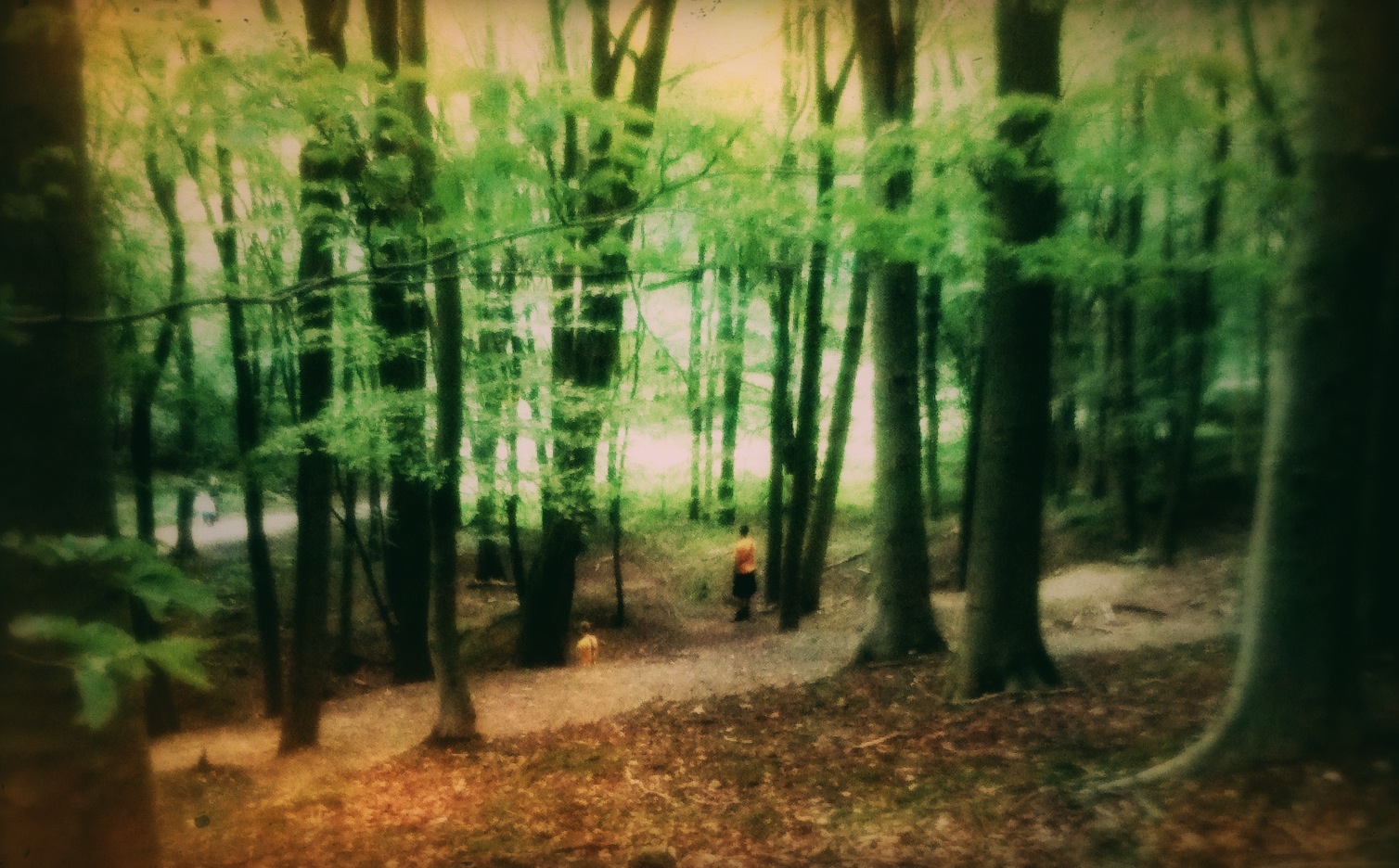
Marks, Measures, Maps and Mind is a promenade performance created by Dog Kennel Hill Project, co-commissioned by South East Dance, Turner Contemporary and Stour Valley Arts as part of RELAY, and produced by South East Dance and Stour Valley Arts, August 27.
Marks, Measures, Maps and Mind celebrates the physical body through a range of sports-driven tasks, in a breathtaking natural setting. Sporting challenges and actions form the basis for a dance that showcases the human drive for precision and perfection within the wild and epic locations of the forest, rekindling the timeless relationship to our natural environment (from the program).
I’ve seen some impressive theatres, but King’s Wood near Challock in Kent beats them all for size, natural beauty and lighting. The forest serves as Stour Valley Arts’ principal gallery for outdoor visual arts commissions, but this is the first time it has worked on a dance performance. With the Olympics looming over every aspect of our cultural life, Dan Howard-Birt, assistant curator at Stour Valley Arts, makes the analogy between the natural and improved in terms of sports training and the natural and improved in terms of the Forestry Commission’s management of King’s Wood. ‘Dog Kennel Hill Project approach the subject of the natural and the improved through dance and the human body…trained and scripted to enact movements and gestures of particular exactness, which when seen sequentially or en masse reveal the artists’ ordered design.’
King’s Wood is thus transformed from a vast gallery into a vast theatre. Front of house facilities are housed on the edge of the car park in a tent with cupcake bunting that is home to an enthusiastic team of production staff from South East Dance and Stour Valley Arts, while in an adjacent silver Airstream a filmed interview with Ben Ash and Henrietta Hale of Dog Kennel Hill Project – creators of this promenade performance – is showing on a screen. It’s not easy to hear the interview as there are children running up and down the ramp to the caravan and launching themselves off the steps with wild enthusiasm. What I do catch is Hale talking about absurdity in their work – ‘a purpose with lack of purpose’ – and according to Ash, there is an umbrella theme in Marks, Measures, Maps and Mind of progress and decline around the notion of work. They talk of the different textures of the forest, of the sense of order and repetition in nature. The theme of sport seems to have taken a back seat. The short interview finishes with an invitation to ‘feel the forest, feel the performance.’
Outside we are formed into two groups of thirty people, each with a guide. It is oversubscribed this evening for the last performance. After a briefing, the two groups merge into the forest like a straggle of pilgrims, some with staffs and walking sticks, some dressed for the theatre, some for hiking. We trek for fifteen minutes through King’s Wood, along a path through the meadow, past the beech trees, sweet chestnut trees, larch and shoulder-high ferns. Little Robin Hoods with their sticks run off into the undergrowth and back, birds sing, and the air becomes danker and cooler and the light more muted as we enter further into the forest. There is no fourth wall in this theatre; there is no wall at all.
After fifteen minutes, we turn right and climb a long and grassy path, the final ascent to the beginning of the performance. At a gateway of green string tied between two trees we divide into our groups and enter along the path. In the dappled light we encounter male and female dancers in groups of two or three, dressed in blue and yellow tops with black or white skirts, standing still among the trees on either side of the path, staring ahead, hands open as if we have come across a group of pagans in a solemn ritual. The figures stand out in the forest, sculpting the space with their bodies, though their costumes are too wooly to make their shapes precise. And then they overtake us, running to the next event in energetic disarray. Our groups stop in front of a dancer precariously wedged between the trunk and an outcropping stem of a tree, with two pieces of wood knotted to either end of a green string balanced over her head; as her head moves dreamily from side to side, she resembles the pendulum of a grandfather clock. We move on and the group splits into two, approaching the next event from two sides. In the clearing a dancer with a giant wooden measuring compass creates heroic geometric shapes, pointing up towards the tops of the trees, or at right angles to the ground, while the other two women jump and circle her as wild, dynamic satellites: images of some cosmic drama, a vestige, perhaps, of Oscar Schlemmer’s Bauhaus experiments.
We move off down a sloping, winding path of rare natural beauty beneath the forest that dwarfs our movement. We come to a ridge of back-lit trees where two dancers manipulate articulated, rectangular frames that make the clacking sound of folding deckchairs. This is more musical than measuring and insufficiently epic to influence the space. If you put small movement in a forest, it is the forest that dominates. Yet a figure standing still throughout the interlude who suddenly runs off down the hill – a tiny figure running amongst the monumental trees – takes our breath away.
We continue our path down, past two performers balancing sticks and come to a turning. A sign says ‘Do not play on the sculptures’, but the sculptures are so much a part of the forest’s natural forms that the sign is our only indication they exist. We are at the bottom of the valley and our guide turns us to look back up the incline to see an impressive array of figures like statues on this vast stage of sloping forest floor. On a shout – the first introduction of any human sound – the dancers run up and down within their delineated space and as suddenly come to rest, their arms marking slowly the four cardinal points. Only the muffled roar of jet engines far above the canopy of trees remind us of the world we have temporarily left. On another shout the dancers flee in all directions, rushing past us and on to the next event. We climb again, a fairly steep climb up the opposite slope and stop before a single introspective figure in white and blue, one knee anchored to the leafy forest floor as she turns slowly with angular arms and arching torso to a faint, watery score that we strain to hear over the brooding silence of the forest. We rustle off in search of our next sighting. Accustomed now to the stillness of the forest, it is easy to spot a running figure. He is circling round the rim of a crater (this is a sculpture) in which water has collected. A woman perches on the rim balancing a triangular construction of string and sticks, as if she is fishing. The man runs round and comes to a stop opposite her to watch.
We meet the other group at an intersection of paths where, in the clearing, two women perform with sticks as extensions of their arms and a giant crossbow-like structure strapped to their backs. They move their extensions like feelers, sensing and searching our invasive presence. They might also be, according to the program, ‘investigating a relationship with space and time through the marking and mapping of points in rhythmic sequences’, but the forest does not suggest such cerebral analysis: the dancers are more like giant insects, who retreat to safety under a canopy of trees. We follow like hunters on the trail of some exotic fauna, now trapped and buzzing, then let them go, and enter another opening off the path, to sit in the bowl of what may well be our second sculpture scooped out of the forest floor with an ordered arrangement of branches and the trunk of a tree. Bird song stands out from the ambient sound as the dancers surround us on the rim, watching us who are watching them. One by one the dancers begin to gyrate their shoulders and raise their heads and arms to the sky in a silent benediction, and then they are gone. As we regroup, we hear them chanting down the path, like a small crowd of victorious football supporters. It is as if the dancers emphasise the nature of the forest by what it is not: trained human shapes, human voices and social activity.
We move off again and come to a circle of trees and the sense of a finale. From the slope above us, the array of dancers descend closer to take up new shapes. One girl does a handstand against a tree. The sound of birdsong from the speakers seems extraneous. As they sweep past us to take up positions further down the slope, the dancers lay red sticks at the edges of our group, marking us. Standing with their backs to us they look out over the sloping forest below. We are once again a part of their ritual. Rain begins to fall, real rain; it sounds like distant applause from under the high canopy of leaves. It is the cue for the dancers to move off down the hill, disappearing over the ridge and leaving us with a tiny crescendo of rain that stops as magically as it began. The sound of our clapping in the forest is surreal, bringing us back to the conventions of a theatre. As we humans file back refreshed in mind and weary in body to the starting point, there is enthusiastic discussion of meaning and experience. I wonder what the forest was thinking as it observed the performance: small, animated figures rushing amongst the trees and gesturing, viewed by two groups of figures following at a different rate, but not doing anything: not feeding, not fighting, not sheltering, not growing. Scripted, ordered, unfathomable. Let’s see that again.
Posted: August 24th, 2012 | Author: Nicholas Minns | Filed under: Coverage | Tags: Alastair Macaulay, Alexander Bland, Anna Halprin, Glen Tetley, Mutations | Comments Off on Nudity in dance: 40 years on

Benjamin Asriel, left, and Burr Johnson in “Fort Blossom revisited.” (photo: Andrea Mohin/The New York Times)
After reading Alastair Macaulay’s New York Times article Nakedness in Dance, Taken to Extremes, I came across a review of Glen Tetley’s Mutations written in 1970 by Alexander Bland, that husband and wife team of Nigel Gosling and Maude Lloyd who wrote about dance like proud and devoted parents, never sparing in praise but never letting any perceived impropriety or imperfection pass unnoticed. The review comes from a collection called Observer of the Dance 1958-1982, published by Dance Books (www.dancebooks.com). This was the final, fruitful period in Gosling’s life when he was both art and dance critic for The Observer.
Gosling must have liked dogs, as elsewhere in the book he compares the academic critic to a good retriever with the qualities of perseverance, concentration, patience and reliability, whereas the journalist critic is ‘like a hunting dog, alert, active, wide-ranging, with a good nose and a strong voice; he may follow some false scents, but he should keep our interest riveted on the chase…’
Which brings me back to the two articles. Both answer Macaulay’s opening question, ‘How do you react to the look of the naked body on stage?’ and go on to discuss the nature and merits of the work under review. That Macaulay’s subject attracted more attention than his regular reviews is notable, though he is writing about dance in New York, where Anna Halprin’s 1965 Parades and Changes was banned for twenty years for its nudity. One aspect of his article is that acceptance of nudity on the stage has moved to a concentration on genitalia, the ‘dark patch’ that Bland wrote about 42 years ago. It seems a slow progress indeed, especially compared to the development of nudity in the European theatre. What Bland came across in Mutations was for him a revelation, something to be celebrated, whereas Macaulay’s celebration is more tentative, as if revealing a secret.
However, my purpose is not to attempt an in-depth analysis of the approach of two critics to nudity in dance, but simply to offer a preamble to Alexander Bland’s delightful review that I reprint here in full with the permission of the publisher, David Leonard.
Mutations, Nederlands Dans Theater, Sadler’s Wells
Let’s face it fully and frontally, we are in the autumn of modesty. Fig leaves flutter down all around, scattered by the wind of change. Thirty years ago Ninette de Valois was showing the formidable founder of the Sadler’s Wells Theatre, Lilian Baylis, the backcloth for a new ballet. It was promptly censored on the grounds that the stomach of a female statue depicted on it was too large. ‘But it’s no bigger than my own,’ protested de Valois untruthfully. ‘Ah, my dear, but you have had an operation,’ replied Miss Baylis.
What would she have said last week? In her own theatre, in Mutations, a new ballet by Glen Tetley (with films by Hans van Manen), four young men and one young girl of the Netherlands Dans Theater dance naked for minutes in full spotlight, not to mention long film sequences in which one of the performers appeared enormously magnified and slow-motioned as if to prove that he was every inch a genitalman.
It has been widely reported that the effect was perfectly unremarkable and indeed irrelevant. Certainly dancers’ slim bodies suggest Bosch’s ‘Terrestrial Paradise’ rather than a Rubens orgy. But I must make an embarrassing confession. In the nudity field I am an outsider, a freak, perhaps even a ghoul which haunts the law courts where learned men fulminate on sex and censorship. Not only am I likely to be depraved; I probably am depraved already, for I find the spectacle of beautiful naked bodies exciting. Their introduction in this ballet induced a glow of added interest which it was painfully easy to analyse.
I comforted myself afterwards by reflecting that respectable authorities in other fields have admitted similar sensations. Lord Clark has even written that all good nude painting and sculpture is sexually stimulating. Sex assumes many disguises. On the stage we readily admit arousal by crafty costumes, lighting or posture, and I tried hard to think that the lack of all disguise was no more sinful than they. Exactly what is contributed – or lost – by the final fall of brassiere or jock-strap varies a great deal. Apart from the fact that some naked people look more naked than others, nudity can obviously be employed either innocently (as it was here) or for hard-core sensuality. The simple shock of seeing it on the stage at all comes largely from the surprise of finding it out of normal context. In my sheltered life it is still usually confined to bath or bed, but the probable spread of its use in the theatre will soon, alas, deaden its impact. What will be left will be more visual than psychological. From the formal point of view the costumed figure presents an image with a single focal-point – the head. By adding a dark patch in the centre of the image a second visual accent is introduced, and this is something choreographers will have to take into account.
These minor questions apart, nudity is used in this ballet as a stimulating but serious ingredient which completely justifies itself artistically. The scene is a kind of arena (by Nadine Baylis) into which white-clad figures gradually fight their way. Once arrived, the mood changes. A nude figure appears dancing on film, and this is followed by a nice trio for girls, a typical Tetley wrestling match, and some all-in applications of red paint suggesting violence. A couple dance, clad and unclad on screen and stage, to gently variegated electronic sounds by Stockhausen; more join in and the film triplicates, until some mysterious figures in transparent suits sweep the action off stage, leaving the couple – naked and strangely vulnerable – alone as the lights fade.
It is not perhaps the most completely successful ballet in the repertoire – the start is slow and the films not very imaginative – but it is sincere, shapely, rich in those plastic movements in which Tetley excels and works up to a fine climax. It was never trivial or titillating and was extremely well danced by the finely trained and good-looking company. 8.11.70