Posted: April 11th, 2017 | Author: Ian Abbott | Filed under: Rehearsal | Tags: Alice Sheppard, Brewband, Graeme Smillie, Jill O'Sullivan, Marc Brew, Marta Masiero, Martyn Garside, Peter Kelly | Comments Off on Ian Abbott on Marc Brew: Building His Brewband
Building The Brewband…Marc Brew at Renfrew Town Hall, Renfrew, January 19 and 20

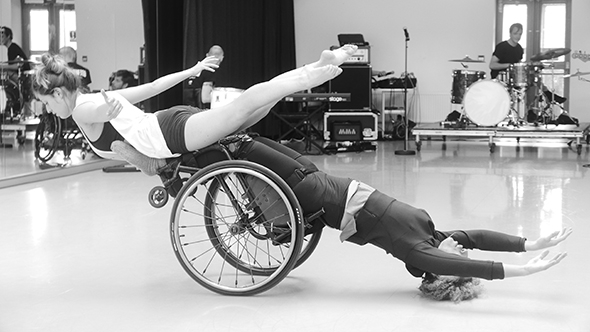
Marta Masiero and Alice Sheppard rehearsing Brewband (photo: Ian Abbott)
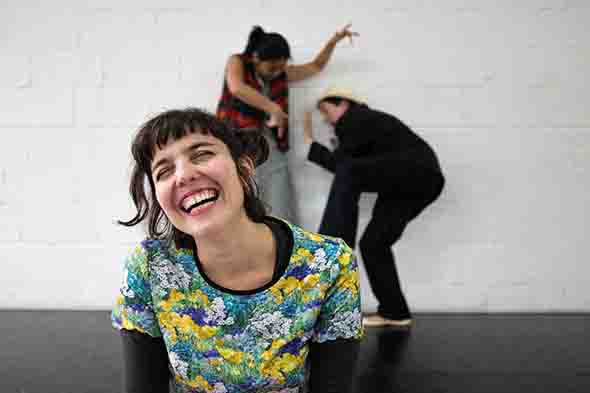
I am a Marc Brew Company writing roadie, invited into the studio as Marc continues the creative process developing his new work BREWBAND. The company describes the work as, ‘Scotland’s new super band — that blurs boundaries and challenges people’s perception of identity.’ BREWBAND is being created in the glorious, high-ceilinged Renfrew Town Hall by award-winning choreographer Marc Brew and brings together the musicians Graeme Smillie (Unwinding Hours/The Vaselines), Jill O’Sullivan (BDY_PRTS/Sparrow And The Workshop), Peter Kelly (Galchen/The Kills) with dancers Martyn Garside (San Francisco Ballet), Marta Masiero (Scottish Dance Theatre) and Alice Sheppard (Axis Dance Company).
The first week is primarily about building confidence and trust between the performers; Marc is consistently asking them to go to places that are unfamiliar but the way he holds the studio and frames the workshop tasks is supportive and this checking in — asking if everyone is OK and making time for care — reaps enormous creative rewards.
Even the trio of post-rock musicians are involved in the physical exercises. None of them has encountered zip-zap-boing and blindfolded touch exercises before but immerse themselves fully before offering these responses: “In the blindfold exercise I was tracing lines on Martyn’s body — it was like a constellation; I was totally buzzing and decided to throw myself in and say touch me, pull me,” and “Being touched on the face is so unexpected; I use my fingers a lot but never really think about them — this is about bringing attention to our body.” This physical and emotional bonding acts as a shortcut and is right out the MIT leadership guide to building a new team; Brew ensures the mission, goals, rules, language and communication are clear and open which leads to a happy and productive team.
Graeme is the only musician who had participated in the first research period in 2015 and offers a thread back to some of the original thinking: “Collaborations are really fertile ground for me because we’re trying new things, challenging habits, and with the introduction of Jill it adds really strong vocals into the band which we didn’t have before. In the improvs I have to be more comfortable about not always trying to remember everything all the time as it isn’t important at this stage; it’s allowing room for experimentation but trying to get that feeling/energy back when it comes to the making.”
The creative tasks involved in the presentation of dance challenged Jill’s preconceptions: “I had some trepidation before the project started. There’s something in musicians, we play in the dark in dingy places and don’t have people looking at us. Marc commented that a lot of musicians have hair that covers their face and I suppose we do. What we’re doing with our bodies here is nothing like I’ve done before. I thought I was fit, but I’ve discovered new muscles that ache at the end of the day and it’s shattered my preconceptions of what dance is in a great way. When I see a dancer respond immediately and physically to what I’m playing — which is really unusual — it makes me play better as I am not only aware of myself, the song and other musicians but of the dancers as well. I’ve already noticed after 4 days that I’m a better musician because of this process.”
In creating BREWBAND there was some discussion from the musicians around repetition; how their bodies default to certain positions whilst playing a song 50 or 60 times before it’s familiar. Humans encounter a lot of repetition in daily routines; familiar faces, habits and pathways enable a certain level of comfort. Elizabeth Hellmuth Margulis, director of the music cognition lab at the University of Arkansas, has spent time investigating why repetition has a profound effect on us: ‘One of the reasons this kind of repeat exposure can cause an earworm to burrow in our mental soundtrack is because repetition actually changes the way we listen to music. Repetition changes the way we orient to sound and it tends to draw us into a participatory stance so that we’re imagining the next note before it happens.’
Repetition makes us listen and see things differently; it offers a chance to pay more attention to the nuances and subtleties in the choreography and composition as we are no longer occupied with just trying to process the main melodic or visually harmonic content. Each day Jill led a short vocal warm up mixing do-re-mi scales, lip-rippling-exhausted-horse exercises and joint head humming all the while stressing the importance of not over-warming up the voice: 10 minutes is often enough. After the warm-up ended it melted into a rich and unforeseen vocal improvisation; with Bjork’s Unravel playing, Alice began riffing in and out of the melodies before passing the mic to Martyn who brought acres of emotion and richness into the speakers. 15 minutes later there was a set of material that was stage ready, demonstrating the mutual trust and each person’s ability to respond to the delicate energies in play.
The structure of each day focused on a morning of skills development and bonding, working towards a creative something in the afternoon which may or may not make it into the final work. Peter offered an insight into how Marc created this mutually supportive environment: “When you join a new indie or rock band there are some salty road dogs who’re in their 60s, on cocaine every night and part of a clique. Here everyone is equal, slightly unsure but also so encouraging. I don’t think about each limb doing different things when I’m on the drums — you’d just fall apart if you did. You zone into it. We did this exercise with a deconstructed drum kit spinning on risers; playing was almost dizzying and a little like Tommy Lee from Motley Crue where he’s in the cage upside down in the audience. We’re working out how all the fills, flourishes and the ends of the tracks work, as well as working out how people work together. Touching strangers sober isn’t something you normally do.”
The shared musical palette of Mogwai, Nils Frahm and Godspeed You! Black Emperor offer a clear set of influences from which the music burrows under your skin and when they played live for the first time in rehearsal their movements — if you removed their instruments — were so compelling to watch. Melodies, rhythms and time signatures pulse through bodies: their physicality is mesmerising and BREWBAND is building.
Posted: April 5th, 2017 | Author: Nicholas Minns | Filed under: Performance | Tags: After the Rain, Christopher Wheeldon, Crystal Pite, David Dawson, Flight Pattern, Greg Haines, Henryk Górecki, Jay Gower Taylor, Kristen McNally, Marcelino Sambé, Nancy Bryant, The Human Seasons, Thomas Visser | Comments Off on The Royal Ballet, works by Dawson, Wheeldon and Pite
The Royal Ballet, Triple Bill, Royal Opera House, March 23

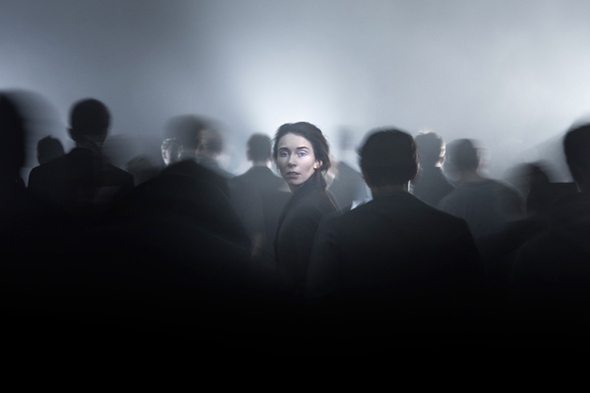
Kristen McNally and artists of the Royal Ballet in Flight Pattern (photo: Johan Persson)
This is a program of repertoire works by former Royal Ballet dancers, David Dawson and Christopher Wheeldon, wrapped around a new commission by Crystal Pite, the first female choreographer to perform her work on the main stage in a long, long, time. Despite this landmark achievement, Pite is not a classical choreographer, nor are her works in the classical idiom. Borrowing a leaf from Tamara Rojo’s astute book, the Royal Ballet has brought in a lauded contemporary name on a contemporary theme at an appropriate moment. It is also borrowing from the book of Sadler’s Wells associate artists. Much as I love Pite’s work, Flight Pattern blends uneasily with both the accompanying repertoire and the surroundings. It’s a beautifully fraught work (beautiful and fraught) about the fate of migrants, not a subject that lends itself naturally to the velvet and gilded glamour of the Royal Opera House. It’s an oddly imbalanced program, too, because Flight Pattern is not a natural closer, and neither Dawson’s nor Wheeldon’s work prepares for it in any way; it comes out of nowhere. It is nevertheless a sublime conception, both scenically and choreographically, for a mass of 36 dancers with the suggestion of a lead migrant couple (an incongruous notion) of Kristen McNally and Marcelino Sambé. Anyone who saw Pite’s monumental Polaris on the Sadler’s Wells stage for the See The Music Hear The Dance program just over two years ago will remember her powerful massed forms of 64 dancers responding to Thomas Adès’ orchestral storm of the same name. Flight Pattern is more poetic and less menacing, influenced by the eerie refinement of the first movement of Henryk Górecki’s Third Symphony, but its subject is harrowing. The work visualises the endless lines of stooped humanity on a desperate trek to an unknown future but Jay Gower Taylor’s set, Thomas Visser’s lighting and Nancy Bryant’s costumes bestow epic proportions on the entire journey. The movements of the dancers are muted and repressed throughout the work, hemmed in by heavy overcoats and by the giant partitions of the set that close inexorably on them until only a gently rocking McNally and a seething Sambé remain isolated. It is a moment that almost spits with rage but Sambé at this crucial point allows his pyrotechnical wizardry to infiltrate his character, dissipating Pite’s entire psychological build-up.
There’s plenty of legitimate technical display on the rest of the program, however, and the men get a thorough workout in Dawson’s first work for the Royal Ballet, The Human Seasons, to a commissioned score by Greg Haines. You know you’re at the Royal Ballet with this level of technical skill, though the loud landings (and there are many of them) of the men in particular exhibit some weakness in execution. The women are on display too, especially when upright; they are less so when being dragged unceremoniously along the ground.
Seeing The Human Seasons (2013) side by side with Wheeldon’s After The Rain (2005) one can’t help seeing similarities; both are in the neo-classical style with stripped down costumes, and there are one or two quotes by Dawson of Wheeldon’s lifts and slides. Where the two works differ is in the use of space as part of choreographic form. For all its intense movement, its entrances and exits, and its asymmetrical groupings, The Human Seasons, unlike Keats’ sonnet that inspired it, is constantly crying out for some kind of form to hold them all together. This is amplified by a lackadaisical deportment in the men in between partnering duties or bravura steps; they just amble over to the next sequence, killing the dynamics. Haines’ score can’t hold the work together either, so with all these holes Dawson’s form fails to gel, leaking out in all directions over the course of the work’s 35 minutes.
Scored for three couples, the first section of After The Rain is set to the first (Ludus) movement of Arvo Pärt’s Tabula Rasa; as soon as it begins, Wheeldon’s spatial stagecraft is apparent. The form is held in place by the harmony of the music allied with the harmony of the choreography, pumpkin rolls and all. The second movement, to Pärt’s Spiegel im Spiegel, is joined to the first but not closely related. It is often performed as a separate duet and its renown makes it appear as the feature film we’ve been waiting for. Marianela Nuñez and Thiago Soares make it a powerful meditation on the beauty of strength and the strength of beauty, where each gesture is thought through and flows seamlessly to its natural resolution. But while the consummate elegance of this movement is framed on one side, the absence of a final, contrasting movement leaves it floating in splendid isolation; it should either be set free for good or the frame completed.
Posted: April 1st, 2017 | Author: Nicholas Minns | Filed under: Performance | Tags: An Archaeology of Me, Chapter, Deborah Light | Comments Off on Deborah Light, Semi Detached – An Archaeology of Me
Deborah Light, Semi Detached – An Archaeology of Me, Chapter, Cardiff, March 17

Deborah Light in a sharing of Semi Detached – An Archaeology of Me (photo: Warren Orchard)
Four years after chipping away at the inner life of the nineteenth century paleontologist Mary Anning in The Curio Cabinet, and six months into carrying a third child, Deborah Light has been turning her choreographic imagination to an excavation of her own life in an array of objects collected from the rocks and crevices of her mind and body. In this sharing of a development phase for a new work, Semi Detached – An Archaeology of Me, she regales the invited audience in the studio at Chapter with a running commentary of her evolution that Darwin himself might have enjoyed if not fully appreciated. Nevertheless, her condensed trajectory from chordate to choreographer and from mollusk to mother is an accelerated but otherwise totally convincing line.
The studio is laid out with tables (they could be glass cases in a museum) on which are arrayed the objects and specimens Light has chosen to represent her. There is no particular order but they include balls of wool and knitting needles (her mother’s influence), fossils, rocks, seeds (her partner’s influence), her grandfather’s mantle clock, flowerpots and books (her private passion), all of which she invites the audience to inspect and handle. There are two other tables that are littered with notes or laid with paper for our written suggestions and interjections.
Kneeling on all fours in front of the clock Light demonstrates with rhythmic dorsal undulations the early chordate’s need for structural reorganization, then evolves into the shape of the mollusk’s hard shell and with evolutionary haste bypasses the seed’s slow-burning life with the vital attempt to stand up. This leads her to the table marked What’s Important on which she asks someone to add, ‘standing up’ and, as she catches her breath, ‘breathing’. As a mother of small children she also adds ‘dry pants’ to the growing list and as a human being she adds, ‘world peace’. In the space of an hour Semi Detached – An Archeology of Me builds up delightfully disparate layers of autobiographical sediment that form Light’s own particular landscape, her own history at this particular moment in her life, and as the unique curator she animates it all as both subject and object. She listens to the sounds of her own name as we might address it, as her mother might have pronounced it, as her children might call it, as she might have called her mother. It is harrowing and deeply moving to hear her label herself with these inflections of welcome, caution, fear and love, scratching under the name to give it life, identity and meaning.
Light has learned from raising her children that the art of dissembling can be very effective in keeping cool under fire. The way she leads us to believe the ‘indispensable’ bear, Mishu, is indeed borrowed from her five-year-old son as she proceeds to dissect his wooly chest with clinical precision is a master class in psychological manipulation. It also turns into a lesson in genetic association at a molecular level and a brief survey of an endangered species. ‘This species of bear will have to adapt’, she adds firmly as we all take a deep breath and follow her at a distance with our eyes.
Continuing to conflate the structures of archaeology and family, Light recreates a symbolic generational skeleton that she animates with her great grandmother’s Motherhood Book as brain, stones as vertebrae, the clock as biological time, a pot of seeds as ovaries and a rock as fused pelvis. She reinstates Mishu as the heart covered in a pinafore handed down from grandmother to mother to daughter.
As if her version of evolution is totally logical, she totters across the room in two flowerpots with a ball of wool that she strings between pieces of table and chair like a game her mother used to play. She is gently inciting us to respond like children, to break through the historical into the present moment, but I think the episode with Mishu has kept us at arms length.
Archaeology and family life come full circle; Light’s final intervention reminds us of the nature of time, of the cyclical nature of starting and finishing. She takes off her outer garments and lies supine in her underwear on the What’s Important table, lying there so still like a living sarcophagus with her belly breathing two lives, while a recording of Handel’s aria Ombra Mai Fu infuses the image with the beauty of both life and death. When she rises to signal the end of the performance, some of the felt tip words are imprinted on her back. At moments like this you know something profoundly significant has just transpired, held in the moment and never to be repeated. It is a privileged moment for Light to be performing this and for us to be witnessing it, but the inspired and nonconformist workings of Semi Detached – An Archaeology of Me clearly have life after birth.
Posted: March 25th, 2017 | Author: Nicholas Minns | Filed under: Performance | Tags: Aakash Odedra, Aditi Mangaldas, David Poznanter, Echoes, Fabiana Piccioli, I Imagine, Sabrina Mahfouz | Comments Off on Aakash Odedra, Echoes and I Imagine
Aakash Odedra, Echoes and I Imagine, Lilian Baylis Studio, March 9

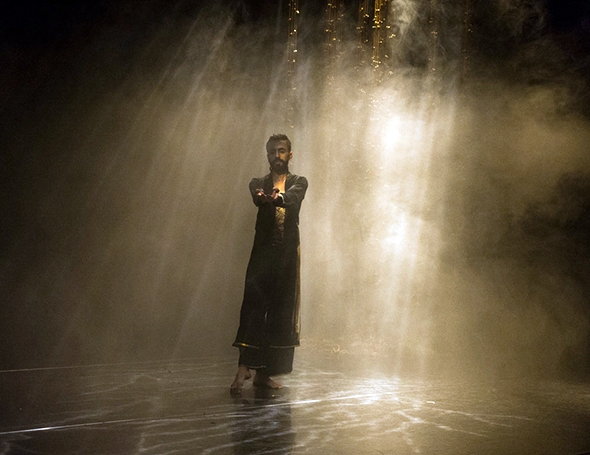
Aakash Odedra in Echoes (photo: Foteini Christofilopoulou)
This review was commissioned by Pulse and appears here with the kind permission of its editor.
The setting of a theatre is not the most conducive to a meditative state; its dimensions are more utilitarian than spiritual and one’s focus on the stage is shared with (in the case of the Lilian Baylis Studio) about 180 other people. In Inter-rupted for Dance Umbrella last year, choreographer Aditi Mangaldas and her designers successfully challenged these limitations with a dynamic use of colour and space. In Echoes, her first Kathak solo for Aakash Odedra, Mangaldas uses the auditory quality of strings of traditional ghungroo bells to usher in a sense of calm. In the program note she quotes J. Krishnamurti: ‘If you listen to the sound of those bells with complete silence you would be riding on it, or rather, the sound would carry you across the valley and over the hill…’ The theatre setting militates against this but Krishnamurti’s aerial metaphor finds a visual counterpart in the strings of bells suspended above the stage, and they also spread like tentacles along the floor like an unrolled skein of wool. The bells become the playing field for Odedra whose dancing imbues them with life. We first see him wafting a tassel of bells around his torso, though Fabiana Piccioli’s engulfing cone of light at this moment is too sharp, too design for Odedra’s languour. While the sound and imagery of the bells recur throughout Echoes, it is Odedra’s presence and his ability to sinuously, noiselessly insinuate his shape into the space around and above him that invites us to contemplate. The silent dynamics of his movement have no edges, like sound itself; they flow and swirl and rise (his joyful elevation is rare in Kathak) in a series of choreographic variations. Mangaldas has fully understood Odedra’s gifts and through them achieves a sense of awe through a oneness of the dancer and the danced.
The contrast with Odedra’s own choreography, I imagine, reveals an artist who is as expressive in a spiritual role as he is as a common man (or woman). On a stage marked out in white tape like an architectural plan and piled with suitcases of all shapes and sizes, he embodies the spirits of his antecedents, inhabiting the symbols of travel (quite literally at first) while questioning the ideas of migration and home. He scrabbles around the suitcases, retrieving old portraits (in the form of masks created by David Poznanter) and honouring their memory by imagining their peripatetic tribulations, their aspirations and dreams. He is so present in their lives that they live through him, voices and all. It takes a while to square this performance with the previous one, because Odedra has moved far from his Kathak roots into experimental theatre; he is an actor in his own drama and indulges his ability to evoke his past and present through theatrical means. Choreography enters slowly, but when he performs what appears to be a ritual dance at a suitcase altar, his flowing hands and arms describe everything words cannot. As in Echoes, his dancing comes from an intimate space inside the body, a place of emotions from which he extrudes meaning through his eloquent limbs. Odedra choreographed I imagine to the voice of spoken word artist, Sabrina Mahfouz. She, too, talks eloquently and powerfully about home and migration, her words complementing Odedra’s staged conception. Except that Odedra, in some alchemy of performance, has managed to say it all himself.
Posted: March 23rd, 2017 | Author: Nicholas Minns | Filed under: Performance | Tags: Alejandro Virelles, Andrey Kaydanovsky, Daniele Silingardi, David LaChapelle, Icarus, Ilan Eshkeri, Jade Hale-Christofi, Narcissus and Echo, Natalia Osipova, Project Polunin, Sergei Polunin, Tea or Coffee, Valentino Zucchetti, Vladimir Vasiliev | Comments Off on Project Polunin: Icarus, Tea or Coffee, Narcissus and Echo
Project Polunin: Icarus, Tea or Coffee, Narcissus and Echo, Sadler’s Wells, March 14

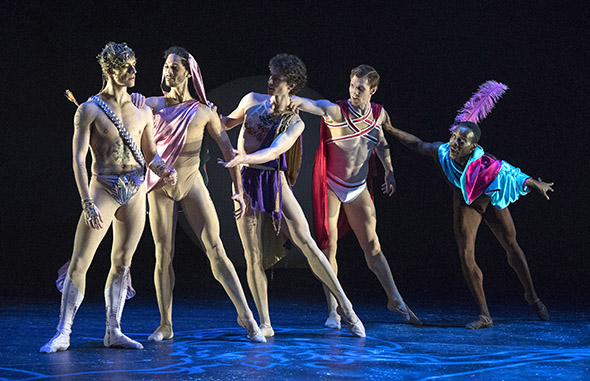
Sergei Polunin, Alejandro Virelles, Daniele Silingardi, Alexander Nuttall and Shevelle Dynott in Narcissus and Echo (photo: Alastair Muir)
Sergei Polunin has long been interested in mythology. It could be said that his early life up to his departure from the Royal Ballet has elements of the myth of Icarus, and his more recent re-emergence in the light of Take Me To Church with the myth of Narcissus. It is perhaps no coincidence that Project Polunin should bookend its triple bill with works that reference both, though in terms of Polunin’s life there’s an important hiatus between the two.
With the recent release of Steven Cantor’s film The Dancer about Polunin’s life, it would be easy to imagine that Project Polunin follows on seamlessly where the film leaves off. But The Dancer took five years to film and another year to edit, so the film’s concluding performance of Take Me To Church — which at the time Polunin conceived as the final act of his ballet career — happened six years ago. A lot has happened in Polunin’s life in the intervening years; most importantly he has rediscovered his desire to dance and has gathered around him a group of creative people who have given him the confidence and stability to develop new projects. He is also, as evidenced in his Q&A following the launch of the film, questioning current norms in the ballet world with the proselytizing zeal of a reformer.
This premier production of Project Polunin consists of three works. As he explains in an interview with Sarah Crompton, “It shows what my thinking is influenced by…There’s an old Soviet ballet, a hint of dance theatre and…the kind of dance theatre I would like to explore.”
Expectations run high for an event like this, especially with the media attention from The Dancer. Will Project Polunin fly or won’t it? When Polunin discovered a video of Vladimir Vasiliev’s duet, Icarus, the night before the flight — created for himself and his wife Ekaterina Maximova in 1971 — it must have struck him as auspicious. Vasiliev had inspired the young Polunin with his powerful, passionate style of dance, and here was choreography with a mythical subject close to his own heart. Polunin extended an invitation to Vasiliev (Maximova died in 2009) to come to London to mount the duet on a younger pair of lovers, Polunin and Natalia Osipova. The choreography for both male and female equates powerful technique with powerful emotions, heroic form with mythological mettle. Polunin revels in the bravura steps, displaying the elevation and flight for which he is renowned and, as his betrothed Aeola, Osipova has so integrated her prodigious technique into her body that she can express every nuance of her devotion to Icarus as well as the depth of her despair suggested in Vasiliev’s choreography. Just to see these two together giving full rein to their Russian heritage is a privilege.
After only a brief pause we jump 45 years ahead to Tea or Coffee, served Russian style with dark and surreal humour. Choreographed by Andrey Kaydanovsky for four soloists from the Moscow Stanislavsky Ballet (Alexey Lyubimov, Valeria Mukhanova, Asastasia Pershenkova and Evgeny Poklitar), the ballet could well share the lineage of Nikolai Gogol with last year’s Royal Opera production of Dmitri Shostakovich’s The Nose, except that instead of the nose it is a cup of tea (or coffee) that seems to have a life and influence of its own. The work consists of four rounds of a game in which whoever starts by stirring the cup of tea (or coffee) is initially eliminated from the next one. Within this ludic format the two couples interchange and squabble over an unspecified but evidently banal issue which gives rise to is a delightfully absurd set of convoluted solos, duets, double duets and trios that borrow their wit and rhythm from the eclectic score.
The relevance of Narcissus and Echo as a contemporary myth is fully developed in the program by Ilan Eshkeri, where he quips, ‘Narcissus’ reflection in the pool is arguably the first selfie.’ Eshkeri also wrote the score (played live by members of the London Metropolitan Orchestra under the baton of Andy Brown) and his concept for Narcissus and Echo is credited as the starting point of the work. In a Polunin work about the power of the image it is not surprising to find the visual influence of photographer David LaChapelle, who conceived the video Take Me To Church. It is evident in the opening tableau of Narcissus (Polunin) and his four Theban mates (Shevelle Dynott, Alexander Nuttall, Daniele Silingardi and Alejandro Virelles), in the overall colour palette and in the surreal pond with its haze of light and outstretched arms appearing from below the dark water. It is less easy to discover the choreographic form of Narcissus and Echo. There are four choreographers listed: Polunin and his assistant choreographer, Valentino Zucchetti, Osipova (for her solo), and Jade Hale-Christofi (also of Take Me To Church fame) for Polunin’s solo. In such a sharing of choreographic initiative it is perhaps inevitable the story of Narcissus and Echo as Eshkeri conceived it is sublimated for a show of dancing inspired by its two protagonists with, in the case of Hale-Christofi’s contribution, ‘selfie’ quotes from Take Me To Church. Polunin, however, inspires his mates to excellence, especially Silingardi and Virelles (both on loan from English National Ballet), while the five nymphs (Alexandra Cameron-Martin, Maria Sascha Khan, Adriana Lizardi, Callie Roberts and Hannah Sofo) seem to operate in the shade of Osipova’s orbit. It is perhaps the first time seeing Osipova working out choreography on her own body, from subtle insinuation to blindingly powerful despair, and the result is sublime.
The similarity between The Dancer and Project Polunin is that they are both in the image of Polunin himself; Icarus has recovered but Narcissus is always going to be susceptible. As Eshkeri points out eloquently in his program note, ‘What is fascinating is how quickly the human condition allows us to become intoxicated with ourselves. And once engulfed by it how do we avoid the beguiling fate of our lamentable protagonists.’ Polunin is clearly trying to distance himself from his own image by paying his respects to his past, but he will need to find a new myth to define his next stage of development.
Posted: March 16th, 2017 | Author: Nicholas Minns | Filed under: Installation | Tags: Alice Labant, Angela Woodhouse, Caroline Broadhead, Close Distance, Dance4, Kristian Tirsgaard, Martina Conti, Nic Sandiland, Nottdance Festival, Vanio Papadelli, Wollaton Hall | Comments Off on Caroline Broadhead, Nic Sandiland and Angela Woodhouse: Close Distance
Caroline Broadhead, Nic Sandiland and Angela Woodhouse, Close Distance, Wollaton Hall, Nottingham, March 11

An image from Close Distance (photo: Nic Sandiland)
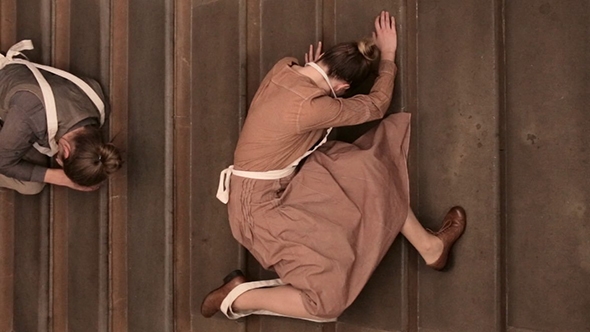
The first impression as you enter Wollaton Hall’s Prospect Room from the narrow stone staircase is one of emerging into light and space. The first owner of this grand Elizabethan pile, Sir Francis Willoughby, had the room designed as a palatial lookout over the sylvan prospect all around, a place of privilege from which he could proudly survey and show off his walled domain. Six floors below, in the rock foundations on which Wollaton Hall stands, lived the household servants with little or no prospect at all. The architecture of Wollaton is thus an existing material imprint of a social hierarchy that no longer exists.
Close Distance, a subtle and imaginative installation by artist Caroline Broadhead, filmmaker and designer Nic Sandiland, and choreographer Angela Woodhouse, uses the present physical imprint to shed light on aspects of domestic life that can no longer be seen, and by setting the installation in the Prospect Room its creators neatly invert history by allowing servants to be re-imagined in this locus of privilege to which they would never have had access. Giving them the key to the Prospect Room was none other than Nottingham City Museums and Galleries, which now runs Wollaton Hall as a historic house and natural history museum, and which commissioned Close Distance as part of Dance4’s Nottdance Festival. This is creative commissioning at its best.
Broadhead, Sandiland and Woodhouse have added the touch of a smile to their reflections on life below stairs at Wollaton through a series of elaborate artistic conceits. The servants are represented by four dancers (Martina Conti, Kristian Tirsgaard, Vanio Papadelli, and Alice Labant) whose movement phrases, choreographed by Woodhouse, nuance the lives of the servants through silent gesture, sometimes inhabiting their despair and sometimes their hopes and aspirations. These choreographic episodes have been captured on film by Sandiland and looped on to small tablet screens embedded into items of furniture sourced by Broadhead. You may need to lift the lid of the sewing box or open the drawer of the escritoire to see the screen, but open or closed the films are running all the time — like the servants, who had to sleep on their feet. To this already complex layering of artifacts Broadhead has added samples of locally sourced material from the Middleton embroidery collection — a piece of lace or a square of luxurious carpet — that frame each screen. A gentle musical continuum of Handel concerti is pierced only by the persistent sound of the servants’ bell.
The focus of the Prospect Room is outwards, not inwards, and its only furnishing was possibly a telescope or a pair of binoculars similar to that in the installation; it was never intended for furniture so the four period items Broadhead has placed there along with the utilitarian wooden stepladder serve to reference other rooms in the house. Once arrived in the room, the privileged spectator wanders freely in this airy space from one artifact to the next in no particular order, building a sensory impression of what life might have been like below them. What Nottingham City Museums and Galleries has commissioned, in effect, is a playfully subversive display of social history at Wollaton Hall that paints the household in a way the taxidermy downstairs in the Natural History Museum can never achieve for its collection of wildlife.
One of the beauties of this kind of installation is that its very subtlety forces you to think, to contemplate and ask questions; it is an imaginative archaeology of past sensations that requires further study and exploration. In avoiding an approach to history that profiles the dates and achievements of the wealthy and powerful, Broadhead, Sandiland and Woodhouse have not only recalled an underprivileged past but have recalibrated it: it is the servants who, after all these years of confinement, have finally emerged into the light and space.
Close Distance is open at Wollaton Hall until May 1, 2017.
Posted: March 12th, 2017 | Author: Nicholas Minns | Filed under: Festival, Interview | Tags: Joe Garbett, Swallowsfeet Collective, Swallowsfeet Festival | Comments Off on A preview of Swallowsfeet Festival
Swallowsfeet Festival, The Old Market, Hove, March 24-25

Swallowsfeet Festival promotional image (photo: Paul Seaby)
This article first appeared in the March edition of the magazine, Viva Brighton, who commissioned it. It appears here with the editor’s kind permission.
Billed as Brighton’s only platform for international contemporary dance in a city that hosts England’s largest arts festival, Swallowsfeet Festival embodies a culture of spirited resistance to the status quo. If one takes New York’s Judson Dance Theatre collective in the sixties as a point of departure, spirited resistance is what guides much of contemporary dance and since it uses the body as its primary instrument, its arguments are a form of physical discourse.
When Swallowsfeet Festival presents its program at the Old Market theatre on March 24 and 25, it will be celebrating its fifth outing. Some of the planned activities around the weekend have had to be put on hold following the failure of an Arts Council funding bid but the core program remains intact thanks to the pluck and conviction of the six-member Swallowsfeet Collective: Jessica Miller, Rosa Firbank, Jessica Léa Haener, Sivan Rubinstein, Gordon Raeburn and Harriet Parker-Beldeau.
They all met while studying contemporary dance at Laban Conservatory of Music and Dance in London but it was Miller who first grounded the performances of the collective in her native Brighton as an outlet for a group of Laban students to present their final works to an audience of friends and family. Just four years later the open callout for the 2017 festival has produced 280 proposals from 39 countries which the Collective has distilled to a program of nine works in the image of Brighton itself: edgy, diverse, challenging, and engaging.
Having narrowed down its 280 proposals, the Swallowsfeet Collective decided to include in the festival those that had, in the vocabulary of the physical, the possibility of the greatest impact on its audience, and the focus of these nine works coalesces around four predominantly physical themes: sexuality, gender, health and identity. At its best, contemporary dance picks up on issues of its time and transforms them through the body as voice.
Ironically, one of the works on the program, Joe Garbett’s No.Company, was conceived as a reaction to funding cuts for the arts. First shown at Emerge Festival in London, six choreographers in six different locations sent movement ideas, images and suggestions via text message to the two performers who then spent only two days in a borrowed space putting it all together. This is unheard of in the current funding matrix of rehearsal time and studio rental, but the result was fresh, immediate and magical. For Swallowsfeet Festival, Garbett is using a different score of text messages and is inviting two couples to interpret and perform two separate works from it; like musical improvisations, they will never be repeated. It might sound like a choreographic manifestation of a throwaway society, but the impression No.Company made when I first saw it was profound. It is this ability of contemporary dance to make the body speak, whisper and shout that has driven the Swallowsfeet Collective’s choice of all nine works on the program in March.
To book tickets for Swallowsfeet Festival and find out more about the events, go to
www.swallowsfeet.com/2017programme/
Posted: March 7th, 2017 | Author: Nicholas Minns | Filed under: Performance | Tags: Danai Pappa, Darling I Don't Sell Dreams, Denis Santacana, Encuentros, Hanna Wroblewski, How to Play a Room, Jan Lee, Katsura Isobe, Lucy Hansom, Resolution 2017, Thelma Sharma, Victor Fernández, Victor Guadiana | Comments Off on Resolution 2017: Jan Lee, Denis Santacana Dance Company, Hanna Wroblewski
Resolution 2017: Jan Lee, Denis Santacana Dance Company, Hanna Wroblewski, February 2

Danai Pappa, Katsura Isobe and Thelma Sharma in How to Play a Room (photo: Tim Murray-Browne)
I should begin by saying Jan Lee and I shared a dramaturgy course last year given by Lou Cope. What drew me to the course was the similarity I felt between dramaturgy and the process of writing about dance; one helps build the internal cohesion of a work while the other attempts a deconstruction of the work to reveal that cohesion. Lou had suggested that any of the participants who wanted dramaturgical help on future projects should ask amongst themselves as a way of offering practical experience, which is how I came to work with Lee on her How To Play A Room. It is a privileged position from which to write as I can view the work, as it were, from somewhere in the middle.
In How to Play a Room Lee explores her own experience of being an outsider crossing social boundaries, of how to play a room when you don’t feel you belong, so having three performers of different nationalities (Katsura Isobe, Danai Pappa and Thelma Sharma) is no coincidence. Lee approaches dance with a musical mind as she is both a musician and dancer; she makes musical gestures with the bodies of her dancers and uses their voices and her own processed recordings of conversation as muscular elements in the choreography. How to Play a Room about the messiness of hybridity and the discovery of what remains inviolable. Isobe may mistranslate the physical conversation of Pappa and Sharma, and may have difficulty finding a way into their circle, but her own identity is poignantly clear in her singing of a Japanese lullaby at the end. Pappa is anchored in a dramatic reality that moves with her and she can transform her environment — especially when expressed in voluble Greek — into an emotional maelstrom, while Sharma is a Chaplinesque figure who finds strength in making sense of the world’s conundrums; she plays down her own identity and knows instinctively how to play a room. Lee and her dancers have collaborated to allow all these elements to overlap like three beams of different-coloured light to see what develops where they meet. The process is as messy as hybridity itself but somehow Lee manages to keep all the action on stage, illumined by the costumes of Elisa Nader and the lighting of Lucy Hansom, so that How To Play A Room emerges as a celebration of cultural fluidity.
There is something brutally physical in much of the dance I have seen from Spain but there is a beauty that inevitably arises from it. Denis Santacana Dance Company’s Encuentros has both a grounded physicality that borrows from flamenco and moments of sinuous energy that fly upwards. Encuentros is as much a duet about the juxtaposition of two contrasting personalities — Santacana and Victor Fernández — as it is about the overlap between the earthy and the ethereal. But if physicality is the motor, the imagery of Encuentros is mercurial, borrowing from chance meetings with changing outcomes; it is not linear but seems to move forwards and backwards. Chairs, a table and a wine glass suggest the nature of the meeting place but the table and chairs also serve as platforms for dancing, and the glass becomes a musical instrument. The relationship between the two men oscillates between manipulator and manipulated, between puppet master and puppet, and between acceptance and rejection, all depicted through episodes of careful shading and projected shadows. The imagery merges into the physicality, sometimes tortured and percussive, sometimes sinewy and light, until the story is exhausted. It’s all in the cinematic flow of the music, too: Encuentros by Victor Guadiana.
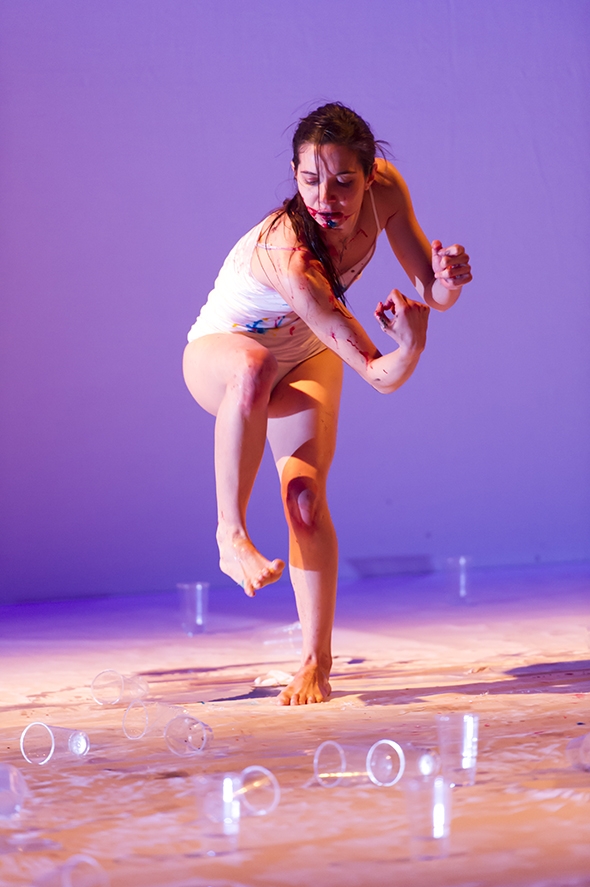
Standing on a tall pedestal, Hanna Wroblewski with her trademark red hair and flowing robe, cuts a statuesque figure. In Darling, I Don’t Sell Dreams… she shrinks the theatre (with the help of Joseph Bisat Marshall’s design and Lucy Hansom’s lighting) into an artist’s studio in which she is both the model accepting our gaze and the artist of her own creation. Inspired by her ‘fascination with the public and private personas of silver screen sirens’, Wroblewski plays a very public figure to the music of her very private thoughts. In her stillness, the bareness of her legs, the downward angle of her head and the sound of her heavy breathing, she at first appears to be on a ledge contemplating her fate. As she leans further, tiny bright red hearts cascade from her dress, flashing in the light as they fall around the pedestal. Gravity wins, but the hearts are escaping dreams. She begins to hum as she continues to revolve, letting her hair down, dipping a leg languorously to either side or raising a pliant arm, to reveal both her defiance of fear and her full sculptural presence. It takes a lot of courage to maintain this slow revolution (interestingly it allows us to conjure up so many images) but it becomes a dream-like metaphor for another kind of courage Wroblewski is about to reveal. After lowering herself over the pedestal, head draped towards us, she breaks the silence with an admission: she has an age-old fear of singing in public except, she realises, when she is feeling comfortable with her surroundings. Evidently she does here, for she launches into the sentimental ballad, Dream A Little Dream Of Me, finding just enough breath and just the right notes, not selling dreams but wrapping them up as gifts.
Posted: March 7th, 2017 | Author: Ian Abbott | Filed under: Performance | Tags: Anton Lachky, Botis Seva, Dreamers, Scottish Dance Theatre, TuTuMucky | Comments Off on Scottish Dance Theatre, Dreamers & TuTuMucky, Traverse Theatre, Edinburgh
Scottish Dance Theatre, Dreamers and TuTuMucky, Traverse Theatre, Edinburgh, March 3

Scottish Dance Theatre in Botis Seva’s TuTuMucky (photo: Brian Hartley)
“My work is to give you what I know of my own particular path while allowing you to walk your own.” – Ta-nehisi Coates
Welcome to Groundhog Day, fellow dreamers. This is my fourth sitting with Dreamers since it premiered in February 2015; Anton Lachky’s choreography has shared the stage with Jo Strømgren, Sharon Eyal/Gai Behar and now Botis Seva. The choreography has switched back to the original 29-minute iteration after being tweaked and extended last year. The last few months have seen a significant amount of change for Scottish Dance Theatre that has brought a different energy to the company: 7 out of 10 dancers are new and there’s a newly appointed rehearsal director, Naomi Murray (who was in the original Dreamers cast). The new dancers are stepping into choreography that was created for and with dancers who are no longer there; they’re inhabiting ghosts and it is difficult for me to un-imagine those who forged and imprinted themselves in their work with Lachky. Although Dreamers has been shaved by 5 or 6 minutes, the essence of taking control and taking back control (though that phrase has been used and coloured since the EU referendum) is the same; narratively it is tighter, but the bullet sharpness and anatomical prowess from the majority of the new dancers isn’t there and consequently the difference between the vignettes isn’t as pronounced.
However, new bodies fitting into old shapes can breathe something revelatory into those carcasses and James Southward (last seen in Janis Claxton Dance’s Pop Up Duets) is a fine example. An excellent addition to the company bringing an energy, presence and attitude to the movement, Southward dances everything with his whole body, hits his lines, responds and reacts to others and he draws the eye as he moves around the stage. Such is his ease with the choreography and in his relationships with the other dancers it feels as if he’s been in the company for years. However, the time it takes for a choreography to really settle on a dancer is different every time and the majority of the company has had only two months to revive Dreamers and create and learn a new work, TuTuMucky; this is evidently too little and the gel and magic isn’t quite settled yet.
“It’s not only what we have inherited from our father and mother that walks in us. It’s all sorts of dead ideas, and lifeless old beliefs, and so forth. They have no vitality, but they cling to us all the same, and we can’t get rid of them.” – Henrik Ibsen
TuTuMucky is an invitation for the company to move differently. Scottish Dance Theatre’s artistic director, Fleur Darkin, saw Botis Seva’s company Far From The Norm perform at British Dance Edition 2016 (I too was in that audience) and commissioned Seva to make a new work on SDT. Seva established Far From The Norm, aged 18, in 2010 and he and its members have developed and refined a shared physicality, training rhythms and performance vocabulary that is unfamiliar to many UK theatre audiences. What makes Seva and his company unique is the trust and commitment to what they want to do; he has kept close control over who is and who isn’t in the company and consequently has developed a trust and communication system that enables his dancers to deliver exceptionally distilled performances. Forged ‘outside’ the subsidised dance sector, Far From The Norm is creating an alternative choreographic language that is attracting attention from London’s dance critics’ cabal, commissioners, festivals and venues across Europe. Darkin was canny to be the first to commission him for SDT and she won’t be the last.
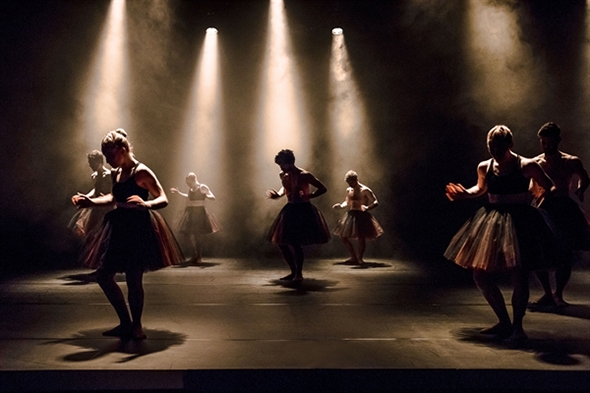
TuTuMucky offers the programme note: ‘Botis Seva defies traditional classification to offer a distinctly new form of dance that blurs the boundaries between ballet, contemporary and hip hop technique.’ Opening in dusky par-can haze we’re aware of writhing backs isolated in pools of light; with these slithery articulations Seva is attempting to get the company to move differently and unlike anything I’ve seen in the previous seven SDT productions. Shifting their energies and dropping their gravitational centres, he’s trying to school them in the hunger, urgency and articulacy of krump. Dressed in dark mesh tutus, the dancers combine a ballet-backed and first-position stiffness with the unnerving Wheelers from Return To Oz — rigid dolls hovering across the stage, mechanical in body and face.
The narrative pace and emotional zoning doesn’t begin to emerge till over halfway through the 30-minute work; it feels like the dancers need to start dancing 15 minutes before they come on stage so the adrenalin is running and we are immediately dunked into their world. Until that point I saw classically-trained dancers attempting to recreate an alien, krump-inspired language. Harry Clark (trained at Rambert and previously dancing with Matthew Bourne’s New Adventures) is particularly exposed in Seva’s choreography, needing to soften his spine and to give himself over to what is being asked. I think it would benefit the dancers if they were to experience and participate in a krump battle, to drink in and taste the emotional shower that spurts from those who krump when they are entirely in that other zone.
The duet between Amy Hollinshead and Southward pivots the energy of the entire work and we see Hollinshead take to krump like a cat giving birth to a fur ball, hissing and verbally banishing her ballet training to birth a new movement language on her body. The transformation of form is the root of the work: seeing bodies begin in one state, transformed to another and then resort back to their default setting. Southward revels in the intensity required and his face channels that intensity whilst his body matches the demands for articulation from his neck to his wrist. From here TuTuMucky begins to build and the electro, glitch noise soundtrack by Torben Lars Sylvest swirls the energy around the dancers and the audience; we begin to be pulled towards the rhythms, potency and urgency of the movement and I get a sense that the dancers finally start to believe; they’ve found Seva’s groove and in taking on his language transform themselves.
When some dancers are able to transform and execute a new language and some really can’t, the effect is a visual unevenness that leaves me unsettled; in a company like SDT I’m left with the question of where the responsibility lies for such unevenness? Is it with Seva who has not communicated or built the necessary trust with the dancers to convince them to give themselves over to his world? Is it the rehearsal director who isn’t noticing the stark differences in the stiffness and supple spines and taking steps to resolve them? Is it the dancers who are unable to execute what is being demanded of them or do not understand what they’re being asked to do? Or is it with Darkin in her choice of bringing a choreographer who is without doubt carving a name for himself but whose language creates an incompatibility with the current company of dancers?
When a choreographer like Seva is invited to make a work on full-time, salaried dancers who exist in a place of comfort and privilege it is impossible for him to recreate the conditions and terrain which he and his company have encountered and which make them so rare. The reality and experience gap is too large and consequently I feel like the two worlds haven’t come together; trust hasn’t been established and they’re still eyeing each other across the choreographic divide. If those who encounter TuTuMucky love what they see, they should seek out the work of Seva’s own company that is offering a choreographic palette, emotional intensity and insight as to where the next wave of British choreography could be going.
“I think certain types of processes don’t allow for any variation. If you have to be part of that process, all you can do is transform—or perhaps distort—yourself through that persistent repetition, and make that process a part of your own personality.” – Haruki Murakami
Posted: March 4th, 2017 | Author: Nicholas Minns | Filed under: Performance | Tags: Can You Hear the Sound of the Flowers?, David Holmgren, Jair Ramirez, Maria Lothe & Co, permaculture, Resolution 2017, Reuben Parker, Sugarman, The Rebirth Network | Comments Off on Resolution 2017: Jair Ramirez, Maria Lothe & Co and The Rebirth Network
Resolution 2017: Jair Ramirez, Maria Lothe & Co, The Rebirth Network, February 23

Maria Lothe & Co’s Can You Hear the Sound of the Flowers? (photo: Maria Lothe)
Jair Ramirez begins Sugarman intriguingly enough, entering the stage in his dressing gown as if it is his bathroom and the audience his mirror. He yawns and takes out toothbrush and paste to clean his teeth, but all too soon the theatricality of his presentation is revealed as a thin pretext for his speciality: aerial straps. His dressing room of sartorial props is set up to lead us to his first show of prowess, turning with his head supported in a strap while holding an open briefcase. In his second feat, he writes notes while suspended in the splits and then braces himself supine between two straps, one attached to his feet and one to his head. He maintains this pose with all the nonchalance of lying in bed and gets applause, for it is his prodigious strength that eclipses the theatricality that leads to its display. It is a problem with circus acts that want to explore outside the ring; there is a difference between emphasizing the theatricality of a particular act, and dressing an act in theatricality. Ramirez has chosen the latter, an option that further reveals its weakness at the end when after finding an effective moment to leave the stage he feels the need to return in his dressing gown to continue brushing his teeth.
Maria Lothe & Co’s Can You Hear the Sound of the Flowers? begins with three supine dancers (Svenja Buhl, Fergus McIntosh and Victoria Rucinska) in loose, vegetable-coloured clothing propelling themselves tortuously across the stage like a race of snails, each holding a potted plant on their stomachs; they could be tendrils searching for light but for the resistance of the Marley floor. Lothe & Co develop these images further with meditative poses, a vocabulary of gestures derived from biology and paleontology, vocal work learned directly, perhaps, from plants in various states of health, and mystical incantations. There is an intensity and humour in the three plant warriors as they grapple with the exotic forms and pliability of nature in all their idiosyncratic rawness, borrowing the dynamics of both growth and sickness since there’s not a drop of water to be seen under those blazing lights. If you’re going to choreograph a piece on the benefits of permaculture* this is the way to do it, using the kind of witty associations between body and plant life that make you want to read more (except for those who mistake the wacky humour as a spoof). But it also renders the recorded text by permaculture founder David Holmgren far too serious, sitting uneasily with the fertile imagery on stage below. It is also superfluous. As the three performers inch their way off at the end leaving the potted plants centre stage, Lothe & Co have already done their job; it’s up to us to explore Mr. Holmgren’s ideas further.
*Permaculture takes its inspiration from ecological systems and patterns in nature. Through its ethics and principles, permaculture provides practical methods of how to develop sustainable human environments.
The Rebirth Network’s Reuben Parker is a selection of episodes that form a preview to a longer work, not enough of them here to spin its moral but complete enough to recognize its value and to want to see more. It is described as ‘a hip-hop dance drama about a man who is granted a special gift to shift and shape his reality.’ Clearly such a gift can be both a blessing and a curse and that is the drift of this morality tale which begins with the narrator’s biblical voice of contrition: “I want to tell you a story.” The action introduces us to Reuben Parker in his present form and then relives autobiographical episodes of his life; dancers who play Reuben at different times of his life each wear white gloves so we know who’s who and each episode or tableau is clearly introduced by the narrator and separated from the next one by a blackout. On the way up, we see Reuben saved from bullying at school by a kind teacher and his acquisition of a special gift of power over others. On the way down we see him squander his gift in his careless treatment of his mother, lose the girl he loves and acquire a gambling habit. The dynamic rhythm of Luke ‘Gkid’ Grant’s original music and Daniel 7’s choreography make Reuben Parker look like a musical on a spiritual theme, but the upbeat production values tend to even out the register of emotional ups and downs: the special teacher, Mr. T., makes only a brief appearance for such an influential figure, and the tragic death of Reuben’s mother becomes merely sentimental. At times there are sixteen dancers on stage and the strongest choreographic expressions belong to them as they communicate not only their love of performing but their belief in their message.