Posted: May 27th, 2012 | Author: Nicholas Minns | Filed under: Performance | Tags: Maresa von Stockert, SEASAW, Tilted Productions | Comments Off on Tilted Productions: SEASAW at the seaside
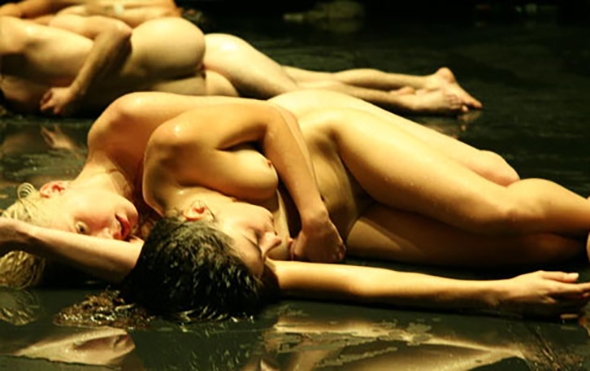
Presented at the Brighton Festival, May 20 at 3pm, SEASAW is a trail of contemporary dance, performance art and physical theatre vignettes inspired by the relationship between humans and water.
I had been to see Motor Show at Black Rock the week before and thought I would be able to park in the adjacent lot, as I had done then. I arrived with five minutes to spare but there was a London to Brighton Mini rally this morning, with 3,000 minis parked along the promenade, so no possibility of getting anywhere near Black Rock unless you are driving a Mini. Parking up on Marine Parade and rushing down the steps, I arrive at the meeting point just in time. It is a free event, and there is a loose crowd of about fourty people on the lawn, wondering what to expect. A festival steward gathers us within hearing distance and warns us that this is what is called a promenade event and that as a result we will have to contend with steep slopes, rubbish and any other natural hazard of a beachside venue. First aid is available.
There are so many Minis around that the director of Tilted Productions and creator of SEASAW, Maresa von Stockert, decides to change the place of the opening picnic from the lawn to the beach. This is the kind of last-minute decision-making that site-specific work can entail. We move past the Minis to the promenade. No engines are roaring or car radios blaring. Standing at the railings, we see a couple walking up towards us from the sea, each with a hamper and a stool, towards a picnic table on the beach in front of us. John Williams’ Jaws theme plays from a portable sound system on a trolley as the surreal picnic begins. The picnic basket has a life of its own, as the couple struggles to get their food (a tin of sardines) on to the table and ready to eat. They are evidently ravenous. Plates, knives and forks are also animated and take some controlling, but the couple finally manages to finish the meal, licked sauce and all, with not a little detritus left on the beach. In a second hamper are glasses and the man pours the wine. They drink with abandon, the wine spilling down their chins and clothing. Replete, they walk off back towards the sea, disappearing from view over the pebbly ridge. A beach attendant (we are not sure at first if he is a health and safety official from the festival) comes to clear up the mess with a litter picker and a plastic bag. The litter picker then takes on a life of its own, pulling the official (now we know he is part of the performance) and us to the next event across the promenade and inside the building site.
A soundtrack by Jeremy Cox plays from a second portable sound system. A plastic sheet is laid out and pegged to a makeshift stage with rocks and stones. The surface is wet, and so are the four dancers, in a mixture of water and grey paint. They are gulls on an oily beach at low tide, unable to fly. The plastic sheet is slippery and conducive to the splashing and struggling antics of panicked birds. The dancers are on their knees and all fours, articulating their arms as oily wings and sliding on to their shoulders with legs flailing, their headstands falling perilously close to the stones on the perimeter of the stage. The beach cleaner picks up the front edges of the plastic sheet and folds it back over the gulls, who dance ever slower to their last suffocated gesture. A marine ecologist’s nightmare.
Back on the seafront the beach cleaner has put on a track by Art Zoyd as he picks up an abandoned plastic bottle that also takes on an animated life of its own, getting up his sleeve where it looks like a continuation of his arm. There is a rubbish bin on wheels nearby, and he tries to get rid of the bottle into the rubbish, but his free sleeve gets caught and when he finally withdraws it, there is another bottle implanted in that sleeve. This is something you can try when you next go beachcombing. Another man with similarly extended arms climbs up over the railings to join his comrade. The long arms of their tee-shirts resemble straight jackets, especially when the arms are wrapped and interlocked around their backs, which happens when the two fight together. One triumphs and slips his rival into the rubbish bin, at which point another bottle man emerges feet first from the same bin. Fantastic. The triumphant fighter slopes off over the rail on to the beach. Rubbish man is a mutant with bottles in his trouser legs as well as in his sleeves. A fourth contestant pushes through the legs of the crowd on all fours. He has a bottle fin, comprised of five plastic bottles sticking up from his back under his tee shirt. The mutant escapes over the railing for a moment, leaving fin man to test his balance on two legs. The mutant returns for a slow-motion wrestle according to the natural law of the seaside plastic bottle chain. Fin man is evidently lower down and the mutant throws him gently over the railings.
Over to the right of the beach a mermaid and a swashbuckling pirate are embracing to music by Michel Rodolfi, but the mermaid is difficult to handle. She is thrashing around and somersaulting over the pebbles. How else does a mermaid move on dry land? He tries to keep her in his arms, but she is too slippery. They eventually disappear over the ridge of the beach, her fin still visibly thrashing. We turn around to face the building site to watch a girl wearing half a dozen lifebelts struggling to keep afloat and a girl playing music through a megaphone. It is like a recitative in an opera on a seaside theme, though the story is not clear. It is here on the promenade that the site-specific nature of the performance comes into its own. A group of three men walk by and one is fascinated by the girl with the megaphone. As she sidles towards him on her planned beat, he retreats just enough, keeping his eyes on her. We are not sure if he realizes she is performing or is just a beautiful girl in high heels who has lost her earphones.
Festival stewards guide us to the sea rail again where a number of conch shells are hanging from string. Picking them up and putting them to our ear (what else to do with a conch shell?) we hear not the tides but a poem by Stevie Smith, Not Waving But Drowning:
“Nobody heard him, the dead man.
But still he lay moaning:
I was much further out than you thought
And I was not waving but drowning.
Poor chap, he always loved larking
And now he’s dead.
It must have been too cold for him his heart gave way,
They said.
Oh, no no no. It was too cold always
(Still the dead one lay moaning)
I was much too far out all my life.
And not waving but drowning.”
This leads naturally to the sight of a deep-sea diver in ancient kit and helmet lurching down the little point towards the lookout. His mask is on backwards, then turns as he dives imaginatively into the concrete, but disappearing more effectively over the wall. Turning around, we see a man with a deckchair on a large rectangle of green artificial turf. I had seen this act in rehearsal quite by chance the day before, and it is worth saying that this is a standard issue deckchair. I saw only one person rehearse then, but today it is an epic duet of deckchair acrobats to a score by Polar Bear. Ingenious, dangerous, hilarious, these two men battle it out with their deck chairs, performing somersaults, headstands, balances and jousting on the basis of whatever-you-can-do-I-can-do-better. Towards the end one plays some dirty tricks on the other and ends up sitting on his chair atop his rival.
Back at the railings, looking out over the beach and a calm sea and sky, we hear a score by Jeremy Cox and see a small iceberg. Two dancers, who might be polar bears in human form, climb on and try to maintain their place on the tiny, uneven, slippery surface with balances and counterbalances. Another couple replace the first one on the floe, with a more bravura, almost capoeira display of interdependence. The male eventually rolls off, leaving the female alone for a moment but she has to cling to the extremes of the floe as it is upended and sinks into the beach. A line of dancers appears from below the ridge carrying lifebelts, staggering up towards us. As we move back, they climb over and through the railings. Stewards keep the crowd (which has burgeoned to about 100) and any unsuspecting promenaders from walking through the performance space. To music by Michel Rodolfi, the dancers put on a display of everything you can do with a lifebelt: a synchronized lifebelt show with rolling, balancing, getting in, getting out, and whirling around like a dervish before they fall to the ground. Like shipwrecked ghosts they climb back over the railing towards the sea and place their lifebelts on mounds of sand in a line on the beach. I watched a man digging those holes the day before. The dancers place the lifebelt over the hole, and scoop out the sand over their shoulders, like dogs digging for a bone. Then they place their heads in the hole and raise their legs skyward. The line of heads in the sand, with a background of a calm sea and sky is as magical as it is symbolic.
A fish tank sits on another ice floe to the right of this head-standing ritual and a girl climbs up on the floe and on to the tank. We see her through the tank so it looks as if she is in it. She balances on the edges and splashes the water with her hand and foot, dips her head in repeatedly and finally, to the shivering shock of the spectators, immerses herself completely: a dancer in a fish tank or a mini deluge? It is the end of the afternoon, and we are suddenly aware of our desire to keep warm, dry and safe. The dream is over, but the images persist.
Posted: May 18th, 2012 | Author: Nicholas Minns | Filed under: Performance | Tags: David Rosenberg, Frauke Requardt, Motor Show | Comments Off on Requardt & Rosenberg: Motor Show — Listening in on the lives of others
Motor Show, co-directed by Frauke Requardt and David Rosenberg, at the Brighton Festival, May 12.
There is something vaguely perverse about sitting outside for an hour near the seafront on a cold, windy night listening in through our headphones on the conversations of young couples out for an adventurous night in their parked cars. What business is it of ours, all 250 of us, huddled together in our parkas, coats, wooly hats and assorted rugs and cushions on this derelict building site at Black Rock participating in a version of The Lives of Others for a cast of beaten-up cars, a couple of caravans and ten dancers with assorted headdresses?
Frauke Requardt and David Rosenberg, co-directors of Motor Show, first joined forces to create Electric Hotel in 2010, which pioneered their use of binaural sound technology to juxtapose a distant image with an intimate sound score. It also branded their artistic taste as slightly twisted and surreal with dark overtones. Motor Show is the follow up, with a week’s run at this year’s Brighton Festival before transferring to derelict building sites at the festivals of Norwich, Greenwich+Docklands and Stockton (see Links page for details). One of the themes of Requardt and Rosenberg’s collaborative work is to transfer the audience from the traditional auditorium to a disused or unfamiliar setting of the urban environment (the performances are presented by Without Walls). Black Rock, with its backdrop of the Brighton Marina car park, is one such area. The disadvantage of such spaces is that they can be numbingly cold.
Box office is also pretty rudimentary: a rusty iron gate with a padlock behind which stands a guy with a fistful of pre-booked tickets. If you want to know how to dress for the event, take a tip from the box office staff. You can also buy a ticket on the night if you thrust a £10 note through the grill ‒ if there are any tickets left. This is, ironically, a hot event. If you come by car, there is a parking lot next to the site, and if you come by bike, you can leave it just inside the entrance, and there’s no need to lock it. There are no programs, no drinks, no ice creams and no crisps; just the obligatory pair of earphones. Only the hardiest of arctic spectators would want to check in their coats, but it’s a moot point as there are no facilities. The construction site toilets are stacked against one of the dilapidated barriers that form the enclosure of this festival site. The only good thing is that the sightlines are a lot better in this banked seating than at the Dome and you don’t have to turn off your mobile phone because nobody can hear it anyway. In the absence of printed programs, there could have been a giant billboard with the information, just so the dancers and production staff can be officially acknowledged by name. The stage is concrete, which is why the dancers don’t jump very much, but it’s great for the cars. This is theatre in the raw for a ferociously clad audience. Or it might be just a creative excuse for catching a cold.
There is an amusing conceit at the beginning of the binaural soundscape: we hear the expectant chattering of a warm and cosy theatre crowd before the lights go down, as at the beginning of a BBC 3 live concert broadcast. There is no chattering in this audience apart from our teeth.
The concept of listening in to intimate conversations in a parked car a hundred yards away is closely associated with espionage, except that in Motor Show there isn’t any dialogue to listen to. Is there an aural equivalent to voyeurism? The promotional material talks of a young couple in a car arguing and planning a world for each other, but this is a stretch too far for the imagination. All we hear is the ambient sound inside the car: engine, ignition switch, handbrake, the opening and closing of a door, a bottle opening, a foamy drink being poured and swallowed, giggling, music playing. The sound quality is such that we are inside the car, but we are ‒ literally and metaphorically ‒ left out in the cold when it comes to following any thread of conversation that might suggest what is happening.
Nor is it easy to extract information from the action, but then again, surrealism is not given to easy interpretation. A prologue sung by a woman in a feathered headdress (headdresses have a certain significance in Requardt and Rosenberg’s work) suggests the work’s dark undertone: “My lightning flashes across the sky; you’re only young but you’re gonna die.” We hear the plastic coat squeaking as the woman moves. Way over in the background a figure is dancing up a storm in the dust, a tiny figure on a huge stage. I have never seen such a small figure on such a vast stage attract so much attention. “Satan’s gonna get you.” The site’s crazed telephone booth buzzes with the sound of an industrial-size electrical short. The light goes out. “Hells bells, hells bells.”
We hear a metal gate opening and a car starts up. It’s real, and approaches us from behind the corrugated fence that forms a backdrop and comes to a halt. We see a man in the driver’s seat and a girl next to him, like figures in a fish tank. He cracks open a bottle and pours a drink, winds down the window and places the bottle on the roof. Good place to keep it cool on a night like this. Getting comfortable, the CD player comes to life. Another car approaches and stops as if lining up at a drive-in cinema. This second couple repeats the same bottle-opening-drinking-CD sequence. The girls in the two cars get out and dance against the side of their respective cars. A third car drives up and the entire sequence is repeated. The three girls in bare legs and summer frocks must be cold and dying to get back into their cars, which they do. A bottle falls off one car roof and breaks. The first two cars reverse to behind the corrugated fence, but the couple in the third car is busy snogging by the sounds of it. Later on there is some interesting thematic choreography for these drivers and passengers, entering and exiting the car windows with acrobatic abandon, but for the most part the cars (there are as many cars as there are dancers) outperform the dancers.
While the three couples in cars form a recurrent theme in Motor Show, the linear scenario seems to begin with a man in a stretch Volvo enticing a schoolgirl into the back seat. She accepts, but eventually gets away, survives being blown up in the boot of an abandoned car and is finally redeemed. We see her at the end through the window of a big caravan that only she can unlock, dancing contentedly. The Volvo man, after staggering around in a state of mental and physical disintegration, endures a final self-inflicted punishment in his underwear groveling on the cold, hard ground. There is also a parallel universe of a gang of violent car bashers with rubber truncheons driving a battered Jaguar and an eccentric shaman who lives in a small but transformative caravan that he pulls himself on to the site.
I am glad I went. Requardt and Rosenberg clearly have an impressive level of imagination to work on this kind of epic scale, marshaling a complex array of resources. Comparing the two projects, Electric Hotel had a unity of set and concept that was essentially contained and complete, whereas the unity of Motor Show is more dispersed, perhaps too much. It is a work of exploration rather than of discovery; the promise is still there; the courage and imagination are still there, but the theatrical experience is frustratingly incomplete. With these two works under their belt, who knows what Requardt and Rosenberg will come up with next, but whatever it is will be worth watching – as long as there is an item in the production budget for heated seats.
Posted: May 12th, 2012 | Author: Nicholas Minns | Filed under: Performance | Tags: Brighton Festival, Leah Morrison, Tamara Riewe, Trisha Brown | Comments Off on Trisha Brown at the Brighton Festival: The unbearable lightness of seeing
Trisha Brown Dance Company in the Concert Hall, Brighton Dome, as part of the Brighton Festival, May 9, 2012
At one end of the foyer a pre-show event has been scheduled amidst the clink of glasses and chatter of the bar. Tamara Riewe, a dancer with the Trisha Brown Dance Company, steps on to the tiny stage with the reverence of someone about to perform a ceremony. The bar chatter subsides as the first chords of Grateful Dead’s country rock track Uncle John’s Band focus the attention. Riewe begins a 1971 work based on a simple accumulation structure: add a movement and return to the one before. It is a work Trisha Brown created for herself. One wonders if Riewe’s body is like Brown’s, but it is not important. What is important is where the movement comes from, and for Riewe to find that place in her own mind and body.
Accumulation starts with a single hand gesture, adds the other hand, a hip twist, a shading of the head, a rise on to half point, a lift of the leg to the side, a step to the back, a return to the front, a bending of the elbows like an Egyptian mudra. It is a piece of pure motion and concentration, a dynamic of one movement phrase inducing the next, and the next influencing not only forward but back until the whole thing is alive and breathing like a living entity. After four minutes and fourty-three seconds, Riewe draws the song and her movement to a close, her lyrical finger tracing a line towards the opposite hand as if she is turning off the switch.
In the main auditorium, the curtain opens to a black backdrop and one overhead arc lamp. Leah Morrison’s back is towards us as she begins If you couldn’t see me (1994), another of Brown’s own solos. We are expecting Morrison to turn towards us, but she doesn’t; we are behind her, and remain in that relationship throughout the dance. She works slowly across the stage in fluid shapes and transitions. One remarkable quality of the Trisha Brown dancers is that they are so well balanced there is rarely – if ever – any hesitation or instability. If you couldn’t see me is one of a group of works on the program that come from the same creative phase of ‘back to basics’ – as Sanjoy Roy writes in the program – that sees Brown ‘deliberately toning down the physical dynamics, simplifying the composition, and for the first time gently allowing personal imagery and emotion to suffuse the atmosphere…’ Robert Rauschenberg’s deep reverberating sound seems to encourage this, and Spencer Brown’s lighting wraps the movement in its warmth and space. Morrison eventually returns to her starting point, repeating the initial theme in ever-shorter sequences until the momentum just winds down.
Brown is a visual artist as well as a choreographer, and one of her black-and-white sketches on the backdrop sets the scale for a relatively recent work, Les Yeux et l’âme (2011) to music from Jean-Philippe Rameau’s opera, Pygmalion. In her formative years, Brown had a particularly proprietary attitude to creating dances: “I didn’t want to be marshaled in a certain direction by music. You know: music makes you dance. That’s cheating!” This attitude led her to experiment with dance as a pure expression of itself, and it is the fruits of those years of movement research and experimentation that we see here in a particularly fresh relationship with a score, as if both music and choreography develop from the same source; the dance breathes within the music and the light. Jennifer Tipton’s superb design and Elizabeth Cannon’s neutral, flowing costumes enhance it further. Brown has a particular affinity for France, and it may be fancy but there is something quintessentially French on stage here, a luminous marriage of Molière’s wit, Rameau’s courtly music, and the intellectual curiosity of Sartre.
If you didn’t miss Accumulation in the foyer, there is a gentle progression from that work to the end of Les Yeux et l’âme that prepares us for Foray Forêt (1990), the most demanding in terms of our concentration. There is a lovely quote on the Trisha Brown website: “If I’m beginning to sound like a bricklayer with a sense of humour, you’re beginning to understand my work.” Her bricks are sequences of movement that she uses to build a greater structure with infinite patience and attention, and her sense of humour is above all a subtle one, more akin to playfulness. With this in mind, you can enter into the spirit of Foray Forêt; without it, all that slowness and silence can become tedious. As in any forest, there is a lot of silence here and it can be deafening.
The silence is broken by a reminder of our urban setting: the sound of a marching brass band, far away at first, and growing louder as it approaches. We never see it; it is a spectral band: we only sense its proximity by the volume of its sound, as if it just happened to be marching around outside the theatre when somebody opened the stage door during the performance. The music seems to make no impression on the dancers, who could be playing in a walled garden during Mardi Gras, oblivious of the noise in the streets outside. Their game has the spontaneity of improvisation even if the movement sequences are now ‘fixed’ in the work. This is the measure of the dancers’ skill. They are so much in the moment doing what comes naturally that they lack any sense of self-consciousness.
Some of Brown’s dances could be danced without a proscenium, but this work makes conscious, playful use of the on-off duality of the stage. Stage and wings in effect form a continuum for the movement, whether it is visible or not. A girl dances close to the wings and tips off balance. An arm appears from the wing to support her, half on, half off stage. Later, while Megan Madorin dances her enigmatic solo, disembodied hands and heads appear around the wings as if kept at bay by the quiet authority of her dance.
Brown may spend a year preparing a work, creating sequences of movement with her dancers, then editing them down, whittling away at the material until the result is exactly what she is looking for. The work is thus rich in memory and experience. Coming to these works for the first time from a hectic outside environment is a challenge for an audience, but there is something so relentlessly pure about Brown’s approach to choreography that makes that challenge soothing and hugely rewarding.
In For M.G.: The Movie a man (Patrick Ferreri) stands with his back to us throughout the work, motionless. His presence is real but the work is a journey of memories surrounding him, images moving in and out of focus and view, as if in a dream. Both Trisha Brown and Spencer Brown worked on the highly evocative setting of light and haze. In the opening sequence, Tara Lorenzen repeats a figure of eight running pattern, jumping as she approaches the front of the stage, buoyant, confident, as if in a trance. We hear some disembodied piano music in slow waltz time, but now the composer, Alvin Curran, introduces us to his ‘sonic tableaux of old-fashioned lawn mowers, the Nantucket Light Ship, mobs of crows, John Cage’s inimitable voice, tin cans being kicked in a deconsecrated Venetian church.’ Such is the complex nature of memory. Lorenzen is still running intently. A boy appears and lifts her across the stage and disappears. Running seems to be a metaphor for brain activity in search of meaning. She runs up and down the stage, mowing swathes of an imaginary lawn (Curran’s lawnmower?) without leaving a trace and in another sequence kicks Curran’s Venetian tin cans as she turns a corner. Two boys run in and she runs off, then back in; disappears and returns, forwards and backwards: run and rewind. Dream is memory beyond time and space. There is a haunting moment when Lorenzen’s face, at the back of the stage, appears and disappears, appears and disappears in the haze. Dancers are bumping into each other and gently bouncing off; a girl lies half on the stage, half in the wings; a boy rolls slowly to the centre where a girl walks over him: all dream-like events without accent or narrative. Lorenzen repeats her opening jumping figure of eight. Imperceptibly a girl has entered on the opposite side, followed by another. They move as slowly as the return of the piano waltz, now synthesized. Riewe, the girl at centre stage, descends slowly, inexorably to the ground then rises again. There is an outburst of movement, a buzzing fly in the sonic tableau. Riewe dances an extended solo beautifully, as if unfolding her own internal processes. The other girl is kneeling in mourning. The fly ceases buzzing; the piano is being tuned; the girls are now on their backs, inert, withdrawn into impermanence. The man has not moved. He reminds us of Leah Morrison’s position at the beginning of If you couldn’t see me. The cycle is complete.
Watching Brown’s choreography is to clear away accretions of traditional form, like cleaning layers of lacquer from an old painting to reveal the freshness and immediacy of the original. But there is something in Brown’s creative evolution that is relevant to other forms of dance: a return to spontaneity and genuineness. It is not a question of the forms she creates or the processes to arrive at them. These are, after all, deeply personal. It is more her ability – and the ability of her dancers – to seize a moment in motion and to keep that moment ever present. No more approximations. How refreshing.
Posted: May 8th, 2012 | Author: Nicholas Minns | Filed under: Performance | Tags: 9-5, David Bintley, Jessica Lang, Kit Holder, Lyric Pieces, Take Five | Comments Off on Birmingham Royal Ballet: Three Short Works
Three Short Works, Birmingham Royal Ballet at Crescent Theatre, Birmingham. Friday May 4 matinée.
Voice over: Welcome to Out of the Box Solutions. The digital clock shows 09:00. Winston and Julia, the new recruits, arrive for their first day’s work in a claustrophobic office space peopled by a chorus of malevolent clerks at their computer terminals. Matthew Herbert’s layered, electronic soundtrack, The Mechanics of Destruction, adds an inspired element of dehumanism and Johnny Westall-Eyre has created a lighting plot worthy of the score, scanning bed and all. Through the door marches a vampire of a Boss (Samara Downs), sexual harassment on pointe, and leads the bespectacled Winston (Joseph Caley) by his tie, back through the door, into her office.
Before we get to the lascivious scene two, a note of explanation. What we are about to see is the original duet which forms the seed of this work. Choreographer and BRB dancer Kit Holder created the duet to a track by MistaBishi called Printer Jam, in a quiet, unguarded moment while recovering from an injury. The work then took on a life of its own, and after a few successful outings, BRB director David Bintley asked Holder to enlarge the work to twenty minutes for inclusion in the present program as 9‒5. Apart from some minor tweaks (according to Holder), the choreography of the duet remains the same; only the roles have changed. So scene two is effectively a hot, manipulative, raunchy duet, danced with convincing animality by the Boss and her new recruit.
The subsequent story line of Winston and Julia’s day from hell and final firing is not important; the action could be in real office time or it could be happening inside Winston’s head. What is important is that Holder has had a chance to develop his choreographic voice with some effective chorus work that is in turns amusing and oppressive, a soothing duet between Winston and Julia to William Byrd’s In Nomine, and some lively passages for both men and women. He also maintains integrity of mood throughout. The development of the narrative side is less convincing, with a tendency to caricature rather than character, but that may be because the original duet was not sufficiently defined itself. Printer Jam has not lost its original character by its transformation into a twenty-minute short work but neither has it gained particularly by its extension. Holder is the winner here, a few steps closer to being, as Bintley himself stated recently in The Stage, “at that place where he’s hopefully about to do something of significance.”
The winner in Jessica Lang’s Lyric Pieces is molo design, a Vancouver-based collaborative partnership of Stephanie Forsythe and Todd MacAllen who are responsible the chic, black, kraft paper décor that is subject to endless manipulation by the dancers as space dividers, stools, and assorted props. This is taking set design to an innovative ‒ and potentially lucrative ‒ level of product placement. Perhaps the black paper is too stark against Nicole Pearce’s beautiful pale washes of light; the opening form looks like a giant water filter set down incongruously in a desert. White paper may offer more luminous possibilities and a gentler contrast to the costumes of Elena Comendador. The dancers emerge gracefully from these kraft paper objects, swirl around them, disappear enigmatically into them, balance playfully on them, lie serenely beside them, fold them up and carry them effortlessly, cover each other lovingly with them, unfurl them musically, enter jauntily with them (with even a whiff of camp) and exit reverently with them. When the dancers are not manipulating the décor, and even while they are, Lang has created for them a series of dances ‒ an ensemble at each end and eight variations in between ‒ based loosely on ten of Edvard Grieg’s folk-inspired lyric pieces played admirably from the pit by Jonathan Higgins. There are some fine individual performances (Tzu-Chao Chou and Nao Sakuma stand out) and engaging ensemble work, but the spotlight is decidedly on molo design, who also supported this production.
During the second intermission, the jazz quartet (Simon Allen on saxophone, Dudley Phillips on double bass, Steve Lodder on piano and Nic France on drums) warms up the auditorium with the music of Dave Brubeck, setting the scene for David Bintley’s Take Five. The curtain rises to Brubeck’s classic of the same name and we see Peter Mumford’s stage divided into nine rectangles of light, like an elongated noughts-and-crosses board. Four boys weave to the piano rhythm while the girl (Carole-Anne Millar) picks out the melodic line of the saxophone. Here is a refreshing fusion of music and dance and the performers convey a sense of ease and enjoyment. Each boy in turn dances with the girl, though it is not until the third boy that contact is finally made. Robert Parker is in the swing of it and smiling, perhaps because he is giving his final performance* before becoming director of the Elmhurst Ballet School. (Seeing him for the first time dancing an extract from De Valois’ Job at a recent memorial service for Alexander Grant, I thought he was a student with a promising career. Just one week later he is, alas, retiring.) Millar is having fun too…until Parker leaves. A trio of girls follows in Three To Get Ready, a series of solos that have a deliciously naïve sense of humour, then a really joyous Flying Solo by Jamie Bond.
Elisha Willis is a girl on a journey in Two Step. She eyes the cool and energetic Parker but the two keep their distance, dancing gradually closer until he finally takes her hand. They work well together. A chorus of boys enters, clapping out the rhythm in Four Square. You can’t ignore the rhythm when you have to clap. The dance increases in difficulty and speed, with thrilling turns and virevoltes. The boys take a well-earned bow before a reprise of the opening in Double Take. The dancers let themselves go, building in intensity and energy, and the fun flows inexorably out into the auditorium. Parker goes for broke, while Willis is relatively understated, a reflection of the music itself. In the ensemble, the accents are right, the lifts work effortlessly, and music and dance come together irresistibly.
*correction. It was Robert Parker’s final performance in Birmingham. His final tour finishes on Saturday May 12 in Truro’s Hall for Cornwall
Posted: May 5th, 2012 | Author: Nicholas Minns | Filed under: Performance | Tags: Ann Dickie, Deborah Jones, Jennifer Jackson, Simon Rice, Susie Crow | Comments Off on Dancing the Invisible
Dancing the Invisible – Late Work at the Ivy Arts Centre, University of Surrey, with Jennifer Jackson, Susie Crow, Ann Dickie, Deborah Jones, Simon Rice
The stage at the Ivy Centre is bare, with seating arranged on three sides, and the two musicians and their array of electronic instruments taking up the fourth. Jennifer Jackson is the compere with words of welcome and orientation. Is this part of the performance? Simply and elegantly dressed, she looks as if she is about to cue the dancers to emerge from some dark edge of the performing space. But it is she who starts, initiating this dialogue into the transformative effect of ageing on dancers and its implications for choreographic practice. As Jackson writes in the program notes, “…opportunities for professional dance artists to sustain performance practice as they age, and for audiences to engage with repertoire that speaks to this experience, are still rare…” The trouble is that ballet dancers age so gracefully it is quite easy to forget this central focus of the research and to simply enjoy what Jackson and her colleagues perform. Perhaps this is the point. Watching Jackson’s introduction to the formal elements of the improvisation that will follow – the Signature section to Late work – it is immediately apparent that her classical ballet training is so deeply embodied in her that no advance in age can take it away. A fourth position of impeccable line and oppositional forces is a beautiful thing, and when Jackson finds this shape, in this intimate space, we are initiated into the essence of ballet without the historical context and trappings. That is another point worth remembering. Despite the years of accumulated training at the Royal Ballet, this loose collaborative of dancers will not be donning tights and tutus. As Jackson reminds us, “I am interested in…how dance might challenge the aesthetics of established dance performances.”
The musicians (Malcolm Atkins and Andrew Melvin) enter, playing spiritedly on melodicas, and Susie Crow follows them, like a small procession in a festive parade. Susie’s torso finds her own beautiful, subtle shapes, engaging the classical vocabulary in a fluid and understated way. Jackson and Crow are at ease in this performing space, filling it with their game of improvisation. Recognisable gestures – a raised arm pointing upwards, a framing of an angle with the hands – appear out of these shapes, as in a narrative. Late work is engagingly internal, addressing what is going on in the minds and bodies of the two dancers but there is also an external dimension, the mysterious domain of the dance that transports us elsewhere. Behind their array of electronic equipment Melvin and Atkins are also intimately involved in what is happening, adding their own magic to that of the two dancers: four improvisers on a fluid theme.
The boots and shoes come off and are replaced by the ballet slipper. Aurora and the Queen, pale deconstructed eminences from the past, play before us. It is enough for Jackson to say “I am a princess” and for Crow to say, “I am a queen” for us to believe it and to enter into the play. A recorded voice reminds us that steps a dancer has learned are without meaning unless experienced within the context of a rhythmical whole. It is Marius Petipa’s Sleeping Beauty choreographed by Samuel Becket. Jackson develops phrases from classical ballet: en dedans, en dehors. Taken apart, detached from a sequence, they nevertheless have a power of association. En arrière, backwards, into the past. Aurora has been here before. Jackson and Crow change roles, and Crow journeys through the body’s memory, bringing out courtly gestures, childlike longing, a trembling leg and arm. The two Auroras embrace, comfort each other, merge.
In the Pulse section, the music is off in all directions and the two dancers are sitting on chairs improvising a set of movements to different counts. This is the evidence, if any is needed, that the mind of an ageing dancer is not in decline. It is functioning at lightning memory speed until the game comes to a halt. This is where the men come in, or so it seems from the musical cue. But it is a section called Fragmentation, sung in disconnected syllables, with an accent on the second syllable. The movement vocabulary is fragmented too, breaking dance phrases into abstract fragments, what Crow calls ‘the merging of personal memory and disciplinary structures.’ In the Haiku section, brief phrases of movement and gesture suggest a poetic narrative, transferred from one dancer to the other. There is an element of contemplation here, eyes closed, a suggestion of an afternoon of a faun. It is this section that is perhaps the most tantalizing, because the relationship between the two dancers begins to acquire some context, a story that is about to find expression, a potential that is awaiting to find its form. The improvisation of movement and music fuses here most convincingly.
In the final section, Rhythm and Melody, Jackson and Crow are seated opposite each other. They begin with a basic port-de-bras and develop it in mirror image, sharing elements of the classical canon that are explored, extended and broken. Assemblé, développé, élancé are quoted though without relation to the seated movements. The two dancers slow down, as if lost in space, fingers searching, reaching across a divide in silence, watching each other, closing in, bending forward in a gentle but inevitable surrender to the pull of gravity.
Part 2, Dancing the Invisible, is set to the Bach’s cello suite no. 2 in D minor, played beautifully by Emily Burridge. The suite’s movements derive from the courtly dances of Allemande, Courante, Sarabande, Menuet and Gigue. Jackson and Crow are joined by Ann Dickie, Deborah Jones and Simon Rice. The five dancers are seated in the audience. During the Prelude one dancer follows the weaving, courtly musical line across the stage to introduce another, until all five are on stage. The choreography is, like Late work, a collaborative venture with all the dancers, though here the improvisation has already happened and the choreography has by now acquired a set structure. The four women disperse once again to their seats leaving Simon Rice propping up the back wall at a rather desperate angle. Rice is the one male presence of the evening’s works, and he takes full advantage, playing the cock among the hens. Jackson chases him into the beginning of the Allemande, but once caught, Rice playfully makes her repeat movements as if in rehearsal. Rice then dances with Jones, commenting that the last time they danced together was 29 years ago at this very university in 1983. It is an anecdotal dance of old friends with a shared past. Crow expresses reticence in her solo, then Dickie and Jones join in a gestural conversation of searching hands and eyes. Dickie’s wrists and hands seem to begin a dance all by themselves, winding and interweaving, engaging her expressive arms and torso. Reminding us of the strains and stresses of a long stage career, the five dancers regroup in the centre to agonise and sympathise with their respective aches and pains. Jones is a shiatsu therapist, but this is not the moment. Each dancer has a signature movement that they express and develop in a final gigue-inspired game.
Dance is often described as ephemeral, but for the dancer it is anything but ephemeral. It is lodged in their muscles and the mind. Looking at these dancers, it is clear the dance has never left them, a vast resource that needed the gentle enticement of academic research for it to emerge into the light. And even if the dance doesn’t come out as a variation from Sleeping Beauty with full orchestra, the power of its associated elements is richly rewarding. The importance of age in this process is that it provides a greater reservoir of experience from which to bring these memories to the surface. Because all forms of memory are invisible, this is dancing the invisible, but the aspect we saw last night was manifestly visible. These are not older dancers strutting their stuff past their virtuosic prime – as some older dancers have been known to do – but offering us the rich territory of individual and shared dance experience.
Jackson herself affirms this in the final lines of her introduction in the printed program: “Does the dancing stop as the body ages? Clearly I think not…and it is a pleasure to share ways in which for us as ageing people the dance and music continue to provoke and promote life, well-being, communication and community.”
For more information on this research, please follow the website and blog:
www.surrey.ac.uk/dft/research/currentprojects/dancingtheinvisible
www.uniofsurreyblogs.org.uk/dancingtheinvisible
www.surrey.ac.uk/arts
Posted: May 1st, 2012 | Author: Nicholas Minns | Filed under: Performance | Tags: Arunima Kumar, Rich Mix, Shane Shambhu | Comments Off on Arunima Kumar and Shane Shambhu: a rich mix
Akademi presents Arunima Kumar and Shane Shambhu at RichMix, April 28.
The evening offered a rich and thought-provoking comparison of the ways these two artists, both trained in classical dance (Kumar in kuchipudi, Shambhu in bharatanatyam), have chosen to interpret their respective dance form for today’s audiences.
Kumar uses her remarkable qualities and her understanding of the dance to reveal the essence of classical form in a contemporary creation. From the moment the lights pick out the crimson presence of Kumar in her latest work, AUM kara, a sense of mystery prevails. She seems to dance from a point of stillness around which her arms and hands are fluid expressions. Connected powerfully to the floor, her body is nevertheless lightness itself and her eyes remain calm and reverent in the face of divinity.
In DHeeM – Dance of the sculpture, the subject is well chosen, for the sculptural qualities of grace, beauty, rhythm and ecstasy are those that Kumar inherently possesses. Her torso is again held in total control, like a block of stone out of which the emotional body emerges. There is a feel of love and compassion, and a deep contentment – even ecstasy – while her physical and rhythmical mastery remains supreme. There is something more of Kumar herself here, which may be a subtle evolution in her creative approach.
In her final offering, Maheshwara – Celebrating Shiva, Kumar chooses a piece of traditional choreography by Padmashri Guru Jaya Rama Rao in which she gives full expression to her virtuoso technique. It is a revelation how such a small gesture as the opening of a hand can be magnified into an event of breathtaking power. Throughout her dances, Kumar’s beautiful shapes and mastery of every fine detail are a joy to watch.
Classical dance, whatever its roots, carries with it a cultural identity. In Pogunilla, Shane Shambhu explores how deeply ingrained such identity is. Symbolically, he divests himself of his outer robes to reveal a shirt and jeans. It is the beginning of a journey in which he re-choreographs a section from a well-known classical bharatanatyam work in a contemporary idiom. The contrast with Kumar’s classical form is revealing. Shambhu’s body is more relaxed, his centre more fluid, and his gestural conversation is more informal. Kumar’s dance is essentially upright, whereas Shambhu’s is in all directions, engaging the floor in ways that would be unthinkable in classical form. Shambhu relishes this freedom of movement, but if the outer form has changed, his cultural and religious attitude has not. This is what he cannot escape.
In his second work of the evening, Dr Jagad & Mr Haridas, Shambhu is in full theatrical mode, with a table of phials, a chart of scribbled formulae and a plastic rat that suffers a squelchy death. In this retelling of the Jekyll and Hyde story with a DNA twist, the point at which Dr Jagad creates his alter ego, Mr Haridas, in the laboratory is where the dance begins. Finding new forms to portray psychological drama is the fertile ground of contemporary dance and Shambhu experiments with the DNA of bharatanatyam to this end with great conviction.
Since the evening’s works inevitably invite a comparison of the approaches of these two artists, it is this: Kumar keeps her subject matter – and her music –close to the roots of her cultural and spiritual heritage, and even when she creates a work, her form is never far from an expression of classical dance. Shambhu, by contrast, thrusts himself into a contemporary situation and challenges himself to devise a grammar that is pertinent to his narrative. Both approaches are valid, and each brings to the stage a living response to the cultural and spiritual heritage they share.
Posted: April 29th, 2012 | Author: Nicholas Minns | Filed under: Performance | Tags: Dave St-Pierre, Un peu de tendresse bordel de merde | Comments Off on Dave St-Pierre: A little tenderness for crying out loud
Dave St-Pierre, A little tenderness for crying out loud, Warwick Arts Centre, April 26

The final scene in A little tenderness, for crying out loud (photo: Dave St-Pierre)
‘Tough, romantic, desperate, angry, funny and full of longing…disarmingly frank and yet often profoundly private, animated by a playful and ironic wit’. These words could well describe Dave St-Pierre’s A little tenderness for crying out loud, but they were in fact applied to the retrospective of Tracy Emin’s work at the Hayward Gallery last year, which happened to coincide with the appearance of Dave St-Pierre’s company at Sadler’s Wells in June. Perhaps because Emin’s work is visual art, the words seem rather dry for the sexual subject matter, but there is a seriousness to the tone of the description, if not reverence. It is evidently more difficult to take seriously a choreographer who unleashes naked men with falsetto voices and blonde wigs into the auditorium, but unless we can get past such antics and take Dave St-Pierre seriously, his contribution to contemporary dance can all too easily be misunderstood as gratuitously provocative. There was a welcome opportunity to see St-Pierre’s A little tenderness for crying out loud once again on these shores just last week, at the Warwick Arts Centre, as part of the International Dance Festival Birmingham.
In his hometown of Montreal, Dave St-Pierre is an iconic figure in the dance universe (and the dance universe in Montreal is rich and varied). He is not a prolific choreographer, but he has just completed a new work, the final part of a trilogy that in 2009 St-Pierre did not know if he would be able to complete. St-Pierre has cystic fibrosis and was then waiting for a lung transplant (which he has since received). He used two weeks of that time to create Over My Dead Body, a work that viewed his own departure from those he loved, his death and burial (with the incomparable Éric Robidoux, in a blonde wig and gorilla suit, as gravedigger, chief mourner and jester). For most of the performance St-Pierre was attached by a breathing tube to an oxygen tank, taking the metaphor of attachment, which pervades his work, to another level of meaning. But there was no sense of self-pity in this work; it was a masterful dosage of heartbreak, fortitude, and irreverent laughter as he mercilessly lampooned Quebec’s most visible icon, Céline Dion, in her role as celebrity patron of the Cystic Fibrosis Society of Canada. The ending was St-Pierre, unplugged from the breathing tube, dancing slowly, ecstatically, upstage through two enormous gates (heaven or hell, you choose) which slowly close behind him. St-Pierre’s fierce spirit to live his art to the very end was what triumphed. Which leads quite naturally to the performance last Thursday at the Warwick Arts Centre.
St-Pierre is uncompromising in presenting his ideas. The aspect of his works most widely enjoyed, discussed and criticized (sometimes, one suspects, all together) is the element of nakedness (not to be confused with nudity). In any performance of his you can guarantee that everyone in the cast will have left their clothes in the wings, or dropped them on stage. For St-Pierre, clothing is another form of emotional attachment. Nakedness is his metaphor.
As the audience arrives, Éric Robidoux, unashamedly naked in a blonde wig, seated on one of a long line of chairs at the back of the (evidently) bare stage, waves and says hello to anybody whose eye he can catch. He maintains a falsetto banter with the audience while other members of the company shuffle and push along rows in the auditorium, sitting in empty seats until the ticket holder arrives, sitting on laps, ruffling hair. They play like kids (the dancers are referred to throughout as girls and boys), only returning home to the stage at the sound of a bell, when Sabrina (the inimitable Enrica Boucher), the mistress of ceremonies, walks icily across the stage to take up court and begin the show. Her role is to comment on the action, and to stimulate audience participation. From the seats at the back of the stage, a girl and boy get up to face each other. In what seems like an eternity, she tries to elicit a response from her partner, who remains totally impassive. Her vocal and physical gestures increase in desperation until she finally gives up. “I’m tired” she says and walks back to her chair. It happens again with another couple. She goes one step further, flinging herself on her impassive partner, flailing wildly as she turns her violent gestures on herself. She, too, has to desist and returns dejectedly to her chair. Sabrina brings her microphone to centre stage and in her dominatrix, smooth voice, comments disdainfully, “I used to be just like her. It hurts just to look at her.” She turns to the audience. “Let’s talk about you now. You are awfully quiet. Shall we talk about tenderness? I think I can smell fear. There is no fourth wall, so when I ask you something, you have to respond.” It is at this point that naked boys are unleashed into the auditorium while the girls fight near the stage. The girls are screaming, tearing at each other’s clothes, throwing shoes, kicking and scratching. The men are by contrast having fun cavorting with the audience before returning to their seats at the back of the stage and masturbating in unison under the cover of their wigs before once more putting on their clothes.
“Congratulations!” exclaims Sabrina. “You have just survived the first twenty minutes of the show.” A boy enters with a cake for her. “What should I eat, the boy or the cake?” The audience expectantly chooses the boy. “I see there are cannibal tendencies in the audience.” She removes her thong and sits on the cake, ravishing it. “Who wants the cherry?”
A lesson in mathematics follows, a brief dissertation on the origins and significance of the number 2, at the end of which Sabrina states, “I hate the number 2”. The dancers form couples, and it becomes immediately clear from the manipulation of the girls in a grunting, brutish set of lifts and embraces why Sabrina prefers the indivisible number 1.
The boys are undressed and in their wigs again, which means falsetto voices. Another lesson in basic mathematics. Each boy in turn runs on to the stage with their bundle of clothes and announces their number. Numbers 1 through 4 manage the exercise, but number 5 (Robidoux, of course) messes up the game by miming his number and keeping numbers 6 through 8 unable to complete the game. Robidoux is a powerful force within the company, a gifted mime who improvises his role to brilliant comic effect. After several permutations of the game, the boys put on their clothes again and what follows is a ritual of violent self-denigration, a series of face slapping to the repeated chant of frappe-moi (hit me). One can see the reddening marks on their stoical faces as they increase the impact of the slaps.
In a small rectangle of light, a girl dances her personal crisis with such natural, ingenuous gesture that we could be seeing her in her room. The gestures amplify over the course of the music, a plaintive love song. During this private moment of disillusion and growing despair, each boy walks over to her, drawn to her pain and longing, to give her a kiss on the cheek, a gesture of comfort. It is one of the few moments of tenderness in the entire work. The girl walks out of her rectangle along a sliver of light across the stage, distracted, falling into the arms of whoever is there to catch her. Everyone is walking up and down the stage, like pedestrians on the street, ignoring her, caught up in their own lives. The rhythm of the walks increases to running, a panic, as the girl’s inner storm affects those around her.
Sabrina, the model of cynical self-control, is herself affected. It is her turn to break down. In using her cynicism to counter a loss of tenderness, she has missed out on the very emotion she craves. “I am so tired. I can’t entertain you anymore. You have to entertain yourselves now.” The cast brings plastic bottles of water on to the stage, holding one in each hand. Sabrina sneers at the audience. “You are shitting yourselves now, aren’t you?”
To Arvo Pärt’s hauntingly beautiful Spiegel im Spiegel, the company raises the bottles over their heads, emptying the water. The poignancy of the music imbues the movement with an almost transcendent beauty, and the movement gives a physical form to the music. While the cast slither slowly to the back, Sabrina walks among the discarded bottles, like searching for the wounded in the aftermath of a battle. Resigned to change, she removes the last vestige of her isolation – her clothes – and launches herself smoothly across the floor, gliding through the film of water like a swan. When the others join her, she sits at the side of the stage and watches the naked, frolicking, bodies losing themselves in guileless play until they each come to rest in the slippery arms of a partner. Sabrina launches herself once again, sailing around the islands of couples, in search of a welcome harbor. Finding none, she curls up by herself in the watery dark.
‘How about a little fucking tenderness’ would be a more accurate translation of the French title of this work, and in keeping with its raw meaning, the movement vocabulary is drawn directly from sexual arousal, a grammar of the private place, the explosive inner territory of the passions. St-Pierre doesn’t have far to go to find such physical expressions, but it takes a strong commitment from a company to perform in his language and they deserve the standing ovation they receive. There is something heroic in the performance, a passionate, full-on, effusive, wild and tender journey that resolves in a final apotheosis that works precisely because of what has gone before. It is a moment in the process of opening up, not the ending.
Dave St-Pierre will be presenting the final work in his trilogy, tentatively titled coup de foudre, on July 3 and 4 at Julidans in Amsterdam.
Posted: April 23rd, 2012 | Author: Nicholas Minns | Filed under: Performance | Tags: Artifact, Royal Ballet of Flanders, William Forsythe | Comments Off on Royal Ballet Flanders: Further inside the mind of William Forsythe
After publishing my review of William Forsythe’s Artifact (Inside the mind of William Forsythe, April 22), I got an email from Kathryn Bennetts with a comment about the curtain in Part 2. I had suggested that the curtain made too much noise, and that surely Forsythe would have wanted something less clumsy that did not detract from the music. Bennetts said she had received messages from people who had seen the original production, who complained the curtain did not come down loudly enough. Could this have been simply because the curtain in 1984 was controlled manually, or because Forsythe the enfant terrible was deliberately flouting theatrical convention (as he does elsewhere during the evening) to keep his audience off guard? If the latter, it reveals a deep seam of wit and conceit throughout the work. Interestingly, Clement Crisp loses patience with precisely this kind of conceit in his review of Artifact for the Financial Times (on.ft.com/I8B7LP).
Perhaps we should be careful not to take William Forsythe too seriously after all. Going back to that photographic portrait of him in the Sadler’s Wells program, isn’t there on that intelligent face the smile of a court jester?
Posted: April 22nd, 2012 | Author: Nicholas Minns | Filed under: Performance | Tags: Artifact, Royal Ballet of Flanders, William Forsythe | Comments Off on Royal Ballet Flanders: Artifact (Inside the mind of William Forsythe)
Royal Ballet Flanders, William Forsythe’s Artifact at Sadler’s Wells, Saturday April 21.
There is a photograph of William Forsythe in the Sadler’s Wells program, a beautifully lit portrait in which his disembodied head and hands emerge from the darkness. If you take a quick glance at the portrait, he is smiling, welcoming; but if you focus on his left eye it is quite severe, dark, critical, and the right one shows love, forgiveness and humour. Focus on the smiling mouth, and it rises up at the right into the possibility of a smirk. What exactly is going on inside William Forsythe’s head at that moment?
In 1984, when Forsythe was given the direction of the Ballett Frankfurt, he created a new work for his company, which he called Artifact. It is a work about what was going on inside his head during that brief, three-week period of heightened creativity that was required to bring it out. The work is essentially a portrait, though of course it is created, edited, somewhat artificial. An artifact.
Part 1 of this ballet in four parts opens with the enigmatically named The Other Person (first soloist Eva Dewaele) appearing in a procession of one across the bare stage on a diagonal from downstage right to upstage left, arms calmly rising, like the woman in Balanchine’s Serenade who leads off the final procession from downstage left to upstage right. As an opening statement, it is both an acknowledgement and an undoing: we may have come from there, Forsythe seems to say, but we are not going in the same direction. Once The Other Person has disappeared, enter the Character in Historical Costume (Kate Strong), a baroque presence with a flourish of welcome. To counteract this voluble female force is The Man with a Megaphone (Nicholas Champion), a 20th-century, nagging, rational male with a low battery. The unlikely scene is set. We are invited to step inside the mind of William Forsythe.
Here is the first broad sweep of movement across the stage in which the dancers of Royal Ballet Flanders give us a first taste of the kind of unity they can bring to their ensemble work. The group re-forms around the stage, and from it escapes the first duet by principals Aki Saito and Wim Vanlessen. This is the first time we see Forsythe’s language of pulled out lines and off balance lifts and promenades, the breaking of the classical lines. A second duet of first soloist Yurie Matsuura and corps member David Jonathan is more restrained but with the same neo-classical grammar. This appears to be familiar choreographic territory, but we are seeing it almost 30 years on, after several imitators have picked up Forsythe’s formal ideas without the intention. Despite its age, Artifact maintains its interest precisely because the intention is still very much alive and vibrant.
Part 2 is set to J.S. Bach’s hauntingly beautiful Chaconne in D Minor, the final movement of the Partita in D Minor, played in a recording by Nathan Milstein, to the accompaniment of his heavy breathing. The actors have retired; this is the movement of the dance untrammeled by any nattering dialectic. The corps de ballet lines the stage and the same two couples repeat material from their first movement duets, but here the music adds its own flowing lines to theirs, transforming it with its intimacy and complexity. The duets end magically as the four dancers merge into the two lines of the corps as they exit across the stage. Whatever Forsythe’s reason for bringing in the curtain during this second act, he surely would never have wanted the sound of the curtain hitting the stage to obtrude as much as it did at Sadler’s Wells.
Part 3 starts without warning; surprised audience members shuffle back to their seats as the action continues on stage. This is not the first time Forsythe seems to step out of his role of choreographer to comment on audience conventions, before diving back into the action. And dive he does. After an opening off-balance, inside-out solo by corps member, Joseph Hernandez, the action descends into madness, stage elements are knocked down and the dance form deconstructed to the accompaniment of Forsythe’s own soundscape in which Bach’s Chaconne appears to be played backwards and The Character in Historical Costume repeats her phrases as rapidly as an auctioneer. The curtain comes down to applause and a solitary and unapologetic boo.
The solo piano, played throughout by the redoubtable Margot Kazimirska, returns with Part 4. Dance form reasserts itself as repeated patterns build up in a remarkable spatial complexity. Towards the end, The Other Person seems to draw into her body all the madness and chaos of the preceding movement. The two speaking characters continue their declamations, to less purpose. The storm has passed; calm is restored. The journey over, and it is time to step outside. The light has gone; all is silence.
This is the kind of work that draws out all the resources of a company and Royal Ballet Flanders has risen to the challenge admirably. The work has been carefully and lovingly put together by the director, Kathryn Bennetts, who was Forsythe’s rehearsal director for 15 years. There will never be abstract dance as long as the dance emanates from the mind of a person, even if not all of its content is readily understandable. Because Forsythe laid bare so much of himself in this seminal work for his new company, by the end of Artifact you feel you have made a journey of discovery that brings you closer to the human condition. It is a credit to the company that they have managed to achieve this so convincingly.
Posted: April 17th, 2012 | Author: Nicholas Minns | Filed under: Performance | Tags: Andy Macleman, Bob Lockyer, Charlie Morrissey, Mark Baldwin, Richard Alston, Robert Binet, Robert Cohan, Sebastian Goffin | Comments Off on Bob Lockyer’s Bash
Usually one receives presents on one’s birthday, but legendary BBC dance producer, Bob Lockyer, decided to celebrate his 70th birthday by asking his dance friends to commission a work or select one of their own to present at an evening of dance at The Place. There was a private showing on April 12th, and an opportunity for the public to see the works the following evening. Bob stipulated that the proceeds from the two evenings would benefit one of two charities: the Royal Philharmonic Society Drummond Fund and The Place’s Pioneering Fund. Among the Lockyer luminaries who contributed to the program were Dame Monica Mason, Robert Cohan, Mark Baldwin, Richard Alston, Siobhan Davies and Wayne McGregor.
The public evening gets underway with Drone, danced by two students from the London Contemporary Dance School, Drew Hawkins and the choreographer, Andy Macleman, to music of The Haxan Cloak. The costumes have the elegance of Quaker simplicity, and the movement itself alternates quiet austerity with bursts of energy. The two dancers set up an intense but sympathetic dynamic between them in both spirit and touch. It is a work of surprising maturity.
It is not often that pointe shoes and classical ballet steps grace the stage at The Place, but Dame Monica Mason’s commission, Papillon, by Royal Ballet School dancer and choreographer, Sebastian Goffin, reminds us just how far the language of dance has developed since the 1830s. Using Dvorak’s Silent Woods, played on stage by Rebecca Herman and Andrew Saunders, Goffin creates a romantic picture of young love and abandoned scholarship in rustic Kensington Gardens with the delightful Mayara Magri and Skyler Martin, both dancers at the Royal Ballet School.
Mark Baldwin’s contribution is Prayer, for four girls from the Rambert Dance Company, each revealing their respective lyrical qualities in a series of solos and forming a remarkably harmonious ensemble. Hannah Rudd’s solo would make any heart melt and the fiddler, Stephen Upshaw, plays a solo within a solo during a section of Julian Anderson’s score, while the dancers look on. His movements are unchoreographed and utterly true to form. A revelation.
Richard Alston is clearly an esteemed colleague of Bob Lockyer because he is responsible for two offerings of the evening. Jo Kondo’s music, Isthmus, sets the tone for the first little gem. And it is little, although the dancers – all from the Richard Alston Dance Company – make it seem so much bigger.
The Way it Works is This… could have been the beginning of Eddie Nixon’s opening discourse, but Orlando Gough uses it as a starting point to frame a series of isolated phrases in a soundscape for Charlie Morrissey’s consummate dance of the same name. Brilliant. Siobahn Davies commissioned this, and chose the projected images from the work of Étienne-Jules Maray representing some of the earliest attempts to record movement photographically (I’m reading from the notes). Morissey’s thoughtful work, like Gough’s soundscape, is a lot of fun and its roots go way back to the minimalist contemporary dance of New York’s Judson Dance Theatre, something Bob would appreciate.
Robert Cohan’s choice is significant for both Bobs. These two go back a long way, which may be why In Memory is chosen, but it also clearly holds memories for Cohan, and there is a passion in the work that is life size. Set to a gorgeous score by Hindemith, his Sonata for unaccompanied viola (played beautifully on stage by Alistair Scahill), this extract of the work sees four men from Alston’s company dancing together until a girl in red with Cleopatra eyes, Nancy Nerantzi, arrives, which is where the passion really begins.
Wayne McGregor offers one of the most beautiful commissions of the evening, Lake Maligne, by Royal Ballet choreographic apprentice, Robert Binet. It is inspired by the paintings of Lawren Harris, one of Canada’s iconic Group of Seven and known for his luminous paintings of the Great White North. Well, the luminosity comes through in the dancing of Daniela Neugebauer of Random Dance. Binet’s choreography is fluid and suits Neugebauer’s qualities beautifully. Her hands and arms turn and reach and then come to perfect rest, articulating shapes that stay in the imagination, while the sonorous voice of Bill Callahan is like dark clouds on a summer day. Neugebauer is totally convincing, her eyes know exactly where and how to focus. Everything is just right, and the audience senses it.
Richard Alston’s big, final present is Shuffle It Right, to the irrepressible music of Hoagy Carmichael. Performed by eight of Alston’s dancers, everyone enters into the swing of the music, on stage and in the audience. This is a great way to end a memorable evening.
This is the kind of performance that could and should be shown on the BBC. It would be a fitting tribute to the man who devised it, but since there has been an evident change in thinking about what public broadcasting can present since Bob Lockyer’s pioneering days, what is familiarly known as Bob’s Bash will have to wait in the wings for a reappraisal of the value of dance production on public television.