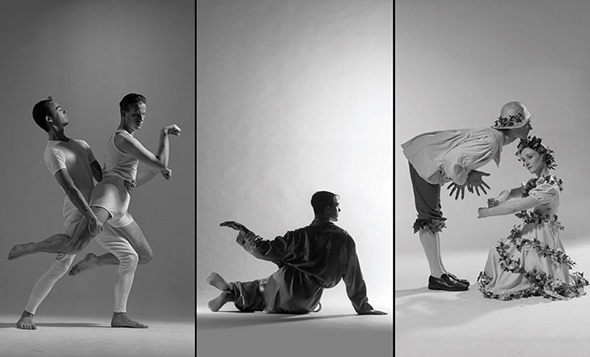
Posted: July 15th, 2012 | Author: Nicholas Minns | Filed under: Performance | Tags: Chris Fogg, Gabi Froden, Gareth Evans, Grigory Tsyganov, Guy Hoare, Helka Kaski, Hold everything dear, ICIA, John Berger, Jules Maxwell, Laïla Diallo, Letty Mitchell, Seke Chimutengwende, Semay Wu, Theo Clinkard | Comments Off on Laïla Diallo: Hold everything dear
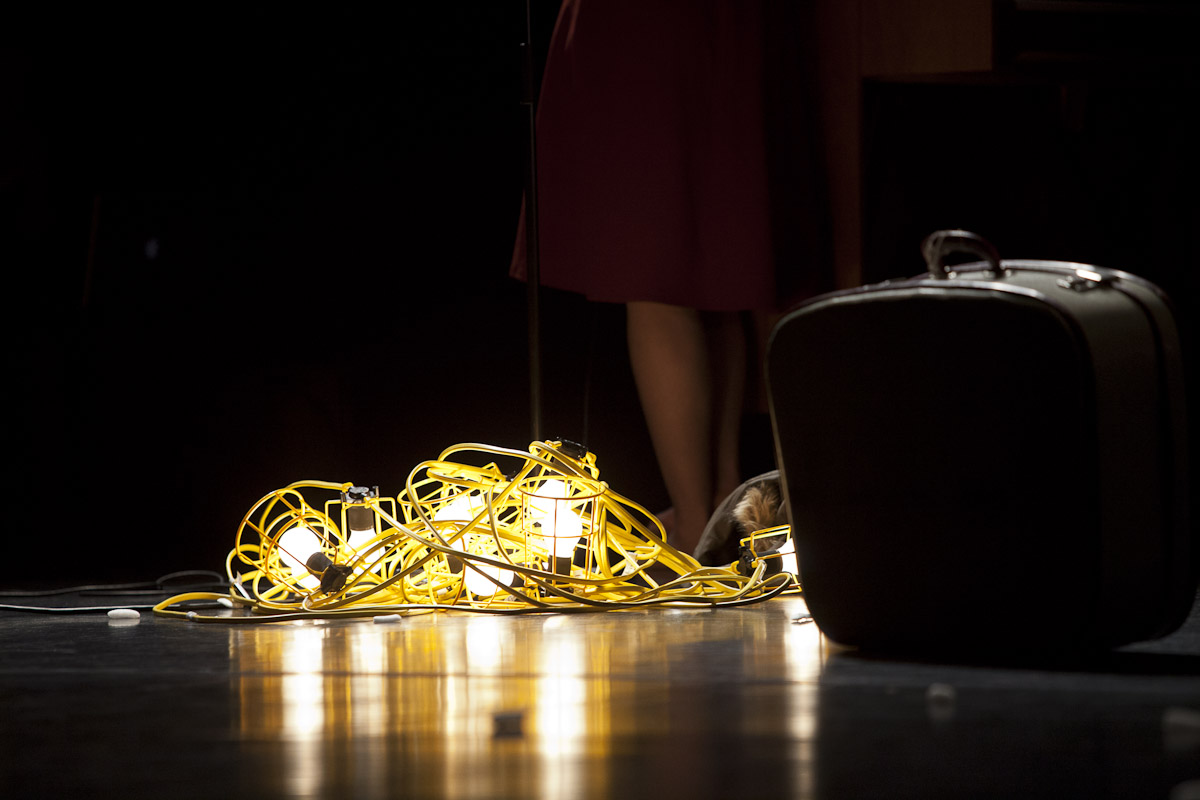
Hold everything dear, Laïla Diallo, ICIA Bath, May 26
The ability of the theatre to transport us somewhere else, the footloose, peripatetic lifestyle of artists, ideas of migration and dislocation, and the state of arts funding are all present in Laïla Diallo’s Hold everything dear, although it is not about any one of them: it is only framed by them, like a play within a play. The richness of the meaning is in the unity of the complete work.
Since March, when the initial work was presented at the Linbury Studio Theatre as a new dance commission, Diallo has been planning to extend the work into a full-length work but she and the dancers have only two weeks together at Bath University’s ICIA to stage those ideas and shape them. Why only two weeks? The tight schedule is partly to do with money – Diallo is stretching the grant money for the project as far as it can go – and partly to do with developments in the creative process that were not conceived at the time the initial grant was submitted. Nevertheless, Guy Hoare has been revising the lighting for the last four days, dramaturge Chris Fogg has been involved on and off for the last two weeks and the musicians arrive just the day before. Time may be condensed but there is clearly an experienced and brilliantly creative team on hand to deliver.
Diallo has said that she only choreographs what is close to her life, and Hold everything dear draws from her experiences of traveling as part of a dance company and in her own right as a dancer/choreographer and her learning about the effects of war zones on refugees and hearing stories of displacement. Given this background, it is no surprise that Diallo cites as a primary inspiration John Berger’s book of dispatches on survival and resistance, Hold Everything Dear – primarily its Ten Dispatches About Place. It gives the work a political undertone that is not evident in the performance, but has clearly influenced Diallo’s conception of the work:
Every day people follow signs pointing to some place that is not their home but a chosen destination. Road signs, airport embarkation signs, terminal signs. Some are making their journeys for pleasure, others for business, many out of loss or despair. On arrival they come to realize they are not in the place indicated by the signs they followed. Where they now find themselves has the correct latitude, longitude, local time, currency, yet it does not have the specific gravity of the destination they chose. [1]
As people come into the theatre, they see the cast on stage in relaxed freeze frame: standing, sitting, or lying down, staring at the floor or into the distance, as if they finished in these positions at the end of the last show and are recharging for the next one. The heartbeat is a single note on an accordion, breathing in and out. The place is indeterminate, many places superimposed on each other:
I imagined, Diallo writes, a stage that could become the end of a pier for a moment, then a station, a void or a home – a stage that might suggest all those places at once maybe, a space where solitudes would find a heightened resonance and where individuals, their stories and emotional worlds might collide expressively.
At a given moment, everyone except for the figure that remains covered with a raincoat on the floor changes into active state to prepare for the performance: Jules Maxwell pushes the piano into place and tunes it, Helka Kaski sweeps up the pile of polystyrene snow from the stage and scoops it into an old-fashioned suitcase; Seke Chimutengwende picks up his cards and puts them back in order. Theo Clinkard unwinds the string of lights from the porter’s trolley and stretches it across the front of the stage. Chimutengwende puts his suitcase on the empty trolley and wheels it away. Gabi Froden (of Foreign Slippers’ fame) is limping towards a chair in one high heel shoe to put on the other one, while Diallo takes the raincoat off the figure on the floor and puts it on herself. Chimutengwende begins a sales pitch about the benefits of a holiday in the sun, standing on his soapbox of a trolley, but his voice is in competition with an increasing volume of recorded music and we only see his mouth and gestures continue as Wu wheels him off. Finally the figure on the floor wakes up to find she is bound up in luggage tape, herself a piece of luggage. Letty Mitchell struggles out of the tape and stands up, but her knees give way and she falls to the floor. She tries to stand again but faints; Kaski is nurse, supporting her, wiping her brow, trying to keep her upright. This disparate group of people, joined by outer circumstance as much as by inner connection, is at once the performer and the performed. Over the course of the evening they reveal their individual selves in their dances and gestures, in their music, and in their relations with each other, but their presence here is dictated by forces beyond their control. As John Berger writes of the former Red Cross shelter for refugees and emigrants at Sangatte near Calais and the Channel Tunnel:
After long and terrible journeys, after they have experienced the baseness of which others are capable, after they have come to trust their own incomparable and dogged courage, emigrants find themselves waiting on some foreign transit station, and then all they have left of their home continent is themselves: their hands, their eyes, their feet, shoulders, bodies, what they wear, and what they pull over their heads at night to sleep under, wanting a roof. [2]
Froden sings the first line of a song in her rich folksy voice, and the dancers begin to cross and re-cross the stage together like a broom, always leaving someone or something behind in their wake, to be swept up in the next time across. Through such images of displacement, temporary residence and the detritus it leaves behind, Diallo portrays her ideas, not to be read as in a book, but to be sensed: frailty, insecurity, a search for home. As she writes, ‘It is an attempt to convey something about leaving, arriving, letting go, holding dear – an attempt to say something about being forever in transit or in a state of waiting.’
Everything moves, in and out of the light, which also moves. People drop in and drop out of the group, form pairs and remain for a time in each other’s arms, then walk away. There are also moments of solitude and calm reflection, as when Diallo walks to the end of a makeshift pier carrying her shoes; you can almost feel the breeze in her face and hear the gulls. She breathes deeply and looks into the distance as Chimutengwende sings a hauntingly beautiful acapella version of I get along without you very well and Clinkard dances an intimate, introspective, inside out solo. Across the stage, four dancers offer their hands in a mutually supportive group; they lean on each other, pull, and counterbalance:
the pledge of offered arms, the single sheet that is our common walking
the map of the palm held
in a knot
but given as a torch [3]
Something disrupts the group; Diallo is the first to walk away. Mitchell and Chimutengwende follow her, leaving Clinkard by himself. Diallo dances a beautiful solo in two opposite directions not knowing which way to go and as she backs up into the piano, Maxwell plays a children’s tune. Everyone is drawn in to the music, accompanying with their own instruments: a band of traveling musicians. Even the piano is traveling. Dancers and musicians pair up, beginning a slow, intimate waltz. Chimutengwende breaks away; he is claiming his travel points and is on his way to Hawaii. Mitchell gives him a pair of sunglasses, places a lei lei around his neck and wheels him around the stage to the piano that doubles as a bar. He is relaxed and downs a cocktail, happy to have escaped his humdrum job and to be close to the beach: the illusion of a holiday when all that we wish to escape is still in our baggage. Mitchell, Diallo and Clinkard carry three muslin clouds suspended from fishing rods over Chimutengwende’s head and follow him around until he exits, we imagine, to the beach. The three forecasters sit down with their back to us, gently wafting their clouds up and down until the storm passes. On the other side of the stage, Kaski is nurse once again, trying to support and encourage a constantly shifting group, but she can’t manage to keep up their spirits or their bodies. She herself succumbs as they fall one by one, leaving only Mitchell standing alone.
Meanwhile (and there is a lot of meanwhile in this environment), Froden begins to haul in the lights along the front of the stage until they are now wound round her arms, making her face radiant. Kaski’s group has recovered, puts on shoes and begins to dance a conversation, huddling together, clasping arms and hands, dispersing and then running into each other’s embrace. They all break off to sing their songs of homeland, and to reminisce. Kaski lays down polystyrene stones on an imaginary path so she can find her way back;
Our poems
like milestones
must line the road. [4]
Chimutengwende takes a plant from his suitcase and places earth around its roots, while Mitchell sits with her battered suitcase, lost in thought. In a beautiful light, Kaski launches into a precariously off-balance dance like a willow in the wind. We see her hands, her face and blonde hair as accents in the dance, as she sinks and rises up, retiring gently into a dimming light to sit on the floor with a bench behind her, staring into the distance. Diallo is the first to step up on the bench and open a suitcase of polystyrene snow on Kaski’s head, a blinding white light falling on her. Mitchell follows with another, then Clinkard with a third, as Kaski lies in the white pile of snow, yearning for the light of home.
They are beside the place they chose to come to. The distance that separates them from it is incalculable. Maybe it’s only the width of a thoroughfare, maybe it’s a world away. The place has lost what made it a destination. It has lost its territory of experience. [5]
The lights dim and a last waltz begins. Everyone dances the same movement sequences but at their own pace. Froden captures in her voice both the transience and the wistfulness of the moment: Hold everything dear till the sky is clear. The song disintegrates and the dancers disperse to the back of the stage. Clinkard walks to the front and passes Diallo circling in the opposite direction. In a flash of recognition they clasp hands and cling to each other, dancing a tango as their comrades approach and clap in accompaniment. The couple breaks apart and comes back together, pushing and shoving as if in the middle of an argument. Chimutengwende and Mitchell begin to dance a slow waltz together but the tensions between Diallo and Clinkard overpower their fragility. Clinkard leaves her on the bench, and immediately falls apart. He turns to Kaski and Mitchell who offer him faltering support. Chimutengwende reads his set of cards, one at a time: “For fear, for hope, for love…” answering the question of why we move around so constantly and what we hope to find. Mitchell is falling again, and as she rolls on the floor she becomes entangled in more tape, watched impassively by all the others. Wrapped up and waiting to be shipped off again…or preparing for the next performance?
the yearning to begin again together
animals keen inside the parliament of the world
the people in the room the people in the street the people
hold everything dear [6]
Diallo spent eight years in Wayne McGregor’s Random Dance, so you might expect her style of movement to have been influenced by his, but this is not immediately evident. What Diallo seems to have picked up from McGregor is more the creative approach to which she contributes her own issues and sense of movement. One might also expect each person in Hold everything dear to be quite distinctly delineated in such a diverse assembly, but there is a homogeneity in the choreographic language that suggests the hand of one person, Diallo herself, although the unity of the group is also a factor. The way Clinkard moves and Kaski moves is not dissimilar to the way Diallo moves, so their body language naturally forms a cohesive whole. I could imagine Mitchell having a different voice if left to her own devices, but her nature fits easily into this group, forming a unity in diversity. Chimutengwende is the extrovert declaimer of the crowd, a versatile performer and striking presence who can sing acapella sublimely with a minimum of vocal chords, and Froden’s rich voice provides in the songs much of the poignancy of the music, though she is backed up by a trio of expressive players: Grigory Tsyganov (violin), Semay Wu (cello) and Jules Maxwell (piano), who made all the musical arrangements. Clinkard contributed the subtle earthen colours of the set and costumes, which form another unifying element. The lighting of Guy Hoare is superb, telling the story as evocatively as the music and the choreographic images and Chris Fogg has had a decisive if unseen hand in shaping the finished work.
I like to think of dance,Diallo has said, as a way of communicating something of what it is to be human (Berger might well say the same about his writing)…The pleasure of being a choreographer is meeting people and discovering the route with them. What we see in Diallo’s Hold everything dear is the particular route she has taken with her fellow artists, and what emerges is a poetic celebration of the human spirit.
[1] John Berger, Hold Everything Dear, Verso, 2007 p 113
[2] John Berger, op.cit., p 114
[3] Gareth Evans, Hold Everything Dear, for John Berger, op. cit.
[4] Poem by Nazim Hikmet, quoted in John Berger op. cit., p 25
[5] John Berger, op. cit., p 114
[6] Gareth Evans, Hold Everything Dear, for John Berger, op. cit.
Posted: July 5th, 2012 | Author: Nicholas Minns | Filed under: Performance | Tags: Christopher Evans, Hofesh Schechter, In Good Company, James Finnemore, Philip Hulford, Sam Coren, Sita Ostheimer, Yeji Kim | Comments Off on Hofesh Schechter dancers: In Good Company
In Good Company: New works by the dancers of Hofesh Schechter Company. The Place, June 23 at 8pm.
Last of his Act: Yeji Kim
In the dim opening light we see just Yeji Kim’s back, at the same level as the lamp, higher than we expect. As the light enlarges, we notice she is clutched to Sita Ostheimer’s torso, her arms tight around Ostheimer’s neck. We hear an electronically manipulated voice emitting globs of sound so guttural as to be close to choking or vomiting. It is the first of many disturbing juxtapositions in Kim’s Last of His Act that seem to derive from a divorce of experience and wisdom as articulated in her program notes: ‘We, women, can express our mind differently from what we really have in mind.’ This separation is expressed in a series of contrasted episodes. After a brief blackout we see the two women lying centre stage, the strong sensuous curve of Ostheimer’s hip highlighted in front of Kim’s concealed form. They embrace and mould themselves to each other along the musical line of a distorted cello migrating to synthesizer: Apocalyptica to early Pink Floyd. Joel Harries’ sound comes in thick layers, wrapping the movement in an almost suffocating embrace from which Kim and Ostheimer emerge as light to the sound’s shade or as waves to the sound’s depths; it is the sound that seems to release them or hold them in place. A powerful bass pulse shakes them free of each other and we see a dance of two frenetic, isolated individuals, their hands wide open like a Rodin sculpture. The guttural globs resume as the two women return to the front of the stage, breathless from exertion. Lit from the floor, they look out at us in the silence, prompting applause, but the women stand their ground until an ominous knock at a massive door focuses our attention once again. We hear the door creaking open on to a section of more antagonistic images and sounds: Kim gently raises the hem of her dress, peering at her sex, to applause or perhaps it is heavy rain, then portentous booted steps. Ostheimer performs the same ritual examination, placing her hands over her womb to the sound of a dog barking and snarling: fragility over violence, courage over intimidation, life over death. We hear fragments of a song in which the words ‘pain’ and ‘strain’ are distinct in the increasing cacophony that drives Kim and Ostheimer to a frenzied state. Never quite out of control – they are both consummate dancers – they manage to draw their movements closer to the body, held in tight like a seething anger. Exhausted, Ostheimer lies down in submission; Kim remains standing close to her in the dying light, but gravity and the dwindling sound undermine her will and release her finally to the floor. ‘Sometimes’, writes Kim, ‘the free will of women can give us distance through cynicism. Conversely, this will can make us feel empathy for others’ lives, mistakenly. We question ourselves if we know them or not’.
Lukewarm and loving it: Philip Hulford
A lampstand upstage left glows faintly, barely revealing Hannah Shepherd standing next to it. A translation from Matthew 6.22-23 is projected on the backdrop: Your eyes are windows into your body. If you open your eyes wide in wonder, your body will fill up with light. If you live squinty-eyed in greed and dishonesty your body is a dank cellar. There is for me an uncomfortable distinction here between advertising an idea for a performance and evangelising. The title of the work is the subject of a sermon by Francis Chan, an American Christian pastor, equating lukewarm with lack of faith, and in his program acknowledgements, Hulford cites the example and teaching of Jesus. Because there is so much ‘message’ before the dance begins, one wonders what role the dance has. Perhaps Hulford should have considered the first verse of Matthew 6, in the same translation, that contains the admonition: Be especially careful when you are trying to be good so that you don’t make a performance out of it. It might be good theater, but the God who made you won’t be applauding.
This is a rather long digression on a personal issue, but as Hulford has made it a primary element in his work, it asks to be addressed. The choreography juxtaposes the appropriately named and dreamy Shepherd, dressed blandly in jeans, a jacket and sneekers, against the dynamic duo of Frederic Despierre and Karima El Amrani, who quickly launch into a disco number fragmented by a strobe light, pushing their limits and swaying violently from side to side to a throbbing, high-decibel beat. Are they the squinty-eyed ones against Shepherd’s wide eyes, or are they the heat to Shepherd’s lukewarm? I tend towards the former interpretation, as Shepherd seems to develop confidence and conviction in the course of the work, culminating in a dynamic and assured solo to lyrics by Jars of Clay: The smile on the outside that never comes in…You break me open, turn on the light…Let the show begin. But if Shepherd develops, there is no corresponding growth for Despierre and El Amrani, which leaves the work rather one-sided and incomplete. Hence the ambiguity.
Like Hofesh Schechter, Hulford is a musician and has composed the score in collaboration with Joe Ashwin of the progressive death metal band, Stone Circle (Ashwin also plays guitar in the Hofesh Schechter band). What sounds like the electronically manipulated buzzing of a bee breaks the opening silence followed incongruously by a stubborn starter motor. A pounding, reverberating pulse underlies the first duet with Despierre and El Amrani, and Shepherd is given a quieter, more pensive treatment, though the general tone of this layered sound leaves little room for subtle expression.
No way but down: Sam Coren
A thunderous rumbling introduces the soundscape by Alberto Ruiz. We see a painting hanging in an artist’s studio, a view of sky and clouds. Perhaps it is the one source of light on this rather seedy, unhealthy interior, designed with particular attention by Kasper Hansen. We see a bicycle on a stand and then the figure of Igor Urzelai get up from bed still covered in bed clothes. He offloads them in a heap. By the look of his costume (Sophie Bellin Hansen must have had fun putting this together – and got it just right) we are not expecting a virtuoso dance. In fact there is no dance at all, unless the furious pedaling can be considered a pure form. No matter. Urzelai pedals to generate electricity to light the room, an introduction to the refreshing but dark sense of humour that pervades No way but down. Urzelai is part pirate, part vagabond. He sorts his collection of cassettes and selects rather prophetically The Handsome Family’s The Lost Soul. What an awful day, when the judgement comes. And sinners hear their eternal doom but the volume is too high for such a crappy machine (perhaps the only instance in the work where production values are divorced from the ‘reality’ of the stage). He sings along, using a bicycle pump as microphone, then breaks off to lay his makeshift table with a plastic sheet, and a large spoon. He selects a can of beans from the collection stacked against the back wall and on his way back to the table changes the ambience by putting on a recorded sound of a restaurant buzzing with activity: clinking plates, teaspoons and conversation. Tucking a newspaper under his chin as a bib, he opens the can and savours the contents. One might be forgiven for thinking of the last supper without the disciples. The spoon then takes on a life of its own: food sprays up, Urzelai’s anger erupts and he throws the can’s contents in his face. To calm down he searches for another recording: a reading (by Ben Coren, read by Jason Jacobs). Chapter two. Companionship. When you are feeling frustrated or irritable with your partner, just remember you are lucky to have each other…Inspired, he puts a waste bin inside the hood of a jacket to shape a partner and performs a grim thé dansant. More music maestro, please; but he has to pedal first to generate more electricity. He plays Graham Lindsey’s Deathtrip Blues. And soon I will be dead…another self-fulfilling choice. Urzelai shines a torch at his partner’s face, then places the light on the table and sits down for a tête à tête. Smoke suddenly appears from under the door on stage left. Urzelai lies his partner on the floor and rushes over to fan the smoke away, peeling off his outer garments (there are many) to stuff under the door. He returns to his act of creation by stuffing another waste bin in another hooded jacket (there’s a pile at the back) and introduces this second figure to the first, laying them side by side on the floor. He pauses, then thoughtfully places the sleeve of one over the torso of the other. Pleased with his work, he removes the clothing from under the door and sits inhaling the bellowing smoke: hope and the light are snuffed out together, leaving that patch of painted sky and clouds above his make-believe lovers.
I don’t know if Sam Coren has direct experience of this condition, but he has created a portrait of despair with a masterly dose of sympathy and understanding unadorned by morality. It is a movingly nuanced portrait by Urzelai, too, who is utterly convincing.
The Age: James Finnemore
A couple stands on stage in the dark. We hear a repeated phrase of three words, like dark age heart, on a score by Joel Harries, followed by a deep pulsing bass track – a common musical feature in the scores this evening. The couple is still, their faces indistinct, with their legs illuminated by a bank of lights on the floor behind them, until the overheads come up and we see their intent look. Victoria Hoyland steps back and Philip Hulford reverentially takes her hand, kneels, lets her sit on his knee, then gently takes her weight as he stands. They dance a ballroom waltz, in very small and faltering steps before disengaging, taking hands and looking out again into the audience as if posing for a photograph. Hoyland takes another position on all fours, and Hulford sits on her back. They repeat their movement sequences but more rapidly. She is now like a wind-up doll in waltz position, with arms in place for an absent partner, turning half turns continuously while Hulford walks to the centre and looks out intently once again. While Hoyland turns, Hulford dances powerfully and mysteriously in the blue light, quick and dynamic, almost manic – one of the most searing images of the evening. The music develops into a heartbeat and finishes. Hulford regains his breath and tries to express something, but he cannot speak. He is on the point of walking away from us but turns to face us in silence. Hoyland and Hulford seem unsure they should be here, as does the audience, who applauds, but it is not the end. Hulford is evidently in discomfort as he begins a dance of shell-shocked fatigue. A blackout and a new pulsing bass line plumb the depths of his being and he begins to jump in place, passing through another blackout to appear standing next to Hoyland with his hands behind his back, she with hands in front. They both walk over to the bank of floor lights that has started up again and to an upbeat, rhythmic march they dance the same elastic, powerful movements, descending deeply to the floor and rising up, accelerating and morphing into an energetic bunny hop from which Hulford disengages and walks one last time towards us with his intense gaze. The Age is a rather bleak work, but full of almost dream-like images, both still and moving, that Hoyland and Hulford so effectively portray.
Accompany: Sita Ostheimer and Christopher Evans
After visiting some of the more profound life states for much of the evening, it is a relief to bubble to the surface with Sita Ostheimer and Christopher Evans in their Accompany. The program note says simply that Sita and Chris are a couple. Onstage, they definitely are, in which case the description is redundant; so presumably it refers to their offstage status. Certainly there is a naturalness in their antics and banter, most of which is recorded. So here is a couple playing themselves with their recorded voices, performing the process of creating the work you are now seeing that finishes with its starting point like Escher’s famous hand drawing itself. It is refreshingly relaxed but its craft is not to be underestimated. We have already seen Ostheimer dance in the first piece, so it is good to see and hear her sense of fun. We see tantalizingly little dancing from Evans but what do you expect in a performance of unrealized expectations? There is no music either, as Ostheimer explains; just background sound, for which the program credits Charlie, Lawry and Ed. They have dressed the silence with layers of recorded voice, distorted voice, snatches of song and conversational snippets between Ostheimer and Evans that unify the conceptual nature of the work. There are songs listed in the credits – Damien Rice, Stephan Micus and Meret Becker – but they seem to have shared the fate of the African idea, the highway idea, the pulling-people-out-of-the-front-row idea and the speaker idea. The best idea is the idea of the work itself.
I recently attended a choreographic evening by Rambert Dance Company and it is interesting to compare the two. Both companies are giving opportunities for aspiring choreographers to hone their choreographic skills and gain experience in a performance setting with full production values. The differences arise from the nature of the two companies: Rambert has a varied repertoire by different choreographers, whereas Schechter is the sole creator, both of music and dance. Rambert has a policy for their choreographers of working with commissioned scores played live – for the most part – by an orchestra. Schechter’s dancers used three scores from two of the company’s own musicians, Joel Harries and Joe Ashwin, and there is a clear influence of the engulfing Schechtian sound on all five works. The works at Rambert were varied between narrative, abstract and psychological, whereas Schechter’s group was surprisingly narrowly focused on expressing (however well) the somber-bordering-on-depressing psychological states, notwithstanding the lighthearted bounce at the end. It would be interesting to see what the Schechter choreographers would do with an orchestral score, and what the Rambert dancers would do with a Joel Harries soundscape. Perhaps it is simply the natural process of young choreographers expressing the dominant influence of their respective companies, but I had the feeling that the young Rambert choreographers were creating in a more open environment than those in Schechter’s. What is important, however, is that these choreographic evenings continue to be supported, and that the choreographers who choose to develop their ideas will find their own voices.
Posted: June 29th, 2012 | Author: Nicholas Minns | Filed under: Performance | Tags: D'un pays plus lointain, Fidelity Project, Frauke Requardt, Freddie Opoku-Addaie, Le Royaume des Ombres, Noé Soulier | Comments Off on Noé Soulier, Frauke Requardt, Freddie Opoku-Addaie: Existential ballet and popcorn
Noé Soulier, Freddie Opoku-Addaie and Frauke Requardt: Mixed Bill, Lilian Baylis Studio, May 29
What else to expect from a dancer trained at the Paris Conservatoire, a graduate of PARTS (Performing Arts Research and Training Studios) in Brussels, with a master’s in Philosophy from the Sorbonne but an existential guide to ballet?
Noé Soulier wanders on stage in practice clothes and explains what he is about to do. The piece is called Le Royaume des Ombres (The Kingdom of the Shades), commonly associated with the most famous scene in the ballet La Bayadère, but Soulier plays on the meaning for his proposal: what is generally unseen in the ballet lexicon, divided into five experiments. “In the first, I took all the ballet steps I could find and I put them in alphabetical order, from arabesque to waltz. The second sequence is based on a distinction you can make in ballet between preparation steps and the steps these preparations allow you to do, like jumps or pirouettes. The next sequence is based on the same principle, but I applied it to an existing variation, Solor’s from La Bayadère. And then I took the same variation and changed the order of the steps. For the last sequence, I took excerpts from all the ballets of the 19th century that I could find and put them in chronological order, men’s roles and women’s roles mixed with some fabulous creatures.”
His technique is clean and precise; it has to be to carry this off. It may be conceptual work, but his body is working hard. There is no musical accompaniment that corresponds to Soulier’s balletic lexicon, so we feel as much in the lecture hall as in the theatre, and the silence heightens our attention. In between sequences he allows his ideas to sink into our consciousness, saying nothing but wandering to the side to take a drink of water. He evidently enjoys being provocative, combining a haughty intellectual rigour with a mischievous sense of humour. He goes through the sequence of preparation steps like a dancer meticulously preparing a variation, stopping at just the place where the step is about to happen. One preparation then morphs incongruously into another. He adjusts his shoe elastics: every detail is intensified in this calm dissection of the classical vocabulary. For the Solor variation, and the concise synopsis of both male and female roles in all the 19th century ballets, Soulier nonchalantly sings the tunes under his breath, dancing with such panache that we believe in the absurdity of what he is doing.
His second piece, D’un pays lointain (From another land) involves a similarly subversive approach, but his focus is the language of 19th century ballet mime. Soulier uses four dancers from the Ballet de l’Opéra du Rhin: Vera Kvarcakova, Sandra Ehrensperger, Alexandre Van Hoorde and Stéphanie Madec. If they are listed in order of appearance, the first is Kvarcakova, who demonstrates close to a hundred phrases of mime in alphabetical order from angry, afraid, baby, beautiful, to why, wicked, woman, you, without explanation or context, then again with recorded explanations. The purpose of ballet mime is of course to avoid speech, but Soulier is interested in this interaction.
Hearing this vocabulary one is inescapably drawn into the nature of the stories and fairy tales from which they derive their meaning, as if from another land. While the individual words are known today, the worldview and social context are of another era and mindset. Death by bow and arrow is a case in point. Soulier now goes a step further: Alexandre Van Hoorde joins Kvarcakova and a male voice is added to the recorded explanations, Van Hoorde following the male voice, Kvarcakova continuing to follow the female voice. Soulier also changes the order of the phrases for each voice, so there are two ‘conversations’ that sometimes overlap or comically contradict each other: ‘come, go away’. After a brief pause, the process starts again with increasing complexity: a trio, (Ehrensperger), then a quartet (Madec), with the addition of respective recorded voices. Soulier thus constructs consecutive words and phrases along the animated line of dancers, like a sentence on a page: ‘welcome, baby, I beg you, to love’ with the delicious irony between the mimed ‘baby’ and the contemporary meaning of the spoken word. Soulier now filters this vocabulary of conversation into snippets of recognizable, historical mime from Sleeping Beauty, though still with the recorded explanation: ‘Why did you forget me?.. She will grow up to be beautiful and graceful, but she will prick her finger and die… The princess will indeed prick her finger with a spindle but instead of dying she will fall into a deep slumber that will last a hundred years at the end of which a prince will come to awaken her.’ In the context of Soulier’s cerebral treatment so far, seeing and hearing this suggests the delightful absurdity of classical mime itself.
In the next sequence, Soulier removes any trace of context, and focuses on abstraction by giving his quartet a series of random phrases, which creates a line of semaphoric choreography, on top of which we hear the odd explanatory term: mother, to die, to kiss, to speak, afraid, to listen, there, to imprison, to die, to give, why? The quartet is reduced to a duet, in which the two speak the mime themselves, then Van Hoorde is left alone: ‘Protect me, come! Thank you, go away! To kill, two, go away, to protect.’ He continues in silence to the end, performing two gestures at the same time with increasing intensity, the movements taking on an individuated life of their own, beyond any recognizable meaning: an existential fate.
For those who enjoy Soulier’s subversive and thought-provoking treatment of dance, he will be back in London with his Idéographie, a discourse about the relation between thought and movement, at Dance Umbrella later this year.
While the house lights are still up after the intermission, Freddie Opoku-Addaie enters with a microphone as if he is a stagehand with a last-minute task before the show; except that Opoku-Addaie is too recognizable and too brightly clad in his red shoes and suspenders (thanks to designs by Justin Arienti) to be mistaken for a stagehand. His hair rises in front into a permanent exclamation mark, so even with his deadpan expression, you know that something unexpected is about to happen. Then Frauke Requardt enters pushing a popcorn stand, placing it downstage right. Opoku-Addaie opens the perspex hood and inserts the microphone. Then the fun begins.
Peter Hall has written that children at play have a concentration – and thus a belief – which is absolute. The only sin is to break the concentration by not believing – by not playing. Fidelity Project, commissioned for last year’s Place prize, has the air of an inspired improvisation, and neither Opoku-Addaie nor Requardt can be accused of lacking concentration and belief in what they are doing from the moment they arrive on stage; that is what is so attractive about their performance. Much of Opoku-Addaie’s work consists of game-playing and risk-taking with a large dose of cunning. Out of the blue, Requardt delivers a backhander to him, but he parries in lightning speed. She turns to hit him again, but he ducks. A tentative embrace leads quickly into a sequence where Requardt pushes Opoku-Addaie’s head down, spins him around and lifts him out of the way, placing him on the floor where he remains in shape while she wanders off to turn on the popcorn machine. There is no story to speak of in Fidelity Project, but fidelity is about trust and the work is all about the trust between these two quite dissimilar artists that is incredibly strong and precise. They perform a dance equivalent of the game of rock-paper-scissors, involving a similar skill in one partner being able to predict the moves of the other in order to gain the advantage. It is difficult to know if the sequences are choreographed or not but there is such split-second timing in some of their antics that the point is moot. It is the kind of precision that gives a thrill and hilarity to the performance. They take movement where you least expect it to go, as when Requardt grabs on to Opoku-Addaie’s wide open mouth to counterbalance his backbend to the floor. Their interaction never develops into a closeness of emotion, but remains a constant testing of these two characters who reveal the freedom with each other to perform intimately, yet with a constant deadpan distance, demonstrating the sheer pleasure of being together. And they are equally matched; she doesn’t pull punches, and he is respectful of her force. At one point she throws him, and he rolls in pain, screeching like a wounded animal, while she goes to serve the popcorn. A moment later they get back together again, and she throws him a second time, with identical results. She turns to the back wall, and when he reaches her he pins her against it above his head. She seems to be trying to strangle him from up there. He lets her down, they kiss, and she blows out her stored popcorn, rubbing his nose: the gestures of two lovers who have developed their own language and intolerance. She points to something; he looks, then she serves him a left hook. Opoku-Addaie is out for the count, as is the popcorn machine, and then the lights. Like two contestants in a tournament, Opoku-Addaie and Requardt take their bows, though there are no winners. Nevertheless, Requardt raises a triumphant arm.
Posted: June 15th, 2012 | Author: Nicholas Minns | Filed under: Performance | Tags: CoisCéim Dance Theatre, David Bolger, Madge Bolger, Swimming with my Mother | Comments Off on CoisCéim Dance Theatre: Swimming with my Mother
Choreographed by David Bolger, artistic director of CoisCéim Dance Theatre, with his mother Madge. Lighting Design: Eamon Fox, Sound Design: Ivan Birthistle & Vincent Doherty, Video Artist: Jym Daly.
Pavilion Theatre, Brighton Festival, May 18
A green wooden bench stands centre stage with a red towel rolled up like a pillow at one end, the kind of wooden bench you might find at any municipal swimming pool, but the story begins at the seaside. White gulls are flying on a black screen and the moon rises slowly up the screen from the rolling surf of the stage while Madge and David, mother and son, arrive in the dark, he dancing at the end of her hand as if he will never stop. As they swim together on the bench, Madge’s recorded voice, as sonorous and rolling as the waves, begins her story: I helped him to swim in the sea. I was always in the water. Naturally when I had children I wanted them to swim too. They swim the crawl. David went to the pool when he was two. They thought he looked like a fish. When you’re in the water you can clear your mind of any worries you may have.
David improvises a dance on a swimming theme, watched by his mother as if she is making sure he is safe in the water, then they both lie on the bench, agelessly kicking their legs while behind them on the screen the water is splashing. A whistle blows and the indefatigable boy finally takes a break. Madge gives him a banana and wipes his hair and face, not forgetting his ears. He is in playful mood and partners his mother, wrapping her in the red towel. Madge continues: I went to dance school so I learnt a few little steps. I got the part of a little bunny rabbit but I got stage fright and couldn’t go on.
We hear a big splash, then the sound of bubbles under water. Mother and son appear like fish in slow motion dancing to the Aquarium section of Saint-Saens’ Carnival of the Animals. He partners her gently by the arm, keeping a filial distance. I think of partnering my mother and it would be just like that. They come up for air and dry off, looking in the mirror to make sure the hair is just right. I continued dancing until I had babies, then my dancing days came to a little halt. David and Madge are now on the ballroom floor. They look together at something off stage, then he dances for her with an imaginary partner, abandons himself to a little tap routine in his bare feet, then offers her his hand. They dance together as he mimes the Nat King Cole song, It’s Only A Paper Moon: “It’s only a paper moon, stretched over a canvas sea, but it wouldn’t be make-believe if you believed in me.” Perhaps this is what she and her husband had danced to before David’s birth. He lets her rest, does another little routine by himself and sits on the bench looking at the moon. Mother and son take hands, then move to opposite ends of the bench, facing out into the night. Some kind of rupture is in the air. He repeats a movement he did earlier, fishtailing along the bench closer to his mother. He puts his head on her shoulder and ends up lying lifeless in her arms. She stretches him out on the bench and gives him artificial respiration. Caught in the undertow for too long, perhaps, but now they are swimming again, now treading water. David’s voice: Madge took me swimming in the night, looking at all the lights in the distance. We were out quite a while, but you always felt safe with Mum. “I think I still do,” he adds with a smile. Madge has set the bench in the other direction, like a diving board, ready for his lesson. He steps up and she pushes him in. The sea scares me, he says. I get panicked about fish. I feel I’m in their world and the water freaks me out. He looks wet now with perspiration; she wipes him down. I was determined they were going to swim properly, she recollects. The wave took me way out. My husband swam but he wasn’t a great swimmer. David’s in the undertow. My husband had a problem with his lungs. He’s been dead 16 years and had emphysema at the end of his life, so maybe he didn’t enjoy swimming as much as we did. She gives David the rolled-up red towel in which she has hidden a gold medal. He finds it; one of his perhaps, but he puts it around his mother’s neck. Nat King Cole sings Unforgettable and he dances with her. It is her music but their dance: time is stretched over two lives, wrapping them up together. “Never before has someone been more unforgettable in every way.” He dances all around her; she moves in swimming gestures that he copies, keeping close to her. He lays out the red towel on the bench. She sits and takes off her shoes: It was my father who taught me to dance. Now they are both in their bare feet, just sitting together, watching the sea and listening to the sound of the gulls.
After the warm applause David talks about a commission he received to make a solo and he thought of the story of how his mother got him to swim. His teachers had demonstrated how to swim on dry ground, so he decided to make a film of dancing in the water. Madge speaks: “Thank you for the applause and all that.” She talks about the film, Deep End Dance, directed by Conor Horgan with original music by Michael Fleming and filmed by Richard Kendrick in the pool where she taught David to swim. We see the film. David appears at the poolside in a suit; he is given a nose plug and goggles and Madge pushes him into the pool fully dressed. The rest is shot underwater. He dances like a fish, somersaults, does handstands, pirouettes, pushes himself up from the floor to the surface, sinks back down and lies on his side as if on an underwater couch. He is in his natural element. Madge plunges in to join him in a beautiful, watery duet after which he sinks to the bottom again, as if to rest, and she returns to the surface. Not for long. She dives down again, grabs him by the hair and heaves him up to the surface. The mother will not allow the element that has united her with her son for so long to separate them now.
Posted: June 14th, 2012 | Author: Nicholas Minns | Filed under: Performance | Tags: Alastair Macaulay, Early Adventures, Matthew Bourne, Spitfire, The Infernal Gallop, Town & Country | Comments Off on Matthew Bourne: Early Adventures
Celebrating 25 Years: Matthew Bourne’s Early Adventures at Sadler’s Wells, May 21

Matthew Bourne’s Early Adventures (photo: Chris Nash)
Having seen Dorian Gray a couple of years ago, I was not, I admit, much inclined to see another work by Matthew Bourne. I am not that drawn to Oscar Wilde’s rather dark and overwrought gothic tale either, but there is in it a psychology that I felt Bourne had treated superficially for his own production purposes – Edinburgh Festival hype notwithstanding. The message I got soon afterwards from the director of Adventures in Motion Pictures, Robert Noble, was that critics who didn’t like Dorian Grey clearly didn’t get it. I was obviously in that bracket (though I didn’t admit it at the time) but I was nevertheless intrigued by the idea of Early Adventures at Sadler’s Wells to mark the 25th anniversary of Bourne’s company.
Was Bourne’s a precocious talent at the outset that Dorian Gray had not lived up to? Would these early works, like the draughtsmanship in early Picasso, show a side of his work that is difficult to discern later on? Sometimes early work, like a band’s first album, is so good its success is difficult to repeat.
It was Chris Nash’s images on the poster that overcame my initial resistance. They are lovely black and white studio shots that give a sense these are old but classic works. I also found a copy of Alastair Macaulay’s extended interview with Bourne in Faber and Faber’s 1999 publication. It’s a great introduction to the choreographer and it was reassuring for me to hear his essentially shy but self-aware voice talking about his work: ‘There were certainly some promoters who thought we were very lightweight – and possibly juvenile. Ours wasn’t considered to be serious work. We certainly wouldn’t have gone down very well at the Bagnolet New Choreography Festival – where all the other new British choreographers of that time were presenting work – or anything like that.” He discusses his training, his way of working, his dancers and talks of such influences as Sir Frederick Ashton, George Balanchine, Fred Astaire and Ginger Rogers as well as contemporary choreographer Lea Anderson and filmmaker Alfred Hitchcock.
Once at Sadler’s Wells, a glance at the printed program gave me my first cause for concern. There are the same classic photographs, but accompanied by a bewildering and artless array of mismatched typography, hyperbolic text and performance images (thanks, but I’ve already bought my ticket) highlighting the 25th anniversary celebrations of the company.
Macaulay had taught Bourne the history of dance at Laban, so there are historical references throughout his works. Spitfire, the first work on the program, is drenched in them. “It was based on the idea of men posing. Partly it was about the poses men do in underwear adverts…And it was also about the way dancers, especially male dancers strike poses in ballet: sometimes they’re poses at the end of a solo, but sometimes they’re poses right in the middle of a dance. And they’re audience-oriented in the way that the underwear ads are camera-oriented. Then, because I had had the idea of making a dance like this for four men posing in underwear, I thought of the most famous dance for four women in nineteenth century ballet, the 1845 Pas de Quatre. So the four men do groupings from the famous lithographs.” Such juxtapositions are designed for comic effect; one of Dudley Moore’s compositions for Beyond The Fringe, was a brilliant variation of the opening bars of Beethoven’s Fifth symphony on a theme of Colonel Bogey. Bourne’s Spitfire is more complex: he has transposed men for women, male underwear models for romantic ballerinas in tutus, and Leon Minkus’ music – know particularly for the virtuoso ballet variations in Don Quixote – for Cesare Pugni’s romantic score. The original Pas de Quatre was choreographed for the four leading ballerinas of the age, so there would no doubt have been an element of technical and artistic competition at the heart of it, a feature that Bourne reduces to parody without the artistry. What saves Spitfire is the clever contrasting of ideas and the irreverent confounding of our expectations, but only just; it finishes as the novelty begins to fade.
Macaulay comments to Bourne in 1999: “I think now that some people felt uneasy and unsure how to take your early work because, while the dancers were often showing innocence, youthfulness, lightness they were also looking out front at the same time. The mixture of calculation, or knowingness, in address with the innocent lightness of what was going on on stage left some people in the audience thinking, ‘Is this serious? Is this light? What is it?” Bourne answers, “Good point. My view now, with humorous things, is that, if you look as though you think you’re funny, it’s not funny. If you look to the audience as though you’re asking for a response, it doesn’t work. My lesson to performers is: Show what it is that you’re trying to show, but don’t be too obvious about it, and don’t ask for laughs.”
But what if the choreographer himself is too obviously asking for laughs? This seems to be the trajectory of the last two works, Town & Country and The Infernal Gallop. The program note for Town & Country says it is remembered as ‘the piece that most crystallised the Bourne style: gloriously witty and ironic, but also strangely moving and heartfelt.’ It was nominated for outstanding achievement in dance in 1992 and has never been performed since.
Town & Country is set to English light music of the 30s and 40s (Percy Grainger, Eric Coates, Jack Strachey and Noel Coward). Two pieces are well known to English radio audiences as the theme tunes to Desert Island Discs and Housewives’ Choice (we hear the Desert Island Discs theme on a radio in the set’s hotel lobby), so there is a definite aural heritage which may be why Town & Country is billed as ‘a look at notions of national character and identity from a bygone era.’ The Infernal Gallop is set to French light music of the 30s and 40s (the most iconic of which are Edith Piaf’s Hymne à l’Amour and Charles Trenet’s La Mer) and is described as a ‘characteristically witty and astute satire of English perceptions of the French,’ though the subtle difference between a satire of English perceptions of the French and a satire of the French by an English choreographer is lost in Bourne’s gallop for laughs. I think he was wise not to take this to Bagnolet.
Macaulay suggests that perhaps Bourne is embarrassed by the prospect of handling serious emotion: that he’d rather get through emotion by giving it an entirely comic emphasis. Bourne’s answer is illustrative of these early works. “I always go into a piece with serious intent…But I get very pulled in the direction of humour, either by ideas of my own that make me laugh or by hilarious suggestions made by people within the company.” The effect of his hilarious distractions in Town & Country and The Infernal Gallop is to distance himself (and us) from the very characteristics he sets out to portray (if we can take him seriously) and the result is these two works appear as insulated from their national environment as Damien Hirst’s shark from the ocean. The only vestige of national identity is in the music itself which operates, as it were, on an emotional track of its own: close your eyes and you can sense the national characteristics in the music; open them and there is an emotional double take, as with Sir Edward Elgar’s Pomp and Circumstance march played on a ukulele by a butler in a chintzy hotel lobby at the beginning of Town & Country, or with Trenet’s La Mer interpreted by ‘an effetely dressing-gowned merman, serenaded by a trio of sailors (exclamation mark)’ in The Infernal Gallop. It is significant that for Swan Lake, in which Bourne is widely thought to have reached creative maturity, he tells Macaulay he resisted the humorous distractions, from whatever the source: “Whenever that came up with Swan Lake, I pulled back and said, ‘No, this isn’t the place to do that. We’re not going to do that here.’ Often I would get quite a lot of opposition. People would say, ‘Look, this is going to be really funny. This is really going to work.’ Obviously Swan Lake does have its funny moments; but I was far more rigorous than before in deciding where humour could and couldn’t occur.”
There are nevertheless two vignettes in Town & Country in which Bourne gets close to emotional expression: his duet to Noel Coward’s song, Dearest Love, and his setting of the song by Percy Grainger, Shallow Brown, at the end of which there is an uncomfortable realization in the audience that a moment of seriousness has just passed; there is neither laughter nor applause. But perhaps the most emotional moment, one in which the audience fully engages, is the accidental death of the hedgehog by an errant clog. The tragic last moments of the little puppet figure and the actions of the mourning rabbit come across with surprising pathos. Is there a clue here to Bourne’s work? Is it possible that his choreographic form is inadequate to express emotion or is form in these early works constantly sabotaged by a preference for overplayed style and comedy? I can’t help feeling it’s a mixture of the two. Although there may well be something in Bourne’s imagination and sense of theatre that is temperamentally suited to the expressive world of the marionette, the problem is more basic. In Peter Hall’s exploration of form and language in drama, compiled in ‘Exposed by the Mask’, he comes to the conclusion that ‘performance always has to have the equivalent of a mask in order to transmit an emotion. It must have a mask, even if it is not a literal mask. It needs the equivalent if it is to deal with primal passions. It demands form – either in its text, or its physical life, or its music. All these can act like a Greek mask. Only then can strong feeling be dealt with.’
In Apart from a lovely flowing episode of entrances and exits for the dancers on scooters – Ashton’s Les Patineurs on wheels – one of the most effective scenes in Town & Country is a choreographed version of the station meeting between Celia Johnson and Trevor Howard in David Lean’s film, Brief Encounter. Instead of one couple, there are two, which gives Bourne the opportunity to play them in unison to great effect until the very end, when one woman finds herself unexpectedly alone. It also explains why the slow movement of Sergei Rachmaninov’s 2nd piano concerto finds itself on the list of English music: it accompanies the original film soundtrack.
When a choreographer is already over the top, what happens in a finale? Over the top on speed. But at the very end of The Infernal Gallop as we are about to relish the energy of Offenbach’s Gaité Parisienne, Bourne catches us unawares and beautifully understates the cancan: a masterful stroke that ironically brings the house down.
Posted: June 12th, 2012 | Author: Nicholas Minns | Filed under: Performance | Tags: Abingdon Dance Project, Abingdon School, ADP, Amey Theatre, Jeremy Taylor, Matthew Hawksworth | Comments Off on Abingdon Dance Project
ICONS, Amey Theatre, Abingdon School, April 29
Abingdon School is where I spent some very enjoyable years in the late 60s, playing lots of sport, having a good social life and studying, though not always in that order. I also had the opportunity to perform in the school play, which was presented once a year in the town’s Abbey Theatre along with students from the local girls’ school, St. Helen’s. Today aspiring thespians have at their disposal the fully equipped, 470-seat Amey theatre that was built on the site of the school’s music rooms where I tried in vain to learn the piano. In addition, an impressive sports complex on Waste Court field incorporates a stunning dance studio that has a ballet barre and mirrors along one wall and floor to ceiling windows along another. I am not sure if the architects of this studio had in mind the development of dance at Abingdon School, but the idea has nevertheless come to fruition in the Abingdon Dance Project under the guidance of Jeremy Taylor, Head of Drama at the school since 1997. In his first years he established his ambition with productions of Jesus Christ Superstar and Sweeney Todd, which went to the Edinburgh Fringe in 2000. The role of Anthony in Sweeney Todd was played by Matthew Hawksworth, who graduated in 2000 and went on to study at Mountview Academy of Theatre Arts. When Jeremy and his colleague Alison Quick wanted some movement choreographed for their 2005 production of Pericles, they offered Matthew the opportunity, which proved fruitful. In the winter of 2009, when Jeremy and Matthew were working on a school production of West Side Story, they realized how much natural dance ability the students had, at which point the Abingdon Dance Project was conceived. Now in its third year, this is only the second public performance as Jeremy was on sabbatical in 2011. Jeremy continues to direct the school’s regular theatre productions at the Amey Theatre. Mike Bartlett, another Abingdon graduate, came to see the first amateur production of his National Theatre début play, Earthquakes in London at the Amey Theatre in 2010, which took the standard of the annual senior production to a new level, and a production of Cabaret followed in 2011. Both productions were choreographed by Matthew. This year’s ADP performance is the first to have a themed program. Matthew eventually came up with icons: who are our icons and why? How has their work in music, dance, politics, history and literature affected us? Icons became a thread throughout the creative process as well as the title of the show. Matthew was also keen to bring in other professional practitioners so that the students would have access to a range of dance and physical theatre styles. Jeremy had met Sachiko Kimura while on sabbatical at the Actor’s Centre in London and subsequently invited her and her production company, Flying Eye, to perform at Abingdon. Matthew loved her style of work, so they met to discuss collaborating on the present ADP show. Matthew also invited some professional colleagues from London to learn with, and inspire the students.
The school might be well advised to make an inventory of its classroom wastepaper bins, as there are a number used in the opening piece, Sweet Dreams are made of this, choreographed by Matthew. From this first moment on stage, the students from Abingdon and St. Helen’s project a sense of confidence, a vibrant energy and a generous dose of swing. Among the girls, only a handful has any knowledge of ballet, and among the boys, only one; so the transformation of this group into a cohesive dance ensemble is a remarkable achievement.
There is a total of six works on the program, and in between each one is a projection of a dance clip, selected at the last minute and with great ingenuity by stage manager, Rory Fraser-Mackenzie. By means of these clips, the audience is introduced to works by such dance icons as Pina Bausch, Gene Kelly, Patrick Swayze, and Michael Jackson.
For the second work, Matthew has choreographed the theme music to the film Schindler’s List. On the stage is Schindler’s battered suitcase out of which Clara Moschetta pulls a long list of names. She dances a poignant solo as a young woman grateful for the gift of life that Schindler had granted her by saving her grandparents, whose names are on the list. After this, the other dancers gather around the suitcase, as if at a memorial for Schindler. There is a reverence in their movement and a sense of unity. As the dancers leave the stage, they each place a stone of the suitcase, which has become Schindler’s grave.
For the third work, David McMullan, a colleague of Matthew’s, has staged Supercalifragilisticexpialidocious, based on original choreography by Stephen Mear and Matthew Bourne. Clearly the dancers are having a good time and it is all they can do to stop their voices joining in the exuberance and fun of the music and dance.
The fourth work underlines an important aspect of the Abingdon Dance Project. It is a solo devised and performed by Othman Mirzan to Jay Z and Kanye West’s Paris/Goldigger/Touch The Sky. In the first three works, we see the students performing what others have created on them or re-created for them, but here Othman has the opportunity, the confidence and the courage to perform his own hip hop-inspired dance. I don’t know if he created it in front of a mirror, but there is a suggestion the mirror is still there. If he can just focus out into the audience, making a gift of what he has created, he will find a new power within that will stand him in good stead whatever he chooses to do after leaving school.
I had watched the first rehearsal of Sachiko Kimura’s work, Our Path, a couple of months before. It was a workshop situation in which she sought to discover the individual qualities of each dancer through verbal interaction, the use of movement phrases, and silent, spatial explorations. In this way Sachiko collected material for the dance from the dancers themselves. By the time this material has been transformed into a theatre work, all the students appear to have made the theatre their natural environment. Each student has chosen someone they respect – a personal icon – with a corresponding quote. One girl, for whom Marilyn Monroe was an icon, chooses, ‘Women who seek to be equal to men lack ambition.’ Other icons include Oscar Wilde, Clint Eastwood, Stephen Fry, Charlotte Bronte, and Elizabeth 1. At one point the students all reach in a circle as if they are coming together with a common aspiration. Sachiko has managed to imbue in this work a stillness in which each character is brought into focus in turn, and then merges back into the group. By the end we see eight individuals who have the confidence to express in their bodies what they feel in their heads.
The final romp is choreographed by Matthew and, as in any finale, provides everyone the chance to let go. To the song Born This Way by Lady Gaga, the feeling is that of a West End musical. Matthew’s colleagues are dancing as well and it is interesting to compare them with the students. The enthusiasm and energy are the same, but the difference lies in how that enthusiasm and energy are projected. Through the experience of the professionals, each intention spreads throughout the body, past the tips of the fingers, through the floor and out the eyes. Each dancer makes every movement his or her own, assimilates it, owns it and then uses every pore and muscle to express it. It is the emotional body that dances.
Under Jeremy Taylor’s guidance, judiciously juggling exam schedules with dance rehearsals, academic studies with choreography, and Matthew’s expertise in crafting a show with one rehearsal a week, the ADP is a stunning success, offering students from both schools a unique opportunity to develop the three ‘C’s to complement the three ‘R’s: character, confidence and comportment. At the heart of Abingdon School’s philosophy is the desire to inspire achievement through challenge and opportunity; each boy is encouraged to make the most of their talent and to give something back. Through the ADP they have achieved this in ways they had perhaps never imagined.
Posted: June 11th, 2012 | Author: Nicholas Minns | Filed under: Performance | Tags: Dane Hurst, Gemma Nixon, Jonathan Goddard, Mbulelo Ndabeni, Patricia Okenwa, Rambert Dance Company | Comments Off on Rambert’s season of new choreography
Rambert Dance Company: Season of new choreography
Queen Elizabeth Hall, May 31
Dance is close to music in that what we see on stage can move us emotionally, but an intellectual gap can exist between what we see and what we understand of what we see. Without bridging this gap, the scope for further discussion and debate about dance is diminished. One has only to think of the talks and explanations about classical music on Radio 3 to appreciate the value of such insights. Rambert Dance Company is evidently aware of this, and for their Season of New Choreography at the Queen Elizabeth Hall, provide helpful program notes and a brief Q&A session with both the choreographers and composers immediately following the performance, mediated by Rambert’s head of learning and participation, Joce Giles. It is clear, for example, that the creative process began with the movement and the music followed, often by long-distance communication. In the music for Face Up composer Semay Wu has incorporated a familiarity with choreographer Mbulelo Ndabeni’s culture that makes the score as much reflective as descriptive. Ndabeni’s explanation of the use of clicks in his language and the meaning of passages in his native tongue that were incorporated into Wu’s composition was not only instructive in itself but an invaluable entrance into the world of the choreographer and his work.
Dane Hurst: The Window
Choreographer Dane Hurst writes in the program notes, “The most devastating phenomenon to affect the residents of old South End (a neighbourhood of South Africa’s Port Elizabeth, where Hurst was born) was undoubtedly the Group Areas Act. The Act was part of a clutch of apartheid laws passed after the National Party came to power in 1948; it was intended to give effect to the Population Registration Act of 1950 which labeled and classified all South Africans as part of a defined population group. Soon after, eviction notices were handed out followed by protests and unrest; but inevitably thousands of families were displaced and homes demolished.”
A tall lamp with a reddish glow is the only visible furniture. A woman (Angela Towler) lies restless on her back at its base, her hand on her stomach. The evocative score by Christopher Mayo describes Towler’s contrasted state with a passage for solo violin and harp combined with an ominous drum. Three girls appear, one after the other, similarly dressed. In this particular household, we imagine them to be three sisters and Towler their mother. The score increases its instrumentation as the family discusses the ramifications of the Group Areas Act. All the girls seem to be talking at the same time, but not listening to each other until Towler focuses their attention. They share a frightened gesture of hand across the face, legs raised forward, unsure of what will happen. Another woman appears, in a light grey dress, moving calmly, unaffected by the commotion. Her hands are open, raised to her face. Raucous trumpets herald the arrival of three men in suits with what we assume to be an eviction notice, flaunting their power in large, expansive movements, swinging legs wide in predatory jumps. The three sisters remain in the shadows but the men grab them by their necks and are about to rape them when a girl in white (Estella Merlos) flies into the room, disrupting the proceedings but focusing all the brutal attention on herself. She is possibly a local activist, and she is interrogated, turned upside down, and threatened with the eviction notice. She treats it with contempt, incensing the men to continue their assault. Shown the notice again, she screws it up and puts it in her mouth, for which she is beaten and left on the floor. The men leave. The scene changes to an overt choreographic quote from Kurt Joos’ Green Table: the family is standing around a table drumming their arms on the surface to a war-like rhythmic pulse in the music. Towler presides as they pass around the eviction note, snatching it from each other. The eight dancers – the family enlarged by a number of neighbours – are angry; the men want to resist, but the women are worried what will happen to them. While they express their frustrations amongst themselves, the light intensity floods in through the wall. A calm descends, and the children dance their way across the stage and out of the room. The woman in grey reappears, a muse indicating a way forward for Towler, who replicates her movements and gestures. Towler is left alone in a pool of fading light, her hand raised in an attitude of stoic resolve, or prayer.
Mbulelo Ndabeni: Face Up
Two figures arrive stage left in the dark. Under a spotlight we see two men, one standing (Miguel Altunaga), the other (Mbulelo Ndabeni) seated on a bench. Altunaga takes off his raffish hat and jacket while Ndabeni remains reflective looking off into the wings. Face Up is clearly about the relationship between these two men, and it works on the dual levels of personal diary and public affirmation. The choreography derives from personal gesture and movement and its philosophical tone is dictated by three phrases in Ndabeni’s native tongue. One phrase states that when we are assailed by too many problems, it is better to take a step back and another that when you take a step back, the knots or problems can be undone. A third advises that even when you feel a lack of kindness in a given situation, don’t give up. From the repeated opening sequence of Altunaga running across the stage, stopping and walking backwards to where he starts, indecision is evidently one of the problems in this relationship, which alternates phases of fighting like children, pulling shirts and jumping on each other’s back, with other more accepting, more caring gestures. It is a constant struggle to retain a sense of respect despite their differences and the pressures they feel. Altunaga is the more extrovert, excitable and sulky, Ndabeni more quiet and philosophical, the one more likely to seek resolution even in the face of rejection. At one point Ndabeni embraces Altunaga, who ducks out leaving Ndabeni holding his position while Altunaga loses himself in a convoluted, shoulder-slapping dance with pumping sobs and the image of bound hands that returns from an opening sequence. After finally exhausting themselves in a flurry of flying falls and floor play, Ndabeni gets up. Both have their hands over their faces, as if not wanting to see or be seen. He drags his friend back to the bench where they take up their opening positions with Ndabeni’s rich, clicking voice saying “I will not give up” as the lights and music fade.
Jonathan Goddard and Gemma Nixon: Heist
The only program note for Heist is a quote from René Magritte: “Everything we see hides another thing; we always want to see what is hidden by what we see.” Whatever it holds of significance for the choreographer’s creative juices, such a quote leaves the spectator in total panic of ever figuring out what he or she is about to see. It is like a self-fulfilling prophecy.
Jonathan Goddard is in the spotlight, adjusting his tie, wiping his neck, pushing at his lapel, his hand around an imaginary figure. There is a figure in the background, in mirror image. It is Gemma Nixon who is backing up towards Goddard. Another man, Eryck Brahmania, enters between Nixon and Goddard. There is a conversation going on in which it is evident that Goddard has a beautifully expressive mime quality. The three form a fluid relationship puzzle, joined but not joined (remember the Magritte quote). The movement sequences repeat. Estella Merlos (much in demand in this evening’s program) enters into the light, a ménage à quatre. She repeats a gesture towards the ground made earlier by Brahmania, and the same lapel gesture as Goddard. She and Brahmania form a duet, melting into one another, turning, lifting, to a rumbling, driving, ticking soundtrack by Miguel Marin. Goddard and Nixon are sitting close by, watching until Nixon gets up to repeat Merlos’ gestures. The two men now partner the two women, starting with the same movements and then mutating them. The relations between the four are constantly shifting, formally and emotionally. The final statement before the lights fade is an enigmatic gesture by Merlos with her back to us. Heist is a fragment of a work, but a beautiful one. Despite the Magritte quote, this is the easiest work to take in visually as it is not narrative but choreographic in structure. There is no story to worry about, only patterns changing, reversing, repeating; it is the overall form that expresses something beyond what we are seeing. Heist seems to be the vestige of an original idea for the work; the idea has changed but the name hasn’t. Very Magritte.
Patricia Okenwa: Viriditas
Viriditas, as the program notes explain, is a word associated with abbess Hildegard von Bingen and has many connotations, but fecundity is the one that seems to have struck a chord with Patricia Okenwa and her designer, Hyemi Shin: the stage is covered in white, polystyrene eggs of all sizes. Before the performance can begin, the stage manager and his assistant are placing them, carefully at first in a circle in the centre, then increasingly randomly around the stage, emptying out the last few with a suggestion of impatience. In the dark we hear what sounds like an ancient drawbridge descending, and a thundering avalanche followed the call of displaced ravens, a medieval prologue to Mark Bowden’s score, Viriditas. After such a cataclysmic event there shouldn’t be many eggs left, but as the lights come up five women in flowing grey robes and crocheted cowls are kneeling among them, unharmed and intact. The program notes explain that there are ‘six types of material’ in the music, ‘all derived from a continuous and never repeating melodic line, intertwined to create a continually shifting structure that moves between moments of tranquil calmness and erratic, hocketing episodes.’ In the Q&A after the performance Bowden has a simpler explanation and a revised figure: there are five women, five distinct characters and five corresponding types of music ‘chopped up into lots of little bits and mixed up into a structure so these five characteristics intertwine with each other.’ The costumes suggest an ecclesiastical setting, and the intensity of this medieval play without words is charged with religious fervor. Hannah Rudd is the first character to break out of the circle, light and jaunty, and a second follows to a darker, more moody theme. A third character is more frenetic and Antonette Dayrit is positively possessed, dancing out a wild ritual in expiation or exorcism of animal spirits. There are sections of healing and mutual encouragement, as when the four women watch Estela Merlos dance cathartically as the chosen sister. However, the brooding sense of ritual exorcism and self-flagellation continues to a dramatic climax with the crash of a gong. It is Rudd who then brings back an element of calm after a moment of silence. The women minister to Merlos who has dropped from exhaustion, lifting her up and circling around the egg-strewn stage in a final redemptive procession.
Posted: June 4th, 2012 | Author: Nicholas Minns | Filed under: Performance | Tags: Amartya Sen, DV8, Islam, Lloyd Newson, Multiculturalism, Theo Van Gogh | Comments Off on DV8 Physical Theatre: Can We Talk About This?
DV8 Physical Theatre, Can We Talk About This?, Brighton Festival, Corn Exchange, May 24

Joy Constantinides in Can We Talk About This? (photo: Gergoe Nagy)
In the Corn Exchange in Brighton it is oppressively hot. The stage could be a classroom or lobby with parquet flooring and a partition wall (that swings back later to open up the entire stage area) of twelve mirror squares and a door. A section of the front four rows of the audience is reflected in the mirrors as we wait for the show to start, fanning ourselves with DV8’s large 25th anniversary program.
The door opens in the dark, and when the lights come up we see a character doing a handstand against the wall asking us: “Do you feel morally superior to the Taliban?” This is the opening salvo of what creator and director Lloyd Newson calls ‘a verbatim theatre work investigating the interrelated issues of freedom of speech, multiculturalism and Islam as manifest in Western democracies.’ Verbatim theatre means that the text of the performance is based on archival material and interviews with prominent people who have had first-hand experience of these themes in this country and in Europe.
The experience of these prominent people spans the period of multicultural policy from the forced resignation of Bradford school principal Ray Honeyford in 1985 to the present. We are told the question in the title may have come from Theo Van Gogh, the Dutch filmmaker, when confronted by his Muslim assassin. The doctor who carried out Van Gogh’s autopsy thinks it improbable he would have had the time or the breath to say anything, so perhaps it is a myth, one that Newson maintains nevertheless in deference to Van Gogh.
For those who saw the last DV8 production, To Be Straight With You, the format of Can We Talk About This? is familiar: quoted speech delivered by the cast in a choreographed, gestural format, with archival film material and a classroom board on the back wall on which relevant names, dates and figures are scrawled: a format that is as much documentary as physical theatre.
Although all the quotes are verbatim, they are nevertheless filtered through Newson’s use of body language and gesture, a form of choreographic editing. He can imply sarcasm and disbelief on the one hand or endorsement on the other; there is no middle ground. When a character makes a statement while hopping around the stage from one foot to the other, it is clear what Newson intends. When the figure of Philip Balmforth, the Bradford ‘Vulnerable Persons Officer’ for Asian Women who was suspended from his job by the local council, tells his story, he does so suspended from a bar. The solemn announcement by six performers of the names of those killed by Islamic fundamentalists for their crimes against Islam is staged as a denouncement, and the figure of Fleming Rose, the Danish publisher of the Mohammed cartoons, is portrayed slithering up and down a wall and balancing on his head with the same chilling nonchalance as his conclusion: “We don’t publish the cartoons any more.”
In these examples and throughout the performance, the level of artistry and commitment of the dancers is superb.
With 25 years of making visually striking, often controversial physical theatre, in which the message is bound up in the imagery, there is a sense in Newson’s two most recent works that he wants to undress his message and put it centre stage; that in Can We Talk About This? we are in effect in the (stiflingly hot) church of DV8, listening to Newson in the bully pulpit.
There are two problems here: firstly, there is a self-righteousness that permeates the sermon; whether or not it is intended, it is easy to come away from the densely argued performance with the impression that Islam is a force for evil that is encroaching on our freedoms. Given England’s legacy of colonial interference in the Middle East, there is an irony here that Newson simply waves away as an irrelevant distraction. It serves him well to start his story in 1985, but the history of multiculturalism in England has its roots from well before then and they have to be taken into account. The second problem is that by associating all Muslims with the fanatics, Newson is in danger of polarising his argument into an equally fanatical stance.
An essay entitled Violence & Civil Society by Nobel Laureate Professor Amartya Sen, a fellow and former master of Trinity College, Cambridge, addresses the basic issue of how to defuse tensions in a potentially violent, multicultural society: “The first challenge is to overcome confused and flammable readings of the world. While we human beings all have many affiliations – related to nationality, language, religion, profession, neighbourhood, social commitments and other connections – the cultivation of group violence proceeds through separating out one affiliation as someone’s only significant identity.
It is not just terrorists and other cultivators of group-based violence who champion this outlook. In the West those who see religious divisions as uniquely significant, who read conflict as an inevitable ‘clash of civilizations’, lend it support.”
Can we talk about this? Yes, of course we can, but let’s bear in mind another of Professor Sen’s counsels to “resist the tempting shortcuts that claim to deliver insight through … single-minded concentration on one factor or another, ignoring other important features of an integrated character.” Newson is undoubtedly brave to take on such an emotionally complex subject as multiculturalism but it is not well served by his well-known confrontational manner; his stance will inflame, which is perhaps what he wants to do. Rather than thinking Can We Talk About This? has gone too far, however, it may be more accurate to suggest it has not gone far enough. At the end of his essay, Professor Sen quotes a remark by Proust: “Do not be afraid to go too far, for the truth lies beyond.”
Posted: June 2nd, 2012 | Author: Nicholas Minns | Filed under: Performance | Tags: Itzik Galili, Mark Baldwin, Rambert, Rambert Dance Company, Siobhan Davies, Vaslav Nijinsky | Comments Off on Rambert Dance Company: Mixed Bill — a question of perspective
Rambert Dance Company at Sadler’s Wells, Mixed Bill, May 17.
There are two perspectives from which to view Rambert’s recent program at Sadler’s Wells: the historical and the spatial. The range of styles of the four works spans 100 years, from Vaslav Nijinsky’s L’après-midi d’un faune of 1912 (in its 1967 staging by Ann Whitley) to artistic director Mark Baldwin’s response to it, What Wild Ecstasy. Itzik Galili’s SUB, created on his own company in 2009, and Siobhan Davies’ 1995 gem, The Art of Touch, are more recent but almost diametrically opposed in approach. Is it possible for a company to do justice to four such diverse works in a single evening? The answer to this could well depend on the spatial perspective, which is the view the spectator has of the stage. No choreographer creates a work with dancers in a studio two floors below across the road, so viewing a work from the perspective of the Second Circle at Sadler’s Wells is to see it in a way that was never intended. Seated in the stalls, you only have to be concerned by the historical perspective; sitting in the Second Circle, it could be the historical or the spatial, or a mixture of the two.
One thing that can be seen from above is pattern. Fortunately there is plenty of that in Itzik Galili’s SUB and the lighting by Yaron Abulafia is particularly sculptural. SUB starts with an explosion of thunder in the dark. A lone figure dances in a circle of light, naked but for what seems to be a long tutu that adds to the all-male cast’s androgynous look as the lighting blasts the dancers’ skin. (I gather later from a critic who sat in the stalls, that the costume is in fact an army greatcoat worn as a kilt). Adding the relentless pulse of Michael Gordon’s string quartet, Weather One, to the white light and military imagery, the scene is set for a work that is in turn hard-edged, nervy and menacing. These qualities are laid down on each layer of music, choreography and lighting. Indeed, the time coding of the lighting is so intimately linked to a commercial recording of the score that the quartet cannot be played live, giving a sense that SUB has been choreographed in light as much as in movement. Abulafia has created shadows on the stage in which a line of dancers will lurk while a duet or trio takes place in the light and the dancers never seem to exit; they glide instead into dark light, giving the work a feeling of constant intense activity. He also forms lines of light in front of the wings, like a lintel (this you wouldn’t see from the stalls, because the lighting designer has the added advantage of working like an architect with a plan). The choreographic structure is closely based on the rhythmic episodes in the music. There are constant juxtapositions of chaos and order, storm and calm, with complex spacing and interweaving that will suddenly transform into a line. The seven men dance for all they are worth, taking risks with their own force and in last-minute catches. The frenetic movement slows into a duet or trio accentuating the lines of the dancers slowly stretching into their shapes while others watch in their line of light at the side of the stage. The quiet is shattered by another explosion of energy, a frenetic movement that resolves in a line of dancers across the front of the stage watching a solo that has the feel of an interrogation under blinding light. Now we see the posse of men break out into seven wild solos that build in intensity until it re-forms with all seven jumping in unison to the rhythm of the music, reducing the evocative strings to a pounding, ominous pulse. Six men line up on the front of the stage, now facing the audience like a line of security guards, while the movements of a single dancer behind them fade in the dying of the light and the music.
Siobhan Davies’ The Art of Touch is a work that should definitely be seen close up. Her inspiration was ‘how a musician’s hand touches the keyboard and how the plectrum makes contact with the strings.’ How intimate and intricate is that? There are so many subtleties of gesture that get lost in seeing it from an upper balcony seat. Later, when I see the film of the original cast on the Siobhan Davies digital archive (see links), it is a revelation.
Harpsichord is not the easiest of instruments to listen to (Sir Thomas Beecham once likened its sound to two skeletons copulating on a tin roof), but there is a sumptuous quality to the playing by Carole Cerasi of five keyboard sonatas by Domenico Scarlatti and the specially commissioned Sette Canzoni of Matteo Fargion. Mathematics apart, the work is set in seven movements for seven dancers. Seeing the work close up on screen, the choreography is so rich and ripe it just bursts on to the stage from the first moment. Thrilling. It is difficult to know if the Rambert dancers are underplaying the subtleties of gesture, or if my own spatial perspective is the reason why what I see on stage is not what I see later on the screen. Not all is lost, however: in the second sonata duet you can feel the gentleness of his touch on her stomach, and in the solo in the third sonata (originally danced by the late Gill Clarke) there are beautiful arm movements, swaying behind the back and the head thrown back in abandon. When the buoyant Scarlatti ends and the reflective, introspective Fargion begins, there is a clear break, psychologically and choreographically. It doesn’t last long. In the following section there is a relentless volley of notes to which a line of dancers one behind the other bourré like a caterpillar on speed. There are spirited games, an element of madness and chaos, patterns flowing from one group to another, solos and duets, and a line wheeling around to a final diagonal, in which the movement seems caught in suspended animation.
The stage is beautifully set by David Buckland, reminiscent of a Paul Klee painting, the colour of reddish cork, and as soft. Now that I have seen the original cast, I notice the costumes have changed since those first performances; a turquoise waistcoat stands out as a vestige of Scarlatti himself. Even if the experience of seeing The Art of Touch from the Second Circle is frustratingly incomplete, it has led to an appreciation of the work through other means. This is the advantage of a digital archive.
When L’après midi d’un faune was first performed at Covent Garden, Diaghilev had made Les Ballets Russes the centre of artistic endeavour: he was determined to make the ballet a catalyst for all that was modern and exciting in the arts. Nijinsky was in his prime as a dancer and Faune was his first choreographic exploration. Crucially, he choreographed the faun on himself, with a cast of seven maidens to frame his erotic episode. Nijinsky’s reputation is always going to be an enigma to audiences today, but one person who saw him dance the faun, Cyril Beaumont, wrote in his memoirs: “Nijinksy’s Faun was a curious conception, a strange being, half human, half animal. There was little of the sprightliness, lasciviousness, and gaiety which legend has ascribed to such beings. There was something cat-like about his propensity for indolence and the elasticity of his slow, deliberate, remorseless movements. His features were set and expressionless, and did not change throughout the ballet. By this means he suggested the brute, the creature actuated by instinct rather than by intelligence. Perhaps the most unusual characteristic of Nijinsky’s portrait was this lack of emotion, all feeling being subjected to the exigencies of pure form.” If I hadn’t seen this quality for the first time in a dancer just last week, I would not have known what Beaumont meant. Dane Hurst has beautiful line and poise, but he has not that brutish quality. Faune is only superficially about turned-in lines and shapes; at its heart is the animal nature in pure form, something primeval. There is no notation that can capture that.
Mark Baldwin’s What Wild Ecstasy is his celebration of the centenary of L’après midi d’un faune and at the same time his response to it in terms of its outdoor nature, its ‘primal instincts and urges, fascinations and attractions.’ The score by Gavin Higgins suggests ‘Acid House music with its hedonistic home in the underground rave scene’ and the design by Michael Howells, dominated by a giant insect hanging above the stage, enhances both approaches: we see a wildly ecstatic dance in wildly colourful costumes from beginning to end. In the program notes, Baldwin writes about his fascination for the ritualized dance gatherings in his native Fiji and their ability to help ‘bond a community, bolster its individuals and act as a way of releasing tension.’ This is perhaps more true for the participants than for the onlooker, especially one seated so far away from the action.
Posted: May 28th, 2012 | Author: Nicholas Minns | Filed under: Performance | Tags: Arno Schuitemaker, Babacar Cissé, Dance Roads, Daniele Ninarello, Iker Arrue, Manel Salas, Maria Kefirvoa, Tanja Råman | Comments Off on Dance Roads
Dance Roads at Chapter Arts Centre, Cardiff, May 25.
Dance Roads is an international touring initiative that supports choreographic development and provides artists with international exposure and networking opportunities on a biennial basis. The network is made up of organisations from five countries: Canada, Italy, France, Wales and the Netherlands and is jointly coordinated. Each country selects a single dance work, or excerpts from a longer work, to make up a program of five chosen choreographers, which then tours to each contributing country. The choreographers this year are Tanja Råman (Wales), Babacar Cissé (France), Maria Kefirvoa (Canada), Daniele Ninarello (Italy) and Arno Schuitmaker (Holland). The producing partners are Coreo Cymru/Chapter, Glob Théâtre, Tangente, Mosaico Danza and Generale Oost.
Tanja Råman: Unattaching
Tanja Råman is standing in the half-light with her back to us. Iain Payne is facing us on the other side of the stage. Both have bare torsos, with floor-length, high-waisted skirts. The projection (by John Collingswood) on the back screen shows sequences of the same dance; giant partners to the figures on stage whose bodies are flecked in the projected light. There is an element of ritual in the dance, a contrast of male and female archetypes that also reveals a psychological drama of two individuals in the process of separation. There are two ominous gestures, one of tumbling hands from the head to toe, the other of an arm thrusting and turning. Råman’s eyes dominate in their outward expression, while Payne looks inside. His suffering is expressed in a solo of extreme tension that ends by restricting all movement to a spasm while a close-up image of his sorrowful, defeated expression is projected on the screen. After this internal cataclysmic event his breathing can be heard again above the silence. Now it is Råman who steps out of the shadows, soft and gentle, healing. She walks around Payne, arms wrapping around her waist and above her head, never quite touching him. They repeat earlier sequences together, then turn to face each other. She walks towards him, but he turns away, shielding himself. They stand next to each other, looking out, like the Saint-Exupéry image of a husband and wife sitting next to each other looking in the same direction, but he cannot maintain his gaze. He circles her; they look at each other once again before he pulls away. She stands with legs wide apart, her arms wrapped behind her back, from which one hand snaps free: tension and release. She finishes alone in lowering light, arms circling around her torso. When she extends her arms her hands remain curled up, unrequited, unfulfilled: part of the process of unattaching.
Babacar Cissé: Le syndrome de l’exilé
This performance consists of three extracts from a longer work whose title suggests a flavor of existentialism before we start. We see a chair and a small coat stand in a square of light at the back corner of the stage, the only furniture in a tiny room. Cissé has just got up and is folding his laundry. He stretches, then checks his hair, looking at us as if in the mirror. We hear the sounds of traffic, and of a ticking clock. More stretching develops into a movement phrase, as Cissé pokes his head and hips into motion. He puts on his trousers and shirt, his body continuing to move in spite of itself, animated, articulate, as if someone inside is moving him. There is a brilliant moment of mime as he nonchalantly explores the edge of his space with his hands. He picks up a letter and reads it, then reaches for a dress on the coat rack, a lifeless dress full of memories. A soul song begins as he puts on his shoes and jumper. He places the dress longingly on the chair and serenades it with remarkable internal rhythm, taking up the dress and dancing with it, one arm holding the sleeve, the other around its limp back. There is no sense of sentimentality here, but an expression of something more animal. Nijinsky’s faune comes to mind. He sits down and the music stops. He is shaking, and falls to the floor. He turns on the radio for distraction, changes the stations and hears a fragment of a talk about Nirvana, the thoughts of Aristotle, of a search for happiness. This leads into the second excerpt, where the small rectangle of light opens up to the entire stage. A clever back projection of Cissé walking and dancing in silhouette becomes a second person, then his own shadow on the screen is a third, all on a journey together. Continuing to interact with his projected image, Cissé dances a beautiful internalized solo (to Apocalyptica’s Ruska) with incredible agility and balance, demonstrating something I have never seen before: the ability of form itself to express emotion. Nijinsky aimed for this in his choreography and evidently expressed it in his dancing. Cissé is totally immersed in the movement, with no attempt to signal what is happening apart from articulating the intrinsic form. It is a sublime level of communication.
Part 3 opens with a back projection of him swimming in a large teacup of water, like a fish in a bowl. He tries to swim over the rim to freedom. On the stage he pours water on to the stage, and as he finally dives over the rim on the screen, he dives onto the stage and slides to the other side. He lies there, twitching with life. He glides and turns on the floor in silence. He tries to stand, but somersaults to the floor in a heartbeat, slips and turns with the grace and agility of a cat. He turns multiple times on his back then tries again to stand. Finally, as the lights go down, we see he has found his balance.
Maria Kefirvoa: Corps. Relations
Maria Kerfirvoa calls this a ‘duet between my head and my body’. The duet starts with Kerfirvoa’s head on the monitor screen saying with excruciating clarity, “My body is absent. I imagine my body here on the left of the screen; I imagine its left hand caressing my right cheek.” Kerfirvoa’s body arrives to the right of the screen holding a large bowl of water: not what the head had in mind. The body has hiccups and takes the water cure three times, the third time lying on the floor with her head immersed in the bowl. It does the trick. With beautiful, long, elegant limbs, Kerfirvoa’s body is expressive, while the head is calculating, almost not belonging to the same body. The dance has little to do with the talking, setting up an interesting tension between the mental and physical. Ideas and statements from the head are rational, but the body’s dancing is impulsive, excited, explosive. The head puts on some music, which the body hears until the head calmly plugs in earphones that cut off the sound. Who’s in control? The body puts tape around its ankles and hips to remonstrate against the unfeeling, insensitive head. The music comes on again: techno rock morphing into exuberant Klezmer. The body jumps to the rhythm, a rapturous expression on its face, but it doesn’t last long. The music changes; head and body are not in harmony; the emotional body is enraged. It brings out a chopping board with a potato and a butcher’s knife and strikes the potato with such pique that pieces fly off the board: a potato tantrum. We laugh at the comic dysfunction between head and body. The head opens its mouth and the body throws chunks of potato at it on the screen, missing nearly all of them. Unnerved and exhausted by this lack of communion, the body expires, while the head disappears from the screen, only to return seconds later from immersing its head in a bowl of water. The body’s message has finally got through.
Daniele Ninarello: Bianconido
Daniele Ninarello has a fine face, and lucid dark eyes with which he looks at us fixedly in these opening sequences of minimal movement, gently bobbing with his fists clenched, like a shadow boxer warming up, or reclining on the floor as if undulating on the ocean floor. Back on his feet, he repeats movement phrases, faster, more off balance and with cyclonic energy. At one moment I see the fleeting image of a Francis Bacon figure: the detail of a face and a blurred body with thrashing limbs. The storm passes and he is now relaxed and thoughtful. There is clarity in Ninarello’s white images. When he walks forward with an imaginary twig between his fists, like a bird carrying in its beak a twig for its nest, he is expressing his existential desire for a home, a place of rest, of equilibrium. There is pathos in his body as he constructs meaning through his physical language, a subtle poetry of space. Another storm is brewing; his body twists, turns, falls, gets up, falling and catching himself in a constant supple dynamic. Standing or sitting, his hands don’t touch the ground on the way down or the way up. Under intense pressure, he throws himself at his imaginary obstacle, then rolls away, exhausted, balancing on his sacrum, arms and legs like tendrils in the tide. A gentle song, I Want You, by Lotte Kestner plays, balm to the soul. He puts on a blindfold to see better, walking backwards slowly towards the audience. With minimal moves, feeling the strength inside, he barely reaches a formal resolution before he claps, and it is over. He takes off the blindfold in the dark.
Arno Schuitmaker: The Fifteen Project.
This is another work that is longer than the material presented here. Two boys wander on to the stage, with a smile in their eyes and hands in their pockets, as if they have just wandered in off the street. In silence, Manel Salas begins with a gesture, one finger, and develops it into a complex pattern of movements of the fingers pointing inwards and around, pulling the body in a natural torsion, and then stretching far into the distance. It is an accretion of gestures and movement phrases that he and Iker Arrue whip through together until one of them interrupts the rhythm then it picks up again, like a mathematical puzzle. An open hand gesture, as if to say, ‘there’s nothing here’, momentarily wipes off the slate at the end of a phrase until the movement takes off again at mesmerizing speed, until it finally comes to a point of inertia. In the second section, they turn to face each other and fall forwards, catching each other’s weight. This starts off a journey around the space in which they are never out of physical contact, in a codependent testing of gravity with a nonchalant sense of risk-taking and precision. The third contest, to a pulsing, syncopated score by Wim Selles, is another game that starts a pattern, breaks it, and refinds it: Salas starts a movement phrase while Arrue walks around him, until they reverse their roles. As the frenzy increases so this charismatic pair accent the movement with their breathing. It is a game unleashed in space, but somewhere there is always a control, and as simply as it starts, it comes to an end, with the same nonchalant smile as at the beginning.