Posted: May 20th, 2016 | Author: Nicholas Minns | Filed under: Performance | Tags: Casson & Friends, Connor Quill, Dougie Evans, Hannah Sampson, Helen Scarlett-O'Neil, Nadenh Poan, Stopgap Dance Company, Tim Casson, Tim van Eyken, Valentina Golfieri | Comments Off on Casson & Friends and Stopgap Dance Company, Night at the Theatre
Casson & Friends and Stopgap Dance Company, Night At The Theatre, Rich Mix, April 24

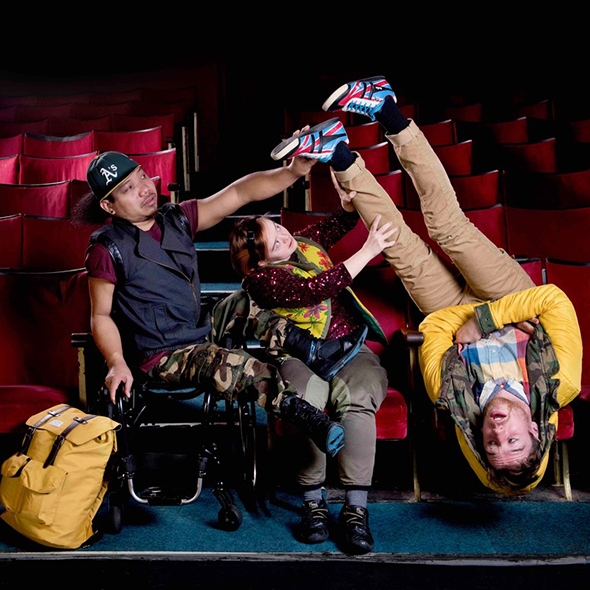
Nadenh Poan, Hannah Sampson and Connor Quill in Night at the Theatre (photo: Camilla Greenwell)
Rather than contain his work within the confines of a theatre Tim Casson usually brings theatre into places that are essentially porous: think hotel, office, pub, or the street. This goes hand in hand with his method of gathering material: anonymous anecdotes from the hotel industry (Selling Secrets Part 1), public houses (Selling Secrets Part 2), office culture (Selling Secrets Part 3) and stories directed through the Royal Mail (Choreospondance). He has also worked directly with the public in outdoor spaces (Dances We Made). So finding Casson making work in a theatre is a new experience on unfamiliar ground. Night at the Theatre is aimed at children of all ages; gone are the adult themes and sardonic humour of the Selling Secrets trilogy and in their place is a complex plot within a plot within a plot that retains elements of Dances We Made. Casson has created a hybrid story that has the wit of the physical and the playfulness of the imagination, a brand of theatre that comes from the heart as well as the head. There is no gearing down for a young audience and the three protagonists — Connor Quill (just up from the mine in COAL) and Stopgap Dance Company’s Nadenh Poan and Hannah Sampson — know exactly how to stir up creative trouble.
‘When three characters discover a theatre, little do they know that they will soon become the stars of their own show.’ Although it takes place in Venue 1 at Rich Mix, Helen Scarlett-O’Neill transforms the stage into a backstage prop room. The three intruders are seen peering through a gauze window next to a high brick wall at the back and it is not long before Casson has his Pina Bausch moment and the wall comes tumbling down with Sampson leading Quill over the cardboard rubble. Clearing the way for Poan’s wheelchair, the trio explores the dusty props: boxes of dresses (all costumes by Valentina Golfieri), masks, and assorted theatrical paraphernalia. Quill finds a megaphone and interrupts Sampson’s reverie over a yellow dress; she is not amused. He then messes around with Poan until they find a pair of partially covered legs. A dead body? Sampson approaches cautiously and in the suspense Poan sneezes. Unfazed, Sampson uncovers the rest of a doll but in the process reveals a horse’s head than neighs loudly. She faints.
This is just the preamble before the plot unfolds in earnest. Casson has a mischievous sense of humour (as do his collaborators) that blends in well with the wide-eyed expectations of the children in the audience. Quill asks a young girl in the front row how she is and then innocently, ‘Why are you here?’ ‘To see a show,’ she replies. Brilliant idea. Quill suggests to Poan and Sampson that they do the same. They sit and watch the audience watching them and match their tics and gestures. Giggles of laughter. Then a phone rings; Quill finds it among the props and answers. It’s the voice of the theatre’s director (Tim Van Eyken); he has only a moment to explain his concept for the show he wants to make and before Quill can demur, the director clicks off. It’s fight or flight and the desire to create a show wins out over scuttling back over the rubble and escaping. The director wants a prince, a princess and a wizard. Dougie Evan’s choice of Prokofiev’s scores for Romeo and Juliet and Peter and the Wolf create an appropriate score of romance and headstrong ingenuity as the three set about deciding their roles and what to choreograph. Inspired by the infectious make-believe of the props they battle with paintbrushes and dusters, cross dress, and perform a trio of arms and torsos. Poan does wheelie pirouettes, Sampson and Quill dance a duet in which she perches on his feet, Sampson starts to seriously groove in a dance of her own, and Poan acts as a DJ on a turntable suitcase. The three are choreographing up a storm and in their enthusiasm miss another call from the director, who leaves a message: he wants a grand finale with 100 extras on stage. That’s 97 additional performers. Quill counts the audience. You know what’s coming. The grand finale becomes Casson’s trademark use of choreographic transmission in which we are all encouraged to make movement phrases that we perform in our seats.
Casson is essentially a choreographic provocateur in the way he blurs the distinction between audience and performer by combining or inverting the two. Night at the Theatre works on both levels, giving young audiences a chance to enter into the ludic nature of theatre with the courage to indulge their natural predilection for combining movement and words. And Poan, Quill and Sampson are ideal kindred spirits.
Posted: May 17th, 2016 | Author: Nicholas Minns | Filed under: Performance | Tags: Company Chordelia, Darren Brownlie, James Bryce, Janis Hart, Jesse Godolphin, Kally Lloyd-Jones, Kyril FitzLyon, Laura Hawkins, Michael Daviot, North Wall Arts Centre, Vaslav Nijinsky | Comments Off on Company Chordelia, Nijinsky’s Last Jump
Company Chordelia Dance Theatre, Nijinsky’s Last Jump, The North Wall, Oxford, May 4

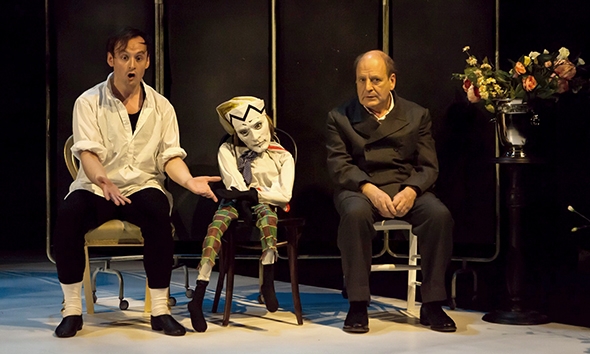
Darren Brownlie, Petrushka and James Bryce in Nijinsky’s Last Jump (photo: Maria Falconer)
Vaslav Nijinsky’s jump was legendary. Asked to describe how he managed to jump so high he is reported to have said, ‘It’s easy. You go up and then pause a little up there.’ The only known visual evidence of Nijinsky’s dancing is contained in some extraordinary photographs taken at the height of his dancing career between 1909 and 1913 which dance critic Edwin Denby wrote, ‘in their stillness…have more vitality than the dances they remind us of…’ They also speak of a quality the artist Alexandre Benois evinces in his memoirs: having described Nijinsky as ‘of uninteresting appearance, rather short of stature with a thick neck and a large head’, he went on to write that ‘having put on the costume, he gradually began to change into another being, the one he saw in the mirror. He became reincarnated and actually entered into his new existence, as an exceptionally attractive and poetical personality.’ Evidently these photographs, and the personality portrayed in them, hold a powerful fascination for Company Chordelia’s artistic director, Kally Lloyd-Jones; Nijinsky’s Last Jump is her response.
Much has been written about and much edited out of Nijinsky’s stage life and his relations with others — notably with Serge Diaghilev and with his wife Romola — but Lloyd-Jones has set out to reveal Nijinsky in his own right. In 1919, at the age of 29, he was diagnosed with schizophrenia and in the same year he wrote a diary over a six-week period that has become the only window into his inner life at the time. It was first published in 1936 in his wife’s carefully edited version, but in 1999 the original unexpurgated text was translated by Kyril FitzLyon. It is this version that informs Michael Daviot’s text for Nijinsky’s Last Jump which Lloyd-Jones has directed and choreographed. Following his diagnosis, Nijinsky lived another 30 years in the shadow of his fame, never again dancing in public and at the mercy of early 20th-century understanding and treatment of his disorder. Lloyd-Jones can’t resist the temptation to wonder what might have happened if schizophrenia had been better understood in 1919. Nijinsky’s Last Jump imagines a lucid dialogue between Old Nijinsky (James Bryce) and Young Nijinsky (Darren Brownlie) in which the two halves of a life divided by illness are reunited.
The only occasion in the south of England to see this work is at the North Wall Arts Centre in Oxford. Given that Judith Mackrell ranked it fifth in her top ten dance works of 2015, it’s a mystery why Nijinsky’s Last Jump has not been invited to London (8 of her 10 choices were seen there). Kudos to North Wall. It’s a lovely theatre, too, with a seating capacity of 200 and its stage tonight has, thanks to set designer Janis Hart and lighting designer Laura Hawkins, become Nijinsky’s dressing room with a table loaded with bouquets of flowers and a mirror that together suggest a shrine. A screen in one corner is the changing area (rather improbably with Nijinsky’s name stencilled on it) and in the opposite corner is another screen reminiscent of a hospital bay. A Petrushka puppet (courtesy of Janis Hart) is draped on a chair. Seated next to the puppet Bryce, in a convincingly Slavic accent, introduces an anecdote about the origins of his famous jump while we hear the latter part of a performance of Le Spectre de la Rose taking place beyond the wings. All we see of the famous final jump is Brownlie landing in a heap on his dressing room floor, breathing heavily. Bryce becomes the regisseur, getting the younger dancer wiped down with a towel and returning him to the stage to acknowledge the rapturous applause (recorded as part of the sound design by Jesse Godolphin). Seated once again, Bryce talks dispassionately of his early preoccupation with masturbation. This is one of the details Romola had excised from the original diary, but its inclusion here not only allows Nijinsky to unashamedly confess his former sexual proclivities but alludes directly to the suggestive final pose of his first choreography, L’Après-midi d’un Faune (‘The Faun,’ he wrote, ‘is me.’). This clever cross-referencing in text and details is key to the richness of Nijinsky’s Last Jump and while Lloyd-Jones mines the roles of Nijinsky to find the person, she wisely avoids any attempt to find the dancer: Brownlie warms up in the dressing room but Nijinsky’s stage performances remain beyond the wings in our imagination.
Bryce and Brownlie form an affecting partnership. Bryce is like a saint who has suffered much, who has arrived at a level of philosophical resignation 30 years ahead of Brownlie; he is thus in a position to comfort him, to encourage him on the journey he is about to take: that long, lonely final jump from worldly fame to enduring myth. The historical and psychological details in Nijinsky’s Last Jump are extensive and interlinked, but while forming an intelligent matrix of meaning, they rely perhaps too much on prior knowledge of the subject to be fully appreciated. A little more in the way of program notes may help to identify the context and some aspects of Nijinsky for those who don’t know a lot about him; without them the detailed cross-references may lose their significance, seem abstruse or simply mystifying. Without a knowledge of the respective ballets, what to make of Brownlie’s landing from the wings, or of Bryce placing Brownlie’s body in the sideways, two-dimensional forms of Faune that were so revolutionary at the time? Or of the re-enactment of Nijinsky’s role as the hapless doll in Petrushka by dancing the puppet in front of a hospital screen? And if the story of the opening night of Nijinsky’s Rite of Spring is unknown, how would Brownlie’s screaming of the musical counts from the wings relate to Bryce’s reading of the reviews afterwards? I am not sure. Nijinsky has been an inspiration for many years and I have read enough to enjoy the density of Nijinsky’s Last Jump, but I was not aware of the extent of Nijinsky’s shock therapy. When Lloyd-Jones has Bryce list the concoction of medications Nijinsky was administered for his schizophrenia — it is long and ends with 228 insulin-induced comas — with the horrendous effects, she takes on the additional role of advocate. At the same time old Nijinsky is in a position to gently guide his younger self to a calm acceptance of his fate in the conviction that their inner life remains intact. So for me it is poignant to see a play about Nijinsky that makes his own voice its subject and, as Lloyd-Jones writes, ‘honours a human being who clearly continues to touch the hearts of many.’
Posted: May 12th, 2016 | Author: Nicholas Minns | Filed under: Performance | Tags: Cloudgate Dance Theatre of Taiwan, Hermann Hesse, Ko Wan-chun, Lee Hwai-min, Lin Hsin-fang, Siddhartha, Songs of the Wanderers, Wang Rong-ji, Wang Wei-min | Comments Off on Cloud Gate Dance Theatre of Taiwan, Songs of the Wanderers
Cloud Gate Dance Theatre of Taiwan, Songs of the Wanderers, Sadler’s Wells, May 7

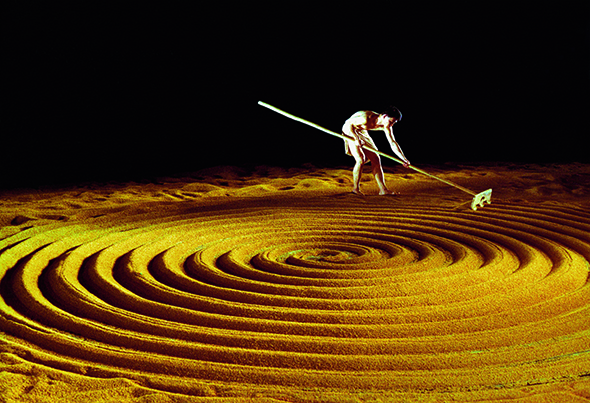
The final pattern of Songs of the Wanderers (photo: Yu-Hui-hung)
A monk in white robes standing motionless on stage for seventy minutes under a steady stream of falling rice is a powerful image of stoicism, concentration, and meditative self-control. Wang Rong-ji’s presence in Cloud Gate’s Songs of the Wanderers is an indication not only of the spiritual nature of the work but counterintuitively of the quality of its movement. We don’t see him move until he re-enters the stage to take his bow but his modest gesture of outstretched arms to acknowledge the applause gives the impression of pure spirit, of a body that has no apparent weight or strength. It is a gesture that defines movement by its absence of physical intent and, in diverting attention away from the body, focuses on the spiritual aspect of being. This is central to Lin Hwai-min’s conception of Songs of the Wanderers, which he created following a pilgrimage to Bodhgaya in India where Shakyamuni Buddha attained enlightenment under the bodhi tree. As Lin Hwai-min describes, “I sat quietly under the bodhi tree, shoulder to shoulder with the monks. I opened my eyes, and saw sunlight coming from the top of the stupa through the branches to land directly on my forehead. My heart became full of joy; I felt a quietude that I had never experienced.”
Songs of the Wanderers is also inspired by Hermann Hesse’s Siddhartha, a novel set in India about a young man who leaves home in search of enlightenment; the meandering river of golden rice we see on stage at the beginning of Songs of Wanderers suggests the river that both physically and metaphorically led Siddhartha from illusion to enlightenment.
The wanderers of Lin Hwai-min’s Songs emerge from behind the dark backcloth and drift towards the river with tall staffs cut from forest branches. The monk is on the opposite shore under the cascading rice: set designer Austin M.C. Wang has thus created two rivers, one vertical and one horizontal. In Hesse’s novel Siddhartha annihilates the contradictions in words and thoughts, seeing the oneness in the reality in and around him. In the same way, Cloud Gate’s community of wanderers gradually removes the obstacle of the river by dissolving its banks: they pick up the rice to let it slip through their fingers, spread it with the force of their bodies in a series of tableaux and release handfuls high into the air. Rice also rains in intervals like a monsoon until the entire stage is covered, merging the two rivers into one. Songs of Wanderers is thus not so much a narrative as a journey in which the seeking spirit of the wanderers aspires to the spiritual influence of the monk. The opening section, called Holy River, sets the character of this journey beautifully; accompanied by a Georgian folk song recorded by Rustavi Choir, the dancers move with calm control, quietly advancing to the river, the uprights of their staffs contrasting with the smoothness of their slow, meandering paths. Out of this meditative prelude that blurs time and space, Lin Hwai-min’s choreography takes a more structured form, weaving ensemble and soloists (Ko Wan-chun and Wang Wei-min) in formal sections with theatrical effects that remind us of space and time. The two deluges of rice are visually stunning, but the first is a device to mask the entrance of Wang Wei-ming at the beginning of his solo and the second seems to have no other function but to replenish the rice on stage. In a work where the material aspect of life slowly erodes into the immaterial, these devices jar and leave me feeling I am watching from the outside rather than participating in the journey.
Which brings me back to Wang Rong-ji. It is only when I see him move that I realise to what extent the physical body can represent the spiritual. Hesse uses the dialectic of words to point the way towards a reality that encompasses their opposition; in the physical realm, Wang-Rong-ji finds a corresponding unity between gravity and weightlessness and points to a qualitative development of movement. By contrast, the physical language of the wanderers does not develop beyond the earthy opening, suggesting a substantive divide between the physical and the spiritual; the transformative effect of their journey remains unfulfilled. Wang Rong-ji has been in the production from the beginning twenty-two years ago — Lin Hwai-min hired him specifically for the role — but the dancers in this production, apart from Wang Wei-min, are relatively new. Perhaps they are just trying too hard, like Siddhartha before he renounced his ascetic practices.
The final phase of Song of the Wanderers is the lone figure of Lin Hsin-fang meticulously raking the rice into a perfect series of concentric circles. He begins as the company takes their bows, when the concentration of the audience has already started to dissipate, and it must seem a strange ritual for those in the stalls who cannot see the pattern he is making. But in Lin Hsin-fang’s solemn, meditative gesture there is the signification of intent and, for those who can see it, the pattern he defines suggests the harmonious goal of all spiritual wandering.
Posted: May 10th, 2016 | Author: Ian Abbott | Filed under: Performance | Tags: Bloody Nora, Eleanor Sikorski, Findhorn, Flora Wellesley-Wesley, Jonathan Burrows, lizaggiss, Lizz Aggiss, Matteo Fargion, Nora, Slap and Tickle | Comments Off on Liz Aggiss, Slap and Tickle
Liz Aggiss, Slap and Tickle, Universal Hall, Findhorn, May 7

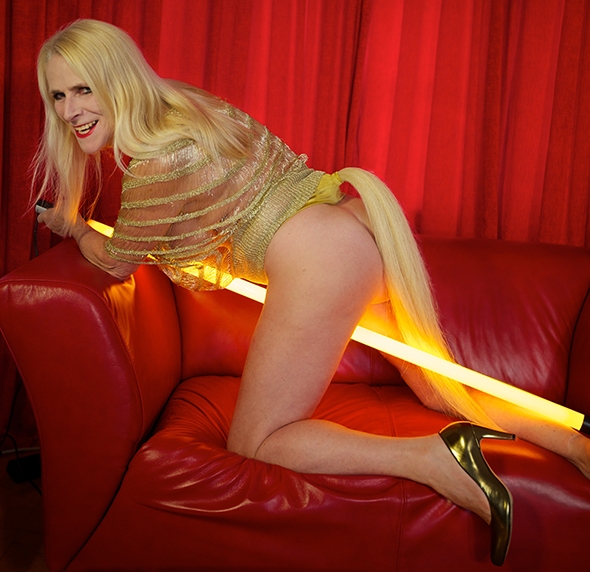
Liz Aggiss in Slap and Tickle (photo: Joe Murray)
“Undermine their pompous authority, reject their moral standards, make anarchy and disorder your trademarks. Cause as much chaos and disruption as possible but don’t let them take you ALIVE.” – Sid Vicious
Liz Aggiss was forged in the cauldron of punk and her new feminist soup, Slap and Tickle, riffs on pishy old women, yummy mummies and flagrantly tosses collapsed floors and sexual taboos out the window. ‘Tis one of the finest crafted and hilarious hours I’ve spent in a theatre.
To witness lizaggiss (the performance persona and brand) in motion is to behold an artist in complete command of her visual world. She nudges the fourth wall, gives it the glad eye, but there’s always the hint that she could demolish it if she wanted. However, it’s also a space where I feel safe as she demonstrates consideration by building the audience’s hardiness to material that some might consider a little saucy. Mining childhood songs, witty word play and music hall standards, there are enough recognisable tropes to keep us comfortable. Through the presentation of her body and what it can do, has done and might do with us watching, it enabled me to consider my own body, the stories it holds and how we look at others. Are you sitting comfortably? You shouldn’t be.
“Make them laugh, make them cry, and back to laughter. What do people go to the theatre for? An emotional exercise. I am a servant of the people. I have never forgotten that.” – Mary Pickford
Slap and Tickle is a machine gun of visual joy; no sketch, sequence or quip outstays its welcome, and mixed in with the frippery and froth are some puncturing sentences which aren’t just close to the knuckle; they’re brushing your elbow with a cheese grater. “Are there any wet women in the house tonight?” she asks with her comedic timing and technique honed during her early 80s stints in cabaret and working men’s clubs; it’s a lean, slick and impressive performance (on only its second public outing) that doesn’t let go of your eyeballs or earballs throughout.
I recognised compositional echoes from her previous stage work, The English Channel: a single microphone, a box of props, and the use of multiple costumes and her body to conceal a wunderkammer of curiosities that are revealed as the performance progresses. There’s oodles of jerky early-modernist hand gestures (in reference to a series of pioneering female inter-war choreographers) mixed with rhythmic beat-filled speech; it’s a little bit rude, a little bit anarchic and actively resists neat definition but the narrative is universal and should be celebrated: Women and their Bodies.
“If I want to define myself, I first have to say, ‘I am a woman’; all other assertions will arise from this basic truth. A man never begins by positing himself as an individual of a certain sex: that he is a man is obvious.” – Simone de Beauvoir
Slap and Tickle is presented in Findhorn as part of Rise 2016, a three-day festival of contemporary dance and performance sensitively programmed by Karl Jay-Lewin. First on the same evening’s bill are Eleanor Sikorski and Flora Wellesley Wesley, aka Nora, who present a double bill of duets by Jonathan Burrows/Matteo Fargion and Liz Aggiss. It is the first time that Bloody Nora is programmed on the same night as Slap and Tickle and it is fascinating to see the tone, scenography, language and ribaldry of Aggiss channelled through two younger female bodies. It looks like an Aggiss, spits expletives like an Aggiss and smells like an Aggiss — yet the solo body has been split and removed from the mother ship. Now we have two distilled red Aggi imps morphing their bodies, accentuating our gaze and letting us linger in the land of the uncomfortable before they “fuck you’ed” into the distance.
There are tens of millions of female bodies and minds in the world that are aged 62 and over yet in our culture they’re almost invisible. Liz Aggiss resists that invisibility and in doing so has created over the past decade a body of live, film and other work that would benefit from the focus of a festival, symposium or conference to see how the works sit alongside the wider UK ecology.
Slap and Tickle is dance/comedy/art (delete as appropriate) that makes the audience snort, howl and cackle with laughter. It’s a rich and visual collage of womanhood and even though Aggiss actively embraces the maverick tag, she’s exploring and presenting a world that every woman can relate to. Let’s have a party.
For a darker view of Slap and Tickle, see a review from the Brighton Festival by Nicholas Minns
Posted: May 9th, 2016 | Author: Nicholas Minns | Filed under: Performance | Tags: Alistair Goldsmith, Charles Webber, Connor Quill, Daniel Thomas, Eleanor Perry, Gary Clarke, James Finnemore, Joss Carter, Nicolas Vendange, Ryan Dawson Laight, Steve Nallon, TC Howard | Comments Off on Gary Clarke Company, COAL
Gary Clarke Company, COAL, The Place, April 15

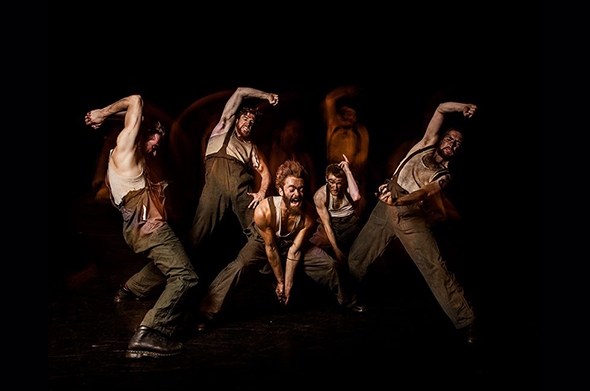
Gary Clarke Company in COAL (photo: Joe Armitage)
“She defined and overcame the great challenges of her age…” – David Cameron in his tribute to Margaret Thatcher in the House of Commons, April 10, 2013
“Thatcherism…reeked the most heinous, social, economic and spiritual damage on this country…” – Glenda Jackson in the House of Commons, April 10, 2013
It is an uncanny coincidence that the 30th anniversary of the miners’ strike should occur at a time the current Conservative government is trying to dismantle another longstanding institution, the National Health Service. Gary Clarke’s COAL, commemorating the 1984/85 miners’ strike in choreographic form, comes as a salutary reminder of how politicians who capitalise on the self-aggrandizing belief they are ‘overcoming the challenges of (the) age’ can ruin the lives of entire communities. Clarke understands this firsthand, having been brought up in Grimethorpe, a mining town in South Yorkshire. ‘It’s deeply, deeply personal, and I just wanted to share how it felt to live through these times. How it felt then, and how it feels now as the pain, loss and division linger on in our stranded communities.’ It is memory that drives the work forward.
COAL is divided into three acts: the first is a slice of early-morning ritual in a single home that suggests the foundation of social life in a mining community. The wife (TC Howard) peels spuds in a bucket while the husband (Alistair Goldsmith) sleeps under a blanket; she is cook and feisty timekeeper, long-time lover and loyal supporter. Costume and set designer Ryan Dawson Laight takes delight in the details (Howard is reading a newspaper with the headline ‘Tory Cuts’) and Clarke fashions the spirit of comradeship in an earthy dance among the assembled miners (Goldsmith, Nicolas Vendange, James Finnemore, Joss Carter and Connor Quill) on their way to work. The second act is set underground (the pit cage and tunnels beautifully delineated in light by Charles Webber); it is a long section and full of tension. The qualities of their movement are a reflection of both the physical effort and their underground minds, a brutal existence spurred on by chalked targets, punctuated by bells and constantly threatened by hazards to limbs and lungs. It is perhaps the first time the opening movement of Beethoven’s 5th symphony has been used at the coalface and Daniel Thomas’ soundscape exaggerates the sense of pressure and confinement until we can’t take any more. Act three takes us up again into the air to the relative freedom of a social gathering, a chance to party and to relax, which is the moment Clarke introduces the figure of then prime minister Margaret Thatcher (Eleanor Perry with the voice of Steve Nallon). This is the dramatic fulcrum of the work, the moment that defines the beginning of the end. From the intimately complex social solidarity of the first two acts, Thatcher’s intervention turns the community into a toxic, socially divisive battleground with Perry prowling like a bird of prey on one side of a picket line that bears a chilling resemblance to a gallows rope.
Clarke maintains COAL is not a political work but the politics are inextricable from the story and he plays the political aspect directly to the audience. If Perry doesn’t get booed during a performance she feels she hasn’t wrung a sufficiently derisive charge from her role. This raises questions as to the exact nature of COAL. In choosing to interpret this story through the medium of dance — particularly using his five muscular, handsome dancers as interpreters — Clarke mixes a social and political polemic with a soft image; he has us bathe in the action until we are as helpless in the face of fate as the miners with whom he is siding. The form of COAL thus straddles the tragedy of a community and an epic story of resistance, but in pointing the finger at Thatcher we collectively miss the opportunity to challenge our readiness to fight such injustices in the future. As Ernst Fischer wrote in The Necessity of Art when discussing Berthold Brecht’s use of emotional detachment to appeal to audiences’ reason and critical action, ‘The work of art must grip the audience not through passive identification but through an appeal to reason which demands action and decision.’
What Clarke has achieved is an intimate, nostalgic memoir in which the material is still full of pain and anger. The work is rooted in the communities he is honouring: apart from the permanent cast of Perry, Howard and the five male dancers, the supporting characters come from local mining communities or have a relationship to them and he uses songs played by colliery bands from areas of the country in which he is performing. This close-knit network of performers strengthens the cohesion of the work, but it is the lack of artistic detachment that weakens the dramatic impact. It implodes rather than explodes, draws us in rather than spits us out on a path to change. It is designed to rouse the emotions of the audience — and is more or less successful depending on where it is performed — to reaffirm the sense of betrayal that continues today.
We want COAL to succeed because what it depicts is vital to an understanding of these blighted communities and of our collective history but it falls short primarily because of its desire to entertain. The reality was and is far worse than COAL can ever admit but commemoration can also be a call to action; the struggle for the survival of the NHS is history repeating itself.
Posted: April 30th, 2016 | Author: Nicholas Minns | Filed under: Performance | Tags: Aideen Malone, Akram Khan, Anish Kapoor, Kaash, Kimie Nakano, Kristina Alleyne, Lighthouse Poole, Nicola Monaco, Nitin Sawhney, Sadé Alleyne, Sarah Cerneaux, Sung Hoon Kim, Yen-Ching Lin | Comments Off on Akram Khan Company, Kaash
Akram Khan Company, Kaash, Lighthouse Poole, April 13

Akram Khan Company in the revival of Kaash (photo: Jean-Louis Fernandez)
I had been invited by Libby Battaglia to give a writer’s workshop for young reviewers at Lighthouse Poole and the performance we were going to review was Akram Khan’s Kaash, his company’s first full-length work created in 2002. Presently on tour 14 years later, Kaash is an early and compelling vision of what the fusion between Khan’s classical kathak training and contemporary dance might look like. The result has the sophistication of the classical with the raw power of the contemporary that remains as thrillingly visceral as it evidently did in 2002 when it won the Critics Circle National Dance award for Best Modern Choreography. Performed by a typically international cast of five — then as now — the choreography has a universal quality unattached to any particular nationality or genre, but Kaash displays a unity of influence through the collaborations with artist Anish Kapoor and musician Nitin Sawhney. In their respective mediums both Kapoor and Sawhney had already established a synergy between their Indian roots and western culture so by the time of their collaboration with Khan his choreographic forms could be framed in an aural and visual environment that complemented and enriched them.
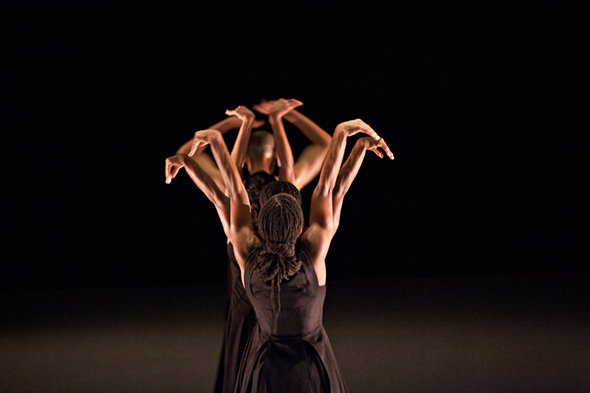
There is no linear narrative in Kaash but rather a series of ideas explored in movement, what the program note describes as ‘Hindu gods, black holes, Indian time cycles, tablas, creation and destruction.’ These are elements of Indian cosmology and dance familiar to Khan who was exploring the affects of his cultural identity without resorting to their traditional cultural signifiers. Images are woven into the fabric of the work, as in the form of the god Shiva glimpsed in a line of dancers, one behind the other, displaying the multiple arms of a single body, or the mudras (hand gestures) that carry their own meaning but here give shape to and refine the movements of the arms and hands. Indian time cycles or signatures are the kathak rhythmical counts that are chanted by the accompanying singer. When Khan himself was dancing in the original he would chant these time signatures himself, but here it is his voice we hear (recorded by Bernhard Schimpelsberger); it becomes part of the score rather than a live element of the dance.
Kapoor’s large black rectangle painted on the backdrop represents the black hole that in Indian cosmology was the centre of the world and the seat of Lord Vishnu, creator of the universe. A black hole is also a region of space-time with such strong gravitational effects that nothing can escape from inside it. The stage becomes a dynamic energy field, lit from smouldering to fire by Aideen Malone, inside which Khan’s choreography creates a powerful sense of gravity acting on the bodies of his dancers. One common characteristic of kathak and contemporary dance is the repudiation of vertical space; movement remains intensely horizontal and grounded. The dancers in Kaash cross from one side of the stage to the other like particles in close proximity. Even solos, especially by the (English) twins Kristina and Sadé Alleyne, have this remarkable vitality that cannot be extinguished. The figure of Sung Hoon Kim, bare-chested in a long black skirt (all costumes by Kimie Nakano), provides a soothing spiritual dimension — an exploration of Lord Shiva, agent of destruction and change. In Hindu cosmology the end of each kalpa brought about by Shiva’s dance is also the beginning of the next cycle. For some time in the opening section Kim remains still, absorbing the energy around him until he starts to move with extraordinary speed and precision, which in turn affects the other dancers; the cycle of creation and destruction continues unabated. Khan’s original role is danced by Nicola Monaco, and the fifth dancer is Sarah Cerneaux. The reconstruction of Kaash under the eye of rehearsal director Yen-Ching Lin has been guided by some of the original cast, though because the techniques of contemporary dance have changed in the last 14 years Kahn encouraged the present dancers to refresh the choreography without losing its overall form. This is perhaps why the work still seems so alive.
Sawhney’s score supports and gives life to the cyclical energy of Kaash, acting on our ears in the same way Kahn’s choreography immerses our visual and kinetic senses. Sawnhey makes use of drumming that belongs as much to the Japanese kodo as to the Indian tabla: powerful, percussive rhythms that emphasise the earthy quality of the dance pervading the first section with its repeated patterns of dynamic lunges and powerful, heavily sweeping arms. At one point the addition of John Oswald’s Spectre played by the Kronos Quartet, seeps into the score like a memory, and similarly there are whispered fragments of recorded speech that tease the notion of ‘kaash’ (Hindi for ‘if only’) into aural puzzles: “If only I’d bought one instead of two” or, more pertinently to Khan’s identity, “If I tell you the truth about who I really am.”
Kaash in 2002 was uniquely situated in the British cultural and social zeitgeist that sought links and bridges to its multicultural communities. Khan responded with a work that seemed to go far beyond that remit, turning it almost inside out. As the dramaturg, Guy Cools, has suggested, Khan’s artistic universe (along with that of Sidi Larbi Cherkaoui) is largely built around ‘his identity in-between dance cultures,’ and in this early work he effectively subsumes his two identities by fusing them into a seamless whole.
Posted: April 19th, 2016 | Author: Nicholas Minns | Filed under: Performance | Tags: Annabelle Lopez Ochoa, Aszure Barton, Broken Wings, Burke Brown, Dieuweke van Reij, English National Ballet, Fabiana Piccioli, Fantastic Beings, Frida Kahlo, Irek Mukhamedov, Isaac Hernandez, Jocelyn Pook, Kimie Nakano, M-Dao, Mason Bates, Matt Deely, Michelle Jank, Peter Salem, Tamara Rojo, Yabin Wang | Comments Off on English National Ballet’s She Said
English National Ballet, She Said, Sadler’s Wells, April 16

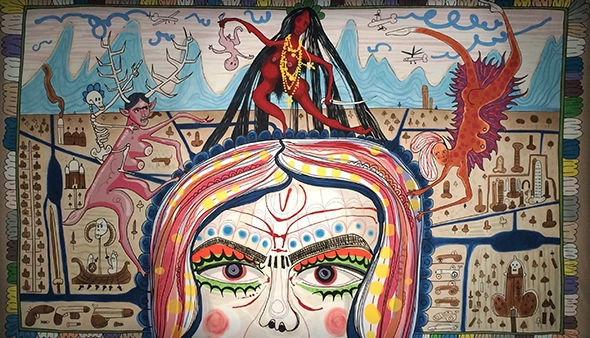
Grayson Perry’s front cloth for She Said
“Dance in its purest form is without gender.” – Ohad Naharin
On message, English National Ballet has fashioned an evening of dance celebrating the female choreographer. She Said brings together Annabelle Lopez Ochoa and Aszure Barton from North America and Yabin Wang from China to each create a work for the company. She Said does not set out to compare their works with the male-dominated canon (reflected in its many iconographic forms in Grayson Perry’s delightful mandala-like front cloth) but to respond to the current criticism that we don’t hear enough of the female choreographic voice in contemporary classical work. One can’t argue with that, and even if the qualities of that voice resist clear identification, the experience of watching the three works in She Said is decidedly refreshing. Along with news that English National Ballet has been granted permission by Tanztheater Wuppertal Pina Bausch to perform Bausch’s Rite of Spring, it seems the initiatives of artistic director Tamara Rojo have an uncanny ability to fill unwarranted gaps in the repertoire while keeping an astute eye on public relations. The profile of the company keeps growing.
Given She Said invokes the gender question, it is perhaps worth noting not all the creative input is female. Lopez Ochoa and Barton both use scores by male composers (Peter Salem and Mason Bates respectively) and Wang seems to have been handed an entire Akram Khan creative toolkit that includes music by Jocelyn Pook, costume design by Kimie Nakano, lighting design by Fabiana Piccioli and video projection by Matt Deely. Given the role of Farooq Chaudhry — co-founder and producer of Akram Khan Company — as creative producer at ENB one can trace a male influence in the choice of Wang’s collaborative team. This might have gone unnoticed but for an overwhelming sense that Pook’s score drowns Wang’s version of the Greek tragedy of Medea, M-Dao. Wang’s approach to Medea is not so much by way of the western notion of fate as through a particularly Eastern sensibility of emotional detachment. Pook misses this subtlety, so M-Dao relies for its effectiveness on its visual construction. Erina Takahashi as Medea is an ideal interpreter for Wang and her articulate, fragile opening solo, one foot in a pale blue pointe shoe the other bare, suggests the enigma of Medea’s character. Because the gestural appearance of James Streeter as Jason and Lauretta Summerscales as his new wife Glauce lack this sense of detachment, their narrative separates naturally from Medea’s and leaves the focus on her. Wang’s understated choreography signifies the drama without getting involved in its outward emotion and she is helped in this by Nakane’s sensibility in set design and Piccioli’s lighting. Deely’s video tends to state rather too much, as if he is afraid Wang’s imagery is not enough, but it is Pook’s fleshy, middle-eastern mix of a score that simply overrides the quiet articulation of Wang’s choreography; we can barely see for hearing.
The opening work, Lopez Ochoa’s Broken Wings, is based on the life and love of Mexican painter, Frida Kahlo. Lopez Ochoa remembers Rojo giving her a list of female figures in history and literature from which to choose a subject, but she kept coming back to Kahlo. Spanish culture is a bond between choreographer and director/interpreter, and Kahlo provides Rojo with a role for which she has an affinity. She is most effective at the beginning as a young, spirited girl playing with the Day of the Dead skeletons; her sense of fun and self-confidence is palpable. Kahlo’s adolescent life was brutally interrupted by a tram accident that left her an invalid but Lopez Ochoa gives Rojo’s transformation a soft balletic treatment — a turned-in, shaking leg that she clutches but which can nevertheless reach 190 degrees behind her when called for — without the tormented, emotional dimension that gave rise to Kahlo’s creativity. Lopez Ochoa uses the visual symbolism of Dieuweke van Reij’s set design to suggest Kahlo’s flights of imagination as well as a corps of male dancers (a lovely inversion) dressed and brilliantly painted (by Dominic Skinner) as Kahlo’s feminine spirits. Broken Wings also provides a wonderful role for Irek Mukhamedov as the painter Diego Rivera. His passionate on-again-off-again relationship with Kahlo is the stuff of legend, and Mukhamedov fills those legendary shoes with weighty, captivating flair.
Mukhamedov is also the company’s principal ballet master, and some of the credit must go to him for the outstanding level of technique evident in the last work, Barton’s Fantastic Beings. Of all the voices this evening, Barton’s is the one I hear most clearly: someone who is confident of what she can coax from the dancers, skilled in putting it together with subtle and witty imagery (enhanced by Burke Brown’s lighting and Michelle Jank’s costumes), and assured in making the music an equal partner to the choreography. This latter aspect is perhaps the only weakness: the length of Fantastic Beings is dictated by Bates’ existing score, which draws out Barton’s wealth of invention beyond its choreographic endpoint. Nevertheless, the technical demands Barton brings out of the dancers are inspired and in turn the dancers — particularly Isaac Hernandez — respond with a precision, clarity and imagination that is thrilling to see. Fantastic beings indeed.
Posted: April 11th, 2016 | Author: Nicholas Minns | Filed under: Performance | Tags: Broken Spectacles, I am not in love, Jim Read, Jodie Cole, Paula Redway, Salisbury Arts Centre, Tam Gilbert | Comments Off on Jodie Cole, I am not in love
Jodie Cole, I am not in love, Salisbury Arts Centre, March 30

Jodie Cole in I am not in love (photo © Foteini Christofilopoulou)
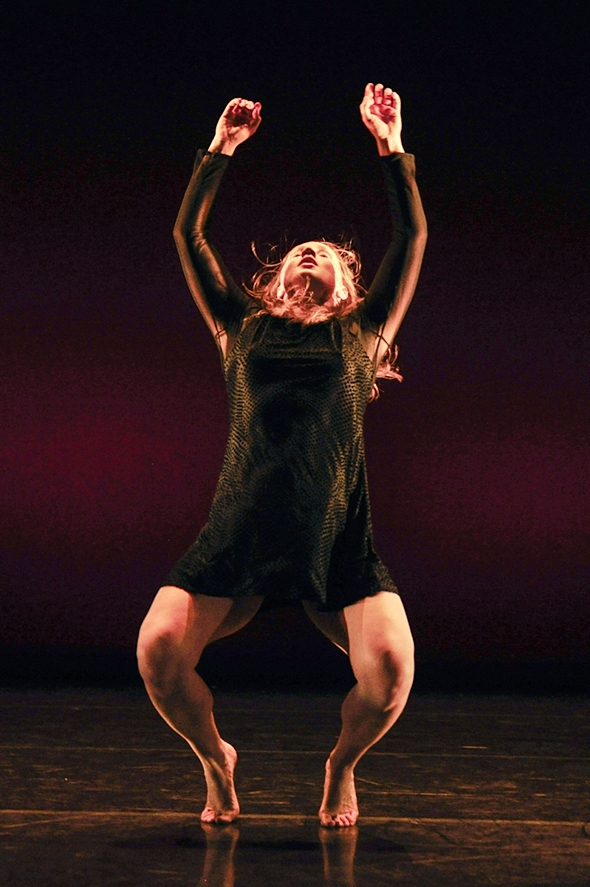
Jodie Cole’s I am not in love uses the stage as a means to communicate an intensely personal reflection on life and love; it has no pretensions to theatre or dance and yet it belongs to both. Such is the intimate quality of the work it could have been a poem on a page or a song on a musical stave, but Cole is clearly in her element on the stage, becoming both the subject and the object of her reflection. She arrives wearing a cycling helmet and a wind jacket as if she has just left her bicycle in the lobby, except that her feet are bare and under the jacket she wears a black, backless dress. While her initial appearance lacks any artifice, it hides the dual nature of I am not in love: within an exploration of the language of performance is a confessional narrative about libido — eros veering off into the erotic. The transformation happens quickly before Cole has even introduced herself: in helmet and jacket she turns her back to the audience and embraces herself to a clip of the song I’m not in love over which we hear her mounting cries of pleasure. It is a shorthand communication of the qualities that will drive the work: frankness, humour and sensuality. She vibrates and shakes as if giving birth to her thoughts and she choreographs short songs with a fluidity that softens the hard-hitting nature of the narrative. The message of I am not in love is built from the interconnected levels of anecdote, analogy and action: a memory of her mother telling her not to wander round the house naked in front of her father; talking of cycling as both a favourite mode of transport and a deep sensation in her stomach; and using the bicycle pump on stage as a comic demonstration of deflation, either from rejection in love or the rejection of a foetus. She is not sure if she wants children, but her relationships lead her to that door even if she never goes through it; she dances her states of desire but ends each episode with a broken relationship told with a matter-of-fact delivery that belies the emotional turmoil she has experienced. We are thus taken on a journey of sensation in constant flux in which for a few delightful minutes our own vulnerabilities and longing are mirrored, celebrated and assuaged. What she comes to understand at the end, which she shares through a recording of a self-help talk, is that love and forgiveness of oneself are a vital component of love and forgiveness of the other. It is not Cole’s voice, however, but a note for herself, one that reminds us of the confessional aspect of her work but leaves her without her own conclusion. Cole has introduced herself with such candour that we can sympathise with her, laugh with her and support her, but having bared her soul, we are not sure where she wants to go from here, nor where she wants to take us.
I am not in love is part of an evening of short works-in-progress called Practice at Salisbury Arts Centre. The purpose is to give artists a ‘platform for testing new and innovative contemporary performance in front of a live audience.’ It’s a varied program in two different spaces within the Centre. Jim Read’s Want to Dance is an engaging, brave monologue about the unexpected effects of his successful participation in a Parkinson’s Dance group; Tam Gilbert’s Sensing Helen is a sensorial exploration of Victorian life in Dorset for the deaf and blind that parallels the story of Helen Keller; and Broken Spectacles’ At Sea fashions stories of mythological selkies through the clever use of cardboard boxes, voices, puppets and magic. All four works are in development and a thoughtful session following the performances, led by director Paula Redway, encouraged the artists to present their creative processes and audience members to respond or ask questions. For those in the audience who could not stay there was a feedback form on which the final question was along the lines of, ‘Which of the four works would you like to see developed?’ To a large extent I am not in love has already been developed and seems, if not quite fulfilled, to stand on its own. The question for Cole is not how to develop the work so much as how to develop her choreographic voice.
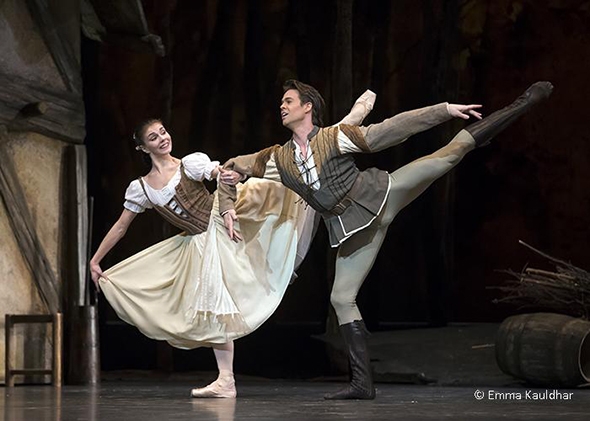
Posted: April 4th, 2016 | Author: Nicholas Minns | Filed under: Performance | Tags: Giselle, Kristen McNally, Marianela Nuñez, Matthew Golding, Natalia Osipova, Peter Wright, The Royal Ballet, Thomas Whitehead | Comments Off on The Royal Ballet’ Giselle with Natalia Osipova
The Royal Ballet, Giselle, Royal Opera House, March 29

Natalia Osipova and Matthew Golding in Giselle (photo Emma Kauldhar)
There is something soothing about seeing a classical ballet like Giselle. You don’t have to wonder what it’s about, the characters are defined in the narrative, the music and the rhythmic structure are familiar, the sequences haven’t changed and the form is known. What is exciting is the anticipation of a great interpretation, not just of the principal character Giselle but of Albrecht, Hilarion, Berthe and Bathilde, and in the second act the Queen of the Wilis. Apart from these major roles (on whom the clarity of the story depends), there are set pieces for the corps de ballet, most notably in the second act but also in the pas de six in the first. That is not to say the lesser characters — dukes and squires, leaders of the hunt and the villagers in the first act — are less important. There are no small roles; everyone has something to do in a narrative ballet and the success or failure of a performance is made up as much of all these small gestures and actions as it is of the interpretation of the principal dancers.
This evening the role of Giselle is danced by Natalia Osipova. I bought a ticket to see her interpretation because she is one of those rare talents with technique and dramatic sensibility who can bring a classical role to a new height of definition. Margot Fonteyn insisted technique is subservient to the ability of a dancer to tell the story. Osipova has both and she does not disappoint; from the moment she steps out of her cottage she is Giselle with all her charm, vitality and naivety expressed in her steps, her posture, gestures, and mime. She is evidently in love and allows that feeling of excitement to infuse her performance. Peter Wright, whose production this is, suggests the possibility that Giselle is of royal birth but illegitimate, a result of the droit de seigneur custom of the time. It would explain why she is different from the other village girls and why her mother wants to protect her from a similar fate to her own. Albrecht is a seigneur himself, son of a noble family that is used to hunting on the lands around the village. He has caught the attention of Giselle and even though he is betrothed to Bathilde, daughter of a local duke, he is drawn to her in spite of himself. This is the delicate balance facing Matthew Golding’s characterisation. Albrecht hasn’t really thought it all through so he has to dissimulate. Golding hasn’t thought it through either and doesn’t. He goes through the noble motions without letting us know what he is thinking or feeling and he fails to differentiate between his feelings for Giselle and those for Bathilde. He talks to them both with the same slow, vapid gestures. This is a major flaw in the production because Osipova has nobody to play off; she appears to fly out of the frame as she did (with the same partner) in Onegin because she is very much on her own; there is only half a conversation. Kristen McNally as Giselle’s mother Berthe is the only character to use her mime to consummate effect; after Giselle’s death the way she brushes Albrecht off her daughter is chilling. Thomas Whitehead as Hilarion also expresses his intentions in mime but, as Wright points out, he is destined to be the baddie and there are few redemptive aspects of his characterisation. Knowing the story, we tend to fill in the colours we don’t see, but it would be heartening to have characters who behave with a full palette and shake us out of our familiarity.
It is not only characterisation that is lacking this evening. Though generally of a high standard — this is after all The Royal Ballet — the level of technical excellence can be unexpectedly weak. In the prelude to tragedy in Act 1, the stage is filled with a joyous harvest festival celebration. The traditional peasant pas de deux becomes in Wright’s production a pas de six, an opportunity for junior talents to shine. But the men must have had a hard day in the fields because their dancing is ragged; they can’t land their double tours cleanly which sets off an uncertainty in subsequent steps. Osipova quickly dispels any uneasiness, taking control of the stage as Giselle becomes unhinged by the shock of Albrecht’s duplicity. Golding could have hidden behind a tree (of which there are many) for all the emotional heft he brings to his unmasking. It is like watching a cinematic version of the ballet in which the camera is focused exclusively on the inner emotions and outer distress of the leading character.
As the first act sets up the basis for the second, any emotional weakness in the former will affect the redemptive quality of the latter. Since the cathartic effect of Giselle cannot be fully expressed by one character alone, we are left to watch Osipova from the edges of our seat as she dances on the edge of hers. In such an ethereal setting, the ability to fly is essential and one of Osipova’s qualities is her ability to suspend her shapes in the air, an extension of her musicality. Marianela Nuñez as Queen of the Wilis has an ethereal elegance of line on the ground but, like her band of fellow spirits, appears less free in the air; the flying exit of Wilis is marked more by propulsion than elevation. And while the corps is exquisite in its unity of design and intent, it is a shame that such a ghostly scene — pale moonlit woods in a milky haze — should be interrupted in the moving arabesque section by the earthy reminder of clunky pointe shoes.
All these detractions don’t seem to count much. There are endless curtain calls in front of the full house, cheers, applause (for Osipova and Nunez in particular) but I wonder what is being celebrated. Yes, it is a privilege to see Osipova in the role of Giselle, but in this 575th performance by The Royal Ballet one would hope for a more complete experience. The Royal Ballet may make money with its production of Giselle but it is short-changing the audience with this kind of unfulfilled performance.
Posted: March 27th, 2016 | Author: Nicholas Minns | Filed under: Performance | Tags: Jordan Lennie, Jordan Tannahill, Joseph Mercier, Lennie, Rachel Good, Theseus Beefcake, Ziggy Jacobs-Wyburn | Comments Off on PanicLab, Theseus Beefcake
PanicLab, Theseus Beefcake, The Albany, Deptford, March 9

Joseph Mercier and Jordan Lennie in Theseus Beefcake
It began with a question choreographer Joseph Mercier was asked by a correspondent on the gay social network app, Grindr: Are you masculine? Not sure how to answer, and then getting blocked, he was left to ponder the question with long-time collaborator Lennie. But Lennie likes to wear his girlfriend’s clothes, paints his fingernails occasionally, wears his hair long and was kicked off his school football team after missing a game for a dress rehearsal of Billy Elliott. Mercier himself grew up in a cowboy environment at the foot of the Canadian Rockies and went to ballet school. If these two researchers were going to explore the question of masculinity they felt they would have to adopt some masculine stereotypes like drinking beer, crushing cans, spitting, watching football games, wearing sports shirts, and going to the gym. They even checked up on the ancient Greek myth of Theseus and the Minotaur for inspiration.
In Theseus Beefcake Mercier tells the story of an evening in a local Alberta town. He had started ballet school and was on his way with friends to a bar called Outlaws when he was stopped by four rednecks in a pickup truck. ‘Are you gay?’, they asked. On replying ‘Yes’, he was immediately surrounded but escaped to the bar only to see the same rednecks arrive later. He fled. “I know that leaving the bar that night was the right solution,” Mercier says, “but part of me wishes I had stayed to fight for my right to be there.” Theseus Beefcake sets out to put the record straight: a beefcake in a labyrinthian struggle to defeat gender stereotypes.
Written and created by the trio of Mercier, Lennie, and Canadian playwright, Jordan Tannahill, the set is a bullring concocted by the ever-resourceful Rachel Good and lit by Ziggy Jacobs-Wyburn: The Albany (who co-commissioned the work with Homotopia) is transformed into an arena in which we are seated around the circular balcony looking down on the action. In the centre is a raised boxing ring with red floor lights but no ropes, attached on opposite sides to a platform where Mercier and Lennie establish their respective camps. Two helmets sit in the ring to remind us of the mythical analogy: a black bull’s head for the Minotaur and one plumed helmet for Theseus. In the opening the two helmeted men raise the stakes of male antagonism by trading threats across the ring about what each will do with the other’s balls. They strip down to their trunks, chug down a can of beer, crush it in one hand, discard it in manly fashion and get down to an all-out wrestle, a homosocial form of sport with sexual undertones that are often disguised.
Mercier first experienced wrestling at school when he and fellow student Joseph were in gym class; sparing together they each discovered a sexual attraction. Being in Alberta, this leads to a Brokeback Mountain moment when Mercier and Lennie camp out to Dinah Mullen’s sounds of a crackling camp fire (Lennie in cowboy outfit with two desultory wieners on a stick), embrace, sing a duet, pass out a shot of Jack Daniels to the audience and dance to the song Cadillac Ranch. They get into a scrap and from the dense haze that permeates the ring, Lennie’s Theseus emerges on the shoulders of Mercier’s Minotaur. This succession of anecdotes, songs, dancing, wrestling and boxing excavates the layers of masculinity in a seamless and often hilarious blend of bulls, balls, beer and ballet. The only flat notes of the evening are the one or two sung by Mercier, but his delivery wins over.
In the Greek myth it is Ariadne, daughter of the Minotaur’s master, who gives her lover Theseus a lifeline in the form of a thread he lets out behind him as he enters the labyrinth so he will find his way back after killing the beast. Mercier’s willingness to enter the labyrinth of gender politics and to slay the monster at its heart is complemented by Lennie as both the Minotaur taunting Mercier in and as Ariadne leading him out. It is part of a complex relationship in which Mercier, with an aversion to aggression, likes to play out his power fantasies while Lennie, with an equal aversion to aggression, likes to play the submissive role that enables it. They discuss this gender identity role-playing in a talk-show format that ties together the Grindr experience and the rednecks at Outlaws. “I don’t want to privilege binary gender mouth,” quips Mercier as he prepares to lay his demons to rest. In anticipation they brawl on a beer-soaked stage, exulting in the physical intimacy. While Mercier as Theseus mops up, Lennie in a parallel universe sings Electricity from Billy Elliott. ‘I really can’t explain it, I haven’t got the words…’
Mercier invites the audience down to the ringside as clients of Outlaws, but the contest is not what we are expecting. Mercier does not appear as Theseus the hero slaying the redneck Minotaur (which would be to perpetuate the myth of gender stereotypes). Instead he enters wearing the Minotaur mask, a Chicago Bulls vest and boxing gloves: “Welcome to the labyrinth, Motherfucker,” he snarls at the defenceless Lennie. They trade insults about the size of each other’s dick then Mercier begins to lay into Lennie, knocking him down repeatedly with hard punches to the chest and head. Lennie takes it all without putting up any resistance, getting up for more until he has finally had enough. We are left wondering who is fighting whom and if anyone has won. But that is exactly what Theseus Beefcake sets out to answer. In the complex fight against straightforward assumptions of what it is to be masculine and the ways in which it might be expressed, Mercier and Lennie have in effect slain the myth of binary opposition in gender stereotypes, and in doing so they have both earned their right to be themselves without fully conforming to any particular stereotype. Recovering, the two men find just enough breath to trade threats about what each will do with the other’s balls.