Posted: July 2nd, 2016 | Author: Ian Abbott | Filed under: Festival, Performance | Tags: Alisdair Macindoe, Antony Hamilton, LIFT Festival, Meeting | Comments Off on Antony Hamilton & Alisdair Macindoe, Meeting
Antony Hamilton and Alisdair Macindoe, Meeting, Battersea Arts Centre, June 28

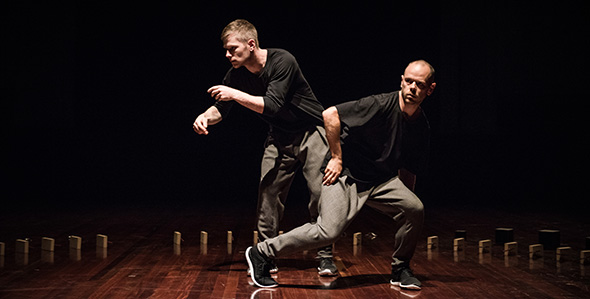
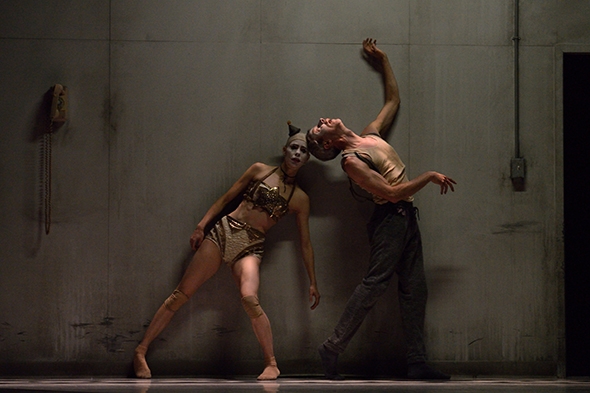
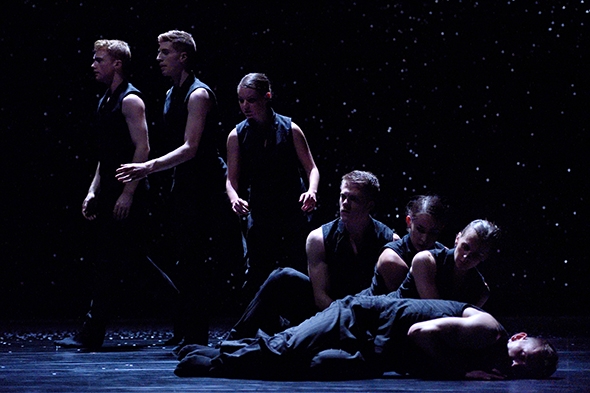
Alisdair Macindoe and Antony Hamilton in Meeting (photo: Gregory Lorenzutti)
“What destroys a man more quickly than to work, think and feel without inner necessity, without any deep personal desire, without pleasure — as a mere automaton of duty?” – Friedrich Nietzsche
Bodies as automatons? It’s a philosophical question that sits at the heart of choreography. Can dancers deliver the same movement, at the same intensity again and again without deviation or wrinkle? Both Antony Hamilton originating the choreography and Alisdair Macindoe inventing the bots and polyrhythmic composition dissolve the seam between choreography and composition. Their meshing as a performance duo with highly tuned musicality is a feast of call and response and displays acres of tensile strength. Imagine the microseconds before the gun of a 100m race is fired: Macindoe and Hamilton don’t go on the ‘b’ of the bang, they play in the space when the lips begin to close and formulate the hum of the ‘b’.
With the 55 minute performance split into three sections, the first sees Hamilton and Macindoe inhabiting the 4-metre radius circle of bots (64 pieces of wood measuring no more than 20 x 15 x 10 centimtres with a pencil attached to a pivoting mechanism on the side, tapping the floor at different intervals); this intensity of focus and action does not allow our gaze to wander or be distracted by any superfluous activity. It deepens the connection between audience and performers as we’re all submerged in this tight frame for the first 25 minutes; it is relentless adventure with feats of physical and verbal memory.
“Words are but the vague shadows of the volumes we mean. Little audible links, they are, chaining together great inaudible feelings and purposes.” – Theodore Dreiser
Hamilton and Macindoe are human gnomons casting shadows and carving air as they latch on to one of the many polyrhythms created by the orchestra. The primary choreographic language employed is popping (sometimes known as the robot dance), building staccato patterns through the isolation of muscles in their arms, neck and torso. The style ensures a crisp, cool and technically impressive feat yet Macindoe does not match Hamilton’s skill. The difference is clear and Macindoe is not able to execute and pop as the softness of a contemporary training blunts the edges required.
As Hamilton slowly breaks the circle of bots, we see his b-boy history as he softly baby freezes over the boundary of bots, shifting his weight as he meets the floor and begins to reconfigure them into a new formation. With a series of miniature robotic henges casting dawn-length shadows across the stage we began to see and hear a transformation. There is a delicacy in play in the second section — a balance between sound, motion, the sound of motion and the motion of sound. The sonic palette has shifted too as miniature trays, blocks and alternative materials are placed underneath the pencils and as they strike down alternative tones reverberate and the monochromatic drum march has been replaced with a textured soundscape.
“Ah, thou hast made my heart captive in the endless meshes of thy music.” – Rabindranath Tagore
Time is often foregrounded; from the unfinished and rewound repeated movements glitching in our eyes, to the complex musical time signatures pulsing in our ears — we know that time exists but are unsure at which speed it is being played out. This invisibility is remembered at the end as the dancers leak off stage and the audience is serenaded for the last five minutes by the orchestra. Even though the bodies are no longer present, the interweaving of choreography and composition ensures a physical residue in the audience memory. As the tones shift I see their bodies echo in the space, popping, patterning and replaying movement sequences that were present a few moments before.
There were dozens of moments of virtuosity: from an eyes-closed verbal recall of a numeric pattern at Mach 1 making them sound like a pair of Australian market traders bamboozling the audience’s ears, to a tight hand sandwich duet at close proximity as they pivot and twist, using their palms as records moving in and out of a jukebox at speed. As an audience we’ve been internally tightened and our gears wound watching these feats without breathing or shuffling in the rich and sparse landscape Hamilton and Macindoe have created. Meeting is a quietly rich encounter between man, machine, motion and sound that rewards your attention with mesmeric human feats and meditative sonic patterns.
Posted: June 23rd, 2016 | Author: Nicholas Minns | Filed under: Festival, Performance | Tags: Albert Garcia, Banjamin Talbott, Claudia Catarzi, Cristina Lilienfeld, Dance Roads, David Gernez, Gwyn Emberton, Jasper van Luijk, Jefta Tanate, Layers, Lucie Augeai, Nœuds, Qui Ora, Yonder | Comments Off on Dance Roads 2016
Dance Roads 2016, Seligman Theatre, Chapter, Cardiff, June 8

Lucie Augeai and David Gernez in Nœuds
Dance Roads is an international touring initiative that supports choreographic development and provides artists with international exposure and networking opportunities on a biennial basis. The network is made up of organisations from five countries: The Netherlands, Wales, France, Italy and Roumania and is jointly coordinated. This performance at Chapter marks the final leg of the touring program.
Jasper van Luijk’s Yonder, danced by Jefta Tanate, is the most formally crafted of the five works on the evening’s program, a play of chiaroscuro in which Tanate moves naked through a field of lights. The stage resembles a photographic studio in which van Luijk has set up lights at various heights and angles. The choreographer cedes his place behind the camera to the audience and allows us to watch as Tanate manipulates the lights during his performative journey. There are thus two sources of movement, human and mechanical, interacting at different rhythms through the action of a single entity. When he is not swinging lights or swinging on them, Tanate moves with an almost automated articulation, his facial expression belying no emotion, nor betraying any narrative for his actions. This existential quality relates to what the program note for Yonder describes as ‘a search for the beginning and the end of time with the lifecycle of one man.’ I’m not sure many in the audience would pick up that notion while watching — I certainly didn’t — but there is a sense of time passing on a journey from darkness to light, from frenzied turning to stillness, from a sublime moment of elevation to a jarring fall to earth. What links these episodes is van Luijk’s paean to the male body that Tanate, without any apparent strain or self-consciousness, dances on the edge of his senses.
The poet Dylan Thomas lived constantly on the edge of his senses; Gwyn Emberton takes on the imagery of his poem Fern Hill in a short solo called Of the Earth, where I came from, originally choreographed on his own body but here danced by Albert Garcia. Emberton chooses not to set movement to Thomas’s words but with composer Benjamin Talbott delves into the sense of exploration in the poet’s memories of spending youthful days on his aunt’s farm. It starts with an image reminiscent of a portrait by Rollie McKenna of Thomas entwined in the branches of a tree: Garcia is in a headstand in shadows cast by tied, gnarled brushwood. Both poem and choreography are suffused with regret for the process of ageing but by setting his choreography on a younger body, Emberton sets up a tension between youth and age. Like the poetry, Of the Earth, where I came from has no rest as one image of the body switches suddenly or slowly, unfolding, unfurling and upending with a muscular fluidity that is nevertheless ageless.
In Noeuds (knots), Lucie Augeai and David Gernez (Compagnie Adéquate) perform a playful take on family relations (they are married) in a bright gestural duet that has elements of theatre, circus, mime, and dance. Their use of baroque music (Marin Marais) gives lively accents to their dialogue that allows the gestural forms, which look at first like conducting, to become the principal channel of expression. Noeuds does not, as its name suggests, describe an easy relationship. Augeai holds her breath with bulging cheeks while Gernez bares his teeth; he holds her tightly while she tries to escape. The initial pleasure builds to confrontation but Augeai does not submit; she gives as much as she gets. She has a way of using her eyes with the tilt of her head that conveys clarity of intention; the register is as high as laughter and as low as aggression. Gernez is her foil, against whom Augeai plays to comic and dramatic effect. He is driven to a final solo of male frustration after which Augeai diffuses it with her weaving pattern. The knots are subtly disentangled and they walk off together.
Claudia Catarzi’s Qui, Ora (here, now) is a minimal work that comes at the end of the middle section after two other works, so not an ideal place for audience concentration, which it needs. Qui, Ora is a choreographic response to immediate physical factors: space, a costume, the audience and sound. It has the feeling of an improvisation, stark in form with playful elements. If you put on a stiff and raspy-sounding coat, then your movements will necessarily emphasise its qualities; Catarzi dances the coat with birdlike attention and a dry sense of humour, sloughing it off at the point it appears to be dancing her. She responds to the space around her (and to a Johnny Cash song) with movements that are angular and loosely anarchic; it is like a play by Samuel Beckett with moments of dry wit, an element of the absurd and moments of pure poetic flow.
Cristina Lilienfeld’s work, Layers, is a meditation on skin and what it reveals of our inner emotional life. She uses her own skin as a material on which to receive our thoughts and feelings, and with which she projects a sensorial appreciation of the unfettered body. Disarmingly generous, she nevertheless protects the intimacy of her personal space in the very act of sharing it, playing with the tension between looking and being looked at and never failing to meet our gaze head on. In the opening section she reinforces the skin’s opacity by rolling and slithering her almost naked body on a mix of sand and flour to the sounds of rain and thunder and masks her face in her long, thick hair. It is a state of emotional turbulence in which she appears to be testing our gaze. “You are under my skin. You are in my heart,” she tells us, and invites us to write whatever comes to mind on her skin with her eyeliner pencils: artist and audience sharing the same material. “Thank you,” she responds, peeling off layers of skin-like patches from her body as she retreats. She reappears carrying a bowl of water. If the first part of Layers is a ritual covering of her skin, the second is a ritual cleansing. In between these two states, where Lilienfeld is naturally expressive, there are moments of ‘dancing’ which immediately signal something inherited or taken for granted. But there are also moments when she creates something mesmerising out of her unadulterated presence. In being naked — a metaphor for both freedom and vulnerability — the removal of physical and psychological layers creates in her an exuberance that makes emotion visible.
Dance Roads, as its name suggests, is a network of roads that is funded by the EU to convey choreographic expression from one country to another. While it is a pleasure to watch works that originate elsewhere, at the performative level the model offers neither integration nor differentiation between cultures, for the audience or for the dancers. What makes van Luijk’s work so different from that of Compagnie Adéquate, for example? What would happen if Catarzi were to create a work on Lilienfeld, or Lilienfeld on Tanate? It might be interesting to explore such questions in future collaborations so that the creative spirit finds new roads to follow.
It is ironic that this article on Dance Roads should be published on the eve of the EU referendum in which a majority of UK voters decided to leave the EU. The result may well mean Wales will no longer be eligible for the Dance Roads network.
Posted: June 20th, 2016 | Author: Ian Abbott | Filed under: Performance | Tags: Baroness Jane Campbell, Chris Henry, David Hevey, Deaf Men Dancing, Dr. Paul Darke, Mark Smith | Comments Off on Deaf Men Dancing, Let Us Tell You A Story…
Let Us Tell You A Story…, Deaf Men Dancing, Surgeon’s Hall Museums, Edinburgh, June 15

Let Us Tell You A Story (photo: Ian Abbott)
“Think you of the fact that a deaf person cannot hear. Then, what deafness may we not all possess? What senses do we lack that we cannot see and cannot hear another world all around us?” – Frank Herbert
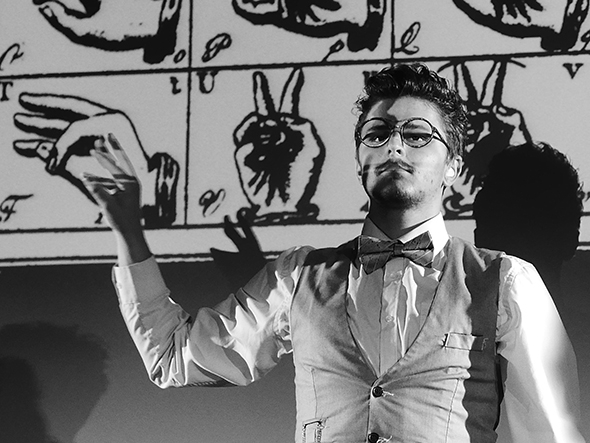
Let Us Tell You A Story… by Deaf Men Dancing (DMD) is one of a number of artistic commissions inspired by eight of the UK’s medical museums. Mark Smith, founder and artistic director of DMD, spent time at the Thackray Museum in Leeds which holds a collection of nearly 1,000 objects relating to deafness, including Queen Victoria’s ear trumpet.
This suite of commissions (DMD, Julie McNamara, Francesca Martinez and David Hevey) are not only inspired by the collections but are also being presented in those same spaces — including the Hunterian and Science Museums, Bethlem Museum of the Mind and the Royal College of Physicians — to open up dialogue, debate and challenge entrenched assumptions. Medical institutions are often hundreds of years old and use a scientific language that perpetuates the medical model rather than adapting the language to the current social model of disability. Walking around the Surgeon’s Hall Museums for an hour looking at hundreds of isolated body parts in jars and preserved examples of tumour-riddled ears or gangrenous hands amplified my bodily awareness before going in to watch the commissions.
How language is used and the choice of words is a delicate issue not only in culture and disability but in medicine, too. In the post-show conversation some audience members called attention to the descriptions on some jars that used the word ‘mongoloid’ and ‘abnormality’ in reference to someone who had learning disabilities. Chris Henry, the director of heritage at the Surgeons’ Hall Museums, was unapologetic as he framed the dialogue and context of the museums in terms of pathology (the study of disease) whilst recognising the need to offer a social context for the language that may have been deemed appropriate at the time of labelling.
“The one thing I have that nobody else has or can duplicate is my sound. The sound of my life. Others may say similar things but they can’t say them like I do.” – Suzette Hinton
As an interrogation of a museum collection Smith has mined a rich history and with his dance training and previous practice in opera there is a theatrical and a choreographic accessibility to his work. As an audio landscape Let Us Tell You A Story… paid particular attention to how the audience experienced the work aurally and for me this was where it was most effective. From the piercing shrills of high frequency hearing tests to hearing in Smith’s own words in voice over (the first time he’s done this) there was a particularly potent vignette referencing Christianity where the soundtrack changed to a heavily muffled — almost imperceptible to my ear — version of the Lord’s Prayer. It was this proximity to a lived experience that brought me closest to the performance.
Let Us Tell You A Story… is Smith’s research process and personal passions made visible. I came away having learnt oodles about the history of the Deaf movement including the seminal 1880 Milan conference where a number of world experts banned sign language and forced people to use speech therapy instead of signing and how thousands of soldiers returned from war deaf yet this was hidden from the public and society at large. Each of the vignettes was presented in isolation and the work suffered dramaturgically as there was little glue holding the sections together. I felt myself wanting to dwell longer in each section. Learning about the magnitude of these events was thought-provoking, but in combination with movement, projection and a newly composed soundtrack, I was struggling to process it all before we were shifted into another period of history.
Coming in at just under 30 minutes, the performance was hampered by the uneven combination of dance technique and theatrical training in the three male dancers who are all on stage all of the time; I was always drawn to the weakest performer. Based on a structure of vignettes there were a number of solos but very little group work and the choreography often leant towards the literal. In the war scene, for example, we have a number of army crawls and hyper excessive facial expressions that did little to coax my empathy. There are fleeting moments of interaction with the audience where the performers share objects like feathers, balloons and clasp our hands; this could be developed more and encourage a greater sensory experience. With a slate grey palette for the costumes, each performer arrives and intermittently interacts with an oversized case with a detailed illustration of the ear on the outside; there’s real attention to detail from the other collaborators in the creative team lead by the excellent sound designer.
Although hampered by a stage depth of barely three metres, I feel that Let Us Tell You A Story… with some editing and dramaturgical input could suit the outdoor festival circuit. The vignette structure would welcome audiences that arrive mid-way through a performance and Smith’s theatrical leanings and the skills and energy of his performers may find a better home in this context.
“There are so many people, deaf or otherwise abled, who are so talented but overlooked or not given a chance to even get their foot in the door.” – Marlee Matlin
On the same bill I also saw David Hevey’s documentary, The Fight For Life, in which he captures — on digital celluloid rather than in formaldehyde — articulate, insightful yet bruising encounters with personal histories of disability. Dr. Paul Darke, who attended a school for disabled people, remembered how all the students in the school were anally and vaginally fingered twice a year by a medical consultant; accepted as normal and authorised by the school, the procedure lead to him feeling that ‘your body was theirs.’ Baroness Jane Campbell of Surbiton, who uses a wheelchair and ventilators to aid her breathing, went to hospital with pneumonia (although in a hazy state she was still conscious) where in her presence the doctor said to her husband: “You wouldn’t want us to intervene or resuscitate her because she’s very fragile.” Seeing the medical staff was making assumptions about her because of her disability, her husband rushed home and brought back her doctorate and examples of the work she had done and said, “She has pneumonia, treat her.” Baroness Campbell summed up her observation that decisions on the disability living allowance are often made by those with little experience of austerity with a devastating aphorism: ‘Nothing about us: without us.’
Led by the Research Centre for Museum’s and Galleries at the University of Leicester, this suite of new commissions is considered and asks questions around why certain bodies are highly valued and others are viewed problematically. It’s a welcome injection that rejects an idealised norm.
Posted: June 12th, 2016 | Author: Nicholas Minns | Filed under: Festival, Performance | Tags: Akram Khan, Akram Khan Company, Battlefield, Brighton Festival, Ching-Ying Chien, Christine-Joy Ritter, Farook Chaudhary, Karthika Nair, Peter Brook, Until the Lions | Comments Off on Until the Lions: Akram Khan Company at The Brighton Festival
Akram Khan Company, Until The Lions, Brighton Dome, May 27

Ching-Ying Chien in Until the Lions (photo: Jean-Louis Fernandez)
Earlier this year I saw Peter Brook’s Battlefield at the Young Vic; it was his adaptation of five books from the Sanskrit epic Mahabharata. Akram Khan made his debut at the age of 13 in Brook’s original nine-hour production of the Mahabharata. What a coincidence then, that Khan should present in the same year as Battlefield another story from the same saga, one of love, betrayal and revenge in an original reworking by Karthika Naïr that has become Until the Lions.
The title comes from an African proverb: ‘Until the lions have their own historians, the history of the hunt will always glorify the hunter.’ The lion in Naïr’s poem is Amba, the daughter of the King of Kashi who is abducted on her public swayamvara (betrothal) ceremony by Bheeshma, the son of the Kuru king. Vowing revenge on Bheeshma, Amba immolates herself and is reincarnated as the male warrior Shikhandi by whose hand Bheeshma meets his end on the battlefield. The dual role of Amba/Shikhandi is danced respectively by Ching-Ying Chien and Christine Joy Ritter; the role of Bheeshma is danced by Khan himself.
Until the Lions has Kahn’s signature symbolism and spirituality dressed in white and covered in haze, with arresting stagecraft and musical accompaniment (by Sohini Alam, David Azurza, Yaron Engler and Vincenzo Lamagna). The dancing of Chien and Ritter is what we have come to expect in Kahn’s international casts of exceptional artists whereas Kahn’s own performance, even if his presence is strong, lacks the flow and attack he once had. It is something he acknowledges, but it begs the question of why he didn’t find a younger dancer on whom to create the role. The result is a performance that has all the appearance of significance yet lacks its bite. There is a feeling that Nair’s poetry has not gained in the dancing, but is simply the starting point of something else, something defined more in the production values than in the content.
Brook’s space for Battlefield is spare, a vast stretched stage cloth with very few stage elements. This environment stands in stark contrast to the subject of the dialogue and enhances the production’s focus on the clarity of thought. Khan and his producer, Farook Chaudry, have taken a different path. The narrative involving three characters has been treated with a monumental production by conceiving it for the 360° Network of round artistic venues across the world. Created in the round, with Tim Yip’s vast slice of fissured tree trunk for a stage and with Michael Hulls’ lighting, the setting is to dance what the rock concert is to music. Michael Billington commented on Battlefield that ‘at a time when theatre is giddy with technology, you are struck by the way economical means are used to maximum effect.’ By contrast Hulls seems to be vying with the choreography for primacy.
The work premiered at The Roundhouse (a founding member of the 360° Network) in January. I didn’t see it there but at the Brighton Festival, which is not only one of 16 co-producers but also a co-commissioner of the work. The outside of the Brighton Dome is, like The Roundhouse, circular, but its concert hall is not configured for theatre in the round. It is at best an elongated semi-circle cut off by the stage, so fitting Until the Lions into this space required some spectacular fudging. The first thing you notice is the massive lighting rig to carry Hulls’ circular lighting conception and the second thing is the stage underneath it, a circular platform on top of the Dome’s regular stage.
So why did the Brighton Festival co-commission and co-produce a work that, as conceived, does not fit into its venue? Why co-commission it at all? How much of the Festival’s dance budget was taken up with this co-commission and what did it get from it? The questions are relevant because the dance programming of England’s prestigious festival in its 50th year is much thinner than the quality of English dance would suggest; the Festival has an opportunity if not a responsibility to present a challenging and varied dance program, rather than go for the prestigious names like Khan, or hook up with what happens to be touring with Dance Consortium (as it happened, NDT2). It’s ‘lazy’ programming and it has a deleterious effect on the country’s dance ecology.
Arts Council England, which funds both Akram Khan Company and the Brighton Festival, has a motto, ‘Great Art For All’. The motto has two elements: ‘great art’ and ‘for all’. Even if Khan is a well-known brand, great art does not necessarily equate with well-known names. And ‘for all’ implies that access to the great art is within the financial reach of a broad audience. An expensive work by a prestigious name means ticket prices are going to be high rather than broadly affordable and I can’t help feeling that with 16 co-producers and a co-commission, Until the Lions is roaring its way to the bank while the Festival is left strapped to build a dance program that does justice to the high quality of work that exists in the country (not to mention locally) with the public funds at its disposal. Perhaps a good starting point would be to appoint a dance producer; there is currently no mention of one listed under the Artistic Staff of the festival. There’s a music producer, a theatre producer, a classic music producer, and a family and children’s producer. For a festival that prides itself on its mandate to take ‘a new look at the arts’ and to have ‘the opportunity to assess developments in the field of culture…’ that’s a stunning omission.
Posted: June 6th, 2016 | Author: Caterina Albano | Filed under: Performance | Tags: Betroffenheit, Bill Viola, Cathy Caruth, Crystal Pite, Jacques Rancière, Jermaine Spivey, Jonathon Young | Comments Off on Crystal Pite and Jonathon Young, Betroffenheit
Crystal Pite and Jonathon Young, Betroffenheit, Sadler’s Wells, May 31

Tiffany Tregarthen and Jonathon Young in Betroffenheit (photo: Michael Slobodian)
‘The accident happened. It has happened. It’s happened’. The past is irrevocable and unchangeable. The past can loop a person in a repetitive rewinding of backward motions; there is no escape. In Betroffenheit, a collaboration between choreographer Crystal Pite and theatre director and actor Jonathon Young, this space of no escape is ‘the room’ — the site of trauma. Based on Young’s own experience, the work deals with horror, pain, loss and guilt. Trauma is not an easy subject to engage with, not so much because of its resistance to representation but rather because of its pervasive presence in our culture. Overused and glamorized, trauma has lost meaning and with it the connotations of the experience it designates. As a result, the risk for any artist wanting to engage with the subject is either that of slipping into self-confessional indulgence or in facile generalization or, even worse, universalization. Pite and Young resist these pitfalls. Betroffenheit does not steer from ‘the event’: it is focused on a moment in time and on the individual locked in its repetitive occurrence, constrained within the claustrophobic narrowness of pain and loss. There is no generalizing. It is one man’s experience — performed by Young himself — that isolates and is isolating: ‘The accident happened. It has happened. It’s happened’, repeats Young in his disjointed re-telling of the drama that unravels in his mind and on stage. ‘The room’ cannot be shared. The shock and the encounter to which the title Betroffenheit alludes are his fears, unbidden memories, guilt and survival. They are the ghosts that unremittingly draw him back to that space where the past repeats itself and attempts to get to terms with it are futile. Indeed, as trauma theorist Cathy Caruth observes, belatedness and incomprehensibility are at the heart of the traumatic event and its repetition opens up realms beyond what can be known.
Performatively, Betroffenheit enters such a space of belatedness and incomprehensibility by drawing on and weaving together a broad range of references from art, literature, theatre, psychology, film and dance. The first half is set within a narrow perimeter of false walls, clinical and industrial at the same time that are open on one side − ‘the room’. Voices intrude, personages enter it and lure Young into a disturbing vaudeville acting out, sinuously performed by Pite’s five dancers. The narrow space of ‘the room’ temporarily blasts open into the event — reminiscent of Hollywood’s disaster movies — then the room closes again onto its painful repetition. Pite and Young have set in motion what Jacques Rancière refers to as ‘a complex set of relations between the visible and the invisible’. This unleashes a chain of images, words, and movements that alter each other to convey ‘the sensible texture of an event’ whose forms are disquieting, grotesque, and nightmarish.
This motion continues in the second half, though the register changes. A spotlight defines the empty stage with its single pillar as a rarefied cone of incomprehensibility. If words and strident visual frames seemed to overtake the first part, dance regains its centrality in the second. Visual references are implicit in the moving tableaux of a Renaissance pietà and deposition reminiscent of the suffused rendering of Bill Viola’s slow-down video reenactments of The Passions (2000). Breathing becomes the sensorial punctum (in Barthes’s sense) on which the affective tension of Pite’s choreography unfolds. And breath carries the emotional movement of the work to its conclusion. The event happened, has happened. The event cannot be escaped nor understood. There is no resolution, only the possibility of acceptance. In the final solo by Jermaine Spivey, the spasmodic dance macabre of compulsive fears of the first half mutates into a fluid quietness of motion and emotion which weave through and across each other.
A question remains: where do Pite and Young position the audience in relation to the work? The first half of Betroffenheit makes subtle use of an alienating effect reminiscent of Antonin Artaud’s theatre of cruelty. Recorded applause cruelly marks the re-enactment of trauma. We are uncomfortably reminded of the spectacle and voyeurism with which horror is so often endowed. In the second half the carefully lit pillar whose shadow lengthens over the auditorium gestures towards another position for the spectator, that of attentive, intelligent and sensitive observance.
Posted: June 6th, 2016 | Author: Nicholas Minns | Filed under: Performance | Tags: Liz Aggiss, Mary Wigman, Nerea Martinez de Lecea, Slap & Tickle | Comments Off on Liz Aggiss, Slap & Tickle
Liz Aggiss, Slap & Tickle, Brighton Concert Hall, May 20

Liz Aggiss in Slap & Tickle (photo: Holly Revell)
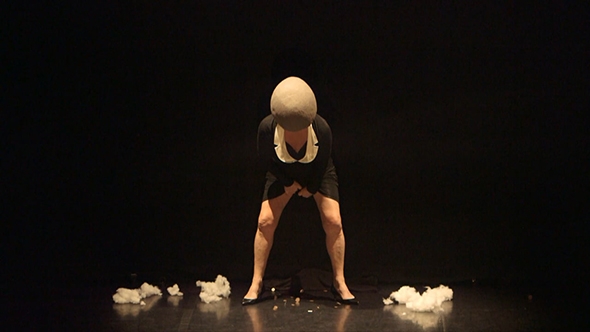
When I read Ian Abbott’s review of Liz Aggiss’s Slap & Tickle and took in the publicity image of a lascivious Aggiss astride a lit fluorescent tube on a red leather armchair, the two together confirmed an image of the show: irreverent, funny, and ripe with sexual innuendo. ‘Slap and tickle’, after all, is a British euphemism for foreplay. However, when I saw the show at the Brighton Festival soon after, these elements were framed in something altogether darker than I had imagined, with more bite.
Aggiss grew up ‘in a repressive era’ in a post-war Essex suburb, but she uses dance imagery that belongs to the 1930s Expressionism of the Weimar Republic and its satire of bourgeois values. We hear signature tunes from family BBC radio programs of the 50s whose naivety is cut through by the sexual politics of a later generation. ‘Are you sitting comfortably?’, she croons the beginning of Listen With Mother. ‘Well, it’s going to get worse.’ She strips back the dark underbelly of social mores and then rescues us from her gleeful dissection with her bawdy humour. Get Aggiss on a bad day, however, and Slap & Tickle would be murderously toxic.
But this evening she’s on her irreverent best behaviour. She even treats us to party games in the brief interludes between acts; the lucky winners of pass-the-parcel unwrap a yellow scarf with the printed black outline of a cock on it. There’s much penis envy among the losers. While playing pass-the-balloon the recorded voice of Emma Kilbey encourages us to rub them on our legs, or stuff them up our jumpers. ‘Let’s have a party’, insists Aggiss, and we do.
According to Aggiss’s trenchant text in the beautiful program booklet designed by Nerea Martinez de Lecea, ‘Slap & Tickle is a solo performance in three acts that decodes, in a disorientating display of contradictions, interpretations and propaganda: girls, ladies, women, mothers, pensioners and senior citizens.’ Pointing obliquely to the fact that when you get to be a pensioner or senior citizen your gender is considered superfluous, Aggiss, at the age of 63, is proof of the lie. She leads her female audience to revolt: ‘Are you sitting comfortably? Well, you shouldn’t be.’ And she means it.
The three acts of Slap & Tickle roughly follow three stages of sexual emancipation, from the ‘world of child’ in which ‘answers…are merely guidelines’ through the dismemberment of ‘romanticism, dominant narratives and social codification’ of adolescence, to the exhilarating realm where ‘puritan ethics and codes are banished’ and ‘wearing a tail, a red hat and no knickers is de rigeur.’ Aggiss has spent her life preparing this work and it is in the editing of her material that she manages to concentrate that experience in such a rich, seamless format. Like the collage work of Hannah Hoch (whom Aggiss cites as an influence), her consummate skill in choosing which element to superimpose on, or juxtapose with another makes her allusions and metaphors subversively and disturbingly entertaining. At the beginning of the first act she enters regally in a voluminous golden dress, her head hidden under a Vogue-ish gourd. She opens a fold of the dress to reveal a cloth doll that she drops repeatedly and dispassionately on the floor before discarding it. She raises the hem of her skirt to reveal one glass slipper and performs an expressive arm dance to Mrs Mills on the piano and professes shyness as she raises the hem of her dress further to reveal bare white legs with a whiff of permissiveness. Then she huffs and she puffs and sings the line about the old lady who swallowed a fly as she slips out of her dress to reveal ample knickers from which she retrieves bits of padding, coins and a number of ping pong balls. If she’s not slapping us out of our social servility she’s tickling our desire for moral clarity. ‘All instincts that do not find a vent without’, wrote Nietzsche, ‘turn inwards…’ Aggiss spent a childhood turning inwards; now is the time to ‘vent without’, challenging ‘expectations of what a mature female dancing body should be doing, why she should be doing it, and where it should be done.’ Just as she uses her subversive brand of vaudeville to articulate suppressed instincts, her dance takes inner movements and turns them into outward form — the Ausdruckstänz, or expressionist dance of Mary Wigman. Her rendition of Klaus Nomi singing The Cold Song in a black and white costume reminiscent of Nomi’s own signature suit, is not only beautifully crafted but is consistent with her theme of bringing the body into line with the unfettered mind: ‘…the body and voice are tethered by an invisible umbilical vocal cord that swings abruptly through buried truths and nasty realities, whilst simultaneously and repeatedly slamming against the on/off button.’ It’s a battle, ‘push and pull’, and if it gets too much, ‘Let’s all go down the Strand – Have a banana!’ Foreplay has turned into punishment and reward.
Slap & Tickle engages fully with the audience in the music hall tradition so that however dark the material Aggiss finds a way into our minds with her irreverent humour and makes us laugh at our own wobbly moral compass. She has travelled a resolute path for the last 40 years and has emerged with ‘the determination to maintain female visibility, to snatch the dance performance space from the clutches of youth, and to contextualize the stage with a content driven world that speaks to and for other generations…’ ‘Are you sitting comfortably? Well it’s going to get a lot better.’
Liz Aggiss will be performing Slap & Tickle at The Place on June 17 and 18 at 8pm.
Posted: May 31st, 2016 | Author: Nicholas Minns | Filed under: Performance | Tags: Alog, Cherrie Lau, Footprint Dance Festival, Helen Cox | Comments Off on Helen Cox, de/construct
Helen Cox, de/construct, Footprint Dance Festival, Michaelis Theatre, May 14

Helen Cox in de/construct (photo: Lawrence Choi)
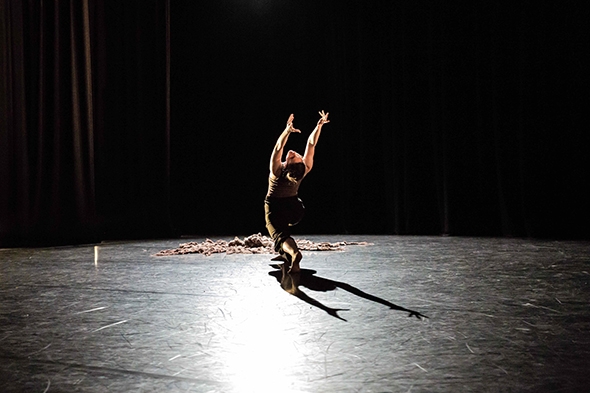
I had seen Helen Cox at Resolution! in February 2014 in a piece called Lapse, co-created with Heather Stewart. Both Stewart and Cox seemed like pawns in a complex game of text and movement, so it was interesting to see Cox performing in her own right at Roehampton University’s Footprint Dance Festival. According to the program note, de/construct traces the patterns of growth found in natural landscapes; though the title has rational connotations, both the imagery and the music by Alog are decidedly organic. As the lights come up we see a small island of sinewy hemp rope and sacking (designed and made by Cherrie Lau) that envelops the kneeling Cox, fitted to her waist and trailing around her like a network of roots. It is not a heart that beats but hands that quiver as she grows slowly out of this material; her body takes on its distinctness, its edges clearly defined. She sloughs off the skin to revel in the space around her but Cox does not take this separation for granted; she looks back at it in breathless moments of stillness, drawn up to her full and immaculate balance. When she begins to move, the agency of her movement is neither inside nor outside her; she simply elongates and stretches her sinuous, smooth gestures around herself in circular patterns that have no end. Watching her is like hearing fragments of speech in the wind, but they are fragments of speech in another language, eerily incomprehensible yet fully formed and complete. She lowers herself to the ground, silently. More quivering hands and smooth, sweeping diagonal gestures across her body, like a conversation with the air, her face intently listening, her body somewhere between birth and independence in the natural world. de/construct is but a fragment but for a moment all social constructs, all structures of human life, dissolve.
de/construct was the last of eight varied works on the final evening at Roehampton’s Footprint Dance Festival, about which more later.
Posted: May 30th, 2016 | Author: Ian Abbott | Filed under: Performance | Tags: Aaron Nuttall, Adam Peck, Avant Garde Dance, Dani Harris-Walters, Fagin's Twist, Jackie Shemesh, Jemima Brown, Joshua James Smith, Lisa Hood, Maxwell Golden, Tony Adigun, Yann Seabra | Comments Off on Avant Garde Dance, Fagin’s Twist

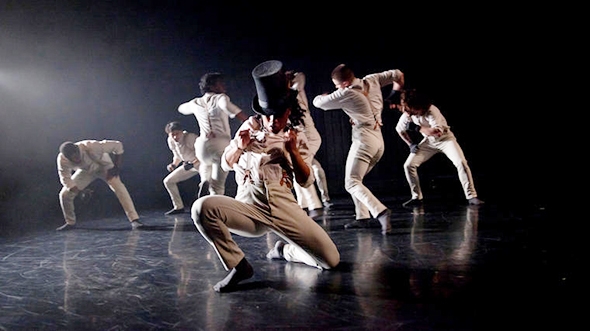
Avant Garde Dance in Fagin’s Twist (photo: Rachel Cherry)
“But struggling with these better feelings was pride — the vice of the lowest and most debased creatures no less than of the high and self-assured.” – Charles Dickens
Avant Garde Dance (AG) has been going “against the grain” for the last 15 years under the auspices of artistic director, Tony Adigun. Having seen more than a dozen of their outdoor and indoor works, commissioned them to work on large-scale performances integrating community casts of 100 people, to working with the Bournemouth Symphony Orchestra on the iconic performance Vesalii Icones by Sir Peter Maxwell Davies, I awaited with curiosity the skewing of a Dickens classic.
Fagin’s Twist, co-produced by The Place, is AG’s largest tour to date with over 40 performances across 2016 and substantial support from Arts Council England and other co-commissioning partners. Working with the writer Maxwell Golden and dramaturg Adam Peck, the audience is presented with a simple storyboard narrative that focuses on Fagin (Joshua James Smith) forging in the workhouse, his adventures in the lair and his ultimate undoing by young master Twist.
Opening with the full company (8 dancers) rotating, snaking and snapping whilst passing a mid-size white hat box between them exposes an early weakness as the ability to blend prop handling and movement restricts them and doesn’t allow them the anatomical freedom to focus or execute with the required conviction. Slipping between theatre, hip hop styles and contemporary dance we’re introduced to a krumping Bill Sykes (Dani Harris-Walters), a breaking Artful Dodger (Aaron Nuttall) and a contemporary Nancy (Lisa Hood). Stylistically these fit their character traits — in the first act the jittery physical vocabulary and nimble b-boy flourishes of Nuttall add a depth of character as he breaks the fourth wall with a set of welcome narrations which aid the re-telling. Smith has also a certain dash about him, like a fencer darting across the stage with able command of both body and voice. With the five leads including Oliver Twist (Jemima Brown) mic’ed up we unfortunately see a lacklustre physicality seeping into the vocal performances; a lack of conviction in both body and voice, and an inconsistency across the two acts (this is the 12th performance on tour) caused my interest to wane.
The first act is a series of establishing speeches twinned with tutting and hip hop routines delving into Fagin, his gradual acceptance by Sykes, their joint escape, finding the lair and the introduction of Oliver. With a second act full of stage choreography for exposition purposes, the character definition breaks down and we are left with 8 moving bodies who’ve seemingly forgotten their original intentions and emotional relationships with each other. With a recurring motif of a low-crouched, puppet-armed jump that hints at A Clockwork Orange, the pack often comes together before splitting off into duets and trios that fall very close to “hip hop as mime” territory. There’s a fine line between showing a story and keeping the audience on the outside and telling a story and pulling us in.
“When I first read ‘On the Road,’ it helped me figure out how to live against the grain. Now I wonder how to be subversive when the subversive has become mainstream.” – Tony D’souza
I see a number of biographical echoes where you could replace Fagin with Adigun; having started life outside the system he recruits a merry band of accomplices who begin to scratch a living together. Success comes slowly as he is embraced by others, but responsibility weighs heavy for the health of the unit whilst younger and hungrier insiders begin to splinter as he takes his eye off his pocket watch. However, after 15 years can you continually go against the grain? Pushing doors open for others takes a lot of energy and being swallowed by the mainstream that is slowly de-teething and sanding the edges that made them want you in the first place is a tricky position for Adigun to hold. Akram Khan serves as a warning/inspiration.
Fagin’s Twist offers an entertaining night out for those new to dance theatre who might be a little Dickens curious and there’s a slick production mask scaffolding the work. Jackie Shemesh’s lighting design casts elongated shadows, hiding faces and bodies in the half-light whilst Yann Seabra’s set offers nooks, levels and holes for the dancers to weave and scuttle about in.
However, if it’s going to sing loud in the autumn tour and emerge as a signature work, then some dramaturgical repairs are in order to build bonds with the audience so we can begin to care rather than watching blunt fireworks; dancers should fill and execute their characters whilst injecting a consistent musicality into their performances and Adigun needs to bring some abrasion and grit back into his choreography.
“You never change things by fighting the existing reality. To change something, build a new model that makes the existing model obsolete.” – Buckminster Fuller
Posted: May 29th, 2016 | Author: Ian Abbott | Filed under: Performance | Tags: 16+ a room, Ballet BC, Bill, Crystal Pite, Emily Molnar, Gai Behar, International Dance Festival Birmingham, Sharon Eyal, Solo Echo | Comments Off on Ballet BC, Birmingham Hippodrome
Ballet BC, Birmingham Hippodrome, May 20

Artists of Ballet BC in Crystal Pite’s Solo Echo (photo: Michael Slobodian)
Without the fanfare and hoopla that surrounded the recent English National Ballet all-female triple bill, She Said, it is testament to Ballet BC and International Dance Festival Birmingham that female choreographers are not a scarcity in either the former nor the latter. With this being the only UK date, a premiere and the debate around non-male choreographers, I don’t understand why “the national critics” weren’t present, choosing to review NDT2 and Northern Ballet instead.
As part of #TheBENCH, an event and wider choreographic support programme designed by 2Faced Dance Company to address the gender inequality in UK contemporary dance, Ballet BC’s Artistic Director Emily Molnar was invited to speak and offer an international perspective. With integrity, sense and articulate coherence in spades she responded and mentioned to the crowd that the company would be performing a programme of Crystal Pite, Sharon Eyal and Gai Behar as well as one of her own works. After seeing Eyal and Behar’s most recent commission on Scottish Dance Theatre earlier in the year and the fervour surrounding Crystal Pite’s forthcoming work on a series of national companies including Scottish Ballet, it was impossible not to be curious.
“One’s action ought to come out of an achieved stillness: not to be a mere rushing on.”- D.H. Lawrence
Molnar’s work that premiered in 2013, 16+ a room, opened the evening. Riddled with detail, pace and luxurious unfurlings of time alongside a repeated slow and knowing presence of a stage walker who held a sign that read ‘This Is A Beginning’ or ‘This Is Not An End’, Molnar accentuated the visibility of time and allowed us to see all the full stops on stage. Almost imperceptible tremors in the bodies floated to the surface in the not quite stillness emphasising the control and fizz of the 16 company dancers. Building entrances and exits into the choreography nothing was wasted whilst oscillating between large packs of movement and intimate duets the piece became structurally familiar but no less impressive. With a lighting design like spots on a domino and an electric rasping soundtrack suiting the crispness of the taut choreographic vocabulary and Molnar’s staccato sock-sliding lunges and pulses 16+A Room was a satisfying start to proceedings.
“When you acknowledge the integrity of your solitude, and settle into its mystery, your relationships with others take on a new warmth, adventure and wonder.” – John O’Donohue
Pite’s Solo Echo left an emotional residue that I’ve only felt after watching the 1953 film Tokyo Story by Yasujirô Ozu. Both are a study of human connections, regret, present echoes and anticipation whilst leaving time for it to settle inside you. With an upstage set design of a constant drop of either snow, petals or sawdust and a sweeping piano and string soundtrack, I read Japanese cherry blossom in the spring, a time for renewal and rituals which were also present in the choreography. A recurring motif of the frozen run, giving space and a softness that supports others, showcased alternative qualities in seven dancers and their ability to connect with the audience and their material. Solo Echo has an emotional sting that remained inside the body long after the curtain had dropped.
“There is no such thing as a life of passion any more than a continuous earthquake, or an eternal fever.” – Lord Byron
Bill is my second live encounter with an Eyal and Behar choreography. Here they remould bodies through anatomical adventures. We see the same limbs and torsos used by Molnar and Pite, yet the angles are skewed, bodies inverted and are presented with a fevered ballet and jelly-legged solos. The stage is flooded with choreography for 22 minutes; patterns of repetitive walking and clockwise rocking provide mesmeric satisfaction mixed with the occasional choreographic burst that is reminiscent of a 90s WWF move by The Bushwhackers beating their arms to a wide invisible drum. They enable the dancers to command the stage with a cat-walking focus whilst conveying the rapturous joy of movement. There’s a depth of field in play, real care for the scenography and texture of the world and a constant eye on the end; Eyal and Behar are always building, always layering and always in control of our gaze. There are echoes of Hofesh Shechter in as much as Eyal and Behar, like Shechter, have the ability to be 1% different, which sets them aside choreographically and spawns a band of imitators. Their craft is a pleasure to revel in.
The construction of triple bills is a delicate game; wanting to build progressively but not drown and leave an audience with an emotional unevenness. Ballet BC’s triple bill was pitched well with an appetising opener, rich and complex main and a finale with all the trimmings and flourishes; here’s a company that has developed a repertoire of more than 35 works since 2009, from William Forsythe to Aszure Barton, and is actively collaborating with The National Ballet of Canada and Frankfurt Ballet to support artists, choreographers and audiences alike. Imagine if British companies would do the same.
Posted: May 25th, 2016 | Author: Nicholas Minns | Filed under: Performance | Tags: Anne Teresa De Keersmaeker, Cecilia Lisa Eliceche, Eveline Van Bauwel, Manon Santkin, Michael Helland, Unison | Comments Off on Cecilia Lisa Eliceche, Unison
Cecilia Lisa Eliceche, Unison, Lilian Baylis, May 7

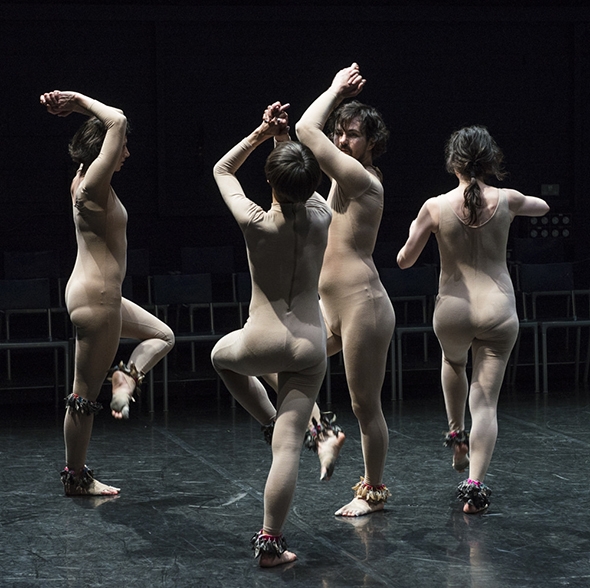
Eveline Van Bauwel, Cecilia Lisa Eliceche, Michael Helland and Manon Santkin in Unison (photo: Foteini Christofilopoulou)
“The frontier between the social and the political is essentially unstable and requires constant displacements and renegotiations between social agents.” – Chantal Mouffe, On the Political
There is something mischievous in the way Cecilia Lisa Eliceche meets the gaze of the audience around her in the Lilian Baylis studio; it’s a cross between intense and ludic and it informs the way she choreographs. Set on four dancers (Eliceche, Michael Helland, Manon Santkin, and Eveline Van Bauwel), her most recent work, Unison, distils the attraction of dance into its component elements of movement, pattern and rhythm in search of the nature of unison. Eliceche costumes her dancers in flesh-coloured unitards to emphasize their bodies as instruments of her choreographic exploration without signifying any particular genre.
The performance starts with a bare stage and the sound of a riotous celebration from one corner, beyond the wings. The celebration moves in silence to another corner where we hear it again, like an early display of stereo. Eliceche studied at the Performing Arts Research and Training Studios in Brussels and the influence of Anne Teresa de Keersmaeker’s uncompromising stagecraft and intellectual rigour is evident. A curtain parts and the performers step through in their body suits with strings of South American folkloric chas chas (lamb hooves sewn on to fabric strips) stuck on various parts of their anatomy. They arrange themselves haphazardly in different areas of the space facing different ways and begin the first exercise in unison. Since they cannot see each other and the movements are silent, there is a contradiction between the intent of the choreography and its realisation; while aspiring to unison, the dancers never quite achieve it. This contradiction will remain at the heart of Eliceche’s exploration and define its choreographic form.
When Helland takes off his chas chas and begins a classical port de bras sequence in the centre of the space, the three others watch. It is a four-phrase moving sequence that he performs to all four directions of the audience, but as the other dancers join in, repeating the sequence in opposing and complementary directions, the classical idea of unison is, despite the form, elusive. In its place is a sinuous weaving of patterns that requires a sophisticated spatial awareness, but even this breaks down when the quartet becomes so interlocked it gets stuck in a corner; there’s no room to manoeuvre so the dancers regroup to set off again. It all seems part of the game as they check with each other which course to set. Unison starts to look more like a choreographic argument than an exposition of a concept even if choreography does not have the same clarity as thought. Nevertheless dance has its own intelligence and Eliceche is experimenting to find out how she can employ it.
A third section sees the quartet moving through a similar set of phrases but to a faster tempo with an accumulation of new material. The voice, like a child’s rendering of a steam engine, is brought into the equation as accompaniment and when the movement stops it is the breath that continues in unison. Here is the first statement by Eliceche of what unison might be rather than what it might not be. A fourth section reimagines unison by introducing contact improvisation. It is the first time the dancers connect with each other, fitting like puzzles within and around each other in dynamic sculptural forms that can at any time fall apart and be refashioned. The quartet takes their sculptural improvisation up the railing of the staircase like naughty children in a playground, but never abandon their choreographic task. A brief pause to drink some water suggests another sense of being together. The quartet put on their chas chas again to start a rhythmic sequence of phrases based on the initial sequence, using clapping and voice to further enhance the folk rhythm. They regroup, standing on one leg like herons, bending their upper body lower until they succumb to gravity and slowly unravel to the floor, redefining once more the boundaries of how they relate to each other. A final sequence takes up the opening phrases like a musical recapitulation: the turning bodies with outstretched arms that continue into the darkness.
There is clearly a lot more to Cecilia Lisa Eliceche’s Unison than meets the eye. It is a refreshing observation on dance, connecting many sources into one manifestation. It is messy in the way life refuses to conform to intellectual concepts but it’s also a social construct if you can unravel watching dance from socio-political theory. The above quote from Chantal Mouffe appears in the extensive program notes to the performance and it is not difficult to see a metaphor for Mouffe’s assertion in the way the dancers negotiate spatially. There is also a long essay by Belgian socio-theorist Rudi Laermans titled, ‘Being in Unison: Being in Common.’ Laermans references Eliceche’s work by answering the question, ‘What does the idea of unison actually suggest or imply, not only as a choreographic tool but also from a wider cultural or socio-political point of view?’ The essay provides an insight into the broad-ranging mind of Eliceche, into her choreographic processes and deconstructs the work itself. Laermans’ writing and Eliceche’s choreography form a powerful package, even if the former is not immediately evident in the latter. Tired of seeing the glossy productions of new work that serve to reinforce the singular idea of dance as sophisticated technique in the service of pre-conceptual amusement, Unison is a salutary and gutsy reminder of just how intelligent dance can be.