Posted: May 18th, 2017 | Author: Ian Abbott | Filed under: Performance | Tags: Charlotte Spencer Projects, Is This A Wasteland? | Comments Off on Charlotte Spencer Projects, Is This A Waste Land?
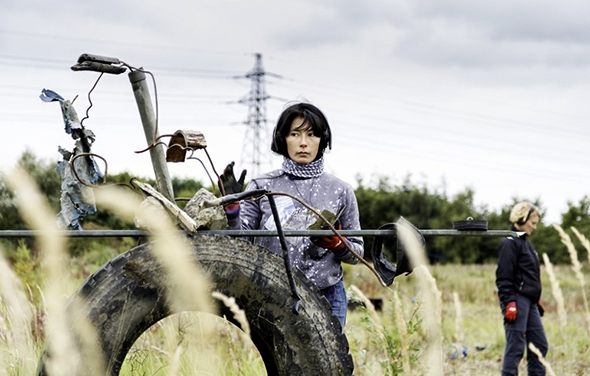
Charlotte Spencer Projects, Is This A Waste Land?, Larkfield Bus Depot, Glasgow, May 12
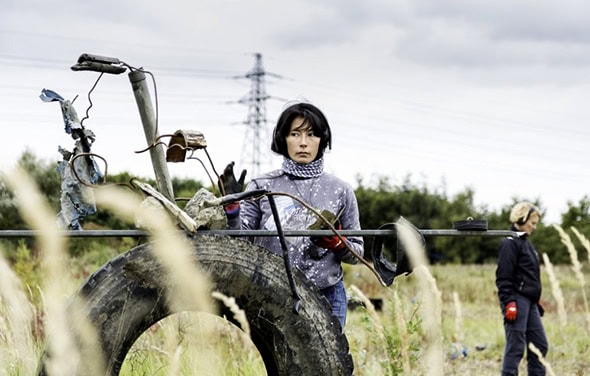
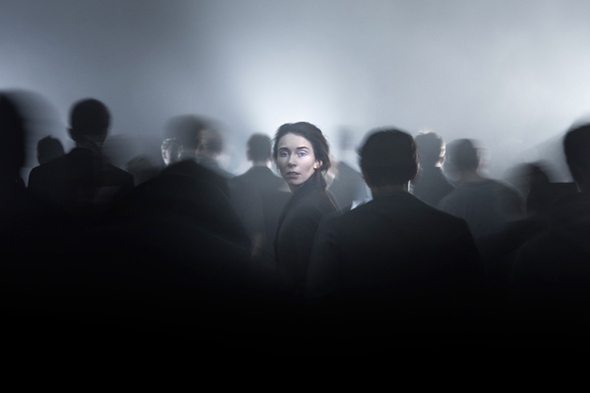
Louise Tanoto in Charlotte Spencer Projects’ Is This A Waste Land? (photo: Pari Naderi)
“Cities are like badger holes, ringed with trash – all of them – surrounded by piles of wrecked and rusting automobiles, and almost smothered in rubbish. Everything we use comes in boxes, cartons, bins, the so-called packaging we love so much. The mountain of things we throw away are much greater than the things we use.” – John Steinbeck
Sited on a former bus depot that has since been razed, we’re aware that there are histories in play; where once buses came to rest for the night, to be repaired and re-fuelled, Charlotte Spencer Projects invites us to inhabit a land and question its former and future use. Armed with headphones and protective gloves we are offered a choice of industrial detritus to carry with us. Is This A Waste Land (ITAWL)? begins with a set of straightforward instructions delineating the boundaries of space and rules of engagement, and then we stop and fill our eyes with the landscape and fill the landscape with our 40 bodies. Instructions begin and we become the temporary workers invited to toil and till the land.
Building upon Spencer’s previous immersive headphone work, Walking Stories, ITAWL? uses six additional professional bodies who work with the site and its contents on a larger and more choreographed scale. The audience is split into three streams indicated by a different coloured LED on their headphones; sometimes we are one, sometimes one mass and at other times broken down into smaller working parties to fulfil particular tasks. Neither Walking Stories nor ITAWL? leave room for dissent; if you want to be an outlier or renegade there is little space for that and it is clear where the power lies. With each member of the audience isolated in their headphones, it is Charlotte Spencer who is in control.
I feel like a doozer from Fraggle Rock as the fetch-carry-and-build endorphins created by using my body in the performance leaves me feeling giddy and engaged; the questions asked in our ears are all achievable as the objects of our labour differ in weight but all bodies can move them. After 10 minutes of building we feel rewarded with a driving soundtrack nestling under the calm invitations to participate and a constant stream of small words of praise reward our behaviour irrespective of whether the task is complete or whether we’re satisfied with our wall of detritus, rope and stick pen or towers of waste creation. The omniscient voice is happy and we must progress on to the next task leaving no time to dwell.
“He who works with his hands is a labourer. He who works with his hands and his head is a craftsman. He who works with his hands and his head and his heart is an artist.” – Saint Francis of Assisi
The six performers (alongside Charlotte) operate inside the work with us; they too are fellow assemblers, preparing scrap teepees and dismantling objects that have come before. However, their tasks are a little more adventurous and pre-meditated, there are clear moments when the focus shifts from the self to them and we must watch them perform a rehearsed set of actions on the site. This creates a divide, a them-and-us, and it is clear they are existing outside the instructional landscape we’re inhabiting. We the participants can be called upon to do remarkable things when instructed, as when we feel against our back the weight of a giant elastic tensile rope in a 30-metre diametric circle we are leaning into and letting it take our weight. The world has been set up so we experience the same place at the same time, we share tasks together and silently encourage each other; if we as nodes were connected a little more often, asked to forge alliances, this would build an even stronger bond under a dwindling light as the city of Glasgow flickers to orangeade and shifts into night mode.
In the programme note there is no mention of the words ‘dance’, ‘dancers’ or ‘choreography’ – this is a work of assemblage and human cartography; individual journeys tracked and mapped onto a waste land as we inhabit it once more creating a new set of histories. Spencer builds and balances our labour and attention over the 90 minutes of the work to offer an analog nourishment to our human form. There’s a simmering of activist intentions to be found alongside a political bite questioning our collective privilege to land and our access to it; if this tone had been introduced earlier it might have coloured our earlier endeavours and how we viewed the work and our part in it. Triggering a set of alternative thoughts on waste as we are gathered together at the end I think about the natural passivity and physical wastage of audiences when work is performed in the theatre; here we may be intellectually or emotionally stimulated but ITAWL? invites us to absorb a work through our bodies as well, leaving us with a dust and physical residue embedded in our pores. Looking at the pattern of exertion between Walking Projects and ITAWL? the next performances by Charlotte Spencer Projects might ramp up the level of investment and industry. I for one would relish the shape of that labour.
“Our toil must be in silence, and our efforts all in secret; for this enlightened age, when men believe not even what they see, the doubting of wise men would be his greatest strength.” – Bram Stoker, Dracula
Posted: May 18th, 2017 | Author: Nicholas Minns | Filed under: Performance | Tags: 10000 litres, Evangelia Kolyra, Joss Carter, Justyna Janiszewska, Sherry Coenen, Sisters From Another Mister | Comments Off on Evangelia Kolyra’s 10,000 litres
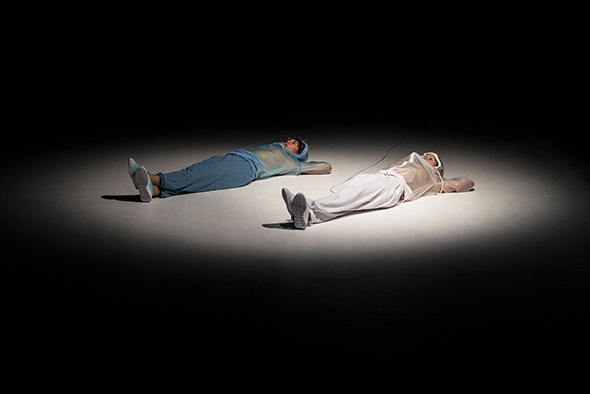
Evangelia Kolyra, 10,000 litres, Rich Mix, May 12

Justyna Janiszewska and Evangelia Kolyra in 10,000 litres (photo: Foteini Christofilopoulou)
The title of Evangelia Kolyra’s new work derives from an estimate for the amount of air that passes through our lungs each day in the process of respiration. After the Rich Mix performance of 10,000 litres I was walking to Old Street tube station when I saw a man in his crash helmet lying very still on his back beside his motorcycle and the van with which he had collided. In the theatre, respiration had been in play, while on the street respiration was held in the balance between life and death. The contrast was stark but rather than influencing my feeling about 10,000 litres, it served to underline the sense of lightness I had felt in Kolyra’s theatrical treatment of something that in a different context appeared so vital and precarious.
It would be safe to say 10,000 litres is not primarily concerned with the physiological phenomenon of breathing but rather with its primary role in the process of movement; without breath, as with the image of the motorcyclist, there can be no movement. In effect it is the lungs of the three dancers (Joss Carter, Justyna Janiszewska, and Kolyra herself) that are given principal roles in 10,000 litres, costumed in hooded plastic breathing suits designed by Sisters From Another Mister, and amplified through the use of microphones embedded close to the chest. The set, designed by the same Sisters, is sparse with a white floor and two black metal chairs while Sherry Coenen’s lighting completes a predominantly clinical environment for these breathing machines.
We first see two of them, Kolyra and Janiszewska, lying supine side by side as if laid out on two hospital beds. They begin a conversation, distorted by speaking through the inbreath as well as the outbreath, about the present and future as if the two are on the verge of dying and departing to the unknown. The words are full of ambiguity with a nod to the absurd, but there is an uncertainty as to where the scene has come from and where it is going. The program note suggests that ‘three individuals take movement right back to its most essential function and use it to define their personality and create relationships whilst touching upon issues of existence, power and freedom.’ This opening would fit into that premise if movement was used as its primary means of expression, but it is the words that take precedence. It comes across as a false start, for elsewhere in the work Kolyra develops physical images for the working of the breath that, without recourse to words, are more eloquent. When the trio of dancers plays a game of mutual gagging, repeatedly stopping each other’s breath with their hands to the point of exhaustion, the image has political and military overtones. Unfortunately the costumes seem out of place in this sinister usage, diverting any sense of threat to a clinical exercise. There is a similar mismatch of costume and tone later in the work when Carter places a harmonica in his mouth to extrapolate his volatile breathing as he tests his increasingly precarious balance on a tilting chair. However costume and movement do work together when the three dancers lie side by side and use their undulating chests, two harmonicas and Janiszewska’s voice to create an amoebic musical trio. Kolyra’s horizontal flip over Carter’s supine form during a sequence of lateral shifts is the kind of physical humour that seems to derive naturally from her brand of theatre. Costumes aside, these physical explorations seem to respond more closely to the promise of 10,000 litres and I wish Kolyra had developed them further rather than resorting to the textual links which tend to dilute the significance of the work to a level of lightness and frivolity that the accident outside only exacerbated.
Posted: May 14th, 2017 | Author: Nicholas Minns | Filed under: Performance | Tags: Alvis Hermanis, Brodsky / Baryshnikov, Joseph Brodsky, Kristīne Jurjāne, Mikhail Baryshnikov | Comments Off on Mikhail Baryshnikov in Brodsky/Baryshnikov
Mikhail Baryshnikov, Brodsky/Baryshnikov, Apollo Theatre, May 7

Mikhail Baryshnikov reading the poetry of Joseph Brodsky (photo: Janis Deinats)
In the foreword to a 1973 collection of Joseph Brodsky’s poems, WH Auden wrote, ‘One demands two things of a poem. Firstly, it must be a well-made verbal object that does honour to the language in which it is written. Secondly, it must say something significant about a reality common to us all, but perceived from a unique perspective.’
For Auden, Brodsky evidently passed the test, even if he was reading the poems in English translation (by George L Kline). As he explains, ‘A really accurate judgement on a poem as a verbal object can, of course, only be made by persons who are masters of the same mother tongue as its creator. Knowing no Russian and therefore forced to base my judgement on English translations, I can do little more than guess.’ Sitting in the Apollo Theatre watching a performance of Brodsky’s poetry by Mikhail Baryshnikov with surtitled translations by Jamey Gambrell, I felt in very much the same position, but I left the theatre enamoured of Brodsky’s poetry and desirous to get my hands on a copy of his Collected Poems in English.
Baryshnikov recites the poems in their original language, but it is his body, the repository of Russian ballet training and years of sublime performance, that translates Brodsky as much as Gambrell herself. Auden’s ‘verbal object’ has become the body of the dancer while his ‘unique perspective’ is the articulation of that body in space. But this is no metaphysical conceit: Brodsky and Baryshnikov shared both a common language and a close friendship enhanced by their experience of exile; this not only provides the starting point for Brodsky/Baryshnikov, but colours the entire performance.
Brodsky was born in Leningrad in 1940, began writing poetry at the age of 17, was tried for ‘social parasitism’ by the authorities, was banished and then forced to emigrate in 1972. Baryshnikov, eight years younger, defected to the West in 1974 while on tour in Canada and met Brodsky in New York the same year. As he writes in the program, ‘From that night on, our conversation continued, unabated, for over twenty years. We talked, if not every day, then every week. He phoned on the evening of January 27, 1996 to wish me a happy birthday. A few hours later, he was no more.’ Brodsky wrote nine volumes of poetry in Russian and English, two plays and numerous essays, all of which earned him the Nobel Prize for Literature in 1987. The two men instinctively understood and admired each other’s art, so that Brodsky/Baryshnikov is not simply the recital by a great dancer of the poetry of a great poet (in Auden’s terms), but the merging of their two forms of art into another dimension of expression.
Kristīne Jurjāne’s set resembles a fin-de-siècle wood and glass pavilion or entrance hall, what the French might call a ‘salle des pas perdus’ (a room of lost footsteps), where the paths of Brodsky and Baryshnikov meet and cross. Waiting for a new coat of paint, its wiring exposed and sparking intermittently, the structure has seen better days, like the past depicted in Brodsky’s poems. The front doors open on to a narrow strip of stage with a bench on either side; it is here that Baryshnikov becomes indistinguishable from his friend, carrying his exile’s suitcase, rolling a cigarette but unable to find his lighter, taking out his glasses with a flicker of frustration at the process of ageing, enjoying a swig of his favourite Jamieson’s whiskey and reading, sometimes whispering his poetry as if he is in the act of creation or hearing it for the first time; you can almost feel it on the breath of his voice.
Clutching the rations of exile,
Embracing a jangling lock,
Arrived at the place of dying,
Again I am wagging my tongue…¹
Like the consummate performer he is, Baryshnikov takes on the character he is portraying so completely that we lose him. His entrance through the pavilion is his passage into the life of Brodsky and his exit 90 minutes later along the same path is his release out of it (though it is not hard to imagine the two of them coming together again after a performance and swapping notes over a drink and a cigarette).
When Baryshnikov is dancing inside the pavilion, there is not a pirouette or a sauté in sight; his body language is quietly understated, inspired by the forms of Kabuki, Butoh and flamenco filtered through the mastery of his own physical repertoire. We see his body interpreting a poem as we hear it recorded by Brodsky himself (signified by the old reel-to-reel tape recorder that sits on one of the benches). The two friends are in the same space at different times, setting up a palpable movement between both past and present and between poet and dancer that fluctuates constantly as it builds a living image of the poetry. Director Alvis Hermanis (artistic director of the New Riga Theatre in Latvia) has spliced together these temporal, spatial and kinetic worlds with a skill and sensitivity that perfectly match the colour palette of Brodsky’s words to that of Baryshnikov’s physical expression. The effect is the poetry of not one but two.
¹ From Clutching the Rations of Exile…(literal translation by Jamey Gambrell)
With thanks to Sophie Kayes, executive producer of Bird & Carrot, producer of the tour of Brodsky / Baryshnikov, who very kindly and unflappably came through with a press ticket for me on this final, sold-out performance of the run.
Posted: May 13th, 2017 | Author: Nicholas Minns | Filed under: Performance | Tags: Artefact 1, Caileen Bennett, Digital Tattoo, John Hunter, Jonathan Mewett, Katie Dale-Everett, Lou Cope, Sophia Sednova, Tom Sayers | Comments Off on Katie Dale-Everett Dance, Digital Tattoo
KDE Dance, Digital Tattoo, The Circle Arts Centre, Portslade, April 21

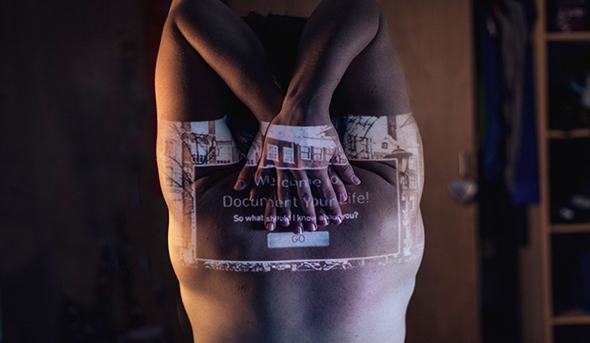
Caileen Bennett in Artefact 1 of Digital Tattoo (photo: John Hunter)
A new company, a new venue. Katie Dale-Everett, artistic director of KDE Dance, studied choreography at Falmouth University, graduating in 2014. She is a freelance dancer, teacher and choreographer and has wasted no time in putting together and performing projects with a focus on how dance can be written and read. In Digital Tattoo she is exploring writing dance in the service of a social project. In this context, Dale-Everett’s writing takes on the French use of the word ‘écrire’ (to write) to describe the notation of the choreographic process whereas in English we prefer the verbs ‘to make’ or ‘to create’.
Recently I have seen different approaches to writing dance: Joe Garbett’s work No. Company takes its point of departure from choreographic text messages; Fevered Sleep’s choreographic performance of Men & Girls Dance is wrapped in a written project, and here in Digital Tattoo is a trio of works within a single program that comments on the concept of privacy in social media. Such an approach has its strengths and weaknesses. Whereas dance can provide an emotional entrance to the understanding of a social concept, there is always a danger that the written aspect, if taken too literally, will take precedence over its imaginative choreographic content, that the image becomes too directly linked to its meaning. It doesn’t have to; it is worth remembering that fairy tales in their written forms were imaginative vehicles for understanding social concepts or cultural values even if today the production values and aspects of the performance — in say the balletic form of The Sleeping Beauty — tend to obscure those lessons. Dealing with contemporary social concepts through dance is thus a complex balance between the rational and the imaginative, one that Dale-Everett sets out to resolve by dividing Digital Tattoo into three separate elements.
The first, Artefact 1, is a short film, subsequently picked up by Channel 4’s Random Acts, with a simple overlay of social media images on a naked female torso, equating privacy with sensuality. The underlying focus of the tripartite program is the notion of the Right to be Forgotten — the right to erase our online footprint whenever we choose. In the film (with John Hunter as director of photography), we see a woman, Caileen Bennett, reaching round her back to erase the projected images by frenzied scratching but the merging of the two surfaces is an illusion. All we see is the scratched red marks underneath the images becoming deeper and more painful while Bennett’s breathing becomes more strained and frantic. The message, like the image, is simple and strong.
The second element, Conversations about the Digital, brings us back into the everyday through a performative quiz on stage with eight willing members of the audience (one male, seven females on this occasion), each with his or her own smartphone. The quiz consists of a series of recorded questions about smartphone usage to which the participants — classified demographically at the beginning as either digital immigrants (born before 1980) or digital natives — respond through gestures, movements, selfies and tweets. The goal is to promote awareness of our online digital presence, the influence it has on our social behaviour and on our understanding of our world (fake news is a current hot topic). Even though the questions stimulate an element of self-reflection, the self-confessional nature of the staged format leaves too much wiggle room for dissimulation which waters down the effect.
The third element, Digital Tattoo, is essentially a recapitulation of the first two in a danced duet performed by Jonathan Mewett and Sophia Sednova with a musical score by Tom Sayers that traces the development of their online meeting, its development and, once concluded, a unilateral effort to erase it from digital memory. Even if the preceding context informs our understanding of it, the structure of the duet is clear (as one would expect with Lou Cope as dramaturg), so that it could stand alone in its depiction of love at first byte, highlighting the self-comment, self-deprecation and self-consciousness engendered by the creation of an online relationship. Dale-Everett enhances the choreographic message with an effective use of digital light (developed with the help of Nic Sandiland), giving Mewett and Sednova the ability to use their fingers as on a keyboard to write on each other’s bodies their interjections and exclamations expressed through ubiquitous emojis. Real life events, like a scene at a party where Sednova loses control, are witnessed through selfie gestures as they might appear on a tagged Facebook page with self-accusatory hashtags.
It might seem counter-intuitive to depict an online relationship in a choreographic duet; the structure is necessarily complex, constantly blurring the distinctions between online and offline. My principal concern is that the educational framework of Digital Tattoo holds back the emotional aspect of the choreography; while Mewett and Sednova are convincing as its exponents, it appears circumscribed by its didactic function. In using dance for purposes that are not inherently choreographic this will always be a danger, even if the social orientation of the project is effectively served.
Posted: April 19th, 2017 | Author: Nicholas Minns | Filed under: Performance | Tags: David Harradine, Fevered Sleep, Kip Johnson, Luke Crook, Matthew Morris, Men & Girls Dance, Nick Lawson, Robert Clark, Sam Butler | Comments Off on Fevered Sleep, Men & Girls Dance
Fevered Sleep, Men & Girls Dance, The Place, April 13

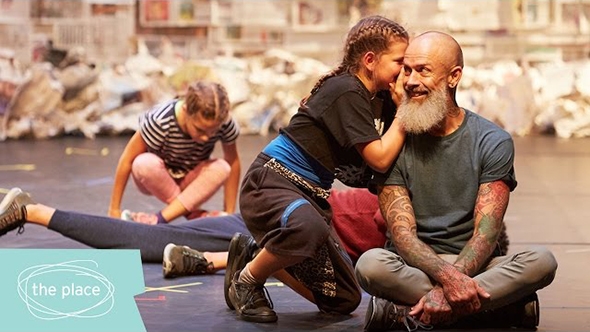
Matthew Morris and two of the girls in Fevered Sleep’s Men & Girls Dance (photo: Matthew Andrews)
I came away from Fevered Sleep’s Men & Girls Dance at The Place with an empty feeling that had started during the performance; for a theatrical presentation this means a failure. The empty feeling developed into a sense of annoyance, all the more vexing as there was nothing specific I could identify in the show that supported it and it was in marked contrast to the upbeat vibe of an audience who evidently loved it.
The idea for Men & Girls Dance started innocently enough when the directors of Fevered Sleep, Sam Butler and David Harradine, were auditioning trained male dancers for a project the day after seeing young girls performing in an end-of-term dance school show. Wondering what they might produce by bringing two such groups together, they explored the social and political implications of men and girls in our society. As Butler and Harradine explain in their newspaper of a program, ‘Men & Girls Dance hopes to offer provocations about, and ultimately solutions to, what we feel has fast become a problem around the culture of adults, and especially male adults, just being with children today.’ ‘We want people to be troubled’, says Butler elsewhere, to which Harradine adds, ‘To be troubled by witnessing playful, tender relationships. Why should that be troubling? But it is…’
The common language between men and girls is play, and this is where the production works best. The set is covered in newspaper pages, crumpled up and heaped at the back or carefully taped together in sheets like a quilt in the centre of the floor. Leaving aside the metaphorical significance of media coverage as floor coverage, the games played in this arena draw me into the engagement between the nine girls and the five men (including a brilliant entrance for Robert Clark who emerges from the crumpled newspapers at the back, dressed in…crumpled newspaper) with a theatrical sophistication that stands on its own. But beyond this delightful play, the choreographic ideas have the drawn-out quality of blandness with a giggly smile.
Part of the popularity of Men & Girls Dance undoubtedly has to do with the young girls who are auditioned locally wherever performances take place. In London the girls are Pebbles Doughty-White, Molly Beasley-Martin, Maya Demetriou, Belesther Huberson-Abie, Chadni Miah, Neve Seekings, Momoka Taniguchi-Warren, Amber Worboys Sayers and Rania Yarde. It must be a wonderful and nerve-wracking experience for them: wonderful to be performing with these five men (Clark, Kip Johnson, Luke Crook, Nick Lawson and Matthew Morris) and nerve-wracking to be learning both text and choreography to performance level in a short space of time. They do it brilliantly.
The other draw for Men & Girls Dance is that it’s a project whose premise you can’t easily reject: to create ‘a public space which allows play, tenderness, trust, empathy and love’ between men and girls. One can understand, for example, why the Wellcome Trust would want to support it and how the hype around the show generates ticket sales (the run at The Place has 9 performances, up to and including Saturday April 22). But a theatrical performance is more than its premise, and my empty feeling perhaps has its origin in the distance between the proposal and its manifestation. Men & Girls Dance treats a subject that is both light and dark, but its presentation on stage is only light; so where is the provocation, and to whom might it be addressed? It seems the only troubling thing about Men & Girls Dance is the absence of anything troubling. It’s a show the girls in their intuitively playful way might have choreographed and then asked the adults to formulate emotionally and intellectually. While the parallel social implications may well be contentious — the 64 pages of program text are an indication of how sensitive the subject can be — the choreographic manifestation in a controlled public space where the men need DBS checks to perform loses all pretensions of being provocative.
Could it be that an unintended consequence of current written funding applications is that what ticks the right boxes is the social significance and implications of a proposal rather than the quality of the performance which, at the point of application, may not yet have been created? Fevered Sleep has written a carefully worded newspaper about the subject of men and girls to accompany the show, offers discussions on the subject within each community where it plays and has garnered plaudits for broaching the subject — all valid — but it feels as if the company has sold us the funding application rather than the show.
Posted: April 5th, 2017 | Author: Nicholas Minns | Filed under: Performance | Tags: After the Rain, Christopher Wheeldon, Crystal Pite, David Dawson, Flight Pattern, Greg Haines, Henryk Górecki, Jay Gower Taylor, Kristen McNally, Marcelino Sambé, Nancy Bryant, The Human Seasons, Thomas Visser | Comments Off on The Royal Ballet, works by Dawson, Wheeldon and Pite
The Royal Ballet, Triple Bill, Royal Opera House, March 23

Kristen McNally and artists of the Royal Ballet in Flight Pattern (photo: Johan Persson)
This is a program of repertoire works by former Royal Ballet dancers, David Dawson and Christopher Wheeldon, wrapped around a new commission by Crystal Pite, the first female choreographer to perform her work on the main stage in a long, long, time. Despite this landmark achievement, Pite is not a classical choreographer, nor are her works in the classical idiom. Borrowing a leaf from Tamara Rojo’s astute book, the Royal Ballet has brought in a lauded contemporary name on a contemporary theme at an appropriate moment. It is also borrowing from the book of Sadler’s Wells associate artists. Much as I love Pite’s work, Flight Pattern blends uneasily with both the accompanying repertoire and the surroundings. It’s a beautifully fraught work (beautiful and fraught) about the fate of migrants, not a subject that lends itself naturally to the velvet and gilded glamour of the Royal Opera House. It’s an oddly imbalanced program, too, because Flight Pattern is not a natural closer, and neither Dawson’s nor Wheeldon’s work prepares for it in any way; it comes out of nowhere. It is nevertheless a sublime conception, both scenically and choreographically, for a mass of 36 dancers with the suggestion of a lead migrant couple (an incongruous notion) of Kristen McNally and Marcelino Sambé. Anyone who saw Pite’s monumental Polaris on the Sadler’s Wells stage for the See The Music Hear The Dance program just over two years ago will remember her powerful massed forms of 64 dancers responding to Thomas Adès’ orchestral storm of the same name. Flight Pattern is more poetic and less menacing, influenced by the eerie refinement of the first movement of Henryk Górecki’s Third Symphony, but its subject is harrowing. The work visualises the endless lines of stooped humanity on a desperate trek to an unknown future but Jay Gower Taylor’s set, Thomas Visser’s lighting and Nancy Bryant’s costumes bestow epic proportions on the entire journey. The movements of the dancers are muted and repressed throughout the work, hemmed in by heavy overcoats and by the giant partitions of the set that close inexorably on them until only a gently rocking McNally and a seething Sambé remain isolated. It is a moment that almost spits with rage but Sambé at this crucial point allows his pyrotechnical wizardry to infiltrate his character, dissipating Pite’s entire psychological build-up.
There’s plenty of legitimate technical display on the rest of the program, however, and the men get a thorough workout in Dawson’s first work for the Royal Ballet, The Human Seasons, to a commissioned score by Greg Haines. You know you’re at the Royal Ballet with this level of technical skill, though the loud landings (and there are many of them) of the men in particular exhibit some weakness in execution. The women are on display too, especially when upright; they are less so when being dragged unceremoniously along the ground.
Seeing The Human Seasons (2013) side by side with Wheeldon’s After The Rain (2005) one can’t help seeing similarities; both are in the neo-classical style with stripped down costumes, and there are one or two quotes by Dawson of Wheeldon’s lifts and slides. Where the two works differ is in the use of space as part of choreographic form. For all its intense movement, its entrances and exits, and its asymmetrical groupings, The Human Seasons, unlike Keats’ sonnet that inspired it, is constantly crying out for some kind of form to hold them all together. This is amplified by a lackadaisical deportment in the men in between partnering duties or bravura steps; they just amble over to the next sequence, killing the dynamics. Haines’ score can’t hold the work together either, so with all these holes Dawson’s form fails to gel, leaking out in all directions over the course of the work’s 35 minutes.
Scored for three couples, the first section of After The Rain is set to the first (Ludus) movement of Arvo Pärt’s Tabula Rasa; as soon as it begins, Wheeldon’s spatial stagecraft is apparent. The form is held in place by the harmony of the music allied with the harmony of the choreography, pumpkin rolls and all. The second movement, to Pärt’s Spiegel im Spiegel, is joined to the first but not closely related. It is often performed as a separate duet and its renown makes it appear as the feature film we’ve been waiting for. Marianela Nuñez and Thiago Soares make it a powerful meditation on the beauty of strength and the strength of beauty, where each gesture is thought through and flows seamlessly to its natural resolution. But while the consummate elegance of this movement is framed on one side, the absence of a final, contrasting movement leaves it floating in splendid isolation; it should either be set free for good or the frame completed.
Posted: April 1st, 2017 | Author: Nicholas Minns | Filed under: Performance | Tags: An Archaeology of Me, Chapter, Deborah Light | Comments Off on Deborah Light, Semi Detached – An Archaeology of Me
Deborah Light, Semi Detached – An Archaeology of Me, Chapter, Cardiff, March 17

Deborah Light in a sharing of Semi Detached – An Archaeology of Me (photo: Warren Orchard)
Four years after chipping away at the inner life of the nineteenth century paleontologist Mary Anning in The Curio Cabinet, and six months into carrying a third child, Deborah Light has been turning her choreographic imagination to an excavation of her own life in an array of objects collected from the rocks and crevices of her mind and body. In this sharing of a development phase for a new work, Semi Detached – An Archaeology of Me, she regales the invited audience in the studio at Chapter with a running commentary of her evolution that Darwin himself might have enjoyed if not fully appreciated. Nevertheless, her condensed trajectory from chordate to choreographer and from mollusk to mother is an accelerated but otherwise totally convincing line.
The studio is laid out with tables (they could be glass cases in a museum) on which are arrayed the objects and specimens Light has chosen to represent her. There is no particular order but they include balls of wool and knitting needles (her mother’s influence), fossils, rocks, seeds (her partner’s influence), her grandfather’s mantle clock, flowerpots and books (her private passion), all of which she invites the audience to inspect and handle. There are two other tables that are littered with notes or laid with paper for our written suggestions and interjections.
Kneeling on all fours in front of the clock Light demonstrates with rhythmic dorsal undulations the early chordate’s need for structural reorganization, then evolves into the shape of the mollusk’s hard shell and with evolutionary haste bypasses the seed’s slow-burning life with the vital attempt to stand up. This leads her to the table marked What’s Important on which she asks someone to add, ‘standing up’ and, as she catches her breath, ‘breathing’. As a mother of small children she also adds ‘dry pants’ to the growing list and as a human being she adds, ‘world peace’. In the space of an hour Semi Detached – An Archeology of Me builds up delightfully disparate layers of autobiographical sediment that form Light’s own particular landscape, her own history at this particular moment in her life, and as the unique curator she animates it all as both subject and object. She listens to the sounds of her own name as we might address it, as her mother might have pronounced it, as her children might call it, as she might have called her mother. It is harrowing and deeply moving to hear her label herself with these inflections of welcome, caution, fear and love, scratching under the name to give it life, identity and meaning.
Light has learned from raising her children that the art of dissembling can be very effective in keeping cool under fire. The way she leads us to believe the ‘indispensable’ bear, Mishu, is indeed borrowed from her five-year-old son as she proceeds to dissect his wooly chest with clinical precision is a master class in psychological manipulation. It also turns into a lesson in genetic association at a molecular level and a brief survey of an endangered species. ‘This species of bear will have to adapt’, she adds firmly as we all take a deep breath and follow her at a distance with our eyes.
Continuing to conflate the structures of archaeology and family, Light recreates a symbolic generational skeleton that she animates with her great grandmother’s Motherhood Book as brain, stones as vertebrae, the clock as biological time, a pot of seeds as ovaries and a rock as fused pelvis. She reinstates Mishu as the heart covered in a pinafore handed down from grandmother to mother to daughter.
As if her version of evolution is totally logical, she totters across the room in two flowerpots with a ball of wool that she strings between pieces of table and chair like a game her mother used to play. She is gently inciting us to respond like children, to break through the historical into the present moment, but I think the episode with Mishu has kept us at arms length.
Archaeology and family life come full circle; Light’s final intervention reminds us of the nature of time, of the cyclical nature of starting and finishing. She takes off her outer garments and lies supine in her underwear on the What’s Important table, lying there so still like a living sarcophagus with her belly breathing two lives, while a recording of Handel’s aria Ombra Mai Fu infuses the image with the beauty of both life and death. When she rises to signal the end of the performance, some of the felt tip words are imprinted on her back. At moments like this you know something profoundly significant has just transpired, held in the moment and never to be repeated. It is a privileged moment for Light to be performing this and for us to be witnessing it, but the inspired and nonconformist workings of Semi Detached – An Archaeology of Me clearly have life after birth.
Posted: March 25th, 2017 | Author: Nicholas Minns | Filed under: Performance | Tags: Aakash Odedra, Aditi Mangaldas, David Poznanter, Echoes, Fabiana Piccioli, I Imagine, Sabrina Mahfouz | Comments Off on Aakash Odedra, Echoes and I Imagine
Aakash Odedra, Echoes and I Imagine, Lilian Baylis Studio, March 9

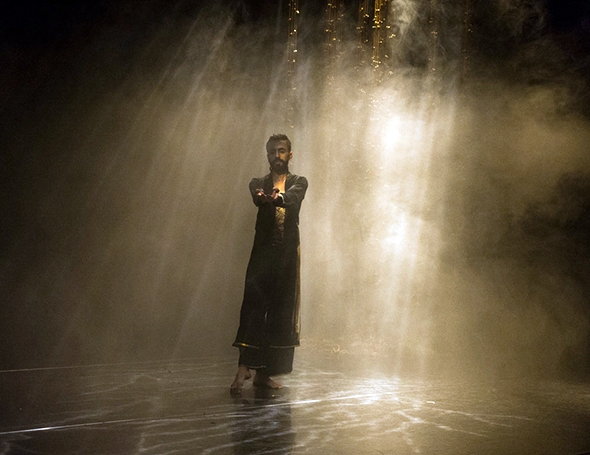
Aakash Odedra in Echoes (photo: Foteini Christofilopoulou)
This review was commissioned by Pulse and appears here with the kind permission of its editor.
The setting of a theatre is not the most conducive to a meditative state; its dimensions are more utilitarian than spiritual and one’s focus on the stage is shared with (in the case of the Lilian Baylis Studio) about 180 other people. In Inter-rupted for Dance Umbrella last year, choreographer Aditi Mangaldas and her designers successfully challenged these limitations with a dynamic use of colour and space. In Echoes, her first Kathak solo for Aakash Odedra, Mangaldas uses the auditory quality of strings of traditional ghungroo bells to usher in a sense of calm. In the program note she quotes J. Krishnamurti: ‘If you listen to the sound of those bells with complete silence you would be riding on it, or rather, the sound would carry you across the valley and over the hill…’ The theatre setting militates against this but Krishnamurti’s aerial metaphor finds a visual counterpart in the strings of bells suspended above the stage, and they also spread like tentacles along the floor like an unrolled skein of wool. The bells become the playing field for Odedra whose dancing imbues them with life. We first see him wafting a tassel of bells around his torso, though Fabiana Piccioli’s engulfing cone of light at this moment is too sharp, too design for Odedra’s languour. While the sound and imagery of the bells recur throughout Echoes, it is Odedra’s presence and his ability to sinuously, noiselessly insinuate his shape into the space around and above him that invites us to contemplate. The silent dynamics of his movement have no edges, like sound itself; they flow and swirl and rise (his joyful elevation is rare in Kathak) in a series of choreographic variations. Mangaldas has fully understood Odedra’s gifts and through them achieves a sense of awe through a oneness of the dancer and the danced.
The contrast with Odedra’s own choreography, I imagine, reveals an artist who is as expressive in a spiritual role as he is as a common man (or woman). On a stage marked out in white tape like an architectural plan and piled with suitcases of all shapes and sizes, he embodies the spirits of his antecedents, inhabiting the symbols of travel (quite literally at first) while questioning the ideas of migration and home. He scrabbles around the suitcases, retrieving old portraits (in the form of masks created by David Poznanter) and honouring their memory by imagining their peripatetic tribulations, their aspirations and dreams. He is so present in their lives that they live through him, voices and all. It takes a while to square this performance with the previous one, because Odedra has moved far from his Kathak roots into experimental theatre; he is an actor in his own drama and indulges his ability to evoke his past and present through theatrical means. Choreography enters slowly, but when he performs what appears to be a ritual dance at a suitcase altar, his flowing hands and arms describe everything words cannot. As in Echoes, his dancing comes from an intimate space inside the body, a place of emotions from which he extrudes meaning through his eloquent limbs. Odedra choreographed I imagine to the voice of spoken word artist, Sabrina Mahfouz. She, too, talks eloquently and powerfully about home and migration, her words complementing Odedra’s staged conception. Except that Odedra, in some alchemy of performance, has managed to say it all himself.
Posted: March 23rd, 2017 | Author: Nicholas Minns | Filed under: Performance | Tags: Alejandro Virelles, Andrey Kaydanovsky, Daniele Silingardi, David LaChapelle, Icarus, Ilan Eshkeri, Jade Hale-Christofi, Narcissus and Echo, Natalia Osipova, Project Polunin, Sergei Polunin, Tea or Coffee, Valentino Zucchetti, Vladimir Vasiliev | Comments Off on Project Polunin: Icarus, Tea or Coffee, Narcissus and Echo
Project Polunin: Icarus, Tea or Coffee, Narcissus and Echo, Sadler’s Wells, March 14

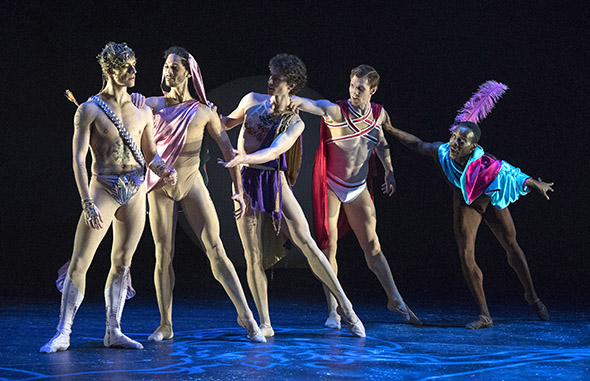
Sergei Polunin, Alejandro Virelles, Daniele Silingardi, Alexander Nuttall and Shevelle Dynott in Narcissus and Echo (photo: Alastair Muir)
Sergei Polunin has long been interested in mythology. It could be said that his early life up to his departure from the Royal Ballet has elements of the myth of Icarus, and his more recent re-emergence in the light of Take Me To Church with the myth of Narcissus. It is perhaps no coincidence that Project Polunin should bookend its triple bill with works that reference both, though in terms of Polunin’s life there’s an important hiatus between the two.
With the recent release of Steven Cantor’s film The Dancer about Polunin’s life, it would be easy to imagine that Project Polunin follows on seamlessly where the film leaves off. But The Dancer took five years to film and another year to edit, so the film’s concluding performance of Take Me To Church — which at the time Polunin conceived as the final act of his ballet career — happened six years ago. A lot has happened in Polunin’s life in the intervening years; most importantly he has rediscovered his desire to dance and has gathered around him a group of creative people who have given him the confidence and stability to develop new projects. He is also, as evidenced in his Q&A following the launch of the film, questioning current norms in the ballet world with the proselytizing zeal of a reformer.
This premier production of Project Polunin consists of three works. As he explains in an interview with Sarah Crompton, “It shows what my thinking is influenced by…There’s an old Soviet ballet, a hint of dance theatre and…the kind of dance theatre I would like to explore.”
Expectations run high for an event like this, especially with the media attention from The Dancer. Will Project Polunin fly or won’t it? When Polunin discovered a video of Vladimir Vasiliev’s duet, Icarus, the night before the flight — created for himself and his wife Ekaterina Maximova in 1971 — it must have struck him as auspicious. Vasiliev had inspired the young Polunin with his powerful, passionate style of dance, and here was choreography with a mythical subject close to his own heart. Polunin extended an invitation to Vasiliev (Maximova died in 2009) to come to London to mount the duet on a younger pair of lovers, Polunin and Natalia Osipova. The choreography for both male and female equates powerful technique with powerful emotions, heroic form with mythological mettle. Polunin revels in the bravura steps, displaying the elevation and flight for which he is renowned and, as his betrothed Aeola, Osipova has so integrated her prodigious technique into her body that she can express every nuance of her devotion to Icarus as well as the depth of her despair suggested in Vasiliev’s choreography. Just to see these two together giving full rein to their Russian heritage is a privilege.
After only a brief pause we jump 45 years ahead to Tea or Coffee, served Russian style with dark and surreal humour. Choreographed by Andrey Kaydanovsky for four soloists from the Moscow Stanislavsky Ballet (Alexey Lyubimov, Valeria Mukhanova, Asastasia Pershenkova and Evgeny Poklitar), the ballet could well share the lineage of Nikolai Gogol with last year’s Royal Opera production of Dmitri Shostakovich’s The Nose, except that instead of the nose it is a cup of tea (or coffee) that seems to have a life and influence of its own. The work consists of four rounds of a game in which whoever starts by stirring the cup of tea (or coffee) is initially eliminated from the next one. Within this ludic format the two couples interchange and squabble over an unspecified but evidently banal issue which gives rise to is a delightfully absurd set of convoluted solos, duets, double duets and trios that borrow their wit and rhythm from the eclectic score.
The relevance of Narcissus and Echo as a contemporary myth is fully developed in the program by Ilan Eshkeri, where he quips, ‘Narcissus’ reflection in the pool is arguably the first selfie.’ Eshkeri also wrote the score (played live by members of the London Metropolitan Orchestra under the baton of Andy Brown) and his concept for Narcissus and Echo is credited as the starting point of the work. In a Polunin work about the power of the image it is not surprising to find the visual influence of photographer David LaChapelle, who conceived the video Take Me To Church. It is evident in the opening tableau of Narcissus (Polunin) and his four Theban mates (Shevelle Dynott, Alexander Nuttall, Daniele Silingardi and Alejandro Virelles), in the overall colour palette and in the surreal pond with its haze of light and outstretched arms appearing from below the dark water. It is less easy to discover the choreographic form of Narcissus and Echo. There are four choreographers listed: Polunin and his assistant choreographer, Valentino Zucchetti, Osipova (for her solo), and Jade Hale-Christofi (also of Take Me To Church fame) for Polunin’s solo. In such a sharing of choreographic initiative it is perhaps inevitable the story of Narcissus and Echo as Eshkeri conceived it is sublimated for a show of dancing inspired by its two protagonists with, in the case of Hale-Christofi’s contribution, ‘selfie’ quotes from Take Me To Church. Polunin, however, inspires his mates to excellence, especially Silingardi and Virelles (both on loan from English National Ballet), while the five nymphs (Alexandra Cameron-Martin, Maria Sascha Khan, Adriana Lizardi, Callie Roberts and Hannah Sofo) seem to operate in the shade of Osipova’s orbit. It is perhaps the first time seeing Osipova working out choreography on her own body, from subtle insinuation to blindingly powerful despair, and the result is sublime.
The similarity between The Dancer and Project Polunin is that they are both in the image of Polunin himself; Icarus has recovered but Narcissus is always going to be susceptible. As Eshkeri points out eloquently in his program note, ‘What is fascinating is how quickly the human condition allows us to become intoxicated with ourselves. And once engulfed by it how do we avoid the beguiling fate of our lamentable protagonists.’ Polunin is clearly trying to distance himself from his own image by paying his respects to his past, but he will need to find a new myth to define his next stage of development.
Posted: March 7th, 2017 | Author: Nicholas Minns | Filed under: Performance | Tags: Danai Pappa, Darling I Don't Sell Dreams, Denis Santacana, Encuentros, Hanna Wroblewski, How to Play a Room, Jan Lee, Katsura Isobe, Lucy Hansom, Resolution 2017, Thelma Sharma, Victor Fernández, Victor Guadiana | Comments Off on Resolution 2017: Jan Lee, Denis Santacana Dance Company, Hanna Wroblewski
Resolution 2017: Jan Lee, Denis Santacana Dance Company, Hanna Wroblewski, February 2

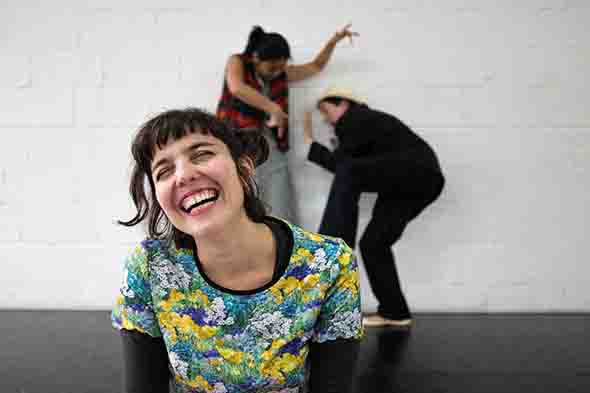
Danai Pappa, Katsura Isobe and Thelma Sharma in How to Play a Room (photo: Tim Murray-Browne)
I should begin by saying Jan Lee and I shared a dramaturgy course last year given by Lou Cope. What drew me to the course was the similarity I felt between dramaturgy and the process of writing about dance; one helps build the internal cohesion of a work while the other attempts a deconstruction of the work to reveal that cohesion. Lou had suggested that any of the participants who wanted dramaturgical help on future projects should ask amongst themselves as a way of offering practical experience, which is how I came to work with Lee on her How To Play A Room. It is a privileged position from which to write as I can view the work, as it were, from somewhere in the middle.
In How to Play a Room Lee explores her own experience of being an outsider crossing social boundaries, of how to play a room when you don’t feel you belong, so having three performers of different nationalities (Katsura Isobe, Danai Pappa and Thelma Sharma) is no coincidence. Lee approaches dance with a musical mind as she is both a musician and dancer; she makes musical gestures with the bodies of her dancers and uses their voices and her own processed recordings of conversation as muscular elements in the choreography. How to Play a Room about the messiness of hybridity and the discovery of what remains inviolable. Isobe may mistranslate the physical conversation of Pappa and Sharma, and may have difficulty finding a way into their circle, but her own identity is poignantly clear in her singing of a Japanese lullaby at the end. Pappa is anchored in a dramatic reality that moves with her and she can transform her environment — especially when expressed in voluble Greek — into an emotional maelstrom, while Sharma is a Chaplinesque figure who finds strength in making sense of the world’s conundrums; she plays down her own identity and knows instinctively how to play a room. Lee and her dancers have collaborated to allow all these elements to overlap like three beams of different-coloured light to see what develops where they meet. The process is as messy as hybridity itself but somehow Lee manages to keep all the action on stage, illumined by the costumes of Elisa Nader and the lighting of Lucy Hansom, so that How To Play A Room emerges as a celebration of cultural fluidity.
There is something brutally physical in much of the dance I have seen from Spain but there is a beauty that inevitably arises from it. Denis Santacana Dance Company’s Encuentros has both a grounded physicality that borrows from flamenco and moments of sinuous energy that fly upwards. Encuentros is as much a duet about the juxtaposition of two contrasting personalities — Santacana and Victor Fernández — as it is about the overlap between the earthy and the ethereal. But if physicality is the motor, the imagery of Encuentros is mercurial, borrowing from chance meetings with changing outcomes; it is not linear but seems to move forwards and backwards. Chairs, a table and a wine glass suggest the nature of the meeting place but the table and chairs also serve as platforms for dancing, and the glass becomes a musical instrument. The relationship between the two men oscillates between manipulator and manipulated, between puppet master and puppet, and between acceptance and rejection, all depicted through episodes of careful shading and projected shadows. The imagery merges into the physicality, sometimes tortured and percussive, sometimes sinewy and light, until the story is exhausted. It’s all in the cinematic flow of the music, too: Encuentros by Victor Guadiana.
Standing on a tall pedestal, Hanna Wroblewski with her trademark red hair and flowing robe, cuts a statuesque figure. In Darling, I Don’t Sell Dreams… she shrinks the theatre (with the help of Joseph Bisat Marshall’s design and Lucy Hansom’s lighting) into an artist’s studio in which she is both the model accepting our gaze and the artist of her own creation. Inspired by her ‘fascination with the public and private personas of silver screen sirens’, Wroblewski plays a very public figure to the music of her very private thoughts. In her stillness, the bareness of her legs, the downward angle of her head and the sound of her heavy breathing, she at first appears to be on a ledge contemplating her fate. As she leans further, tiny bright red hearts cascade from her dress, flashing in the light as they fall around the pedestal. Gravity wins, but the hearts are escaping dreams. She begins to hum as she continues to revolve, letting her hair down, dipping a leg languorously to either side or raising a pliant arm, to reveal both her defiance of fear and her full sculptural presence. It takes a lot of courage to maintain this slow revolution (interestingly it allows us to conjure up so many images) but it becomes a dream-like metaphor for another kind of courage Wroblewski is about to reveal. After lowering herself over the pedestal, head draped towards us, she breaks the silence with an admission: she has an age-old fear of singing in public except, she realises, when she is feeling comfortable with her surroundings. Evidently she does here, for she launches into the sentimental ballad, Dream A Little Dream Of Me, finding just enough breath and just the right notes, not selling dreams but wrapping them up as gifts.