Posted: January 23rd, 2018 | Author: Nicholas Minns | Filed under: Performance | Tags: Aaron Robison, Begoñia Cao, Crystal Costa, Daniel Kraus, English National Ballet, Isaac Hernandez, Jean Babilée, Jurgita Dronina, La Sylphide, Le Jeune Homme et La Mort, Sarah Kundi, Walter Benjamin | Comments Off on English National Ballet, Le Jeune Homme et La Mort and La Sylphide
English National Ballet, Le Jeune Homme et La Mort, and La Sylphide, London Colisseum, January 20

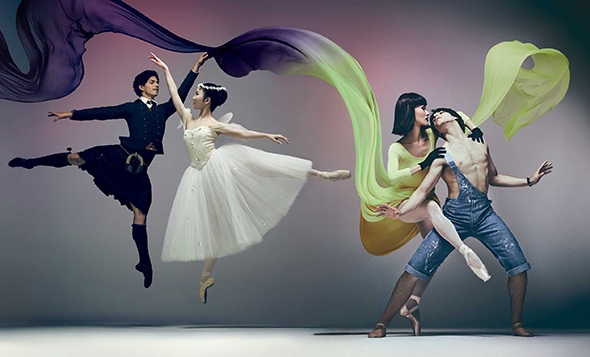
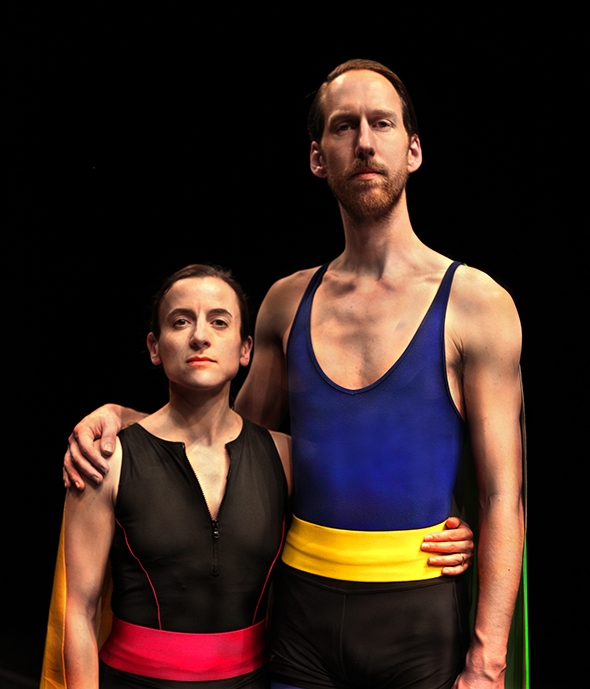
Publicity photo for English National Ballet’s double bill (photo: Jason Bell)
There are several elements that link Roland Petit’s 1946 creation, Le Jeune Homme et La Mort and August Bournonville’s 1836 creation, La Sylphide that English National Ballet presented at the Colisseum. Both are set in the past, both treat the fragile nature of life and death, and both exteriorize the anguish of the principal characters (the unnamed young man in his Parisian garret and James in his Scottish baronial hall) in the figure of a femme fatale who exists largely in the imagination of the men but manifests in ethereal or earthly form on stage. These can be thought of as contemporary human sensations conveyed within a historical setting, but the historical setting — its sets, lighting and costume — however beautifully conceived, is never enough to convince an audience of the authenticity of the re-staging.
Le Jeune Homme et La Mort was created in Paris one year after the end of the second world war when most of the audience and performers would have experienced five years of either fighting, losses, German occupation or all three. That kind of experience is impossible to recreate, but it can be translated. Walter Benjamin makes a case in his essay The Task of the Translator, that transmitting information (in this case, the choreographic and visual elements) is to transmit the inessential. The essential is contained in what is additional to the information, the original emotional force of the work. In Le Jeune Homme et La Mort there is no chemistry between Isaac Hernandez and Begoñia Cao which gives Hernandez nothing to rage against. He rages against gravity, but not against his inner turmoil and Cao plays her role so outside his existential head that in showing him the noose she could be a member of cabin crew demonstrating safety procedures before takeoff.
In La Sylphide, despite the impeccable qualifications of Frank Andersen, Eva Kloborg and Anne Marie Vessel Schluter who have brought the production from its home at The Royal Danish Ballet, the performers lack the emotional sensitivity to astonish. Here the story is not so far removed from contemporary experience — unrequited love, the illusion of attraction and the despondency of having made the wrong decisions — but these need to be expressed in the context of romanticism whose principal aspects, as Jane Pritchard writes in the program, are ‘the dual fascination with the supernatural and the customs of remote exotic countries.’ It’s difficult today to conceive of Scotland as exotic, but the supernatural still has its allure. As the Sylph, Jurgita Dronina dances with all the technical precision one could want but there is something hard-edged about her interpretation that cannot be compared to what Théophile Gautier wrote of Fanny Elssler in a production of the original La Sylphide in 1838, that she ‘appeared and vanished like an impalpable vision, now here, now there’. Similarly, both Aaron Robison as James and Daniel Kraus as Gurn are convincing in their translation of the Bournonville style but Robison has difficulty differentiating between the presence of Dronina and the illusion of the Sylph, which leads to him expressing his feelings with contemporary shorthand gestures like snapping his hand and head as if to say ‘Damn, I missed her again.’ Kraus doesn’t have the same difficulty because Effie is flesh and bone in the form of Crystal Costa, a last-minute substitution for Connie Vowles. But Costa’s costume gives her the perplexing appearance of a school girl which withholds all belief in her betrothal to either James or Gurn, and Sarah Kundi’s mime as Madge may be accurate in terms of text, but lacks the conviction to convey the darkness and savage predictability of internal fate. By contrast, the two older men, Bimse and Bumse (James Streeter and Fabian Reimair) feeling the aches and pains from being pushed hither and thither, are entirely successful in imparting to the audience their condition.
If the older ballets are not stories that belong exclusively to the era of their creation but have what Benjamin called the essential element of ‘translatability’ then the question is how to translate them so as to make them relevant to the performers (for it is the performers who ultimately translate a ballet). Perhaps in the quest for technical brilliance the development of the psychological and emotional aspects of a character might be seen as secondary. Looking from today’s perspective at extracts of Jean Babilée in the original production of Le Jeune Homme et La Mort, his technique is dated but his muscular conviction translated into the steps defies time. The language of the feet, as Gautier wrote, may be universal and everywhere understood, but something in this double bill has been lost in translation.
Posted: January 22nd, 2018 | Author: Nicholas Minns | Filed under: Performance | Tags: Dominique Dardant, Le Récital des Postures, London International Mime Festival, Yasmine Hugonnet | Comments Off on Yasmine Hugonnet, Le Récital des Postures
Yasmine Hugonnet, Le Récital des Postures, Lilian Baylis Studio, January 19

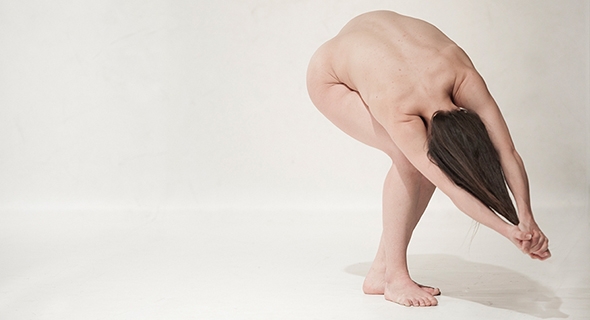
Yasmine Hugonnet in Le Récital des Postures (photo: Anne-Laure Lechat)
Presented as part of the London International Mime Festival, Yasmine Hugonnet describes Le Récital des Postures as ‘a silent concert for one instrument – the human body’. As the lights come up in the silence of the bare stage we know from the program that the human form we see is that of Hugonnet but even if you know what she looks like this image would not corroborate that knowledge because her face is well hidden by her hair; under Dominique Dardant’s lighting her hair becomes a black extension of her black top and grey tights. She is standing in profile with her upper body bent forward, her hair almost touching the ground and her hands resting just in front of her knees. The longer she remains immobile in this pose the more our eyes adjust to seeing a living sculptural form with no passport-like identification. Hugonnet descends by subtle stages to lie prone like a stain on the floor recalling the shapes of Francis Bacon’s melting figures. She seems to empty into the shadow of her own body what once filled it. And then her two arms rise eerily from the shadows like two periscopes idly surveying the audience, her legs and flexed feet articulate the space behind her like beaks that Dardant subtly highlights, and her back ripples as if subjected to an invisible, childlike hand playing with a favourite toy. In this ‘slow burn’ evolution of postures Hugonnet intensifies the subtle stillness of being through the suggestion of touch, the thinly veiled threshold of pain, and the slow sensuality of sliding and crossing limbs.
Regaining her initial pose, she slips her black top effortlessly over her head to the ground. But how can you do that with tights? Her gesture immediately transforms to the utilitarian as she takes her hands to her waist to slip them off one foot at a time. At the moment she discards her clothes she makes an artistic decision that changes the development of the work; she can no longer maintain the formal approach she has used up to that point. Briefly after she rolls up her clothes, grey within black, and brushes them in a single abrupt gesture to the side of the stage, she keeps her hair pulled forward over her bowed head, naked but still faceless. But as soon as she unfurls to the point we can identify her she has moved from Bacon to Matisse or Bonnard; she has entered the figurative. She has also entered into the recognizable aesthetic of the female nude. She has, in a sense, let the cat out of the bag when she could have kept it inside to more effect, the cat being not simply the clothing but more importantly the self-identification. The abstraction of form and the blurred edges of autonomous movement that she evokes while covered are lost in her nakedness. Once set adrift on this broader stage, Hugonnet is never again able to disguise her identity, even though she pulls her hair in fanciful arrangements with hands and feet and even, in a whimsical gender reversal, twirled carefully and held as a moustache between nose and pouted lips. Where she had begun by forcing us to change the way we see her body, slowing down our vision to take in the full ambiguity of the postures she was making, she is now in the cross hairs of our sight and fleeing the newly-emerged clarity of her bodily form. She sets off on a journey of plastic shapes, borrowing from Egyptian friezes and dance vocabulary that through motion become sculptural fragments but she leaves us no time to take in her postures; her exposure has changed the dynamic of our gaze.
Intriguingly Hugonnet reclaims her original ambiguity through aural means. In the final section she kneels facing the audience in a single posture with a dispassionate, neutral gaze. Out of the stillness and silence we hear an eerie disembodied voice, animate yet inanimate for it seems to arise from Hugonnet’s mute posture. “We are going to dance together”, says the voice, “Let your imagination dance.” As she had once made us search for the human agency of her postures through our eyes, she now confounds our ears by being both ventriloquist and doll and challenges them rather than our eyes to search for the truth of her imposture.
Posted: January 20th, 2018 | Author: Nicholas Minns | Filed under: Performance | Tags: Gandini Juggling, Guy Hoare, Indu Panday, Kati Ylä Hokkala, Kim Huynh, London International Mime Festival, Sean Gandini, Seeta Patel, Sigma | Comments Off on Gandini Juggling and Seeta Patel, Sigma
Gandini Juggling and Seeta Patel, Sigma, Lilian Baylis Studio, January 15

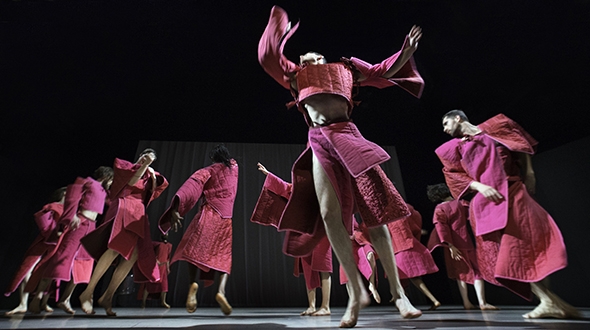
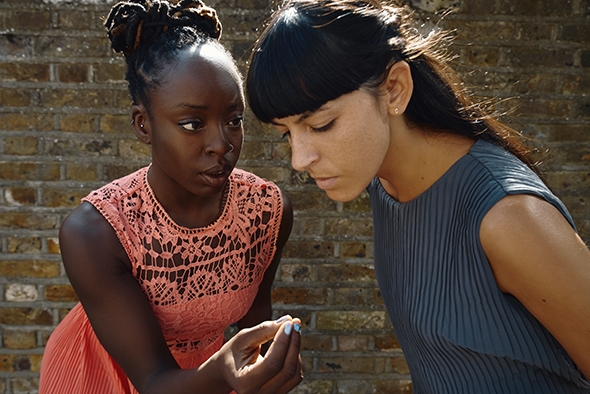
Iconographic collage of Seeta Patel in Sigma (photo: ASH)
In Sigma, presented at Lilian Baylis Studio as part of the 2018 London International Mime Festival, Sean Gandini, artistic director of Gandini Juggling and Seeta Patel, an accomplished bharatanatyam soloist and choreographer, propose a dialogue — or flirtation as Gandini calls it — between juggling and bharatanatyam. Sigma is the second of three such dialogues Gandini has curated, the first being with classical ballet (4×4 Ephemeral Architectures) and the third, Spring, with contemporary choreography by Alexander Whitley, which will premiere at Cambridge Junction next month.
The term ‘sigma’ means ‘sum of small parts’, aptly describing the structure of Gandini’s and Patel’s dialogue that examines aspects of their respective arts from their two distinct perspectives. Clearly nothing much will result from a dialogue where perspectives are too closely aligned, and on the surface there appears to be little in common between juggling and classical Indian dance. The history of juggling suggests it has always been an artistic form on the informal edges of entertainment; while it has developed its own virtuosic routines it has eschewed a formal musical or physical framework for the improvised freedom of the street or circus. By contrast, bharatanatyam has a long history of formalized representation with an improvisational core based on a close relationship with its musicians. In formalizing such a dialogue Gandini and Patel run the risk of either framing juggling too tightly or unframing bharatanatyam, but in their irrepressible curiosity they set out to explore how the geometries and dynamics of their respective arts intersect within their common experience of space and time.
By putting the two forms on the same stage, Sigma immediately reveals a formal affinity, a double intricacy of gesture and rhythm that initially sets the dialogue alight. It is in the inordinate physical dexterity, agility and coordination of hand and eye, as well as in the use of complex musical rhythms that the two art forms thrive. Seeing Patel’s refined hand gestures against the juggling hands of Kim Huynh and Kati Ylä Hokkala and to juxtapose the complex rhythms of bouncing balls with Patel’s and Indu Panday’s intricate footwork is to appreciate both arts in a fresh light. There are notable similarities, too, in the use of improvisation (uncommon in the western classical ballet tradition) and in the dynamic tension between concentration and relaxation that allows the performers of both forms to appear at ease as they negotiate demanding routines. Perhaps one of the most interesting developments in Sigma’s dialogue, one in which both art forms find themselves in new territory, is the section ‘Tribute to London’ in which both dance and juggling are performed to the syncopated rhythms of chanted tube station names. There are also some notable disagreements between the two forms: gesture in bharatanatyam is embedded in meaning, whereas in juggling it is a function of the dynamic act. This fundamental difference renders the section in which Patel and Huynh compete in physical expressivity rather flat because there is no standard of comparison. Another disagreement is in a contrasting sense of humour. Humour in juggling is a response both to the inherent illusion and the nonchalant virtuosity of the act. In bharatanatyam humour is embedded in the story that the artist expresses. Sigma carries no story in itself — except in the ethnological, autobiographical framing — so Patel and Panday are roped into Gandini’s sense of humour that appears to be less a result of dialogue than of acquiesence.
There is an external element in Sigma that enhances its presentation: the stage setting and Guy Hoare’s atmospheric lighting. What we see as we arrive is a bare stage with two bland, institutional dividers on wheels. As the performance unfolds, so do the screens, revealing mirrors on the hidden side that reflect both the audience and the performers. In the duet between Patel and Huyhn to the aria from Bach’s Goldberg Variations, Panday and Hokkala circle the performers with the mirrored panels, extending the sculptural forms of the choreography to which Hoare’s lighting gives a visual unity even if the full effect is evident only to those sitting in the middle of the stalls.
Out of the sum of its many components, however, Sigma fails to create a cohesive whole. The initial exploration throws up ideas like balls and keeps the dialogue afloat, but the joint dynamics fall off, and balls drop as the exchange deconstructs into its constituent soliloquys. At the end illusion peters out with a muted chorus of regrets.
Posted: January 2nd, 2018 | Author: Ian Abbott | Filed under: Performance | Tags: Guy Hoare, James Keane, Leah Marojević, Steph McMann, Theo Clinkard, This Bright Field | Comments Off on Theo Clinkard, This Bright Field
Theo Clinkard, This Bright Field, Tramway, Glasgow, October 13

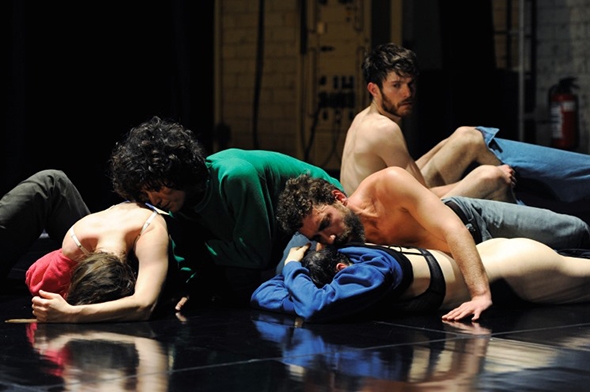
The dancers in Theo Clinkard’s This Bright Field (photo: Pari Naderi)
“I once read in my physics book that the universe begs to be observed, that energy travels and transfers when people pay attention.” – Jasmine Warga
I’ve written this in two parts; my first set of words were noted down soon after seeing Theo Clinkard’s This Bright Field at Tramway, capturing the intensity of feeling on the performance night and then again 10 weeks later, at a distance to the work, seeing what residue remains with me.
This Bright Field is in itself a work in two parts running consecutively but with a small break in between that invites us to consider proximity, scale and experiences of togetherness. Following two international commissions from Danza Contemporanea de Cuba and Tanztheater Wuppertal Pina Bausch, it offers the audience a chance to see how Clinkard (with artistic collaborator Leah Marojevic) crafts a large-scale work with a company of his own dancers. In The Listening Room, the piece he choreographed on the 24 dancers of Danza Cuba last year, Clinkard demonstrated a rare ability that profiled the individuality of the dancers whilst creating a conceptually satisfying choreographic approach with a performance rigour on a large scale. What would Clinkard do with dancers of his own choosing with a longer creation and rehearsal process? Part 1 of This Bright Field is an intimate, 15-minute interaction on stage seeing (and not seeing) the dancers up close and in the round; Part 2 is back in the orthodox seating bank for a 60-minute formal presentation.
In the comprehensively informative written program Clinkard offers the following:
“What are the inherent politics of theatre spaces? What kind of spectatorship do they encourage in you, the audience? Mindful that scale and proximity to the action affect our sense of self, the way we relate to others and the way we receive a performance, I decided to re-orientate the audience-performer relationship to provide you with two distinct perspectives in the hope of refreshing your experience of dancing and dancers in larger theatres.” And Marojevic adds: “Throughout his body of work, the invite for audiences remains the same; to come as you are, to be within yourself, within time, experiencing quality, surprise, colour and ambience; to receive the work through your own history by engaging your present senses.”
There is warmth generated through the ability to see all four sides of a work and all four sides of a dancer; a 15-minute amuse-bouche continues the Clinkardesque trope from Of Land and Tongue of letting the dancers in his company reveal themselves, connect with the audience and have a number of delightful interactions framed by choreographic tasks. Here the dancers have agency to fill and flourish in their own rhythm, intimacy and moments of exchange with the audience; here is the Clinkard I expected.
“Look on every exit as being an entrance somewhere else.” – Tom Stoppard
How does a choreographer change scale? Clinkard brings us close in Part 1 and then pushes us away in Part 2. It feels even more distancing as we had a taste of the intimacy that was possible, but with 12 dancers on a large stage for a small audience (limited by a maximum of three slots of 100 people each in Part 1) this tension between proximity and scale leaves me unsettled. With over 500 entrances and exits in Part 2, running, rolling and lurching upstage, the dancers exist in a constant state of leaving and never staying; this disruption dilutes any sense of connection or extended presence that might have been forged with the dancers from Part 1. It is to be applauded that Clinkard is attempting to invert the staid practices of large-scale dance, but the gap of 25 minutes between the end of Part 1 and the beginning of Part 2 ensures any momentum and intimacy that was built has dissolved by the time we get back to the auditorium.
Ten weeks later, the work has faded slightly. Alongside the eruption of white noise and percussion from composer and performer James Keane, the bright white field backdrop, white flooring and the impact of teal waves of the dancers flooding from downstage to upstage in their glacial staccato roles has disappeared. There are flaws and there are holes in memory and then there is Steph McMann (at seven months pregnant) and Leah Marojevic who exercise their innate watchability in a sitting duet with intimate gestures, unfurling wrists and torso shifts. Together they conjure up a magnetism via a suite of mundane gestures whilst the waves of bodies wash, run and make visual noise behind them.
Clinkard has brought together distinguished collaborators including the lighting designer Guy Hoare who offers a sensuality of multiple light baths in dialogue with the dancers, bathing them in an eight-parcan stage-left wash that subtly creates visual texture and emotion, drawing our focus closer to the nude form of Marojevic as she rediscovers the possibility of her body and sinews. There are echoes in Part 1 of Clinkard’s earlier piece Ordinary Courage with the softbox lighting heightening the intimacy levels by bringing the sky down closer. Within the construction of Part 2 there are multiple parts which vibrate in isolation and fail to listen to each other; I find I’m looking for glue and left with multiple questions. Why this order? How do the multiple parts belong together? What are the feelings that were close and are now distant? Clinkard is dealing with us in temperature — embracing us in warmth before moving to tepid then to a cryogenic icy distance and then back to cool. There are multiple works and multiple feelings in play within This Bright Field but I left on the night feeling unsure but bombarded by brightness; on reflection the dazzle has dimmed considerably and I’m left thinking of other works of his which shone a lot brighter.
“The poetic image […] is not an echo of the past. On the contrary: through the brilliance of any image, the distant past resounds with echoes.” – Gaston Bachelard
Here’s another review of This Bright Field
Posted: January 2nd, 2018 | Author: Ian Abbott | Filed under: Performance | Tags: h2dance, Hanna Gillgren, Heidi Rustgaard, Strangers & Others | Comments Off on H2Dance, Strangers & Others
H2Dance, Strangers & Others, iC4C, Nottingham, 2nd December 2017

H2Dance with Strangers & Others (photo: Benedict Johnson)
“Sometimes one feels freer speaking to a stranger than to people one knows. Why is that? Probably because a stranger sees us the way we are, not as he wishes to think we are.” – Carlos Ruiz Zafon
If I am not a stranger, then I must be other. I have developed an alternative relationship with the latest work, Strangers & Others, of H2Dance (Heidi Rustgaard and Hanna Gillgren) by working as their writer-in-residence, talking to people at three of their tour dates (Colchester, Peterborough and Nottingham) to gauge and document their reactions to the work. H2Dance have described their intention for this work, which has only participants and no seated audience, in these terms: “Invited to look, touch, assume and judge, audiences choose how to respond, placing themselves into lines, groups and pairs. Witnessed only by the choreographers, they use appearance, physicality and behaviour as a guide to negotiate each other as they cooperate in silence.”
As writer-in-residence my interaction was solely with the audience before and after their participation in Strangers & Others, listening to them describe in detail the parts of that resonated with them. While this meant that all surprise was erased when I entered the studio at iC4C as one of the participants in the last performance on the last date of the Autumn 2017, this erasure enabled me to create a mechanical and objective plot of what happens in the studio over the course of 80 minutes but left me space to inhabit the incoming interactions without the emotional distraction of surprise.
As the gathering of 20 people begins in the foyer we are invited to wear Silent Discoesque headphones; I notice that some wearers have blue lights and some red on their headphones. I begin to think about the idea of a stranger and things that are strange to us. Strangers & Others is a stranger to me, to the collective us and we (as a body of people) are strange to each other. The word stranger has a history and resonance in the UK that is forged in childhood; we are told to not trust strangers, to question their intentions and reject any attempt at interaction. Its etymology suggests an “unknown person, foreigner” derived from the Old French estrangier. As a form of address to an unknown person, it is recorded from 1817, and has a meaning of “one who has stopped visiting” first recorded in the 1520s.
“Be peaceful, be courteous, obey the law, respect everyone; but if someone puts his hand on you, send him to the cemetery.” Malcolm X
H2Dance invite us to construct a social choreography; we are architects of our own awkwardness through a set of solo, duet and group instructions offered through the headphones. A slow desensitisation occurs and as the instructions escalate we begin to un-strange each other whilst acclimatising to the rhythm of the work. Starting with “notice the space”, progressing to “take the hand of someone who is your equal” and finishing with “rub the bum of the person opposite” the voices of Rustgaard (my ear instructor) and Gillgren offer little inflexion, emotion or judgement and are the conductors of an ever-decreasing sense of erasure of our personal boundaries. If this is what happens after 80 minutes, imagine where an audience might be persuaded to go after 3hrs hour or half a day. It’s a choreographic alternative to Milgram social psychology experiments, a study which measured the willingness of participants to obey an authority figure who instructed them to perform acts conflicting with their personal conscience. How persuadeable are we? Here we are offered no reward but continue to be subservient to those voices in our ears.
Nestled in the stiffness of some of the bodies in the room a sense of childhood stranger scepticism lingers; the interactive and participative nature of Strangers & Others makes for an interesting combination as it is full of the childlike and playful possibilities which forge bonds, create gangs through awkward physical encounters. We continue to revisit each other. Encounters with those who are unknown to us as we get older can be equally fraught; the currency and resonance of #MeToo with the recent exposure of intimidation, sexual abuse and rape of women and men at the behest of those exercising their power is clearly present. H2Dance are whispering in our ear with an invitation to “stand next to someone you find sexy” and later on “point to the person you think is sexist” followed by “stroke the cheek of the person” and “put your hands on the chest of the person opposite”. It leaves you in a moral quandary — do I participate (as everyone else seems to be doing) or do I remove myself (as I’m uncomfortable with what is being asked of me)?
Strangers & Others deals in power, invitation and suggestion with Rustgaard and Gillgren having created a tightly crafted work that leaves your moral compass askew and lingers long in the mind after leaving the studio. Although we are told at the beginning that “any response is valid” this phrase is not repeated or emphasised; amongst the sensorial and social input of making judgements on people does this crucial phrase settle into the mind? Can we reject what is being asked of us? We are asked to consider a spectrum of: trust, class, privilege, income, homophobia, racism, age, sexuality and foreignness based entirely on sight, smell and touch. When we exit the space (one by one) we are greeted by a glass of prosecco and a new invitation; a chance to decompress the previous 80 minutes and to verbalise all that has gone before; we are no longer strange, we are now other.
“There is an odd synchronicity in the way parallel lives veer to touch one another, change direction, and then come close again and again until they connect and hold for whatever it was that fate intended to happen.” Ann Rule
Posted: December 14th, 2017 | Author: Nicholas Minns | Filed under: Performance | Tags: Elena Gianotti, Lo Squardo del Cane, Saint Augustine, Saint Jerome, Vittore Carpaccio | Comments Off on Elena Giannotti, Lo Sguardo del Cane
Elena Giannotti, Lo Sguardo del Cane, Italian Cultural Institute, November 28

Elena Giannotti in Lo Sguardo del Cane (photo: Eamonn O’Mahony)
Like the two works shown at Trip Space a few days before as part of Intercontinental Drifts (which also programs work at the Italian Cultural Centre), Elena Giannotti’s solo, Lo Sguardo del Cane (‘the dog’s gaze’), is engaging, playful, and experimental. But what Giannotti achieves with a calmness of demeanour and smoothness of motion is a sense of choreography as language that can communicate on a broad, cross art form level. She takes her point of departure from a painting by the renaissance artist Vittore Carpaccio of Saint Augustine in his study looking out at a spectral image of Saint Jerome. There is a small white dog seated on the floor that appears to be looking in the same direction as Saint Augustine but Carpaccio deliberately leaves the viewer in doubt as to whether its gaze is directed toward its master or past him at the ghostly vision (according to legend, Saint Jerome has just communicated with Saint Augustine his own imminent death).
With no musical accompaniment, Giannotti employs equal dexterity and ambiguity towards the movement of her own gaze. She stops quite still at various moments in her performance, staring intently at an undefined point in space; we might attempt to follow that line of vision, but we can also watch her in the act of seeing, just as we study Saint Augustine’s posture as he looks out of the window. We cannot see what he sees, but we know from his rapt attention that he has seen something. And just at the point we take in Giannotti’s still gaze, she begins to move again and our focus changes to the completeness of her expression, to the reiteration of phrases and to her accumulating vocabulary. Certain expressions stand out, like an impatient gesture of the hand or a petulant kick towards an unseen object, and as the choreography progresses we begin to recognize and acknowledge the return of repeated phrases. The effect is one of cinematic montage, of overlapping sections or phrases punctuated with the still gaze. Giannotti sketches scenes with the outlines of figures and expressions, fragments of larger stories of which we only get a glimpse; the moment we recognize them they disappear and overlap with other ones, like impalpable phantoms. As Giannotti repeats them, however, each fragment becomes more distinctive, the contours and features more intelligible to our eyes, filling all our senses with the impression of the movement and its afterimages.
Gaze thus becomes an action not only of the eyes but of the entire body. The direction of our eyes reflects the attention of our entire physiognomy, which is why the eyes are so important in choreographic use. If the eyes look in a direction that the rest of the body does not support, we are not convinced. This is as true for a suggestive glance, a coy aside or a political speech. Giannotti takes all these kinds of glances and freely distributes them in the space she is occupying, allowing her body to flow through her eyes. It is a spatial dialogue which, by the force of its argument and her sense of being ever present keeps our attention, even more acutely as there is no sound apart from the ambient noise of the audience in the room and of traffic outside in the street. There is a temporal sense involved, too. Giannotti’s patterns and traces overlap in space and in one sense are sequential, but like early twentieth-century experimentation with cinematic montage, each pattern or trace can be seen occurring in the same moment, overlapping in time. Giannotti compounds this by running in to the room at the beginning and spinning out at the end, suggesting all that happens in between occurs within a single moment of timeless concentration like a daydream or a vision. Which takes us back to Saint Augustine and his dog experiencing, in their separate but interwoven ways, the beatific apparition of Saint Jerome.
Posted: December 14th, 2017 | Author: Nicholas Minns | Filed under: Performance | Tags: Adam Silverman, Aki, Alexander Leonhartsberger, Anna Kaszuba, Carys Staton, Danny Diamond, Dr. Elizabeth Cameron Dalman, Erik Nevin, Hyemi Shin, Mary Barnecutt, Michael Keegan-Dolan, Mikel Murphy, Molly Walker, Rachel Poirier, Sabine Dargent, Saku Koistinen, Zen Jefferson | Comments Off on Michael Keegan-Dolan, Swan Lake / Loch na hEala
Michael Keegan-Dolan, Swan Lake / Loch na hEala, Sadler’s Wells, November 30

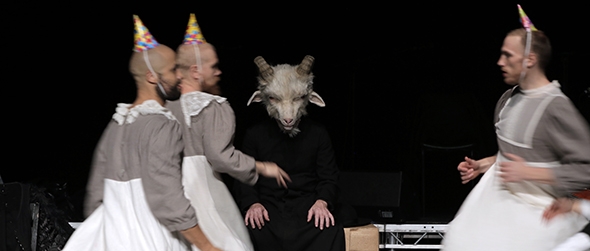
Zen Jefferson, Saku Koistinen, Mikel Murphy, and Erik Nevin (photo: Colm Hogan)
Michael Keegan-Dolan’s Swan Lake makes a journey through the reductive division in Christian culture between light and dark, and between God (good) and the devil (evil) to lay bare what he calls ‘the root of much suffering and confusion’. He sets his story around his home in County Longford in Ireland whose many lakes are home to flocks of migrating swans but his principal characters — the overbearing mother who wants her introspective son to marry, the woman he falls in love with and the magician who has cast a spell on her — have much in common with the plot of the ballet of the same name produced in Moscow in 1875 to Tchaikovsky’s famous score. It is as if Keegan-Dolan has taken the Russian myth and re-mythologized it in the image of Ireland, and because the lakes and swans are tangible and the narrative is taken from local news and national history, his Swan Lake is grounded in a conflictual social and political reality of a kind the romantic ballet of Imperial Russia could never have acknowledged.
There is in actor Mikel Murphy, whom Keegan-Dolan casts as The Holy Man, a distant relation to the wicked magician, Von Rothbart, though at the beginning of Swan Lake he is the one who is under a spell, stripped to his underwear and tethered by the neck to a concrete block, bleating like a goat. It is not hard to see the image of a plundered Ireland tethered to England’s oppressive rule. Then three ‘watchers’ (Saku Koistinen, Zen Jefferson and Erik Nevin) release him, wash him down, beat him dry with red towels and prepare him for interrogation. In Keegan-Dolan’s psychological landscape it is only those representing the dominant culture of oppression — be it political, religious or matriarchal — who speak; while tethered Murphy can only bleat but once freed and offered an informant’s seat at the oppressor’s table, he talks the talk — but not before he’s had a cup of tea and a few biscuits.
It’s an enigmatic but brilliantly staged beginning to what is in effect the re-telling and re-enactment of a story in which Murphy is the sole narrator because the other principal witnesses are the victims of his crimes: one drowned and the other shot. Under Adam Silverman’s lighting and with Hyemi Shin’s evocative costumes, Sabine Dargent’s set is a makeshift restaging of the events with trusses, curtains, ladders, plastic sheeting, theatre boxes and props for the benefit of the audience whose role is to listen and to pass judgement: morality with its oppressive mores and prejudices is on trial.
To make up for having to leave the condemned family home for a new build, the ailing Nancy O’Reilly (Dr. Elizabeth Cameron Dalman) gives her son Jimmy (Alexander Leonhartsberger) his father’s rifle as a birthday gift. It becomes for him an inert symbol of power in a life that has little promise as a result of depression, both mental and environmental. Finola (Rachel Poirier) is one of four sisters (with Anna Kaszuba, Carys Staton and Molly Walker) in the village along with three burly, bisexual watchers and a fine band of musicians (Aki, Mary Barnecutt and Danny Diamond) playing the music of Slow Moving Clouds. In his narrative, Murphy recalls the characters in relation to his various roles as parish priest, local politician and police chief revealing his determinant role in their lives and destiny. As the priest he admits to sexually abusing Finola and threatening her sisters if they were to reveal the truth; as a politician he takes advantage of Nancy and Jimmy for a photo opportunity and as police chief he pressures the depressed Jimmy into a fatal showdown. Within this narrative, but beyond Murphy’s control, Finola, the only village girl to express an interest in Jimmy, makes a fateful connection with him. Keegan-Dolan gets inside the psychology of his characters and expresses it in raw body imagery with overtones of traditional dance; at the beginning Jimmy doesn’t speak and barely moves, but when he senses love from and for Finola he unlocks his reticence and awkwardness with a freedom of gesture that is a first sign of healing. But that reductive division in Christian culture claws back any such redemption, shaming Finola into drowning herself in the lake which sends Jimmy back into deep depression with a rifle at his side. As police chief, Murphy forces a faceoff with him and has him shot by his officers (recalling the tragic shooting of John Carthy, a depressed Longford man who refused to be evicted from his home). Murphy has finished his worldly story but Swan Lake continues in an afterlife with clouds of feathers where the lovers are reunited and dance among their friends with the freedom of unconstrained, unfettered bodies in an environment without hypocrisy, connivance and political ill-will. It’s not so much the idea as the jubilant choreographic conviction that suggests there is hope.
Posted: December 6th, 2017 | Author: Nicholas Minns | Filed under: Performance | Tags: Dan Watson, Do Not Be Afraid, Katherine Hollinson, Largely Unsung, Matthias Sperling, Rachel Krische | Comments Off on Intercontinental Drifts #4: Dan Watson and Matthias Sperling
Intercontinental Drifts #4, Dan Watson and Matthias Sperling, Trip Space, November 25

Rachel Krische and Matthias Sperling in Do Not Be Afraid (photo: Neil Wissink)
For its final 2017 Intercontinental Drifts program, Trip Space presents two duets: Largely Unsung by Dan Watson with Katherine Hollinson and Do Not Be Afraid by Matthias Sperling with Rachel Krische. Watching Largely Unsung is to enter a world of suggestion and allusion without coming to grips with either its title or its content, while Sperling introduces us to a super-hero duo from a large format comic book with a lot of brightly-coloured illustrations.
Watson writes in the program note that Largely Unsung is inspired by the music of the girl groups, a pop phenomenon of the late 1950s and 60s that channeled some darker subjects in a chic, popular style that sold millions of records. He is also interested in the phenomenon of backing singers with their nonsensical lyrics, flashy costumes and secondary stage identity. Watson, whose Jacket Dance I saw four years ago, describes himself as an artist ‘working somewhere between dance, performance and messing about’ but I am uncertain where Largely Unsung lies on this orbit. Visually, what Watson and Hollinson do satisfies the initial interest; both are engaging, even when engaged in doing very little, and the existence of a microphone on a stand and a clothes rack with two pairs of male and female evening wear hints at future possibilities. But the hesitation, abstraction and fragmentation of the movement phrases do not clarify what the microphone or clothes rack imply. When Watson and Hollinson finally do change into their formal wear — each at first into the menswear — it comes as a relief while the two remaining long, sequined dresses set up a further expectation. Perhaps Watson is leading us from one visual clue — or cue — to another as if preparing an intricate filmic journey that will resolve in the end, but this is only the conjecture of a tired swimmer looking for something on which to float. And while the choreographic language continues to deliver a mischievous sense of humour — a wagging tail sequence on all fours, a slinky hand on hip sequence, mincing walks, punching the air, and even a scaled-down light show behind a Folies-Bergères kicking routine — this seems more of a distraction than an exploratory path. Of course Watson and Hollinson do change into the sequined dresses and finally approach the microphone, at the back, off to the left, to harmonise a backing vocal together, but this one clear image is not enough to save Largely Unsung from a largely unfocused song.
At the beginning of Do Not Be Afraid Sperling and Krische are released on to the stage through the back door like a jack-in-a-box duo, one tall and one short in garish super-hero outfits. It’s deliberately ridiculous and designed to make you laugh, but so is everything else in Do Not Be Afraid. The press release states the work ‘proposes that the dance performer’s superpower is the ability to make their mind visible for an audience, in and through their body’. Since body and mind are the fundamental materials of dance, this proposal seems self-evident, but by examining it in a ludic way with a comic-strip hero as interlocutor, Sperling can’t stop his tongue-in-cheek humour dominating the work. Costumes, competitive ballet steps, gymnastic display, theremin gestures and word games become the means by which he places dance outside its familiar context and sets it up for ridicule; in short, Do Not Be Afraid is a dance in the form of an intellectual conceit. If it were to be packaged as a children’s show, its clowning alone would undoubtedly prove successful, but its internal argument plays to a knowledge of dance and its conventions; it is above all an inside joke and there are many at Trip Space who get it.
Both Largely Unsung and Do Not Be Afraid express the ‘engaging, playful and experimental’ qualities in the work Intercontinental Drifts programs, but they also rely too conspicuously on the narrow confines of a dance audience. It is perhaps worth remembering the late French choreographer Maurice Béjart’s desire to make dance as an art in the 20th century as popular as the art of cinema. It is a call for dance to make the power and intelligence in the language of the body relevant for broad audiences without sacrificing the engagement, play and experiment on which new choreography thrives. While cinema has gone on to develop dramatically its own art form (I just saw Michael Haneke’s Happy End), the evolution of choreography can’t afford to turn in on itself. Nor can it afford to waffle at the back, off to the left.
Posted: November 30th, 2017 | Author: Nicholas Minns | Filed under: Performance | Tags: Amarnah Ufuoma Amuludun, Azzurra Ardovini, Barnaby Booth, Carlos Pons Guerra, Crystal Zillwood, Gianluca Vincentini, Jamaal Burkmar, Kasichana Okene-Jameson, Lucia Chocarro, Marivi Da Silva, O Maria, Otis Jones, Phil Sanger, Ryan Dawson Laight, Stefania Pinato, Tom Davis Dunn | Comments Off on Gianluca Vincentini, Wild Card
Gianluca Vincentini, Wild Card, Lilian Baylis Studio, November 23

Amarnah Ufuoma Amuludun and Stefania Pinato in Encounter One (photo: Danilo Moroni)
For his Wild Card program at Lilian Baylis Studio, Gianluca Vincentini presents dance makers based in the north of England: Carlos Pons Guerra, Crystal Zillwood and Jamaal Burkmar. Having been artistic director of VERVE (the postgraduate company of the Northern School of Contemporary Dance) for five years, Vincentini knows these dancers and choreographers well. Prior to the main program, he presents his own company, Möbius Dance, in a short film, Encounter One, with Amarnah Ufuoma Amuludun and Stefania Pinato, followed by a structured improvisation to guitar accompaniment by Otis Jones with the same two dancers among the pre-show audience in Fox Garden Court. According to its website, Möbius Dance has two dancers (Amuludun and Pinato) and four collaborators, all of whom are presented or represented in the film. The program note for Encounter One — ‘Can I allow myself to let boundary lines blur while being within myself and accept compromises as part of co-existence’ — is so fluid and open-ended that the presence of two bodies moving in space is enough to fulfil its premise, and they do. But for those who enjoy a little more meat, Pons Guerra’s O Maria on the main stage hits the spot.
Written for two women, a man and a ham, it is played by two women, a man and a ham but gender correspondence is not on the menu. Concepción (Marivi Da Silva) and Armando (Azzurra Ardovini) are at home one evening, though all we see is the domineering Concepción sitting at the dinner table in a dress as black as her eyes with the wrapped or bandaged figure of Armando at her feet. There’s another wrapped figure (Phil Sanger) lying a little distance from the table, and a wrapped ham on the table. Clearly Ryan Dawson Laight has had as much fun with the costumes as Barnaby Booth with the lighting. The relationship between Concepción and Armando is described as ‘an unhappy marriage’ but this is an understatement; the ties that bind have turned to rope and bondage. In a beatific vision, Sanger’s arising — or arousal — as anything-but-the-virgin Mary is the catalyst that releases poor Armando from his wrapping to reveal his true gender and entangles Mary with the leg of ham. The program note for O Maria serves notice of nudity and sexual references but the satirical treatment of suffocating religious hypocrisy in 1950’s Seville is positively seditious.
Evolutio is one of three solos Zillwood will include in her creation, Spiral. In it she examines evolution with a little scientific guidance and abundant inspiration. She enters the stage out of darkness, from a distance too far to comprehend. Her postures on that first diagonal towards the light suggest the successive stages of human evolution but in reverse order, finishing on her haunches before repeating the sequence; at the third attempt she evolves into a dancer. Zillwood moves quietly and lightly along her exploratory journey, dancing a language that derives from classical technique but which breaks into a series of organic images derived from the natural world: from invertebrate motion to a human embryo, from a bird in flight to an anthropoid marveling at the stars. Her final pose is balancing on her coccyx, floating in the vastness of evolutionary history. She sketches these images fluently and fluidly against the musical phrases of a haunting arrangement by Nigel Kennedy of a Polish folk song, Ederlezi, that she has digitally altered and extended to fit the dynamic range of her choreography. There is nothing of the anthropological museum in Evolutio; it reveals itself like the spark of an idea with an intelligence that matches Zillwood’s musicality.
Jamaal Burkmar presents The Calm, one of three works he created for the New Adventures Choreographer Award showcase he won in 2016. Inspired ‘by family, home and music’, The Calm is a quartet of solos to a quintet of funky, soulful songs. Burkmar focuses first on the songs, playing Angie Stone’s Makings of You in the dark, and a second, D’angelo’s Send It On, as the four dancers — Burkmar, Lucia Chocarro, Tom Davis Dunn and Kasichana Okene-Jameson — lie in a stylised heap on the floor. As a choreographic device the heap is clichéd and artificial; no effort is made to suggest how the dancers arrive in that place, nor in the heap, nor how they relate to each other. Nor does the rest of The Calm offer any further clarification, but focuses instead on the individual choreographic responses to the music. Here Burkmar and his dancers are far more interesting, especially Okene-Jameson who blasts into her theatrical space with a freedom and invention that is all her own; if the others make it happen, she lets it happen. She also uses the direction of her head and eyes as she dances, which takes her expression to a level that is as generous as it is self-reinforcing. The Calm, however, ends on a note that is as anti-climactic as it is predictable, with the music fading and the lights dying slowly on a heap of dancers.
My friend Ian Abbott has also written about Carlos Pons Guerra’s De Nada Dance in a triple bill at mac last year.
Posted: November 27th, 2017 | Author: Nicholas Minns | Filed under: Performance | Tags: Claire Vivianne Sobottke, Damaged Goods, Doris Dziersk, Gilles Roosen, Jared Gradinger, Jurgen Kolb, Kristof Van Boven, Leyla Postalcioglu, Marc Lohr, Maria F. Scaroni, Meg Stuart, Nadine Grellinger, Neil Callaghan, Samuel Halscheidt, Stefan Rusconi, Until Our Hearts Stop | Comments Off on Meg Stuart / Damaged Goods, Until Our Hearts Stop
Meg Stuart / Damaged Goods, Until Our Hearts Stop, Sadler’s Wells, November 15

Claire Vivianne Subottke, Leyla Postalcioglu, Maria F. Scaroni, Jared Gradinger and Neil Callaghan in Until Our Hearts Stop (photo: Iris Janke)
The stage setting by Doris Dziersk for Meg Stuart’s Until Our Hearts Stop transforms the Sadler’s Wells stage, under the lighting of Jurgen Kolb and Gilles Roosen, into an unencumbered volume like a traditional American basement with its plain wooden panels and a single staircase at the back. It can also be thought of as what psychoanalyst Donald Winnicott’s calls a ‘transitional space’ — an in-between space open to possibilities and the imagination. It’s a space for play, and the playground of the theatre is where Stuart has set out the parameters of her game.
In a pre-show talk with Tim Etchells, Stuart, who is also known for her solo collaborations, spoke of how larger works take her to places she can’t go alone, and of the body as a ‘switching station’ where streams of influence flow through it into a shared pool of collective dreams. Both of these ideas are fundamental to the central theme of Until Our Hearts Stop which is the exploration of intimacy on a theatrical scale.
Dance is fundamentally different from the other arts in that its language is not words, lines, colours or musical notes but the body in space with its own contours and boundaries. In pushing these limits both spatially and psychologically in her search for intimacy, Stuart engages the transitional possibilities — the ‘switching station’ — of the body in a game where those limits are apt to dissolve: the absence of clothing in dance is a logical extension of its corporeal language. Stuart presents the naked body in Until Our Hearts Stop on a raw, unselfconscious scale that erodes its private and thus its erotic nature. She even leaves out suggestion; Claire Vivianne Sobottke and Maria F. Scaroni strip off to play with and explore each other’s bodies, slapping, splaying, pulling, pinching, and sniffing without limits not as a metaphor but as the lowest common denominator of physical intimacy.
Stuart employs games on other levels. The stage setting includes a drum kit, a piano and a bass guitar but when the nine performers enter there is no immediate differentiation between the six dancers and the three musicians; they disentangle over the course of the initial placement and replacement of individuals and groups. Gender is effectively masked in Nadine Grellinger’s initial costumes of jeans and sweatshirts and the touch of contact improvisation becomes the catalyst for the intimate games they are about to play. The framework of theatrical conventions is also called into question; there is no intermission as such, but where there would normally be a break the performers fabricate an intermission with offers of water, plates of fruit and a bottle of scotch that they deliver into the audience. Stuart also uses an audience plant who goes by the name of Myriam to dissolve the divide between audience and performers. It starts when Neil Callaghan takes off his underwear to which Myriam reacts with untrammeled delight and an infectious laugh. Any further instances of nakedness (of which there are plenty) send her into whoops of laughter, and she’s one of the first to request water at the false intermission. It’s as if Stuart is not sure the British audience will enter into the spirit of the performance as she had intended; she drives home the illusion in Kristof Von Boven’s witty conversation with the pianist Stefan Rusconi — whispered into a microphone — in which he comments on the politics of the day as well as on Myriam’s ‘outrageous’ behaviour.
Until Our Hearts Stop is, as a title, an exhortation to the performers to push their limits to the point of physical and psychological exhaustion, but where Pina Bausch, for example, broke down the theatrical framework to explore her interest in what moved people, Stuart uses the limits of her dancers to manipulate theatrical conventions. Until Our Hearts Stop is an expression of intimacy but not, because of the graphic exaggeration of the means employed, a call for intimacy; closeness does not strip down to its emotional components and reach under the skin. Until Our Hearts Stop thus turns in on itself like an exercise that, for all its ludic intensity, leaves little room for the imagination.
In the pre-show talk Stuart said she wanted to ‘create a space I can’t see in the world but where I’d like to be.’ By virtue of the unquestionable integrity of Until Our Hearts Stop she has created that space, but you have to enter the theatre to experience it.