Malik Nashad Sharpe (aka Marikiscrycrycry), UK Première of Hang Time, The Place
Posted: November 9th, 2026 | Author: Nicholas Minns | Filed under: Performance | Tags: Alex Moore, Connor Jay, Corlee Haverty, Erik Annerborn, Harry MacGibbon, Jay Miller, Justin de Luna, Kezi Moustakim, Malik Nashad Sharpe, Marikiscrycrycry, Robin Dobler | Comments Off on Malik Nashad Sharpe (aka Marikiscrycrycry), UK Première of Hang Time, The PlaceMalik Nashad Sharpe (aka Marikiscrycrycry), Hang Time, The Place, October 29
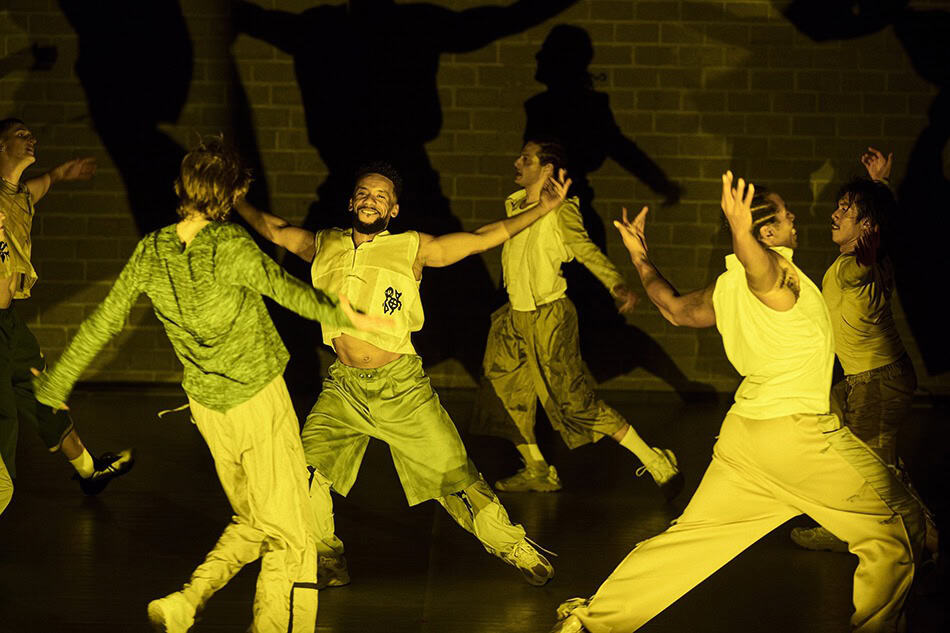
Waiting for the UK première of Malik Nashad Sharpe’s Hang Time to start at The Place, the calm of a bare stage with one isolated chair under Barnaby Booth’s uniform light is the perfect starting point for a show described as ‘a choreographic meditation’; the often gratuitous haze is here kept to a minimum (though why have it at all). In the blackout the dancers enter the perimeter of the stage and when the lights come up again, we are in a barber salon, with one of the dancers on the chair having his hair braided. We watch the time-consuming ritual of braiding on stage until, with what seems a sleight of hand, the process is complete and the dancing begins to a score by Harry MacGibbon.
I have seen so many of these salons just on and off the Old Kent Road, clustered together and always busy, with colour-faded photographs in the window of amazingly sophisticated braids. These are not like the barber shops of old but vibrant Black and Caribbean community hubs. This abstracted opening image of the barber salon is a metaphor for the ‘Black and Caribbean histories and lived experience’ on which Sharpe has based the work. The only other metaphor is a recorded telephone message left on an answering machine from a woman seeking news of her son, perhaps, but evidently getting no response. The increasingly harrowing messages punctuate the work without resolution. ‘At its heart’, we read in the freesheet, ‘Hang Time asks what holds a community together in moments of vulnerability and loss — and what remains when someone disappears.’
Sharpe describes the work as ‘moving between soca and bouyon, séance, ritual and social gathering’…’a charged work where dance, music and haunting collide.’ There’s enough there to give a flavour to the work, but the choreography remains broadly descriptive of that flavour, like a series of adjectives and adverbs without a subject. We are carried along by the powerful flow of movement, by a sense of community as well as isolation in the exhaustive physical displays from each of the dancers, but the work remains on that plane. There is little in the choreography of Hang Time to fill in the details between the anchor points of the salon and the telephone messages. It makes me think of film music, which can be so effective when played with the imagery of the film but sounds less than itself when played alone. Hang Time is like choreographic film music; it looks as if the specific imagery Sharpe had in mind when he conceived it, like a film running in his head, got swallowed up in the choreography so that the finished work, as seen by an audience, has lost the heart of its Caribbean context. This is as much a dramaturgical dilemma as it is one of conception, as Jay Miller, the dramaturg for Hang Time, must know. The process of any creation is to carry through the original intentions to the very end of the work, but there are so many decisions made in the studio at different times for different reasons (sometimes conflicting) that can militate against this. Cultural threads get mixed up, diluted or lost. How much of soca, bouyon, séance, haunting or horror has actually made it through into the bodies of the dancers, and what may have been lost in translation?
What we are left with — and it is not negligible — is the engagement of a masculine community dancing to the limits of skill and exhaustion. The dancers — Alex Moore, Connor Jay, Corlee Haverty, Justin de Luna, Kezi Moustakim, Robin Dobler and Sharpe himself — are totally committed, giving Hang Time a cohesive energy that the costumes of Erik Annerborn enhance. Another strand of the work alluded to in the freesheet is ‘grief, mental health and vulnerability within masculine communities’, a subject that suggests a change happening in the individual that has not yet found an expression of understanding in society. The phenomenal strength and endurance of the dancers belies any sense of vulnerability, but perhaps that is the point of this choreographic meditation: it is their sense of strength and community that saves them.