Posted: November 14th, 2017 | Author: Nicholas Minns | Filed under: Festival, Performance | Tags: After Tears, Asha Thomas, Clay, Dance Umbrella 2017, Freddie Opoku-Addaie, La Macana, Rich Mix, Sello Pesa, Ven, Yinka Esi Graves | Comments Off on Dance Umbrella 2017: Out of the System
Dance Umbrella 2017, Out of the System, Rich Mix, October 16

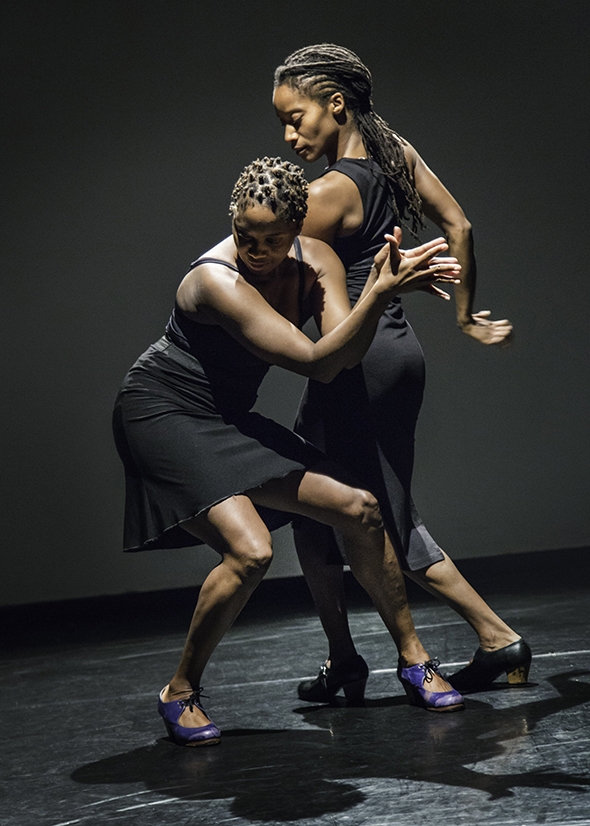
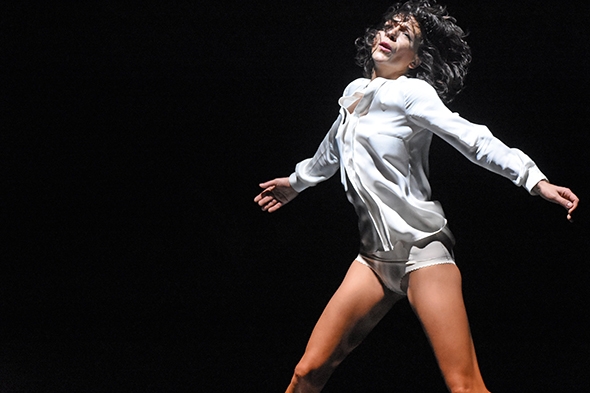
Asha Thomas and Yinka Esi Graves in Clay (photo: Pari Naderi)
In another creative twist in the development of Dance Umbrella under the artistic direction of Emma Gladstone, Out of the System is a mini festival within the festival curated by guest programmer, Freddie Opoku-Addaie. He describes the title as a metaphor for the presence of diverse dance cultures within vocational and non-vocational structures outside the regular framework of dance presentation — not to mention the inclusion of bands Yaaba Funk & DJ Kweku Aacht, and Kioko who perform on successive evenings. It is also, like the Shoreditch Takeover, a crossover between dance curation and building management; this one involves four distinct works by artists from five countries in three different spaces within Rich Mix over two nights (which is a shame, as I miss Alesandra Seutin’s Across The Souvenir). Both here and at the Town Hall the programs weave together loose associations with what we might consider to be dance and turn them into a wealth of experience that can change that perception profoundly. There is a sense of open-ended raw material here, even if the works are finished: La Macana’s Ven seems to arise directly out of the audience; Sello Pesa’s After Tears throws time out of the window, and the improvisational energy of Asha Thomas and Yinka Esi Graves in Clay wants to break out of the confines of the stage and take over the entire floor.
I had seen Ven two years ago at Costa Contemporánea in Andalucia, and it is one of those works that can bury itself in the recesses of your memory and come out again unchanged. The intricate timing of the interaction between Caterina Varela and Alexis Fernández is breathtaking but it is also polished: it has to be. They are like two circus performers who eschew trapeze and ropes for the instruments of their own bodies; they climb on each other, jump on each other, lift each other, balance and counterbalance in a defiant flow of impossibility that resolves through the strength and sensitivity of their well-honed skills. Against such precision, the couple’s apparent nonchalance is matched by the delightfully offbeat songs of Einstuerzende Neubauten.
Sello Pesa’s After Tears undoes all preconceptions. Described as an investigation of ‘the mourning process and the strategies people use in order to cope with death’, it’s like a private ritual to which the Soweto-born Pesa has invited us. He makes no pretense of a performance as he practices yoga on a red rug at the entrance to the third-floor space; we aren’t sure if this is part of the work, so we watch until we are ushered through the door to pick up a folding chair and wait behind a curved shoreline of red tape. In his own time Pesa moves his rug into the space with a pair of boots, a couple of crates of beer and a transistor radio playing a local station as the central focus and sole source of sound. Pesa gives an eerie sense we aren’t in the same room and yet his trance-like presence is all-pervasive. He rolls himself up in the rug and lies like the deceased, but then wears the rug around his shoulders and his head like an enigmatic, animated spiritual guide before bludgeoning it with fists and boots to mark his resolve. He seems to span both the realms of the living and the dead so as to come to grips with the inner conflict of the ‘South African tradition of returning a person’s spirit to its rightful destination’. Utterly compelling, After Tears returns dance to its ritual roots, revealing new dimensions in both movement and performance.
There is little doubt, however, about the performative nature of the collaboration between Asha Thomas and Yinka Esi Graves in Clay. Whatever inner resources well up from within their minds and bodies are fully expressed in energetic and sensual form. The collaboration between an American contemporary dancer with Southern Baptist genes and a British flamenco dancer with roots in Jamaica and Ghana is just the beginning; what they share goes beyond their recent origins to ‘explore the connections between who they believe themselves to be, and the unconscious parts that make up who they are’. As they play off each other’s physical styles and sartorial taste, their individuality merges with an infectious sense of delight at the connections made — a body percussion sequence with guitarist Guillermo Guillén borders on the ecstatic — and like old friends they can complete each other’s rhythmic phrases. But there’s more here; we tend to think of flamenco as a Spanish phenomenon with Moorish origins, but recent research suggests a link, through the rhythmic musical structures, to the Spanish slave trade with the New World. In Clay, images of flamenco merge with South American religious iconography as Thomas adorns Graves as a participant in a Holy Week procession and wheels her across the stage. The two women finish playfully to Guillén’s accompaniment, like two sisters from the distant past revelling in their common roots.
I first heard Opoku-Addaie before I saw him, in a performance of Silence Speaks Volumes at BDE 2010 where his blood-curdling roar from the behind the audience announced his entrance. His voice has again preceded the choreographic action, this time not his own but of his own choosing. May the experiment continue.
Posted: November 10th, 2017 | Author: Nicholas Minns | Filed under: Performance | Tags: Arkadi Zaides, Helka Kaski, Luke Birch, Morrighan MacGillivray, Rahel Vonmoos, Samuel Kennedy, to find a place | Comments Off on Rahel Vonmoos, to find a place
Rahel Vonmoos, to find a place, Laban Theatre, November 7

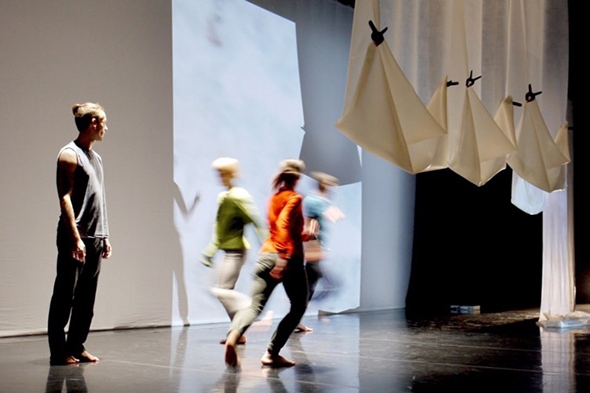
The cast on the set of Rahel Vonmoos’ to find a place (photo: Antigone Avdi)
When the subject of a dance work in a theatre is something as disturbing and destabilizing as displacement, the context of the performance — from the lighting, the set and costumes, to the comfortable seats in a warm auditorium and the bar just outside the door — becomes a screen through which an audience experiences it. When this filter is accompanied by the choreographic device of gestural abstraction, the subject of the work finds itself even further removed from its source; a work on displacement itself becomes a displacement. This is the conundrum posed by Rahel Vonmoos’ to find a place, performed at the Laban Theatre on Tuesday and Wednesday night. Even if crisis is written into it in the form of the dis-ease of movement, the fragmented groupings, the dislocation of projected images and the collage of discordant sounds, the production values of to find a place are too refined and the choreography too beautifully performed by Helka Kaski, Luke Birch, Morrighan MacGillivray and Samuel Kennedy to allow an audience to get to grips with the emotional and psychological complexities of the humanitarian crisis it addresses.
Vonmoos’ use of filmed projections on sheets of stretched silicon works well with the danced action; the opening visual sequence shows a crowd of people walking to and fro like a flock of humanity, slowed down in close-up to aimlessness and indecision; displacement, they seem to say, is a wandering with no direction home. The silhouettes of the dancers merge with the projected figures like blank, anonymous shapes against a mediatized throng. Apart from this extended opening scene, subsequent images are of landscapes and abstracted architecture, powerful reminders of events and places that have passed into memory, that float like fragments across the staggered placement of screens. There is a sense of time passing in the way the projected images spill from the screens on to the performers in the present or run in the background like the past.
I begin looking for individual clues to what Vonmoos wants to convey, but I have to wait till the end and beyond to let the accumulated response to the moving images — both of the dancers and the projections — find their mark. In the short term there is certainly a sense of puzzlement and confusion, which are states that arise from the condition of displacement, but it would be too easy to confuse this with a response to the work. Vonmoos has transferred the effects of displacement on to a painterly stage and turned them into symbols and marks on an artist’s canvas, yet the audience does not have the luxury of sitting in front of dance in the same way one can look at a painting (or listen to a recording of music) over time. Without a narrative, to find a place has to rely on constant movement — the essence of displacement, physically and psychologically — to convey meaning. Vonmoos also has the dancers suspend and modify the silicon sheets, tying them up, crumpling them or holding up a corner as if to sweep something underneath. If the projected images are memories, they are constantly vulnerable to disruption. The sheets also take on the roles of temporary bed sheets, shrouds and clothing.
There is a dry heat in the atmosphere of the work, where heat is not the kind in which to luxuriate but where you stand still to avoid exhaustion, where you get frustrated, in which you toss and turn at night. In this way Vonmoos imagines dis-ease and its effect on the body. The approach reminds me of Israeli choreographer, Arkadi Zaides, who studied the movements of Israeli settlers attacking Palestinian farmers and their lands seen in images filmed by the Palestinians themselves; against the film footage he takes up these same stances and gestures on stage as a choreographic form to show the effects of cultural aggression on the body. Vonmoos avoids the specific political questions but in abstracting the dis-ease of movement in the face of displacement, she asks the audience to re-translate the affect of the choreographic images to sense their original intent. It is a lot to ask of an audience or perhaps, in our relatively sheltered society, too little.
I can’t help noticing (not for the first time) that in the auditorium of one of London’s most prestigious contemporary dance conservatories with high enrolment figures, the audience is sparse. A work of art is only able to speak to those who are willing to experience it and to find a place has plenty to say; if the students who file through Laban don’t engage with the works that are shown there, what does that say about their engagement with the art they are studying or about Laban’s engagement in presenting them?
Posted: November 5th, 2017 | Author: Nicholas Minns | Filed under: Festival, Performance | Tags: Andre Schulz, Eun-Me Ahn, Let Me Change Your Name, Pina Bausch, Young-Gyu Jang | Comments Off on Dance Umbrella 2017: Let Me Change Your Name
Dance Umbrella 2017, Eun-Me Ahn, Let Me Change Your Name, The Place, October 24

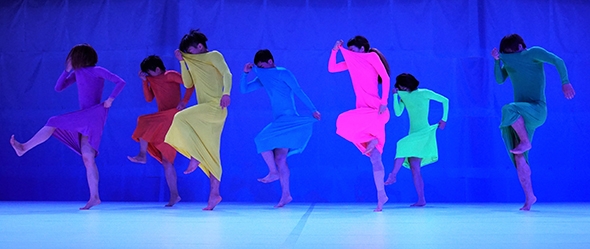
Eun-Me Ahn’s company in Let Me Change Your Name (photo: Eunji Park)
Every performance I have seen at this year’s Dance Umbrella has a markedly sophisticated aesthetic; whatever the venue, the lighting and set design makes the performance a visual delight. The set for Eun-Me Ahn’s Let Me Change Your Name at The Place looks like a glistening ice rink in Andre Schulz’s even wash of ice-blue light. With the program image in mind (see above), it’s just waiting for something in lurid colours to emerge on to it. But after an introduction of some of Young-Gyu Jang’s icier music from his score of natural and composed sounds, three dancers in long black torso-hugging dresses walk on to the stage; like birds walking in formation they wheel around slowly and walk off. The same happens in mirror image on the other side. Dancers then slide in crouched on their hands and shins, paddling in a circular rhythm until they stand up and look fixedly at the audience before dropping down and continuing. Women hitch their dresses to their bare chests to be lifted off over the heads of their men, and a man rolls slowly across the stage with a woman draped nonchalantly over his haunches. It is Ahn’s way of introducing not only her band of accomplices (for this is a work she shares unequivocally with her dancers) but her clear sense of style that merges abstracted postures from commonplace human activity with the consciousness of image, the gentle strut, and the fixed, penetrating regard that belongs to the fashion catwalk. It’s a style that builds in intensity throughout the work as the dancers engage the audience with a candour that draws us into their world of energy, wit, sensuality and colour.
Ahn uses the issue of sensuality openly; coyness is not part of her choreographic palette. Her dancers are all attractive and they embody and display this quality knowingly and with a flirtatious sense of humour. As the spirited cast of four male and four female dancers in lurid neon unisex dresses appear and reappear from the wings, the colours themselves smile with Schulz’s complementary light washes, and the way the dresses are worn, slipped off, left off and thrown around in playful abandon is a joy to watch. The dancers share their physical exertion equally with indefatigable vigour, energy and virtuosity.
Ahn balances this youthful exuberance with a more reflective aspect, not so much of age but of experience. While her dancers speed up linear time with their effusive antics, Ahn’s presence on stage stretches it out vertically; in her solos there is the gravity of a quiet, shamanistic presence. She expresses a thinking body with gestures that are as rich as poetry and eloquent in any language. There is also something in her solos of an attempt that never quite happens, a testing of her powers with the youthful energy around her through a motif of hand to chest that can either overwhelm the other or be repulsed by the greater force — a force that has no gender differentiation. When Ahn performs one of her solos half naked, she is not flirting in the same way as the other dancers but sharing her secrets; in her universe, nakedness is the opposite of hiding. She gathers up the sloughed-off skins of discarded black dresses, making a nest of them underneath her own skirt like a matriarchal force casting a spell of renewal. As she leaves with her skins, the dancers erupt on to the stage to Jang’s riff on ‘fuck’ with hedonistic abandon, ramping up their individual antics within a choreographic framework that recaps some of the opening phrases.
Let Me Change Your Name is a deep pool of imagination that overflows in non-verbal representation. Ahn was a friend of Pina Bausch and they had a mutual admiration for each other’s work. Even if their respective creations are dissimilar, they shared an understanding of how to nurture their dancers. Bausch developed their qualities in the service of a theatrical stream of consciousness that she then edited and moulded to her particular conception of dance theatre. Ahn cultivates the personality of her dancers to amplify and fill out the relatively simple steps and actions of her choreography until they are indistinguishable; every gesture and step is brimming with ebullient spirit. In the post-show talk, Ahn displays the same irrepressible energy and unassuming freshness she brings to her work. The notion of vibrant colour, she says, came from an impulsive desire to change the darker tones of her personal wardrobe for brighter ones. Let Me Change Your Name could just as easily be an invitation to change our wardrobe, to lighten up, and to infect others with the euphoria of our transformation.
Let Me Change Your Name is also part of Korea/UK 2017-18, a year of cultural collaborations between South Korea and the UK.
Posted: November 3rd, 2017 | Author: Nicholas Minns | Filed under: Festival, Performance | Tags: Annie Hanauer, Feelings, Lora Juodkaite, Nina Simone, Rachid Ouramdane, Stéphane Graillot, Sylvain Giraudeau, Tordre | Comments Off on Dance Umbrella 2017: Tordre
Dance Umbrella 2017, Rachid Ouramdane, Tordre, artsdepot, October 17

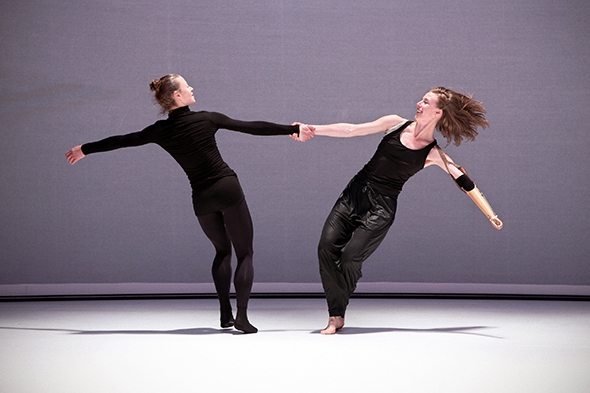
Lora Juodkaite and Annie Hanauer in Rachid Ouramdane’s Tordre (photo: Patrick Imbert)
The first sensation on walking into the auditorium at artsdepot is one of harmony. Sylvain Giraudeau’s set for Rachid Ouramdane’s Tordre, presented as part of Dance Umbrella’s 2017 festival, is like the contour of a shell, a gently curving light grey wall at the back of the stage that is evenly lit by Stéphane Graillot. Two metal pipes of different lengths descend like abstract sprinklers each with a lateral arm parallel to the floor. ‘Tordre’ (literally, to twist) comes from the same family of words as torsion or torque, and while there is an expectation of circular movement in Giraudeau’s set, the only immediate indication is a small electric fan at the foot of the rear wall that turns back and forth on its axis. Just as you’re getting used to this soothing conception, the music starts and two dancers, Annie Hanauer and Lora Juodkaite, make a flourishing entrance from opposite sides of the stage. The recorded soundtrack from the musical Funny Girl gets stuck in a groove, so Hanauer and Juodkaite repeat their entrances again and again. If you didn’t already know her, you can’t help noticing Hanauer has a prosthetic lower left arm — but that’s the point; this is a gently provocative opening gambit in which attention is deliberately drawn to Hanauer because of her perceived disability. Yet by the time the two dancers have made five or six entrances, we have come to accept it and are drawn instead into the comic absurdity of their repeating groove and their subtly different dynamics in entering and departing.
Having introduced them with a broad smile, Ouramdane begins to delve down into their individual strengths, presenting first Juodkaite and then Hanauer in separate solos to his own music that reveal their unique approaches to dance. We see Juodkaite initially turning very slowly and evenly like a clockwork dancer on a stand before she melts into luxuriant postures like spirals within spirals, belying her strength in her effortless flexion. Ouramdane pays no more attention to Hanauer’s prosthetic arm but creates for her a mesmerizing, extended solo that takes her movement beyond a virtuosic level to an emotional plane where he leaves us to distill our perceptions. Later in a choreographed, eloquent response to Nina Simone’s song, Feelings, Hanauer enters unerringly into the phrasing with its lyricism, its hesitations, and its questioning. The two solos mark a progression from a literal, physical notion of Hanauer’s disability to a more abstract and emotional understanding of how disability can itself engender ability and, with resilient determination, emerge as artistry. Hanauer expresses herself as the dancer she is without settling for a physical absence that might somehow diminish her.
Juodkaite doesn’t appear to have any disability but rather a unique ability to spin endlessly without losing balance or presence. And yet this ability did not arise out of nowhere; she has been practicing spinning, or movement gyration, every day since she was a small child as a form of psychological strengthening. To see her spinning is, like seeing Hanauer at first, to notice the exception before the exception becomes, in its artistic transformation, a heightened emotional experience. TS Eliot, referring to time in his poem, Burnt Norton, wrote of ‘the still point of the turning world’ where ‘past and future are gathered’:
‘Except for the point, the still point,
There would be no dance, and there is only the dance.’
Juodkaite, in spatial terms, has made her dance the turning (gyroscopic) point where she finds her equilibrium in the turning world. And turn she does, with variations of speed and a rich articulation of her arms that are reflected in the turning, horizontal metal arms above her. She spins around the stage with perfect composure in ever decreasing circles, setting up a hypnotic moving image that, like Hanauer, removes us beyond the virtuosity. In one of the few interactions in this section of solos, Hanauer intercepts Juodkaite, gently receiving her into her open arms before releasing her once again; the dynamics seem effortless and timeless.
Tordre is both a dance performance and a documentary in movement, for as soon as there is talk of obstacles there is a response in biography. In her final spinning solo, Juodkaite relates anecdotes about her early life with her sister as if the spinning is in itself a form of remembering. But Ouramdane is careful to balance biographic attention with his meditation on difference and artistic ability. He reveals in both Juodkaite and Hanauer a way of moving that is generated by the obstacles and is not simply a result of them. This notion goes to the very heart of dis/ability and thus in its abstract treatment, Tordre is more powerful and far-reaching than the presentation of two remarkable artists on stage. Another connotation of ‘twist’ is to change perceptions; Ouramdane, Juodkaite and Hanauer together show how this can be done.
Posted: October 31st, 2017 | Author: Nicholas Minns | Filed under: Festival, Performance | Tags: Anna Martine Freeman, Bob Dylan, Charles Linehan, Dance Umbrella 2017, Hannah Burfield, Julie Cunningham, Karolis Janulis, Lisbeth Gruwez, Londiwe Khoza, Monique Wittig, Shoreditch Takeover, Vanessa Kisuule | Comments Off on Dance Umbrella 2017: Shoreditch Takeover
Dance Umbrella 2017, Shoreditch Takeover, Shoreditch Town Hall, October 28

Lisbeth Gruwez dances Bob Dylan (photo: Luc Depreitere)
The final party of Dance Umbrella 2017 at Shoreditch Town Hall continues the festival’s experiments in matching dance and architecture, the body and its forms of expression. The theme of Shoreditch Takeover could well be the power of the moving word: Julie Cunningham & Company’s Rays, Sparks, Beating Glows is inspired by the writings of French feminist and literary theorist Monique Wittig; Lisbeth Gruwez embodies the songs of poet Bob Dylan, and Vanessa Kisuule performs a selection of her own poetry. For the word-weary there is Charles Linehan’s 18-minute choreographic film, The Shadow Drone Project, that loops silently in a space of its own throughout the evening. Shoreditch Town Hall was never designed for dance, but this pairing of dance and spoken word neatly blends its municipal role with a temporary focus on communicative performance.
Coming into the elegantly proportioned Assembly Hall for Rays, Sparks, Beating Glows, there is a heightened sense of order in the rectangle of black floor, the haphazard arrangement of lyre-backed chairs — some upturned or leaning against another like the silent aftermath of a domestic quarrel — and Richard Godin’s diffused lighting with the faintest whiff of haze. Three women enter in the dark; Anna Martine Freeman sits but in a gentle light Hannah Burfield and Londiwe Khoza start to recreate in halting, abstract terms their personal quarrel to which the mute chairs bear witness, an irretrievable chasm within the suggestion of an embrace. Freeman remains silent, untying her boots as she recalls through her skin the discomfort of the injurious past, when from behind the audience Cunningham enters noisily into the present like a latecomer in a skimpy black outfit supported on high-heeled boots and topped with a long unruly blonde wig. She minces directly to Freeman and climbs over her like an exotic dancer called upon to perform for a client. Cunningham’s raw, explicit imagery contrasts emotionally and spatially with duet of Burfield and Khoza, who wait for the right moment to slip away. Off come the wig and boots as Cunningham explores the relationship between Wittig’s textual imagery (delivered by Freeman) and her own. But while Freeman gives a forceful, emotionally mature reading through her gestures and the very texture of her voice, Cunningham’s response feels self-conscious, lacking the emotional potency conveyed in the spoken words. By the time Rays, Sparks, Beating Glows finishes, the order in the room has been replaced by a sense of unease.
Downstairs in the Council Chamber, Vanessa Kisuule presents a colourful set of her poems, following on from Freeman in delivering not only the words but the gestures that carry them. Dance is a non-verbal art form but used in the right way Kisuule reminds us these silent gestures move through figures of speech and poetic images in celebration of the sensual non-verbal eloquence of the poetry. Kisuule whets the appetite with a poem entitled Rosé, and follows it with a ribald tale about shaving assholes (‘the crassist of bathroom ballets’) before delivering in a soft patina of an American accent a dark, poignant reflection on Martin Luther King told through the voice of one of his lovers. Effusive, expressive and irrepressible, Kisuule then reads a touching tribute to her Ugandan grandmother before a final bullet-point poem of irreverent reflections.
Back upstairs after the intermission, Lisbeth Gruwez and musician/composer Maarten Van Cauwenberghe stand behind the sound console with the relaxed attitude of old friends and the nervous excitement of waiting for the audience to settle. Lisbeth Gruwez dances Bob Dylan is what’s written on the tin, like the iconic covers of Dylan’s early vinyl LPs resting on the floor against the console. Van Cauwenberghe slips out a record on to a turntable and lowers the needle while Gruwez stands in bare feet and casual clothes, an image of expectancy in a field of energy. These are early songs, fresh, acoustic and enthusiastic; again we are reminded that words move and transport us into the worlds they create through the sensuality of sound and inflection. It is difficult to establish exactly where Gruwez positions herself in these songs though she is rhythmically attuned and the odd gesture picks out an accent in the poetic sequence of words. She is neither illustrating the songs, nor simply doing her own thing with them; it’s as if she has turned the rasp and lilt of Dylan’s dancing voice inside out and given it powerful, fluid gestures and an intense gaze; at times she even resembles Dylan. She relishes the verbal musicality, capturing the idiosyncrasies of Dylan’s alliterations, the expansiveness of his metaphors, and the minimalism of his synecdoche with exuberant delight and elegant nonchalance, but at the same time her gestures set up other images. Walking slowly upstage in Knockin’ on Heaven’s Door, her white silk shirt sticking to her skin and emphasizing the muscular rippling in her back, she is like the lonely hero in Wim Wenders’s film Paris Texas; in the glorious Sad Eyed Lady of the Lowlands we see her floating bare-legged on the floor in a pool of light that Van Cauwenberghe guides around and over her, reflecting in the shiny black surface a seamless depiction of femininity in Western art from Venus to St Theresa. Catching her breath, she tenderly asks the audience ‘Is everyone all right’? Gruwez is very much at ease on stage; she comments on her own actions and jokes with Van Cauwenberghe in asides between songs and then climbs back inside the voice, romping delightfully through Subterranean Homesick Blues before inviting us to select a song (Hurricane is chosen), take off our shoes and join her on the stage to dance Bob Dylan together.
In the intermission, there were too many people in the room watching Linehan’s film projection, The Shadow Drone Project, to be able to stand back and contemplate Karolis Janulis’ (already) long-distance photography from a drone of dancing figures in various landscapes. We returned after Gruwez and before the DJ had started up in the Council Chambers. Linehan has made choreographic poetry of the aerial photography by featuring the extended shadows of dancers in the late sunshine; we are watching their patterns superimposed on the dancing patterns of the landscape or shoreline. It’s a serenely simple concept and the result takes dancing to another distant realm, totally enchanting and surreal at the same time.
Posted: October 24th, 2017 | Author: Nicholas Minns | Filed under: Festival, Performance | Tags: Ann Teresa de Keersmaeker, Chantal Cloupet, Coralie Levieux, Dominique Drillot, Elsa Monguillot de Mirman, François Renard, Graziella Lorriaux, Grosse Fugue, Jacqueline Bâby, Jan Joris Lamers, Lucinda Childs, Lyon Opera Ballet, Maguy Marin | Comments Off on Dance Umbrella 2017: Trois Grandes Fugues
Dance Umbrella 2017, Lyon Opera Ballet, Trois Grandes Fugues, Sadler’s Wells, October 19

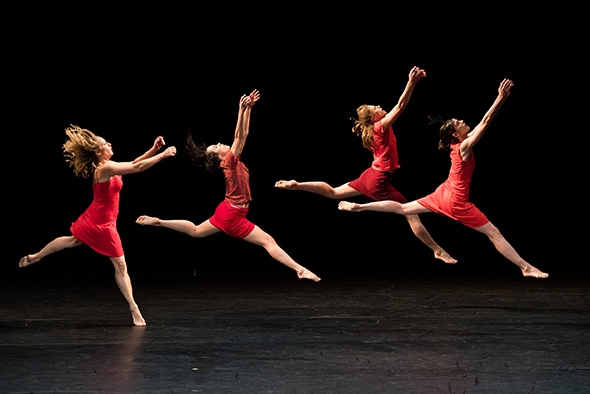
Graziella Lorriaux, Elsa Monguillot de Mirman, Jacqueline Bâby and Coralie Levieux in Maguy Marin’s Grosse Fugue (photo: Bernard Stofleth)
In a welcome visit to Dance Umbrella’s 2017 festival, Lyon Opera Ballet’s program of three distinct responses to the same score — in this case Beethoven’s Die Grosse Fugue, op.133 — is an enlightened way of seeing the music through the eyes of each choreographer. And such is the variation in response — even taking into account the different recordings used — that the music is in turn affected by the choreography and sounds quite distinct with each performance. Originally written for string quartet, Lucinda Childs’ Grande Fugue (2016) employs a score transcribed for string orchestra; Anne Teresa de Keersmaeker’s Die Grosse Fuge (1992) here uses a 2006 recording by the Debussy Quartet and Maguy Marin prefers a 1968 recording by Quartetto Italiano for her Grosse Fugue (2001).
Childs’ use of a string orchestra transcription inevitably softens the music, rounding its edges and subduing the meticulous clarity and brio of the original four instruments; if the string quartet version is white, the string orchestra version is in shades of grey, which happens to be the starting point for the production design, lighting and costumes by Childs’ long-time collaborator, Dominique Drillot. Childs, whose name came to international attention with her choreography for Robert Wilson and Philip Glass’s Einstein on the Beach in 1976, is known for her minimalist vocabulary that is expressed here as repetitive patterns with frequent changes of direction. Created for six couples, Childs adds extended arabesque lines to the inherent minimalism of Grande Fugue to give it a neoclassical patina; her linear conception responds deferentially to the complexity of the score without exploring its emotional heights or depths.
De Keersmaeker, on the other hand, accents the up beat of the musical phrases to raise the choreography into the air while grounding Beethoven’s powerful shifts of emotion through the bodies of her dancers. Her intention was to choreograph Die Grosse Fugue with ‘a masculine vocabulary, non-classical and sexual’ to which she alludes in the black and white formal evening wear worn by the six male and two female performers. If the costumes also relate to the classical nature of Beethoven’s composition, de Keersmaeker’s exuberant exploration of space and gestural form, pushed to the limit by the dancers, gives it an exhilarating, contemporary energy. Through her trademark use of hand and arm movements that fold and extend, her flying lifts and spirited floor rolls she reimagines the music as dance, finding new meaning in the score by underlining the continuity of movement between musical and choreographic composition. Within this intimate and playful reading, De Keersmaeker makes no gender distinction in developing a series of variations that draw her eight dancers — and the contrasting forces within the score — seamlessly together. The beauty of de Keersmaeker’s Die Grosse Fuge, and its power in performance, is that the music, choreography and imagery complement each other in an all-embracing unity that finds its climax in the final uplifting chord with the dancers left suspended in the air by Jan Joris Lamers’ perfectly timed blackout.
Marin chooses a slower recording (we are by now becoming attuned to the score) and also a freer vocabulary of inner emotional turmoil that gives her Grosse Fugue an existential feeling. Choreographed for four women (Jacqueline Bâby, Coralie Levieux, Graziella Lorriaux and Elsa Monguillot de Mirman), the vocabulary of tense syncopated movements and clenched gestures seems to derive from an exploration of states of frustration and despondence, reminiscent of photographs of the patients of nineteenth-century neurologist Jean-Martin Charcot in which the body articulates inner suffering and desperation.
Marin and lighting designer François Renard allow us to listen to the opening bars of the overture in the dark before the four women burst on to the black stage in Chantal Cloupet’s shades of red, carmine and vermillion, beginning an intimate, witty, sometimes heated conversation between themselves that constantly echoes the dialogue of the four instruments. They find moments to support each other in their instability and also give into their own silent unease but wherever they may be on stage Marin’s spatial construction conveys a unified field of emotional highs and lows, a powerful dynamic for breaking through an impasse that Beethoven himself may have experienced in overcoming his deafness at the time of Die Grosse Fugue’s composition; there is both empathy and catharsis in the fusion of the two art forms. In the halting section before the finale, the four women stop on the edge of the stage in an idiosyncratic family portrait before launching themselves into a gloriously abandoned recapitulation of their conversation in which they end up sliding supine to the floor with an energy that reverberates well beyond the final chord. When the lights come up they are still there.
Posted: October 20th, 2017 | Author: Nicholas Minns | Filed under: Festival, Performance | Tags: Dance Umbrella 2017, Fred Costa, Origami, Satchie Noro, Silvain Ohl | Comments Off on Dance Umbrella 2017: Satchie Noro & Silvain Ohl, Origami
Dance Umbrella: Satchie Noro & Silvain Ohl, Origami, Battersea Power Station, October 11

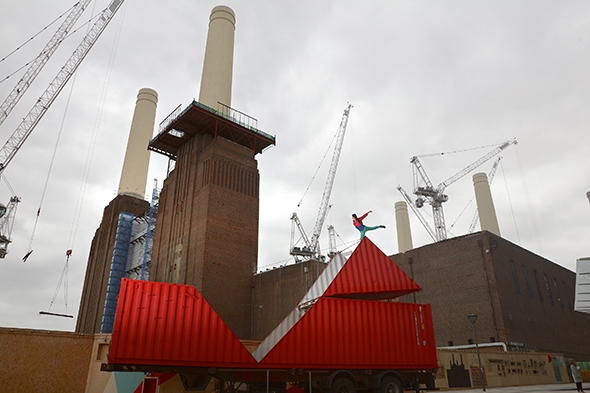
Satchie Noro in Origami in front of the Battersea Power Station (photo: Johnny Stephens)
Origami’s free performance opened London’s 2017 Dance Umbrella Festival and was subsequently performed in four other London locations.
If we were to imagine the American artist Donald Judd dozing in his studio, he might have been dreaming of a bright red container on the Thames riverfront set against the profile and the silhouetted cranes of Battersea Power Station on a drizzly, misty evening. An audience gathers in front of the parked 40-foot container on the terrace in front of Circus West Village Piazza, which is the point at which Judd’s dream vies with reality. On a balcony just above and to the side of the container, as if they are sitting in a covered theatre box, residents from the block of flats have settled down to watch the spectacle. Dance Umbrella is turning open air spaces into theatres and bringing dance to new audiences.
Origami is as much about the experience of watching it as it is about the performance itself. What Satchie Noro and Silvain Ohl have created is an awareness of both scale and contrast and as if the inherent contrast between a container and a solo dancer is not enough, the evening’s floodlit landscape of the refurbished power station rises like a monumental set behind them. Fred Costa’s sound score seems to arise from the same industrial, riverside setting and continues as a collage of music, speech and urban sounds that merge with the installation’s own mechanical rasp to wrap the visual reverie in a timeless and borderless aural space. Despite the sense of imposing gravitational force all around, the experience of watching the performance is somehow unearthly.
Origami is generally thought of as the Japanese art of paper folding, but the development of the science and mathematics of origami has led to research where hard materials, oxyacetylene cuts and metal hinges replace the traditional paper and folds. What Ohl has conceived in slicing up his container is a rigid origami pattern which we see initially in profile as essentially flat, but when its inverted triangular section slowly winches open on its hinges we experience a three-dimensional origami flooded with light. The light in turn softens the industrial edges of the metal to prepare for the emergence of a human element. At first we see two elegantly pointed feet swimming languidly in the air but as the geometric space unfurls, we see the feet are joined to a female figure dressed in green trousers and layered blue and red tops suspended by her hips on a trapeze. The playful colours are reminiscent Robert Indiana’s LOVE sculpture, though Noro’s shades of blue and green are minute flecks of colour against the giant red surface.
Noro’s childlike nonchalance and sense of adventure within this layered interaction of material and light, of mass and space, of small and industrially large is what gives Origami its dreamlike aspect. Her agile motion animates the space and plays with the juxtaposition of scale. At the top corner of the container close to the balcony she seems to be within reach of the spectators, drawing them into the action, and when all we can see is her hands gripping the top of a container wall she’s hiding behind, such a tiny detail is clearly recorded as an extension of her invisible form.
Once the rigid origami begins to open, its two mobile sections continue to move, almost imperceptibly, until the end. Noro’s negotiation of both the material of the container and the spaces between its elements shares this elongation of time; she moves slowly and smoothly, an ability derived from her training in classical dance and circus arts. She is as comfortable hanging in space and from the steel ropes that connect the three sections as she is climbing on their exterior surfaces or sliding down their edges. She occasionally punctuates the arc of her movement with static poses like a classical sculpture in the pediment of the upturned triangle, or draping herself over its apex, drawing our attention to the architectural shapes and spaces that the origami pattern suggests.
Just in front of the standing audience three children follow Noro’s every move with their eyes and bodies, daring each other to accomplish on the damp terrace what she is achieving up above. It is only at the end when Noro drops lightly from the trapeze to the floor of the container and disappears into the welcoming light of its interior that the children finally awake from their dreams of aerial adventure.
Posted: October 17th, 2017 | Author: Nicholas Minns | Filed under: Festival, Performance | Tags: Carlos Marquerie, Dance Umbrella 2017, Eduardo Trassiera, Fallen from Heaven, Rocío Molina | Comments Off on Dance Umbrella 2017: Rocío Molina, Fallen from Heaven
Dance Umbrella 2017: Rocío Molina, Fallen from Heaven, Barbican, October 14

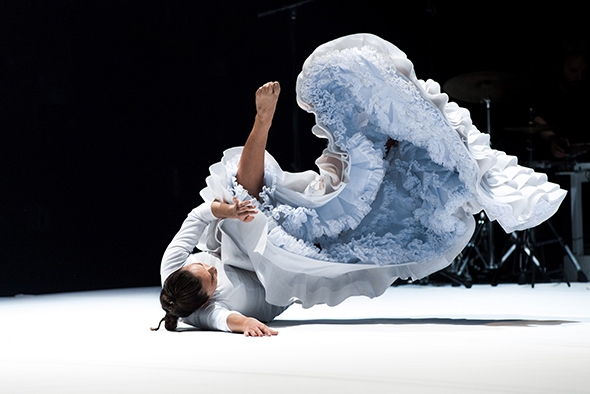
Rocío Molina in Fallen from Heaven (photo: djfrat)
There’s a suggestion of flamenco in Rocío Molina’s image (see above) on the cover of Dance Umbrella’s program for Fallen from Heaven but the stage set — a white screen, a bare white floor with a drum kit, a beat box, and two electric guitars propped up against chairs — does not immediately corroborate it. Another suggestion comes from a program note stating Molina has ‘coined her own artistic language based on a reinvented traditional flamenco style’ but following the opening acid rock number by the four musicians who then leave the stage, expectations are left wide open. When the lights reveal the voluptuous Molina alone on stage in her white flamenco dress poised as Botticelli’s Venus in a scalloped shell, images collide. Molina displays the silent vestiges of flamenco in her raised arms, coiled wrist and fingers and slow, silent clapping before descending to the floor like a muffled chrysalis about to emerge as a new form: birth and death at the same time, or what Joseph Schumpeter called in economic terms ‘creative destruction’. She slides across the floor with a marked disdain for fluidity, her body and dress morphing into the shape of insects whose upended legs and feet wilfully contort the upright elongation of the classic form. If the body is doing its best to rub out its flamenco traces, there is still the dress to dispose of, which Molina slips off with less modesty than coyness; her arms cover her chest and groin with more precision than Botticelli until her attendant musicians arrive to place an ample jacket over her shoulders under which she changes into her next costume. We have almost arrived at the point in the press release where Molina ‘borrows from feminine, masculine and animalistic codes to give a very personal performance about womanhood’.
The next tableaux deal rather messily with the masculine code in which Molina self-consciously pulls flamenco through the ringer of cross-dressing (herself as buxom toreador in white tights, black sports bra and black plastic knee pads) and overt sexual imagery like her codpiece of ejaculating crisps. Her provocative tone degrades her treatment of male stereotypes to a parody, but while she mocks them she fails to avoid clichés of her own, particularly the superficial projection of woman as sexual object surrounded by admiring men. When Molina steps into a box to pull on a transparent latex skirt drenched in a sticky carmine substance with which she subsequently paints the floor in choreographic strokes, her statement loses the biting gender critique that performance artists and female choreographers before her (like Charlotte Vincent) have expressed, because she treats it, through an overhead camera, too literally as image. It is this indulgence in the mere visual effect of images that makes a muddle of the many tableaux, costume changes, entrances and exits that constitute Fallen from Heaven. Molina inhabits her material too superficially to build a convincing picture out of these various elements and her performance suffers by not moving beyond the safe boundaries of modest déjà vu. Some of the responsibility for this must also lie with Carlos Marquerie whose roles as co-artistic director, dramaturg, stage and lighting designer are too deeply embedded in the production to ignore.
The one thread that remains constant throughout Fallen from Heaven is the virtuosity of Molina’s rhythmic, percussive footwork that, in her interaction with the musicians, proves an impressive (and un-reconstituted) element of her art, even if it loses its spirited theatricality through being used unsparingly as a running commentary. It is only later in the work, when the fallout from heaven has strewn the stage with plastic carnations, red paint and bunches of plastic grapes that Molina seems to come into her own as a flamenco exorcist in search of Dionysus. Guitarist Eduardo Trassiera plays memorably, but Molina has difficulty navigating the end. With nothing left but her indefatigable energy and a raft of costume clichés, she plays to the crowd (and in the crowd) unashamedly as if she’s the heroic survivor of an unjust plot by the flamenco gods — all male — to banish her from the classical heaven. Her revenge is to bring the audience to its feet.
Rocío Molina performed Fallen from Heaven (Caída del Cielo), part of Dance Umbrella 2017, at the Barbican 12-14 October. www.danceumbrella.co.uk
Posted: October 14th, 2017 | Author: Nicholas Minns | Filed under: Visual Art | Tags: ballet, Burrell Collection, Edgar Degas, National Gallery, pastels | Comments Off on Drawn in Colour, Degas from the Burrell
Drawn in Colour, Degas from the Burrell, National Gallery, September 18.

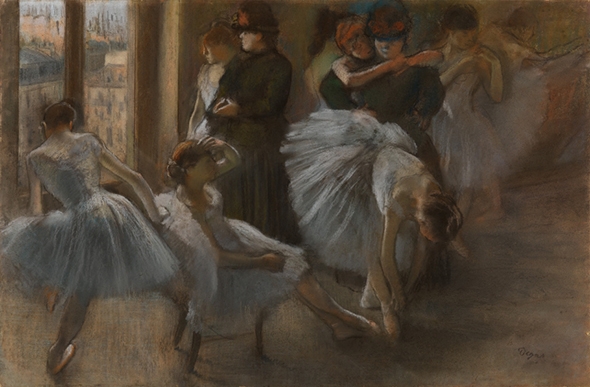
Edgar Degas, Preparation for the Class about 1877 Pastel on paper, The Burrell Collection
As a dancer I have for many years felt an affinity for the works of Edgar Degas who for the last 20 years of his life found an enduring subject in the dancers and dance culture of Paris at the end of the nineteenth century. The current exhibition at the National Gallery, Drawn in Colour, Degas from the Burrell, marks the centenary of Degas’ death on September 27, 1917, and is loaned for the most part from the Burrell Collection in Glasgow while its permanent home undergoes refurbishment. Drawn in Colour, curated by Julien Domercq, also includes works from the National Gallery’s own collection.
Degas’ drawings, paintings and pastels of dancers, some of which form part of the exhibition, are inured in the practice and performance of ballet at the Opéra Garnier in Paris. He was born too late (1834) to know the height of romantic ballet in the city but before he died, although his health was frail and his eyesight poor, he attended the first performances in Paris of Diaghilev’s Ballets Russes in 1909. (There are two pastels in the exhibition called simply Russian Dancers, dated 1899, which are, according to Alexandre Benois, figures from the Russian folk dance or Hopak, in Fokine’s ballet Le Festin at that 1909 performance).
Since Degas died during the First World War his estate was auctioned in Paris before the war ended. Maynard Keynes, then a humble Treasury adviser but also a keen art collector, used funds borrowed from the United States for the war effort to send himself and the then director of the National Gallery, Sir Charles Holmes, to Paris to bid on the Degas estate. The sound of the guns could be heard from the auction room but although Keynes and Holmes managed to bring home some works for the national collection, they did not return with any works by the artist himself. Sir William Burrell had already started collecting Degas around 1910, amassing 22 works by the time he gifted them, with his entire collection, to the city of Glasgow in 1944. All 22 are assembled in this exhibition, the first time they have been seen together outside Glasgow.
The exhibition is divided into three rooms organized around the themes of Modern Life, Dancers, and Private Worlds; Degas’ interest in the new middle class preoccupations with horse racing (Longchamp held its first race in 1857) and with ballet at the Opéra Garnier (opened in 1875) coincided with his interest in the passing gesture, in traces of movement, in the unique framing of subjects that sits somewhere between the Japanese print and the photographic snapshot and, it is evident, in his love of the intimacy and sensuality of the female form. Degas might have been a photographer — he became proficient in the use of a camera that he purchased in 1895 — but drawing and painting in colour was his particular medium. He sometimes merged the two techniques as in an oil painting, After the Bath, from 1896, which he painted from one of his own photographs. Perhaps I am imagining it, but while its sensuality of form is as equally present as in the bathers drawn from life on the same wall, its flatness of plane belongs more to the nature of the photograph than to the directness of the artist’s own eye.
It is in his use of pastels that Degas found a medium that most successfully united his emotions, his eye and his subject, an effervescence of cross-hatched lines and colour that extend beyond the subjects themselves to express both a sense of movement and his feelings towards them. Red is a tone that is particularly evident in this collection of works, from the red hair of many of his dancers and their tulle skirts to the orgy of red that is the National Gallery’s own Combing the Hair (1896). All the paintings in the exhibition focus on the female form, either at work (Laundresses, 1882-4), at leisure (At the Jewellers, about 1887), dancers rehearsing (Dancers on a Bench, 1898) or preparing their toilette (Woman in a Tub, 1896-1901). If one is prepared to allow this sensuality to arise from the canvas, then Degas, Drawn in Colour allows us behind the eyes and into the life of a famously protective artist; if not, the ‘shocking voyeurism’ of which he is accused by reviewers like Rachel Spence in the Financial Times (writing about the parallel Degas: A Passion for Perfection at the Fitzwilliam Museum) becomes an excuse to use his work as a keyhole through which to observe the private life of the artist.
Drawn in Colour, Degas from the Burrell is at The National Gallery until May 7, 2018. Admission free, donations welcome.
Posted: October 10th, 2017 | Author: Nicholas Minns | Filed under: Performance | Tags: Chahine Yavroyan, François Testory, Jean-René Lemoine, Lia Prentaki, Medea, Mr. Pearl, Neil Bartlett, Nelson Fernandez, Phil Von | Comments Off on Jean-René Lemoine, Medea (Written in Rage)
Jean-René Lemoine, Medea (Written in Rage), The Place, October 7

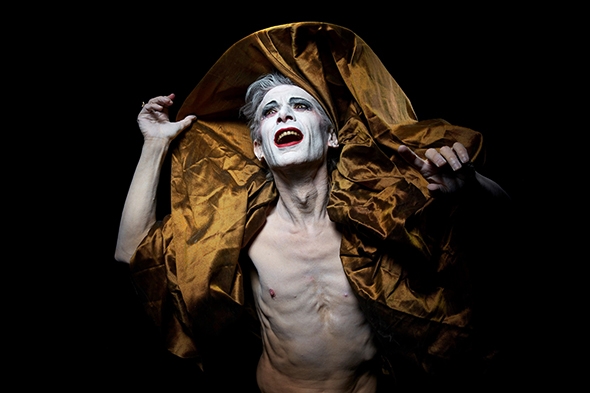
François Testory as Medea (photo: Manuel Vason)
Just how Medea (Written in Rage) ended up on the stage of The Place is an example of cooperation between a raft of organisations (NFA International Arts & Culture, SACD, Institut Français, Arts Council England, Theatre of Europe, FOLKE, Southeast Dance and The Place) that shows how Europe can work together seamlessly in the realm of arts production. The artistic team is also multi-national, where Lia Prentaki and Nelson Fernandez are the producers of a Neil Bartlett translation, adaptation and direction of a Jean-René Lemoine play — Médée, poème enragé — with actor François Testory, music composition by Phil Von and lighting by Chahine Yavroyan. There is an ironic coincidence of timing between this no-holds-barred 90-minute monologue of Medea’s vengeful family relations and the pathological UK Conservative Party seeking to subvert with similar sang-froid but less éclat the very union that made this kind of production possible.
Were Testory a demagogue, you could sense the rapt audience would follow him unquestioningly because of the commanding nature of his performance, dissolving convincingly from a male portraying a female to the female being portrayed. Von, onstage with a battery of sound equipment and musical instruments, steps in on occasion to prompt Medea to explain a particularly unsavoury action or her reason for doing it, and she obliges. Medea, in turn, asks Von to fast forward or rewind the details of her story, and he obliges. Yavroyan’s dramatic, hazy lighting and Mr. Pearl’s haute couture gown and platform shoes place the visual centre of the performance on the charismatic presence of Testory himself, specifically on his eloquent face and hands and the network of sinews and muscles that animates them. From these articulate physical instruments arises a voice that when singing the aria E lucevan le stelle has a wealth of emotion but when recounting his sordid tale has a disarmingly dispassionate tone; it is the words themselves that carry the horror of the images that Lemoine/Bartlett/Testory conjure up in giving Medea the opportunity to tell her own tale from the beginning. This is fertile and congenial ground for Bartlett who over the years has given voice to historical and literary figures, conjuring them up from oblivion and notoriety in theatrical performances that merge the personal and the political, spectacle and intimacy. Medea (Written in Rage) is no exception.
The story draws on Euripides’ play and on Medea’s famous monologues as well as from other versions of the classical legend and modern references. Medea invokes the spirit of similar mythical figures in bearing witness to the love and pain that run through her story of betrayal and bloody revenge. Lemoine riddles the text with ambivalence, layering meanings and imbuing the ancient legend with current undertones so that as a genderless, stateless, and raceless figure, Medea’s tragic story resonates with the sorrow of exile, the drama of being an ‘outsider’, of never belonging. There are echoes of the current refugee crisis, of sexual, racial and gender discrimination and exploitation that infuse the horror with grief and the desolation of a life that paradoxically seems to find a form of liberation only in violence. For the sake of Jason, Medea is disloyal to her father and kills her brother, betrays herself and becomes ‘occidentale’ in a vain attempt to please her partner. When Jason abandons her for a younger woman she punishes him by drowning their two sons and poisoning his new bride. There is neither justification nor condonation of the violence: Medea writes herself in rage. The character and the story are one and the same; rage is both the historical context and the personal response.
Medea’s fate is weighted by her actions, but even more by the aggression hidden in the biases, intolerance and double standards that society imposes on her. ‘I am not guilty’, Medea claims towards the end of her tale. ‘Life is punishment enough.’ Testory’s high platform shoes well convey the difficult balancing act of a character at the boundaries of acceptability with the constant peril of stumbling but his restrained performance does not yield to dismay, nor allow us bathos. Medea’s story is ancient but still tragically topical, a sober act of drama whose horror seems to continue to repeat itself over time, its scale no longer mythical but far too human.