Posted: October 17th, 2015 | Author: Nicholas Minns | Filed under: Festival | Tags: Ana Cembrero, Anna Borràs, Cabo de Gata, Costa Contemporánea, Hung-Wen Chen, Nerea Aguilar, Sara Cano | Comments Off on Opening night of Costa Contemporánea
Costa Contemporánea, Centro de Artes Escénicas de Nijar, Almeria, September 2

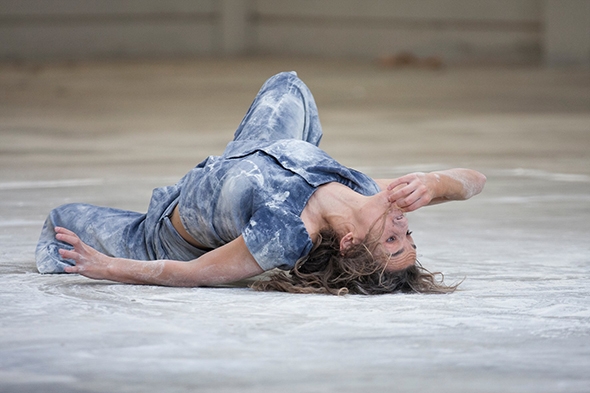
Anna Borràs in SIQ, winner of Il Certamen Mujer Contemporánea
It is with huge thanks to my friend Agustin Ferrando Castellano, co-director and technical director of this festival, that I was able to attend.
The costa in question is the southern tip of Andalucia in Spain, a volcanic landscape with a desert climate on an exquisite coast. Costa Contemporánea is a contemporary dance festival founded and directed by Nerea Aguilar that has carved a reputation in the region over the last six years. All festival participants stay in the beautiful natural park, Cabo de Gata; morning classes are on the grounds of the camping site or on the nearby beaches while performances are in indoor or outdoor venues in local towns.
The opening of the 6th Festival of Dance and Performing Arts is a gala at the Centro de Artes Escénicas de Nijar that presents the winners of a solo female choreographic competition, II Certamen Mujer Contemporánea. It is headlined by a filmed choreography by Ana Cembrero, Lost Archive, followed by the three performances of finalists Sara Cano, Hung-Wen Chen and Anna Borràs.
Lost Archive is the seed of a longer film, or so it seems, talking about memory and how it is maintained or lost in archival forms. The film evokes memory not as a stream of consciousness but in a rational and seamless juxtaposition of images and danced movement over a haunting musical score and spoken text in English and French. Dance is a perfect metaphor for memory as it relies on that fragile retention of something inexpressible through means that are incomprehensible. Lost Archive equates the fragility of documents that can be destroyed by fire with dance that is susceptible to visual extinction.
In A Palo Seco Redux, Cano creates a path from flamenco to contemporary dance; it is soon clear that her training is in the former and that she has thought through where the influences might overlap. In three separate circles of light she creates a different fusion that is cumulative over the performance. It begins with a decidedly flamenco form in all its energetic rhythms and arched elegance and finishes in contemporary with its brash looseness and sinuous flow. In the process Cano gathers elements of contemporary technique into flamenco, fitting them together with consummate skill so that on the physical level the edges of each are softened to make the fusion seamless. In terms of expression, however, the inescapable pride of flamenco and the abstract physicality of contemporary makes the fusion less apparent, as if the glue of the work does not mix quite as it should. It is the one element that holds back Cano’s work from an expressive whole.
In Renew Chen uses costume initially to erase her features, identifying herself on the outside by her grunge but chic black clothing, sunglasses and hat. Her choice of music hints at a discordant society with which she is in sympathy but her refined sense of movement indicates a self-awareness and confidence that sets her apart; perhaps she is playing with the dual role she must experience as a Taiwanese living in Germany. It is only when a rapid transformation sees her outer disguise fall as if she is sloughing off her skin that she becomes herself. While the synthesized score resembles a swarm of bees she remains serenely unfazed, contained within a cocoon of movement whose sudden, intense changes of direction are so smooth and unctuous that we do not see how she resolves them. Her body has an ability to move at speed while a stray arm or head reads slower, occupying a space that is finely delineated whatever her surroundings. Renew is thus a process of reinventing one’s identity without discarding what is essential.
Anna Borràs is a qualitatively different performer, a passionate dreamer with gritty edges. At the beginning of SIQ she backs on to the stage holding a small sack of flour to her chest. Her spatial choreography becomes a visual pattern as she throws, sows and tosses the flour around her with the expressive force of a shaman and the fragility of a dreamer. Her body is at the centre of her magic, the eye of a storm and like Chen she moves fast in tight spirals then unwinds. The dispersed flour remains suspended in the air like a universe in which she suddenly seems small, struggling to find her place, to assert herself. She writes of wanting to show the intersection of moments of adversity in periods of deep happiness, a universal theme that reminds me of an ancient poet relating epic tales of life lived fully. Having exhausted her resources — the equivalent of finishing the tale — she simply retreats into the darkness to recover her energy. Impressive.
The judges awarded Borràs the first prize, Cano the second and Chen the third, with Cano receiving the audience prize.
The remaining performances over the next four days were in a small open-air arena in Rodalquilar. But more of those later.
Posted: March 28th, 2015 | Author: Nicholas Minns | Filed under: Festival, Performance | Tags: Alexander Michael, Alexandra Waierstall, Alexia Nicolaou, Aneesha Michael, Arianna Marcoulides, Cyprus Contemporary Dance Platform, Elena Antoniou, Evie Demetriou, Fotis Nicolaou, Hamilton Monteiro, Harry Koushos, Julia Brendle, Konstantina Skalionta, Machi Dimitriadou-Lindahl, Marios Konstantinou, Milena Ugren Koulas, Petros Konnaris, Roula Kleovoulou, Vicky Kalla, Zoe Georgallis | Comments Off on 15th Cyprus Contemporary Dance Platform
15th Cyprus Contemporary Dance Platform, Limassol, Cyprus, March 6-8

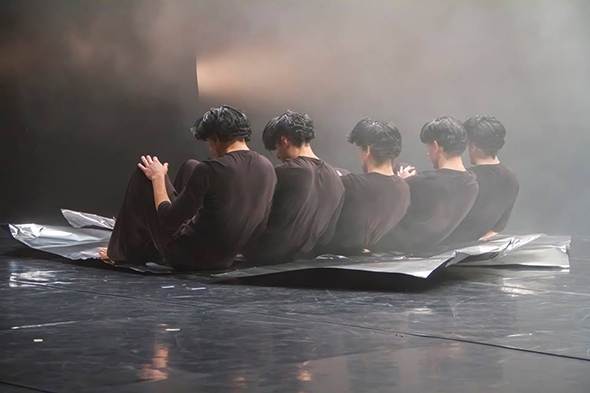
The final scene in Harry Koushos’ MAN-OEUVRES (photo: Arsham Rafiei)
The Cyprus Contemporary Dance Platform takes place annually over three days, with fifteen main stage performances in the Rialto Theatre and four parallel events at Dance House Lemesos next door. The event is supported generously by the Ministry of Education and Culture to whom I am indebted for being able to attend.
Limassol is a city on the southern coast of Cyprus in which dance is flourishing thanks to the pioneering work over the last fifteen years of the Rialto’s former director, Georgia Doetzer and a stronghold of dedicated dance teachers. The platform is open to the public, the theatre seats 550 and is well attended.
The dance community in Cyprus is close, with choreographers sharing dancers as well as dancing for other choreographers. There is also a pool of dramaturgs, musicians and various designers of sound, lighting and costumes on hand to prepare new works for performance. There seems to be no hierarchy but rather a collective desire to develop the art form; for a relatively small community the variation in ideas and dance forms is diverse.
Two points of emotional contact on the second night set me free from any geographical limitation. One is the final tableau of Harry Koushos’ work, MAN-OEUVRES that brings to mind the laying to rest of five identical brothers-in-arms with their shiny metal shields on a field of smoke to a glorious anthem by Henry Purcell. The movement has finished, the brothers lie in a row and the smoke is dissipating, but the images keep rolling through my imagination as the trumpets ring out over the battlefield: Koushos has captured an essential element of theatre, that of making images of mythological proportions from the artifice of its components. When he can bring all the elements of a work to this level it will be stunning. The other is watching Julia Brendle in a work that begins from the audience and stays in the audience, appropriately titled within and between. It is a duet with Brendle on one side of the auditorium and Marios Konstantinou on the other; they never make it to the stage. It begins very naturally from the premise of self-consciousness at the moment the two performers identify and separate themselves from the audience in which they were sitting and make their way to their respective aisles. It is such a simple idea that takes self-consciousness on a journey from introspection and nervous apprehension to a joyous celebration of gesture that raises the audience to a moment of euphoria. The careful sound design by Panos Bartzis based on a MEW instrumental track supplies the musical structure on which the dance builds. Watching it is like watching a game of tennis, following the performers from one side of the auditorium to the other, but my eyes are focused on how Brendle’s movement spreads by degrees throughout her body and beyond without ever betraying the gestures from which it derives.
There is an interesting cross-fertilization between choreographers Fotis Nikolaou and Hamilton Monteiro. Nikolaou presents his work called Inland (in which both he and Monteiro dance) that derives its mystery and power from the decision to have each of the five performers wear the same masks (designed by Martha Foka). With the elimination of facial expression, it is the posture and gesture of the body that communicates and Nikolaou sets the tone with his initial appearance alone standing almost naked on a platform under top lighting. With the weightless articulation of a bird he steps off and back on to the platform to fetch one item of clothing at a time until he is fully attired. On the same program, Monteiro creates a solo for Nikolaou, Marika’s dress, in which he utilizes a similar quality of movement to depict a controversial society figure (I am relying on the notes) who reacts in solitude to his/her pariah status. Mariko’s dress is more delineated as a piece of dance theatre than Inland — for all its intricate details it is too much like a choreographic maze to be coherent to the end — but the quality of movement in both is distinctive.
Machi Dimitriadou-Lindahl’s Gate for three women and two men is a mature work that celebrates flowing dance movement with patterns of dynamic form and clear imagery linked to a powerful score (two works, by Dimitris Savva and Julia Kent). Dimitriadou-Lindahl heads one of only five dance companies in Cyprus, Asomates Dynameis (Incorporeal Forces/Angels) which she founded as a way of exploring through contemporary dance and martial arts the inner energy and presence of the body. Gate deals with states of consciousness and has the sensitivity of ebbing and flowing energy in the group that ranges from collapse to support, from alienation to spiritual consolation.
Three works share a predilection for stillness, even though their averred creative sources vary, respectively, from sound frequencies to Samuel Beckett to philosophy: Arianna Marcoulides’ solo, Stomach Rumblings, Elena Antoniou’s solo more and (most starkly) Roula Kleovoulou’s duet, Standstill. Each work raises questions about the treatment of silence and about its effect.
Marcoulides lies motionless on what appears to be a thin catafalque as if she is awaiting burial. The lighting by Rialto’s resident designer Aleksandar Jotovic is deliberately somber so we can see the transmission of a crackling green light over her body to which she reacts by slowly raising her chest and feet before shuddering faintly and returning to the supine position. From a visual perspective this happens three times with minor variations but the concept, developed by Marcoulides and sound designer Panis Bartzis, is to relate sonic frequencies to their physiological effect on the human body. This discrepancy between visual and conception means either the science is simply more accessible in the reading than in the images Mercoulides chooses to give us, or the science is a shield for something more mysterious and unspoken to which she is not yet ready to give form.
Antoniou’s more is also divided into three distinct phases: as we enter the auditorium she is standing statuesquely on stage in a black leotard, kneepads and socks. She doesn’t move except for the infinitesimal impulses in the body that manifest in her torso down to her fingers. The kneepads give away Antoniou’s intention to descend to her knees which is a contradiction; the beauty of stillness is in not knowing what, if anything, will succeed it. The light fades very slowly to blackout and when it returns suddenly in full force Antoniou is on her way down to the floor. Interestingly she uses a sketch drawing of a figure by Francis Bacon as her program image; it is this fluid transition to an animalistic posture on her hands and knees that she captures though she doesn’t go for the tortured image of Bacon’s figure in which there appears to be a naked light bulb suspended above it, as in a squalid chamber. Antoniou’s floor movement eschews animality, deriving its form from the stomach or solar plexus with her head restlessly thrashing from side to side, but this doesn’t have sufficient force to justify the descent. She drags herself forward on a diagonal path but stops to stand, quite still, as before. This pattern is repeated with variations twice more until she takes off her socks and steps out of it, as if out of Bacon’s frame.
When the curtain opens on Kleovoulou’s twenty-minute duet, Standstill, there are two standing figures (Arianna Marcoulides and Milena Ugren Koulas) in close proximity and they don’t move for what seems the longest time; my first concern is that the music cue has failed. Ugren Koulas is looking out beyond the audience and Marcoulides is drilling her eyes into the side of her head expecting her to respond; she doesn’t. Panayiotis Manousis limits his lighting to the two faces thus concentrating the intimacy of this standoff but when Marcoulides inclines towards her partner/adversary the lighting opens up to the full stage and the tension starts to dissipate. An offstage fan ruffles the costumes and then stops. Marcoulides fixes her eyes on her partner as she sways like a heavily weighted pendulum, building up a tension that is oppressive, but it is not she who releases it: it is Ugren Koulas who begins to laugh. Suddenly the standoff that has kept the two women and the entire work together becomes meltdown as Marcoulides is reduced by slow, calculated degrees to a wounded, hysterical figure shaking uncontrollably. As soon as she stops the lights drop to black.
On the first night Zoe Georgallis presents For your entertainment only… in which she dances with Konstantina Skalionta and Typhaine Delaup. The work romps through the question of an artist’s identity without really addressing its serious, sometimes tragic nature, so the humour lacks depth (which is what gives it its bite). There is lots of movement referencing flappers and cabaret, but like the humour it lacks context. It is no wonder the disembodied voice of the choreographer as God is not sympathetic.
A trenchant and altogether darker treatment of the dual nature of existence is Alexia Nicolaou’s I will dark you down. I love the quote from Nikos Kazantzakis that headlines her program note: “What is light? Staring with a fearless eye into the darkness.” Nicolaou writes in a highly physical, visceral language that takes I will dark you down to the edge of madness but the distinction between light and dark is not always apparent even though she separates them by using Roza Maria Pantzis as her demonic alter ego. The dark side is well expressed but I am not sure by the end if Nicolaou has developed that ‘fearless eye’ or if her alter ego has got the better of her. One great asset of I will dark you down is the live soundscape by Dimitris Spyrou who transforms an array of found objects into a spooled orchestra of sound.
Vicky Kalla presents Big laugh for ever on which she collaborated with co-dancer Yoav Greenberg. Despite its title, this is more of a playful young love ritual than a big laugh and it is tinged with a sadness, or loss of innocence (symbolized by the pile of hats Greenberg loses one by one to Kalla) that saves it from being cute. There is a third character who sits from beginning to end on the top of a ladder with his back to us. We never see his face but we can see he is writing on a laptop. If he is the author, and Big laugh forever is his story, I don’t know what he adds to the performance; if the dance is his stream of consciousness, it is implicit in the dance. Now if he could cross out a phrase or sentence and rework it, his participation would warrant his inclusion in the work.
Alexandra Waierstall’s Lightless is, according to the program, part of a choreographic study that will lead to a full evening performance to premier in Dusseldorf in the fall, which makes it perhaps two stages away from completion. Nevertheless its otherworldliness is covered by Waierstall’s description of it as ‘minimal science-fiction with humans, plants, objects and feelings.’ The setting appears to be the stage itself after the audience and stagehands have left, a murky lifeless scene but for the spectral presence of Waierstall among several potted palm trees, scattered stage lights, electric fans and three microphones on stands. Fotis Nikolaou and Harry Koushos constitute the human element, the one moving low and stealthily around the stage, the other lighting him with a hand-held lamp but with very little to suggest any emotional relationship between the two. It is as if Waierstall is manipulating her elements — human, vegetable and mineral — to generate arresting images that derail our search for narrative and leave us finally to ponder the sound of the fans blowing the suspended microphones recording the swaying palm fronds: a storm of perception that ‘questions the relationship between man and the environment, ecology and theatre, archaeology and future utopia, the visible and invisible.’ There is clearly more in the description than is contained in this segment of Lightless, so it will be the Dusseldorf audience who benefit from its full evolution.
Konstantina Skalionta’s In the likeness of… is a compassionate observation of the complex relationship between mother and daughter. Ten minutes is not enough time to delve deeply into the relationship but Skalionta conveys her sentiments succinctly in a series of images that flow easily from one to the next. She is helped by Bea Bonafini’s fine red costume that embodies maternal love in the form of a womb and umbilical chord by which Typhaine Delaup emerges from under its voluminous folds. This is not a beatific vision of motherhood — Skalionta doesn’t shy away from the daughter’s struggle for independence and the cat fights — but it does celebrate it in a heartfelt way. She also links the work to her own childhood by singing a traditional Cypriot lullaby which is then taken up by Irma Vastakaite on violin. By the end the roles of mother and daughter seem to reverse but it is ultimately the umbilical chord that draws them together and erases any differentiation.
Alexander Michael’s Diluted Intentions is perhaps the first neo-classical dance inspired by grant applications. The set is a permutation of a chessboard with black and white squares on the floor and corresponding grid-like variations projected on the backdrop. The white squares on the floor turn out to be sheets of paper representing the grant application form whose wording appealed to Michael’s sense of humour, or to his sense of the absurd. Official documents can do that, but he appears to have navigated them well enough to be included on the platform. Diluted Intentions also refers to the nature of the creative process: ‘The artist, who claims to create a work that reflects society must embark on a creative process during which the artist, being open to intuitive choices, inevitably discovers new intentions during this process, resulting in Diluted Intentions.’ So while this is cerebrally a work about funding applications, the choreography explores a strategic game — something between chess and hop scotch — for four dancers, Julia Brendle, Rania Glymitsa, Dara Milanovic-Michael and Alexia Perdikakis, in which they watch each other intently before deciding on their next move. The footwork is fast and the lines long, but the gestures are what distinguish the work, especially in the extended improvisation by Brendle at the end.
Gestures are what bring the platform to a close in Happiness by Milena Ugren Koulas in which she performs with her husband, musician George Koulas. The program note relates the title to Aristotle’s philosophy of happiness, but looking at Ugren Koulas’ dance as language, happiness is a physical condition in which the body is a finely-tuned instrument of expressive power that the dancer can ‘play’ for the benefit of self and others. It is therefore fascinating to see the interplay between dancer and musician — Koulas on drums and singing — in which first one and then the other take the lead until they are both performing in rapturous harmony, a tour de force of gesture and percussion.
During the three days of the platform there are two parallel events at Dance House Lemesos. It is a studio and performance space set up in 2007 by five Cyprus-based dance companies with a common vision to create a structure that would allow dance art to develop on the island and also act as a portal for international collaborations and exchange. There are four performances staged in Dance House and the intimate, relaxed environment is ideal for them.
Take a marble torso of a young maiden from the archaeological museum and bring her alive with a piercing gaze, expressive limbs and a red bonnet and you have an idea of Aneesha Michael’s hauntingly serene presence. Her Quest is performed in a metaphorical landscape of a whitewashed block of four miniature steps and a small pile of talcum powder. The negotiation of these steps represent the obstacles Michael challenges with perilous equilibrium (she is not dissembling but presenting herself with problems of balance that she then resolves) and the powder that releases its particles and fragrance into the air as she passes with swirling patterns and fluid arm gestures is the transfiguration of her experience into mystical delight. Quest is a work whose qualities are invested in the performer; Michael is, as a colleague suggested, as much a medium as a dancer, channeling values that seem to come from somewhere beyond our mundane experience. Consciously or unconsciously we are all on this quest; Michael in her unornamented simplicity is showing us the way.
Another refreshing work in Petros Konnaris’ Nude Tree that is the most honest expression of the nude body I have yet seen. In a round table series of introductions on the opening morning of the Platform, he says he dances without clothes because he simply loves to be naked and it is this enthusiasm and lack of artifice that makes his work so engaging. Through careful manipulation of his body — he maps his way around the floor, usually upside down, with his hands and feet like a cartographer’s calipers — he creates forms that reveal the body, particularly his back, in startling beauty and yes, there are similarities between his upturned torso and supporting arms to the trunk of a tree. The latter part of his work is more playful but could be interpreted as a statement of his choice to be naked. His pants and shirt lie on the floor and he sets out to superimpose his body on first the pants and then the shirt, without ever putting them on. Lying on his back he lifts the hems of his pants in his prehensile toes so they fall over the contours of his legs then joins them meticulously to his shirt. He finishes by defiantly screwing up both into a ball with his feet and walking off the stage into the sunlight outside.
Evie Demetriou was pregnant when she created the duet Double Days (a term that refers to the ‘workload of men and women who work to earn money, but also have responsibility for unpaid, domestic labour’) and it is the experience of motherhood that not only links the three women — Demetriou herself and performers Milena Ugren Koulas and Rania Gymitsa — but informs the creative process. Questions about the female body, about desire and sex after giving birth, about husbands (‘they are all beautiful….from a distance’) are all exposed through graphic demonstration, satirical text and Ugren Koulas as radio commentator fielding listeners’ accounts of sex in extraordinary places. Double Days is framed in a highly physical language that puts the female body into the role of commentator, heroine and victim but it clearly derives its significance from the context of feminist politics, albeit of a good-humoured, non-judgmental variety.
The final work of the parallel events is a work in progress by Harry Koushos, the time quality. It continues Koushos’ exploration of the visual and aural qualities of thin metal sheeting. In his MAN-OEVRES he uses the same metal sheeting to create a thunderous interlude that we hear from behind the stage, but here the dancer is only ten feet away. At the same time Koushos projects images on to the metal sheet, abstract when it is at rest and a series of buildings raining down when the sheet is in rapid motion. The dancer, tall and thin like Koushos himself, makes his elongated way around the stage on variations of all fours, followed by another dancer lighting him with a mobile stage light. Both sound and light have a harsh, apocalyptic quality that is not expressed to the same degree in the movement. As in MAN-OEUVRES, Koushos is searching for a complete scenographic expression in which the dancers play a visual role.
Posted: December 23rd, 2014 | Author: Nicholas Minns | Filed under: Festival | Tags: Arkadi Zaides, Batsheva, International Exposure 2014, Israeli Dance, Ohad Naharin, Suzanne Dellal Centre | Comments Off on International Exposure 2014, Tel-Aviv

I am very grateful to Hillel Kogan who initially suggested I attend this festival and to Rachel Grodjinowsky of the Suzanne Dellal Centre for making it possible.
Anyone among London dance audiences who may feel (like me) they know Israeli dance through the works of Israeli choreographers presented in the UK may well have been astonished by the wealth of imagination and beauty on display at International Exposure 2014 in Tel Aviv’s Suzanne Dellal Centre for Dance and Theater* at the beginning of December. Open to the world, International Exposure is a showcase of new choreographic work by Israeli choreographers living in Israel.
Culture defines the way we imagine a country and the view of Israel culled from the works I have seen by Hofesh Shechter, Itzik Galili and Uri Ivgi is one of tension and oppression, an image corroborated by news reports of violence and political intransigence. I was expecting to see more of this kind of choreography in Tel Aviv but the first evening of works by Ohad Naharin, Project Secus, for the Batsheva Ensemble shows Israeli dance has moved on. Yes, there is an intensity in the work but one that comes from the dancers, and the tension is in the dynamics of the choreography. Each of the four works demonstrates the fluidity of the dancers’ bodies and the poetic imagination of Naharin, although the final work, Secus, caps them all with its sensuality and complexity. With Tel Aviv enjoying a late summer I felt I had landed in paradise.
There is an irony here: a predominantly oppressive choreographic output from Israeli choreographers living outside the country while choreographers inside it are creating works in which the freshness comes from the very desire to find a way through the darkness to a place of light. Apart from Naharin’s Project Secus, there are Inbal Pinto and Avshalom Pollak Dance Company’s Wallflower (created for Tel Aviv Art Museum’s sculpture gallery), Vertigo Dance Company’s Reshima, Dafi Dance Group’s In-Dependent and the lovely duet by Iris Erez, I’ll be right back. In other works this sense of light is enhanced by a keen sense of humour. Idan Sharabi presents a duet, Ours, that is choreographed to four of Joni Mitchell’s songs and to a witty stream of consciousness that relishes the absurd. Yossi Berg and Odad Graf’s 4 Men, Alice, Bach and the Deer seems to graft gaga with Monty Python; Hillel Kogan’s ability to carry the text to its illogical conclusion is brilliant (Kogan’s own satirical We Love Arabs was shown at the festival last year). Shani Gravot and Nevo Romano’s wry An Hour with All-Eaters includes fragments of a Bach partita in a simulation of a ‘one-hour visit to an archaeological site’ exploring the intimate landscape of their two naked bodies while Maria Kong overlays a talk-show format on a Buster Keaton soundtrack to produce perhaps the most surreal experience of the festival.
Interestingly, where choreographers choose to express violence and darkness the work is not entirely successful even if the experience of the dancers gives their performance a certain authority. The young woman who lectures the audience on sniper training in Kolben Dance Company’s Charlie Mandelbaum was indeed a sniper instructor during her military service, but the work as a whole wallows in its sense of angst. Sharon Eyal and Gai Behar’s Killer Pig has an odd balance between its dark, menacing poetry and the sensual beauty of the movement; its subject is ambivalent but it is mesmerizing, especially in the nightclub atmosphere of Reading 3 in Tel Aviv Port where the dancers commanded total silence from the packed crowd. One work that approaches violence from a different angle is Noa Dar’s Skin. Dar takes skin as a metaphor for protective boundaries that can be subjected to endless aggression; the analogy is clear but in placing the audience around the performance ring in which the four dancers spar in brutal, unrelenting combat Dar creates a clear division between performance and reality that abstracts the violence without compromising its visceral charge.
A recent work by Ohad Naharin, The Hole, for the Batsheva company is performed in their studio in which an octagonal platform has been built that leaves space for a few rows of chairs around it and a raised corridor behind the audience on which the men begin the dramatic opening of the dance. Much of Israeli dance is built on the circle, and here the audience is also in the round, setting up an intense spatial dynamic with the dancers. The women emerge from under the platform and return at intervals while the men descend and return to the grid above the performance space. Rich in symbolism, spectacular in effect, The Hole is like a vortex that draws in the audience to its mystery.
Three works at the festival were created for museum spaces, though only one, Dana Ruttenberg’s delightful NABA 2 is performed in the setting for which it was designed. Choreographed for four performers dressed as gallery attendants (the real ones are also in attendance) it references with succinctness and wit both the art works on display in adjacent galleries and the imagined relationships they suggest. Wallflower is presented on a stage that resembles two white walls of a museum space, and Jasmeen Godder shows her choreographic research for CLIMAX in her studio in which we are as much participants as observers.
One choreographer stands out for his uncompromising stance: Arkadi Zaides interprets Julia Wolfe’s string quartet Dig Deep, but he chooses not to compete with the musicians or the music. Instead he sits ruminating on the side of the performance space while the quartet plays within its architecture of lamps, metal music stands and chairs. Once the quartet has finished, the members change places with Zaides who then begins his Response to ‘Dig Deep’. If Wolfe’s score is stormy, Zaides is the eye of the storm, his gaze searching in silence for the currents of the music and responding with undulations and circles within his body to what the musicians expressed with the dynamics of their bows on taut strings. It is this kind of visceral approach that imbues two other of Zaides’ works (not seen at the festival) that received a Critics Circle award the following evening: Archive and Capture Practice in which Zaides throws himself into the action of projected films (from the human rights organization B’Tselem) of Jewish soldiers and settlers attacking Palestinian residents in the Occupied Territories. They are works of choreographic outrage and indicate the presence within the cultural community of forces that are actively protesting the government’s hard line.
There are also shorter works, some complete and some in the process of development though it is not always easy to distinguish to which state they belong. Uri Shafir’s Fail Better is a cerebral view of the limitations imposed on the dancing body by ageing, but it reduces the dancing to a level of the absurd (the title comes from a quote by Beckett) that leaves little room for hope. Other works address in differing metaphors the issue of relationships and their consequences: boundaries, separation, independence and dependence. Sharon Vazanna’s Transparent Borders is particularly convincing and both Noa Shadur’s Shifters and Nadar Rosano’s Off-Line are rich choreographic ideas that feature compelling performances (Adi Boutrous in the former and Stav Stuz in the latter). Roy Assaf’s GIRLS (the full version) carries the least complicated program note (‘Five dancers in leotards dancing a dance’) that belies its sensual juxtaposition of innocence and experience.
At the heart of the festival are the dancers, who bring all the choreographic works alive with such remarkable passion and fluency (gaga, the training technique developed by Naharin, is a central influence). Those who stand out are the young man who dances a solo at the very end of Secus as the lights began to fade who has the dynamics of a Francis Bacon painting carved in space; Ofir Yudilevitch who dances in three contrasting works with unaffected eloquence; the intensity of Mor Nardimon in Skin, and the sultry calm of Olivia Court Mesa in Dafi Altabeb’s In-Dependent. If Barrack Marshall’s Wonderland relies as much on an eclectic list of musical tracks as choreographic invention to convey emotions, he has in Inbar Nemirovsky a dancer who turns everything he does into beauty. She is musical, intelligent and has that rich plastic quality of the Batsheva diaspora.
International Exposure has been an opportunity to begin to connect the dots in Israeli dance, from Rudolph Laban and German expressionist influence to Martha Graham to Ohad Naharin and gaga. If you read Hebrew or German, Gaby Aldor has gathered this research in a book that is waiting to be translated into English. Aldor is adviser to Talia Amar, curator of a remarkable exhibition, Out of the Circle: The Art of Dance in Israel, currently in the Israel Museum in Jerusalem that features a wealth of archival material. Not only does it suggest that archival film has an enduring power to inspire but it celebrates the roots on which International Exposure is based.
Unfortunately there are no presenters from the UK at this year’s event, but hopefully the image of Israeli dance in London will not have to wait too long for its next update.
*The Suzanne Dellal centre, named after the daughter of a wealthy family in London who died too young, houses the two Batsheva companies as well as the Inbal Dance Theatre of which Barack Marshall is the new artistic director. The death of Suzanne Dellal has thus become a catalyst for a flourishing dance centre, directed for the past 25 years by a former dancer with Rambert and founder of Dance City, Yair Vardi.
Posted: November 11th, 2014 | Author: Nicholas Minns | Filed under: Festival, Performance | Tags: Alexandra Palace, Alexandre Hamel, Dance Umbrella, Edward Gordon Craig, Jasmin Boivin, Jenn Pocobene, Le Patin Libre, Lucy Carter, Pascale Jodoin, Samory Ba, Taylor Dilley | Comments Off on Le Patin Libre: Vertical Influences
Le Patin Libre, Vertical Influences, Dance Umbrella, Alexandra Palace Ice Rink, October 29

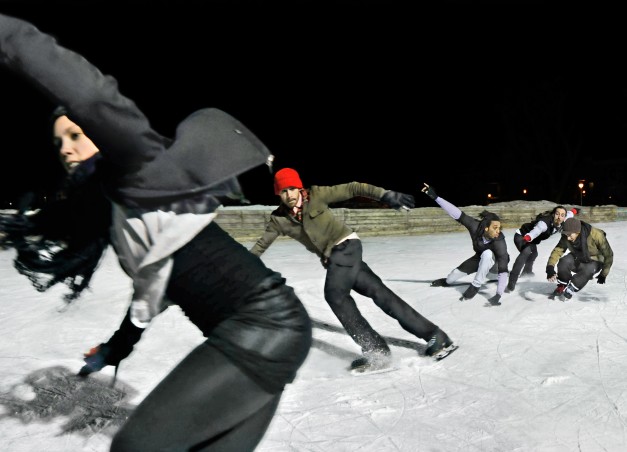
Le Patin Libre (photo: Rolline Laporte)
Two hours drive from Teddington should get you well out of London but on this particular Thursday it only got me to Alexandra Palace 15 minutes after the performance of Le Patin Libre started but as some kind soul who was wheeling his fold-up bike on his way to see the Hugging Guru in another part of Alexandra Palace told me, the time you arrive is precisely the time you should arrive. Notwithstanding the wisdom of his statement, I would have liked to see the beginning of Le Patin Libre’s Vertical Influences because what I saw subsequently was such a revelation.
Here you are on the ringside of this vast arena watching six skaters tracing lines in the ice like exuberant explorers, pushing space in front of them and pulling it behind them like a flock of birds. There is still a sense of the proscenium theatre because we are seated in a cosy rectangle on one side of the rink and the performers play towards us. But otherwise the dynamics of the conventional theatre are blown away by the sheer volume of this space, and also by the dance form. The origins of Le Patin Libre began on the frozen lakes and outdoor rinks of Montreal where ice underlies the national temperament. Every local park in winter has its seasonally constructed ice rink dedicated for the most part to hockey but also to free skating (patin libre). The photograph on the front of Dance Umbrella’s printed program gives you the idea. All but one of the members of Le Patin Libre took to the ice as naturally as we might learn to dribble a ball in the back yard. They then developed their skills in figure-skating competition but found the creative side limited. Alexandre Hamel got together a small group to develop a choreographic form on ice, and the rest, as they say, is icestory.
Back to Alexandra Palace where the skaters are like free spirits in autumn colours (courtesy of Jenn Pocobene) stamping out rhythms on the ice and swooping around the rink chasing each other, Hamel in an orange shirt darting in an out of the group. I am reminded of Paul Klee’s description of his doodle sketches as ‘taking his pencil for a walk’. Taylor Dilley doodles on one leg for long, slow stretches, but for the most part the skaters take their entire shape around the ice at high speed, skating with ballet bravura without having to compete for points. All six skaters have characters that brim with confidence without ever getting haughty about their skills or precious about their choreography; they have removed themselves from the trappings of figure skating and simply dance on ice, drawing the audience into their performance with endearing modesty. Perhaps it’s because I lived in Montreal for so long that the performance touches me deeply, but I felt at Alexandra Palace that I was not alone.
By taking the sport and artistic competition out of skating, Le Patin Libre presents a new dynamic of dance, one that allows shapes to glide and swoop and turn at dizzying speeds. And because the performers need so much space to move, the dance venue has expanded to heroic stature. Alexandra Palace is not exactly beautiful but tracking these dancers as they course around its rink is exhilarating. It is as if our senses grow into the new volume, enlarging our perceptions and expectations. Perhaps this is what Edward Gordon Craig had in mind when he wrote about his vision of theatre having heroic stature. There is much to explore in this new form and it is an inspired co-commission by Dance Umbrella.
After the interval, the ‘front’ has changed from the side to one end of the rink where we are seated on benches on a covered section of the ice. The skaters enter from the furthest point from the audience gliding endlessly towards us in Lucy Carter’s brilliant backlight until they turn effortlessly at the very last, impossible moment to regroup in the distance. In between these long patterns that resemble cloverleaf motorway intersections, the skaters introduce their individual skills in a narrow band of light across the front of the ice. Coming forward again, they stop suddenly in the silence of snow. Jasmin Boivin, doubling as the composer for the group, smiles a wicked smile in front while the others weave down the ice in S-curves and in beautiful counterpoint Boivin skates up the ice as the others race down towards him, splitting around him like water round a pebble. There are quartets, a lovely turning solo by Pascale Jodoin and a superbly articulated riff by Samory Ba with his elongated body in shirt and orange pants that has the syncopated, ice-tapping rhythms of free improvisation. The others join for more gliding patterns at speed, their camaraderie as palpable as their joy of movement.
Driving home was a breeze.