Ian Abbott on Romania at the DANS. CONTEXT. SHOWCASE
Posted: December 29th, 2025 | Author: Ian Abbott | Filed under: Festival | Tags: Alexandra Mihaela Dancs, Alice Veliche, Anca Stoica, Andreea Novac, Andreea Vălean, Anna Maria Popa, Arcadie Rusu, Beatrice Oneț, Camelia Neagoe, Cătălin Rugină, Corina Andrian, Corina Șuteu, Cristina Lilienfeld, Elena Zamfirescu, Ioana Marchidan, Mădălina Dan, Maria Luiza Dimulescu, Mihai Mihalcea, Oana Mureșan, PAMPA, Radu Alexandru, Romania, Sandra Mavhima, Sergiu Diță, Simona Dabija, Simona Deaconescu, Simona Paraschivu, Sofia Sitaru-Onofrei, Vanessa Goodman, Vlad Benescu, Vlaicu Golcea | Comments Off on Ian Abbott on Romania at the DANS. CONTEXT. SHOWCASEReflections on Romania at the DANS. CONTEXT. SHOWCASE
In late March 2025, I received an invitation to Romania for the “Dans. Context. Showcase, a contemporary dance showcase designed to present the most significant Romanian contemporary dance works of recent years (2022-2025) to an audience of festival programmers from Romania and abroad, members of international networks and the general public. The showcase includes an eclectic selection of 11 contemporary dance performances, curated by seven diverse dance professionals.”
Having visited Bucharest for a PAMPA Community Meeting in 2024 and met members of the performing arts producing community, I was interested in seeing live work in a festival-like context, and how a country might present a portrait of itself to international guests. As this was to be their first national showcase in 10 years, I was also interested in understanding how their contemporary dance community supports itself.
The 11 works selected were drawn from an open call where 24 eligible performances were submitted for consideration. Some of the criteria for selection included: “a minimum duration of 20 minutes, created in independent contexts or produced by public institutions, as well as dissertations created in academic settings.” The project jury consisted of: Cristina Lilienfeld (choreographer, performer and co-director of Areal), Sandra Mavhima (choreographer and lecturer at the “George Enescu” National University of Arts in Iași), Mihai Mihalcea (director of programs and projects at the National Dance Centre Bucharest), Andreea Novac (choreographer), Simona Paraschivu (choreographer professor at the “Floria Capsali” Choreography High School), Anna Maria Popa (manager of the “Andrei Mureșanu” Theater in Sfântu Gheorghe) and Elena Zamfirescu (choreographer and lecturer at the Choreography department at the “I.L. Caragiale” National University of Theater and Cinematography in Bucharest).
That’s some of the context provided by National Dance Center Bucharest (CNDB); here’s some other context that I picked up from across the showcase:
- Only 6-7 new works of contemporary dance are produced each year in Romania.
- Out of the 50 theatres in Romania, only 1 attended the full event.
- Romania has had 16 cultural ministers in the last 8 years.
- The national cultural funding body (AFCN) funds 6-10 contemporary dance works per year.
- I was 1 of 5 international guests who attended the event from over 100 who were invited, having my flight and accommodation paid for.
One other thing that piqued my interest about the invitation (and I kept thinking about this while I was in Bucharest) was that, from all the platforms, festivals and dance works I see in the UK and internationally, it is rare to see a contemporary dance work from Romania. I saw the following works:
BLOT – Body Line of Thought (Simona Deaconescu and Vanessa Goodman)
Human Bodies Images (Ioana Marchidan)
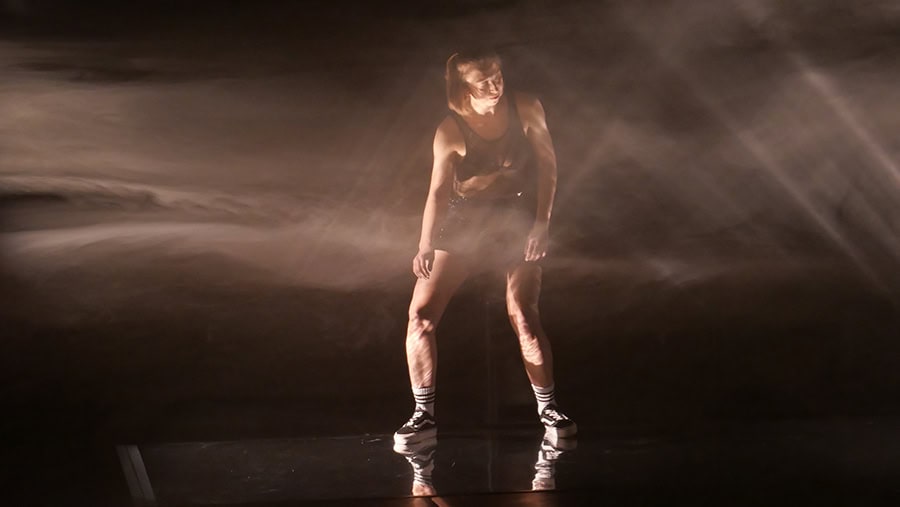
Pathosphere (Mădălina Dan)
Somatic Freaks (Alexandra Mihaela Dancs and Vlad Benescu)
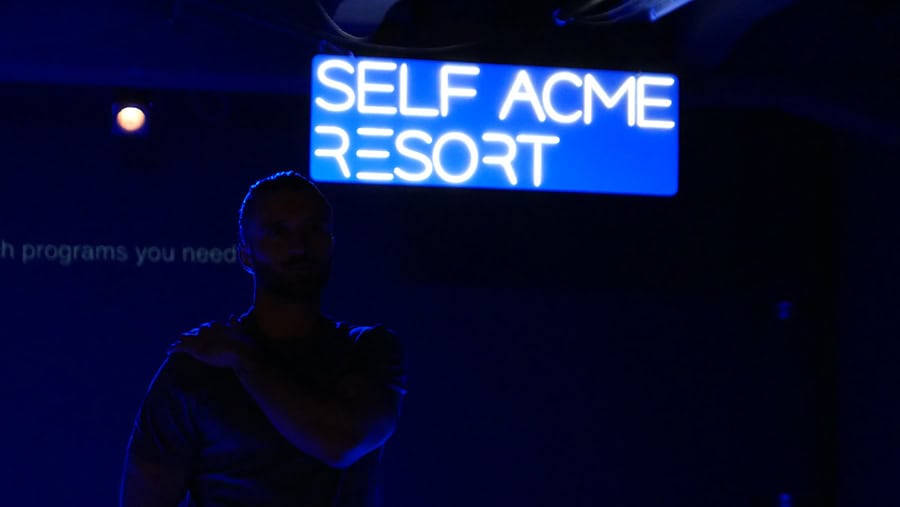
Self ACME (Camelia Neagoe)
Balkan Ballerinas (Platform 13 – Sergiu Diță and Anca Stoica)
OMEN (Arcadie Rusu)
Crossing (Sofia Sitaru-Onofrei)
BPM – Beats per Millennium (Simona Dabija and Vlaicu Golcea)
BORN(E) (Maria Luiza Dimulescu and Beatrice Oneț)
Red Line (Radu Alexandru and Alice Veliche)
The final piece of context I was thinking about was how Romanians (and Bulgarians) have been represented in the British National Press in the last 12 years. The Migration Observatory from the University of Oxford offered this:
“On 1 January 2014 the British government – along with all other EU governments – was required to lift the temporary restrictions that had been placed on Romanian and Bulgarian citizens’ rights to work in the UK. These transitional controls were introduced after Romania and Bulgaria joined the EU in 2007 to reduce the likelihood of a sudden increase in immigration from those countries to the UK. From 1 December 2012 to 1 December 2013, an important period leading up to the lifting of these transitional labour market controls, Britain’s 19 main national newspapers published more than 4,000 articles, letters, comment pieces and other items mentioning Romanians or Bulgarians. In total this amounted to more than 2.8 million words.”
If you want to get into the detail around the racist and xenophobic language used by the British national press including: gang, criminal, beggar, thief, squatter, flood, flock, stop, control and block etc. click here. I wonder if (and if so, how much) this seepage of language and decades-long attempt at skewing perception of a country affected the reason why there’s been so little Romanian dance programmed in the UK.
BORN(E)by Maria Luiza Dimulescu and Beatrice Oneț, presented at Arcuba, was the favourite work I experienced. One of the markers of a strong work is that it still stays with me, four months later; I can remember it and the feelings it evoked in me. It self-describes as: “a performative installation based on 18 interviews with people between the ages of 8 and 90, the installation questions the existence of the (contemporary) human body, focusing on the complexity of the processes it goes through during its existence.”
With four large screens filled with talking heads and beautiful details while Maria and Beatrice performed in the space, this glass-on-head-balancing, pedestrian movement meditation (yes I know, meditations on XYZ…are a plague in contemporary dance) on the body, explores what happens to us emotionally, philosophically and anatomically at different stages in life. How women at age 35 are in their greatness or how a 9-year-old wunderkind absolutely flaws the audience with an explanation of death, describing it as the second disappearance because the first disappearance is before we are born. It’s like a choreographic and philosophical Gogglebox, bringing in the perspectives of different members of the community on these big-picture themes to sit alongside the subtle watching and gaze-directing movements of Maria and Beatrice which complement the delicious work of Director and Video Editor, Corina Andrian, and Director of Photography, Cătălin Rugină.
Presented at Linotip, Balkan Ballerinas, by Anca Stoica & Sergiu Diță, had a lot of hype from Romanian peers across the showcase, and the work has just been presented at Battery Dance Festival in the USA. It self-describes as: “a performance that aims to question the boundaries of the body by relating to Eastern European and Balkan identity. Inspired by stigmas and identity stereotypes created by the West and projected onto the Balkans, the performance conducts an analysis of Balkan culture.”
Performed by choreographer Sergiu Diță, Sofia Sitaru-Onofrei and Andreea Vălean, it had a really big opening with some extremely intense shoulder isolations and neck rotations which were pushing at the limits of what the skeletal frame can do. However, if you start so big and so impressively, it’s difficult to maintain the impact. There’s around a dozen scenes which attempt to portray stereotypes of Balkan identity and maybe four of them resonate for me or have some depth or conceptual commentary behind them. From spitting out liquid from unmarked water bottles, not knowing whether it’s water or alcohol, to the confrontational cracking, chewing and spitting of nuts and their shells, to jerking off behind the tapestry that all grandparents have in their home. Diță is not as technically strong as the other dancers and unable to match the performance charisma of Sitaru-Onofrei and Vălean, both of whom I could watch for days.
I’m still unsure of the purpose of the work four months later. Stoica and Diță are presenting and reinscribing stereotypes that were originally created by colonial, oppressive, Western diplomats with little or no commentary, analysis or inversion of them. Is it an attempt to create a mirror satire that skews the media/coloniser perceptions made for those who live outside of the Balkans? Is it made for a Balkan audience to feel some sort of nostalgia and familiarity with the tropes of their childhood which were informed by the days of communism from their parents’ and grandparents’ generation? I really don’t know.
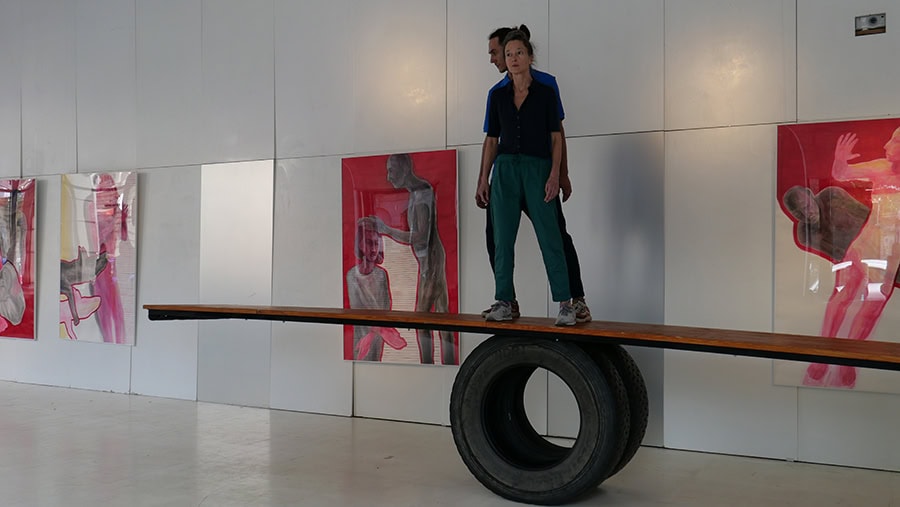
Somatic Freaks – The Proprioceptor Revolution by Alexandra Mihaela Dancs and Vlad Benescu, presented at Galeria Galateca, was a close second in the works I enjoyed at the showcase. Self-describing as: “based on the study of proprioception and the methods to improve it through balance training, from a choreographic perspective. For three hours, the two performers explore the body’s response to imbalance through interaction with a large tandem balancing apparatus.”
With a 7m board, balanced on 2 industrial, tractor-sized tyres, this durational performance had infinitesimal amounts of movement, with Alexandra and Vlad taking 25 minutes for them to cross from one side of the board to the other (from sitting on laying) in a glacial, fine-tuned set of tiny movements whilst looking out to the audience. When they meet at the centre, there is so much stillness as their tiny foot shuffles and body balances demonstrated an acute listening and weight awareness. It’s the ultimate call and response, because if one increases their weight distribution by 0.5kg, the other has to answer it too, rapidly but with a depth of motor skills. It’s harder to move slower whilst retaining control.
There were numerous times when balance wasn’t held, the board would touch down, slide and squeak on the tires and they’d have to reset, with Vlad running up the board to the other side and Alexandra acting as the counterweight to regain the balance. These moments of unbalance are not failures, they’re rehearsals, attempts to strengthen those listening and positional muscles so that when they do finally land in the right place at exactly the right time, they can attempt the entire board crossing again. It’s a simple concept, delightfully executed — I would be quite happy to join those Somatic Freaks for the full three hours and more.
There were two other events alongside the performances at the showcase; one was the book launch of the Romanian translation of Exhausting Dance, Performance and the Politics of Movement, by André Lepecki and the other was a two-hour roundtable discussion with 8 speakers that was moderated (terribly) by Corina Șuteu, one of those 16 Ministers of Culture over the last 8 years (her term was from May 2016 to January 2017). Each speaker had around 7 minutes to present and the second speaker, Oana Mureșan, spoke about her work opening OM, the first independent choreographic centre in Cluj-Napoca dedicated to contemporary dance and contemporary choreographic research. It opened in 2022 and last year Mureșan established the OM Dance Festival – Transilvania International Dance Festival. It was a clear presentation, with images and video supporting her work but the moderator singled her out with a semi-violent questioning energy and tone — “What is the connection with the local audience? How many new people are embracing contemporary art in the city? Who is your target audience?” — that displayed her credentials as a former Minister of Culture but failed to forge links or build connections between each of the presenters. I couldn’t help feeling the tension in the room and a feeling of defeatism leaking out from the speakers because of the difficulty of existing and keeping a level of hope in the Romanian contemporary dance scene.
Out of the 11 works, 2 were good, 1 was OK, 6 were dull and 2 were atrocious. That ratio of 27% of shows that are ok or better is in line with other international showcases and festivals I have attended — including the 2024 KFDA in Belgium, PAMS in Korea or this year’s Edinburgh Festival Fringe. The contemporary dance scene in Romania is no better nor worse than anywhere else in the world.
However, what makes the Romanian showcase remarkable is how it is achieved under the financial conditions that I outlined earlier in addition to other tribulations and contexts. The chaos that emerges through the revolving door of their Ministers of Culture is a clear tactic for political distraction that impedes genuine progress. Imagine trying to press for funding increases while having to build a new relationship with another Minister every 6 months.
The annual culture budget of AFCN is €19.6 million and the maximum budget that any project can be allocated is €50,000. Add to this a financial situation where the minimum wage (€815 per month before taxes and €500 net) barely covers accommodation (to rent a a studio flat is from €450 and a 1-bed flat is €500-700) and food, the dance scene in Romania is precarious. If you have one of the few full-time jobs in this tiny sector, you’re not going to leave it and find something comparable quickly in the same country.
None of this was spoken about explicitly — but it was present. Yes, there’s a lack of dramaturgical coherence in a lot of the works; yes, the male choreographers and dancers are weaker than the women, but there were three works out of eleven that I enjoyed spending time with and that’s enough for me. And the hospitality from the CNDB team was strong: I was thoroughly well looked after, with people checking in multiple times a day, taking the international guests for Romanian snacks, and walking us between venues to see the city.
When everyone is trying to earn enough to live on and so few people are working for the good of a scene, there is little time to think, dream or create and it feels like the hope has been steamrollered out of them; one of the most noticeable things was the missing generation of those between aged 35-50 who have left the country in search of better things.
How do you weigh a country?
How can you sense a country’s entire contemporary dance scene?
How do you maintain hope, history and the invisible energies that are choreographing in the Bucharest air?