Posted: July 31st, 2016 | Author: Nicholas Minns | Filed under: Performance | Tags: Ben Duke, John Milton, Lost Dog, Paradise Lost | Comments Off on Lost Dog, Paradise Lost (lies unopened beside me)
Lost Dog, Paradise Lost (lies unopened beside me), Wilton’s Music Hall, July 19

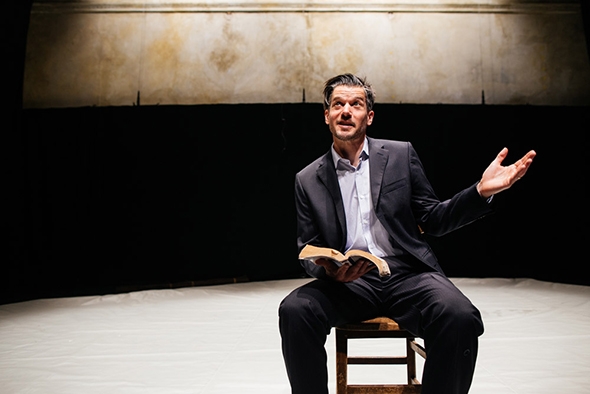
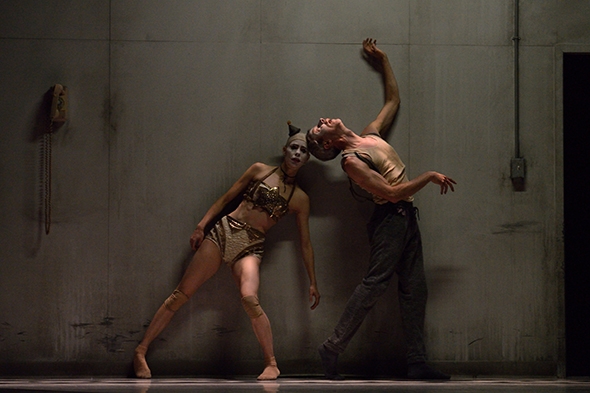
Ben Duke as God in Paradise Lost (photo: Zoe Manders)
The architecture of Wilton’s Music Hall is a performance in itself; without anything happening on stage the drama of the place is palpable and those responsible for its restoration are allowing the impression that all those conversations and performances of the past 150 years can still be heard within the texture of its walls. What Wilton’s perhaps never heard was a reading of the 10,000 lines of blank verse comprising John Milton’s Paradise Lost, and the way Ben Duke displays his dog-eared copy of the poem at the beginning of his performance, hoping nobody in the audience will have read it, only confirms what we already know: we won’t be hearing it tonight either. Once he has found his place, however, he reads the last few lines so we know the ending, in case, he smiles dryly, he fails to reach that point in his performance. Like the Cambridge Buskers playing all nine of Beethoven’s symphonies in under four minutes, Duke prepares us for the impossible: one man playing the story of Creation from Day One to the present in an hour and a quarter.
He runs nimbly through the contents of Milton’s epic — God’s creation of the world, the faltering friendship with Lucifer, Adam and Eve, the temptation, and the banishment from the Garden of Eden — with a parallel interpretation derived from his own experiences of fatherhood and creative endeavour. The empty white stage (reminiscent of the circus ring in Duke’s It Needs Horses) seamlessly reconciles the building site for the creation of the world, the locus of the Garden of Eden, and his own living room where Duke plays God as a father of rambunctious children and as a choreographer who is not averse to reworking scenes that don’t work or if the cast takes too much liberty with his ideas. In other words, he plays God in his own image.
Like a heavenly broadcast of Desert Island Discs, Duke selects tracks from God’s record collection — from early influences of religious plainsong, through Bach and Handel to Richard Strauss, Nick Cave and Janis Joplin — to accompany the emotional highlights of his story. Indeed, there are moments when the tracks are the emotional highlights as Duke valiantly battles on with his narration behind a wall of sound. No music, however, can equal Duke’s own voice box as he conjures up the bubbling, molten plasma from which he fashions heaven and earth in his workmanlike hands and with which he later orchestrates the surgical removal of Adam’s rib to create Eve.
As the work’s full title — Paradise Lost (lies unopened beside me) — suggests, Milton’s poem is both inspiration and pretext; Duke is constantly blurring time and place to embellish Milton’s story with anecdotal material of his own. God and Lucifer meet in a bar, exchange telephone numbers and eventually share a flat together but Lucifer’s jealousy arises from God’s desire for a child; Lucifer is not ready and leaves God to pursue his career. He shares his grievances with a group of angels who get drunk together and cause a violent disturbance, falling into the state of hell. God feels he has to start again and creates Adam (Duke in flesh-coloured tights with a fig leaf whose appearance in his living room traumatises one of his daughter’s friends). Adam is the contemporary male pondering questions of identity and masculinity and whose predilection for masturbation gives God the idea of creating Eve. Adam and Eve meet in a dance studio and fall in love, thinking they can make a living in contemporary dance. The relationship breaks down and Eve walks out into the garden. The snake (a talking sock on Duke’s hand) is a shrink who suggests Eve takes a therapeutic bite of the apple; feeling refreshed she returns to Adam and persuades him to take a bite. God is waiting to push the stop button but as Adam bites into the apple Jesus mistakenly head-butts his father in the balls while playing a game of tunnel. Creation can have its ups and downs. God grits his teeth: “What’s wrong with my fucking children?” Cooling off under a shower of water, he projects a bleak outlook for the world: bodies falling from a burning tower; the Ark; slaughtered lambs; a room full of childrens’ shoes; the nativity in straw and horse shit; Jesus preaching, his betrayal by Judas and his crucifixion. “There’s been a mistake,” cries God, seeing his son on the cross. “That’s my son. Can you take him down? Do you know who I am?” The shower stops. “Can I hold him?” asks Duke in the birthing room. “He looks limp; is he alright?” God and the new father share their vulnerability but while Milton’s God rues the outcome of his creation, Duke is in heaven with his.
God’s final track? The Battle Hymn of the Republic. It’s a rousing and suitably conflicted finale to a richly textured and finely crafted re-telling of the Creation.
Posted: July 28th, 2016 | Author: Nicholas Minns | Filed under: Performance | Tags: Automaton Animalia, Comebacks I thought of later, de/construct, Eleanor Sikorski, Eteins Pas, Éter, Feet off the Ground Dance, Helen Cox, London Contemporary Dance School, Marcus Foo, Mickael Marso Riviere, Postgraduate to Professional | Comments Off on London Contemporary Dance School, Postgraduate to Professional
London Contemporary Dance School, Postgraduate to Professional, The Place, June 21

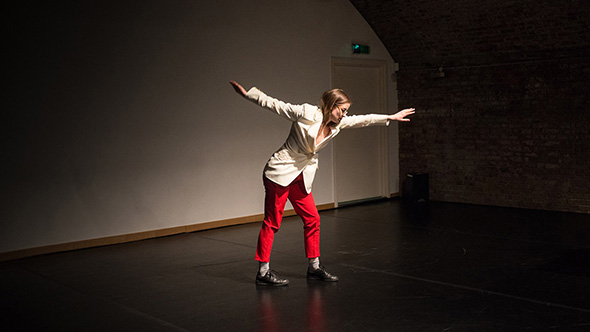
Eleanor Sikorski in Comebacks I thought of later (photo: Marta Barina)
The London Contemporary Dance School’s evening of Postgraduate to Professional dance, now in its third year, offers choreography from a current postgraduate student (Marcus Foo), alumni (Feet off the Ground Dance, Helen Cox, and Eleanor Sikorski) and faculty (Mickael Marso Riviere). As an evening of dance it falls somewhere between a showcase for the school and a choreographic platform, but its predictably uneven quality makes it an unwieldy concept.
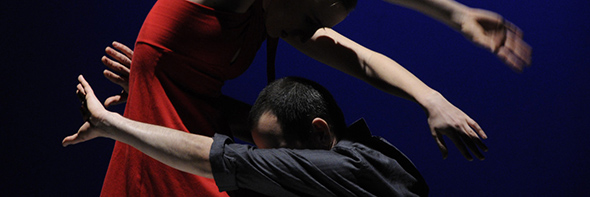
The first work, Éter, by Feet off the Ground Dance, an all-female group who describe their mission as ‘contact improvisation and partnering for performance’ is just that: contact improvisation and partnering for performance. But where is the performance? Beginnings, as Ben Duke (another graduate of London Contemporary Dance School) quips at the beginning of Paradise Lost as he searches for his place in the text, are vital for capturing the attention of the audience. But the opening minutes of Éter, in which two women inch slowly sideways, on hands and knees, forehead to forehead, along either side of a diagonal shaft of light has little to recommend it but the contact. The lighting is dim and pulsating and the live score is a low-level wash of sound that makes the sensory compass unable to find its bearings. Most significantly the performance appears to extend class-based contact improvisation exercises on to the stage without any spatial framework. The action of Éter develops with two other women, but without the objectivity that an audience brings, the whole never takes on a performative quality. It is significant that the program note lacks any identifying feature of the work.
Foo’s Automaton Animalia is another piece of choreography that starts in the mist and gets lost. The program note is telling: ‘If I look hard enough, if I could will my mind to look beyond the arch, I might still see it. Maybe it’s still there, just not really here anymore.’ There is an archway of crates we can see through a backlit haze, and five performers moving slowly, mysteriously as they dismantle it and reconfigure it. At least there is a visual focus, but the choreographic concept has no legs; it turns on itself with a score that fails to inspire it. Inspire is to ‘breathe in’ and education is to ‘lead out’, but here the breathing is restricted and the exit is obscured. Creation is the victim.
I wrote about Cox’s de/construct after I saw it at Roehampton University’s Footprint Dance Festival earlier this year. Interestingly her program note has changed focus. ‘Reflect on a time in your life when you were in a period of transition. It is sometimes said that this space in between is the most creative, but also the most vulnerable. Using the dancing body, I move through this space, deconstructing routines and listening to the infinite possibilities of what lies between.’ But this version doesn’t take into account the organic, tree-like hemp dress she wears at the beginning, which ties her to the landscape of her original conception. Once she sloughs it off she is wearing everyday clothes that are closer to the idea of a dancing body exploring the creative space. Somewhere in between the two is the true nature of Cox’s work.
Sikorski’s Comebacks I thought of later substitutes a quote from Shelley for a program note: “Our sweetest songs are those that tell of saddest thought.” The register is slightly off, for Sikorski’s ‘songs’ are not so much sweet as bitingly funny and the sadness is in her derisive tales of sexual misadventure. Comebacks consists of spoken texts about grunting male chauvinism, minimal musical accompaniment on a portable keyboard, to Sikorski’s vitriolic physical responses to her tales. The poignancy of the performance is as much in the wit of Sikorski’s ribaldry as in her self-deprecatory realization of her inability to think up the comebacks at the moment they were needed. The great strength of Comebacks is in its mastery of the anecdotal form and its scathing celebration of male failings.
Riviere brings the evening to a close with his Éteins Pas, a reworked version of a 2009 piece he made at The Place during Choreodrome. It is inspired ‘by the idea of life after death, with many ideas coming from reading stories about out-of-body experiences.’ Riviere is bold at the beginning to remain supine and motionless for some time; all we hear is the air conditioning. Then he adds the smallest gestures of fingers and hands, ripples through his back to rise on to his knees and to stand, looking slightly sheepish as he looks at us for the first time as if saying, ‘I am not really supposed to be here.’ But having traced his revival with such sensibility, Riviere then subverts it with a display of breaking technique to a driving track by Armand Amar. It comes all too soon and all too easily; Éteins Pas in effect bridges two languages without acknowledging the bridge.
Posted: July 22nd, 2016 | Author: Nicholas Minns | Filed under: Performance | Tags: Carol Prieur, Henri Michaux, Henri Michaux: Mouvements, Louis Duffort, Marie Chouinard, Valeria Galluccio | Comments Off on Marie Chouinard: Double Bill
Marie Chouinard, Double Bill, Sadler’s Wells, June 20

Marie Chouinard’s company in Henri Michaux: Mouvements (photo: Sylvie-Ann Paré)
There is something remarkable about the theatrical output of Québec. A province of Canada, large in surface area but small in population, it has produced artists of startling originality in the theatre (Robert Lepage), circus (Cirque du Soleil, Les Septs doigts de la Main, Cirque Éloise), and above all in dance (Carbone 14, Louise Lecavalier, LaLaLa Human Steps, O Vertigo, Cas Public, Fortier Danse Création, Daniel Leveillé, Montréal Danse, Dave St-Pierre, Le Patin Libre, Virginie Brunelle, and Marie Chouinard, to name but a few). Nearly all these companies have their origins in Montreal, an island city one third of the size of London with one fifth of its population. Rebellious roots have become smoother over the years but there are everywhere vestiges of independent thinking that refuse to retire. You don’t invite someone like Marie Chouinard to London, as Sadler’s Wells has done, without expecting a little discomfort. Chouinard’s double bill is uncompromisingly original, even startlingly eccentric, but her conviction in carrying through her idiosyncratic vision means her works unerringly challenge conceptions about dance. She doesn’t appear to build on the ideas of others, nor even to borrow from her own works, but resolutely enters into a new universe suggested by the nature of each new project. Her London program contains two works, the first of which, Soft virtuosity, still humid, on the edge, wipes clean the choreographic (and aural) palette and prepares for the extraordinary Henri Michaux: Mouvements that follows.
Soft virtuosity ‘explores different time schemes…through various forms of perambulation…’ which borrow heavily from forms of disability; the dancers, dressed in black against a white backdrop, start their perambulations with a series of crippled walks across the stage, extricating the shape from the condition with impassive clarity. They may be difficult to watch at first but Chouinard makes us see them in terms of their shape and rhythm, not in terms of their pathology. They are no more ‘silly walks’ than the turned-out gait of the ballet dancer or of dancing on pointe.
A couple sits turning in tantric embrace on a turntable near the front of the stage. Chouinard uses live projection to multiply their image on the entire backdrop like a phantasmagoric vision focusing on their faces as they turn, from joy to despair. Behind them the dancers cross in ever more complex rhythms and shapes, using their own voices like wild calls; they meet and part, embrace without touching, chillingly disconnected; there is a feral quality that pushes any residual discomfort into atavistic confrontation. Chouinard is evidently coming from a darker place, from what appears to be a disordered universe that is nevertheless more real that we might wish to admit. Composer Louis Duffort is more understanding; his score, reminiscent of the more experimental tracks on Pink Floyd’s Ummagumma, is a collage of organ, guitar, rumbling percussion, the descending arc of a siren and other found or manufactured sounds; where Chouinard provokes, Duffort soothes.
Chouinard pushes the limits of slow-motion movement (butoh is one of her inspirations), borrowing the technology of film to inspire and enhance the movement of her dancers. They move from one side of the stage to the other like a shackled Rodin frieze, their faces and torsos projected on to the backdrop above them. It is a double reality on two scales, like looking at a specimen under a magnifying glass then looking away. For those reviewers ready with an editing pencil, it is worth remembering John Cage’s quoted zen aphorism: ‘if something is boring after only two minutes, try it for four. If still boring, try it for eight, sixteen, thirty-two, and so on. Eventually one discovers that it’s not boring at all but very interesting.’ It is its very duration that makes this scene so effective and engraves it into the imagination.
Chouinard designs the lighting, sets, costumes and props. Her palette in these two works is monochrome and she gives maximum emphasis to the shape and movement of her creation with an intellectual rigour that cuts through any half measures to lay bare the raw physical and erotic material of dance.
In Henri Michaux: Mouvements Chouinard delves so completely into the work of Belgian artist Henri Michaux that the 64 India ink sketches that make up his book Mouvements take on three dimensions and a life of their own through the energy and artistry of the dancers embodying their hallucinatory, anthropomorphic qualities. Chouinard uses the drawings as a score, and like the marks of a painter, she makes marks that coalesce into brief dances of rich invention and seering force. Each image or page of images is projected on to the white backdrop and a dancer, dressed in black like the ink, sketches it in movement. All the images remain on the screen so we can follow Chouinard’s interpretation. The process develops in complexity as groups of dancers take on the more challenging images — or when several miniature images appear on a single page. At one point Carol Prieur with a microphone lies down under a trap of the floor where she recites Michaux’s accompanying poem in its original French (translated in the program notes), bringing its surreal imagery surging to life. Dufort as composer enters Chouinard’s universe with equal power without dividing our attention from the movement language; his rhythms correspond with Chouinard’s choreography and provide her with the musical trajectory for her steps. And all ten dancers, from the elongated Valeria Galluccio to the explosive Prieur, never let up. The integraton of text, movement, music and setting builds into a complete theatrical experience that etches itself on the imagination long after the lights go out.
In the afterword to his poem, Michaux wrote of his belief his images would be ‘finally expressed far from words.’ Chouinard has done him proud.
Posted: July 8th, 2016 | Author: Nicholas Minns | Filed under: Performance | Tags: Brexit, EU referendum, Joan Clevillé, John Kendall, Matthias Strahm, Plan B for Utopia, Solene Weinachter | Comments Off on Joan Clevillé Dance, Plan B for Utopia
Joan Clevillé Dance, Plan B for Utopia, Battersea Arts Centre, June 2

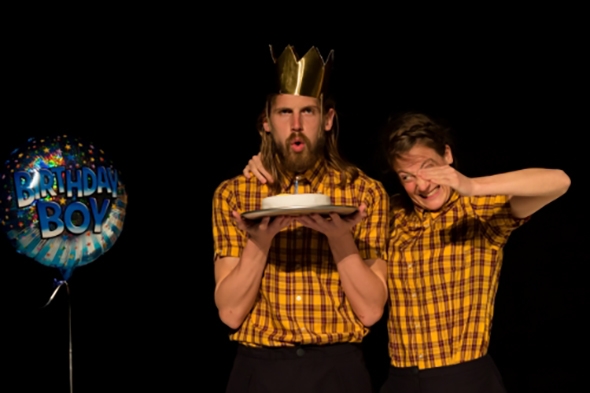
John Kendall and Solène Weinachter in Plan B for Utopia (photo: Nicole Guarino)
The United Kingdom’s constitutional crisis triggered by the EU referendum gives Joan Clevillé’s Plan B for Utopia a timely relevance — and an unintended irony — especially when he writes in the program note that it concerns ‘the impact of our decisions on others and the environment around us, about what happens when things don’t go according to plan…’ The derivation of the term ‘utopia’ comes from the Greek for ‘nowhere’, which is, until Article 50 is (or isn’t) invoked, the political situation in which the UK currently finds itself, and since there was evidently no Plan A for Brexit, Plan B is being pieced together on an ad hoc basis while both sides machinate in a dystopian political environment with daggers drawn.
Although Clevillé’s research for Plan B for Utopia takes a serious look at socio-political concerns, designer Matthias Strahm’s setting of a clownish, colourful world of building blocks and a cardboard box full of props derives from the more popular vision of utopia as an ideal society in which the hopes and dreams of humanity are realised. The values underlying a utopian society — equality, liberty, and justice, among others — are predicated on a dissatisfaction with the present, as suggested in Solène Weinachter’s opening question: ‘Why is it easier to imagine the end of the world than to imagine the world changing for the better? How do we start a conversation about changing the world?’ Her partner John Kendall replies, as he slowly cocks his head close to the microphone: ‘Good question.’ Weinachter is the voluble, adrenalized partner constantly taking the initiative while Kendall is calmer and more subdued; they form a vulnerable pair whose contrasting approaches to progress do not augur well for their own. Dressed alike in yellow checked shirts and black pants we first see them balancing building blocks on the upended cardboard box, an image of the fragility, if not the impossibility, of their world. Weinachter is desperate to affect the future while Kendall is content with the present. He sets off on a hedonistic display of disco dancing and mating, but she is not interested, her face neutral, questioning; she smiles to the audience, trying to extricate herself from Kendall’s pursuit, but he persists. Not one to be fazed, she upends him over her shoulder and takes the microphone. With Kendall immobilized she answers her own question by talking about the gap between rich and poor, the degradation of the environment, the dismantling of social policies, economic growth and progress, consumerism and the ease with which we are distracted and entertained. Only when she has finished does she ask Kendall how he is. (‘A little sick’). Getting his feet back on the ground, Kendall then lip-synchs Over the Rainbow while from behind the puppeteer Weinachter manipulates his arms with wire hangers from the cardboard box. The contrast between the rosy idealism of the song and the manipulation of the singer is stark but its symbolism is subverted by the comic pathos of the scene.
The problem is not one of performance but of perspective. In a subsequent scene Kendall sprays haze around Weinachter like insecticide as she begins the story of the man in the magic forest. It’s a tour de force with a battery of onomatopoeic sounds through which we glimpse the moral of the story somewhere in the background: Weinachter’s performance is so good in itself that it upstages the content. Again towards the end, when Weinachter implements Plan B (for Birthday) and magics a cake with a single candle and a paper crown with which she anoints King John, she breaks into a rollingly fast mix of French and English with exploding voice and gestures that leave Kendall dazed and confused. She unwraps his ‘cadeau’ of an electronic keyboard programmed to play Happy Birthday and then picks out the tune of Imagine which she sings two octaves too low and out of tune. No matter, Plan B is too desperate to fail. She even gets the audience to sing along. Kendall, whose distress increases with Weinachter’s every effort, collapses in tears. She sits in the cardboard box frantically miming a campervan, a boat, an aeroplane — anything, even Marat dying in his bath — until she succeeds in reviving his spirits.
It’s a spectacular climax of performance, but the final scene descends from pathos to bathos — an inherent danger in a work where the dialectic forces are insufficiently balanced. Kendall and Weinachter play a game of wooden blocks to Louis Armstrong singing What a Wonderful World, gently lowering their symbolic wooden house from mouth to elbow to fingers to the floor so as not to disturb the illusion of a happy ending.
Despite the imbalance of perspective, Plan B for Utopia is not a weak work; its structure is tight, its performance is powerful but most importantly its sincerity is unquestionable. Clevillé himself has both an engagingly serious side and a keen sense of humour that together reveal a passionate, imaginative voice. With his strong desire to set up a dialogue with his audience, the more he can harmonise these strengths of character in his work, the greater the balance and the impact it will have.
Posted: July 2nd, 2016 | Author: Ian Abbott | Filed under: Festival, Performance | Tags: Alisdair Macindoe, Antony Hamilton, LIFT Festival, Meeting | Comments Off on Antony Hamilton & Alisdair Macindoe, Meeting
Antony Hamilton and Alisdair Macindoe, Meeting, Battersea Arts Centre, June 28

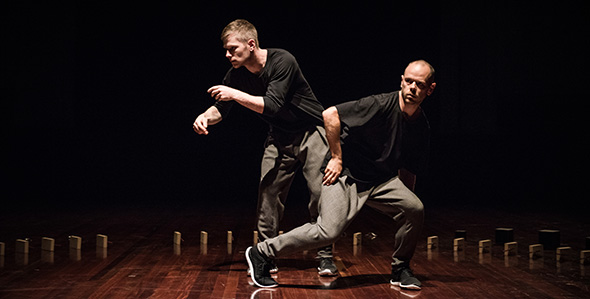
Alisdair Macindoe and Antony Hamilton in Meeting (photo: Gregory Lorenzutti)
“What destroys a man more quickly than to work, think and feel without inner necessity, without any deep personal desire, without pleasure — as a mere automaton of duty?” – Friedrich Nietzsche
Bodies as automatons? It’s a philosophical question that sits at the heart of choreography. Can dancers deliver the same movement, at the same intensity again and again without deviation or wrinkle? Both Antony Hamilton originating the choreography and Alisdair Macindoe inventing the bots and polyrhythmic composition dissolve the seam between choreography and composition. Their meshing as a performance duo with highly tuned musicality is a feast of call and response and displays acres of tensile strength. Imagine the microseconds before the gun of a 100m race is fired: Macindoe and Hamilton don’t go on the ‘b’ of the bang, they play in the space when the lips begin to close and formulate the hum of the ‘b’.
With the 55 minute performance split into three sections, the first sees Hamilton and Macindoe inhabiting the 4-metre radius circle of bots (64 pieces of wood measuring no more than 20 x 15 x 10 centimtres with a pencil attached to a pivoting mechanism on the side, tapping the floor at different intervals); this intensity of focus and action does not allow our gaze to wander or be distracted by any superfluous activity. It deepens the connection between audience and performers as we’re all submerged in this tight frame for the first 25 minutes; it is relentless adventure with feats of physical and verbal memory.
“Words are but the vague shadows of the volumes we mean. Little audible links, they are, chaining together great inaudible feelings and purposes.” – Theodore Dreiser
Hamilton and Macindoe are human gnomons casting shadows and carving air as they latch on to one of the many polyrhythms created by the orchestra. The primary choreographic language employed is popping (sometimes known as the robot dance), building staccato patterns through the isolation of muscles in their arms, neck and torso. The style ensures a crisp, cool and technically impressive feat yet Macindoe does not match Hamilton’s skill. The difference is clear and Macindoe is not able to execute and pop as the softness of a contemporary training blunts the edges required.
As Hamilton slowly breaks the circle of bots, we see his b-boy history as he softly baby freezes over the boundary of bots, shifting his weight as he meets the floor and begins to reconfigure them into a new formation. With a series of miniature robotic henges casting dawn-length shadows across the stage we began to see and hear a transformation. There is a delicacy in play in the second section — a balance between sound, motion, the sound of motion and the motion of sound. The sonic palette has shifted too as miniature trays, blocks and alternative materials are placed underneath the pencils and as they strike down alternative tones reverberate and the monochromatic drum march has been replaced with a textured soundscape.
“Ah, thou hast made my heart captive in the endless meshes of thy music.” – Rabindranath Tagore
Time is often foregrounded; from the unfinished and rewound repeated movements glitching in our eyes, to the complex musical time signatures pulsing in our ears — we know that time exists but are unsure at which speed it is being played out. This invisibility is remembered at the end as the dancers leak off stage and the audience is serenaded for the last five minutes by the orchestra. Even though the bodies are no longer present, the interweaving of choreography and composition ensures a physical residue in the audience memory. As the tones shift I see their bodies echo in the space, popping, patterning and replaying movement sequences that were present a few moments before.
There were dozens of moments of virtuosity: from an eyes-closed verbal recall of a numeric pattern at Mach 1 making them sound like a pair of Australian market traders bamboozling the audience’s ears, to a tight hand sandwich duet at close proximity as they pivot and twist, using their palms as records moving in and out of a jukebox at speed. As an audience we’ve been internally tightened and our gears wound watching these feats without breathing or shuffling in the rich and sparse landscape Hamilton and Macindoe have created. Meeting is a quietly rich encounter between man, machine, motion and sound that rewards your attention with mesmeric human feats and meditative sonic patterns.
Posted: July 1st, 2016 | Author: Nicholas Minns | Filed under: Festival, Film | Tags: André Semenza, Fernanda Lippi, Frame Film Festival, Kai Engel, Kirill Burlov, Marcus Waterloo, Rosa Antuña, We have bled | Comments Off on Marcus Waterloo, We have bled
Marcus Waterloo, We Have Bled, Frame Film Festival, Rose Theatre, June 10

Rosa Antuña in a still from We have bled
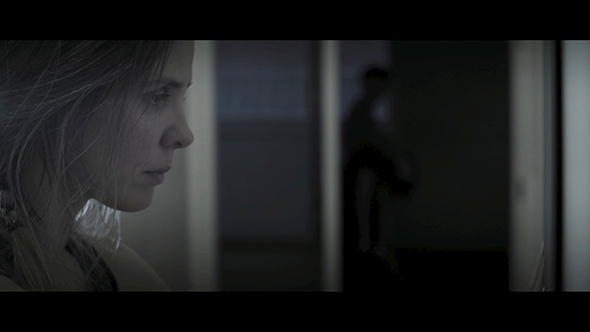
The director of We have bled, Marcus Waterloo, was not able to attend the film’s showing due to illness, but the film’s producer, André Semenza, very kindly agreed to ask him my questions about his approach to the film. I have used some of Waterloo’s responses written from hospital.
Apart from the opportunity to see dance live on stage, film is the most effective medium for capturing the dance elements of movement, line, rhythm, and colour. But a seat in the theatre offers both a fixed distance to the dancers and a fixed perspective. Film has the advantage of moving the audience exactly where the director wants; both the distance and perspective can change as well as the frame of vision and the clarity of focus.
A film by Marcus Waterloo, We have bled, shown at the Frame Film Festival in Kingston, emphasised these advantages so much it stood out for pushing beyond ‘dance on film’ and even ‘dance as film’ to a mature creative genre of ‘film as dance’. Waterloo was director of photography for another film at Frame, the full length Sea Without Shore (2015) by directors André Semenza and Fernanda Lippi, with whom he has worked since 1998, notably on Ashes of God (2003). His cinematography is rich in colour, meticulously framed and he has a feel for choreographic space; he doesn’t simply follow dancers but enhances their movement with his camera work. For some time Waterloo has also directed, filmed and edited his own short dance films, of which We Have Bled is the most recent and the longest he has made in this genre.
Waterloo did not start with a vision for the film; as he writes, ‘Everything started with Fernanda and André, and the possibilities that came up when Rosa was in town; we felt “let’s get together and see what happens.” I know that something always happens when we get together, a sort of magic. I was not going to bring the camera to the first rehearsal but I did, and I am so glad I did.’
Waterloo joined the three dancers — Lippi, Rosa Antuña and Kirill Burlov — in a dance studio observing through his lens ‘…the interactions and natural energies between the people’ that Lippi had orchestrated through task-oriented choreography and improvisation. He was interested simply in ‘watching people; people, like little creatures, and what the creatures are up to…It’s as if I want to swim and flow with other humans. There is no ‘grand statement’ — it’s simply part of the process of being human, the poetry of it…It’s like dancing with other people.’
It was in the first edit that Waterloo perceived in the images what he describes as, ‘a compassionate look at the turmoil in our relationships; when we exhaust ourselves and can turn to a place of surrender and acceptance. We cannot be anything else but human, it’s an inevitability of life: to acknowledge we will hurt a little on the way.’
Cued to piano music by Kai Engel, we see the dancers alone or in pairs, close up or at a distance, framed within the architectural space; within that frame there are others because Waterloo glances at the moving bodies through windows, through reflections in windows, through doorways, at the end of passages and from behind the studio’s barres. The motion of the camera sets up a tantalising superimposition of bodies and architecture moving in and out of focus within and through the frame — sometimes multiple frames within the same shot — at different rhythms. In the editing Waterloo thus sets up a poetic syntax that enhances what we see, building emotional traces like brush strokes on a canvas. This process, Waterloo writes, is like ‘excavating the human heart…The film is about people: you see straight into people’s hearts and souls, and what is possible — what great potential there is. Editing is about totally surrendering; it’s a natural response.’
The originality of We have bled is in its creation of an intoxicating juxtaposition of choreographic images to create the suggestion of a narrative. The starting point was not conceptual but instinctual: ‘I see the beauty of humans drifting past all the time, like a grand archaeological and architectural display. Filming is knowing where you are going to dig. You have an inkling that there is something under the surface, so “let’s set up and dig”. When something is revealed, you just continue digging…it’s a response, an experience…’
Marcus Waterloo’s website http://marcuswaterloo.com/
Vimeo page: https://vimeo.com/marcuswaterloo
Ten days after writing this, in the afternoon of July 11, 2016, Marcus Waterloo succumbed calmly to his illness.
Posted: June 23rd, 2016 | Author: Nicholas Minns | Filed under: Festival, Performance | Tags: Albert Garcia, Banjamin Talbott, Claudia Catarzi, Cristina Lilienfeld, Dance Roads, David Gernez, Gwyn Emberton, Jasper van Luijk, Jefta Tanate, Layers, Lucie Augeai, Nœuds, Qui Ora, Yonder | Comments Off on Dance Roads 2016
Dance Roads 2016, Seligman Theatre, Chapter, Cardiff, June 8

Lucie Augeai and David Gernez in Nœuds
Dance Roads is an international touring initiative that supports choreographic development and provides artists with international exposure and networking opportunities on a biennial basis. The network is made up of organisations from five countries: The Netherlands, Wales, France, Italy and Roumania and is jointly coordinated. This performance at Chapter marks the final leg of the touring program.
Jasper van Luijk’s Yonder, danced by Jefta Tanate, is the most formally crafted of the five works on the evening’s program, a play of chiaroscuro in which Tanate moves naked through a field of lights. The stage resembles a photographic studio in which van Luijk has set up lights at various heights and angles. The choreographer cedes his place behind the camera to the audience and allows us to watch as Tanate manipulates the lights during his performative journey. There are thus two sources of movement, human and mechanical, interacting at different rhythms through the action of a single entity. When he is not swinging lights or swinging on them, Tanate moves with an almost automated articulation, his facial expression belying no emotion, nor betraying any narrative for his actions. This existential quality relates to what the program note for Yonder describes as ‘a search for the beginning and the end of time with the lifecycle of one man.’ I’m not sure many in the audience would pick up that notion while watching — I certainly didn’t — but there is a sense of time passing on a journey from darkness to light, from frenzied turning to stillness, from a sublime moment of elevation to a jarring fall to earth. What links these episodes is van Luijk’s paean to the male body that Tanate, without any apparent strain or self-consciousness, dances on the edge of his senses.
The poet Dylan Thomas lived constantly on the edge of his senses; Gwyn Emberton takes on the imagery of his poem Fern Hill in a short solo called Of the Earth, where I came from, originally choreographed on his own body but here danced by Albert Garcia. Emberton chooses not to set movement to Thomas’s words but with composer Benjamin Talbott delves into the sense of exploration in the poet’s memories of spending youthful days on his aunt’s farm. It starts with an image reminiscent of a portrait by Rollie McKenna of Thomas entwined in the branches of a tree: Garcia is in a headstand in shadows cast by tied, gnarled brushwood. Both poem and choreography are suffused with regret for the process of ageing but by setting his choreography on a younger body, Emberton sets up a tension between youth and age. Like the poetry, Of the Earth, where I came from has no rest as one image of the body switches suddenly or slowly, unfolding, unfurling and upending with a muscular fluidity that is nevertheless ageless.
In Noeuds (knots), Lucie Augeai and David Gernez (Compagnie Adéquate) perform a playful take on family relations (they are married) in a bright gestural duet that has elements of theatre, circus, mime, and dance. Their use of baroque music (Marin Marais) gives lively accents to their dialogue that allows the gestural forms, which look at first like conducting, to become the principal channel of expression. Noeuds does not, as its name suggests, describe an easy relationship. Augeai holds her breath with bulging cheeks while Gernez bares his teeth; he holds her tightly while she tries to escape. The initial pleasure builds to confrontation but Augeai does not submit; she gives as much as she gets. She has a way of using her eyes with the tilt of her head that conveys clarity of intention; the register is as high as laughter and as low as aggression. Gernez is her foil, against whom Augeai plays to comic and dramatic effect. He is driven to a final solo of male frustration after which Augeai diffuses it with her weaving pattern. The knots are subtly disentangled and they walk off together.
Claudia Catarzi’s Qui, Ora (here, now) is a minimal work that comes at the end of the middle section after two other works, so not an ideal place for audience concentration, which it needs. Qui, Ora is a choreographic response to immediate physical factors: space, a costume, the audience and sound. It has the feeling of an improvisation, stark in form with playful elements. If you put on a stiff and raspy-sounding coat, then your movements will necessarily emphasise its qualities; Catarzi dances the coat with birdlike attention and a dry sense of humour, sloughing it off at the point it appears to be dancing her. She responds to the space around her (and to a Johnny Cash song) with movements that are angular and loosely anarchic; it is like a play by Samuel Beckett with moments of dry wit, an element of the absurd and moments of pure poetic flow.
Cristina Lilienfeld’s work, Layers, is a meditation on skin and what it reveals of our inner emotional life. She uses her own skin as a material on which to receive our thoughts and feelings, and with which she projects a sensorial appreciation of the unfettered body. Disarmingly generous, she nevertheless protects the intimacy of her personal space in the very act of sharing it, playing with the tension between looking and being looked at and never failing to meet our gaze head on. In the opening section she reinforces the skin’s opacity by rolling and slithering her almost naked body on a mix of sand and flour to the sounds of rain and thunder and masks her face in her long, thick hair. It is a state of emotional turbulence in which she appears to be testing our gaze. “You are under my skin. You are in my heart,” she tells us, and invites us to write whatever comes to mind on her skin with her eyeliner pencils: artist and audience sharing the same material. “Thank you,” she responds, peeling off layers of skin-like patches from her body as she retreats. She reappears carrying a bowl of water. If the first part of Layers is a ritual covering of her skin, the second is a ritual cleansing. In between these two states, where Lilienfeld is naturally expressive, there are moments of ‘dancing’ which immediately signal something inherited or taken for granted. But there are also moments when she creates something mesmerising out of her unadulterated presence. In being naked — a metaphor for both freedom and vulnerability — the removal of physical and psychological layers creates in her an exuberance that makes emotion visible.
Dance Roads, as its name suggests, is a network of roads that is funded by the EU to convey choreographic expression from one country to another. While it is a pleasure to watch works that originate elsewhere, at the performative level the model offers neither integration nor differentiation between cultures, for the audience or for the dancers. What makes van Luijk’s work so different from that of Compagnie Adéquate, for example? What would happen if Catarzi were to create a work on Lilienfeld, or Lilienfeld on Tanate? It might be interesting to explore such questions in future collaborations so that the creative spirit finds new roads to follow.
It is ironic that this article on Dance Roads should be published on the eve of the EU referendum in which a majority of UK voters decided to leave the EU. The result may well mean Wales will no longer be eligible for the Dance Roads network.
Posted: June 20th, 2016 | Author: Ian Abbott | Filed under: Performance | Tags: Baroness Jane Campbell, Chris Henry, David Hevey, Deaf Men Dancing, Dr. Paul Darke, Mark Smith | Comments Off on Deaf Men Dancing, Let Us Tell You A Story…
Let Us Tell You A Story…, Deaf Men Dancing, Surgeon’s Hall Museums, Edinburgh, June 15

Let Us Tell You A Story (photo: Ian Abbott)
“Think you of the fact that a deaf person cannot hear. Then, what deafness may we not all possess? What senses do we lack that we cannot see and cannot hear another world all around us?” – Frank Herbert
Let Us Tell You A Story… by Deaf Men Dancing (DMD) is one of a number of artistic commissions inspired by eight of the UK’s medical museums. Mark Smith, founder and artistic director of DMD, spent time at the Thackray Museum in Leeds which holds a collection of nearly 1,000 objects relating to deafness, including Queen Victoria’s ear trumpet.
This suite of commissions (DMD, Julie McNamara, Francesca Martinez and David Hevey) are not only inspired by the collections but are also being presented in those same spaces — including the Hunterian and Science Museums, Bethlem Museum of the Mind and the Royal College of Physicians — to open up dialogue, debate and challenge entrenched assumptions. Medical institutions are often hundreds of years old and use a scientific language that perpetuates the medical model rather than adapting the language to the current social model of disability. Walking around the Surgeon’s Hall Museums for an hour looking at hundreds of isolated body parts in jars and preserved examples of tumour-riddled ears or gangrenous hands amplified my bodily awareness before going in to watch the commissions.
How language is used and the choice of words is a delicate issue not only in culture and disability but in medicine, too. In the post-show conversation some audience members called attention to the descriptions on some jars that used the word ‘mongoloid’ and ‘abnormality’ in reference to someone who had learning disabilities. Chris Henry, the director of heritage at the Surgeons’ Hall Museums, was unapologetic as he framed the dialogue and context of the museums in terms of pathology (the study of disease) whilst recognising the need to offer a social context for the language that may have been deemed appropriate at the time of labelling.
“The one thing I have that nobody else has or can duplicate is my sound. The sound of my life. Others may say similar things but they can’t say them like I do.” – Suzette Hinton
As an interrogation of a museum collection Smith has mined a rich history and with his dance training and previous practice in opera there is a theatrical and a choreographic accessibility to his work. As an audio landscape Let Us Tell You A Story… paid particular attention to how the audience experienced the work aurally and for me this was where it was most effective. From the piercing shrills of high frequency hearing tests to hearing in Smith’s own words in voice over (the first time he’s done this) there was a particularly potent vignette referencing Christianity where the soundtrack changed to a heavily muffled — almost imperceptible to my ear — version of the Lord’s Prayer. It was this proximity to a lived experience that brought me closest to the performance.
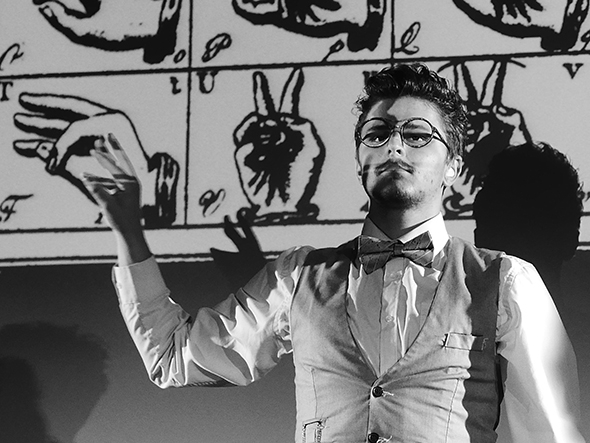
Let Us Tell You A Story… is Smith’s research process and personal passions made visible. I came away having learnt oodles about the history of the Deaf movement including the seminal 1880 Milan conference where a number of world experts banned sign language and forced people to use speech therapy instead of signing and how thousands of soldiers returned from war deaf yet this was hidden from the public and society at large. Each of the vignettes was presented in isolation and the work suffered dramaturgically as there was little glue holding the sections together. I felt myself wanting to dwell longer in each section. Learning about the magnitude of these events was thought-provoking, but in combination with movement, projection and a newly composed soundtrack, I was struggling to process it all before we were shifted into another period of history.
Coming in at just under 30 minutes, the performance was hampered by the uneven combination of dance technique and theatrical training in the three male dancers who are all on stage all of the time; I was always drawn to the weakest performer. Based on a structure of vignettes there were a number of solos but very little group work and the choreography often leant towards the literal. In the war scene, for example, we have a number of army crawls and hyper excessive facial expressions that did little to coax my empathy. There are fleeting moments of interaction with the audience where the performers share objects like feathers, balloons and clasp our hands; this could be developed more and encourage a greater sensory experience. With a slate grey palette for the costumes, each performer arrives and intermittently interacts with an oversized case with a detailed illustration of the ear on the outside; there’s real attention to detail from the other collaborators in the creative team lead by the excellent sound designer.
Although hampered by a stage depth of barely three metres, I feel that Let Us Tell You A Story… with some editing and dramaturgical input could suit the outdoor festival circuit. The vignette structure would welcome audiences that arrive mid-way through a performance and Smith’s theatrical leanings and the skills and energy of his performers may find a better home in this context.
“There are so many people, deaf or otherwise abled, who are so talented but overlooked or not given a chance to even get their foot in the door.” – Marlee Matlin
On the same bill I also saw David Hevey’s documentary, The Fight For Life, in which he captures — on digital celluloid rather than in formaldehyde — articulate, insightful yet bruising encounters with personal histories of disability. Dr. Paul Darke, who attended a school for disabled people, remembered how all the students in the school were anally and vaginally fingered twice a year by a medical consultant; accepted as normal and authorised by the school, the procedure lead to him feeling that ‘your body was theirs.’ Baroness Jane Campbell of Surbiton, who uses a wheelchair and ventilators to aid her breathing, went to hospital with pneumonia (although in a hazy state she was still conscious) where in her presence the doctor said to her husband: “You wouldn’t want us to intervene or resuscitate her because she’s very fragile.” Seeing the medical staff was making assumptions about her because of her disability, her husband rushed home and brought back her doctorate and examples of the work she had done and said, “She has pneumonia, treat her.” Baroness Campbell summed up her observation that decisions on the disability living allowance are often made by those with little experience of austerity with a devastating aphorism: ‘Nothing about us: without us.’
Led by the Research Centre for Museum’s and Galleries at the University of Leicester, this suite of new commissions is considered and asks questions around why certain bodies are highly valued and others are viewed problematically. It’s a welcome injection that rejects an idealised norm.
Posted: June 12th, 2016 | Author: Nicholas Minns | Filed under: Festival, Performance | Tags: Akram Khan, Akram Khan Company, Battlefield, Brighton Festival, Ching-Ying Chien, Christine-Joy Ritter, Farook Chaudhary, Karthika Nair, Peter Brook, Until the Lions | Comments Off on Until the Lions: Akram Khan Company at The Brighton Festival
Akram Khan Company, Until The Lions, Brighton Dome, May 27

Ching-Ying Chien in Until the Lions (photo: Jean-Louis Fernandez)
Earlier this year I saw Peter Brook’s Battlefield at the Young Vic; it was his adaptation of five books from the Sanskrit epic Mahabharata. Akram Khan made his debut at the age of 13 in Brook’s original nine-hour production of the Mahabharata. What a coincidence then, that Khan should present in the same year as Battlefield another story from the same saga, one of love, betrayal and revenge in an original reworking by Karthika Naïr that has become Until the Lions.
The title comes from an African proverb: ‘Until the lions have their own historians, the history of the hunt will always glorify the hunter.’ The lion in Naïr’s poem is Amba, the daughter of the King of Kashi who is abducted on her public swayamvara (betrothal) ceremony by Bheeshma, the son of the Kuru king. Vowing revenge on Bheeshma, Amba immolates herself and is reincarnated as the male warrior Shikhandi by whose hand Bheeshma meets his end on the battlefield. The dual role of Amba/Shikhandi is danced respectively by Ching-Ying Chien and Christine Joy Ritter; the role of Bheeshma is danced by Khan himself.
Until the Lions has Kahn’s signature symbolism and spirituality dressed in white and covered in haze, with arresting stagecraft and musical accompaniment (by Sohini Alam, David Azurza, Yaron Engler and Vincenzo Lamagna). The dancing of Chien and Ritter is what we have come to expect in Kahn’s international casts of exceptional artists whereas Kahn’s own performance, even if his presence is strong, lacks the flow and attack he once had. It is something he acknowledges, but it begs the question of why he didn’t find a younger dancer on whom to create the role. The result is a performance that has all the appearance of significance yet lacks its bite. There is a feeling that Nair’s poetry has not gained in the dancing, but is simply the starting point of something else, something defined more in the production values than in the content.
Brook’s space for Battlefield is spare, a vast stretched stage cloth with very few stage elements. This environment stands in stark contrast to the subject of the dialogue and enhances the production’s focus on the clarity of thought. Khan and his producer, Farook Chaudry, have taken a different path. The narrative involving three characters has been treated with a monumental production by conceiving it for the 360° Network of round artistic venues across the world. Created in the round, with Tim Yip’s vast slice of fissured tree trunk for a stage and with Michael Hulls’ lighting, the setting is to dance what the rock concert is to music. Michael Billington commented on Battlefield that ‘at a time when theatre is giddy with technology, you are struck by the way economical means are used to maximum effect.’ By contrast Hulls seems to be vying with the choreography for primacy.
The work premiered at The Roundhouse (a founding member of the 360° Network) in January. I didn’t see it there but at the Brighton Festival, which is not only one of 16 co-producers but also a co-commissioner of the work. The outside of the Brighton Dome is, like The Roundhouse, circular, but its concert hall is not configured for theatre in the round. It is at best an elongated semi-circle cut off by the stage, so fitting Until the Lions into this space required some spectacular fudging. The first thing you notice is the massive lighting rig to carry Hulls’ circular lighting conception and the second thing is the stage underneath it, a circular platform on top of the Dome’s regular stage.
So why did the Brighton Festival co-commission and co-produce a work that, as conceived, does not fit into its venue? Why co-commission it at all? How much of the Festival’s dance budget was taken up with this co-commission and what did it get from it? The questions are relevant because the dance programming of England’s prestigious festival in its 50th year is much thinner than the quality of English dance would suggest; the Festival has an opportunity if not a responsibility to present a challenging and varied dance program, rather than go for the prestigious names like Khan, or hook up with what happens to be touring with Dance Consortium (as it happened, NDT2). It’s ‘lazy’ programming and it has a deleterious effect on the country’s dance ecology.
Arts Council England, which funds both Akram Khan Company and the Brighton Festival, has a motto, ‘Great Art For All’. The motto has two elements: ‘great art’ and ‘for all’. Even if Khan is a well-known brand, great art does not necessarily equate with well-known names. And ‘for all’ implies that access to the great art is within the financial reach of a broad audience. An expensive work by a prestigious name means ticket prices are going to be high rather than broadly affordable and I can’t help feeling that with 16 co-producers and a co-commission, Until the Lions is roaring its way to the bank while the Festival is left strapped to build a dance program that does justice to the high quality of work that exists in the country (not to mention locally) with the public funds at its disposal. Perhaps a good starting point would be to appoint a dance producer; there is currently no mention of one listed under the Artistic Staff of the festival. There’s a music producer, a theatre producer, a classic music producer, and a family and children’s producer. For a festival that prides itself on its mandate to take ‘a new look at the arts’ and to have ‘the opportunity to assess developments in the field of culture…’ that’s a stunning omission.
Posted: June 6th, 2016 | Author: Caterina Albano | Filed under: Performance | Tags: Betroffenheit, Bill Viola, Cathy Caruth, Crystal Pite, Jacques Rancière, Jermaine Spivey, Jonathon Young | Comments Off on Crystal Pite and Jonathon Young, Betroffenheit
Crystal Pite and Jonathon Young, Betroffenheit, Sadler’s Wells, May 31

Tiffany Tregarthen and Jonathon Young in Betroffenheit (photo: Michael Slobodian)
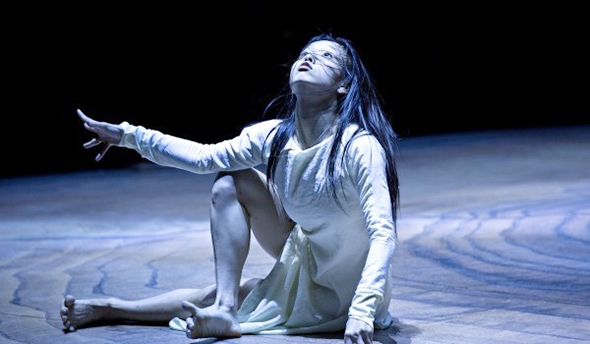
‘The accident happened. It has happened. It’s happened’. The past is irrevocable and unchangeable. The past can loop a person in a repetitive rewinding of backward motions; there is no escape. In Betroffenheit, a collaboration between choreographer Crystal Pite and theatre director and actor Jonathon Young, this space of no escape is ‘the room’ — the site of trauma. Based on Young’s own experience, the work deals with horror, pain, loss and guilt. Trauma is not an easy subject to engage with, not so much because of its resistance to representation but rather because of its pervasive presence in our culture. Overused and glamorized, trauma has lost meaning and with it the connotations of the experience it designates. As a result, the risk for any artist wanting to engage with the subject is either that of slipping into self-confessional indulgence or in facile generalization or, even worse, universalization. Pite and Young resist these pitfalls. Betroffenheit does not steer from ‘the event’: it is focused on a moment in time and on the individual locked in its repetitive occurrence, constrained within the claustrophobic narrowness of pain and loss. There is no generalizing. It is one man’s experience — performed by Young himself — that isolates and is isolating: ‘The accident happened. It has happened. It’s happened’, repeats Young in his disjointed re-telling of the drama that unravels in his mind and on stage. ‘The room’ cannot be shared. The shock and the encounter to which the title Betroffenheit alludes are his fears, unbidden memories, guilt and survival. They are the ghosts that unremittingly draw him back to that space where the past repeats itself and attempts to get to terms with it are futile. Indeed, as trauma theorist Cathy Caruth observes, belatedness and incomprehensibility are at the heart of the traumatic event and its repetition opens up realms beyond what can be known.
Performatively, Betroffenheit enters such a space of belatedness and incomprehensibility by drawing on and weaving together a broad range of references from art, literature, theatre, psychology, film and dance. The first half is set within a narrow perimeter of false walls, clinical and industrial at the same time that are open on one side − ‘the room’. Voices intrude, personages enter it and lure Young into a disturbing vaudeville acting out, sinuously performed by Pite’s five dancers. The narrow space of ‘the room’ temporarily blasts open into the event — reminiscent of Hollywood’s disaster movies — then the room closes again onto its painful repetition. Pite and Young have set in motion what Jacques Rancière refers to as ‘a complex set of relations between the visible and the invisible’. This unleashes a chain of images, words, and movements that alter each other to convey ‘the sensible texture of an event’ whose forms are disquieting, grotesque, and nightmarish.
This motion continues in the second half, though the register changes. A spotlight defines the empty stage with its single pillar as a rarefied cone of incomprehensibility. If words and strident visual frames seemed to overtake the first part, dance regains its centrality in the second. Visual references are implicit in the moving tableaux of a Renaissance pietà and deposition reminiscent of the suffused rendering of Bill Viola’s slow-down video reenactments of The Passions (2000). Breathing becomes the sensorial punctum (in Barthes’s sense) on which the affective tension of Pite’s choreography unfolds. And breath carries the emotional movement of the work to its conclusion. The event happened, has happened. The event cannot be escaped nor understood. There is no resolution, only the possibility of acceptance. In the final solo by Jermaine Spivey, the spasmodic dance macabre of compulsive fears of the first half mutates into a fluid quietness of motion and emotion which weave through and across each other.
A question remains: where do Pite and Young position the audience in relation to the work? The first half of Betroffenheit makes subtle use of an alienating effect reminiscent of Antonin Artaud’s theatre of cruelty. Recorded applause cruelly marks the re-enactment of trauma. We are uncomfortably reminded of the spectacle and voyeurism with which horror is so often endowed. In the second half the carefully lit pillar whose shadow lengthens over the auditorium gestures towards another position for the spectator, that of attentive, intelligent and sensitive observance.