Ian Abbott at the 2025 Edinburgh Festival Fringe
Posted: December 26th, 2025 | Author: Ian Abbott | Filed under: Festival | Tags: Aviaja Dance, Edinburgh Festival Fringe 2025, Hee Suhui, Helen Simard, Lenka Vagnerová & Company, Martha Paling, Maxine Segalowitz, Roger White, Sarah Aviaja Hammeken, Shaper Caper, We All Fall Down | Comments Off on Ian Abbott at the 2025 Edinburgh Festival Fringe A Tale of Four Five Cities
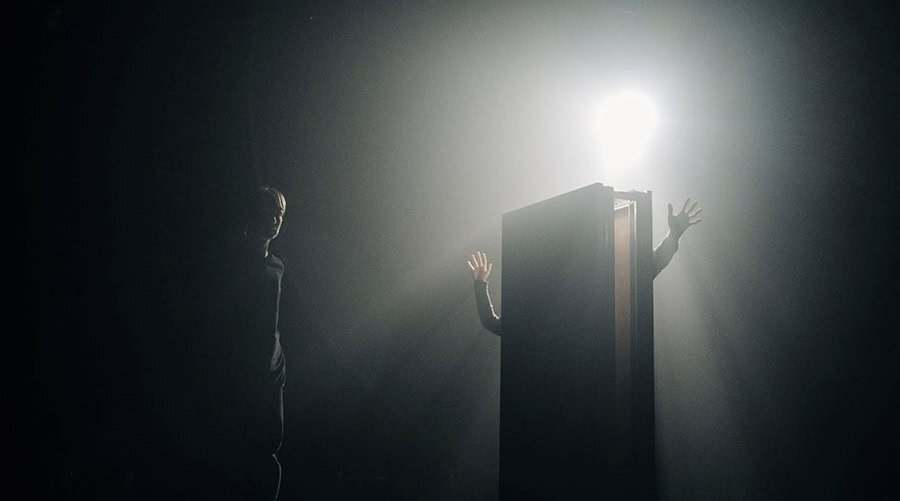
There’s something about the way the best work you see in a festival context begins to gently dominate the other works you see; it grooves into you, you keep coming back to it, revisiting it in the dozens of two-minute queue conversations you have about your festival highlights and it’s safe to say that this same best work highlights the flaws in all the other works you encounter. This was the case with Because You Never Asked by We All Fall Down (Montreal) at Summerhall at this year’s Edinburgh Festival Fringe.
“Chronicling a moment of intergenerational exchange. Based on discussions between creator Roger White and his grandmother, Marianna Clark, about a hidden life under the Nazi regime. Blending a haunting soundscape, featuring recorded conversations of grandmother and grandson, with evocative choreography that embodies memory. A cautionary tale highlighting the perils of anti-immigrant narratives, through stories that pivot between humour and darkness, documenting the slow march toward authoritarianism. A heart-warming reminder to honour the wisdom that came before us and hold on to the memory of those we cherish most.”
The startling and most stunning thing about Because You Never Asked was the artistic cohesion, dramaturgical balance and tonal harmony running through the work. The recorded conversations played throughout the production — we’re hearing the personal testimony and historical weight of life under the Nazi regime — could so easily have skewed and distorted the rest of the production elements: how can a lighting design, score, choreography and four dancers compete with that? But to the credit of WAFD co-artistic directors Helen Simard (choreographer) and Roger White (composer) I felt held, safely held, and I could dwell in this scenographic world and focus on what these two highly-tuned artists have created, the needs of their show and the emotional spaces created for the audience.
In a strong cast of four performers, with sections split into solos, duets and group work, Maxine Segalowitz is luminous. She is that rare performer, one you come across maybe once a year, someone who keeps drawing your attention when they’re on stage. This isn’t about her hyper-extensions or physical fireworks; this is about pure performance magnetism and she has it in spades. It feels like that artistic cohesion and balance is manifesting through her, how she performs, the angle of her chin, the intensity of her windmilling arms — she is the perfect vehicle and tonal embodiment of the work.
In a festival with a host of international companies supported by their respective national/regional arts councils and other private philanthropy, I would hope there would be — at the very least — a consistency of good dancing, to assuage my unquenchable desire for cohesion, balance and harmony. I would be wrong.
Soil by Aviaja Dance (Copenhagen, Denmark) “is a powerful dance performance about identity, language and belonging. Through movement and the rhythms of Kalaallisut (Greenlandic language), it explores how we connect to culture: beyond words, across borders and through the body. A poetic and physical journey of self-discovery, Soil delves into language and the search for self and recognition. It invites audiences to experience the beauty and challenges of communication in new ways. A dance of belonging and becoming.”
In a startling act of false advertising which got this earnest Trading Standards Dance Writer heading to Dance Base on a Sunday afternoon for 35 minutes with 13 others audience members, I regret to report that there is no soil in Soil. The show should be called Tiny Black Pieces of Rubber or How I Couldn’t Think of a Dramaturgical Structure or Satisfying Narrative Device So I Kept Going Back To Sit On A Chair And Listening To A Voice-over About Roots.
Elsewhere the show — which is part of the #DANISH season — self describes as “In her first solo performance, dancer and choreographer Sarah Aviaja Hammeken explores the complexity of her own cultural background in both Kalaallit Nunaat (Greenland) and Denmark.” And it really does feel like her first solo work, and that’s OK because you don’t get to your fifth or tenth solo show without doing your first and so all those recognised tropes are present: the glitchy electric soundtrack where she moves in predictable floor patterns; the difficulty she faces learning so many languages and moving to different European countries for education, love or work, and the under-confidence I see in her bodily performance which all make it more difficult for me to connect with this work.
Sometimes, connection is less important, because sometimes entertainment is the order of the day (see my thoughts of the art vs entertainment debate at the fringe from 2024). Lenka Vagnerová & Company (Prague) take over ZOO Southside — aka the best stage for dance at the fringe — for 90 long minutes with Panoptikum which: “amazes, entertains, and frightens. It has pace, humour and a strong theme with an emphasis on humanism. Thrilling, impressive dance which is an expression of total theatre, invites the spectator to a mystically decadent, visually compact freak show, over which the magical theatre dust of something ancient hovers. The world, inspired by the phenomenon of the nineteenth century, says a lot about our contemporary world. Panoptikum is about the fear of the stranger and the unknown, but also courage and hope.”
In a noticeable choreographic shift that has taken place over the last decade or so, the amount of partner work, lifting, contact and real, stage-munching travelling is rarer and rarer. Is it because these skills are no longer being taught in conservatoires? Do choreographers under 35 think it’s a bit trad or is funding only available for tiny casts? Perhaps these skills lose their place for audiences that are served so much solo, screen-based work that fits neatly inside the frame of a portrait phone. Panoptikum bucked this trend and it felt, for one tiny moment, like I was back in the middle of Europe in 2015, when 8 strong casts were the norm, with dozens of costume changes and artists were making frictionless art and not mining their own trauma for the funding gods.
In a very uneven cast of dancers, with two or three noticeably weaker technically (who often didn’t bother to finish their lines), we’re introduced to a range of characters in a series of 4- to 6-minute dance skits featuring the likes of the elephant man, conjoined twins, snakey lady, ringmaster etc. I was bored. The novelty of the trick lasts for less than 10 seconds, the ennui of narrative predictability sets in and I’m just sat there, waiting for it to finish before the next solo, duet or group work to begin. Although there was an occasional “trick” — like pepper’s ghost, the appearing/disappearing bottle or a floating head being crushed into a top hat — it’s third-rate magic and you can see a LOT better magic and a lot better dancing at the Fringe. The thing that Vagnerová is known for (partner work, lift work, real, stage-munching travelling and contact) was satisfying when it arrived, but it was all too infrequent and at 90 minutes, Panoptikum really needed sawing in half.
Coming in at a shade over 50 minutes and with very little bodily movement happening on the 3m x 2m stage in the subterranean Former Gents Locker Room at Summerhall, Ill Behaviour by Hee Suhui (Anise) (Singapore) was in some ways the antithesis to Panoptikum but explored some of the same conceptual terrain. It self-describes as: “a deviation from the habits of the well and able. An interdisciplinary performance exploring the act of auscultation and the visceral body turned inside out, playing with qualia, the collective clinical, moving through disembodiment and discomfort to reach for tenderness and reciprocity. Amplifying the body’s interior transmutes the act of listening inwardly into an act of care and intimacy. Ill Behaviour holds an unanswered question: How do we live in and listen to the (ill) body we are given?”
Ill Behaviour is the first work from Hee Suhui (Anise), part of the new Singapore Spotlight season and it’s purposely slow and small. Only one of the performers moves for the first 15 minutes, oozing her body off the stainless steel morgue-like bench before the aforementioned auscultation in question (listening to the internal body sounds via a radio mic slowly dragged on the skin over the throat, eyelashes and mouth) kicks in. If Ill Behaviour was extensions and glacial repetitions of this it would be an ASMR dream world that was serving Clicker vibes from the video game The Last of Us and I would have loved it.
It’s in the middle section that the second performer wakes up and we get some more movementy sections where the bodies have been layered on top of each other, in nude, mesh, cheese-holed, skin-tight suits. They delivered some light and basic contact and release work which I felt was problematic in terms of the imitation and portrayal of what could be “inmates from asylum” with clichéd, self-hooking fingers in mouths, twisted limbs, toes pointed inwards etc. With an introduction in the final section of a slime balloon being crushed in the middle of a hug between them we begin to see the slime drip and leak from the table before it is scooped and tenderly applied to each performer in turn. Ill Behaviour is a first work in every sense; it doesn’t really exist outside the visual world – there’s nothing for an audience to emotionally hook into. Empty, tender-ish, slime dance with a cracking score.
Once again I return to Because You Never Asked; that’s the work that stays with me because of the feelings it evoked and because it was flawless. There was a fifth dance work I saw, Small Town Boys by Shaper Caper (Dundee, Scotland) at ZOO Southside which was part of the Made in Scotland showcase, but it was so bad, like in my bottom three of the all-time dance works I’ve seen in the last 20 years — all choreographed by white men — that I cannot write about it in less than 4000 words. All of the other works, in comparison, had flaws, either in their dramaturgy, concept, performance quality or choreographic naivety, and when you see works back-to-back in a short space of time, they will talk to each other and internally compete for the space in your head, so I’m happy to carry that one jewel with me whilst the others slowly fade into the archive. Outside of dance, there was a whole suite of strong, one-woman theatre/performance works I saw which had the holy trinity of writing, direction and dramaturgy and performance in perfect alignment (I’m looking at you in particular Chat Sh*t, Get Hit by Martha Paling), but in terms of dance, it seems like I’m entering a new era. An era where I appreciate the invisible in dance — the craft, the knowledge and expertise of intelligent choreographers who leave their footprints and fingerprints over everything and bring their concept to life in ways that are imperceptible to the human eye, but somehow, they hook us into something deeper and something more emotionally cohesive.